Hubbry Logo
Avar MarchAvar MarchMain
Open search
Avar March
Community hub
Avar March
logo
8 pages, 0 posts
0 subscribers
Be the first to start a discussion here.
Avar March
Avar March
from Wikipedia
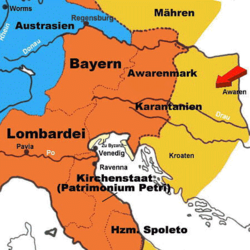
Southeastern Frankish territories, including the Avar March, at the beginning of the 9th century
  Frankish Austrasia in 774
  Territories incorporated by 800
  Dependent territories

The Avar March (Latin: Provincia Avarorum; German: Awarenmark) was a southeastern frontier province of the Frankish Empire, established after successful Frankish campaigns and conquests of Avarian territories along the river Danube, to the east from the river Enns, in what is today Lower Austria and northwestern Hungary. Since the Frankish conquest in the late 8th century, there were several administrative changes in those regions. Territory along the river Danube, from the river Enns to the Vienna Woods, was ruled directly, as a frontier extension (march) of the Frankish Bavaria, while regions further to the east, up to the river Rába, were initially designated to remaining Avarian princes, under the Frankish supreme rule. During the 820s and 830s, additional administrative changes were made in the wider region of Frankish Pannonia, inhabited mainly by Pannonian Slavs. Territories of the remaining Avarian princes were fully incorporated, and Avars eventually disappeared from the region.[1][2][3][4]

Later during the 9th century, the region was contested between Eastern Frankish Kingdom and Great Moravia, while at the very beginning of the 10th century it was invaded and conquered by the Magyars. After the Battle of Lechfeld (955), territories along the river Danube, from the river Enns to the Vienna Woods, were reconquered by Germans, and new march was established (c. 972) thus creating the nucleus of the Margraviate of Austria.[5][6]

History

[edit]
Settlement area of Avars in the Pannonian basin, from the 7th to the 9th century

During the 8th century, Avarian rule in the regions along the river Danube stretched towards the west up to the river Enns, bordering Bavaria. In 788, Franks had established direct rule over Bavaria, and also strengthened their influence over the vassal Carantania, thus provoking neighbouring Avars. During the same year, Avars made an incursion into Bavaria, but Franko-Bavarian forces succeeded in repelling them, and then launched a counterattack towards neighbouring Avarian territories, situated along Danube, eastern from Enns. Two sides clashed near the river Ybbs, on the Ybbs Field (German: Ybbsfeld), where Avars suffered a major defeat (788).[7][8][9]

Frankish offensives

[edit]

In order to secure eastern borders, Charlemagne came to Bavaria in person, during the autumn of the same year (788). He held a council in Regensburg and regulated several issues regarding Bavarian frontier regions (marches),[10][11] thus preparing the basis for future actions towards the east. In 790, Avars tried to negotiate a peace settlement with Franks, but no agreement was reached.[12]

In 791, large Frankish army, led by Charlemagne, crossed from Bavaria in to the Avarian territory beyond the river Enns. Frankish army was advancing along the river Danube, divided in two columns, but neither of them found any active resistance, and soon both reached the region of Vienna Woods, at the gates of the Pannonian Plain. No decisive battles were fought, since Avars had retreated deeper into Pannonia, allowing Franks to advance up to the river Rába.[13][14]

In 796, Frankish forces under Charlemagne's son, king Pepin of Italy (d. 810) and local commanders Eric of Friuli and Voynomir the Slav launched major offensive against Avars in Pannonia.[15] Frankish army allied with local Pannonian Slavs, reached the river Drava, crossed the river Danube to the east and destroyed the main Avarian fortress called the Ring of the Avars. Avarian might was decisively crushed and their khagan became a Frankish vassal, while the remaining Avars retreated behind the river Tisza. Those victories were perpetuated by the epic poem De Pippini regis Victoria Avarica. Frankish campaigns against Avars were also described in the Vita Karoli Magni.[16][17]

New frontier administration

[edit]

Successful Frankish conquests and acquisition of new territories, particularly those between the river Enns and the Vienna Woods, and further towards the river Rába, represented a significant gain for the security of the Frankish state, and particularly for Bavaria. At first, new territories in Upper Pannonia were placed under the jurisdiction of Bavarian prefect Gerold,[18] and subsequently organized as a frontier unit, that became known as the (Bavarian) Eastern March (Latin: marcha orientalis) or Avarian Province (Latin: Provincia Avarorum). It provided safety for Bavarian eastern borders, also securing main communication between Frankish Bavaria and Pannonia.[19]

In the same time, further to the south, neighbouring Carantania, Carniola and southeastern Pannonian regions (Lower Pannonia) were left under the jurisdiction of king Pepin of Italy. Those regions were governed as frontier territories and dependencies of the Carolingian Duchy of Friuli. Thus, at the beginning of the 9th century, Frankish possessions in Pannonia were governed from two centers: Frankish administration in Bavaria was in charge of the northwestern regions of Pannonia (Avarian March in Upper Pannonia), while Frankish administration in Italy was in charge of the southern and eastern regions (Lower Pannonia with Slavic dependencies).[20][21]

In 799, Bavarian prefect Gerold was killed fighting the Avars,[22] and by 803 situation in Pannonian regions demanded another Frankish intervention. Charlemagne came to Bavaria and dispatched an army to the east, headed by new Bavarian prefect Audulf and frontier count Werner, commander of the eastern march, whose seat was in Lorch (ancient Roman Lauriacum, on the confluence of Enns and Danube). The campaign was successful, and by the end of the same year several Avarian and Slavic lords from Pannonia came to Regensburg, to pay personal homage to Charlrmagne.[23]

During those years, territory along the river Danube, between Enns and Vienna Woods, was ruled directly, as a frontier extension (march) of the Frankish Bavaria, while regions further to the east, up to the river Rába, were designated to remaining Avarian princes, Theodor (d. 805) and Abraham. Avarian princes converted to Christianity and continued to govern their people under the Frankish supreme rule, in the regions of Upper Pannonia, between Carnuntum and Savaria (modern Szombathely, in Hungary).[24][20]

In 811, another Frankish expedition was sent to the east, this time in order to settle ongoing disputes between Avars and Slavs in Danubian regions of Pannonia. In the autumn of the same year, several Avarian and Slavic lords came to Aachen, in order to resolve mutual disputes in front of the Charlrmagne, thus reaffirming their submission to the supreme Frankish rule.[25][26] In 822, remaining Avars from Pannonia reaffirmed their allegiance to the Frankish rule.[27]

Administrative changes

[edit]
Realm (green) of king Louis of Bavaria, that included (since 828) all southeastern frontier regions

In 817, new emperor Louis I (d. 840) decided to regulate (in advance) various issues related to succession, including the question of governance over dependent peoples on Frankish eastern frontiers. Announcing the future division of Frankish provinces among his three sons, the emperor decided to bestow his young son Louis (d. 876) with prospect of Bavaria, including the rule over dependent Avars and Slavs (Bohemians and Carantanians).[28]

Since prince Louis was still underage, those provisions were not put into immediate effect, but they heralded an important change: since the time of late king Pepin (d. 810), dependent Slavic regions in Carantania, Carniola and southern Pannonia were not governed from Frankish Bavaria, but from Frankish Italy, as territories dependent to the Carolingian Duchy of Friuli. When prince Louis finally became of age in 825–826,[29] those regions were still under administration of his older brother Lothar I (d. 855), ruler of Italy, and his frontier commander, duke Baldric of Friuli.[30][31]

Upon receiving Bavarian royal crown in 826, young king Louis also wanted to take charge (as soon as possible) of all other regions that were promised to him in 817. Very soon, he got the chance to achieve that goal, and concentrate in his hands governance over Bavaria and Carantania, including all eastern and southeastern marches and dependent Avarian and Slavic territories.[32]

In 826, emperor Louis sent Bertrich, count of the palace, to inspect southeastern frontier regions, regarding the possible Bulgarian threat.[33] Neglected by the emperor, those threats turned out to be real and already by 827–828, king Lothar of Italy and duke Baldric of Friuli failed to secure southeastern frontiers from Bulgarian intrusions.[34] Because of that, emperor Louis decided to divide the vast Duchy of Friuli into four counties,[35][36] consequently placing Carantania and adjacent regions under the charge of Louis of Bavaria (828).[37][38] At that point, king Louis of Bavaria became direct ruler of entire Frankish southeast, that included Bavaria and Carantania with all eastern marches and dependent Avarian and Slavic regions throughout Pannonia.[39][40]

The aftermath

[edit]

Unified under Louis of Bavaria (828), entire Frankish southeast became linked to the emerging Eastern Frankish Kingdom, and was subsequently reorganized as the March of Pannonia. During the 830s and 840s, further administrative changes were made in the wider region of Frankish Pannonia, that was by then inhabited mainly by Slavs. By that time, territories of the remaining Avarian princes were fully incorporated into regular administrative structure,[41] and Avars eventually disappeared from the region. Avarian designation for the march also disappeared, and by the 850s, the entire region to the east from Bavaria was already known as the Bavarian wasteland.[42]

In the aftermath, within the further internal subdivisions of the Frankish Empire, Bavaria and southeastern frontier regions remained linked to the Eastern Frankish Kingdom. By the middle of the 9th century, Frankish rule in the region was contested by the Slavic princes of Great Moravia. At the very beginning of the 10th century, the region was invaded and conquered by the Magyars. After the Battle of Lechfeld (955), territories along the river Danube, from the river Enns to the Vienna Woods, were reconquered by Germans, and new Bavarian Eastern March (Latin: marcha orientalis) was established (c. 972) thus creating the nucleus of the Margraviate of Austria.[43][44]

See also

[edit]

Citations

[edit]
  1. ^ Bowlus 1995.
  2. ^ Schutz 2004.
  3. ^ Pohl 2018.
  4. ^ Nelson 2019.
  5. ^ Pohl 1995.
  6. ^ Goldberg 2006.
  7. ^ Scholz 1970, p. 66-67.
  8. ^ Bowlus 1995, pp. 47, 80.
  9. ^ Pohl 2018, pp. 378–379.
  10. ^ Scholz 1970, p. 68.
  11. ^ Nelson 2019, pp. 14, 257.
  12. ^ Pohl 2018, pp. 379.
  13. ^ Scholz 1970, p. 69-70.
  14. ^ Schutz 2004, p. 61.
  15. ^ Scholz 1970, p. 74-75.
  16. ^ Bowlus 1995, pp. 55–57.
  17. ^ Schutz 2004, p. 61–62.
  18. ^ Bowlus 1995, pp. 74, 86.
  19. ^ Bowlus 1995, pp. 24, 45, 85, 101.
  20. ^ a b Hosszú 2013, pp. 58.
  21. ^ Szőke 2014, pp. 10.
  22. ^ Scholz 1970, p. 78.
  23. ^ Bowlus 1995, pp. 57, 60.
  24. ^ Bowlus 1995, pp. 57–58, 74, 86.
  25. ^ Scholz 1970, p. 94.
  26. ^ Bowlus 1995, pp. 60.
  27. ^ Scholz 1970, p. 112.
  28. ^ Goldberg 2006, p. 29–31.
  29. ^ Goldberg 2006, p. 47.
  30. ^ Bowlus 1995, pp. 55.
  31. ^ Goldberg 2006, p. 48–49.
  32. ^ Bowlus 1995, pp. 90.
  33. ^ Scholz 1970, p. 119.
  34. ^ Bowlus 1995, pp. 91, 95, 128.
  35. ^ Pertz 1845, p. 98.
  36. ^ Scholz 1970, p. 122.
  37. ^ Bowlus 1995, pp. 97, 100.
  38. ^ Goldberg 2006, p. 49.
  39. ^ Bowlus 1995, pp. 20.
  40. ^ Goldberg 2006, p. 49–50.
  41. ^ Pohl 2018, pp. 389.
  42. ^ Goldberg 2006, p. 266.
  43. ^ Pohl 1995, pp. 64.
  44. ^ Goldberg 2006, p. 176.

References

[edit]
Revisions and contributorsEdit on WikipediaRead on Wikipedia
from Grokipedia
The Avar March (German: Awarenmark) was a southeastern frontier district of the , established after 's forces dismantled the Avar Khaganate through campaigns in 795–796 that captured the Avars' central stronghold known as the Ring and seized vast treasures. This conquest ended Avar dominance in the , where the nomadic confederation had controlled territories since the 6th century, allowing the to impose direct administration over former Avar lands east of . The march functioned as a defensive buffer zone along the Danube, stretching from the Enns River eastward into regions of modern Austria, Hungary, and adjacent areas, with margraves appointed to govern and fortify the frontier against residual nomadic threats. Key to its formation was the redirection of Avar wealth to Frankish coffers, which bolstered Carolingian resources, while the territory's incorporation facilitated Slavic settlements and missionary efforts under Frankish oversight. Over time, the Avar March evolved, with portions reorganized into subordinate districts like the around 840 under to counter Bulgarian incursions, reflecting the dynamic nature of Carolingian border management amid shifting alliances and invasions. Its establishment underscored the causal link between military subjugation and imperial consolidation, prioritizing empirical control over vast steppelands previously held by decentralized khaganates.

Etymology and Terminology

Origins of the Name

The designation "Avar March" derives from the medieval Latin Marchia Avarorum, literally translating to "the march (or borderland) of the Avars," reflecting both the defeated inhabitants and the region's role as a defensive frontier of the . The term marchia evolved from the Frankish marka, a Proto-Germanic word (*markō) denoting a boundary or delimited territory, often militarized for defense against external threats; this usage became standardized in Carolingian administration during the 8th and 9th centuries to organize peripheral provinces like those along the and rivers. The "Avarorum" element specifically alludes to the , a nomadic confederation of Turkic, Iranian, and other ethnic elements that had controlled the Carpathian Basin (referred to in contemporary sources as Avaria) since their migration from the Pontic-Caspian around 558 CE. Frankish chroniclers, including those compiling the Annales Regni Francorum, applied this name post- to signify Frankish dominion over former Avar lands, emphasizing the transition from khaganate to after Charlemagne's campaigns of 791–796 CE, which captured the Avar ring-fortresses (hrings) and treasury. The nomenclature underscored causal realities of : the Avars' assimilation or subjugation rendered their territory a Frankish against eastern nomads like the . In vernacular evolution, the German Awarenmark retained the compound structure, with Mark to marchia and Awar adapting the Latinized Avarus from Byzantine Greek Abaroi, itself likely derived from a Turkic or Iranian root connoting "wanderer" or "" among steppe peoples. This naming convention paralleled other Carolingian marches, such as the Marca Hispanica or Saxon March, prioritizing functional geography over ethnic persistence, as surviving Avars were integrated as subjects rather than autonomous entities by the early . Primary Frankish sources like capitularies from the period confirm administrative references to Avar territories without implying enduring Avar political identity.

Historical Designations

The Avar March was designated in Carolingian Latin sources primarily as Provincia Avarorum, denoting the province or administrative territory of the Avars, a term reflecting its establishment as a district following the Frankish of Avar holdings between 791 and 803. This nomenclature appears in diplomatic documents, such as those issued by in 830, confirming ecclesiastical possessions within the region. The designation emphasized the ethnic and territorial legacy of the defeated Avars, positioning the march as a successor entity to their khaganate rather than a novel Frankish creation. Alternative Latin terms included Avaria and terra Avarorum, used interchangeably to describe the core Avar-inhabited lands incorporated into the Frankish Empire, often in annals and charters highlighting missionary and settlement activities. Due to medieval associations linking the Avars with Hunnic predecessors, some contemporary references employed Hunia, regnum Hunorum, or simply Hunni to evoke the region's nomadic heritage and justify Carolingian expansion as a continuation of Roman-era subjugation of steppe peoples. In later medieval German-language and administrative records, the march was termed Awarenmark, a direct underscoring its role as an eastern border mark (Mark) against residual nomadic threats, with the Avar element (Awaren) persisting into Ostfränkisch (East Frankish) documentation even as Slavic populations dominated demographically by the 9th century. These designations evolved with administrative shifts; post-843 divisions, eastern portions retained Avar-derived names in Bavarian contexts, while oriens or plaga orientalis occasionally denoted its frontier status relative to the imperial core. The persistence of such terms in primary sources like the underscores their utility in Carolingian governance, prioritizing ethnic markers for legitimacy over geographic precision.

Geographical Context

Location and Physical Features

The Avar March occupied a strategic position as the southeastern frontier of the Carolingian Empire, directly adjoining the Duchy of Bavaria and extending eastward into former Avar territories. It was centered along the Danube River, commencing at the Enns River in modern-day Upper Austria and reaching toward the Vienna Woods near present-day Vienna. This core area, often referred to as Avaria, formed an extension of Bavarian administration, while southern extensions included Carantania down to the Drava River and parts of Lower and Upper Pannonia up to the Raab River. The march's terrain was predominantly characterized by the low-lying, fertile plains of the , a vast sedimentary depression spanning approximately 250,000 square kilometers and bounded by the , , and . These alluvial plains, with elevations generally below 200 meters, supported intensive and pastoral activities, contributing to the region's economic viability and military defensibility through open landscapes suitable for mounted forces. The served as the principal fluvial feature, providing a navigable corridor for trade and troop movements, flanked by levees and floodplains that influenced settlement patterns. Peripheral zones featured more varied topography, including the undulating hills of the Vienna Basin and denser woodlands in areas like the , which offered natural barriers and resources for fortification. The and rivers marked southern hydrological boundaries, draining into the and creating marshy lowlands that posed logistical challenges but also defensive moats against incursions. Overall, the combination of expansive steppes, riverine corridors, and encircling highlands underscored the march's role as a , leveraging geographical features for and rapid response.

Extent and Boundaries

The Avar March was delineated to the west by the Enns River, which marked the frontier with the Duchy of Bavaria following the Frankish subjugation of Avar territories in 791–796. This boundary, previously the limes between Bavarian lands and the Avar Khaganate, was reinforced as a defensive line under Carolingian control. Eastward, the march incorporated the Danube valley regions of eastern Bavaria's extension, reaching into the Pannonian plains of modern eastern Austria and western Hungary. Northern extents aligned closely with the upper Danube's course, encompassing the Vienna Basin and adjacent wooded areas up to the , where direct Frankish oversight transitioned into tributary oversight of Slavic settlements. Southern boundaries adjoined the March of , roughly along the line of the River and extending influence over Lower , though effective control waned toward the River amid Slavic polities. The eastern limits were fluid, penetrating the former Avar core areas including ringfort systems in the , but administrative reach diminished beyond the Rába River, relying on local counts and alliances rather than permanent garrisons. This configuration prioritized strategic depth for defense against residual Avar resistance and emerging threats from Moravian , with the core administered as Avaria by 811, integrating Pannonian under Frankish margraves. The march's irregular eastern and southern perimeters reflected the nomadic legacy of Avar domains, lacking natural barriers and necessitating fortified outposts along riverine corridors.

Pre-Conquest Background

The Avar Khaganate

The Avar Khaganate emerged in the mid-6th century as a nomadic confederation led by elites of East Asian genetic origin who migrated rapidly across , arriving in the vicinity of the by around 558 CE. These Avars, possibly remnants of the or related Turkic-Mongolic groups, sought alliance with the against common foes like the and , receiving subsidies and permission to settle in the Carpathian Basin after defeating the in 567 CE. Under (r. circa 562–602 CE), the khaganate consolidated control over the , encompassing modern-day , eastern , and parts of the , extending influence along the to the Adriatic and coasts. The political structure featured a dual kingship with a sacred and a ruling (jawed) , supported by a warrior aristocracy marked by distinctive cranial deformations and horse-archer tactics, as evidenced by over 60,000 excavated graves revealing elite burials with weapons, horses, and gold rings used as currency and status symbols. Society integrated subjugated Slavic tribes for and labor, with Avars maintaining a nomadic core while fostering semi-sedentary settlements; archaeological finds indicate iron and Byzantine-influenced , reflecting flows and diplomatic exchanges. innovations, including widespread use, enhanced effectiveness, enabling raids and sieges that pressured neighbors. Relations with oscillated between alliance and conflict, marked by subsidies in the 570s CE, wars from 568–626 CE culminating in the failed siege of in 626 CE alongside , and subsequent demands that strained Byzantine resources until internal Avar strife post-626 weakened their position. Interactions with were initially limited to border raids, but by the late , civil wars and Bulgarian incursions under Khan Krum fragmented the khaganate, exposing its "ring" (central treasury) to Frankish exploitation. Kinship networks, revealed through genetic analysis of large pedigrees, underscore patrilineal elite continuity and practices that sustained cohesion amid expansion, though over-reliance on and failure to adapt to sedentary pressures contributed to vulnerabilities exploited by Charlemagne's campaigns starting in 791 CE.

Relations with Neighbors

The Avars established their khaganate in the following an alliance with the , who together defeated the in 567 CE, enabling the Avars to occupy former Gepid territories while the migrated into . This victory consolidated Avar control over the region, incorporating remnants of Gepidic society into their domain, though the Gepids as a cohesive ceased to exist thereafter. Relations with the Byzantine Empire began diplomatically in 557 CE, when an Avar embassy sought subsidies to counter steppe threats, leading to Byzantine support for Avar settlement against the Lombards and Gepids. However, by the 570s, the Avars shifted to predatory raids on Balkan provinces, extracting tribute and captives, though a brief military cooperation occurred in 578 CE against Slavic incursions. Tensions peaked with the failed Avar siege of Constantinople in 626 CE, after which diplomatic contacts diminished sharply until the 8th century, confining Avars north of the Danube amid Byzantine consolidation. The Avars exerted dominance over neighboring Slavic tribes, compelling them to provide tribute, labor, and military auxiliaries for joint raids, such as the 586 CE assault on Thessalonica. Under by circa 580 CE, this subjugation extended across and adjacent areas, integrating into the khaganate's periphery while maintaining ethnic separation except through intermarriage. Slavic discontent erupted in a major around 623 CE, led by the Frankish merchant , who forged a tribal union defeating Avar forces and establishing an independent Slavic polity lasting until Samo's death in 658 CE, after which Avars partially reimposed control. Contacts with the remained limited before 791 CE, despite shared borders along the ; early skirmishes occurred in the 560s CE, but no sustained diplomacy or major campaigns ensued, as the Avars prioritized eastern and southern frontiers. This relative stability persisted, with the khaganate acting as a buffer separating Frankish expansions from emerging Bulgar powers to the southeast.

Frankish Conquest

Campaigns of 791–796

In 791, assembled a large army at and launched an invasion of Avar territories along the from the west, coordinating with his son Pepin, , who advanced from in the southeast. The Frankish forces devastated numerous Avar settlements and border fortresses, capturing prisoners and livestock, but encountered scorched-earth tactics by the Avars, who retreated into their central stronghold known as the Ring—a complex of concentric earthen fortifications housing the khagan's and warriors. Supply shortages and harsh weather forced 's withdrawal without breaching the Ring, though the campaign weakened outer Avar defenses and triggered internal divisions within the khaganate between rival factions. The following year, in 792, Frankish commanders conducted follow-up operations against residual Avar resistance in the border regions, consolidating gains from the initial incursion and suppressing raids, but these efforts remained peripheral to the khaganate's core. By 795, exploiting the Avars' civil strife—pitting the khagan against a western tudun (subordinate ruler)—Duke Eric of Friuli, governing from Friuli, dispatched a Lombard-Slav force under the Slavic chieftain Woynimir to strike the heartland. This raid successfully stormed and razed the Ring, yielding an immense hoard of accumulated plunder from centuries of conquests, transported to Charlemagne at Aachen in approximately twenty wagons loaded with gold, silver, and jewels. In 796, Pepin renewed the offensive, advancing deep into Avar lands along the Theiss River with combined Frankish, Lombard, and allied contingents, defeating the remnants of Avar military power and prompting the khagan's unconditional submission without . Avar envoys arrived at 's court bearing gifts and hostages, including the khagan's son, marking the effective dissolution of centralized Avar authority and the khaganate's integration into Frankish spheres. These campaigns, spanning six years, relied on superior Frankish , exploitation of Avar disunity, and multi-front pressure rather than decisive field engagements, ultimately dismantling a that had dominated the for over two centuries.

Key Figures and Strategies

, as king of the , directed the overall strategy and personally led the initial major campaign against the Avars in 791, dividing his forces into three coordinated armies advancing from along the , from the southern reaches of the river, and from the northern bank to breach Avar defensive lines. His son Pepin, , played a pivotal role in subsequent operations, leading Frankish and Lombard troops in 795–796 to ravage , capture the Avar capital (the "Ring" fortress), demolish the khagan's palace, and seize immense treasures, which forced the Avars' submission and near-destruction as a military power. , of , supported these efforts by invading from the valley and along the , capturing the Ring in 794 and aiding in the systematic dismantling of Avar strongholds. Frankish strategies emphasized multi-pronged pincers to overwhelm Avar mobility and fortified positions, deploying fast-moving strike forces () with to exploit internal Avar divisions following their khaganate's civil strife, while incorporating Saxon and Lombard contingents for manpower. Logistical innovation included riverine supply via boats on the and construction of pontoon bridges to sustain advances deep into hostile terrain, mitigating the impact of prior setbacks like the 791 equine epidemic that halted Charlemagne's first push after partial successes against border forts. These tactics culminated in the 796 sack of the central Ring, yielding vast spoils transported to , and enabled the appointment of figures like the Alamannian count Gerold of Vinzgau as military prefect of the nascent Avar March to consolidate control. The approach prioritized decisive destruction of the Avars' symbolic and economic core—their ring forts and treasury—over prolonged occupation, leveraging alliances with Slavic tributaries and Bulgarian pressures to fragment Avar resistance without direct field battles, as the Avars favored raiding from entrenchments rather than open confrontation. This causal focus on severing the khagan's authority, evidenced by the 795 defection of sub-khagan Tudun, ensured rapid collapse and facilitated Frankish frontier stabilization by 803, when surviving Avars accepted and vassalage.

Establishment of the March

Initial Frontier Organization

Following the Avar khagan's submission to Charlemagne in 796, the conquered territories were swiftly incorporated into the Carolingian Empire as the Avar March, a southeastern frontier province designed to buffer against eastern threats and facilitate control over the Pannonian Basin. Gerold of Vinzgouw, already serving as prefect of Bavaria, was appointed margrave of the Avar March, extending his authority over the newly subdued lands east of the Enns River and into former Avar heartlands. This appointment centralized military and administrative command under a trusted Frankish noble, enabling rapid stabilization through Bavarian administrative models adapted for frontier conditions. The march was subdivided into counties governed by counts, primarily or , who enforced royal capitularies, collected tribute from surviving Avar and Slavic populations, and mobilized local forces for defense. A convened in during the summer of 796 promoted Christian conversion among Avars and , integrating ecclesiastical structures into the secular framework to foster loyalty and . Fortifications and garrisons were established at strategic points, such as along the , to secure trade routes and deter incursions from or independent Slavic groups, while co-opted Avar elites retained lands in exchange for . Gerold's tenure emphasized consolidation through limited campaigns, including operations in against residual resistance, during which he perished on the eve of battle. This initial organization prioritized military readiness, with margravial authority encompassing judicial, fiscal, and defensive duties, supported by units and levies from settled populations. The structure reflected broader Carolingian frontier strategy: delegating broad powers to margraves while maintaining royal oversight via missi dominici, ensuring the march served as both a defensive bulwark and a source of manpower and resources.

Military and Defensive Structures

Following the conquest of the Avar Khaganate, the systematically dismantled key Avar fortifications, including the central "Ring of the Avars" destroyed by in 796, which had served as the khagan's fortified residence and treasury. This destruction, involving multiple campaigns from 791 to 796, targeted Avar strongholds along the to neutralize internal resistance and secure supply lines, with Frankish forces capturing and plundering sites like the uualum fort near the Italian frontier on August 23, 791. Rather than extensively reusing Avar structures, which were viewed as alien to Carolingian norms—such as the exaggeratedly described massive walls of the Avar Ring in contemporary accounts—the prioritized establishing their own frontier defenses. The core of the Avar March's defensive system comprised a decentralized network of forts and border posts under margraves, leveraging the Danube for naval support and rapid troop movements. Key installations included Mosaburg (modern Zalavár), constructed around 800–802 near Lake Balaton as a fortified settlement in swampy terrain, built by free peasant labor to house garrisons and administer Slavic and Avar subjects. Lorch (ancient Lauriacum) functioned as a primary border fortress east of the Enns River, reinforced as a logistical hub and arms control point, with a 805 capitulary prohibiting weapon exports beyond it to prevent arming potential foes. Ennsburg, located at the Enns River crossing, marked the western boundary and served as a defensive outpost against eastern incursions. Military organization emphasized mobility over static lines, with margraves like those in coordinating local levies, , and for campaigns, as seen in responses to Slavic revolts under Ljudovit (819–823), where multiple armies and fortified bases repelled invaders. No comprehensive linear barrier existed; instead, defenses relied on these dispersed strongholds, alliances with submitted Avar and Slavic leaders, and expeditionary forces to project power into the open post-conquest zone, maintaining Frankish amid threats from Moravians and . This approach reflected Carolingian frontier practices, associating fortifications with peripheral territories rather than core imperial lands.

Administration and Governance

Margraves and Local Rule

Gerold, an Alamannian noble and Prefect of , was appointed of the Avar March by circa 798, tasked with military oversight, tribute extraction from subdued Avars, and initial administrative consolidation of the frontier east of . His role encompassed coordinating defenses along the , suppressing residual Avar resistance, and facilitating missionary activities led by Bavarian clergy from and to Christianize local populations. Gerold's sudden death on September 1, 799, during operations against Slavic insurgents, prompted a swift reorganization under , separating the march's border administration from Bavaria's internal governance. Audulf succeeded as from 799 to 818, maintaining Frankish authority amid ongoing threats from Slavic groups in , while the was subdivided into governed by loyal counts responsible for local , taxation via the hide , and muster of levies for campaigns. Local rule blended Frankish oversight with pragmatic incorporation of Slavic elites; for instance, the chieftain , displaced from , submitted to Carolingian rule in the 830s and received a near around 846, where he established the fortified settlement of Mosaburg under Count Ratbod's supervision, exemplifying delegated authority to converted allies for stabilizing peripheral areas. This approach extended to other like Priwilzlauga and Cemicas, who served as ducal underlings until at least 828, aiding in collection and patrols. Challenges to centralized control persisted, as evidenced by the rebellion of Duke Ljudovit of Lower from 818 to 823, who exploited ethnic tensions and Avar remnants to challenge margraviate authority before his execution. Margraves like Ratpot, of the east circa 830, enforced Carolingian capitularies through royal missi dominici, emphasizing fortifications, infantry-based defenses, and naval elements on the to deter incursions, while promoting Germanization via Bavarian settler counts. By the mid-9th century, figures such as Wilhelm and Engelschalk managed segments, reflecting a shift toward more fragmented but resilient local governance under , with ecclesiastical lords from bolstering administrative reach through land grants and conversions.

Administrative Reforms in the 9th Century

In the early , under Emperor (r. 814–840), the Avar March, also known as the Ostmark, underwent initial refinements to its administrative framework, building on Charlemagne's march system by subdividing frontier territories into counties (comitatus) for enhanced local control, taxation, and military mobilization. Counts were appointed to oversee these units, reporting to margraves who coordinated defense against residual Avar unrest and Slavic groups, with royal missi dominici dispatched periodically to enforce imperial edicts and judicial standards. A pivotal reform occurred around 830 when appointed Ratpot as () over eastern , granting him authority to integrate displaced Slavic leaders and stabilize the region amid internal Slavic conflicts, such as the expulsion of Prince Pribina from by . Pribina, a Nitran Slavic noble, fled to Ratpot's jurisdiction, receiving initial protection and lands, which marked an early experiment in delegating administrative duties to loyal non-Frankish elites to leverage local knowledge for governance and frontier security. Following the in 843, which allocated the eastern territories to (r. 843–876), further reorganization emphasized hybrid Frankish-Slavic rule in Lower . In 839, elevated to of the Balaton region, establishing the Principality of Lower as a semi-autonomous buffer entity centered at Mosaburg (modern Zalavár), where constructed a fortress, palace, and church to assert Carolingian authority and promote . This reform shifted from purely Frankish margravial oversight to vassal princely administration, enabling to recruit Slavic levies, administer justice, and collect renders while subordinating to the king, thereby addressing ethnic diversity and reducing direct imperial burdens in sparsely settled areas. Upper remained under Frankish margraves like Ratpot (until his rebellion in 854), with counties focused on and musters to counter Moravian incursions. Pribina's administration persisted until his death in 861 during a campaign against Mojmir's successors, after which his son Kocel briefly continued the model until 874, when direct royal intervention reasserted control amid growing instability. These changes, while pragmatic for short-term stability, highlighted tensions between centralized imperial oversight and decentralized local rule, contributing to administrative fragmentation by the late 9th century.

Society, Economy, and Population

Ethnic Composition and Assimilation

The Avar March, encompassing much of the former Pannonian Basin after the Frankish campaigns of 791–796, was predominantly populated by Slavic groups who had migrated into the region from the 6th century onward and formed the agricultural and demographic base under Avar rule. These Slavs, including tribes such as the Moravians and those in Lower Pannonia, constituted the majority, engaging in settled farming and village life, while the Avars had maintained a nomadic warrior elite overlay. Remnants of the Avar population persisted post-conquest, primarily as a small, decentralized aristocracy whose numbers had been reduced by warfare and internal collapse, with genetic evidence indicating their East Asian steppe origins distinct from the Slavic substrate. Frankish and Bavarian elements were introduced sparingly as military garrisons, margraves, and administrative personnel to secure the frontier, rather than through large-scale settler colonization; these Germanic groups focused on fortified outposts and oversight of local Slavic principalities, such as those led by figures like of , who submitted to Carolingian authority around 833. The overall remained low, estimated in the tens to hundreds of thousands across the March, sustained by Slavic agrarian communities rather than dense urban centers. Assimilation accelerated after 796, as the destruction of the Avar "ring" of fortified treasuries dismantled their khaganate's central authority, leading to the rapid disintegration of Avar ethnic identity through intermarriage with , adoption of sedentary lifestyles, and via Frankish missions from and . By the 820s, Avars had largely blended into the Slavic populace, ceasing to function as a cohesive group and contributing to a more homogeneous burial culture signaling cultural fusion among Avars, , and neighboring . Slavic communities, in turn, experienced partial integration into Carolingian structures through baptism campaigns—such as those under bishops like Reginhar of —and feudal ties, though they retained linguistic and customary under tributary princes; this process fostered inherited from Avar rule, with emerging Slavic elites aligning with Frankish overlords. Frankish influence waned eastward, limiting Germanic linguistic assimilation and preserving Slavic dominance in the core territories until the 9th-century incursions by Moravians and Magyars.

Economic Activities and Resources

The economy of the Avar March centered on , leveraging the fertile soils of the and Valley for grain cultivation, , and , which supported both local sustenance and through provisions supplied by free peasants. These agrarian activities were integral to frontier stability, as peasants also provided fodder for cavalry horses and contributed labor for fortifications and . Riverine trade along the supplemented agricultural output, with salt shipments via vessels forming a key commodity, regulated through Carolingian toll stations like Raffelstetten established by around 857 to collect duties on eastern commerce. Slavic groups from adjacent territories, such as or , participated by selling horses at frontier markets, while pre-conquest exchanges included arms trade between and Avars, transitioning post-796 to more structured exploitation under Frankish oversight. Settlements by Bavarian freemen in and facilitated resource extraction, including timber from surrounding forests and initial redistribution of Avar hoards—estimated at vast quantities of and silver seized in 795–796—which bolstered Carolingian fiscal capacity but gave way to sustained land-based production rather than . This agrarian-trade nexus underpinned the march's role as a , prioritizing self-sufficiency amid ongoing Slavic and Bulgar pressures.

Decline and Integration

Challenges and Uprisings

The primary internal challenge to Carolingian authority in the Avar March emerged with the revolt led by the Slavic leader Ljudovit, who served as of Lower , a core territory of the march. In 818, following grievances against the Bavarian Cadolah's harsh rule, Ljudovit assassinated him and incited a widespread uprising among Slavic populations in the region, which rapidly extended to the Timocian , , and even incursions into . Carolingian annals record that Ljudovit's forces achieved initial successes, including a defeat of local Frankish contingents, prompting Emperor to dispatch multiple expeditions from 819 onward, involving troops from , , and . The rebellion persisted through 822, requiring four major campaigns that devastated Slavic territories but failed to capture Ljudovit immediately; he fled to the Serbs before being killed by them in 823. These uprisings exposed vulnerabilities in the march's governance, including overreliance on local Slavic elites and inadequate integration of conquered populations, leading to temporary administrative disruptions and the need for reinforced fortifications along the and rivers. External pressures compounded these internal threats, particularly Bulgar incursions under Khan Omurtag beginning in 824, which targeted the weakened Pannonian frontier after failed diplomatic negotiations. Bulgar forces exploited riverine routes, raiding villas and settlements in the march during 827 and 829, burning key sites and prompting Carolingian counter-campaigns under . These invasions highlighted the march's exposed eastern flank, contributing to a broader reconfiguration of defenses, including the subdivision of counties and increased emphasis on naval patrols, though they did not result in permanent territorial losses at the time. Together, the Slavic revolts and Bulgar raids strained resources, fostering a cycle of retaliation that undermined long-term stability in the region.

Absorption into Broader Carolingian Territories

Following the decisive Frankish campaigns of 791–796 and the subsequent submission of Avar remnants, the territories of the Avar March transitioned from a contested frontier to integral components of the Carolingian administrative apparatus. The destruction of the Avar khaganate's central authority enabled the imposition of Frankish governance structures, including the appointment of margraves such as Eric of Friuli, who oversaw the region until his death in 799. This period marked the initial phase of stabilization, with surviving Avar elites compelled to accept baptism and fealty to Charlemagne, thereby dissolving independent Avar political entities. Under , administrative reforms further embedded the march within the empire's core territories. The region was subdivided into counties governed by counts loyal to the crown, supplemented by the activities of missi dominici who enforced imperial edicts and collected tribute. By 817, Avar leaders participated in Carolingian assemblies, reflecting their incorporation into the empire's feudal hierarchy. The diet of 822 represented a pivotal moment, as Avar delegates appeared alongside Frankish nobles, indicating the erosion of the march's distinct status and its alignment with broader provincial administration. Christianization efforts, led by missionaries from and , accelerated socio-economic integration, with the establishment of bishoprics facilitating local rule and . Archaeological evidence of continuous settlement and Carolingian-style fortifications underscores this shift, as the former Avar heartlands contributed taxes and levies to imperial campaigns. External threats from the , who seized southeastern portions around 804, preserved some military vigilance in the east but did not impede the internal absorption of core areas into Bavarian and Pannonian provinces. By the mid-9th century, the strategic integration of these territories was evident in the empire's expanded domain, as reflected in contemporary delineations of Carolingian extent. Genetic and material analyses confirm the blending of Avar, Slavic, and Frankish populations under unified governance, marking the definitive end of the as a semi-autonomous .

Significance and Scholarly Debates

Role in Carolingian Expansion

The Carolingian conquest of the Avar Khaganate from 791 to 796 marked a pivotal phase in the empire's eastern expansion, incorporating the and adjacent territories into Frankish control. 's campaigns, initiated in response to Avar raids on Bavarian and Italian frontiers, culminated in the decisive strikes of 795 and 796, where Frankish forces under captured the Avars' central stronghold known as the "Ring," symbolizing the collapse of their political structure. This victory added vast steppe lands—encompassing modern and parts of , , and —to the empire, extending its reach along the River and eliminating a longstanding nomadic threat that had disrupted Frankish borders since the . The establishment of the as a southeastern transformed these conquered territories into a militarized , administered by appointed margraves responsible for defense, tribute collection, and pacification of residual Avar and Slavic populations. This organizational structure, blending Frankish oversight with local Bavarian and Lombard elements, secured the empire's flanks against potential incursions from or eastern nomads while serving as a staging ground for subsequent operations. By stabilizing the Middle region through fortification and settlement policies, the march enabled Carolingian forces to conduct raids and alliances with Slavic groups, such as the Timociani and Abodriti, thereby extending influence toward the Carpathians and facilitating the integration of peripheral ethnicities via efforts and conditional . Strategically, the Avar March linked the Italian and Bavarian duchies, enhancing internal cohesion and logistical routes for overland military movements, which indirectly supported broader imperial ambitions. The immense Avar treasures seized—estimated to include hundreds of cartloads of gold and silver—bolstered Carolingian finances, funding administrative expansions and campaigns elsewhere, though primary motivations stemmed from geo-political imperatives to protect Italian gains rather than mere plunder. Under successors like , the march's framework evolved into sub-divisions like the Pannonian and Lower Pannonian Marches, which defended against Moravian pressures and laid groundwork for the later East March (Ostmark), underscoring its enduring role in anchoring Frankish eastward momentum until the empire's fragmentation in the late .

Archaeological Evidence and Interpretations

Excavations at Mosaburg (modern Zalavár, ), the principal Carolingian fortress established around 800 CE in the heart of the Avar March, have uncovered extensive fortifications, including stone walls, towers, and a palace complex, alongside multiple churches indicating ecclesiastical integration. Geophysical surveys and digs since the 1950s reveal a planned urban layout with artisan workshops and administrative buildings, reflecting Frankish imposition of centralized control over subdued Avar territories without evidence of prior destruction layers at the site. Archaeological surveys in the broader March region, spanning eastern and western , document Avar-period settlements characterized by sunken-floor dwellings, post-built structures, and cemeteries with horse burials and steppe-style artifacts like ornate belt fittings and sabers, continuing into the early . Sites such as Podersdorf am See in , , yield 7th-8th century Avar graves with exceptional wooden chamber tombs, while recent finds near Ebes and in include complete lamellar armor sets and rare sabers, underscoring elite warrior continuity amid Carolingian oversight. Interpretations of this evidence emphasize limited archaeological traces of violent conquest, with few burn layers or mass graves supporting textual accounts of Avar submission rather than extermination; instead, hybrid material culture emerges, blending Avar nomadic elements with Frankish and , suggesting assimilation of local populations into Carolingian structures. Genetic analyses from Carpathian Basin cemeteries indicate persistence of Avar lineages post-811 CE, with gradual admixture from Frankish and Slavic groups, challenging narratives of total demographic replacement. Scholarly persists on the scale of Avar depopulation, as the scarcity of fortified Avar ringforts in the March contrasts with denser pre-conquest settlements further east, implying strategic Frankish focus on key nodes like Mosaburg for control rather than wholesale territorial overhaul.

Debates on Conquest Extent and Avar Fate

Historians debate the precise geographical extent of Carolingian over Avar territories following Charlemagne's campaigns from 791 to 796, with the Royal Frankish Annals recording the capture of the Avar "ring" (hring)—a fortified central symbolizing khaganate power—in 795 or 796, which facilitated the submission of remaining Avar leaders. Some scholars argue that Frankish control was limited to western , establishing the Avar March as a rather than fully integrating the eastern regions, as evidenced by slower and persistent local compared to conquests in . Archaeological findings indicate demographic disruptions but continuity of settlement patterns in peripheral areas, suggesting nominal overlordship rather than total subjugation, with Frankish garrisons focused on key routes rather than comprehensive occupation. The final pacification in 803, when Avar khagan Abraham submitted and transferred lands to , marked the nominal end of resistance, yet debates persist on whether this encompassed the entire former khaganate or merely its core, as emerging Slavic principalities like the Moravians soon contested Carolingian fringes by the 820s. Proponents of broader conquest cite the influx of Avar treasure to and missionary activities by figures like Archbishop Theotmar, implying effective dominance over , while critics highlight the absence of sustained Frankish administrative structures beyond the , pointing to reliance on local Slavic allies for control. Regarding the fate of the Avars, early medieval sources portray a dramatic collapse, with chroniclers like implying near-total destruction through warfare and internal strife, but modern scholarship, particularly Walter Pohl, rejects notions of mass extermination or wholesale migration, arguing instead for rapid dissolution of Avar ethnic identity due to the breakdown of their nomadic structure post-800. Pohl posits that while elite power centers were dismantled, Avar populations likely assimilated into surrounding Slavic, Frankish, and Bulgar groups, as the Avar name vanishes from records within a generation, not from physical eradication but from the loss of political cohesion that defined identities. Archaeological and genetic evidence supports assimilation over annihilation: show hybrid Avar-Carolingian by the early 9th century, and from Lower Austrian sites reveals genetic continuity with admixtures indicating cultural integration despite Eastern Asian origins for elites. Remnants persisted as tributaries or converts, with some khagans like Theodorus seeking Frankish aid in 805, but by the 820s, Avar political agency had evaporated, absorbed into the Carolingian periphery amid Slavic demographic shifts. This view contrasts with outdated narratives of total disappearance, emphasizing instead adaptive survival through in multi-ethnic frontier zones.

References

Add your contribution
Related Hubs
User Avatar
No comments yet.