Hubbry Logo
AIM-47 FalconAIM-47 FalconMain
Open search
AIM-47 Falcon
Community hub
AIM-47 Falcon
logo
8 pages, 0 posts
0 subscribers
Be the first to start a discussion here.
AIM-47 Falcon
AIM-47 Falcon
from Wikipedia

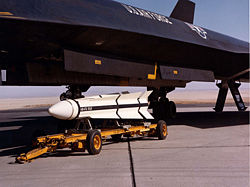
The Hughes AIM-47 Falcon, originally GAR-9, was a very long-range high-performance air-to-air missile that shared the basic design of the earlier AIM-4 Falcon. It was developed in 1958 along with the new Hughes AN/ASG-18 radar fire-control system intended to arm the Mach 3 XF-108 Rapier interceptor aircraft and, after that jet's cancellation, the YF-12A (whose production was itself cancelled after only 3 vehicles). It was never used operationally, but was a direct predecessor of the AIM-54 Phoenix used on the Grumman F-14 Tomcat.

Key Information

Development

[edit]

Development for XF-108

[edit]

In the early 1950s, the United States Air Force developed requirements for a high speed, high performance interceptor aircraft, originally called the LRI-X. In 1957, Hughes won the contract to supply the weapons system for this aircraft. This system consisted of the GAR-X missile and the YX-1 radar and fire control system. The original missile design had a range of 15 to 25 miles (24 to 40 km), and could be equipped with a conventional warhead or a 0.25 kiloton version of the W42 nuclear warhead. When the North American XF-108 Rapier was announced as the winner of the LRI-X contest in April 1958, the Hughes entries were redesignated GAR-9 and AN/ASG-18 on the same day. The F-108 was canceled in September 1959, but the Air Force decided to continue development of the missile system with both warheads.[1]

During its development, the capabilities of the new missile grew tremendously. Growing much larger, the missile's range was extended to 100 miles (160 km), using the Aerojet-General XM59 solid-fuel motor. The SARH seeker was a powerful system of its own, with the resolution to be able to lock onto a 100-square-foot (9.3 m2) target at 63 nmi (117 km). Some consideration was given to the addition of a passive infrared homing seeker to improve terminal performance but that would have required the missile to grow by 180 lb (82 kg) and two inches in diameter, making it too large for the F-108's weapon bay. The W42 nuclear version was dropped in 1958 in favor of a 100-pound (45 kg) high-explosive design.[1]

Problems with the motor during development led to the brief consideration of using a storable liquid-fuel rocket design, but was replaced instead by the Lockheed XSR13-LP-1 solid rocket. This lowered the top speed from Mach 6 to Mach 4. In this form, the GAR-9 started ground firings in August 1961. For air-launch testing at supersonic speeds the Republic XF-103 had originally been proposed as a test platform, but this aircraft was canceled before reaching the prototype stage. Instead, B-58 Hustler s/n 55-665 was modified to house the AN/ASG-18 radar in a large protruding radome that gave it the nickname "Snoopy", and in-flight launches started in May 1962.

Development for YF-12

[edit]

In 1960 Lockheed started development of the Lockheed YF-12 interceptor, as a lower-cost replacement for the F-108. The GAR-9/ASG-18 were moved to this project. The F-12 would have featured four flip-open internal weapons bays on the chines behind the cockpit, one of these filled with electronics. The F-12B bays were too small for the GAR-9, so the GAR-9B was developed with flip-out fins to reduce its diameter. It weighed 805 pounds (365 kg).[2]

Test firings of the GAR-9A from the prototype F-12As resulted in six kills from seven launches, the lone miss due to a missile power failure (there were several non-guiding test launches as well). The missile was renamed AIM-47 in late 1962 as part of the transition to common naming for aerospace vehicles across the U.S. Department of Defense in 1962. The last launch was from a YF-12 flying at Mach 3.2 and an altitude of 74,400 feet (22,700 m) at a QB-47 target drone 500 feet (150 m) off the ground.[3]

In 1966, the F-12 project was canceled just as the F-108 had been. Another project which expressed an interest in the design was the XB-70 Valkyrie, a bomber which could have carried the AIM-47 for self-defense. This aircraft was also canceled after Soviet deployment of effective high-altitude surface-to-air missiles made high-altitude attacks on the Soviet Union impractical.

Hughes had built 80 pre-production AIM-47 missiles.

Legacy

[edit]

The AIM-47 was used as a base for the AIM-54 Phoenix (originally the AAM-N-11), intended for the General Dynamics F-111B. This project was also canceled in 1968, but the weapon system finally found a home on the F-14 Tomcat, entering service in the early 1970s.

In 1966, the basic airframe was adapted with the seeker from the AGM-45 Shrike and the 250 lb (110 kg) warhead from the Mk 81 bomb to create the high-speed AGM-76 Falcon anti-radar missile, although this did not see service.[4]

See also

[edit]

References

[edit]
[edit]
Revisions and contributorsEdit on WikipediaRead on Wikipedia
from Grokipedia
The AIM-47 Falcon, originally designated GAR-9, was a large, long-range air-to-air missile developed by Hughes Aircraft Company for the United States Air Force, featuring semi-active radar homing guidance and a maximum range exceeding 160 kilometers (100 nautical miles) at Mach 4 speeds. Initiated in 1957 as part of the USAF's Long Range Interceptor Experimental (LRI-X) program to arm the North American F-108 Rapier supersonic interceptor against Soviet bomber threats, the missile's development continued after the F-108's cancellation in 1959, with testing conducted using modified Convair B-58 Hustler bombers and later the Lockheed YF-12A interceptor prototype derived from the A-12/SR-71 Blackbird family. Redesignated XAIM-47A in 1963 under the Department of Defense's unified designation system, it measured approximately 3.82 meters in length, had a diameter of 34.3 centimeters, and weighed 371 kilograms, powered by a solid-fuel rocket motor from Lockheed Propulsion Company. The missile carried a 45-kilogram high-explosive warhead or a W-42 nuclear warhead (0.25 kT), both with proximity fusing, and incorporated an early autopilot for mid-course guidance, though plans for a dual-mode semi-active radar and infrared seeker were abandoned due to size and weight constraints. Flight testing began in the early , with the YF-12A serving as the primary launch platform; between 1965 and 1966, seven AIM-47 launches were conducted against radio-controlled drone targets, achieving six direct hits and one miss attributed to a failure, demonstrating high reliability in high-altitude, high-speed intercepts. Despite these successes, the AIM-47 program was terminated in 1968 following the cancellation of the F-12 fleet interceptor production, with only around 80 missiles built and no operational deployment occurring. Its advanced radar guidance and fire-control integration, developed in tandem with the YF-12A's radar system, directly influenced the subsequent missile for the U.S. Navy's , marking the AIM-47 as a pivotal, albeit unrealized, step in long-range air-to-air weaponry.

Design

Guidance System

The AIM-47 Falcon employed a (SARH) , relying on illumination from the launching aircraft's to guide the missile toward its target. This approach allowed for long-range interception, with the missile's X-band seeker receiving reflections from the illuminated target during the terminal phase. As an evolutionary step from the earlier family, the AIM-47's guidance emphasized extended range and integration with advanced interceptors like the XF-108 and YF-12. For mid-course guidance, the utilized a pre-programmed to maintain its trajectory over distances up to 62 nautical miles, after which it transitioned to active terminal homing for the final 38 nautical miles. The seeker's design enabled lock-on to a representative 100-square-foot (9.3 ) target at over 63 nautical miles, supporting engagements at ranges exceeding 100 nautical miles overall. This capability addressed the demands of high-speed, high-altitude interceptions, though the seeker head faced engineering challenges inherent to Mach 4 flight, such as management for sustained performance. Integration with the radar provided seamless fire control, including pulse-Doppler processing for operations against low-altitude targets, with the system capable of handling altitude differentials up to 40,000 feet. The radar's functionality allowed simultaneous and , enhancing the AIM-47's role in beyond-visual-range intercepts without requiring constant aircraft maneuvering.

Propulsion and Warhead

The AIM-47 Falcon missile employed a solid-fuel rocket motor designed for high-speed and extended range, critical for intercepting high-altitude . Initially, the program considered a storable liquid-fuel motor, but reliability issues led to the adoption of the Lockheed XSR13-LP-1 solid-fueled rocket motor, which provided to speeds exceeding Mach 4. This motor replaced an earlier Aerojet-General XM59 solid rocket, which had been planned for Mach 6 performance but encountered development problems. The XSR13-LP-1's profile and burn characteristics enabled a range greater than 160 km (100 nautical miles) at high altitudes, supporting the missile's role in long-range air-to-air engagements. In the AIM-47B variant, the propulsion system was adapted for internal carriage on the YF-12 interceptor, incorporating folding fins to fit within the aircraft's weapons bay while maintaining the same XSR13-LP-1 motor performance. This configuration preserved the missile's aerodynamic stability and acceleration capabilities post-launch, allowing seamless transition to supersonic flight. The options for the AIM-47 reflected evolving requirements for lethality against formations. Early designs envisioned a 0.25 kiloton W-42 nuclear , but this was canceled in 1958 due to program shifts and technical challenges in nuclear integration. The operational variants, including the XAIM-47A and AIM-47B, utilized a 45 kg (100 lb) high-explosive equipped with a proximity fuse for effective near targets. This conventional provided reliable fragmentation and blast effects, optimized for the missile's high-speed intercept profile.

Physical Specifications

The AIM-47 Falcon was significantly larger than its predecessors in the Falcon family, such as the AIM-4, to accommodate extended-range capabilities for high-altitude missions. Its overall length measured 3.82 meters (12 feet 6.5 inches), with a body diameter varying slightly between variants at 0.33 to 0.343 meters (13 to 13.5 inches) and a of 0.838 meters (33 inches). Launch weight for the ranged from 363 to 371 kilograms (800 to 818 pounds), reflecting differences in seeker and configurations across . The XAIM-47A featured fixed fins and a slightly heavier build at 371 kilograms, while the AIM-47B production variant incorporated folding fins for compact storage in the YF-12's weapon bays, reducing weight to 363 kilograms. Construction emphasized lightweight materials suitable for sustained high-speed flight, with the and wings formed from bonded directly to the for aerodynamic efficiency. Magnesium reinforcements strengthened the against aerodynamic stresses and supported the rear control surfaces, which utilized honeycomb assemblies for durability. A weatherproof sleeve enclosed the forward to shield sensitive from environmental exposure.
SpecificationXAIM-47AAIM-47B
Length3.82 m (12 ft 6.5 in)3.82 m (12 ft 6.5 in)
Diameter0.343 m (13.5 in)0.33 m (13 in)
Wingspan0.838 m (33 in)0.838 m (33 in)
Launch Weight371 kg (818 lb)363 kg (800 lb)
FinsFixedFolding

Development

Origins for XF-108 Rapier

The initiated the Experimental (LRI-X) program in the mid-1950s to develop advanced weaponry capable of intercepting high-altitude Soviet bombers at extreme ranges and speeds. began developing a system in 1957 specifically for this Mach 3-class interceptor requirement, aiming to provide a robust defense against anticipated threats from long-range strategic aviation. The initial design included a 0.25 kiloton nuclear (W-42), which was cancelled in 1958 and replaced by a conventional high-explosive . In April 1958, following the selection of North American Aviation's XF-108 Rapier as the LRI-X winner, Hughes' missile and radar components received official designations: GAR-9 for the and for the associated . The design emphasized high-speed, long-range engagement, targeting Mach 3+ interception capabilities beyond 100 miles to neutralize bomber formations effectively. Initial ground tests began in 1961 to validate structural and propulsion elements. Hughes led the missile development, while North American handled integration with the XF-108 airframe. The GAR-9 shared a basic heritage with the earlier but was scaled up significantly for enhanced performance. However, on September 23, 1959, the USAF abruptly canceled the XF-108 program amid shifting strategic priorities and budget constraints, though development of the GAR-9 continued independently to preserve the advanced .

Adaptation for YF-12 Interceptor

Following the cancellation of the XF-108 Rapier program in 1959, the AIM-47 Falcon underwent significant adaptations during the early 1960s to serve as the primary armament for the YF-12 interceptor, a derivative of the CIA's classified "Oxcart" A-12 developed under oversight. This shift, spanning 1960 to 1962, reflected ongoing U.S. strategic needs for high-speed, long-range interception amid evolving Soviet threats. In 1963, the missile was redesignated from XGAR-9 to XAIM-47A under the Department of Defense's new standardized nomenclature, formalizing its transition to the YF-12A prototype and planned F-12B production variant. These changes ensured compatibility with the YF-12's Mach 3+ operational envelope while maintaining the missile's role in () engagements at extreme ranges. Key modifications focused on and adjustments to accommodate the YF-12's internal carriage requirements and high-velocity launch profile. The AIM-47B variant incorporated folding fins to enable compact stowage within the aircraft's chine-mounted bays, allowing up to three missiles per side without compromising the interceptor's stealthy, low-drag . The guidance seeker was simplified by abandoning an initially planned dual-mode / configuration, which had proven too bulky and complex for integration, opting instead for a refined system optimized for the platform's speeds. tweaks included replacing the original Aerojet-General XM59 solid-fuel motor—capable of Mach 6 but oversized—with the more compact Lockheed XSR13-LP-1 motor, rated for Mach 4 performance, to better match the YF-12's and reduce launch platform stress. These alterations preserved the missile's 100+ range and 45 kg high-explosive proximity-fuzed warhead while enhancing reliability in hypersonic intercepts. Approximately 80 prototypes of the adapted were produced between 1963 and 1966, primarily at Hughes Aircraft's facilities, to support YF-12 development. Integration efforts centered on linking the to the YF-12's Hughes fire-control radar and associated , including data uplink for mid-course guidance from the aircraft's pulse-Doppler system. This suite, housed partly in a dedicated forward bay, enabled automated and illumination for the missiles, with the second crewmember serving as a weapons systems officer to manage intercepts. The adaptations were driven by persistent requirements for a credible defense against supersonic Soviet bombers like the Tu-95 Bear and emerging Myasishchev M-50, filling the void left by the F-108 cuts without pursuing a new program.

Testing

Early Launches and Evaluations

The initial testing of the GAR-9 (later designated AIM-47 Falcon) commenced with ground launches in August 1961 from test stands at , , focusing on verifying basic motor performance and structural integrity under static conditions. The first ground launch occurred in May 1961 at , with eight unguided firings completed by the end of 1961, evaluating rocket motor ignition reliability and initial functionality. The first guided ground launch occurred on January 15, 1962, demonstrating (SARH) acquisition at ranges up to 50 miles against drone targets. Air-launch evaluations began in 1962 using a modified bomber, designated "Snoopy," equipped with the radar fire-control system in a ventral pod. In March 1962, the first in-flight launch took place from 35,000 feet, with the passing within six feet of a QF-80 Shooting Star drone target approximately 15 nautical miles away, confirming effective control and basic homing accuracy. A second air launch in August 1962 grazed the side of another QF-80 drone, further validating mid-course guidance and terminal-phase performance. These tests, totaling approximately five launches, emphasized motor ignition under dynamic conditions, stability, and seeker lock-on capabilities at extended ranges. A failure occurred on February 21, 1963, when a disintegrated while targeting a Regulus-II drone, leading to a redesign and resumption of trials in July 1963; the last B-58 launch took place in February 1964. The 's solid-fuel rocket motor, adapted from the family, provided the necessary boost for achieving supersonic speeds during these evaluations. Early trials revealed challenges, including intermittent seeker lock issues with the system due to signal interference and target aspect limitations, which occasionally disrupted homing. Additionally, radome ablation from during high-speed flight caused signal degradation, necessitating material refinements to maintain transparency. Despite these hurdles, the tests established foundational data on the weapon's long-range potential, paving the way for subsequent platform integrations.

YF-12 Integration Trials

Following the initial proof-of-concept launches from the B-58 Hustler, the AIM-47 Falcon underwent integration trials with the YF-12A interceptor prototypes at , , spanning 1965 to 1966. These tests simulated operational intercepts by launching unarmed missiles from the high-speed, high-altitude platform against various target drones, including QF-86 and QF-104 Starfighter variants, at altitudes ranging from 500 to 75,000 feet. A total of 13 launches were conducted, evaluating the missile's compatibility with the YF-12A's weapons bay, radar illumination, and . The trials demonstrated high reliability, with 12 of the 13 missiles achieving successes defined as direct hits or passes within lethal radius of the targets. The single failure resulted from a power malfunction in the guidance section, which prevented proper (SARH) acquisition. Among these, seven launches were fully guided under operational conditions, yielding six kills and validating the complete SARH illumination cycle at ranges exceeding 100 miles. Launch conditions typically involved YF-12A speeds above Mach 3, with intercepts occurring at closing speeds surpassing Mach 6, highlighting the system's potential for engaging distant, low-flying threats from extreme altitudes.

Cancellation and Legacy

Program Termination

The cancellation of the F-108 Rapier interceptor program on September 23, 1959, marked the initial shift in priorities that affected the , as the missile had been specifically designed for that platform, leading to a reevaluation of its role amid rising costs and the emerging emphasis on intercontinental ballistic missiles (ICBMs) as the primary strategic deterrent. Despite this, development continued with adaptations for the follow-on YF-12 interceptor, but the program's trajectory was increasingly precarious. In 1963, the Department of Defense redesignated the missile from XGAR-9 to XAIM-47A, yet funding began to dry up as the escalation of the diverted resources toward tactical airpower needs and away from high-altitude interceptor projects, compounded by the strategic pivot toward ICBMs that diminished the perceived threat from Soviet bombers. Technical challenges further eroded support, including reliability issues with the seeker—particularly in dual-mode variants that were ultimately abandoned due to design complexity—and inconsistencies in the initial Aerojet-General XM59 rocket motor, which required replacement with a Lockheed solid-propellant unit to resolve performance shortfalls. These hurdles, alongside significant cost overruns in prototyping, intensified scrutiny during a period of fiscal restraint. The program reached its final end between 1966 and 1968, following YF-12 integration trials that demonstrated successes such as six out of seven successful intercepts despite the impending cuts, with the F-12B production interceptor eliminated in the 1968 budget. Ultimately, only around 80 AIM-47 units were built as prototypes, which were subsequently stored and later scrapped without entering operational service.

Technological Influence

The AIM-47 Falcon significantly influenced the development of subsequent U.S. Navy air-to-air missiles, most notably serving as the direct technological foundation for the . The Phoenix inherited key elements from the AIM-47, including (SARH) guidance for midcourse and terminal phases, a scaled-up to accommodate larger rocket motors for extended range, and overall architecture optimized for high-altitude, long-range intercepts against bomber formations. This lineage enabled the AIM-54 to achieve operational status in the 1970s aboard the , providing fleet defense capabilities with a range exceeding 100 nautical miles. The associated fire-control radar, developed alongside the AIM-47 for the YF-12 interceptor, evolved into the system integrated with the F-14 and AIM-54. This progression retained core pulse-Doppler principles from the ASG-18, enhancing them with advanced to support simultaneous tracking of up to 24 targets and guidance of six missiles in flight, a capability unprecedented at the time. The AWG-9's design directly leveraged the ASG-18's functionality and , adapting them for naval multi-role operations. A brief evaluation of the AIM-47's anti-radar variant, designated AGM-76A, further extended its technological footprint into standoff weaponry concepts. Proposed in 1966, the AGM-76A replaced the original seeker with a homing system and a 250-pound high-explosive , aiming for suppression of enemy air defenses at extended ranges. Although the program was canceled in 1968 in favor of the , its testing demonstrated viable integration of anti-radiation seekers on large airframes, informing early developments in precision standoff munitions. The AIM-47's legacy endures in modern assessments of high-speed missile systems, where its Mach 4 capabilities and robust homing performance under extreme conditions provided foundational lessons for hypersonic interceptor designs. Declassified U.S. Air Force documentation highlights the missile's innovations in achieving over 100-nautical-mile ranges at supersonic speeds, influencing contemporary efforts to counter advanced aerial threats.
Add your contribution
Related Hubs
User Avatar
No comments yet.