
Added mass
View on WikipediaIn fluid mechanics, added mass or virtual mass is the inertia added to a system because an accelerating or decelerating body must move (or deflect) some volume of surrounding fluid as it moves through it. Added mass is a common issue because the object and surrounding fluid cannot occupy the same physical space simultaneously. For simplicity this can be modeled as some volume of fluid moving with the object, though in reality "all" the fluid will be accelerated, to various degrees.
The dimensionless added mass coefficient is the added mass divided by the displaced fluid mass – i.e. divided by the fluid density times the volume of the body. In general, the added mass is a second-order tensor, relating the fluid acceleration vector to the resulting force vector on the body.[1]
Background
[edit]Friedrich Wilhelm Bessel proposed the concept of added mass in 1828 to describe the motion of a pendulum in a fluid. The period of such a pendulum increased relative to its period in a vacuum (even after accounting for buoyancy effects), indicating that the surrounding fluid increased the effective mass of the system.[2]
The concept of added mass is arguably the first example of renormalization in physics.[3][4][5] The concept can also be thought of as a classical physics analogue of the quantum mechanical concept of quasiparticles. It is, however, not to be confused with relativistic mass increase.
It is often erroneously stated that the added mass is determined by the momentum of the fluid. That this is not the case, it becomes clear when considering the case of the fluid in a large box, where the fluid momentum is exactly zero at every moment of time. The added mass is actually determined by the quasi-momentum: the added mass times the body acceleration is equal to the time derivative of the fluid quasi-momentum.[4]
Virtual mass force
[edit]Unsteady forces due to a change of the relative velocity of a body submerged in a fluid can be divided into two parts: the virtual mass effect and the Basset force.
The origin of the force is that the fluid will gain kinetic energy at the expense of the work done by an accelerating submerged body.
It can be shown that the virtual mass force, for a spherical particle submerged in an inviscid, incompressible fluid is[6]
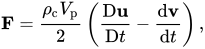
where bold symbols denote vectors, is the fluid flow velocity, is the spherical particle velocity, is the mass density of the fluid (continuous phase), is the volume of the particle, and D/Dt denotes the material derivative.


The origin of the notion "virtual mass" becomes evident when we take a look at the momentum equation for the particle.

where is the sum of all other force terms on the particle, such as gravity, pressure gradient, drag, lift, Basset force, etc.

Moving the derivative of the particle velocity from the right hand side of the equation to the left we get

so the particle is accelerated as if it had an added mass of half the fluid it displaces, and there is also an additional force contribution on the right hand side due to acceleration of the fluid.
Applications
[edit]The added mass can be incorporated into most physics equations by considering an effective mass as the sum of the mass and added mass. This sum is commonly known as the "virtual mass".
A simple formulation of the added mass for a spherical body permits Newton's classical second law to be written in the form
- becomes


One can show that the added mass for a sphere (of radius ) is , which is half the volume of the sphere times the density of the fluid. For a general body, the added mass becomes a tensor (referred to as the induced mass tensor), with components depending on the direction of motion of the body. Not all elements in the added mass tensor will have dimension mass, some will be mass × length and some will be mass × length2.


All bodies accelerating in a fluid will be affected by added mass, but since the added mass is dependent on the density of the fluid, the effect is often neglected for dense bodies falling in much less dense fluids. For situations where the density of the fluid is comparable to or greater than the density of the body, the added mass can often be greater than the mass of the body and neglecting it can introduce significant errors into a calculation.
For example, a spherical air bubble rising in water has a mass of but an added mass of Since water is approximately 800 times denser than air (at RTP), the added mass in this case is approximately 400 times the mass of the bubble.


Naval architecture
[edit]These principles also apply to ships, submarines, and offshore platforms. In the marine industry, added mass is referred to as hydrodynamic added mass. In ship design, the energy required to accelerate the added mass must be taken into account when performing a sea keeping analysis. For ships, the added mass can easily reach one fourth or one third of the mass of the ship and therefore represents a significant inertia, in addition to frictional and wavemaking drag forces.
For certain geometries freely sinking through a column of water, hydrodynamic added mass associated with the sinking body can be much larger than the mass of the object. This situation can occur, for instance, when the sinking body has a large flat surface with its normal vector pointed in the direction of motion (downward). A substantial amount of kinetic energy is released when such an object is abruptly decelerated (e.g., due to an impact with the seabed).
In the offshore industry hydrodynamic added mass of different geometries are the subject of considerable investigation. These studies typically are required as input to subsea dropped object risk assessments (studies focused on quantifying risk of dropped object impacts to subsea infrastructure). As hydrodynamic added mass can make up a significant proportion of a sinking object's total mass at the instant of impact, it significantly influences the design resistance considered for subsea protection structures.
Proximity to a boundary (or another object) can influence the quantity of hydrodynamic added mass. This means that added mass depends on both the object geometry and its proximity to a boundary. For floating bodies (e.g., ships/vessels) this means that the response of the floating body (i.e., due to wave action) is altered in finite water depths (the effect is virtually nonexistent in deep water). The specific depth (or proximity to a boundary) at which the hydrodynamic added mass is affected depends on the body's geometry and location and shape of a boundary (e.g., a dock, seawall, bulkhead, or the seabed).
The hydrodynamic added mass associated with a freely sinking object near a boundary is similar to that of a floating body. In general, hydrodynamic added mass increases as the distance between a boundary and a body decreases. This characteristic is important when planning subsea installations or predicting the motion of a floating body in shallow water conditions.
Aeronautics
[edit]In aircraft (other than lighter-than-air balloons and blimps), the added mass is not usually taken into account because the density of the air is so small.
Hydraulic structures
[edit]Hydraulic structures like weirs or locks often contain moveable steel structures like valves or gates, which are submerged under water. These steel structures are often constructed with thin steel plates mounted on girders. When the steel structures are accelerated or decelerated, substantial amounts of water are moved, too. This added mass must e.g. be taken into account when designing the drive systems for these steel structures.
See also
[edit]- Basset force for describing the effect of the body's relative motion history on the viscous forces in a Stokes flow
- Basset–Boussinesq–Oseen equation for the description of the motion of – and forces on – a particle moving in an unsteady flow at low Reynolds numbers
- Darwin drift for the relation between added mass and the Darwin drift volume
- Keulegan–Carpenter number for a dimensionless parameter giving the relative importance of the drag force to inertia in wave loading
- Morison equation for an empirical force model in wave loading, involving added mass and drag
- Response Amplitude Operator for the use of added mass in ship design
References
[edit]- ^ Newman, John Nicholas (1977). Marine hydrodynamics. Cambridge, Massachusetts: MIT Press. §4.13, p. 139. ISBN 978-0-262-14026-3.
- ^ Stokes, G. G. (1851). "On the effect of the internal friction of fluids on the motion of pendulums". Transactions of the Cambridge Philosophical Society. 9: 8–106. Bibcode:1851TCaPS...9....8S.
- ^ González, José; Martín-Delgado, Miguel A.; Sierra, Germán; Vozmediano, Angeles H. (1995). Quantum electron liquids and high-Tc superconductivity. Springer. p. 32. ISBN 978-3-540-60503-4.
- ^ a b Falkovich, Gregory (2011). Fluid Mechanics, a short course for physicists. Cambridge University Press. Section 1.3. ISBN 978-1-107-00575-4.
- ^ Biesheuvel, A.; Spoelstra, S. (1989). "The added mass coefficient of a dispersion of spherical gas bubbles in liquid". International Journal of Multiphase Flow. 15 (6): 911–924. Bibcode:1989IJMF...15..911B. doi:10.1016/0301-9322(89)90020-7.
- ^ Crowe, Clayton T.; Sommerfeld, Martin; Tsuji, Yutaka (1998). Multiphase flows with droplets and particles. CRC Press. doi:10.1201/b11103. ISBN 9780429106392.
External links
[edit]Added mass
View on GrokipediaFundamentals
Definition and Concept
Added mass refers to the additional inertia experienced by a body when it accelerates through a surrounding fluid, stemming from the kinetic energy that the body's motion imparts to the fluid. This effect increases the body's effective mass beyond its physical mass, as the acceleration requires displacing and accelerating nearby fluid particles.[4][5] Unlike buoyancy, which arises from static hydrostatic pressure gradients due to gravity and acts even on stationary bodies, added mass is an unsteady phenomenon tied directly to the body's acceleration. It also differs from drag, a viscous force proportional to velocity and dependent on fluid friction, as added mass operates in the inviscid limit without relying on viscosity.[6][4] Qualitatively, the fluid surrounding the body cannot instantaneously rearrange or fill the space left behind during acceleration, generating a pressure distribution that opposes the motion and mimics the inertia of an additional mass. This concept parallels renormalization in physics, where the effective mass of an object incorporates contributions from its interactions with the environment, such as a field or medium.[6][5] The added mass effect scales with fluid density, rendering it far more pronounced in dense liquids like water—approximately 800 times denser than air—than in gases, where it is typically minor relative to the body's inertia.[7]Historical Development
The concept of added mass received early recognition in 1752 through Jean le Rond d'Alembert's application of Leonhard Euler's equations to the motion of bodies in ideal, incompressible fluids, where calculations of fluid forces on accelerating bodies revealed an inertial effect now identified as added mass, though it was embedded in the broader context of what became known as d'Alembert's paradox regarding zero steady-state drag. In 1828, Friedrich Wilhelm Bessel proposed the added mass idea to account for the observed increase in the oscillation period of pendulums immersed in fluids, attributing the effect to the inertia of the surrounding fluid rather than just buoyancy or viscous drag.[8] This empirical insight built on earlier observations, such as those by Pierre Louis Georges Du Buat in 1786, but Bessel's work emphasized the fluid's contribution to the effective mass during oscillatory motion.[8] Siméon Denis Poisson provided the first mathematical treatment of added mass for a spherical pendulum in the early 19th century, deriving that the effective mass includes half the mass of the displaced fluid, a result later attributed by George Gabriel Stokes in his 1851 analysis of pendulums oscillating in viscous fluids.[9] Stokes extended this by incorporating internal friction effects while confirming Poisson's inviscid added mass correction as proportional to the displaced fluid volume.[9] Gustav Kirchhoff formalized the concept as "virtual mass" in 1869, developing equations for the motion of rigid bodies in ideal fluids under the potential flow assumption, where the added mass appears as a symmetric tensor coupling the body's acceleration to hydrodynamic forces. During the 1860s and 1870s, William Thomson (Lord Kelvin) advanced the understanding of added mass in unsteady flows through his investigations of vortex dynamics and circulation, including theorems that clarified inertial forces on bodies amid evolving fluid motion. In the 20th century, particularly within naval hydrodynamics, the added mass tensor evolved into a standard 6x6 matrix for analyzing arbitrary ship motions in six degrees of freedom, with significant refinements appearing in mid-century theories for seakeeping and maneuvering.[10] Early theories focused primarily on simple translational or oscillatory motions of basic shapes like spheres, leaving gaps for arbitrary geometries and complex rotations; these were addressed post-1900 through expanded potential flow methods and computational approaches in engineering contexts.[11]Theoretical Foundations
Potential Flow Assumption
The potential flow assumption forms the foundational model for analyzing added mass in fluid dynamics, describing an idealized motion of a fluid that is irrotational, inviscid, and incompressible.[1][12] In this framework, the fluid velocity is the gradient of a scalar velocity potential , such that , ensuring zero vorticity ().[12] The absence of viscosity implies no shear stresses or energy dissipation, while incompressibility maintains constant fluid density, leading to the governing equation , known as Laplace's equation.[1][11] To solve for the potential, specific boundary conditions are applied. On the surface of the body, the no-penetration condition requires that the normal component of the fluid velocity matches the normal component of the body's velocity, expressed as , where is the outward normal direction.[12] At infinity, a radiation condition ensures that disturbances decay, with the fluid approaching rest far from the body.[11] These conditions allow the flow to be decomposed into basic solutions that can be superposed linearly.[1] This assumption is justified for added mass calculations because it isolates the inertial effects of the fluid displaced by the accelerating body, neglecting viscous and rotational influences that are secondary at high Reynolds numbers or during rapid unsteady motions.[11][1] By focusing on the kinetic energy imparted to the surrounding fluid, potential flow provides a means to quantify the effective increase in the body's inertia due to fluid acceleration.[11] However, the model has notable limitations. It fails to capture separated flows, where vorticity generation leads to wake formation, or the effects of viscous boundary layers near the body surface, often resulting in overprediction of added mass in real fluids.[1][12] Additionally, the assumption breaks down near free surfaces or in confined domains, where interactions within a few body lengths can alter the flow significantly.[11] The potential flow assumption relates to d'Alembert's paradox, which states that steady motion of a body through an inviscid fluid predicts zero net drag force, as pressure forces balance symmetrically.[12] While this highlights the model's inability to account for viscous drag in steady cases, it accurately reproduces the unsteady inertial forces central to added mass, distinguishing it as a valuable tool for acceleration-dominated scenarios.[13][1]Derivation of Added Mass
In potential flow theory, the added mass arises from the kinetic energy imparted to the surrounding fluid by the motion of a body. The fluid is assumed to be incompressible and inviscid, with the velocity field derived from a velocity potential that satisfies Laplace's equation outside the body. The total kinetic energy of the fluid is given byFormulation and Examples
The Added Mass Tensor
In fluid dynamics, the added mass for a rigid body undergoing multi-degree-of-freedom motion in an inviscid, incompressible fluid is formalized as a second-order tensor, often represented as a symmetric 6×6 matrix to account for the three translational and three rotational degrees of freedom. This tensor relates the hydrodynamic force (or moment) components to the acceleration components through the relationAdded Mass for Simple Geometries
For simple geometries, the added mass can be derived analytically by solving the Laplace equation for the velocity potential under the assumption of irrotational, incompressible flow, yielding explicit coefficients that depend on the shape. These coefficients are typically expressed as a fraction of the displaced fluid mass, ρV, where ρ is the fluid density and V is the body volume (or equivalent for 2D cases). Such solutions provide foundational benchmarks for understanding how geometry affects inertial loading during acceleration.[11] For a sphere of radius $ r $ translating with velocity $ \mathbf{v} $ in an infinite fluid, the added mass is $ m_a = \frac{1}{2} \rho V $, where $ V = \frac{4}{3} \pi r^3 $ is the displaced volume. This result arises from the velocity potential $ \phi = -\frac{1}{2} \frac{r^3}{R^2} v \cos \theta $, where $ R $ and $ \theta $ are spherical coordinates relative to the direction of motion, leading to a kinetic energy equivalent to accelerating half the displaced fluid mass.[15][11] An infinite cylinder of radius $ r $ undergoing transverse acceleration perpendicular to its axis experiences an added mass per unit length of $ m_a = \rho \pi r^2 $, which equals the mass of fluid displaced per unit length. This 2D result follows from the logarithmic potential solution to Laplace's equation in cylindrical coordinates.[11] For an infinitely thin circular disk of radius $ r $ oscillating normal to its face, the added mass is $ m_a = \frac{8}{3} \rho r^3 $. This value is obtained by integrating the potential flow around the disk edges, capturing the higher inertia due to the sharp geometry.[11] Ellipsoids admit a general analytical form for the added mass tensor diagonals, $ m_{ii} = \rho V k_i $, where $ k_i $ (for $ i = 1,2,3 $) are shape factors depending on the semi-axes ratios, with $ 0 < k_i \leq 1 $. For a sphere, all $ k_i = \frac{1}{2} $; prolate or oblate forms yield axis-specific values, such as $ k_1 \approx 0.021 $ for a slender prolate ellipsoid (aspect ratio 10:1) along the major axis. These factors are computed via elliptic integrals in the potential solution.[11] The following table compares the nondimensional added mass coefficients $ m_a / (\rho V) $ for select geometries (using equivalent volume $ V $ where applicable; for the 2D cylinder, per unit length):| Geometry | Coefficient $ m_a / (\rho V) $ | Notes |
|---|---|---|
| Sphere | 0.5 | Isotropic |
| Infinite cylinder | 1.0 | Transverse motion (2D) |
| Circular disk | N/A (V ≈ 0 for thin disk) | Normal oscillation; $ m_a = \frac{8}{3} \rho r^3 $, ≈0.85 relative to ρ times volume of sphere of radius r |
| Ellipsoid (sphere limit) | 0.5 per axis | General $ k_i $ varies by aspect ratio |