Hubbry Logo
Alexander EtkindAlexander EtkindMain
Open search
Alexander Etkind
Community hub
Alexander Etkind
logo
8 pages, 0 posts
0 subscribers
Be the first to start a discussion here.
Alexander Etkind
Alexander Etkind
from Wikipedia

Alexander Etkind

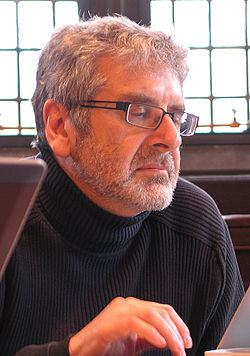
Alexander Etkind (born 1955, St. Petersburg, Russia) is a historian and cultural scientist.[1][2] Currently he is employed as a professor in the Department of International Relations at the Central European University.[3] He is fellow of the European Institute for International Law and International Relations.[4]

Career

[edit]

He completed his B.A. and M.A. in 1978 in Psychology and English at Leningrad State University.[5]  In 1998, he defended PhD (Habilitation) in Slavonic Studies/ Cultural History at the University of Helsinki.[2][6][5] Etkind taught at the European University at St. Petersburg then at Cambridge University where he was also a fellow of King's College.[7][2] He was a visiting fellow at New York University, Wissenschaftskolleg in Berlin, and other places.[8][5][9]

Etkind's research focuses on European and Russian intellectual history, memory studies, natural resources and the history of political economy, empire and colonies in Europe, and Russian politics, novels and film in the 21st century.[5][10]

Nature's Evil: A Cultural History of Natural Resources is a world history (with special emphasis on Russia) of the economic and political roles of grain, meat, fur, sugar, hemp, metals, peat, coal and oil.

From 2010 to 2013, he led the international research project “Memory at War: Cultural Dynamics in Poland, Russia, and Ukraine”. The project studied the role of cultural memory of the Soviet era in Russia, Ukraine and Poland and received funding from Humanities in the European Research Area (HERA).[10]

Etkind has publications in Russian and English, and speaks both languages.[5][6]

Selected publications

[edit]
  • Russia Against Modernity. Cambridge: Polity Press, 2023.
  • "Alexey Navalny: A hero of the new time." New Perspectives (2022): 2336825X211065909.
  • Rethinking the Gulag: Identities, Sources, Legacies Indiana University Press, 2022, editor, with Irina Anatolievna Flige, Susan Grunewald, Jeffrey S. Hardy, Mikhail Nakonechnyi, Judith Pallot, Gavin Slade, Lynne Viola, Josephine von Zitzewitz, and Sarah J. Young.
  • Nature's Evil: A Cultural History of Natural Resources Polity Press, 2021. excerpt; see online review
  • Eros of the impossible: The history of psychoanalysis in Russia. Routledge, 2019, with Maria Rubins. online review
  • "Petromacho, or Mechanisms of de-modernization in a resource state." Russian politics & law 56.1-2 (2018): 72–85. online
  • "Kant’s Subaltern Period: The Birth of Cosmopolitanism from the Spirit of Occupation." in Cosmopolitanism in Conflict (Palgrave Macmillan, London, 2018) pp. 55–83.
  • Roads not Taken. An Intellectual Biography of William C. Bullitt. Pittsburgh University Press 2017. online review
  • Cultural Forms of Protest in Russia, co-ed. with B. Beumers, O. Gurova and S. Turoma. New York: Routledge, 2017.
  • “How Russia Colonized Itself. Internal Colonization in Classical Russian Historiography”, International Journal for History, Culture, and Modernity, Vol 3, No. 2, 2015, pp. 159–172.
  • “Post-Soviet Russia: The Land of the Oil Curse, Pussy Riot, and Magical Historicism” Boundary 2, Vol 41, No. 1, 2014, pp. 153–170.
  • Memory and Theory in Eastern Europe, co-ed. with U. Blacker and J. Fedor, New York: Palgrave Macmillan, 2013.
  • Warped Mourning. Stories of the Undead in the Land of the Unburied, Palo Alto: Stanford University Press, 2013.
  • Remembering Katyn. Cambridge: Polity 2012, co-authored.
  • Internal Colonization. Russia’s Imperial Experience, Cambridge: Polity 2011.
  • A Parable of Misrecognition: Anagnorisis and the Return of the Repressed from the Gulag,” Russian Review 68 (October 2009): 623–640.
  • Stories of the Undead in the Land of the Unburied: Magical Historicism in Contemporary Russian FictionSlavic Review 68, no. 3, Fall 2009, pp. 631–658.
  • Хлыст: Секты, литература и революция (The Russian Flagellant: Sects, Literature, and Revolution) Moscow: NLO 1998; second revised edition: 2013.
  • Eros of the Impossible: The History of Psychoanalysis in Russia. Boulder - Oxford: Westview 1996.

References

[edit]

Further reading

[edit]
[edit]
Revisions and contributorsEdit on WikipediaRead on Wikipedia
from Grokipedia
Alexander Etkind is a Russian-born and cultural theorist specializing in Russian and European intellectual history, , and the cultural of resources and . Currently a in the Department of at , where he joined in 2022 after teaching at the in from 2013 to 2022, Etkind earned his PhD in Russian cultural history from the in 1998 and has supervised over 30 doctoral students across Europe. His scholarly work examines themes such as internal in imperial , warped in post-Soviet , and the role of petrostates in denying while pursuing aggressive , as explored in books like Internal Colonization: Russia's Imperial Experience (2011), Nature's Evil: A Cultural History of Natural Resources (2021), and Against (2023). Etkind's analyses often highlight causal links between resource-dependent and resistance to democratic progress, framing 's invasion of as part of a broader rejection of .

Early Life and Education

Childhood and Formative Influences in Leningrad

Alexander Etkind was born in 1955 in Leningrad, then the second-largest city in the , during the post-Stalin period following Nikita Khrushchev's 1956 "Secret Speech" denouncing , which initiated limited but maintained strict ideological controls over intellectual life. This era, marked by the Khrushchev Thaw's partial relaxation of censorship juxtaposed against persistent surveillance of dissident thought, formed the backdrop for Etkind's early years in a city renowned for its pre-revolutionary yet scarred by the lingering of the 1941–1944 , though Etkind himself grew up a decade after its end. Etkind's family background immersed him in intellectual and currents atypical of mainstream Soviet society. His uncle, Efim Etkind, a prominent literary scholar and translator who became a key figure in the Soviet movement through involvement in publications and protests against show trials like that of and Yuli Daniel in 1966, exemplified resistance to state orthodoxy; Efim was eventually stripped of Soviet citizenship in 1974 and exiled. His stepfather, philosopher Moisei Kagan, a specialist in and at Leningrad State University, provided models of rigorous philosophical inquiry within the constraints of Marxist-Leninist academia. These relatives' examples of intellectual bravery amid repression influenced Etkind's formative worldview, fostering skepticism toward official narratives. Family lore of Stalinist terror further shaped Etkind's early understanding of Soviet history, centered on the arrest of his grandfather, Etkind, a physician whose fate embodied the era's purges; upon Grigory's brief return, his son Efim—Etkind's —refused to recognize him due to trauma, highlighting intergenerational psychological rupture. In Leningrad's state-dominated intellectual milieu, where was subordinated to Pavlovian and official ideology, such personal exposures to unofficial histories and ethical dissent contrasted sharply with the censored public discourse, priming Etkind's later critical engagement with , trauma, and power structures.

Higher Education and Early Academic Training

Alexander Etkind completed his combined bachelor's and master's degrees in and English at Leningrad State University in 1978. This five-year specialist program, typical of the Soviet higher education system, provided foundational training in empirical psychological methods alongside philological studies. Following this, Etkind pursued advanced research within the USSR academic framework, earning a degree—equivalent to a PhD—in from the V.M. Bekhterev Psychoneurological Research Institute in Leningrad in 1985. The institute, known for its focus on and neurophysiology, emphasized rigorous clinical and theoretical approaches aligned with Soviet scientific materialism. Etkind's trajectory shifted toward international academia with his habilitation, a degree in Slavic languages and literatures, defended at the in 1998. This higher doctoral qualification, requiring an original and public defense, facilitated his integration into Western scholarly networks, bridging his Soviet-era expertise in with emerging interests in cultural and historical analysis of and society.

Academic Career

Positions in Russia

Etkind served as an of at the European University at St. Petersburg (EUSP) starting in the late 1990s, with his primary affiliation there spanning 1999 to 2004, during which he contributed to departments focused on and social sciences. Founded in 1994 as a private graduate institution, EUSP positioned itself as a bastion of independent scholarship in post-Soviet , emphasizing interdisciplinary social sciences modeled on Western academic standards and fostering empirical analysis free from ideological dictates of the prior Soviet era. This period coincided with the consolidation of power under President , who assumed office in , marking a shift from relative openness in the toward intensified state oversight of institutions. Independent entities like EUSP encountered early regulatory hurdles, including accreditation disputes and financial audits, as authorities moved to align education with nationalistic priorities and curb perceived foreign influences. Etkind's work at EUSP occurred amid these emerging tensions, where scholars navigating sensitive topics on Russian history and culture risked institutional vulnerability, though overt crackdowns on the university intensified post-2004 with repeated license revocations and operational restrictions. The broader post-Soviet academic landscape in during Etkind's domestic tenure reflected causal pressures from economic instability and political centralization: state funding favored compliant institutions, while independent ones relied on precarious grants and faced ideological scrutiny, contributing to an exodus of talent and erosion of critical inquiry. EUSP's model of autonomy, which enabled hubs for unorthodox , thus operated under mounting constraints that presaged deeper authoritarian controls, compelling many academics to seek stability abroad.

Transitions to Western Institutions

In 2004, Etkind relocated from the European University at St. Petersburg to the , where he held positions as Reader and subsequently Professor in and until 2013, while also serving as a of . This transition facilitated expanded research on cultural dynamics and memory politics, leveraging Cambridge's resources for interdisciplinary scholarship previously constrained in . Etkind's subsequent move in 2013 to the (EUI) in positioned him as holder of the Chair in the Department of History and Civilization, a role he maintained through 2022. The appointment emphasized his expertise in historical and civilizational studies, aligning with EUI's focus on and global historical processes, and reflected strategic career advancement amid evolving professional landscapes in post-Soviet academia. These relocations underscored Etkind's pursuit of institutional environments offering greater autonomy for theoretical innovation, as he later shared in academic seminars on scholarly mobility and project-building in the . By bridging Russian expertise with Western frameworks, the shifts enabled sustained output in comparative and , free from domestic institutional pressures.

Current Role at Central European University

Alexander Etkind serves as a professor in the Department of at (CEU) in , a position he assumed in 2022. In this role, he contributes to the department's curriculum on international relations, history, and related interdisciplinary fields, integrating his expertise in Russian studies and global political dynamics. Etkind heads the Hub for the of the (OHPA), an initiative he established upon joining CEU, which focuses on examining the intersections of , , and authoritarian through , events, and . His responsibilities include directing hub activities, such as organizing seminars and publications on petrostates and environmental conflicts, thereby fostering across CEU's academic community and external partners. As of 2025, Etkind continues to supervise graduate students in areas like Russian studies and supervises theses that align with the department's emphasis on Eurasian politics and . His integration into CEU underscores the institution's commitment to critical perspectives on post-Soviet transitions and global challenges, with ongoing involvement in teaching and hub leadership shaping departmental discourse on and conflict.

Research Themes and Theoretical Contributions

Internal Colonization and Imperial Experience

Alexander Etkind conceptualizes internal colonization as the Russian Empire's practice of exerting colonial-style domination over its own core territories and predominantly ethnic Russian populations, through economic exploitation and cultural subjugation, rather than solely through outward territorial expansion. This model posits Russia as an inward-facing empire that domesticated its heartlands via mechanisms such as the fur trade, which from the 16th century onward drove massive territorial growth while binding local populations in subservient roles akin to colonial labor. Unlike typical European empires that distinguished metropolitan centers from peripheral colonies, Russia's internal colonization blurred these lines, treating its own subjects as resources for state-building and elite enrichment. Central to this framework is , formalized in the 1649 Ulozhenie ( Code), which Etkind analyzes as a quintessential tool of self-colonization, enabling nobles to extract labor and tribute from —primarily Russian and other eastern —without granting them full legal personhood or mobility. functioned as a for lifestyle preservation and in the empire's core provinces, fostering economic dependencies that mirrored colonial plantations but lacked racial justifications seen in Atlantic ; instead, it relied on class and territorial hierarchies to justify the subjugation of the empire's own ethnic majority. Historical empirics, including state censuses and noble estate records from the 18th and 19th centuries, reveal how this system sustained imperial expansion by channeling peasant surplus into and administrative needs, with over 80% of Russia's rural enserfed by the late imperial period. Etkind's model extends these imperial dynamics as legacies influencing Soviet structures, where internal persisted through policies like collectivization in , which echoed serfdom's forced extraction by subordinating the core peasantry to state quotas and relocations, thereby perpetuating self-subordination without external ethnic pretexts. This continuity underscores causal patterns of centralized control over domestic resources, shaping the USSR's and resistance to modernization, as evidenced by archival data on campaigns that displaced millions from central regions. Empirical grounding in Etkind's analysis draws from primary sources like 19th-century , which itself framed as "colonizing itself" through internal migrations and state interventions, highlighting the empire's unique fusion of and introspection.

Politics of Memory and Warped Mourning

In his 2013 book Warped Mourning: Stories of the Undead in the Land of the Unburied, Alexander Etkind conceptualizes "warped mourning" as a distorted collective grief process in post-Stalinist , where the trauma of mass repression remains unburied and unacknowledged, preventing resolution and allowing the past to haunt the present through undead cultural motifs. Following Joseph Stalin's death on March 5, 1953, initiatives under offered limited exposure of crimes via the 1956 Secret Speech but failed to deliver justice, compensation, or widespread reburials for victims, whose numbers Etkind notes range uncertainly from 5 to 30 million across broad definitions of repression. This inhibition fosters a dominated by state-controlled denial, contrasting with more institutionalized reckonings elsewhere and embedding unresolved Stalinist legacies into 's cultural and political fabric. Drawing on Freudian models of , Etkind describes warped mourning as a of partial remembrance intertwined with enforced forgetting, where societies grieve not only victims but also the utopian ideals that enabled their destruction, yielding cautionary narratives against repetition. In Russian cultural production, this manifests as figures—ghosts, vampires, and zombies—populating literature by authors such as Andrei Siniavsky and Viktor Pelevin, films by Grigory Kozintsev, artwork by Boris Sveshnikov, and compositions by , symbolizing the return of the unprocessed dead amid inadequate physical memorials. Etkind emphasizes Russia's reliance on "soft" cultural software—texts, debates, and symbolic expressions—over "hard" hardware like monuments or trials, a dynamic rooted in authoritarian suppression that sustains trauma denial from the Soviet era into post-1991 politics. Etkind's framework underscores how such processes in authoritarian settings perpetuate collective neurosis, as unmastered Stalinist integrates into ongoing power structures, hindering empirical confrontation with causal chains of repression and enabling mythic reinterpretations of the past. By analyzing these hauntological patterns, Etkind reveals denialism's role in forestalling societal adaptation, where the undead past signals incomplete causal accounting of mid-20th-century atrocities rather than resolved historical closure.

Petrostates, Nature, and Anti-Modernity

Etkind contends that petrostates, defined by their economic overreliance on hydrocarbon exports, suffer from a structural "" that incentivizes authoritarian consolidation and external aggression rather than institutional development or innovation. In Russia's case, oil and gas revenues, which constituted approximately 40% of federal budget income in the early , enable the regime to maintain power through networks and spending without pursuing diversification into high-value sectors like technology or services. This dynamic, akin to the "" where resource booms erode non-extractive industries, fosters and , as surplus rents from extraction—peaking at over $500 billion annually during high-price periods—obviate the need for accountable governance or productivity-enhancing reforms. Causally, Etkind links this oil dependency to heightened interstate conflict, dubbing it "petro-aggression," where resource windfalls correlate with militarized foreign policies in petrostates like and . Empirical patterns show that such regimes, insulated from domestic pressures by export earnings, prioritize territorial expansion to secure pipelines and markets, as seen in 's 2022 invasion of , which disrupted global energy flows but reaffirmed Moscow's leverage over dependencies. Unlike diversified economies, petrostates exhibit lower incentives for or compromise, with oil rents funding protracted wars that align with elite interests in perpetuating extraction over transition. Central to Etkind's framework is Russia's self-inflicted " against ," a deliberate ideological and material resistance to decarbonization, digital economies, and liberal environmental norms driven by imperatives. He argues that the invasion targets 's alignment with standards on and emissions reductions— having committed to net-zero by 2050 under pre- agreements—while rejecting the broader shift away from fossil fuels that threatens Russia's $300 billion-plus annual export model. This anti-modern stance empirically manifests in state denialism of anthropogenic , suppression of green technologies, and promotion of extractive narratives that frame progress as Western decadence, thereby sustaining a causal loop where resource curses entrench regressive policies against adaptive modernization.

Major Publications

Early Works on Psychology and Culture

Etkind's foundational scholarship in the integrated with cultural and , drawing on his training in to examine how psychoanalytic concepts shaped and reflected Russian societal dynamics. His PhD research at the Bekhterev Psychoneurological Institute in Leningrad focused on historical aspects of psychological thought, laying the groundwork for analyses of mind and under authoritarian regimes. The landmark publication Eros of the Impossible: The History of in (1997) systematically documented the rise, adaptation, and repression of Freudian in . Etkind highlighted the pre-revolutionary "" of psychoanalytic interest noted by Freud in 1912, detailing contributions from pioneers like Ivan Ormeny and , whose works intertwined personal analysis with revolutionary politics. The book argued that offered tools for interpreting collective traumas but clashed with Bolshevik , leading to its institutional by , with surviving ideas persisting underground in and . Etkind extended this framework in essays on "psychological culture," exploring how Soviet-era efforts to engineer personality types fostered ambivalence toward modernization. In works like "Psychological Culture: Ambivalence and Resistance to Social Change," he critiqued the totalitarian impulse to impose modal personalities, linking it to deeper cultural resistances evident in post-perestroika introspection. These early outputs emphasized psychoanalysis not as abstract theory but as a lens for causal historical processes, such as the interplay between individual psyche and state ideology, prefiguring Etkind's later shifts toward memory and empire without overlapping into post-2010 themes.

Key Books on Russian History and Imperialism

Internal Colonization: Russia's Imperial Experience (2011) presents a of the , arguing that its involved "internal ," a process where the state domesticated its own heartlands and peoples alongside external conquests. Etkind draws on literary sources from the 18th to 20th centuries to illustrate how Russians experienced dual roles as both colonizers of peripheral territories—like and the —and as subjects of internal control through , , and . This framework challenges traditional views of Russian exceptionalism by framing empire-building as a symmetrical interplay between external expansion and domestic subjugation, evidenced by examples such as noble estates mimicking colonial plantations and state policies enforcing on ethnic minorities within core regions. The book employs interdisciplinary methods, integrating , , and to analyze phenomena like the "civilizing mission" inverted upon themselves, where elites projected imperial tropes onto their own society. Etkind contends that this internal dynamic persisted into the Soviet era, influencing patterns of modernization and resistance, supported by archival references to imperial decrees and literary depictions from authors like Pushkin and Gogol. In Nature's Evil: A Cultural History of Natural Resources (2021), Etkind extends his analysis of to the exploitation of natural resources, positing that resource extraction has historically intertwined with imperialism, fostering dependencies and moral ambiguities across civilizations, including Russia's. Spanning from ancient to modern petrostates, the highlights how resources like , , and minerals enabled Russian imperial growth—such as the funding 17th-century expansions and shaping 20th-century —while embedding "evil" in human-nature relations through and inequality. Etkind uses case studies, including Russia's conquests and resource-based , to argue that empires accrue power via resource monopolies, which distort cultural narratives and perpetuate cycles of abundance and scarcity. This work critiques Enlightenment optimism about progress, asserting that resource-driven reveals a darker where nature's bounty enables domination rather than liberation, substantiated by on Russian exports and philosophical reflections on and . Etkind's approach remains rooted in , avoiding econometric models in favor of textual and symbolic interpretations of resource curses in imperial contexts.

Recent Analyses of War and Modernity

In his 2023 book Russia Against Modernity, Alexander Etkind frames 's 2022 invasion of as a deliberate on core elements of contemporary , including climate mitigation efforts, the shift to sources, and the rise of digital economies. Etkind contends that the Kremlin's "special ," as officially termed, extends beyond territorial aims to preserve a resource-extraction model incompatible with global decarbonization trends, where fuels—accounting for over two-thirds of Russia's exports and more than half of its federal budget in the years preceding the —subsidize and authoritarian control. This analysis posits petrostates like as inherently antagonistic to modernity's environmental imperatives, prioritizing dominance over . Etkind draws causal links between Russia's petro-economy and its geopolitical aggression, arguing that and gas revenues, peaking at $320 billion in 2022 despite sanctions, enable wars that distract from internal economic stagnation and forestall transitions to low-carbon technologies. He highlights how state propaganda equates with imperial revival, rejecting international climate accords like the , which Russia ratified in 2019 but has undermined through fossil fuel expansions yielding over 500 billion cubic meters of potential gas reserves by 2030. This resistance, per Etkind, manifests in tactics that blend military incursions with campaigns denying anthropogenic climate impacts, evidenced by Russian media's amplification of skeptic narratives during the 2021–2022 buildup to . The work critiques modernity not as an unqualified good but as a framework demanding ecological accountability, which Russia's elite evades through narratives of civilizational exceptionalism. Etkind supports this with historical parallels to other resource-cursed regimes, noting that between 2014 and 2021, Russia's military spending rose 50% amid oil price volatility, correlating with escalated hybrid threats against Ukraine and NATO's eastern flank. While acknowledging Russia's ratification of UN climate goals, he attributes non-compliance to structural incentives: fossil fuel dependency generated 60% of export revenues in 2021, insulating the regime from diversification pressures. Etkind's thesis, though interpretive, aligns with empirical data on petrostate behaviors, such as Iran's similar denialism amid sanctions, underscoring a pattern where resource rents—$1.2 trillion cumulatively for Russia from 2000–2020—fuel anti-modern revanchism.

Political Commentary and Views

Critiques of Russian Authoritarianism

Alexander Etkind characterizes Russia's political system under Vladimir Putin as a petrostate, where dominance over hydrocarbon resources enables authoritarian stability by generating super-profits that fund patronage networks and security apparatuses. In this framework, oil revenues—constituting approximately one-third of GDP, two-thirds of exports, and half of the state budget—underpin regime longevity by distributing wealth through clientelism, rewarding political loyalty with economic opportunities while suppressing dissent via a bloated military-security sector that consumes a significant portion of expenditures. The weakness of domestic opposition stems from this resource dependency, which fosters economic distortions akin to the , including that crowds out diverse sectors and heightens societal reliance on state-controlled rents. Etkind argues that such dynamics preclude robust or alternative power centers, as the regime preempts challenges through coercion financed by energy windfalls, rendering high approval ratings superficial and legitimacy derived not from social contracts but from fear and material incentives. Etkind predicts potential regime collapse linked to fluctuations in dynamics, particularly the global shift toward decarbonization, which erodes export revenues and exposes vulnerabilities in a system predicated on monopolies. He posits that declining super-profits from could unravel elite cohesion and , as the petrostate's parasitic —marked by and inefficiency—lacks adaptive mechanisms for post-carbon transitions, historically tying authoritarian resilience to resource abundance rather than institutional resilience.

Perspectives on the Russo-Ukrainian War

Etkind interprets the Russian full-scale invasion of Ukraine, launched on February 24, 2022, as a manifestation of imperial continuity, wherein Moscow seeks to reassert historical patterns of colonization and annexation over Ukraine, a region long subjected to Russian imperial dominance. In his 2023 book Russia Against Modernity, he posits that the war extends Russia's legacy of internal colonization by targeting Ukraine's post-Soviet independence and its alignment with decentralized, sustainable development models, contrasting sharply with Russia's oil-dependent "paleomodernity." This framing underscores the invasion not merely as territorial aggression but as an effort to halt Ukraine's divergence from Moscow's centralized, resource-extractive paradigm, evidenced by Russia's pre-invasion military buildup exceeding $1 trillion in cumulative spending from 2000 to 2020. Central to Etkind's analysis is the invasion's character as an anti-modern , described as a deliberate "stopmodernism" aimed at suppressing global shifts toward -aware economies and digital pluralism. He argues that Putin's , through the invasion, resists "gaiamodernity"—a lean, diverse exemplified by Ukraine's younger (with most cabinet members under 45 in 2022)—by promoting denialism, , and interference in Western elections to preserve dominance, as accounted for significant global emissions while spending approximately $1 billion daily on the in its early phases. Etkind links this to broader outcomes, including over 3,000 Russian soldier deaths by May 2022, disproportionately from non-ethnic Russian regions, signaling internal strains that could precipitate 's defederation. Etkind further characterizes the conflict as involving a " of minor differences," where Russian rhetoric amplifies trivial cultural variances into existential threats to justify erasing Ukrainian distinctiveness. Drawing on Raphael Lemkin's framework, he highlights preplanned genocidal elements, such as the forced transfer of Ukrainian children and atrocities like the Bucha massacres in 2022, which followed Putin's July 2021 essay asserting Russians and Ukrainians as "one people" and his February 24 speech invoking unsubstantiated claims of against Russian-speakers (a with 2.2 million residents, 40-45% ethnic Russian). This narrative, Etkind contends, evolves from historical identification to genocidal denial of Ukrainian agency, mirroring imperial homogenization tactics while the rejected Moscow's "" pretext as baseless.

Views on Global Issues like Climate and Resources

Etkind examines the interplay between natural resource extraction and global challenges, emphasizing how dependence shapes policy resistance to . In his 2021 book Nature's Evil: A Cultural History of Natural Resources, he analyzes resources such as and through historical lenses, linking their to enduring patterns of inequality, conflict, and that culminate in contemporary crises. , in particular, emerges as a transformative force that restructures societies and states, often prioritizing extraction rents over . In petrostates, Etkind identifies causal mechanisms where resource wealth sustains authoritarian governance and incentivizes denial of imperatives to safeguard revenues. Fossil fuels comprise over two-thirds of 's exports and fund more than half its federal budget, rendering decarbonization a perceived threat that Russia counters through of its emissions footprint—equivalent to those from exported hydrocarbons—while financing military endeavors. This "" extends to policy inertia, where oil-dependent economies like those of + members (23 since ) resist transitions, as a single barrel of oil generates approximately 0.5 tons of gases, amplifying global warming while petrostates externalize costs. Etkind draws parallels between and , both of which leverage oil to underwrite proxy conflicts— via support for and the Houthis—while downplaying risks to maintain petro-regimes. He terms this dynamic "petroaggression," supported by evidence that such states initiate and prolong wars more than non-petrostates, as resource rents enable , , and external adventurism without domestic accountability. Global decarbonization pushes, such as the EU Green Deal of 2020, provoke backlash, with Etkind linking resource vulnerabilities to escalatory policies that prioritize dominance over multilateral cooperation. In Russia Against Modernity (2023), Etkind portrays Russia's reliance as emblematic of anti-modern stances rejecting awareness and energy shifts, positioning it among the world's most carbon-intensive and militarized powers. This framework underscores how resource endowments—Islamic countries hold 62% of global oil reserves—causally entrench resistance to environmental realism, perpetuating cycles of isolation and conflict amid accelerating planetary constraints.

Reception, Influence, and Criticisms

Academic Impact and Citations

Etkind's publications have amassed 6,993 citations on , reflecting substantial quantitative academic impact across and related fields. His of 34 indicates that 34 of his works have each been cited at least 34 times, while his i10-index of 89 shows 89 publications with at least 10 citations each. These metrics, current as of recent data, demonstrate broad scholarly engagement, with 2,724 citations accrued since alone, underscoring ongoing influence amid evolving discussions in and . In Russian studies, Etkind's concepts have gained traction, particularly his of internal , which has been referenced in over a dozen scholarly works on Russian and . For example, his 2011 book Internal Colonization: Russia's Imperial Experience has shaped examinations of self-colonization in classical Russian narratives and postcolonial frameworks within the discipline. This adoption extends to , where his earlier contributions on political mourning in have been cited in comparative analyses of across . Such citation patterns highlight his role in integrating literary and historical methodologies into Russian imperial scholarship.

Positive Assessments of Contributions

Etkind's theorization of internal colonization has received acclaim for empirically connecting cultural narratives to Russia's imperial structures, providing a framework that illuminates post-Soviet identity struggles rooted in historical self-domination. In his 2011 book Internal Colonization: Russia's Imperial Experience, he analyzes literary works by figures such as and Vladimir Dahl to demonstrate how Russia's empire internalized colonial dynamics, treating peripheral regions and even the center as colonized spaces, which fosters a distinctive persisting beyond 1991. This approach has popularized the concept within scholarship on post-Soviet dynamics, enabling analyses of how imperial legacies shape mnemonic practices and political continuity in the Russian Federation. Reviewers have highlighted the work's innovation in applying postcolonial lenses to Russian history, describing it as a "clever, wide-ranging" contribution that aptly illustrates classical postcolonial concepts through Russian empirical examples, such as reverse imperial radiance and negative . This empirical linkage of —via texts and artifacts—to has been praised for offering a "striking new lens" on enduring processes of , inspiring debate and extending to post-imperial theorizing by revealing how Soviet and post-Soviet grapple with unresolved internal fractures. Etkind's method thus bridges historical with contemporary post-Soviet phenomena, such as distorted and state-periphery tensions, grounded in verifiable cultural evidence rather than abstract ideology.

Critiques of Theoretical Frameworks

Critics of Etkind's concept of internal colonization, as articulated in his 2011 book Internal Colonization: Russia's Imperial Experience, argue that the framework suffers from imprecise boundaries and definitional ambiguity, rendering it difficult to apply rigorously without conflating distinct historical phenomena. The term, intended to describe Russia's simultaneous external expansion and internal domination of its own populations through cultural and rhetorical mechanisms, is faulted for not being adequately delineated, leading to analyses cluttered by digressions into tangential factoids rather than sustained empirical scrutiny of colonial institutions or practices. Etkind's theoretical emphasis on cultural narratives and rhetorical structures, particularly in works like Russia Against Modernity (2023), has drawn structuralist and materialist critiques for sidelining causal factors rooted in , resource dependencies, and economic imperatives in favor of an overreliance on symbolic or discursive explanations of Russian exceptionalism. This approach risks portraying 's developmental path as predominantly ideational, potentially underplaying verifiable material determinants such as vast territorial endowments and extraction economies that shaped imperial and Soviet trajectories independently of . Such critiques highlight a broader concern in Etkind's oeuvre: amid Western academic contexts often predisposed against Russian authoritarian narratives, his frameworks may amplify anti-regime interpretations at the expense of balanced causal analysis, though direct evidence of partisan distortion remains debated in scholarly reviews.

Recent Developments and Activities

Post-2022 Engagements

In the immediate aftermath of Russia's full-scale invasion of Ukraine on February 24, 2022, Etkind issued analyses forecasting structural changes within Russia as a consequence of the conflict. In a May 2022 article for The Moscow Times, he depicted a speculative "fantasia" on the dissolution of the Russian Federation, drawing on biblical motifs to frame the war as accelerating imperial fragmentation. He expanded this view in June 2022, asserting in another Moscow Times piece that "all empires eventually fall apart" and positioning the Russian Federation as the next to undergo defederation amid military overextension and internal strains. By 2023, Etkind turned to prospective settlement frameworks for the . In a report for the Centre for Eastern (SCEEUS), he proposed four historical models—Korean (frozen with high recidivism risk), German (Russian victory leading to partitioned and constrained expansion), Israeli (prolonged U.S.-backed Ukrainian resistance with dependency dynamics), and Habsburg (Ukrainian triumph triggering Russian disintegration and extensive rebuilding)—to evaluate potential cease-fire terms, timelines, and ripple effects on , , and global institutions. These analogies emphasized varying degrees of institutional overhaul, from minimal in scenarios to transformative in victory-driven ones, based on prior conflicts' outcomes up to August 2023 data. Etkind also addressed wartime occupation dynamics in a May 2023 article in Nationalities Papers, arguing that Russian policies in seized Ukrainian territories exemplified "demodernization"—an adaptive strategy rooted in military culture that regresses , , and social norms to pre-modern states, contrasting with Ukraine's modernization trajectory. Operating from his Vienna base at , these engagements marked a pivot from pre-war historical scholarship to real-time geopolitical forecasting without reported personal relocation.

Leadership in New Initiatives

Since 2024, Etkind has led the Hub for the Politics of the (OHPA) at , directing research into the political interfaces between human societies and environmental transformations in the . The hub, supported by project management and coordinated teams, emphasizes empirical analysis of resource politics, climate dynamics, and societal responses to ecological crises, including monitoring interfaces between nature and governance amid radical changes. Under Etkind's direction, OHPA has initiated collaborative workshops, such as the 2025 event on "War and the ," co-authored with , exploring intersections of conflict, resource extraction, and through case studies of militarized environmental impacts. These efforts extend to public engagements, including Etkind's scheduled lecture on the " of Natural Resources" on February 14, 2025, at the Latvian Academy of Culture, where he contends—drawing on historical examples—that sustainable economies depend on human creativity and labor rather than extractive dependencies. Etkind has also spearheaded collaborations addressing Eurasian futures, notably contributing historical models for post-conflict Northern Eurasia in a December 2023 SCEEUS analysis, which projects scenarios of regional reconfiguration based on precedents of imperial dissolution and resource-driven transitions. These initiatives position Etkind at the forefront of interdisciplinary efforts linking , , and geopolitical forecasting, prioritizing data on resource flows and causal pathways over ideological narratives.

References

Add your contribution
Related Hubs
User Avatar
No comments yet.