Hubbry Logo
Alfred ReedAlfred ReedMain
Open search
Alfred Reed
Community hub
Alfred Reed
logo
8 pages, 0 posts
0 subscribers
Be the first to start a discussion here.
Alfred Reed
Alfred Reed
from Wikipedia

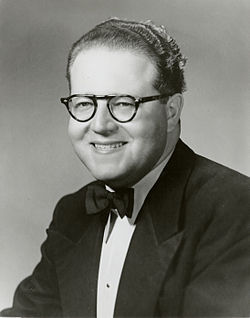
Alfred Reed (born as Alfred Friedman) (January 25, 1921 – September 17, 2005) was an American neoclassical composer, with more than two hundred published works for concert band, orchestra, chorus, and chamber ensemble to his name. He also traveled extensively as a guest conductor (most notably for the Tokyo Kosei Wind Orchestra after the retirement of Frederick Fennell) and served as a professor at the University of Miami School of Music.[1][2]

Key Information

Life

[edit]

Alfred Friedman was born on January 25, 1921, in Manhattan, New York City, to Austrian immigrants Carl Friedemann von Mark and Elizabeth Strasser. Because of anti-German sentiment during World War I, Carl changed the family surname to Friedman shortly before having Alfred.[3] Alfred began his formal music training at the age of ten studying cornet at the New York Schools of Music. In 1938, he started working in the Radio Workshop in New York as a staff arranger and assistant conductor.

In the early 1930s, Reed hired an agent to help market himself around the New York circles. The agent suggested changing his original surname to something less Jewish- and German-sounding to help avoid discrimination. The agent took a syllable from "Friedman", shortening it to "Reed". Reed used this surname for the remainder of his life, legally changing it in 1955.[4]

In 1944 during World War II, he enlisted with the 529th US Army Air Force Corps in Atlantic City, New Jersey as their radio production director and associate conductor producing over 150 weekly broadcasts, and writing scores for over 100 original compositions and arrangements.[5] Following his military service, he attended the Juilliard School of Music, studying under Vittorio Giannini but left without completing in 1948 to instead pursue a career composing music for film and television as a staff composer and arranger first for NBC and then for ABC.

In 1953, he became the conductor of the Baylor Symphony Orchestra at Baylor University, where he received his Bachelor of Music in 1955 and his Master of Music in 1956. His master's thesis, Rhapsody for Viola and Orchestra, was awarded the Luria Prize in 1959.[6]

From 1955 to 1966, he was the executive editor of Hansen Publications, a music publisher. Afterward, he was appointed professor of music at the University of Miami School of Music, where he worked with composer Clifton Williams from 1966 until the latter died in 1976. Reed was the director of the Music Industry Program at the time of his retirement in 1993. During his tenure, he established the Bachelor of Music and Music Merchandising (B.M.M.M) degree and the first college-level music business curriculum in the country.[7]

Works and arrangements

[edit]

Works for concert band

[edit]
  • 1944 Russian Christmas Music
    1. Carol of the Little Russian Children
    2. Antiphonal Chant
    3. Village Song
    4. Cathedral Chorus
  • 1952 Symphony for Brass and Percussion
  • 1955 Lumberjack Overture
  • 1956 Ballade for Solo E♭ Alto Saxophone & Band
  • 1956 The Crowning Glory
  • 1956 Ode for Trumpet for Solo Trumpet & Band
  • 1958 Might and Majesty (A Biblical Suite)
  • 1959 Music Man (Music from the Meredith Willson Musical) (arr.)
    1. The Wells Fargo Wagon
    2. Till There Was You
    3. Seventy-Six Trombones
  • 1962 A Festival Prelude
  • 1962 Seascape for Solo Baritone or Trombone & Band
  • 1962 A Sacred Suite
  • 1963 A Festive Overture
  • 1963 A Symphonic Prelude
  • 1965 Poetry and Power
  • 1966 Rahoon for Solo Clarinet & Band
  • 1966 Serenade for Solo Clarinet & Band
  • 1966 Choral Prelude In E Minor
  • 1967 The Music-Makers
  • 1967 Passacaglia
  • 1968 Intrada Drammatica
  • 1968 Wapawekka - White Sands
  • 1970 A Jubilant Overture
  • 1970 The Pledge of Allegiance
  • 1971 A Ceremonial Fanfare
  • 1972 A Northern Legend
  • 1972 Armenian Dances, Part I
    1. Tzirani Tzar - The Apricot Tree
    2. Gakavi Yerk - The Partridge's Song
    3. Hoy, Nazan Eem - Hoy, My Nazan
    4. Alagyaz
    5. Gna, Gna - Go, Go!
  • 1972 Imperatrix
  • 1972 In Memoriam, an Elegy for the Fallen
  • 1973 Punchinello, Overture
  • 1973 Alleluia! Laudamus Te
  • 1973 Music for Hamlet
  • 1976 Sine Nomine (Ceremonial March in English Style)
  • 1976 First Suite for Band
    1. March
    2. Melody
    3. Rag
    4. Gallop
  • 1977 Armenian Dances, Part II
    1. Hov Arek
    2. Khoomar
    3. Lorva Horovel
  • 1977 Othello (A Symphonic Portrait for Symphonic Band in Five Scenes (after William Shakespeare))
    1. Prelude (Venice) - The tyrant custom hath made the flinty and steel couch of war my thrice-driven bed.
    2. Aubade (Cyprus) - Good Morning, General
    3. Othello and Desdemona - She loved me for the dangers I had passed, and I loved her that she did pity them.
    4. Entrance of the Court - Behold, the Lion of Venice!
    5. The Death of Desdemona; Epilogue - I kissed thee ere I killed thee: no way but this....
  • 1977 Siciliana Notturno for Solo Alto Saxophone & Band
  • 1978 Prelude and Capriccio
  • 1978 Second Suite for Band ("Latino Mexicana")
    1. Son Montuno
    2. Tango ("Sargasso Serenade")
    3. Guaracha
    4. Paso Double ("A la Corrida!")
  • 1979 Second Symphony for Band
    1. Lento (ma ritmico)
    2. Allegro con fuoco
    3. Molto moderato e sostenuto
  • 1980 A Christmas Intrada
  • 1980 The Enchanted Island
  • 1981 The Hounds of Spring
  • 1981 Rushmore
  • 1981 Jesu, Joy of Man's Desiring (arr.)
  • 1982 Queenston Overture
  • 1982 The Garden of Proserpine Symphonic Pastorale
  • 1982 Viva Musica
  • 1982 Third Suite for Band ("Scenes De Ballet")
    1. Fanfare and Intrada
    2. Pas de deux
    3. Polka excentrique
    4. Danse generale
  • 1983 Three Revelations from the Lotus Sutra
    1. To Awaken in the Light of the Universe
    2. To Contemplate the Depths of the Soul
    3. To Rejoice in the Beauty of Peace
  • 1983 Two Bagatelles
  • 1984 Pro Texana
  • 1984 Sleepers, Awake! (arr.)
  • 1984 A Little Concert Suite
    1. Intrada
    2. Siciliana
    3. Scherzo
    4. Gigue
  • 1985 El Camino Real
  • 1985 Ramparts of Courage
  • 1986 Second Century
  • 1986 Danza Caribe
  • 1987 A Christmas Celebration
  • 1987 Golden Jubilee
  • 1988 Praise Jerusalem!
  • 1988 Third Symphony for Band
    1. Pesante e molto sostenuto Allegro agitado
    2. Variations on the "Porazzi" Theme of Wagner
    3. Allegro deciso
  • 1990 Mr. Music
  • 1991 A Springtime Celebration
  • 1991 Curtain Up! (A Theater Overture for Winds)
  • 1992 With Trumpets and Drums
  • 1992 Fourth Symphony for Band
    1. Elegy
    2. Intermezzo
    3. Tarantella
  • 1992 Hymn Variants
  • 1993 Fourth Suite for Band (City of Music)
    1. Intrada
    2. Arie
    3. Marsch
  • 1993 Concertino for Marimba and Winds
  • 1993 Greensleeves (arr.)
  • 1993 Evolutions
  • 1994 Fifth Symphony for Band ("Sakura")
    1. Moderately and sustained
    2. Sakura (Cherry Blossoms)
    3. Allegro molto, con fuoco
    4. Hoe Down (America)
    5. Sarabande (France)
    6. Yamabushi Kagura (Japan)
    7. Hora (Israel and Rumania)
  • 1995 Fifth Suite for Band ("International Dances")
    1. Hoe Down (America)
    2. Sarabande (France)
    3. Yamabushi Kagura (Japan)
    4. Hora (Israel and Rumania)
  • 1995 The King of Love My Shepherd Is
  • 1995 Concerto for Trumpet and Winds
    1. Sonata
    2. Slow Blues
    3. Jazz Waltz
    4. Song
    5. Samba
  • 1997 Canto E Camdombe
  • 1997 The Big East March
  • 1997 The Golden Year
  • 1997 Sixth Suite for Band
    1. March Miniature
    2. Summer Stroll
    3. Halloween Hobgoblin
    4. Awa Odori (Japanese Dance)
  • 1998 Prism
  • 1999 Millennium III
  • 1999 Silver Shadow
  • 2000 Children's Suite for Solo Alto Saxophone & Band
    1. Kiyoko's Lullaby
    2. Kiyoko's Playtime
  • 2001 Acclamation! (A Global Greeting for Winds)
  • Jidai - Year Of Years!
  • 2000 Giligia (A Song of Remembrance)
  • 2000 Music in the Air!
  • 2002 Exhortation and Praise
  • 2003 East And West (The Kohoku New Town March)
  • 2003 Twelfth Night (A Musical Masque after William Shakespeare)
    1. Prelude: Illyria
    2. Viola and Orsino
    3. The Merry Conspirators
    4. Malvolio's Lament in "Prison"
    5. A Double Wedding and All's Well!
  • 2003 Seventh Suite for Band ("A Century of Flight")
    1. Prologue: Look to the Skies!
    2. Intermezzo: The Winds and Waves of Wajima
    3. March: To Fly With the Wings of Eagles
  • 2004 Ebo Signation
  • 2005 Victory!
  • 2005 Rosalind in the Forest of Arden

Works for orchestra

[edit]
  • 1988 American Sketches
    1. No. 1 ("Strings 'n Things")
    2. No. 2 ("Fashion Show")
    3. No. 3 ("Country Night")
    4. No. 4 ("By the Lagoon")
    5. No. 5 ("The Mechanical Doll")

Works for choir and orchestra

[edit]
  • 1970 The Pledge of Allegiance for mixed choir and orchestra
  • 1979 All Hall to the Days! for harp, piano or guitar, strings, and mixed choir

Chamber music

[edit]
  • 1954 Organ Meditations for solo organ
  • 1955 Havana Moon for clarinet choir (3 B, alto, bass, contrabass), percussion, string bass
  • 1966 Scherzo Fantastique for B or E contrabass clarinet and piano
  • 1966 Pastorale for clarinet and piano
  • 1966 Five Dances for Five Clarinets for solo clarinet and accompaniment
  • 1970 Suite Concertante for eight celli, bass, and harp
  • 1975 Double Wind Quintet
  • 1977 Siciliana Notturno for solo alto saxophone and piano
  • 1977 Trilogue for solo string bass, vibraphone, percussion
  • 1983 Two Bagatelles for trombone quartet

References

[edit]
[edit]
Revisions and contributorsEdit on WikipediaRead on Wikipedia
from Grokipedia
Alfred Reed (January 25, 1921 – September 17, 2005) was an American composer, conductor, arranger, and educator best known for his extensive contributions to wind band music, including over 200 works for , wind ensemble, orchestra, chorus, and chamber groups. Born Alfred Friedman in to Austrian immigrant parents Carl and Elizabeth Friedman, he began formal music training at age ten on the and soon adopted the professional surname Reed while playing professionally in New York. During , Reed served as an associate conductor and arranger with the 529th U.S. Army Air Force Band. After the war, he studied composition under Vittorio Giannini at the of Music and earned Bachelor of Music (1955) and Master of Music (1956) degrees from , where he also conducted the symphony orchestra in 1953. Reed's professional career included roles as a staff composer and arranger for NBC and ABC radio networks from 1938 to 1942 and again postwar, as well as executive editor at Hansen Publications from 1955 to 1966. In 1966, he joined the University of Miami as a professor of music, where he chaired the music media and industry department, directed the music industry program, and taught until his retirement in 1993. Among his most celebrated compositions are Russian Christmas Music (1944), Armenian Dances (1972–78), and El Camino Real (1985), which have become staples in wind band repertoires worldwide and earned him international acclaim as a guest conductor. Reed's legacy endures through his innovative arrangements and original works that elevated the artistic standards of the wind band medium.

Early Life and Education

Childhood and Family Background

Alfred Reed was born Alfred Friedman on January 25, 1921, in , , to parents Carl and Elizabeth Friedman, who had emigrated from , , before . As first-generation Americans of Austrian descent, the Friedmans instilled a deep appreciation for European cultural traditions in their home. Although neither parent was a professional musician, music held a central place in the family environment as a cherished cultural value, with daily exposure to classical repertoire shaping Reed's early sensibilities. The household revered composers such as Beethoven, Brahms, Bach, Bruckner, and Wagner—whom they regarded as greater figures than political leaders—fostering an atmosphere that encouraged artistic pursuits from a young age. By his early teens, while performing in a dance band, Friedman adopted the stage name Alfred Reed at the suggestion of an agent, who noted that it carried no particular religious or ethnic connotations, making it more suitable for the music industry. He continued using this name professionally and legally changed it to Reed in 1955 to align with his established career identity. Reed's childhood unfolded amid the dynamic energy of and New York City, a period marked by proliferation, economic shifts from to the , and a burgeoning immigrant cultural scene that enriched everyday life for families like his. This vibrant urban backdrop contributed to his early years before his formal musical studies began at age ten.

Musical Training and Formal Education

Reed began his formal musical training at the age of ten, studying under the guidance of his family's encouragement of musical pursuits in their Austrian-descended household. He enrolled at the New York Schools of Music, where he focused on , laying the foundation for his instrumental proficiency. During his high school years, Reed deepened his involvement in music through active participation in ensembles and professional performances on , while also exploring early attempts at composition and studying and harmony with instructor John Sacco. In the 1940s, following the war, Reed enrolled at the of Music, where he pursued composition studies under Vittorio Giannini until an interruption in 1948. Later, he completed his education at , earning a degree in 1955 and a degree in 1956; his master's thesis, titled Rhapsody for Viola and Orchestra, was awarded the Luria Prize in 1959. During his time at Baylor, Reed conducted the symphony orchestra in 1953 and became a member of the Beta Tau Chapter of , the national music fraternity for men.

Professional Career

Early Professional Work and Military Service

Reed began his professional career in 1938 as a staff arranger and assistant conductor at the Radio Workshop in , where he contributed to radio productions until 1942. In 1944, amid , Reed enlisted in the U.S. Army Air Forces and was assigned to the 529th Army Air Force Band in , serving as radio production director and associate conductor. In this role, he oversaw the creation of more than 150 weekly broadcasts and morale-boosting performances, while composing and arranging nearly 100 works for the band. During his service, Reed composed his early notable work Russian Christmas Music in November 1944, a four-section suite premiered that December on a nationwide broadcast from Denver, Colorado, blending Russian folk elements with Western choral traditions. Following the war, Reed briefly resumed his interrupted studies at before transitioning in 1948 to a staff position as composer and arranger for and later ABC, focusing on music for radio, film, and television productions.

Teaching and Academic Positions

In the early 1950s, Reed began his academic career at in , where he served as conductor of the Symphony Orchestra from 1953 to 1955 while completing his Master of Music degree. His prior experience as an editor at Hansen Publications from 1955 to 1966 informed his later curriculum innovations in music industry education. Reed's most significant academic tenure was at the University of Miami School of Music, where he joined the faculty in 1966 as a with a joint appointment in the Theory-Composition and departments, a role he held until his retirement in 1993. During this period, he also served as chairman of the Music Theory and Composition Department and, from 1980, as conductor and of the Symphonic following Frederick Fennell's retirement. In a pioneering effort, Reed established the and Music Merchandising (B.M.M.M.) degree program in 1966, creating the first college-level curriculum in music business and management, which emphasized practical aspects of the music industry and influenced similar programs at other institutions. Through his teaching in theory and composition, Reed mentored numerous students, guiding them in compositional techniques and band conducting practices tailored to wind ensembles. Reed extended his academic outreach through extensive guest conducting engagements worldwide, including multiple invitations with the Kosei Wind Orchestra, where he was the first foreign conductor to lead and record performances of his works, fostering international collaboration and educational exchange in wind music. These activities complemented his roles by providing students with exposure to global performance standards and professional networks in the field.

Editorial and Publishing Roles

Following his tenure as a staff arranger for and ABC, Alfred Reed transitioned to the publishing sector in 1955 as executive editor of Hansen Publications in New York, a role he held until 1966. In this position, he oversaw the editing and publication of educational music for school bands, orchestras, and choruses, focusing on high-quality scores that supported ensemble performance and instruction. During his time at Hansen, Reed contributed to numerous arrangement projects for the publisher and others, adapting a range of musical materials to suit band and orchestral settings. Notable examples include his arrangement of Autumn Leaves, which showcased his skill in transcribing popular and jazz-influenced works for educational ensembles, and adaptations drawing on folk and international themes, such as elements in Russian Christmas Music based on traditional Russian carols. These efforts helped expand accessible for student performers by blending cultural motifs with idiomatic band instrumentation. Reed's editorial selections at Hansen played a key role in standardizing band literature, as he curated and promoted works that became staples in and programs, emphasizing balanced programming and technical development for ensembles. His position facilitated over 60 commissions throughout his career, with several originating from publishing connections during this era, including A Festival Prelude (1956), composed for the Tri-State Music Festival's 25th to highlight emerging band standards. These initiatives elevated the quality and diversity of published band , influencing pedagogical practices in the United States.

Compositions and Arrangements

Concert Band Works

Alfred Reed composed over 200 published works for , establishing it as his primary compositional medium and contributing significantly to the wind band . Many of these pieces emphasize educational accessibility while showcasing advanced techniques suitable for school and professional ensembles. Among his symphonic output for band, Reed wrote several multi-movement works, including Symphony No. 2 (1985) and Symphony No. 3 (1988), which explore programmatic themes through expansive structures. His neoclassical approach to band scoring is evident in these symphonies, blending traditional forms with modern harmonic language. One of Reed's earliest landmark pieces, "Russian Christmas Music" (1944), is an original rhapsodic fantasy for band that weaves an ancient Russian Christmas , "Carol of the Little Russian Children," with motifs from Eastern Orthodox . The work's structure unfolds in four connected sections—Children's Carol, Antiphonal Chant, Village Song, and Cathedral Chorus—building from intimate folk-like expressions to grand choral climaxes evoking Russian Orthodox traditions. It premiered in December 1944 in , , as part of a U.S. State Department cultural exchange broadcast on , and was revised in 1946 before winning a prize in the 1947 Band Composition . "Armenian Dances," Parts I and II (1972 and 1977), represent another cornerstone of Reed's oeuvre, consisting of a four-movement suite arranged from authentic Armenian folk songs collected by Gomidas Vartabed (1869–1935), the founder of modern Armenian . Part I (1972) is a single extended movement divided into five sections—"The Apricot Tree," "Partridge's Song," "Hoy, My Nazan," "Alagyaz," and "Go, Go"—each highlighting rhythmic vitality and modal melodies from Vartabed's transcriptions, lasting approximately 11 minutes. Part II (1977) adds three movements: "Hov Arek" (a lively dance), "Khoomar" (a pastoral lament), and "Lorva Horovel" (a majestic processional), extending the total suite to about 32 minutes. Part I premiered on January 10, 1973, with the University of Illinois Symphonic Band under Harry Begian, to whom it is dedicated; Part II followed in performance by the same ensemble in 1978. These works draw on national motifs to preserve and adapt Armenian cultural heritage for Western wind instruments. "El Camino Real" (1984), subtitled "A Latin Fantasy," is an original programmatic piece inspired by Spanish flamenco traditions and the historic El Camino Real route, employing Reed's "melodizing of harmony" technique to transform chord progressions into lyrical themes. Its ternary structure (fast-slow-fast) features a vigorous opening Jota section, a contemplative central variation, and a fiery recapitulation, capturing the passion of flamenco guitarists within band sonorities. The work premiered on April 15, 1985, in , by the 581st U.S. Band under Lt. Col. Ray E. Toler, to whom it is dedicated. "A Festival Prelude" (1955) serves as a concise original , designed to open concerts with its bright, majestic tone colors achieved through antiphonal and woodwind interplay. Structured around a primary lyrical theme flanked by two figures, it progresses from an initial flourish and statements to a variation, processional , and resounding coda, evoking celebratory pomp without specific narrative ties. Composed for the 25th anniversary of the Tri-State , it premiered in 1956 with the Phillips University Band in , conducted by Reed himself. Reed's thematic focus often centered on national and cultural motifs, as seen in these pieces, which incorporate folk elements from Russian, Armenian, and Spanish traditions to foster appreciation in band settings. While his originals dominate, Reed also created numerous arrangements for , adapting orchestral and choral works to highlight wind textures; notable examples include "" (traditional English folk song, arranged to emphasize modal colors and modal shifts) and "" from Elgar's (a solemn processional underscoring contrapuntal depth). These adaptations, numbering over 100 from his era alone, distinguish themselves by prioritizing band's idiomatic strengths over literal transcription.

Orchestral Works

Alfred Reed's orchestral compositions, though fewer in number than his prolific output for , demonstrate his versatility in adapting neoclassical structures to the full symphony orchestra, with particular emphasis on lush textures and prominent lines that echo his wind ensemble expertise. Unlike his band works, which often prioritize rhythmic drive and sonorities, Reed's orchestral pieces explore more intimate thematic development and contrapuntal interplay among , woodwinds, and percussion, creating a balanced symphonic palette. A pivotal early work in this repertoire is his Rhapsody for Viola and Orchestra, composed in 1956 as his master's thesis at , which won the Luria Prize in 1959. This piece features a lyrical viola solo navigating expansive, rhapsodic themes supported by a full scored for 3 flutes (3rd doubling ), 3 oboes, 3 clarinets, 3 bassoons, 4 horns, 3 trumpets, 3 trombones, tuba, timpani, four percussion, harp, and strings. Lasting about 16 minutes, it premiered in 1959 and was published by in 1966, highlighting Reed's skill in blending soloistic expression with orchestral color. Reed's later orchestral contribution, American Sketches (1988), consists of five concise movements for full : "Strings 'n Things," "," "Country Night," "By the Lagoon," and "The Mechanical Doll." Commissioned and published by Edwin F. Kalmus, this suite evokes varied American vignettes through neoclassical forms, with thematic material developed via inversion, augmentation, and canonic writing tailored to orchestral timbres—strings providing melodic fluidity in the first movement, while and percussion add in the finale. The work's details remain tied to contemporary orchestral ensembles of the late , underscoring Reed's commission-driven approach to symphonic writing.

Choral and Vocal Works

Alfred Reed's choral and vocal works often integrate voices with orchestral or band accompaniment, emphasizing patriotic fervor and sacred themes that reflect his neoclassical style and American heritage. These compositions typically feature mixed choruses () and draw on texts from historical or literary sources to evoke emotional depth and communal unity. Among his output, Reed produced approximately 20-30 pieces in this genre, many of which adapt folk tunes, holiday carols, or original librettos to create accessible yet sophisticated vocal ensembles. A prominent example is (1970), composed for mixed chorus and band or , which sets the iconic American to a stirring, majestic melody that builds from solemn recitation to triumphant affirmation. This work, published by Edward B. Marks Music Company, has been widely performed in educational and patriotic settings, underscoring Reed's commitment to civic themes through simple yet powerful vocal lines supported by robust instrumental textures. Similarly, Testament of an American (1974) for chorus with , band, or adapts patriotic texts to explore themes of and resilience; its lyrics draw from American historical sentiments, creating a narrative arc that mirrors the nation's foundational struggles and ideals. The piece premiered in educational concerts and has since become a staple for choral ensembles seeking inspirational repertoire. Reed's sacred vocal works frequently incorporate holiday motifs, as seen in A Christmas Celebration (Medley) for SSAA/SATB chorus, which weaves traditional carols like "Silent Night," "Angels We Have Heard on High," and "" into a cohesive arrangement suitable for choral-orchestral performance. Published by (Edward B. Marks imprint), this medley highlights Reed's skill in blending voices with instrumental forces for festive, uplifting effects, often crossing over from his band arrangements to include choral elements. Another notable contribution is All Hail to the Days! (1979) for chorus with , or guitar, strings, and percussion, an original setting of seasonal texts that celebrates renewal through lyrical vocal writing and delicate . These pieces demonstrate Reed's approach to text-music integration, where vocal lines enhance textual meaning through dynamic phrasing and harmonic support, fostering a sense of shared cultural narrative without relying on elaborate librettos. histories of these works span choirs, ensembles, and orchestras, affirming their enduring appeal in American musical .

Chamber and Other Works

Alfred Reed's chamber compositions, though fewer in number compared to his larger-scale works, showcase his innovative approach to small writing, often tailored for educational settings or specific combinations. These pieces typically feature under 20 works, emphasizing rhythmic vitality, contrapuntal textures, and idiomatic writing for , strings, and percussion. Many were commissioned by academic institutions or professional groups, reflecting Reed's dual role as and educator. Among his notable wind-focused chamber works is Havana Moon (1955), the third movement of the Caribbean Suite, composed for clarinet choir and percussion during a period of growing interest in clarinet ensembles among music educators. This lively piece evokes Latin rhythms through syncopated lines and percussive accents, and it was published by Kalmus, making it accessible for school performances. Similarly, the Double Wind Quintet (1975) unites a traditional woodwind (, , , horn, ) with a brass (two trumpets, horn, , ), exploring diverse timbral interactions across three movements: an energetic intrada, a lyrical , and a spirited . Premiered by faculty ensembles at the , where Reed taught, it highlights his skill in blending wind families for chamber settings and was published by Marks Music Corporation. Reed also ventured into non-wind chamber music with Suite Concertante (1970), originally scored for eight s and , premiered on April 19, 1970, by the Cello Ensemble. The five-movement work draws on forms like prelude and fugue, adapted for the homogeneous string texture, and was later expanded to include and full for broader performance options; it remains a staple for cello ensembles in educational programs. Another experimental piece, Trilogue (1978), a for solo accompanied by two mallet percussion instruments ( and ), emphasizes virtuosic interplay and percussive drive in a compact, one-movement form. Published by Kalmus, it was designed for advanced student recitals, underscoring Reed's interest in unconventional timbres for pedagogical purposes. These chamber efforts, often premiered in academic contexts, served as vehicles for exploring neoclassical techniques in intimate scales, complementing Reed's broader oeuvre without overlapping into vocal or large-ensemble domains.

Musical Style and Influences

Neoclassical Approach

Alfred Reed's neoclassical approach in composition represented a deliberate return to classical structures, including and , while incorporating 20th-century harmonic elements such as modal inflections and extended tonalities. This synthesis allowed for a balanced framework that honored traditional formal rigor without sacrificing modern expressiveness, distinguishing his output from both purely romantic excess and serialist abstraction. Central to Reed's style was an emphasis on clarity and contrapuntal textures, particularly in his writing for , where intricate polyphonic lines interwove to create transparent yet robust sonic landscapes. Programmatic elements further enriched this approach, drawing on cultural or narrative inspirations to guide thematic development, as seen in Russian Christmas Music, which evokes Russian liturgical traditions through modal themes and antiphonal exchanges. These features ensured accessibility while highlighting the band's timbral capabilities. Reed consistently avoided experimentation, preferring a tonal foundation that prioritized intelligibility and performability in educational and ensemble settings. His music remained rooted in functional , often resolving through conventional progressions augmented by subtle dissonances, making it ideal for student ensembles and professional wind groups alike. This commitment to underscored his role in elevating band literature to symphonic standards without alienating performers or audiences. Reed's neoclassical style evolved from earlier romantic influences toward a more refined maturity in the , as evidenced by works like Armenian Dances, where classical forms supported folk-derived programmatic narratives with heightened contrapuntal sophistication. This progression reflected his extensive experience in and , culminating in compositions that balanced and for enduring impact.

Key Influences and Techniques

One of Alfred Reed's primary influences was his composition Vittorio Giannini at the of Music, where Reed studied following and absorbed romantic-traditional techniques such as elaborate thematic development. Giannini's approach emphasized structural coherence and melodic expansion, which Reed applied throughout his career, as seen in works like Russian Christmas Music, where four distinct themes are transformed across sections to create unity and progression. Reed drew significant cultural inspirations from folk and liturgical traditions, incorporating Armenian folk songs collected by Gomidas Vartabed into Armenian Dances, Parts I and II, a suite that adapts these melodies for concert band while preserving their rhythmic and modal characteristics. Similarly, in Russian Christmas Music, he integrated elements of Russian Orthodox chants, particularly in the "Antiphonal Chant" section, evoking the vocal polyphony of Eastern Orthodox liturgical music inspired by his exposure to such traditions during a visit to an Orthodox church community in Colorado. Reed's compositional techniques highlighted advanced wind scoring to achieve timbral color and sectional balance, utilizing large ensembles with independent lines for double reeds and trumpets to layer textures effectively. In his band works, he frequently employed ostinatos, such as the rapid bass patterns in the "Village Song" of Russian Christmas Music, and fanfares, like those passed antiphonally in the " Chorus" to build dramatic climaxes. His service in the 529th Army Air Force Band, where he served as an arranger, deepened his affinity for wind ensembles and infused patriotic themes into pieces reflecting national pride and resilience. Additionally, Reed received over 60 commissions, which broadened his exploration across genres and reinforced his adaptable methods.

Legacy and Recognition

Awards and Honors

In 1959, Alfred Reed received the Luria Prize from the for his master's thesis composition, Rhapsody for Viola and Orchestra, which marked an early recognition of his orchestral writing talents. Reed was honored with the Distinguished Service to Music Medal, the highest award bestowed by National Honorary Band Fraternity, during the 1989–1991 biennium in the Composition category, acknowledging his profound contributions to band literature and performance. Throughout his career, Reed garnered over 60 commissions from prestigious institutions and ensembles, reflecting ongoing esteem for his compositional expertise; notable examples include A Festival Prelude (1956) commissioned by the Tri-State Music Festival, The Music-Makers (1967) for the Spencerport High School Wind Ensemble, and a centennial work for the Bands (1986).

Impact on Wind Music and Education

Alfred Reed's prolific compositional output significantly elevated the status of the concert band, transforming it from a primarily educational ensemble into a symphonic-level medium capable of performing sophisticated, original works. With over 250 published compositions for concert band and wind ensemble, Reed's music emphasized complex orchestration, thematic development, and emotional depth, drawing parallels to orchestral literature. His pieces, such as Armenian Dances (1975), based on authentic folk songs collected by Komitas Vartabed, have become enduring standards in the wind band repertoire, frequently programmed by professional and collegiate ensembles for their rhythmic vitality and cultural authenticity. This body of work helped legitimize the wind band as a serious artistic vehicle, influencing composers and performers to approach it with greater ambition. In education, Reed pioneered the integration of music business training into academic curricula, establishing the first college-level music merchandising degree program at the University of Miami in 1966 during his tenure as professor of music. This in Music Industry initiative, which he developed and led, covered topics like , , and management, addressing a gap in preparing musicians for professional careers beyond performance. The program's success prompted similar offerings at other institutions, broadening to include entrepreneurial skills and fostering a new generation of industry professionals. Reed's legacy as a guest conductor further amplified his influence on wind music globally, as he led performances in 49 U.S. states and internationally in , , , , , and . Notably, his frequent collaborations with the Tokyo Kosei Wind Orchestra, including multiple tours and recordings, promoted American wind band literature abroad and elevated the ensemble's international profile. These engagements, spanning decades, inspired conductors and ensembles worldwide to adopt Reed's interpretive approaches and expand their repertoires. Posthumously, Reed's contributions continue to resonate, with more than 400 recordings of his works documented by 1999 and ongoing performances affirming their vitality into 2025. Recent ensembles, such as the Wind Ensemble in 2024 and the All-State High School in 2025, have featured pieces like El Camino Real, demonstrating the sustained integration of his music into educational and professional settings. This enduring presence underscores Reed's role in shaping wind music and repertoire for future generations.

References

Add your contribution
Related Hubs
User Avatar
No comments yet.