
Alnico
View on Wikipedia
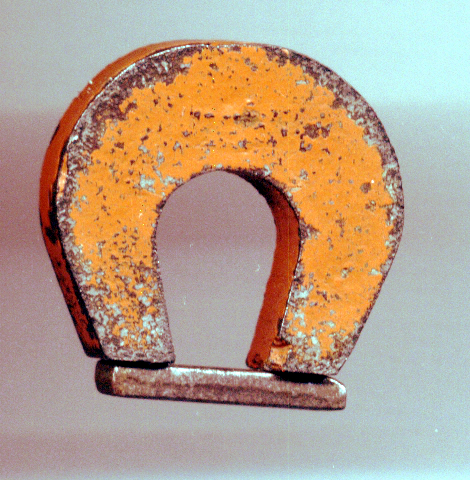
Alnico is a family of iron alloys which, in addition to iron, are composed primarily of aluminium (Al), nickel (Ni), and cobalt (Co), hence the acronym[1] al-ni-co. They also include copper, and sometimes titanium. Alnico alloys are ferromagnetic, and are used to make permanent magnets. Before the development of rare-earth magnets in the 1970s, they were the strongest permanent magnet type. Other trade names for alloys in this family are: Alni, Alcomax, Hycomax, Columax, and Ticonal.[2]
The composition of alnico alloys is typically 8–12% Al, 15–26% Ni, 5–24% Co, up to 6% Cu, up to 1% Ti, and the rest is Fe. The development of alnico began in 1931, when T. Mishima in Japan discovered that an alloy of iron, nickel, and aluminum had a coercivity of 400 oersteds (32 kA/m), double that of the best magnet steels of the time.[3]
Properties
[edit]Alnico alloys can be magnetised to produce strong magnetic fields and have a high coercivity (resistance to demagnetization), thus making strong permanent magnets. Of the more commonly available magnets, only rare-earth magnets such as neodymium and samarium-cobalt are stronger. Alnico magnets produce magnetic field strength at their poles as high as 1500 gauss (0.15 tesla), or about 3000 times the strength of Earth's magnetic field. Some alnico brands are isotropic and can be efficiently magnetized in any direction. Other types, such as alnico 5 and alnico 8, are anisotropic, each having a preferred direction of magnetization, or orientation. Anisotropic alloys generally have greater magnetic capacity in a preferred orientation than isotropic types. Alnico's remanence (Br) may exceed 12,000 G (1.2 T), its coercivity (Hc) can be up to 1000 oersteds (80 kA/m), its maximum energy product ((BH)max) can be up to 5.5 MG·Oe (44 T·kA/m). Therefore, alnico can produce a strong magnetic flux in closed magnetic circuits, but has relatively small resistance against demagnetization. The field strength at the poles of any permanent magnet depends very much on the shape and is usually well below the remanence strength of the material.
Alnico alloys have some of the highest Curie temperatures of any magnetic material, around 800 °C (1,470 °F), although the maximal working temperature is typically limited to around 538 °C (1,000 °F).[4] They are the only magnets that have useful magnetism even when heated red-hot.[5] This property, as well as its brittleness and high melting point, results from the strong tendency toward order due to intermetallic bonding between aluminum and other constituents. They are also one of the most stable magnets if handled properly. Alnico magnets are electrically conductive, unlike ceramic magnets.[citation needed] Alnico 3 has a melting temperature of 1200 - 1450 °C.[6]
| MMPA class |
IEC code ref. |
Composition by weight (Fe comprises remainder) |
Magnetic properties | Physical properties | Thermal properties | |||||||||||||||||||||||||
|---|---|---|---|---|---|---|---|---|---|---|---|---|---|---|---|---|---|---|---|---|---|---|---|---|---|---|---|---|---|---|
| Max. energy product, (BH)max |
Residual induction, Br |
Coercive force, Hc |
Intrinsic coercive force, Hci |
Density | Tensile strength |
Transverse modulus of rupture |
HRC | Thermal expansion coefficient (10−6 per °C) |
Electrical resistivity, at 20 °C (μΩ·cm) |
Reversible temp. coefficient, (% per °C) |
Curie temp. |
Max. service temp. | ||||||||||||||||||
| Al | Ni | Co | Cu | Ti | (MGOe) | (kJ/m3) | (gauss) | (mT) | (Oe) | (kA/m) | (Oe) | (kA/m) | (lb/in3) | (g/cm3) | (psi) | (MPa) | (psi) | (MPa) | Near Br |
Near max. energy prod. |
Near Hc |
(°C) | (°F) | (°C) | (°F) | |||||
| Isotropic cast AlNiCo | ||||||||||||||||||||||||||||||
| Alnico 1 | R1-0-1 | 12 | 21 | 5 | 3 | - | 1.4 | 11.1 | 7200 | 720 | 470 | 37 | 480 | 38 | 0.249 | 6.9 | 4000 | 28 | 14000 | 97 | 45 | 12.6 | 75 | |||||||
| Alnico 2 | R1-0-4 | 10 | 19 | 13 | 3 | - | 1.7 | 13.5 | 7500 | 750 | 560 | 45 | 580 | 46 | 0.256 | 7.1 | 3000 | 21 | 7000 | 48 | 45 | 12.4 | 65 | -0.03 | -0.02 | -0.02 | 810 | 1490 | 450 | 840 |
| Alnico 3 | R1-0-2 | 12 | 25 | - | 3 | - | 1.35 | 10.7 | 7000 | 700 | 480 | 38 | 500 | 40 | 0.249 | 6.9 | 12000 | 83 | 23000 | 158 | 45 | 13.0 | 60 | |||||||
| Anisotropic cast AlNiCo | ||||||||||||||||||||||||||||||
| Alnico 5 | R1-1-1 | 8 | 14 | 24 | 3 | - | 5.5 | 43.8 | 12800 | 1280 | 640 | 51 | 640 | 51 | 0.264 | 7.3 | 5400 | 37 | 10500 | 72 | 50 | 11.4 | 47 | -0.02 | -0.015 | +0.01 | 860 | 1580 | 525 | 975 |
| Alnico 5DG | R1-1-2 | 8 | 14 | 24 | 3 | - | 6.5 | 57.7 | 13300 | 1330 | 670 | 53 | 670 | 53 | 0.264 | 7.3 | 5200 | 36 | 9000 | 62 | 50 | 11.4 | 47 | |||||||
| Alnico 5-7 | R1-1-3 | 8 | 14 | 24 | 3 | - | 7.5 | 59.7 | 13500 | 1350 | 740 | 59 | 740 | 59 | 0.264 | 7.3 | 5000 | 34 | 8000 | 55 | 50 | 11.4 | 47 | |||||||
| Alnico 6 | R1-1-4 | 8 | 16 | 24 | 3 | 1 | 3.9 | 31.0 | 10500 | 1050 | 780 | 62 | 800 | 64 | 0.265 | 7.3 | 23000 | 158 | 45000 | 310 | 50 | 11.4 | 50 | -0.02 | -0.015 | +0.03 | 860 | 1580 | 525 | 975 |
| Alnico 8 | R1-1-5 | 7 | 15 | 35 | 4 | 5 | 5.3 | 42.2 | 8200 | 820 | 1650 | 131 | 1860 | 148 | 0.262 | 7.3 | 10000 | 59 | 30000 | 207 | 55 | 11.0 | 53 | -0.025 | -0.01 | +0.01 | 860 | 1580 | 550 | 1020 |
| Alnico 8HC | R1-1-7 | 8 | 14 | 38 | 3 | 8 | 5.0 | 39.8 | 7200 | 720 | 1900 | 151 | 2170 | 173 | 0.262 | 7.3 | 10000 | 59 | 30000 | 207 | 55 | 11.0 | 54 | -0.025 | -0.01 | +0.01 | 860 | 1580 | 550 | 1020 |
| Alnico 9 | R1-1-6 | 7 | 15 | 35 | 4 | 5 | 9.0 | 71.6 | 10600 | 1060 | 1500 | 119 | 1500 | 119 | 0.262 | 7.3 | 7000 | 48 | 8000 | 55 | 55 | 110. | 53 | -0.025 | -0.01 | +0.01 | 860 | 1580 | 550 | 1020 |
| Isotropic sintered AlNiCo | ||||||||||||||||||||||||||||||
| Alnico 2 | R1-0-4 | 10 | 19 | 13 | 3 | - | 1.5 | 11.9 | 7100 | 710 | 550 | 44 | 570 | 45 | 0.246 | 6.8 | 65000 | 448 | 70000 | 483 | 45 | 123.4 | 68 | |||||||
| Anisotropic sintered AlNiCo | ||||||||||||||||||||||||||||||
| Alnico 5 | R1-1-10 | 8 | 14 | 24 | 3 | - | 3.9 | 31.0 | 10900 | 1090 | 620 | 49 | 630 | 50 | 0.250 | 6.9 | 50000 | 345 | 55000 | 379 | 45 | 11.3 | 50 | |||||||
| Alnico 6 | R1-1-11 | 8 | 15 | 24 | 3 | 1 | 2.9 | 23.1 | 9400 | 940 | 790 | 63 | 820 | 65 | 0.250 | 6.9 | 55000 | 379 | 100000 | 689 | 45 | 11.4 | 54 | |||||||
| Alnico 8 | R1-1-12 | 7 | 15 | 35 | 4 | 5 | 4.0 | 31.8 | 7400 | 740 | 1500 | 119 | 1690 | 134 | 0.252 | 7.0 | 50000 | 345 | 55000 | 379 | 45 | 11.0 | 54 | |||||||
| Alnico 8HC | R1-1-13 | 7 | 14 | 38 | 3 | 8 | 4.5 | 35.8 | 6700 | 670 | 1800 | 143 | 2020 | 161 | 0.252 | 7.0 | 55000 | 379 | 45 | 11.0 | 54 | |||||||||
As of 2018, Alnico magnets cost about 44 USD/kg (US$20/lb) or US$4.30/BHmax.[7]

Classification
[edit]Alnico magnets are traditionally classified using numbers assigned by the Magnetic Materials Producers Association (MMPA), for example, alnico 3 or alnico 5. These classifications indicate chemical composition and magnetic properties. (The classification numbers themselves do not directly relate to the magnet's properties; for instance, a higher number does not necessarily indicate a stronger magnet.)[8]
These classification numbers, while still in use, have been deprecated in favor of a new system by the MMPA, which designates Alnico magnets based on maximum energy product in megagauss-oersteds and intrinsic coercive force as kilo oersted, as well as an IEC classification system.[8]
Manufacturing process
[edit]
Alnico magnets are produced by casting or sintering processes.[9] Cast alnico is produced by conventional methods using resin bonded sand molds, which can be intricate and detailed, thereby allowing for complex shapes to be produced.[10] The produced alnico magnet typically has a rough surface.[11] This process has higher initial tooling costs for mold creation.[12] Sintered alnico magnets are formed using powdered metal manufacturing methods. While sintering can also produce a range of shapes, it may not be as suitable for extremely intricate or detailed designs compared to casting.[10][13]
Most alnico produced is anisotropic, meaning that during manufacturing the grains are precipitated with their magnetic axes parallel. Anisotropic alnico magnets are oriented by heating above a critical temperature and cooling in the presence of a magnetic field. Both isotropic and anisotropic alnico require proper heat treatment to develop optimal magnetic properties. Without it, alnico's coercivity is about 10 Oe, comparable to technical iron, a soft magnetic material. After the heat treatment alnico becomes a composite material, named "precipitation material"—it consists of iron- and cobalt-rich[14] precipitates in a rich-NiAl matrix.

Alnico's anisotropy is oriented along the desired magnetic axis by applying an external magnetic field to it during the precipitate particle nucleation, which occurs when cooling from 900 °C (1,650 °F) to 800 °C (1,470 °F), near the Curie point. There are local anisotropies of different orientations without an external field due to spontaneous magnetization. The precipitate structure is a "barrier" against magnetization changes, as it prefers few magnetization states requiring much energy to get the material into any intermediate state. Also, a weak magnetic field shifts the magnetization of the matrix phase only and is reversible.
Uses
[edit]
Alnico magnets are widely used in industrial and consumer applications where strong permanent magnets are needed. Examples are electric motors, electric guitar pickups, microphones, sensors, loudspeakers, magnetron tubes, and cow magnets. In many applications they are being superseded by rare-earth magnets, whose stronger fields (Br) and larger energy products (B·Hmax) allow smaller-size magnets to be used for a given application.
The high-temperature resistance of alnico magnets leads to many uses that cannot be filled by less resistant magnets, such as in magnetic stirring hotplates.
References
[edit]- ^ Hellweg, Paul (1986). The Insomniac's Dictionary. Facts On File Publications. p. 115. ISBN 978-0-8160-1364-7.
- ^ Brady, George Stuart; Clauser, Henry R.; Vaccari, John A. (2002). Materials Handbook: An Encyclopedia for Managers. McGraw-Hill Professional. p. 577. ISBN 978-0-07-136076-0.
- ^ Cullity, B. D.; Graham, C. D. (2008). Introduction to Magnetic Materials. Wiley-IEEE. p. 485. ISBN 978-0-471-47741-9.
- ^ "Alnico Magnets & Custom Assemblies". Arnold Magnetic Technologies. Archived from the original on September 13, 2024. Retrieved September 13, 2024.
- ^ Hubert, Alex; Rudolf Schäfer (1998). Magnetic domains: the analysis of magnetic microstructures. Springer. p. 557. ISBN 978-3-540-64108-7.
- ^ "ALNICO 3 Safety Data Sheet" (PDF). September 2, 2014. Archived (PDF) from the original on September 13, 2024.
- ^ "Frequently Asked Questions". Total Magnetic Solutions. Magnet Sales & Manufacturing Company, Inc. Archived from the original on March 12, 2019. Retrieved March 12, 2019.
- ^ a b "Standard Specifications for Permanent Magnet Materials (MMPA Standard No. 0100-00)" (PDF). Magnetic Materials Producers Association. Retrieved 9 September 2015.
- ^ Campbell, Peter (1996). Permanent magnet materials and their application. UK: Cambridge University Press. pp. 35–38. Bibcode:1996pmma.book.....C. ISBN 978-0-521-56688-9.
- ^ a b Cui, Jun; Ormerod, John (2022). "Manufacturing Processes for Permanent Magnets: Part I—Sintering and Casting". JOM. 74 (4): 1279–1295. Bibcode:2022JOM....74.1279C. doi:10.1007/s11837-022-05156-9.
- ^ "AlNiCo Magnets". Stanford Magnets. Retrieved September 13, 2024.
- ^ Rottmann, P.F.; Polonsky, A.T. (2021). "TriBeam tomography and microstructure evolution in additively manufactured Alnico magnets". Mater. 49: 23–34. doi:10.1016/j.mattod.2021.05.003.
- ^ Dussa, Saikumar; Joshi, S. S. (2024). "Additively Manufactured Alnico Permanent Magnet Materials—A Review". Magnetism. 4 (2): 125–156. doi:10.3390/magnetism4020010.
- ^ Chu, W.G; Fei, W.D; Li, X.H; Yang, D.Z; Wang, J.L (2000). "Evolution of Fe-Co rich particles in Alnico 8 alloy thermomagnetically treated at 800 °C". Materials Science and Technology. 16 (9): 1023–1028. Bibcode:2000MatST..16.1023C. doi:10.1179/026708300101508810. S2CID 137015369.
Further reading
[edit]- MMPA 0100-00, Standard Specifications for Permanent Magnet Materials
Alnico
View on GrokipediaIntroduction
Composition and Definition
Alnico is a family of permanent magnet alloys primarily composed of iron (Fe) as the base metal, along with aluminum (Al), nickel (Ni), and cobalt (Co) as key alloying elements, and often including smaller amounts of copper (Cu) and titanium (Ti) in certain variants.[17] Typical compositions across Alnico grades feature 7–12% Al, 14–25% Ni, 5–38% Co, 28–55% Fe, 2–4% Cu, and 0–8% Ti by weight, with the exact ratios varying to achieve specific performance characteristics.[17] These alloys derive their name from the primary non-iron elements: Al-Ni-Co.[18] Each element plays a distinct role in the alloy's magnetic behavior. Iron provides the foundational ferromagnetic properties, enabling high saturation magnetization essential for the material's overall magnetic strength.[17] Aluminum contributes to phase formation that enhances remanence, the ability to retain magnetization after an external field is removed.[17] Nickel improves coercivity, the resistance to demagnetization, by stabilizing phases and forming bridges that enhance magnetic connectivity.[17] Cobalt significantly boosts the Curie temperature—the point at which the material loses its permanent magnetism—and increases saturation magnetization, allowing Alnico to operate effectively at elevated temperatures up to around 860°C.[17] Copper aids in phase separation during processing, which refines the microstructure and improves coercivity.[17] Titanium similarly refines grain structure by increasing phase volume and preventing unwanted gamma phase formation, thereby enhancing coercivity and remanence in high-performance grades.[17] These elemental contributions result in Alnico's characteristic nanostructured architecture, which underpins its utility as a thermally stable permanent magnet material.[17]Historical Development
The development of Alnico magnets originated in the early 1930s when Japanese metallurgist Tokushichi Mishima discovered that an alloy composed primarily of iron, nickel, and aluminum possessed enhanced magnetic coercivity compared to earlier magnetic steels.[19] Mishima filed a patent for this AlNi composition in 1932 (granted in 1936), marking the initial breakthrough in creating stronger permanent magnets through precise alloying.[19] The name "Alnico" derives from the elemental symbols of its key constituents—aluminum (Al), nickel (Ni), and cobalt (Co)—after cobalt was incorporated to further boost magnetic performance, with the first such formulations patented in Japan by 1935.[20] Parallel efforts in the United States advanced the technology around the same time; in 1935, General Electric engineer William E. Ruder developed an improved Alnico variant, leading to early commercial production by companies like Arnold Engineering.[21] Commercial manufacturing scaled up in the late 1930s, enabling widespread use during World War II in military electronics, such as compasses, generators, and radar components, due to the alloy's reliability.[22] Post-war expansion in the 1940s and 1950s extended Alnico into consumer and industrial sectors, including electric motors and audio equipment, as production techniques matured. Early versions of Alnico suffered from magnetic instability, particularly in isotropic forms with uneven field retention, which was mitigated through advancements in casting processes by the 1940s, including directional solidification to align magnetic domains.[23] By the 1970s, Alnico's market share declined sharply with the advent of rare-earth magnets like samarium-cobalt, which offered higher energy products at lower cost for most applications.[24] Nonetheless, Alnico experienced a resurgence in the late 20th and early 21st centuries for specialized high-temperature roles, leveraging its Curie point above 800°C where rare-earth alternatives demagnetize.[25]Classification
Magnet Types
Alnico magnets are categorized into structural types primarily based on their production methods, which influence their shape versatility and magnetic alignment. The most prevalent form is cast Alnico, produced by melting and pouring the alloy into molds, allowing for both isotropic variants—where magnetic domains are randomly oriented and magnetization can occur in any direction—and anisotropic variants, where domains are aligned during cooling in a magnetic field for enhanced performance along a preferred axis.[26] Sintered Alnico, made via powder metallurgy by compacting and heating alloy powders, enables the creation of more complex geometries unsuitable for casting, though it typically yields slightly lower magnetic strength compared to cast versions.[7] Bonded Alnico, involving the mixing of Alnico powder with a resin binder and compression or injection molding, offers greater flexibility in shaping and assembly but at the cost of reduced overall magnetic properties.[7] Subtype variants of Alnico are distinguished by their compositional tweaks and resulting performance profiles, often denoted by numerical or Roman numeral grades. Alnico 2 represents an isotropic subtype with lower coercivity, making it suitable for applications requiring multi-directional magnetization without high resistance to demagnetization.[27] In contrast, Alnico 5 is an anisotropic subtype offering a higher energy product, achieved through aligned domains that provide greater magnetic strength in the designated direction.[26] Alnico 8 and 9 subtypes emphasize high coercivity, with Alnico 9 incorporating titanium additions to further enhance resistance to demagnetization while maintaining strong performance.[26] Grades such as Alnico V, VI, and VII—often corresponding to refined versions of Alnico 5, 6, and 7—prioritize temperature stability, exhibiting minimal flux loss even at elevated operating temperatures due to optimized alloy ratios.[6] Classification of these types hinges on criteria like the direction of magnetic field application during formation—isotropic for omnidirectional capability versus anisotropic for directional optimization—and variations in elemental ratios, such as increased cobalt or titanium, which promote uniform domain alignment and influence magnetic domain structure.[26] These factors result in qualitative energy product (BHmax) ranges spanning approximately 1 to 10 MGOe across subtypes, with anisotropic forms generally at the higher end.[27] Composition variations, including adjustments to aluminum, nickel, and cobalt proportions, underpin these distinctions while preserving the core alloy definition.[26] Recent advancements in the 2020s have particularly advanced sintered and bonded Alnico types through integration with 3D printing techniques, enabling near-net-shape production of intricate designs for rare-earth-free applications, as demonstrated in projects like MagNEO.[28]Grades and Specifications
Alnico magnets are graded numerically from 1 to 9, primarily based on their maximum energy product (BHmax), measured in mega-gauss-oersteds (MGOe), which indicates the magnetic strength and energy density of the material.[29] Lower grades, such as Alnico 2, offer BHmax values in the range of 1.1 to 1.7 MGOe and are favored for applications requiring high initial flux but lower resistance to demagnetization. Higher grades provide greater energy products; for instance, Alnico 5 achieves 5.5 MGOe, Alnico 8 reaches 5.5 MGOe, and Alnico 9 attains up to 10.5 MGOe, enabling stronger magnetic fields in compact designs.[6] These grades distinguish between cast (anisotropic or isotropic) and sintered variants, with cast types generally exhibiting higher performance due to directional alignment during heat treatment.[29] Key specifications for Alnico grades include remanence (Br) ranging from 7,000 to 13,000 Gauss, reflecting the residual magnetic flux density after saturation, and coercivity (Hc) spanning 500 to 1,900 Oersteds, which measures resistance to demagnetization.[6] The temperature coefficient for Br is typically -0.02% per °C, indicating stable performance across wide thermal ranges, with maximum operating temperatures up to 550°C before significant irreversible losses occur; the Curie point, where magnetism is lost, is approximately 860°C for standard grades.[29] Demagnetization curves for Alnico magnets feature a characteristic "knee" in the second quadrant of the B-H loop, signaling a point of rapid flux loss under opposing fields or low load lines, which necessitates careful circuit design to avoid operating below this threshold.[30]| Grade | BHmax (MGOe) | Br (Gauss) | Hc (Oersteds) | Max Operating Temp (°C) |
|---|---|---|---|---|
| Alnico 2 | 1.6 | 7,200 | 560 | 550 |
| Alnico 5 | 5.5 | 12,500 | 640 | 550 |
| Alnico 8 | 5.5 | 8,300 | 1,650 | 550 |
| Alnico 9 | 10.5 | 11,200 | 1,375 | 550 |