Hubbry Logo
Alpine orogenyAlpine orogenyMain
Open search
Alpine orogeny
Community hub
Alpine orogeny
logo
8 pages, 0 posts
0 subscribers
Be the first to start a discussion here.
Alpine orogeny
Alpine orogeny
from Wikipedia
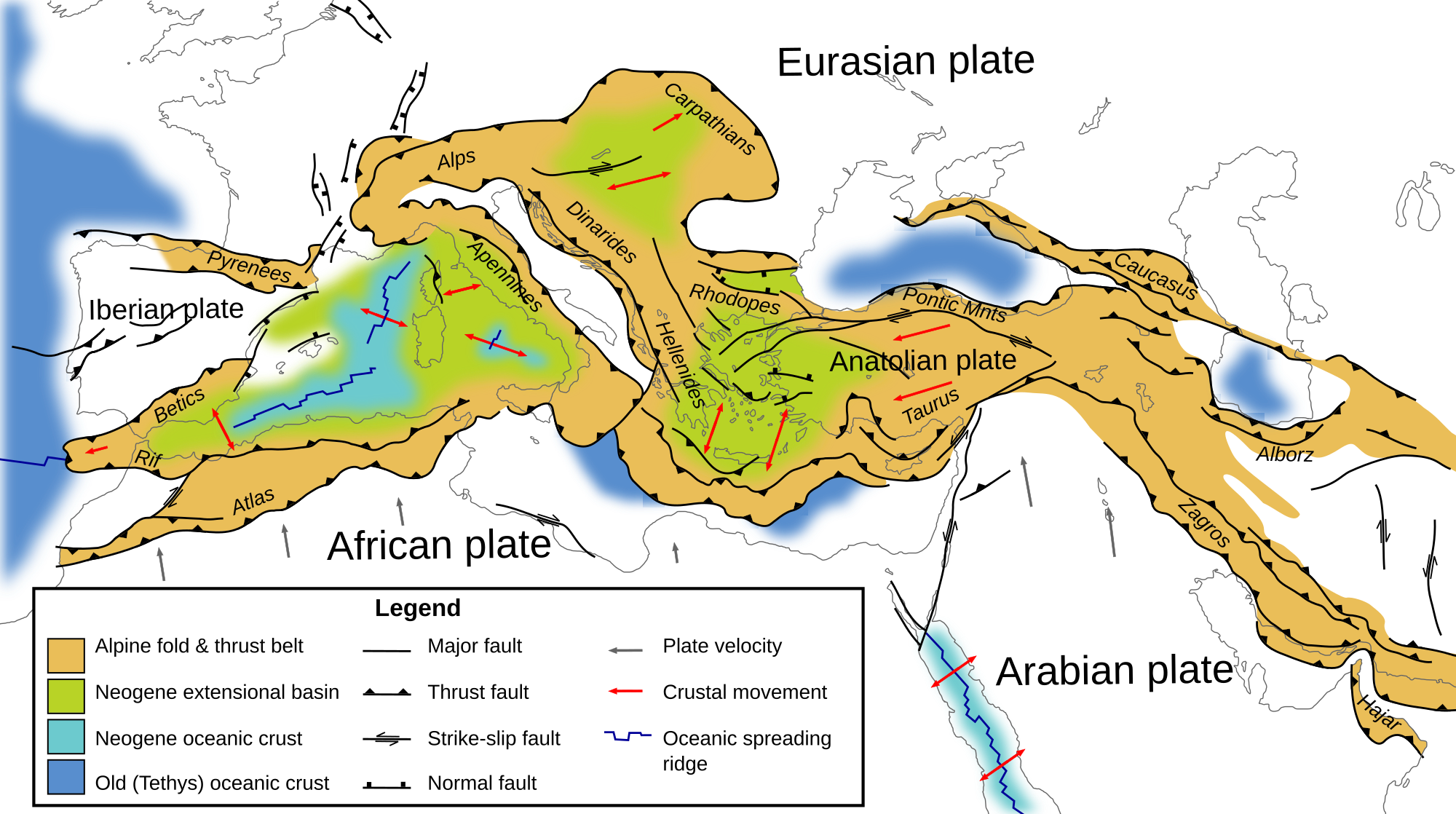
Tectonic map of southern Europe and the Middle East, showing tectonic structures of the western Alpide mountain belt
Eurasian Plate

The Alpine orogeny, sometimes referred to as the Alpide orogeny, is an orogenic phase in the Late Mesozoic[1] and the current Cenozoic which has formed the mountain ranges of the Alpide belt.

Cause

[edit]

The Alpine orogeny was caused by the African continent, the Arabian Peninsula, the Indian subcontinent, and the Cimmerian plate colliding with Eurasia in the north. Convergent movements between the African, Arabian and Indian plates from the south, and the Eurasian plate and the Anatolian sub-plate from the north – as well as many smaller (micro)plates – had already begun during the early Cretaceous, but the major phases of mountain building began during the Paleocene to the Eocene. The process continues currently in some of the Alpide mountain ranges.[citation needed]

The Alpine orogeny is considered one of the three major phases of orogeny in Europe that define the geology of that continent, along with the Caledonian orogeny that formed the Old Red Sandstone Continent when the continents Baltica and Laurentia collided in the early Paleozoic, and the Hercynian or Variscan orogeny that formed Pangaea when Gondwana and the Old Red Sandstone Continent collided in the middle to late Paleozoic.[citation needed]

Mountain ranges

[edit]

From west to east, mountains include the Atlas, the Rif, the Baetic Cordillera, the Cantabrian Mountains, the Pyrenees, the Alps, the Apennines, the Dinaric Alps, the Albanides, the Pindus, the Carpathians, the Balkanides (the Balkan Mountains and Rila-Rhodope massifs), the Pontic Mountains, the Taurus, the Antitaurus, the Armenian Highlands, the Caucasus Mountains, the Alborz, the Zagros Mountains, the Hajar, the Hindu Kush, the Pamir, the Karakoram, and the Himalayas.[2]

Sometimes other names occur to describe the formation of separate mountain ranges: e.g., "Carpathian orogeny" for the Carpathians, "Hellenic orogeny" for the Pindus, "Altai orogeny" for the Altai Mountains, and "Himalayan orogeny" for the Himalayas.

Formation of geological features

[edit]

The Alpine orogeny has also led to the formation of more distant and smaller geological features such as the Weald–Artois Anticline in Southern England and northern France, the remains of which can be seen in the chalk ridges of the North and South Downs in Southern England. Its effects are particularly visible on the Isle of Wight, where the Chalk Group and overlying Eocene strata are folded to near-vertical, as seen in exposures at Alum Bay and Whitecliff Bay, and on the Dorset coast near Lulworth Cove.[3] Stresses arising from the Alpine orogeny caused the Cenozoic uplift of the Sudetes mountain range[4] and possibly faulted rocks as far away as Öland in southern Sweden during the Paleocene.[5]

See also

[edit]

References

[edit]
[edit]
Revisions and contributorsEdit on WikipediaRead on Wikipedia
from Grokipedia
The Alpine orogeny is a major collisional mountain-building event that formed the , primarily through the and closure of the Alpine Tethys Ocean between the Eurasian and African (including the ) tectonic plates. This process represents a of , integrating of oceanic lithosphere, underthrusting, and subsequent crustal thickening and . The orogeny encompasses a complex involving multiple paleogeographic domains, including remnants of oceans like the Meliata and Piemont-Ligurian basins, which were inverted during convergence. The orogenic evolution began with Permian-Triassic rifting that led to the opening of the Alpine Tethys in the around 190 Ma, followed by initial in the (approximately 145–125 Ma). Convergence between and accelerated in the (94–70 Ma), with peak collision and orogenic growth occurring in the , particularly the Eocene (50–40 Ma), culminating in the closure of Tethys remnants by the late Eocene (around 35 Ma). This phase involved significant shortening, such as 111–165 km in the segment from the Santonian to (86–5 Ma), and produced high- and ultrahigh-pressure in the Western and Central between 62 and 35 Ma. Key structural features of the Alpine orogen include a two-phase development: an earlier phase closing the Meliata Ocean against , and a dominant Tertiary phase involving the Alpine Tethys between and , resulting in stacks, fold-thrust belts, and along-strike variations in architecture from the to the Dinarides. Major units comprise the Penninic and Helvetic domains in the north, the Austroalpine units in the east, and southern belts like the Apennines and Betics-Rif, all shaped by subduction rollback, microcontinent involvement, and post-orogenic extension. Following the main collisional phase, back-arc extension (from 35 Ma onward) led to the opening of basins such as the (20–10 Ma) and partial collapse of the orogen, influenced by ongoing Africa-Eurasia convergence. The study of the Alpine orogeny employs an integrated approach combining detailed field mapping, , , and geophysical profiling (e.g., the TRANSALP seismic ), revealing pre-Alpine Variscan and connections to broader Mediterranean . This event not only built Europe's highest peaks but also exemplifies how drives crustal growth and differentiation at convergent margins.

Overview

Definition and Scope

The Alpine orogeny refers to the mountain-building processes that occurred during the Late to era, primarily driven by the convergence and collision of the African, Arabian, and Eurasian plates, leading to the deformation and uplift of extensive mountain belts. This tectonic event encompasses the of , , and associated crustal shortening, which transformed the former domain into a complex collage of folded and thrust terrains, involving multiple paleogeographic domains including the Apulian microplate and remnants of oceans like the Meliata and Piemont-Ligurian basins. Temporally, the orogeny initiated with subduction phases in the Early Cretaceous, approximately 140–130 million years ago, marking the onset of significant compressional , and continues to the present day with ongoing Quaternary uplift and in various segments of the belt. This extended timeframe highlights the protracted nature of the process, evolving from early oceanic closure to sustained continental convergence and post-collisional adjustments. Geographically, the Alpine orogeny is centered on the Mediterranean-Alpine-Himalayan belt, extending from the Atlantic margin of Iberia through the , Carpathians, and to the and beyond into , but it is distinct from earlier orogenies such as the Paleozoic Hercynian (Variscan) event, which involved different plate configurations and predated the breakup of Pangea. The orogeny's scope is thus confined to this Cenozoic-dominated system, excluding unrelated structures. As a multi-phase process, the Alpine orogeny involves initial subduction of lithospheric slabs, followed by continental collision that caused widespread crustal thickening through thrusting and folding, and later phases of extension in some regions, all contributing to the modern topographic relief.

Geological Significance

The Alpine orogeny played a pivotal role in the progressive closure of the western Tethys Ocean, a process that began in the Late Cretaceous and extended through the Cenozoic, ultimately shaping the modern Mediterranean Sea as a remnant basin. The convergence of the African and Eurasian plates drove the subduction and obduction of Tethyan oceanic lithosphere, with the northern Ligurian-Piemontese branch closing around 55 million years ago through northward-directed subduction beneath the European margin, while the southern Magrebian-Lucanian branch closed during the Oligocene to Miocene via northward subduction. This diachronous closure fragmented the Tethys into isolated marine realms, culminating in the Early Miocene with the accretion of microplates and the establishment of the Mediterranean as a confined, evaporative sea system. As part of the broader , the Alpine orogeny represents a key collisional phase following the breakup of Pangea around 200 million years ago, contributing to the reassemblage of continental fragments toward a future configuration. along the Tethyan margins, integral to the Alpine system, facilitated the dispersal of Pangea's remnants by balancing extensional forces in the Atlantic with compressional closure in the Tethys, thereby influencing global plate motions and the transition from supercontinent fragmentation to renewed assembly. This orogenic event underscores the role of peripheral in driving dynamics, linking the Pangean cycle to subsequent tectonic reorganizations that affected Earth's long-term crustal evolution. In contemporary terms, the Alpine continues to pose significant seismic hazards in the , where ongoing convergence between the European and Adriatic plates sustains brittle deformation in the upper crust, with extending to depths of up to 20 km and temperatures up to 600°C in the indenter-like Adriatic block. This activity, evidenced by over 4,500 events of magnitude greater than 2 between 2000 and 2018, reflects the orogen's incomplete stabilization and poses risks to densely populated regions. Additionally, the orogeny facilitated resource formation in foreland basins, such as the North Alpine Molasse Basin, where burial beneath thrust sheets matured source rocks like the Schöneck Formation, generating over 1 ton of hydrocarbons per square meter and enabling lateral migration into Eocene reservoirs trapped by Alpine-related faults.

Tectonic Setting

Involved Plates and Boundaries

The Alpine orogeny primarily results from the convergence between the African Plate and the Eurasian Plate along a complex system of convergent boundaries that formed following the closure of the Tethyan Ocean. The African Plate, acting as the southern indenter, includes the microplate (also known as ), which functioned as a promontory protruding northward into the Eurasian margin, complicating the collision geometry in the central Mediterranean region. These boundaries transitioned from passive margins associated with the rifting of the Alpine Tethys to active convergent zones characterized by subduction and continental collision. In the eastern segment of the orogen, the Arabian Plate contributes to the convergence with the Eurasian Plate, particularly along the Zagros fold-thrust belt, where it overrides remnants of the Neotethys Ocean. Paleogeographic reconstructions depict the Tethys remnants as a series of oceanic basins and suture zones, including the Ligurian-Piemontese and Vahic ophiolitic sequences, that once separated the African (including Adria) and Eurasian plates, preserving evidence of their pre-collisional positions. Microplates such as Iberia further influence the western boundaries, where its detachment from the Eurasian Plate during the led to the formation of the Pyrenean convergent margin as part of the broader Alpine system. The / microplate, integral to the African Plate, integrated with adjacent terranes like those in and southwestern , enhancing the indentor effect and localizing deformation along irregular boundaries.

Subduction Mechanisms

The Alpine orogeny was initiated by the of the Neo-Tethys , specifically the Alpine Tethys branch (also known as the Piedmont-Ligurian ocean), primarily beneath the African (Adriatic) starting in the around 100-80 Ma. This process involved the southeast-directed of the (attached to the European plate) beneath the Adria (an extension of the African plate), driven by the overall convergence in the Tethyan realm. Paleogeographic reconstructions indicate that the Alpine Tethys was a narrow, slow-spreading ocean basin, approximately 400-700 km wide, which facilitated its relatively rapid consumption during this phase. A key dynamic in this subduction was slab rollback, where the descending Neo-Tethys slab retreated southward relative to the overriding plates, causing migration and extension in the back-arc regions. This rollback mechanism, particularly prominent in the central and , led to the formation of back-arc basins such as the Valais ocean and influenced the overall architecture of the orogen by promoting lateral tectonic escape and orogenic wedge development. Associated arc magmatism was limited, with sparse adakitic and calc-alkaline intrusions reflecting the shallow and transient of the magmatic processes, often attributed to the narrow slab width and rapid rates that inhibited extensive melt generation. The transition from oceanic to occurred in the Eocene around 50-35 Ma, as the buoyant continental margins of and impinged, halting further oceanic consumption and leading to the obduction of complexes—fragments of Neo-Tethys crust thrust onto the continental margins. This obduction, evident in sequences like the Western Alpine ophiolites, marked a shift to compressional , with ophiolitic mélanges preserving evidence of intra-oceanic thrusting prior to continental involvement. The process was diachronous, progressing from west to east along the orogen, and involved a switch in subduction polarity around 35 Ma to northwest-directed beneath the Europe-Iberian plate. Subduction during these phases exhibited variable angles and velocities, with paleomagnetic data indicating convergence rates of approximately 7-9 mm/yr between and , influencing slab geometry—steeper dips (around 30-60°) in the western segments and shallower in the east due to inherited lithospheric heterogeneities. These variations controlled the depth of and the timing of slab breakoff events, contributing to the segmented nature of the Alpine subduction system.

Chronology

Oligocene to Miocene Phases

The Oligocene phase of the Alpine orogeny initiated with the onset of continental collision between the Adria plate (part of the African plate) and the Eurasian plate, transitioning from oceanic subduction around 35–32 Ma. This contact led to initial crustal shortening, with convergence rates decreasing and accommodating early deformation through northward indentation of the Adriatic margin. In the western sectors, this phase involved the incorporation of continental crust into the subduction zone, marking a shift from subduction-dominated to collisional processes, with total convergence contributing to approximately 450 km of Africa-Europe relative motion since the late Eocene. During the Miocene, the main collision phase intensified, contributing to total crustal shortening estimated at 100–150 km in the Pyrenees and Provence regions from the Late Cretaceous to the Miocene, and up to 120 km in the central Alps since the late Oligocene. This shortening, varying from 21–95 km across transects in the central and eastern Alps, drove the development of early fold-thrust belts, particularly in the external zones like the South Pyrenean Zone and North Pyrenean Frontal Thrust, where N-S directed compression inverted Mesozoic rift basins. Concurrently, metamorphic core complexes began forming through exhumation of high-pressure units, such as blueschist-to-greenschist facies rocks in the Western Alps (exhumed 58–47 Ma, with Miocene continuation) and the Alpujarride Complex in the Betic Cordillera, linked to localized extension amid overall contraction. A pivotal event in the western sectors was the cessation of subduction between approximately 30 and 20 Ma, culminating in slab break-off of the subducting European lithosphere around 30–32 Ma. This break-off, occurring at depths of 80–150 km, facilitated rapid exhumation, backthrusting along the Insubric Line, and northward migration of the orogenic front by 80–100 km, while promoting and crustal accretion. The process transitioned the tectonics toward indentation and , influencing the overall architecture of the early collisional belt without significant post-Miocene uplift.

Pliocene to Quaternary Phases

During the , the Alpine orogeny experienced an acceleration in the rate of convergence between the Nubian (African) and Eurasian plates, reaching approximately 7-8 /yr across the central Mediterranean region, which contributed to intensified compressional deformation and rock uplift in the Alpine edifice. This phase marked a transition to more rapid exhumation, with uplift rates estimated at 1.3-1.8 /yr (or ~1.3-1.8 km/Ma) in key areas of the northern Apennines and adjacent Alpine sectors between 6 and 4 Ma, as inferred from low-temperature thermochronometric data and intramontane sedimentation patterns. These elevated rates reflect ongoing crustal shortening superimposed on earlier deformation, driving the final stages of topographic buildup in the central and western . A pivotal process during this interval (approximately 10-5 Ma) was the delamination of thickened lithospheric roots beneath the orogen, where dense mantle lithosphere detached and sank into the asthenosphere, leading to isostatic rebound and accelerated surface uplift. Evidence for this delamination is provided by thermochronological records showing a distinct "5 Ma event" of enhanced exhumation in the western and central Alps, correlated with increased sediment discharge and anomalous heat flow, though less pronounced in the eastern sectors. This tectonic adjustment replaced eclogitic lower crust and mantle with hotter asthenospheric material, facilitating ~1-2 km of localized uplift over a few million years and contributing to the modern crustal architecture observed in seismic profiles. In the Quaternary, glacial erosion during repeated ice ages profoundly modified the Alpine landscape, with intensified valley incision and removing up to several hundred meters of material since the onset of major Pleistocene glaciations around 2.7 Ma. This erosional unloading triggered significant isostatic rebound, accounting for approximately 90% of the present-day geodetically measured rock uplift rates of 1-2 mm/yr in the central , as modeled from viscoelastic responses to Last Glacial Maximum deglaciation ~20 kyr ago. The combined effects of glacial processes and isostatic adjustment have shaped the rugged current , with deeper valleys and higher peaks emerging through enhanced amplification. Ongoing tectonics in the to present continue to influence the through persistent Africa-Eurasia convergence at ~5-6 mm/yr, accompanied by extensional in peripheral back-arc regions such as the Ligurian-Tyrrhenian domain, where rollback of the Adriatic slab promotes normal faulting and basin formation. In the Alpine core, this manifests as localized extension along inherited shear zones, like the Periadriatic lineament, balancing compressional stresses and contributing to differential uplift patterns observed in GPS and leveling data. These dynamics underscore the as an active orogen, with post-orogenic adjustments still modulating its .

Resulting Structures

Major Mountain Ranges

The Alps serve as the type locality for the Alpine orogeny, representing the archetypal collisional mountain chain formed by the convergence of the European and African (Apulian) plates during the era. This range arcs across for approximately 1,200 km, from the Mediterranean coast to the Vienna Basin, with widths up to 280 km and maximum elevations reaching 4,808 m at Mont Blanc. The elevated topography of the Alps results from extensive crustal shortening, estimated at 250–350 km across the orogen, which thickened the crust to over 50 km in places and produced the prominent arcuate morphology aligned with the northeastward convergence direction. The Dinarides, extending southeastward along the eastern Adriatic margin, form another key segment of the Alpine orogenic belt, shaped by oblique convergence and during the to . This range spans about 645 km in length, with average elevations around 2,000 m and peaks up to 2,694 m at Maja e Jezercës, reflecting moderate differential shortening of roughly 100–150 km compared to the . Their linear to slightly arcuate form correlates with the northwest-southeast convergence vector, influencing the development of thrust-dominated structures and associated foreland basins. The exhibit partial involvement in the Alpine orogeny, primarily through late-stage reactivation of earlier structures during Miocene convergence between Iberia and . Stretching approximately 450 km along the France-Spain border, the range averages 80–100 km in width and features elevations exceeding 3,000 m, including at 3,404 m, with documented north-south shortening of about 111 km in the eastern sector. This limited Alpine-phase deformation contrasts with the range's dominant earlier Pyrenean orogeny, resulting in a more rectilinear morphology tied to the orthogonal convergence direction. The Apennines represent a subduction-related segment of the Alpine system, formed by the rollback of the Adriatic slab beneath from the onward. This chain extends roughly 1,500 km down the , with mean elevations of about 1,200 m rising to 2,912 m at Gran Sasso, and widths varying from 40 to 100 km, accommodating 200–250 km of arc-parallel shortening. The northeastward convexity of the Apennines reflects the changing convergence direction from orthogonal to oblique, driving asymmetric thrusting and ongoing extension in the hinterland. The Carpathians close the eastern arc of the Alpine orogenic belt, resulting from subduction and collision involving the European margin and intra-Carpathian blocks. Curving for approximately 1,500 km from to , the range reaches average elevations of 1,000–2,000 m and culminates at 2,655 m on Gerlachovský štít, with total shortening estimates of 150–200 km concentrated in the flysch nappes. Their tightly arcuate shape mirrors the eastward-oblique convergence, promoting lateral extrusion and the indentation of the surrounding basins. The Betics-Rif arc forms the westernmost segment of the Alpine-Himalayan belt in the western Mediterranean, resulting from the and collision of the Iberian and African plates. This orogen extends approximately 800 km from southern to northern , with widths of 50–200 km and elevations up to 3,478 m at in the Sierra Nevada. It accommodated about 200 km of shortening through to thrusting, influenced by slab rollback and toroidal flow around the arc. Across these ranges, variations in length, elevation, and overall morphology arise from differential shortening influenced by local plate kinematics, with higher, more compact chains like the linked to greater convergence rates and magnitudes compared to the lower, more extended Apennines and Carpathians. The correlation between range geometry and convergence direction is evident in the progressive arcuation from the linear to the curved eastern segments, reflecting indentor and slab dynamics during the .

Fold-Thrust Belts and Nappes

The Alpine orogeny produced extensive fold-thrust belts and systems through compressional deformation during between the European and Adriatic plates. These structures formed as sedimentary cover sequences and rocks were shortened and displaced northward, creating a complex stack of sheets that define the internal architecture of the orogen. Thin-skinned thrust belts, characterized by detachment along weak layers in the sedimentary cover, predominated in the foreland regions, while thick-skinned deformation involving the crystalline occurred in the orogenic core. In the foreland, thin-skinned thrusting detached and sediments from the underlying along horizons such as evaporites and black shales, leading to the formation of imbricate fans and detachment folds. This style is exemplified in the Helvetic nappes of the , where the sedimentary cover of the European margin was sheared off and transported northward over the , with individual thrusts accommodating up to 50 km of displacement. In contrast, the orogenic core featured thick-skinned tectonics, where rocks participated directly in thrusting, often along inherited rift structures, resulting in the uplift of external crystalline massifs like the Aar and . This involvement facilitated broader and the inversion of pre-existing normal faults into thrusts. Nappe stacking in the Alps involved the progressive accretion and overthrusting of units derived from different paleogeographic domains, with the Helvetic nappes forming the basal layer and the Penninic nappes overlying them as higher allochthons. The Helvetic nappes, comprising Jurassic to Eocene sediments, were thrust as a series of klippes and sheets, while the Penninic nappes incorporated remnants of the Tethyan oceanic crust and Briançonnais platform, stacked in a south-to-north sequence during Oligocene to Miocene collision. Overall horizontal displacement across major thrusts reached 100-200 km, particularly in the Penninic system, reflecting the scale of convergence. A key aspect of this deformation was out-of-sequence thrusting, where later faults cut across earlier thrust sheets, accommodating additional shortening after initial in-sequence propagation. In the Alps, such thrusts, like the Glarus overthrust in the Helvetic domain, reactivated basement structures and contributed to the exhumation of deeper units, integrating thin- and thick-skinned styles. This mechanism, combined with basement involvement, allowed for sustained deformation despite varying rheologies.

Associated Features

Sedimentary Basins

The Alpine orogeny influenced the development of peripheral on both the northern and southern margins of the orogen, where syn-orogenic sediments accumulated in response to tectonic loading. The northern , extending approximately 850 km from western to , represents a classic formed adjacent to the European plate, with up to 5 km of sediments deposited near the front, primarily during the to . Similarly, the southern Po Plain Basin, situated on the Adriatic foreland, accumulated over 6-8 km of sediments in its depocenters, reflecting asymmetric driven by the advancing Apennine thrust belt and Alpine compression. These basins served as primary depositional sites for eroded material from the rising , with sediment thicknesses tapering northward and southward away from the orogenic wedge. Intra-orogenic extension, particularly in the eastern segment of the orogen, led to the formation of intra-montane basins amid ongoing compression. The Vienna Basin, a prominent example at the junction of the and , originated as a pull-apart structure during Middle Miocene (~16 Ma) sinistral associated with eastward lateral extrusion of Alpine blocks. This extension accommodated up to 4.3 km of marine and brackish sediments, with the basin evolving from active rifting in the Badenian to terrestrial conditions by the , influenced by the broader dynamics. The evolution of these basins transitioned from dominant flexural loading during thrusting, which caused initial through lithospheric bending under the orogenic load, to post-orogenic phases marked by partial rebound and inversion. In the , early flexural downwarping peaked around 20 Ma due to slab and topographic loads, followed by localized in the central and western sectors while the eastern part experienced uplift after slab breakoff. The Po Plain similarly shifted to increased post-20 Ma eastward of the Giudicarie fault line, but overall basin systems underwent inversion and between 10-5 Ma as compression waned, leading to current peripheral positioning. A significant economic aspect of the Alpine orogeny involves reservoirs in inverted rift basins peripheral to the orogen, such as extensions in the southern , where to compression reactivated normal faults into reverse structures, trapping hydrocarbons in sandstones and chalks. This inversion enhanced trap formation and migration pathways, contributing to major fields like those in the Central .

Volcanic and Magmatic Activity

The volcanic and magmatic activity during the Alpine orogeny prominently features calc-alkaline magmatism in the , driven by along convergent plate boundaries such as the Carpathian arc. In the northern Carpathian-Pannonian region, this phase spanned approximately 16 to 11 Ma, producing dominantly andesitic to dacitic rocks with medium-K calc-alkaline affinities, reflecting of a mantle wedge metasomatized by subducted slab-derived fluids. These rocks show typical arc signatures, including enrichment in large lithophile elements (LILE) like Ba, Rb, and Sr relative to high field strength elements (HFSE) such as Nb, Ta, and Zr, with ratios like Ba/Nb > 200 and Th/Yb > 1, indicative of influence on mantle sources. Post-collisional potassic , occurring broadly between 20 and 10 Ma, arose from slab break-off following , which facilitated asthenospheric and heating of the overlying lithospheric mantle. In the Carpathian-Pannonian domain, this transition is evident after the initial calc-alkaline phase, with potassic to ultrapotassic alkaline rocks (e.g., shoshonites and high-K andesites) emplaced around 18 to 10 Ma, linked to and of enriched subcontinental lithospheric mantle. The process involved rapid mantle decompression and influx of slab-derived components, resulting in geochemical patterns with elevated LILE/HFSE ratios (e.g., Rb/Nb > 10) and radiogenic signatures (e.g., high ^{87}Sr/^{86}Sr > 0.706), distinguishing them from earlier arc magmas. Notable examples of this include the and Mount Etna in , where ongoing slab rollback of the Ionian has sustained volcanic activity since the . The Aeolian arc hosts calc-alkaline to shoshonitic series with high LILE/HFSE ratios, derived from mantle in a back-arc setting influenced by retreating . Similarly, Etna's Na-K alkaline basalts and potassic trachybasalts, active from ~0.5 Ma to present, reflect localized mantle decompression due to rollback-induced extension, with geochemical evidence of HIMU-type enriched sources mixed with -modified mantle. Overall, these igneous manifestations underscore the role of mantle in generating orogenic magmas, with persistent high LILE/HFSE enrichment tracing the legacy of prior across the Alpine belt.

References

Add your contribution
Related Hubs
User Avatar
No comments yet.