


Community hub
Recent from talks
Contribute something
Nothing was collected or created yet.
Ammit
View on Wikipedia | This article needs additional citations for verification. (March 2020) |
| Ammit | |||||||
|---|---|---|---|---|---|---|---|
 | |||||||
| Name in hieroglyphs | Egyptian: ꜥm-mwt[1]
(devourer of the dead)
| ||||||


| Part of a series on |
| Ancient Egyptian religion |
|---|
 |
 Ancient Egypt portal Ancient Egypt portal |
Ammit (/ˈæmɪt/; Ancient Egyptian: ꜥm-mwt, "Devourer of the Dead"; also rendered Ammut or Ahemait) was an ancient Egyptian goddess[2][clarification needed] with the forequarters of a lion, the hindquarters of a hippopotamus, and the head of a crocodile—the three largest "man-eating" animals known to ancient Egyptians. In ancient Egyptian religion, Ammit played an important role during the funerary ritual, the Judgment of the Dead.
Nomenclature
[edit]Ammit (Ancient Egyptian: ꜥm-mwt; ꜣmt mwtw[3]) means "devourer of the dead"[4][1] ("devoureress of the dead"[5][7]) or "swallower of the dead",[3] where ꜥm is the verb "to swallow",[8] and mwt signifies "the dead", more specifically the dead who had been adjudged not to belong to the akhu ("blessed dead") who abided by the code of truth (Ma'at).[4][a]
Iconography
[edit]

Ammit is denoted as a female entity, commonly depicted with the head of a crocodile, the forelegs and upper body of a lion (or leopard[5][6][10]), and the hind legs and lower body of a hippopotamus.[6] The combination of three deadly animals of the Nile: crocodile, lion, and hippopotamus, suggests that no one can escape annihilation, even in the afterlife.[5] She is part lioness,[11] but her leonine features may present in the form of a mane,[12][13] which is usually associated with male lions. In the Papyrus of Ani, Ammit is adorned with a tri-colored nemes,[14][15] which were worn by pharaohs as a symbol of kingship.

Versions of the Book of the Dead from the New Kingdom started to include Ammit.[16] During the eighteenth dynasty, the crocodile-lion-hippopotamus hybrid was the conventional depiction of Ammit. She appeared in scenes showing the Judgment of the Dead, in tombs and funerary papyri. In this scene, Ammit is shown with other Egyptian gods in Duat, waiting to learn if she can consume the heart of the deceased.[16] A stylistic shift occurred, during the Third Intermediate Period. Around the twenty-first dynasty, the Judgment of the Dead scene was painted on the interior and exterior of coffins. The coffin lid of Ankh-hor, a chief from the twenty-second dynasty featured Ammit bearing the head of a hippopotamus, and the body of a dog with rows of paps.[16][17][20]While the Papyrus of Nes-min (ca. 300–250 BCE) from the Ptolemaic Period, portrayed Ammit with the head of a crocodile, and the body of a dog.[21]
Role in ancient Egyptian religion
[edit]Unlike other gods featured in ancient Egyptian religion, Ammit was not worshipped.[6] Instead, Ammit was feared and believed to be a demon rather than a deity, due to her role as the 'devourer of the dead'.[6] During the New Kingdom, deities and demons were differentiated by having a cult or center of worship. Demons in ancient Egyptian religion had supernatural powers and roles, but were ranked below the gods and did not have a place of worship.[22] In the case of Ammit, she was a guardian demon.[22] A guardian demon was tied to a specific place, such as Duat. Their appearance was based on a hybrid of an animal or a human and was denoted so the dead could recognize them. Guardian demons that appeared as a hybrid of animals were an amalgamation of traits meant to be feared and to differentiate them from deities associated with humanity.[22]
.jpg)
Prior to the New Kingdom and the creation of Chapter 125 in the Book of the Dead, Ammit did not have a large presence in ancient Egyptian religion. However, Khonsu, the god of the moon, was depicted as a 'devourer of the dead and hearts' in Old Kingdom pyramid texts and Middle Kingdom Coffin Texts.[23]
Throughout the First Intermediate Period and the Middle Kingdom, a collection of spells was created to form the Coffin Texts. In Spell 310, Khonsu burned hearts heavier than the feather of ma'at during the Judgment of the Dead.[23][24] In Spell 311, Khonsu devoured the hearts of the gods and the dead. Divine hearts were devoured for their power. Hearts deemed impure during judgment were devoured, leaving the deceased trapped in Duat.[23][25] These spells were among those adapted into the Book of the Dead starting in the New Kingdom.
Spells 310 and 311 of the Coffin Texts are referred to in Chapters 79, and 125 in the Book of the Dead. Chapter 79 refers to the burning of the heart, while the scene of judgment and devouring of hearts is found in Chapter 125.[23] Instead of Khonsu devouring the heart of the dead, Ammit was referred to as the 'devourer of the dead'. Ammit was present during the weighing of the heart, usually near the scale waiting to learn the results. If the heart of the dead was impure, she ate their heart leaving them soulless and trapped in Duat.[26]
Weighing of the heart
[edit]

The Book of the Dead was a collection of funerary texts used to guide the dead to Duat, the Egyptian underworld. The process of the Judgment of the Dead was described in Chapter 125.[27][3] The ruler of Duat, Osiris, presided over judgment. New Kingdom depictions of this scene occurred at the Hall of the Two Truths (or Two Maats). [b][4][15] Anubis, the Guardian of the Scales, conducted the dead towards the weighing scale.[29] Ammit would be situated near the scale, awaiting the results. While Thoth, the god of hieroglyphs and judgment, would record the results.[30] The heart of the deceased was weighed against the feather of Ma'at,[c] the goddess of truth.[4][15][28] The feather of Ma'at symbolized the balance, and truthfulness needed to be present during one's lifetime. The heart or Ib, represented the individual's soul and was the key to traveling to Aaru.[31]
In Chapter 125 of the Book of the Dead, the deceased is given a series of declarations to recite at the Judgment of the Dead. The Declaration of Innocence was a list of 42 sins the deceased was innocent of committing. The Declaration to the Forty-two Gods and The Address to the Gods were recited directly to the gods, proclaiming the deceased's purity and loyalty.[27]
After the declarations are recited, their heart is weighed. If the heart weighed less than the feather of Ma'at, the deceased was ruled to be pure. Thoth recorded the result and Osiris would allow the deceased to continue their voyage toward Aaru and immortality. If the heart was heavier than the feather of Ma'at, the deceased was deemed impure. Ammit would devour their heart, leaving the deceased without a soul. Ancient Egyptians believed the soul would become restless forever, dying a second death. Instead of living in Aaru, the soulless individual would be stuck in Duat.[3][16][26]

Ammit is often depicted sitting in a crouched position near the scale, ready to eat the heart.[16][15] Ancient Egyptians were buried with a copy of the Book of the Dead, guaranteeing they would be successful at the Judgment of the Dead. Thus, Ammit was left hungry without any hearts to eat, and the consecrated dead was then able to bypass the Lake of Fire, featured in Chapter 126 of the Book of the Dead.[3][32]
In popular culture
[edit]Saba Mubarak portrays Ammit in the Marvel Cinematic Universe (MCU) television series Moon Knight (2022).[33] In the Mummies Alive! cartoon series, the main villain Scarab accidentally summons Ammut, and she sticks around. In the show, she is a dog-like and rather small-sized pet who does not speak. In Rick Riordan's series The Kane Chronicles, Ammit is portrayed. In Primeval, Ammit was a Pristichampsus that came through an Anomaly (a gateway in time) to ancient Egypt, where people believed it to be a god.
Gallery
[edit]-
 Full view of the Weighing of the Heart from the Papyrus of Ani. Ammit is shown at the far right, near Thoth. c. 1250 BCE, Nineteenth Dynasty.
 -
 Full view of the Weighing of the Heart from the Papyrus of Hunefer. Ammit is shown next to the scale. Anubis is on her left, and Thoth on her right. c. 1275 BCE, Nineteenth Dynasty.
 -
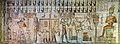 Full view of the Weighing of the Heart from the Temple of Hathor in Deir el-Medina. Thoth is seen to the right of the scale, while to the right, Ammit sits on top of a pedestal.


See also
[edit]- Book of the Dead
- Chalkydri, other mythical creatures depicted with the body of a lion and head of a crocodile[34]
- Cerberus, a chthonic creature in Greek mythology
Explanatory notes
[edit]- ^ She was also called "eater of hearts", and "great of death" in her capacity as an underworld deity.[6]
- ^ With Osiris accompanied Isis and Nephthys and the Sons of Horus. In later times, its judgment was presided by Ra.[4]
- ^ Often illustrated as an ostrich feather (the feather was often pictured in Ma'at's headdress).
References
[edit]- Citations
- ^ a b Erman, Adolf; Grapow, Hermann, eds. (1926). "ꜥm". Wörterbuch der ägyptischen Sprache (PDF). Vol. 1. Berlin: Akademie-Verlag. p. 104.9.
ꜥm-mwt Totenfressen (Name des Tiers beim Totengericht) [Feeding/feeder on the dead. (Name of the beast at the judgment of the dead)]
- ^ Estate Overseer of Menmaatra; King's Scribe., Hunefer (10 December 2024). "papyrus". British Museum. Retrieved 10 December 2024.
{{cite web}}: CS1 maint: multiple names: authors list (link) - ^ a b c d e Snape, Steven (2011). "Rekhmire and the Tomb of the Well-Known Soldier". Ancient Egyptian Tombs: The Culture of Life and Death. John Wiley & Sons. p. 198. ISBN 9781405120890.
- ^ a b c d e f Taylor, John H. (2001). "Death and Resurrection in Ancient Egyptian Society". Death and the Afterlife in Ancient Egypt. University of Chicago Press. pp. 36–38. ISBN 9780226791647.
- ^ a b c d Hart, George (April 8, 1986). A Dictionary of Egyptian Gods and Goddesses (1st ed.). Taylor & Francis Group. pp. 3–4. ISBN 9780203136447.; —— (2005) [1986]. "Introduction; Ammut". The Routledge Dictionary of Egyptian Gods and Goddesses. Psychology Press. pp. 7, 12–13. ISBN 9780415344951.
- ^ a b c d e f Wilkinson, Richard H. (2003). The complete gods and goddesses of ancient Egypt. Internet Archive. Thames & Hudson. p. 218. ISBN 978-0-500-05120-7.
- ^ Female "devourer of the dead".[6]
- ^ Erman & Grapow (1926), p. 103. ꜥm 'verschlucken [swallow]'
- ^ Von Dassow (2008), Pl. 3.
- ^ Cf. one depiction in Egyptian Book of the Dead, Papyrus of Ani, Chapter 30B (Pl. 3), where Ammit is shown with a torso of spotted fur (See image right).[9]
- ^ Venit, Marjorie Susan (2016). "Tradition and Innovation in the Tombs of the Egyptian Chora". Visualizing the Afterlife in the Tombs of Graeco-Roman Egypt. Cambridge University Press. p. 142. ISBN 9781107048089.
- ^ Cf. Depiction on the Papyrus of Hunefer, Dyn. XIX, British Museum (shown right). A line drawing of the creature in the papyrus is given by Hart.[5]
- ^ a b Gibson, Gayle (2021). "The Place of Silence: Musings on a Partial Ptolemaic Burial Shroud Recently Rediscovered in the Royal Ontario Museum". In Geisen, Christina; Li, Jean; Shubert, Steven B.; Yamamoto, Kei (eds.). His Good Name: Essays on Identity and Self-Presentation in Ancient Egypt in Honor of Ronald J. Leprohon. ISD LLC. p. 180. ISBN 9781948488389.
- ^ "mane that hangs down like a tripartite wig" on a burial shroud, Royal Ontario Museum.[13]
- ^ a b c d Von Dassow (2008), p. 155.
- ^ a b c d e Taylor, John H. (2019). "The Mummies and Coffins of Ankh-hor and Heribrer". In Kalloniatis, Faye (ed.). The Egyptian Collection at Norwich Castle Museum: Catalogue and Essays. Oxbow Books. p. 23. ISBN 9781789251999.
- ^ Venit, Marjorie Susan (2009). "Avaleuses et dévoreuses: des déesses aux démones en Égypte ancienne". Chronique d'Égypte (in French). 84: 13.
- ^ Von Dassow (2008), Pl. 11.
- ^ "Papyrus of Ani, sheet 11 (vignette)", The Archive for Research in Archetypal Symbolism (ARAS), JSTOR community.11652438
- ^ Cf. Egyptian Book of the Dead, Papyrus of Ani, Chapter 148 (Pl. 11), where the aspect of the Guardian of the Fifth Pylon/Portal,[18] (Hentet-Arqiu), is assumed by Ammit, and she is illustrated as a "monstrous female demon with hippopotamus body and head, pendulous breasts, lion legs and crocodile snout, squatting, with open jaws and tongue extended, forepaws, holding huge knife,.."[19]
- ^ Peck, William H. (2000). "The Papyrus of Nes-min: An Egyptian Book of the Dead". Bulletin of the Detroit Institute of Arts. 74 (1/2): 20–31. doi:10.1086/DIA41504961. ISSN 0011-9636. JSTOR 41504961. S2CID 165731702.
- ^ a b c Lucarelli, Rita (September 2010). Wendrich, Willeke; Dieleman, Jacco; Frood, Elizabeth; Baines, John (eds.). "Demons (Benevolent and Malevolent)". UCLA Encyclopedia of Egyptology. 1: 2–6.
- ^ a b c d Adel Zaki Nasr, Youmna (December 12, 2022). "Apotropaic Roles of Khonsu in the Ancient Egyptian Religion during the Dynastic Period" (PDF). Research Journal of the Faculty of Tourism and Hotels (12). Mansoura University: 541–545.
- ^ Faulkner, Raymond O. (1973). The Ancient Egyptian Coffin Texts: Volume I Spells 1-354. Warminster, England: Aris & Phillips Ltd. pp. 227–228. ISBN 0-85668-005-2.
- ^ Faulkner, Raymond O. (1973). The Ancient Egyptian Coffin Texts: Volume I Spells 1-354. Warminster, England: Aris & Phillips Ltd. pp. 228–229. ISBN 0-85668-005-2.
- ^ a b Kleiner, Fred S. (2020). Gardner's Art through the Ages: The Western Perspective, Volume I. Cengage Learning. p. 57. ISBN 978-0-357-37048-3.
- ^ a b Lichtheim, Miriam (April 3, 2006). Ancient Egyptian literature : a book of readings. Volume II, The New Kingdom. Hans-Werner Fischer-Elfert (2nd ed.). Berkeley, CA: University of California Press. pp. 132–139. ISBN 978-0-520-93306-4. OCLC 778435126.
- ^ a b Budge, E. A. Wallis (1988) [1934]. From Fetish to God in Ancient Egypt. Dover. pp. 213, 294. ISBN 9780486258034.
- ^ Lay literature sees fit to say that Anubis drops the heart on the scale, but scholarship stops at stating that Anubis drags the person to the scale, and also attending to the pan and plumb bob of the scale in the weighing process (e.g. Budge,[28] Taylor here.[4])
- ^ Aronin, Rachel; et al. (Meg Gundlach) (2008). "Divine Determinatives in the Papyrus of Ani". In Griffin, Kenneth (ed.). Current Research in Egyptology 2007: Proceedings of the Eighth Annual Conference. Vol. 8. Oxford: Oxbow Books. pp. 8, 10–11. doi:10.2307/j.ctvh1dqv7.5. ISBN 978-1-84217-329-9. JSTOR j.ctvh1dqv7.5.
- ^ de Ville, Jacques (Fall 2011). "Mythology and the Images of Justice". Law and Literature. 23 (3). Taylor & Francis, Ltd.: 336–337. doi:10.1525/lal.2011.23.3.324. hdl:10566/288. ISSN 1535-685X. JSTOR 10.1525/lal.2011.23.3.324. S2CID 220308728.
- ^ Janes, Regina M. (2018). "Impermanent Eternities: Egypt, Sumer, and Babylon, Ancient Israel, Greece, and Rome". Inventing Afterlives: The Stories We Tell Ourselves About Life After Death. New York: Columbia University Press. pp. 40–42. doi:10.7312/jane18570. ISBN 978-0-231-18570-7. JSTOR 10.7312/jane18570. S2CID 166143164.
- ^ "Who Voices Ammit In Moon Knight's Final Episode?". ScreenRant. 2022-05-04. Retrieved 2022-05-10.
- ^ Kulik, Alexander (2010). 3 Baruch: Greek-Slavonic Apocalypse of Baruch. p. 238. De Gruyter. ISBN 9783110212488. Retrieved 22 August 2024.
- Bibliography
- Von Dassow, Eva, ed. (2008). The Egyptian Book of the Dead: The Book of Going Forth by Day – The Complete Papyrus of Ani Featuring Integrated Text and Full-Color Images. Translated by Faulkner, Raymond; Goelet, Ogden. Chronicle Books. ISBN 9780811864893.
External links
[edit] Media related to Ammit at Wikimedia Commons

