Hubbry Logo
List of wind deitiesList of wind deitiesMain
Open search
List of wind deities
Community hub
List of wind deities
logo
8 pages, 0 posts
0 subscribers
Be the first to start a discussion here.
List of wind deities
from Wikipedia

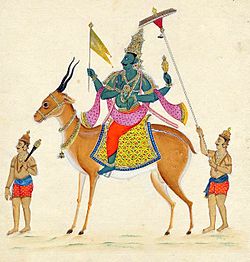
The Hindu wind god, Vayu.

A wind god is a god who controls the wind(s). Air deities may also be considered here as wind is nothing more than moving air. Many polytheistic religions have one or more wind gods. They may also have a separate air god or a wind god may double as an air god. Many wind gods are also linked with one of the four seasons.

Africa/South Africa

[edit]

Yoruba tradito the goddess of wind storms and transformation.

oya goddess of storms and string winds and lighting and air

Nomkhubulwana/Nomkhubulwane, an angel associated with rain.

yemaya is most powerful goddess she formed the oceans and rivers when her water broke while she was giving birth to her first child

greek goddess rand is greek god of south africa and known for his currency south africa money and coins and he a single man of south africa

zulu she is south africa goddess she dwells in water.

african goddess of money is aje is goddess of wealth and prosperity

anyanwu is the sun goddess

mawu is a prominent creator, ruling the moon and night sky

Egyptian

[edit]
  • Amun, god of creation and the wind.
  • Henkhisesui, god of the east wind. In art, Henkhisesui appears as a winged man with a ram head, or a winged, ram headed Scarab.[1]
  • Ḥutchai, god of the west wind.[2] In art, Hutchai appears as a winged man with a snake head.[citation needed]
  • Qebui, god of the north wind[3] who appears as a man with four ram heads or a winged ram with four heads.[4][5]
  • Shehbui, god of the south wind.[2] In art, Shehbui appears as a winged man with a lion head.
  • Shu, god of the air. and wind

Pokot

[edit]
  • Yomöt, god of the wind.

Europe

[edit]

Albanian

[edit]
  • Shurdhi, weather god who causes hailstorms and throws thunder and lightning.
  • Verbti, weather god who causes hailstorms and controls the water and the northern wind.

Balto-Slavic

[edit]

Lithuanian

[edit]
  • Vejopatis, god of the wind according to at least one tradition.

Slavic

[edit]
  • Dogoda is the goddess of the west wind, and of love and gentleness.
  • Stribog is the name of the Slavic god of winds, sky and air. He is said to be the ancestor (grandfather) of the winds of the eight directions.
  • Moryana is the personification of the cold and harsh wind blowing from the sea to the land, as well as the water spirit.
  • Varpulis is the companion of the thunder god Perun who was known in Central Europe and Lithuania.

Basque

[edit]

Celtic

[edit]

Germanic

[edit]
  • Kári, son of Fornjót and brother to Ægir and Logi, god of wind, apparently as its personification, much like his brothers personify sea and fire.
  • Njörð, god of the wind, especially as it concerns sailors.
  • Odin, thought by some scholars to be a god of the air/breath.[citation needed]

Greco-Roman

[edit]
  • Aeolus, keeper of the winds; later writers made him a full-fledged god.
  • Anemoi, (in Greek, Ἄνεμοι—"winds") were the Greek wind gods.
    • Boreas (Βορέας), god of the north wind and of winter.
    • Eurus (Εὖρος), god of the east or southeast wind.
    • Notus (Νότος), god of the south wind.
    • Zephyrus (Ζέφυρος), god of the west wind.
  • Aura, the breeze personified.
  • Aurai, nymphs of the breeze.
  • Cardea, Roman goddess of health, thresholds, door hinges, and handles; associated with the wind.
  • Tritopatores, gods of wind and marriage
  • Thraskias (Θρασκίας), god of the north-northwest wind
  • Venti, (Latin, "winds") deities equivalent to the Greek Anemoi.

Western Asia

[edit]

Persian Zoroastarian

[edit]
  • Vayu-Vata, two gods often paired together; the former was the god of wind and the latter was the god of the atmosphere/air.
  • Enlil, the Sumerian god of air, wind, breath, loft.
  • Ninlil, goddess of the wind and consort of Enlil.
  • Pazuzu, king of the wind demons, demon of the southwest wind, and son of the god Hanbi.

Uralic

[edit]

Finnish

[edit]
  • Ilmarinen, blacksmith and god of the wind, weather and air.
  • Tuuletar, goddess or spirit of the wind.

Hungarian

[edit]

Sami

[edit]

Asia-Pacific / Oceania

[edit]

South and East Asia

[edit]

India

[edit]

Hindu-Vedic

[edit]
  • Maruts, attendants of Indra, sometimes the same as the below group of gods.
  • Rudra, wind or storm god.
  • Rudras, followers of Rudra.
  • Vayu, god of wind.

Chinese

[edit]
  • Fei Lian, the Chinese wind god; Feng Bo is the human form of Fei Lian.
  • Feng Po Po, the Chinese wind goddess.
  • Feng Hao, general of the wind.
  • Han Zixian, assistant goddess of the wind.

Japanese

[edit]

Korean

[edit]

Vietnamese

[edit]

Austronesia

[edit]

Philippine

[edit]
  • Amihan, the Tagalog and Visayan goddess of the northeast winds. She is also known as Alunsina.
  • Anitun Tabu, the fickle-minded ancient Tagalog goddess of wind and rain.
  • Apo Angin, the Ilocano god of wind.
  • Buhawi, the Tagalog god of whirlwinds and hurricanes' arcs. He is the enemy of Habagat.
  • Habagat, the Tagalog god of winds and also referred to as the god of rain, and is often associated with the rainy season. He rules the kingdom of silver and gold in the sky, or the whole Himpapawirin (atmosphere).
  • Lihangin, the Visayan god of the wind.
  • Linamin at Barat, the goddess of monsoon winds in Palawan.

Polynesian

[edit]

Hawaiian

[edit]
  • Hine-Tu-Whenua, Hawaiian goddess of wind and safe journeys.
  • La'a Maomao, Hawaiian god of the wind and forgiveness.
  • Pakaa, Hawaiian god of the wind and inventor of the sail.
Winds of Māui
[edit]

The Polynesian trickster hero Māui captured or attempted to capture many winds during his travels.

Māori

[edit]

Native American

[edit]

North America

[edit]

Anishinaabe

[edit]

Cherokee

[edit]

Iroquois

[edit]
  • Da-jo-jo, mighty panther spirit of the west wind.
  • Gǎ-oh, spirit of the wind.
  • Ne-o-gah, gentle fawn spirit of the south wind.
  • O-yan-do-ne, moose spirit of the east wind.
  • Ya-o-gah, destructive bear spirit of the north wind who is stopped by Gǎ-oh.

Inuit

[edit]
  • Silap Inua, the weather god who represents the breath of life and lures children to be lost in the tundra.

Lakota

[edit]
  • Okaga, fertility goddess of the south winds.
  • Taku Skanskan, capricious master of the four winds.
  • Tate, a wind god or spirit in Lakota mythology.
  • Waziya, giant of the north winds who brings icy weather, famine, and diseases.
  • Wiyohipeyata, god of the west winds who oversees endings and events of the night.
  • Wiyohiyanpa, god of the east winds who oversees beginnings and events of the day.
  • Yum, the whirlwind son of Anog Ite.
[edit]
  • Niltsi, ally of the Heroic Twins and one of the guardians of the sun gods.[8]


Pawnee

[edit]
  • Hotoru, the giver of breath invoked in religious ceremonies.[9]

Central American and the Caribbean

[edit]

Aztec

[edit]
Statue of Ehecatl, on display at INAH

Mayan

[edit]

Taino

[edit]
  • Guabancex, goddess of the wind and hurricanes.

South America

[edit]

Quechua

[edit]

Brazil

[edit]
  • Iansã goddess of wind and air

See also

[edit]

References

[edit]
Revisions and contributorsEdit on WikipediaRead on Wikipedia
from Grokipedia
Wind deities are supernatural entities in global mythologies that personify the wind as a vital natural force, often embodying directional winds, breath, storms, or atmospheric phenomena essential for life, agriculture, and cosmic balance. These figures frequently appear as anthropomorphic gods, spirits, or aspects of greater deities, reflecting humanity's ancient reverence for wind's dual role in fertility and destruction across cultures. In , the principal wind gods are the , comprising Boreas (north wind, associated with winter), (west wind, linked to spring and gentle breezes), (south wind, bearer of summer storms), and (east wind, harbinger of ill fortune); their Roman counterparts are the Venti. Similarly, in Hindu tradition, serves as the god of wind and breath, a primordial deity invoked in the Rig Veda for his life-giving vitality and role in cosmic order. Mesoamerican cultures, such as the , venerate Ehecatl, a wind god depicted with a duck-bill mask and conch shell, who clears paths for rain and embodies the breath of life as an aspect of the feathered serpent Quetzalcoatl. In ancient Egyptian cosmology, Shu stands as the god of air and wind, separating earth from sky to create space for existence and symbolizing the supportive breath of the atmosphere. Mesopotamian lore features , the Sumerian wind god and lord of the air, who decrees fates and controls storms as a chief deity in the pantheon. East Asian traditions include Fujin in Japanese mythology, a demonic wind god who unleashes tempests with his bag of winds, often paired with the thunder deity . Among Indigenous North American peoples, such as the tribes, the four directional winds are revered as powerful spirits influencing weather and natural cycles, integral to ceremonial life. This diverse array underscores wind deities' universal significance, with lists organized by cultural or regional traditions revealing patterns in their attributes, iconography, and narratives.

Africa

North African Mythologies

In ancient Egyptian mythology, wind deities played crucial roles in cosmology, embodying the forces that separated chaos from order and sustained life through breath and atmosphere. Primarily centered in the Nile Valley traditions, these gods were integral to creation narratives, particularly in the Heliopolitan , where wind represented a primordial element emerging from the creator god . Shu, the most prominent wind deity, personified dry air and the space between earth and sky, while aspects of and Set highlighted wind's dual nature as life-giving and destructive. These deities influenced pharaonic rituals and temple , underscoring wind's symbolic connection to divine breath and cosmic balance. In Berber (Amazigh) mythologies of , (a form of the Egyptian ) was revered as a wind god and king of the gods, reflecting shared cultural motifs across the region. Shu, the god of air and , was depicted as a human figure supporting the , often with feathers on his head symbolizing lightness and elevation. As the son of , Shu emerged from the creator's breath or spittle in the Heliopolitan , embodying the vital force that animated the and separated the god from the goddess Nut, his children and consort. This act of separation created habitable space, associating Shu with dry that dispersed moisture and maintained cosmic order, while his role as "he who rises up" emphasized his function in upholding the against gravitational chaos. In temple reliefs and , Shu is invoked as a pillar of stability, linking to the breath of life and the daily renewal of the sun's path. Amun, revered as the "hidden one," incorporated wind attributes in his Theban cult, where he was seen as an invisible, life-sustaining force akin to breath and gentle breezes that animated creation. Emerging as a local before merging with the sun god to form Amun-Ra, Amun's wind aspect tied him to primordial emergence from the Nun's waters, with his breath symbolizing the spark of existence in all things. Temple rituals in and , such as the , involved processions invoking Amun's breath to renew pharaonic power and fertility, portraying him as a concealed that permeated the without visible form. This hidden quality distinguished Amun from more manifest deities, positioning wind as a metaphor for divine invisibility and creative potency. Set, the god of chaos and storms, governed violent desert winds and tempests, embodying the disruptive power of arid blasts that threatened order. Often antagonistic in myths, Set wielded the was-scepter, a symbol of dominion over winds and dominion, to control chaotic forces while battling the serpent Apep, whose coils represented nocturnal disorder and solar eclipses. In cosmogonic tales, Set's stormy winds contrasted Shu's , highlighting wind's dual role in Egyptian thought as both destroyer and protector against greater evils like cosmic stagnation. His in the western Delta and Nubt emphasized rituals to harness desert gales for protection, though his chaotic nature led to fluctuating reverence across dynasties. Within the of Heliopolis, wind served as a primordial force, with Shu's creation from 's breath initiating the generational unfolding of the cosmos from inert waters to structured reality. This myth portrayed wind not merely as weather but as the expansive medium enabling light, life, and separation, integral to the 's from through Shu and to the earth-sky pair. Such narratives influenced broader Nile Valley cosmogonies, where wind's breath-like essence linked human vitality to divine origins, without direct parallels in later Greco-Roman adaptations beyond shared motifs of aerial separation.

Sub-Saharan African Mythologies

In Sub-Saharan African mythologies, wind deities and spirits often embody the dynamic forces of , serving as messengers, healers, or harbingers of change within animistic traditions that emphasize oral histories and communal rituals. These entities are typically integrated into local cosmologies, where winds represent life-giving breaths, carriers of , or agents of transformation in forested, , and cliff-dwelling societies. Unlike more hierarchical pantheons elsewhere, Sub-Saharan wind figures frequently blur lines between the natural and spiritual realms, influencing , , and ancestral communication through breezes and storms. Among the of and , Ayao is revered as an associated with air and , distinct from but complementary to Oya, the of violent winds and storms. Ayao serves as a caretaker of young maidens and is invoked in rituals that harness subtle air currents for and protection, often symbolized by gentle zephyrs that whisper secrets to practitioners. In Yoruba lore, Ayao's domain extends to the ethereal aspects of breath and atmosphere, positioning her as a patron for those engaging in necromantic arts, where air facilitates communion with the departed. Closely related is Aja, another Yoruba embodying the whirlwind and wild winds of the , who patrons herbal healers and the medicinal properties of . Known as Ajija or "wild " in Yoruba, Aja is depicted as wandering through dense woodlands, using gusts to disperse healing herbs and teach herbalists the secrets of for curing ailments. Myths portray her as a teacher who carries medicines on breezes, enabling healers to access remote remedies, and her presence is felt in sudden eddies that stir leaves and reveal hidden roots. Rituals honoring Aja involve offerings of feathers and leaves, invoking her winds to purify and transport curative essences across communities. In the Kalenjin traditions of , particularly among the Pokot, wind spirits play a pivotal role as intermediaries in cosmology, with Ilat serving as a thunder and whose domain includes the as a divine messenger. Detailed in oral epics, Ilat acts as a conduit between the sky god Tororot and earthly realms, where winds—especially the —herald and , carrying messages of renewal and warning. Pokot narratives describe these winds as kiyokin, or heralds of Ilat, essential for scattering seeds and sustaining pastoral life in arid landscapes. Dogon cosmology from further illustrates wind's sacred role as an ancestral force, emerging from the creator god Amma's initial act of division within the , which separated air as a vital element alongside , , and . In this framework, winds symbolize the breath of ancestors, animating creation and aiding in the dispersal of life-giving seeds given to the primordial forebears by Amma. This conception underscores wind's function in Dogon rituals as a medium for ancestral spirits to influence and communal harmony, evoking a breath-like vitality that permeates the universe's ongoing renewal.

Western Asia and Middle East

Mesopotamian Mythologies

In Mesopotamian mythologies, particularly those of the Sumerian, Akkadian, and Babylonian traditions preserved in texts, wind deities often embodied chaotic and destructive forces, serving as instruments of divine will that could bring storms, floods, and cosmic disorder. These entities were integral to the pantheon, reflecting the arid region's reverence for and fear of unpredictable winds that influenced agriculture, weather, and fate. Unlike more benevolent air spirits in other cultures, Mesopotamian wind gods frequently wielded authority over life and death, decreeing destinies through tempests and gales as described in temple hymns and epics from sites like . The Four Winds represent cardinal directions as personified deities, each linked to major gods and influencing weather and omens. The is associated with Ea, the east with , the north with , and the west with , symbolizing their roles in maintaining cosmic balance through seasonal breezes and storms. , the preeminent Sumerian god of wind, air, earth, and storms, was revered as the lord whose breath animated the world but could also unleash devastation. As the head of the pantheon in early Mesopotamian religion, Enlil bore the Tablet of Destinies, a mythical artifact granting him supreme authority to decree the fates of gods and humans alike, symbolizing his control over cosmic order and chaos. In the epic, an Akkadian narrative from the 18th century BCE, Enlil orchestrates a great flood to eradicate noisy humanity, deploying relentless winds and rains as agents of destruction after lesser plagues fail to curb overpopulation. His stormy aspects underscore the dual nature of wind as both life-giving and annihilating, often invoked in Nippur's Ekur temple rituals to ensure fertility amid potential ruin. Ninlil, Enlil's consort and a goddess associated with air and the north winds, complemented his dominion by embodying the gentler yet fateful breezes that carried divine pronouncements. In the Sumerian myth "Enlil and Ninlil," originally titled "Enlil and Sud," Enlil abducts the young goddess Sud (later renamed ) near Nippur's sacred canal, leading to her pursuit into the underworld where their union births the moon god Nanna/Sin, along with underworld deities like and Ninazu. This abduction narrative, recorded on tablets from the Old Babylonian period, highlights Ninlil's role in wind-mediated fertility and destiny, as her persona aids in seasonal cycles, while tying her to protective aspects against chaotic southern gales ruled by . Pazuzu, an Assyrian wind demon from the first millennium BCE, personified the scorching south winds that brought and famine but was paradoxically invoked for protection against worse evils. Depicted on clay amulets and plaques with a canine head, avian talons, tail, and massive wings, Pazuzu was the son of the god and king of evil wind spirits, wielding authority over pestilential gales. In exorcistic texts and artifacts from and , he served as an apotropaic figure, countering the child-devouring demon by overwhelming her with his fiercer winds, a role evidenced in household talismans where his image warded off linked to malignant airs. Winds appear as divine messengers in the , an Akkadian epic compiling Sumerian tales from around 2100–1200 BCE, where they convey godly omens and execute judgments. In Tablet XI, the flood hero releases birds carried by winds to test receding waters, symbolizing winds' role in post-cataclysm renewal, while Enlil's unleashed gales herald apocalyptic storms that nearly erase humanity. The Anzu myth, a related Babylonian narrative, features the storm bird Anzu stealing the Tablet of Destinies from Enlil's chamber, temporarily halting winds and rains to sow chaos until retrieves it, illustrating winds' entanglement with stolen divine power and restoration of order. These motifs, drawn from cuneiform libraries at , emphasize winds' messenger function in bridging mortal and immortal realms amid destructive turmoil.

Persian and Zoroastrian Mythologies

In ancient Iranian and Zoroastrian mythologies, wind deities and forces embody the elemental interplay between creation and destruction, reflecting the religion's core dualism of as articulated in the , the sacred texts compiled around the 6th century BCE. Winds are not merely meteorological phenomena but divine agents that carry moral significance, with benevolent breezes symbolizing purity and life, while malevolent gales represent chaos and corruption. This ethical framework distinguishes Zoroastrian wind lore from earlier Mesopotamian archetypes, such as Enlil's storm powers, by emphasizing prophetic renewal over capricious tempests. Central to this tradition is , the wind god who serves as a life-giving breath and warrior companion, invoked in the Avestan Yashts for his role in upholding cosmic order. Vayu, adapted from Vedic influences into , is depicted as a swift, dual-natured deity embodying both the vital (breath of life) and martial vigor, often riding the winds to aid the righteous in battles against evil. In the , particularly the and Yashts, Vayu is praised as a companion to , the god of covenants, where he disperses foes with gusts and invigorates the faithful with refreshing airs, underscoring his role in maintaining (truth and order). Zoroastrian rituals, such as those in the , invoke Vayu to purify spaces from demonic influences, highlighting his function as a mediator between the physical and spiritual realms. Unlike purely destructive wind figures, Vayu's benevolence aligns with Ahura Mazda's creative will, making him a protector of and moral integrity. Contrasting Vayu's purity are the destructive winds unleashed by Angra Mainyu, the destructive spirit and adversary of , who corrupts the natural world through tempests that blight crops and spread druj (falsehood). In the Yashts and Gathas, these gales are portrayed as tools of chaos, eroding mountains and carrying pestilence, yet they are ultimately countered by 's pure winds that restore balance during the eschatological (final renovation). This dualism illustrates Zoroastrian cosmology, where winds serve as battlegrounds for ethical forces, with Angra Mainyu's storms symbolizing moral decay that the faithful must resist through and purity rites. The , a mythical benevolent bird in Persian epic traditions, particularly in the composed by in the 10th century CE, is linked to winds through its perch on the Tree of All Seeds, from which falling seeds are carried by Vayu's winds to foster renewal and healing. Drawing from roots, the Simurgh nurtures heroes and embodies wisdom, aiding in cosmic renewal by associating with the dispersal of divine scents and seeds on pure airs during the . This connection highlights winds as carriers of divine fragrance in Zoroastrian lore, symbolizing the ethical dualism where benevolent gusts convey asha's purity, fostering renewal, while corrupt winds propagate Angra Mainyu's deceit, a concept central to Zoroastrian environmental and moral ethics.

Europe

Mediterranean Mythologies

In Mediterranean mythologies, particularly those of ancient Greece and Rome, wind deities were often personified as directional forces integral to seasonal cycles, navigation, and cosmic order. The Greek Anemoi represented the four cardinal winds, embodying the rhythmic interplay of nature's breath, while their Roman counterparts, the Venti, mirrored these roles in epic narratives of fate and empire. These figures, frequently depicted as winged beings or ethereal entities, underscored the ancients' reverence for winds as both benevolent harbingers of spring and destructive tempests. The , or Greek wind gods, comprised a quartet personifying the primary directions: , the chilling north wind associated with winter; , the gentle west wind linked to spring and blooming; , the rainy south wind of summer storms; and , the warm east wind heralding autumn. As sons of the Titan (god of ) and (goddess of dawn), they symbolized the winds' origin from the twilight union of sky and light, a genealogy detailed in Hesiod's . , in particular, features prominently in myths of unrequited desire; jealous of Apollo's affection for the Spartan youth Hyacinthus, he diverted a discus thrown by the god, causing the mortal's fatal injury and the flowering of the hyacinth from his blood, as recounted in Ovid's . Central to Greek lore is Aeolus, the steadfast keeper of the winds, who ruled from the floating island of Aeolia and confined the tempestuous gales in a vast leather bag to aid sailors. In Homer's , Aeolus gifts Odysseus this bag containing all winds except the favorable , instructing him to bind it tightly; yet, the hero's crew, mistaking it for treasure, unleashes the storms, stranding them far from home. Aeolus further maintained order by imprisoning violent winds in deep island caves, preventing chaos until divine command released them, a motif evoking the precarious balance between harmony and turmoil. The Romans adapted these concepts through the Venti, collective wind spirits equivalent to the , with individualized names like Aquilo for the (mirroring Boreas's severity) and Favonius for the west (echoing Zephyrus's mildness). Virgil's vividly portrays the Venti's role in divine intrigue, as Juno persuades to loose them from their cavernous prison, unleashing a cataclysmic storm to thwart Aeneas's voyage and scatter his fleet. In Orphic Hymns, the winds appear as vital cosmic forces, invoked with rhythmic, incantatory verses that liken their sweeping motions to harmonious players in the universe's grand symphony, blending elemental power with mystical reverence.

Northern and Western European Mythologies

In Northern and Western European mythologies, wind deities often embody the chaotic forces of nature intertwined with war, seafaring, and the supernatural, reflecting the harsh maritime and battlefield environments of Celtic and Norse cultures. These figures, drawn from saga literature and epic cycles, personify winds not merely as meteorological phenomena but as agents of fate, prosperity, and divine intervention, contrasting with more structured directional winds in other traditions. Celtic lore emphasizes winds' role in summoning otherworldly beings, while Norse myths link them to sea voyages and origins. In , the , or "Veiled One," is a divine hag associated with winter, storms, and the winds that shape the landscape. As a creator figure in Scottish and Irish traditions, she commands the cold gales and tempests of the dark season, her staff summoning blizzards and her presence marking the transition to winter, as preserved in folklore and tales of seasonal battles with the youthful . Among the Norse gods, Njörðr stands as a key deity ruling over sea winds, coastal waters, and prosperity, invoked by sailors and fishermen for calm voyages and bountiful harvests. As a member of the tribe, he was sent to as a hostage following the Æsir-Vanir war, where he resided in the seaside hall Nóatún, from which he calmed tempests and protected maritime commerce. His brief marriage to the giantess Skaði, a winter and mountain goddess, ended in divorce due to their incompatible domains—Njörðr's love for the sea clashing with Skaði's preference for high peaks—leading them to part after alternating residences proved untenable, as detailed in the . This union highlights Njörðr's ties to gentle, prosperous winds that foster wealth, symbolized by his affinity for seabirds like gulls and seals. Kári, the personification of the north wind in Norse mythology, is the eldest son of the jötunn Fornjótr and brother to Logi (fire) and Ægir (sea). As a primordial force, he embodies the harsh, icy gales of the north, often invoked in sagas as a ruler of winter blasts and atmospheric fury, distinct from the more benevolent sea winds of Njörðr. Unique myths in these traditions portray winds as supernatural carriers, bridging the mortal and divine realms. In Celtic folklore, sidhe winds summon fairies from the Otherworld, with testimonies describing the aos sí arriving on sudden gusts or causing storms from their tumuli dwellings, as reported by seers in Ireland who felt the "good people" approaching with the breeze. In one ancient narrative, the Tuatha Dé Danann figure Etain is wafted on fairy winds from the sidhe realm into the human world, entering a mortal via a drink, symbolizing winds' power to ferry ethereal beings. These motifs underscore winds' heroic and mystical functions in saga and cycle literature, distinct from domestic spirits elsewhere.

Eastern European Mythologies

In Eastern European mythologies, wind deities often embody the unpredictable forces of nature, intertwined with seasonal cycles, agrarian life, and cosmic battles, as preserved in oral traditions, chronicles, and folk epics from Slavic, Baltic, and Finno-Ugric cultures. These figures reflect a where winds influence , storms, and human fate, frequently depicted as ancestral or divine kin controlling gales for both benevolence and destruction. Unlike seafaring wind gods in neighboring Germanic traditions, such as Njord, Eastern European counterparts emphasize ties to land-based solstices and origins. Stribog stands as a prominent Slavic associated with winds and the broader sky realm, invoked in ancient East Slavic texts as a grandfatherly figure overseeing atmospheric phenomena. He appears in the 12th-century , where Prince I of Kiev erected idols for him alongside other gods like and , indicating his central role in pre-Christian worship around 980 CE. In the epic Tale of Igor's Campaign (late 12th century), the winds are explicitly described as Stribog's grandsons, blowing fiercely "from the sea like arrows" against warriors, underscoring his dominion over stormy blasts that shape battles and seasons. Among Baltic traditions, particularly Lithuanian , Vėjopatis emerges as the lord of winds, portrayed as an ancient, wrathful old man residing in the sky or on clouds, capable of unleashing gales that uproot trees and scatter roofs. Identified with Indo-European wind gods like the Vayu, he commands atmospheric forces, including blasts originating from forest depths, as reflected in ethnographic reconstructions of his attributes. Vėjopatis features in dainos—traditional Lithuanian folk songs—where winds act as messengers or helpers in romantic quests, such as carrying gifts southward to lovers, blending his elemental power with human narratives of longing and aid. In Finno-Ugric mythology, especially Finnish lore compiled in the and related incantations, Tuuletar serves as the maiden of the winds, embodying gentle breezes and atmospheric weaving. As the daughter of , the supreme sky and thunder god who governs weather patterns including rain and storms, she is tasked with crafting ethereal elements like wind cloaks from misty threads, symbolizing the fabrication of natural veils that cloak the earth in seasonal change. This role highlights her nurturing aspect amid Ukko's fiercer tempests, drawn from shamanistic magic songs where she is invoked as "Wind's daughter" to calm or direct air currents. A distinctive motif across these traditions involves winds as extensions of ancestral or divine essences, particularly in Baltic beliefs where gales carry echoes of departed souls, linking meteorological events to commemorative rituals. In Slavic lore, this manifests through , the thunder god whose storm-winds combat serpentine dragons like Veles, the chthonic adversary representing chaos and watery depths; Perun's victorious strikes with lightning axes restore order, scattering draconic threats and fertilizing the land with rain, as reconstructed from comparative Indo-European mythic patterns.

Asia

South Asian Mythologies

In South Asian mythologies, particularly within the Vedic and Hindu traditions, wind deities are often intertwined with concepts of breath, life force, and cosmic movement, reflecting the region's philosophical emphasis on as the vital energy sustaining the universe. These deities embody not only meteorological winds but also the subtle airs that govern physiological and spiritual processes, as described in ancient texts. Central to this pantheon is , the primordial god of wind, who personifies both the destructive gales and the nurturing breath of life. Vayu, revered in the as the swift-moving deity who traverses the skies on an antelope-drawn chariot, is the divine embodiment of air and , the universal life breath that animates all beings. As the father of the monkey god , Vayu plays a pivotal role in epic narratives, granting his son immense strength derived from wind's boundless energy, a motif echoed in the where Hanuman's feats symbolize mastery over vital forces. Vedic hymns portray Vayu as a benevolent yet formidable presence, allied with in battles against chaos, underscoring wind's dual role in creation and dissolution. Closely associated with Vayu is Pavana, an epithet denoting the purifying aspect of wind that cleanses the world of impurities and sustains purity in rituals. In the Mahabharata, Pavana is depicted as the leader of the Maruts, a group of storm deities who accompany him in thunderous processions, emphasizing wind's role in cosmic order and fertility. This purificatory function extends to yogic practices, where controlled breathing invokes Pavana to refine the practitioner's inner energies, bridging mythology with ascetic disciplines. A unique conceptual framework in South Asian thought is the division of winds into the five vayus in Ayurvedic texts, which classify subtle airs as (inward breath governing intake), apana (downward expulsion for elimination), vyana (circulatory diffusion), udana (upward ascension for expression), and samana (balancing assimilation). These vayus, detailed in the , integrate wind deities into medical and yogic systems, portraying them as regulative principles for health and enlightenment rather than solely anthropomorphic figures.

East and Southeast Asian Mythologies

In East and Southeast Asian mythologies, wind deities embody the delicate between human societies and natural cycles, particularly the monsoons that dictate agricultural rhythms and seasonal renewal. These figures, drawn from diverse traditions, often personify gentle breezes for or fierce gales for , reflecting the region's dependence on for cultivation and balance. Unlike more abstract cosmic forces in other cultures, East and Southeast Asian wind entities frequently appear as anthropomorphic carriers or animal-like messengers, emphasizing practical interactions with daily life and rituals. A prominent example is Feng Po Po from Chinese mythology, known as the "grandmother of wind" or "Lady Wind," depicted as an elderly woman who rides a tiger and carries a goatskin bag from which she releases winds to usher in seasonal changes. This imagery symbolizes her control over atmospheric forces, blending benevolence with potential destruction, and she appears in ancient compendia like the Shan Hai Jing (Classic of Mountains and Seas), where she collaborates with rain masters to regulate weather for harmony. Her role underscores the Taoist and folk emphasis on wind as a vital qi (life energy) precursor, akin to breath in sustaining ecological balance. Feng Po Po's female form evolved from earlier male counterparts like Fengbo, the Earl of Wind, highlighting gender fluidity in weather personifications across dynastic texts. In Japanese tradition, serves as the wind god, portrayed as a muscular, green-skinned () wielding a massive bag of winds slung over his shoulder, from which he unleashes gusts that can nurture or ravage. Derived from Chinese influences like Feng Po, represents the unpredictable yet essential seasonal shifts, often paired with his brother , the thunder god, to illustrate nature's dual forces. He guards the ("Thunder Gate") at Tokyo's Senso-ji temple, where statues of him flank the entrance, invoking protection against tempests and symbolizing wind's role in purifying and renewing the land. 's lore integrates Buddhist-Shinto , portraying him as an ancient deity who maintains cosmic order through controlled chaos. Vietnamese animist traditions feature wind spirits called Gió, ethereal entities believed to inhabit monsoons that irrigate rice paddies and drive agricultural cycles, embodying the vital yet capricious forces of . These spirits are invoked in folk rituals during Tet () festivals, where offerings and chants seek favorable winds for bountiful harvests, reflecting indigenous beliefs in appeasing natural elements to ensure communal prosperity. Rooted in pre-Hindu and Taoist influences, Gió highlights 's animistic worldview, where winds are not distant gods but immanent presences tied to -based sustenance and seasonal harmony. Among Philippine Tagalog myths, emerges as the goddess of the , a gentle manifesting as a vibrant bird who brings cool, refreshing breezes signaling the onset of the . In creation narratives, Amihan acts as a mediator, pecking open a stalk to release the first humans, Malakas and Maganda, thus linking wind to origins, peace, and fertility. Her serene nature contrasts with fiercer southern winds like Habagat, underscoring wind's role in balancing ecosystems and human beginnings within Austronesian cosmology. Amihan's lore preserves pre-colonial oral traditions, emphasizing her as a creator spirit fostering harmony in . Distinctive elements enrich these traditions: in Korean folklore preserved in the Samguk Yusa, winds are conceptualized as the exhalations of dragons, majestic beings who summon gales and rains to nourish the earth and influence royal destinies, intertwining meteorology with shamanistic views of cosmic breath. Similarly, Japanese history venerates the ("divine winds") as typhoons divinely dispatched in 1274 and 1281 CE to shatter Mongol invasion fleets, later mythologized as interventions by wind to safeguard the archipelago's sacred isolation. These motifs parallel South Asian as a pranic life force but prioritize regional emphases on winds as seasonal harmonizers rather than metaphysical doctrines.

Central Asian Mythologies

In Central Asian mythologies, wind deities from Turkic, Mongolian, and Tibetan traditions reflect the nomadic and shamanic ethos of peoples, where symbolize mobility, spiritual transport, and divine intervention in human affairs. These figures often function as intermediaries between the earthly and the sky, carrying prayers, , or omens across vast landscapes, and are invoked in rituals to harness the unpredictable forces of essential to life. Shamanic practices particularly emphasize as vital allies, enabling ecstatic journeys and soul retrieval, distinguishing Central Asian conceptions from more static agricultural wind myths elsewhere. Among Mongolian traditions, Bai-Ülgen serves as a supreme whose domain extends to atmospheric phenomena, including the mastery of winds that shape the environment. As a benevolent creator figure, he is depicted in epic lore, such as variants of the Geser cycle, where his winds manifest as powerful gales aiding heroic endeavors or testing mortal resolve, underscoring his role in maintaining cosmic balance. In Turkic cosmology, , the eternal sky god, dispatches winds as emissaries to enforce moral order, with storms interpreted as ethical judgments on rulers and tribes, as evidenced in the 8th-century that attribute victories and calamities to his atmospheric will. Tibetan traditions, influenced by Bon shamanism, feature Lungta, the wind horse, as a dynamic deity embodying good fortune and vital energy. Depicted as a swift horse borne on winds, Lungta carries aspirations and prayers skyward, prominently symbolized on prayer flags that flutter to invoke blessings; ancient Bon texts describe it as a spirit facilitating spiritual elevation and prosperity in nomadic contexts. Unique to these mythologies are narratives portraying winds as soul carriers during shamanic journeys, where practitioners ride gusts to retrieve lost essences or commune with ancestors, a practice central to Altai and broader steppe shamanism. These motifs occasionally echo Persian Zoroastrian influences, such as Vayu, transmitted via Silk Road interactions, adapting wind gods to emphasize ethical and protective roles.

Oceania and Pacific Islands

Austronesian Mythologies

In Austronesian mythologies, spanning the diverse cultures of , , the , and , wind deities and spirits play a pivotal role in narratives centered on maritime navigation and seasonal cycles, reflecting the seafaring heritage of these island societies. These traditions emphasize winds not merely as natural forces but as divine intermediaries facilitating , migration, and across vast archipelagos. Influenced by Hindu-Buddhist in and indigenous in the Pacific, wind figures embody both benevolence and caprice, guiding vessels through monsoons or unleashing storms as tests of human resolve. In , is the god of the northeast wind, associated with winter and often depicted as a bird-like figure who aids in creation myths and seasonal changes. In Malaysian folklore, angin (winds) are personified as spirits influencing weather and travel, invoked in rituals for safe voyages. A prominent example is Batara Bayu, the wind god in Balinese and broader Indonesian mythology, who governs the breezes essential for sailors navigating the and . Derived from the Vedic deity , Batara Bayu is invoked for favorable monsoons that enable seasonal voyages between islands, symbolizing protection, health, and prosperity for seafarers and rice cultivators alike. In shadow puppet performances, a cornerstone of Javanese cultural expression, Batara Bayu appears as a fierce yet benevolent figure, often adorned with leaves and flowers, aiding heroes in epic tales of exploration and battle by summoning winds to propel their journeys. Broader Austronesian oral traditions, particularly in , portray winds as echoes of ancestral voices within navigation chants, where elders recite incantations to summon guiding breezes during inter-island voyages, preserving knowledge of currents and stars passed down through generations. Bue of the exemplifies this, teaching islanders to raise winds through magic to build canoes and traverse the Pacific, blending practical with spiritual invocation. These motifs echo parallels in Polynesian lore, where similarly aid ancestral migrations, though Austronesian variants stress localized dynamics over open-ocean epics. Such beliefs highlight the enduring reverence for winds as conduits of ancestral wisdom in Austronesian societies.

Polynesian Mythologies

In Polynesian mythologies, wind deities often embody the dynamic forces essential for creation, , and cosmic balance across the vast Pacific, reflecting the islands' reliance on oceanic and seasonal patterns. These figures, typically tied to ancestral lineages and environmental harmony, contrast with broader Austronesian influences by emphasizing winds' roles in familial rebellions and voyaging epics. Key examples include the Hawaiian La'amaomao and the Tawhiri, alongside personified wind concepts in Samoan lore that highlight storms as ancestral interventions. La'amaomao is the Hawaiian goddess of winds, revered as an 'aumakua (ancestral deity) who controls the atmospheric currents vital to the archipelago. She is central to the legend of Paka'a, her son, who inherits the ipu makani (wind gourd), a sacred vessel containing all the winds of Hawai'i, which can be summoned by chanting their names to calm or direct them. This gourd, embodying the god Lono's fertility and passed down through generations—from La'amaomao to her granddaughter (also named La'amaomao), then to Paka'a and his son Kūapāka'a—serves as a navigational tool, enabling Paka'a to predict and harness winds for voyages and to aid chiefs like Keawenuiaumi and Lonoikamakahiki I. The artifact's lineage underscores La'amaomao's connection to chiefly ancestry, as Paka'a's family served as kahuna (priests) and navigators for Hawaiian ali'i (rulers), linking her to genealogical chants that trace royal origins. Tawhiri-matea (or Tawhiri), the god of winds and storms, plays a pivotal role in the creation myth as the son of Rangi () and Papa (earth mother), born into primordial darkness. Sympathizing with his parents' embrace, Tawhiri opposes their separation by his siblings, particularly (god of forests), and unleashes fierce hurricanes, gales, and tempests against them in retribution. His assaults ravage 's forests, batter Tangaroa's seas with waves and tides, and challenge Tū (god of war), though Papa shields some children like (cultivated food) and Haumia (wild food); this familial establishes Tawhiri's domain over atmospheric fury, birthing varied winds from fiery blasts to freezing sleet, and underscores themes of cosmic conflict in cosmology. Unique to Polynesian traditions, winds function as pathfinders in , where deities like La'amaomao aid navigators in reading subtle shifts for long-distance voyages . In Hawaiian lore, Paka'a's use of the wind gourd exemplifies this, allowing precise control over currents to guide canoes, a skill essential for settling remote islands. Similarly, in , (winds) are personified through ancestral figures such as the brothers Utuvamua and Utuvamuli, who fled a heavenly and introduced January storms, categorizing winds by direction and intensity—such as (south wind) tied to seasonal calm or disruption—to forecast and cyclones (afa). These storm-bringing entities reflect winds' dual role as benevolent guides and destructive forces in Polynesian seafaring narratives.

The Americas

North American Indigenous Mythologies

In North American Indigenous mythologies, wind deities often embody directional forces, renewal, and spiritual mediation, reflecting the animistic where natural elements are intertwined with cosmic balance and human rituals. These beings are typically personified as messengers or guardians associated with specific tribes' cosmologies, influencing , cycles, and ceremonial practices across woodland, plains, and regions. Unlike more centralized pantheons, wind spirits here emphasize relational harmony with the environment, appearing in origin stories, rites, and directional lore. Among the (), the four directional winds are revered as powerful spirits integral to the society, a traditional and spiritual order. Mudjekeewis, the west wind spirit, is depicted as a guardian of tradition and renewer, symbolizing introspection, closure, and the transition to the spirit world at dusk. In teachings, Mudjekeewis assists in guiding souls westward and is invoked during initiations for emotional and seasonal renewal, often represented through offerings to maintain cosmic equilibrium. In Cherokee traditions, the serves as a carrier in migration myths, facilitating journeys to Galunlati, the Great Spirit Land, a realm beyond the sky where souls ascend after death and from which animals descended in creation narratives. This , associated with the Red Man spirit of power and success, propels ancestral paths, embedding its role in tribal origins and the soul's eastward renewal. Myths describe the aiding in the Buzzard's formation of valleys, linking it to topographic and spiritual migrations that shaped Cherokee identity. The (Haudenosaunee) recognize Gaoh as the wind spirit, a giant who serves as a messenger in the Sky Woman descent myth. , emerging from the northern sky under the control of a supreme force, embodies the life force that animates creation; in the tale, he assists Sky Woman's fall to , carrying seeds of life and ensuring the balance of twins. As an ethereal entity, facilitates communication between sky and earth realms, invoked in ceremonies to promote harmony and seasonal change. For the Navajo (Diné), Nilch'i (or Nilch'i Diyin) is the Holy Wind Person, a sacred being central to the Blessingway ceremony, which restores (hózhǫ́). As one of the Diyin (Holy People), Nilch'i carries pollen symbols of and breath, embodying the inner life force (nilch'i) present in all beings from creation's first mists. In Blessingway chants and sandpaintings, Nilch'i is summoned to dispel illness by aligning personal winds with cosmic ones, emphasizing its role in birth, healing, and the four-directional . Sites associated with Nilch'i are treated as traditional cultural properties, underscoring its enduring spiritual significance. Lakota (Sioux) cosmology features the four directional winds as sons of Tate (Wind) and Okaga (South Wind), personified powers that define the sacred hoop of creation. Tate, the father wind, oversees motion and weather from the center, while his sons—north (Waziya, the grandfatherly cold bringer), east (renewal), south (warmth and growth), and west (introspection)—circumnavigate the world to set boundaries and seasons. Waziya, as north wind grandfather, is a benevolent elder in myths, providing snow for purification and featured in Sun Dance rites to honor the winds' council, which maintains fertility, health, and the Lakota's relational ties to the land. These winds are invoked in pipe ceremonies to appeal to Wakan Tanka (Great Mystery) for guidance. Unique among northern traditions, the Inuit view Sila as the consciousness of air and wind, a formless indweller that permeates all life as the breath-soul (anirniq). Sila governs weather and moral order, punishing taboo violations with storms while sustaining awareness and vitality in humans and animals; it is not anthropomorphized but experienced as the unifying force of the . In shamanic practices, angakkuit (shamans) draw power from Sila to navigate its moods, reflecting its role in Inuit ethics and environmental attunement. The Pawnee maintained sacred hurricane bundles, ritual objects housing wind deities' essences to control storms and ensure agricultural prosperity. These bundles, containing feathers, herbs, and effigies, were activated by during ceremonies to appease chaotic , drawing from myths where wind gods like the three-fingered hurricane spirit shaped landscapes and tested human resilience. Passed through priestly lineages, the bundles symbolized the Pawnee's star-based cosmology, where aligned with celestial patterns for communal protection. In Hopi traditions, wind is embodied by kachinas such as Mastamho, associated with breath and creation, and directional wind spirits that influence ceremonies and agriculture in the worldview. These beings are invoked in dances to bring rain and balance, reflecting the 's integration of winds into seasonal rituals and cosmic harmony.

Mesoamerican Mythologies

In Mesoamerican mythologies, wind deities played crucial roles in cosmologies that intertwined natural forces with ritual sacrifice and cyclical renewal, particularly among the Aztec, Maya, and peoples. These gods often embodied the breath of creation, directional guardians, or destructive storms, reflecting urban and sacrificial worldviews distinct from the more individualistic spirit traditions in North American Indigenous systems, where winds sometimes aligned with four-directions medicine wheels. Ehecatl-Quetzalcoatl, the Aztec wind god, represented an aspect of the deity Quetzalcoatl, embodying the vital breath that animated life and cleared paths for rain. In this form, Ehecatl swept away obstacles to foster vegetation growth, serving as a creator force whose gentle winds symbolized renewal while his more forceful gusts demanded ritual propitiation through offerings. Depicted with a distinctive duckbill mask and conch shell trumpet, Ehecatl governed the tonalpohualli, the 260-day ritual calendar, where his day sign influenced and ceremonies tied to wind's dual nature as life-giver and harbinger of storms. Among the Maya, the Bacabs functioned as four directional wind bearers who upheld the sky, each associated with a , color, and year-bearer day in the ritual calendar. Known also as Pawahtuns in some contexts, these deities—such as white-skinned Kantzicnal of the north, red Chab of the east, yellow Ek of the south, and black Kib of the west—supported the cosmic structure, preventing collapse during cycles of creation and destruction as described in the . Their role emphasized winds as stabilizing forces, invoked in rituals to maintain balance at the year's end, with each Bacab linked to specific trees and atlantean postures in temple . In Taíno mythology, emerged as the goddess of hurricanes and destructive winds, commanding chaos through violent storms that could devastate communities. Accompanied by assistants Guataubá (evoking destruction) and Coatrisquie (heralding calmer aftermaths), Guabancex embodied the unpredictable fury of tropical weather, her tempests seen as expressions of divine wrath requiring appeasement in arauaco rituals involving cemí idols and communal ceremonies. Unique myths in Mesoamerican traditions further highlighted winds' ties to sacrifice, as seen in the , where blood offerings nourished deities associated with atmospheric cycles, including wind gods demanding autosacrifice to ensure and avert calamity. Similarly, Olmec wind masks, precursors to later buccal masks of Ehecatl, featured snarling or avian motifs on and artifacts, symbolizing the wind's role in rain-bringing and cosmic breath from as early as 1200 BCE.

South American Indigenous Mythologies

In South American indigenous mythologies, wind deities and spirits are often conceptualized as vital forces shaping the natural world, reflecting the ecological diversity of the Andes, Amazon basin, and southern volcanic regions. These entities embody the dual nature of wind as both a life-sustaining breath and a potentially destructive gale, tied to ancestral realms, fertility, and environmental balance. Unlike the directional associations in Mesoamerican traditions, where winds align with cosmic pillars for divination, South American narratives emphasize winds' roles in highland illnesses, forest guardianship, and volcanic fury, preserved through oral traditions and colonial chronicles. In Quechua Andean beliefs, wayra (wind) manifests as a spiritual entity known as machu wayra or suq'a wayra, the "wind of the ancestors," which inhabits liminal spaces like high mountain passes and ancient burial sites in the . This wind spirit is considered malignant when it causes illnesses such as (soul loss), requiring intervention by a paqu (healing specialist) through rituals to restore harmony. Huacas, sacred natural features like stones or peaks, serve as broader conduits for such ancestral forces, though wayra specifically evokes the unpredictable gales that sweep the highlands, linking human health to ecological reverence. In Mapuche traditions of south-central and , the pillan represent powerful ancestral spirits residing in volcanoes, where they generate storm winds, eruptions, and earthquakes as expressions of trapped rage. These entities, sometimes viewed as malevolent forces confined within mountains during creation myths, unleash fierce gales and ash-laden winds when provoked, tying volcanic activity to atmospheric disturbances like thunder and . Winds act as adversaries to other spirits, such as the fire demon cherruve, triggering lava flows and seismic events, thus integrating pillan into a cosmovision where ecological cataclysms reflect spiritual conflicts and demand appeasement. The Inca creator god incorporates wind-like breath in his generative acts, emerging from to sculpt stone figures of giants and breathe life into them, forming the first human-like beings in a dark, pre-solar world. Dissatisfied with these brainless creations, Viracocha later refashioned smaller humans from stone with his animating breath, dispersing them across the before commanding the sun, , and into existence. This breath motif symbolizes as the primordial force of vitality and renewal in Andean cosmology, central to Incan chronicles that portray Viracocha's exhalations as the origin of life's diversity amid mountainous terrains.

References

Add your contribution
Related Hubs
User Avatar
No comments yet.