


Community hub
Recent from talks
Contribute something
Nothing was collected or created yet.
Anchored cross
View on Wikipedia

The anchored cross, or mariner's cross, is a stylized cross in the shape of an anchor. It is a symbol which is shaped like a plus sign depicted with anchor-like fluke protrusions at its base. There are many variations on this symbol, but the most common form connects a ring with a bar, with a cross-bar, terminating on the other end with two curved branches or arrowheads. The anchor symbolizes hope, steadfastness, calm and composure.[1] It also can symbolize security in one or more uncertain experiences of life, such as sea voyages, one's fate after death, and the vagaries of fortune.
Background
[edit]The anchor cross may be referred to as the "Cross of Hope," a concept dating back to (and perhaps before) Hebrews 6:19: "Which hope we have as an anchor of the soul, both sure and steadfast, and which entereth into that within the veil."[2]
The use of the anchor as a symbol has been attributed to Seleucus I.[3] The symbol was then adopted by the Jews living in the Seleucid Empire on their coinage.[4] Therefore, the anchor as a symbol would have been widespread and familiar to early Christians. Inscriptions found in the catacomb of St. Domitilla dating back to the 1st century CE use the anchor as a symbol.[5] The anchor is thus one of the oldest symbols used in Christianity, and in this instance it is combined with the cross, representing Jesus. Clement of Alexandria is said to have approved the use of the anchor as a symbol because of its use in scripture. Hebrews 6.19 ties the anchor to the concept of "hope," and thus Christians' hope of salvation through Christ.[1]
Missionaries of the United Methodist Church wear the anchor cross as a reminder that their work should always be "anchored in faith, hope and love".[6]
The region of Camargue in France created their own symbol, made to represent the "Gardian Nation" of herdsmen and fishermen, and the three theological virtues of Christianity. It has the same elements as an anchored cross:
- a cross anchory with the three fleur-de-lis replaced by camargue tridents[7] representing Christian faith;
- an anchor representing hope; along with
- the heart of The Three Marys representing charity[8]
St. Clement's Cross
[edit]The anchored cross is also referred to as the mariner's cross or St. Clement's Cross, in reference to the way he was supposedly martyred – tied to an anchor and thrown from a boat into the Black Sea. Despite this tradition of his untimely end at sea, Clement is considered a patron saint of sailors, and many wear his cross for protection.[9]
In heraldry
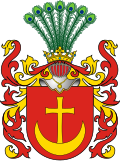
[edit]The anchored cross is a feature in coats of arms, and flags, in which context it is referred to by the heraldic terms "anchry" or "ancre."[10] Examples of this are found in the hooked anchor that represents Vinnytsia, Ukraine; a three-leaf cross with an anchor on the coat of arms of Pyhäranta, Finland; a patriarchal cross with an anchor in the coat of arms of Barkakra Municipality, Sweden, and Wollmatingen, Germany; the coat of arms of León, Spain and Tallinn, Estonia; and the personal shield of Claude Feidt, the Archbishop of the Roman Catholic Archdiocese of Aix.
Gallery
[edit]- Variants of the anchored cross
-
 Admiralty Pattern anchor
 -
 Stockless anchor cross
 -
 Anchor cross with rope
 -
 Anchor with wheel (wheel cross)
 -

-
-
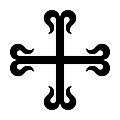
 St. Clement's Cross
 -
 Anchored cross necklace


- Anchored cross used in heraldry
-
 Hooked anchor representing Vinnytsia
 -
 Red anchor cross
 -
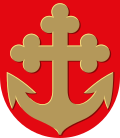 Cross bottony on an anchor on the coat of arms of Pyhäranta, Finland
 -
 Patriarch's Cross with an anchor in the coat of arms of Barkakra Municipality (Skåne County, Sweden)
 -
![Anchor of the Patriarch's Cross in the coat of arms of Wollmatingen [de], Germany](//upload.wikimedia.org/wikipedia/commons/thumb/c/c3/Wappen_Wollmatingen.png/120px-Wappen_Wollmatingen.png) Anchor of the Patriarch's Cross in the coat of arms of Wollmatingen, Germany
Anchor of the Patriarch's Cross in the coat of arms of Wollmatingen, Germany -
 The coat of arms of the Czech city of Odolena Voda
 -

-
 Tallinn, Estonia
 -
-

-
 Anchor cross


![Anchor of the Patriarch's Cross in the coat of arms of Wollmatingen [de], Germany](https://en.wikipedia.org/wiki/File:Wappen_Wollmatingen.png)


See also
[edit]- Crosses in heraldry
- Kotwica - Poland's anchor cross, used during the Second World War
References
[edit]- ^ a b Klöpping, Laura (2012). Customs, Habits and Symbols of the Protestant Religion. GRIN Verlag. p. 5. ISBN 978-3-656-13453-4.
- ^ Hebrews 6:19
- ^ Grainger, John D. (1990). Seleukos Nikator: Constructing a Hellenistic Kingdom. Routledge. p. 2. ISBN 978-0-415-04701-2.
- ^ "What is the origin of the anchor as a Christian symbol, and why do we no longer use it?". CHRISTIAN HISTORY.
- ^ Maurice Hassett (1913). . In Herbermann, Charles (ed.). Catholic Encyclopedia. New York: Robert Appleton Company.
- ^ "What an Anchor Cross Means". The United Methodist Church. July 19, 2019.
- ^ "Une croix du pont du Mort, sur le site du musée de la Camargue" (in French).
- ^ "La croix Camarguaise". www.chevalcamargue.fr (in French). Retrieved July 20, 2019.
- ^ Stracke, Richard (October 20, 2015). "Saint Clement: The Iconography". Christian Iconography.
- ^ Pimbley, Arthur Francis (1908). Pimbley's Dictionary of Heraldry: Together with an Illustrated Supplement. p. 3.
External links
[edit].svg)
.svg)

.svg)
.svg)

.svg)


.svg)


.svg)

.svg)
.svg)


.svg)
.svg)
.svg)


.svg)


.svg)
.svg)

.svg)

.svg)
.svg)
.svg)
.svg)
.svg)
.svg)
.svg)
.svg)
.svg)


.svg)
.svg)
.svg)


.svg)
.svg)
.svg)


.svg)

.svg)
.svg)
.svg)
.svg)
.svg)


.svg)
.svg)
.svg)
.svg)
.svg)


.svg)


.svg)


.svg)


.svg)


.svg)
.svg)


.svg)
.svg)


.svg)


.svg)


.svg)
.svg)
.svg)


.svg)
.svg)


.svg)

_Swastika_(%D0%A1%D0%B2%D0%B0%D1%81%D1%82%D0%B8%D0%BA%D0%B0)_-_Rodnovery.svg)


.svg)


.svg)


Anchored cross
View on GrokipediaDefinition and Form
Physical Description
The anchored cross features a principal vertical staff intersected by a horizontal crossbar located nearer to the upper end, forming the essential cross configuration, while the lower terminus expands and bifurcates into two opposing curved arms analogous to the flukes of a marine anchor. This forked base imparts a characteristic broadening at the bottom, setting it apart from the unadorned Latin cross by evoking the stabilizing form of an anchor embedded in seabed. In certain depictions, a ring or hoop caps the junction of the staff and crossbar, replicating the anchor's crown for securing a cable.[4] The vertical shaft is typically elongated relative to the lateral arms, enhancing the anchor-like proportion wherein the height substantially exceeds the width, thereby emphasizing structural poise over equidistant extension. Early manifestations in stone reliefs from the 2nd-century Catacomb of Domitilla illustrate an upright anchor with an integrated transverse bar, rendering the disguised Christian emblem in compact, incised lines on tufa walls. Subsequent artifacts employ metals such as bronze for engraved pendants or wood for carved icons, preserving the bifurcated geometry amid refinements in curvature and symmetry.[4]
Variations and Related Forms
The cross moline serves as a primary heraldic variant of the anchored cross, distinguished by its arms terminating in bifurcated, inwardly curved lobes that evoke the flukes of an anchor.[8] This form abstracts the anchor's morphology into symmetrical, mill-rind-inspired terminations, with each end splitting into two opposed points rather than replicating a literal shank-and-flouke structure.[10] The mariner's cross constitutes another subtype, adopting more precise nautical contours wherein the vertical shank forms the upright, the horizontal crosspiece aligns with the anchor's crown, and the lower flukes project as downward-curving prongs.[10] Some renditions incorporate a circular ring at the superior end of the shank, simulating the hawse ring for securing the anchor rode, thereby enhancing the resemblance to functional maritime hardware.[11] Morphologically distinct forms include the Camargue cross, which modifies a tau-shaped anchor base by integrating a superimposed heart and trident-like elements atop the vertical arm, diverging from the anchored cross's unadorned, equitable-arm configuration.[12] Similarly, the ankh exhibits an oval loop capping a tau cross, lacking the characteristic lower fluke bifurcations essential to anchored cross subtypes.[13]Historical Origins
Early Christian Adoption
The anchored cross appeared as an early Christian symbol in Roman catacombs during the 2nd century CE, often rendered as a simple anchor to conceal its cruciform shape and evade imperial persecution while evoking steadfast hope in salvation.[4] Archaeological evidence from sites like the Catacomb of St. Domitilla includes marble fragments blending anchor and cross forms dated circa 150–200 CE, predating the overt cruciform iconography that proliferated after Constantine's Edict of Milan in 313 CE legalized Christianity.[14] This usage aligned with maritime imagery for the soul's voyage, where the anchor signified secure mooring amid life's tempests, distinct from pagan nautical motifs by its theological emphasis on eternal stability.[15] In the Catacomb of Priscilla, anchors feature in frescoes and loculi decorations from the late 2nd century onward, appearing alongside fish and dove symbols to denote salvation's safe harbor without explicit crucifixion references.[16] These artifacts, excavated and documented by 19th-century archaeologists like Antonio Bosio, demonstrate the symbol's role in funerary inscriptions expressing faith's firmness, as noted in Vatican analyses of catacomb iconography.[17] Patristic texts, such as those by Clement of Alexandria (c. 150–215 CE), invoked the anchor metaphorically for hope's assurance, influencing its adoption in grave markers that served proto-liturgical functions in commemorating the deceased's steadfast confession.[4] This discreet emblem facilitated communal identity under duress, with anchors etched on over 100 catacomb epitaphs by the 3rd century, underscoring causal links between scriptural hope (Hebrews 6:19) and visual cryptography for resilience.[18] Empirical patterns from these sites reveal no equivalent pre-Christian anchor ubiquity in funerary art, affirming the symbol's adaptive Christian genesis amid Roman maritime culture's reinterpretation.[15]Association with Saint Clement
The tradition associating the anchored cross with Saint Clement of Rome stems from accounts of his martyrdom circa AD 99–101, during which he was reportedly bound to an anchor and cast into the Black Sea near Chersonesos (modern Crimea).[19] This narrative appears in apocryphal texts such as the Martyrdom of Clement, an early Christian apocryphal work describing the saint's execution by drowning to prevent proper burial, ordered by Roman authorities irritated by his conversions among pagans.[19] While early patristic sources like Eusebius confirm Clement's role as bishop of Rome without detailing his death, the anchor motif in later hagiographical traditions directly links his fate to the symbol's form.[20] The designation "St. Clement's Cross" for the anchored cross emerged in medieval contexts, reflecting the anchor's role in his legendary execution as depicted in hagiography and art. A verifiable early visual connection is found in the Book of Hours illuminated by the Workshop of the Bedford Master around 1440–1450, portraying Saint Clement holding an anchor as his attribute, underscoring the symbol's association with his maritime martyrdom.[21] This iconographic tradition, rooted in apocryphal acts rather than contemporaneous records, influenced the cross's nomenclature among mariners and Christians, though primary evidence for widespread use as a dedicated symbol predates the 15th century minimally.[21] Relics attributed to Clement, including bones and an anchor, were reportedly discovered in Chersonesos in the 9th century by Saint Cyril during his mission among the Khazars, who transported them to Rome in 867.[22] The site's historical Christian basilicas and proximity to the Black Sea reinforced regional veneration, with the Inkerman Cave Monastery later marking a purported burial location, contributing to localized iconography featuring anchors in Clementine contexts without extending to broader anchored cross proliferation.[23] Archaeological evidence from Chersonesos confirms early Christian presence but does not independently verify the relics' authenticity or direct causal ties to the symbol's development.[24]Symbolism and Interpretations
Biblical Foundations
The primary biblical foundation for the anchored cross derives from the Epistle to the Hebrews, particularly Hebrews 6:19, which states: "We have this hope as an anchor for the soul, firm and secure. It enters the inner sanctuary behind the curtain." In context, this verse concludes a discussion of God's unchangeable promise of inheritance through Abraham, extended to believers via Christ's priesthood, emphasizing hope as a stabilizing force amid doctrinal exhortations against apostasy.[25] The anchor metaphor causally evokes the device's practical role in maritime stability—embedding into the seabed to resist wind and current—paralleling the soul's anchorage in Christ's eternal priesthood, which secures believers against existential drift without reliance on transient circumstances.[26] This imagery aligns with the New Testament's broader nautical motifs underscoring faith's endurance in peril. In Acts 27, the narrative details Paul's sea voyage and shipwreck, where four anchors are deployed from the stern to hold the vessel steady during a violent nor'easter (Acts 27:29), yet ultimately discarded to enable survival (Acts 27:40). Paul's unwavering trust in divine revelation—"not a hair shall perish from the head of any of you" (Acts 27:34)—empirically demonstrates faith's grounding effect, as all 276 aboard reach safety despite apparent doom, tying anchor-like stability to providential hope rather than human seamanship alone.[27] Such exegesis prioritizes the anchor's mechanical reliability as a direct analogue for soteriological certainty, rooted in Christ's mediatorial entry "as a forerunner for us" (Hebrews 6:20), without extending to later symbolic accretions.[28] This textual basis underscores hope's causal efficacy in preserving the soul's orientation toward divine promise, verifiable through the epistle's priestly typology and the historical verisimilitude of Acts' seafaring account.[29]Theological and Cultural Meanings
The anchored cross embodies the theological concept of hope as a stabilizing force, rooted in Hebrews 6:19, which describes it as "an anchor for the soul, firm and secure," entering the divine presence through Christ's high-priestly role.[30] This biblical metaphor, emphasizing endurance against uncertainty, finds patristic reinforcement in Clement of Alexandria's Paedagogus, where he recommends the anchor—alongside the dove, fish, and ship—as a discreet emblem of steadfast faith suitable for Christian seals and signets.[9] Early church adoption during Roman persecutions transformed the anchor's general connotation of safety into an exclusively soteriological symbol of salvation's certainty, distinct from any prior secular or pagan maritime uses.[4] This interpretation maintains empirical consistency across denominations: Catholic tradition links it to eternal stability in Christ's sacrifice, Orthodox usage integrates it with resurrection motifs in liturgical art, and Protestant emphases, as in Methodist missionary badges, highlight anchoring in faith, hope, and love amid evangelistic trials.[5] Claims of non-Christian syncretism, such as purported borrowings from Hellenistic or Egyptian iconography, lack supporting artifacts predating Christian catacomb evidence from the second century, where the anchor-cross form appears tied solely to Hebrews' imagery rather than broader cultural diffusion.[3] Culturally, the symbol extends to seafaring Christian communities as a representation of divine refuge, mirroring naval anchors' role in averting drift while invoking Christ as the ultimate secure harbor, evidenced in traditions like those of patron saints for mariners and monastic orders with maritime apostolates.[31] Such usages, documented in Western naval heraldry from the early modern period, prioritize causal resilience in peril over mere nautical utility, without romanticized overtones unsupported by primary texts.[9]Uses in Heraldry and Iconography
Heraldic Applications
The anchored cross functions in heraldry primarily as the cross moline, also termed cross anchory from the French croix ancrée, with arms ending in splayed, bifurcated flukes evocative of anchor extremities. This configuration differentiates it from undifferentiated crosses like the Latin or Greek forms, enabling precise identification amid the proliferation of armorial charges in medieval Europe. Its bifurcations derive from practical heraldic needs for visual distinction, rather than mere ornamentation, while echoing the anchor's form to convey steadfastness.[32] Documented in blazons from the 13th century, the cross moline appears in rolls of arms during the reign of Henry III of England (1216–1272), including the arms of de Baucey circa 1244. A standard blazon renders it as "gules, a cross moline or," as in the registered arms of Greig of Glencarse, where the red field contrasts the golden cross for visibility in battle or seals. Scottish heraldry incorporates it in clan and family bearings, such as those denoting industrial or ecclesiastical ties, with the moline ends historically linked to millrinds but adapted for broader symbolic utility.[32][33][34] In armorial contexts, the form symbolizes hope and resolution, attributes inherent to the anchor's nautical role in securing vessels against tempests, paralleling Christian virtues of unyielding faith. This interpretation persists in European precedents, including municipal coats like those of León, Spain, and Tallinn, Estonia, where the charge underscores regional maritime heritage without implying universal naval origin. Empirical records prioritize its role as a charge for differentiation over explicit maritime exclusivity, as bifurcated ends facilitated rendering on shields and standards from the era's earliest systematic heraldry around 1250.[35]Depictions in Art and Architecture
In medieval churches dedicated to Saint Clement, the anchored cross motif appears in stone carvings symbolizing the saint's martyrdom by drowning with an anchor tied to his neck, as seen in the 13th-century Church of St. Clement at Powderham, Devon, England, where fouled anchors are incorporated into architectural features like the tower and interior elements to evoke steadfast hope amid peril.[36] Early medieval frescoes, such as those in the 11th- and 12th-century lower basilica of San Clemente in Rome, depict scenes from the saint's hagiography including his execution by anchor, fostering the iconographic link between the anchor's form and the cross as a composite symbol of salvation, though distinct from later stylized anchored crosses.[37] By the Renaissance, narrative art integrated the anchored cross more explicitly, as in a circa 1440–1450 Book of Hours illumination from the Workshop of the Bedford Master, where Saint Clement is portrayed with an anchor evoking the cross shape, marking a shift toward personalized devotional imagery that combined biographical detail with theological symbolism.[21]Modern and Contemporary Usage
Revival in Christian Symbolism
In the late 19th century, the anchored cross gained renewed prominence in Protestant devotional literature, exemplified by the hymn "Will Your Anchor Hold" (also known as "We Have an Anchor"), written by Priscilla J. Owens in 1882 and set to music by William J. Kirkpatrick. This composition, drawing directly from Hebrews 6:19, portrays Christ as a steadfast anchor amid life's tempests, reflecting the symbol's appeal during an era of rapid industrialization, transoceanic migration, and maritime expansion that heightened seafaring risks.[38] The hymn's inclusion in numerous denominational hymnals, such as those of Methodist and Baptist traditions, facilitated its widespread ecumenical dissemination, underscoring the anchored cross's role in conveying unshakeable hope grounded in biblical promises rather than transient cultural trends.[39] This resurgence paralleled organized seafaring evangelism efforts, including the founding of the American Seamen's Friend Society in 1828, which distributed Bibles and tracts to sailors while invoking anchor imagery to symbolize spiritual security in volatile oceanic conditions. Such initiatives, proliferating amid the Industrial Revolution's boost to global shipping fleets—from Britain's Merchant Navy peaking at over 19 million gross tons by 1914—reintegrated the anchored cross into maritime chapels and sailors' bethels, where it served as a visual emblem of resilience against both literal storms and metaphorical upheavals like economic dislocation and secular rationalism. Unlike earlier patristic associations with martyrdom, this period emphasized the symbol's scriptural causality: an immutable divine assurance (Hebrews 6:19) anchoring believers amid modernity's disruptions, evidenced by its persistence in 20th-century naval iconography during world wars, when chaplains invoked it for morale among crews facing unprecedented mechanized perils.[2] Catholic contexts similarly sustained the symbol's vitality, often linking it to Saint Clement's legacy while adapting it for contemporary devotionals, as seen in 19th-century altar cloths and votive art combining anchor, cross, and chi-rho to affirm Christ's salvific stability.[40] Across denominations, the anchored cross's endurance stemmed not from revivalist fads but from its empirical alignment with observed human needs for constancy—quantified in the era's rising shipwreck statistics, exceeding 500 annually in British waters alone by the 1890s—thus reinforcing theological realism over ephemeral narratives of progress.Examples in Jewelry, Tattoos, and Media
Sterling silver mariners' cross pendants, featuring the anchored cross design, have been produced and sold since the 20th century, with vintage examples available on resale platforms like eBay. [41] Contemporary offerings include 925 sterling silver nautical mariner's crucifix anchor pendants marketed for their Christian and maritime themes, distributed through retailers such as Amazon. [42] These items remain present in faith-based accessory markets as of 2025, with handmade variations offered on platforms like Etsy. [43] In tattoo artistry, the anchored cross appears in designs combining the anchor's form with a crucifix, symbolizing strength, hope, and stability amid adversity. [44] Modern examples include stylized motifs documented in online tattoo catalogs, where the symbol represents unwavering faith, with over 900 design variations cataloged for 2025. [45] Such tattoos often incorporate nautical elements like ropes to emphasize endurance, appealing to those seeking personal emblems of resilience. [46] Appearances of the anchored cross in media are less prominent but occur in nautical narratives evoking steadfast Christian faith, such as symbolic representations in maritime-themed literature and films portraying sailors' devotion. [9] Specific documented instances include visual motifs in contemporary discussions of Christian symbols in cinema, though direct plot integrations remain sparse in mainstream productions. [47]References
- https://commons.wikimedia.org/wiki/Category:Anchors_in_heraldry