


Community hub
Recent from talks
Contribute something
Nothing was collected or created yet.
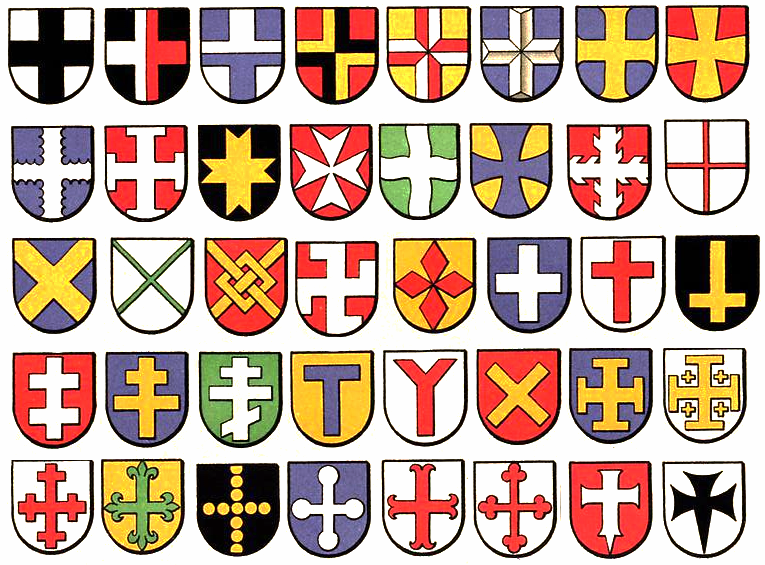
Crosses in heraldry
View on Wikipedia
A number of cross symbols were developed for the purpose of the emerging system of heraldry, which appeared in Western Europe in about 1200. This tradition is partly in the use of the Christian cross an emblem from the 11th century, and increasingly during the age of the Crusades. Many cross variants were developed in the classical tradition of heraldry during the late medieval and early modern periods. Heraldic crosses are inherited in modern iconographic traditions and are used in numerous national flags.
History
[edit]The Christian cross emblem (Latin cross or Greek cross) was used from the 5th century, deriving from a T-shape representing the gibbet (stauros, crux) of the crucifixion of Jesus in use from at least the 2nd century. The globus cruciger and the staurogram is used in Byzantine coins and seals during the Heraclian period (6th century). Under the Heraclian dynasty (7th century), coins also depict simply crosses potent, patty, or pommy.
The cross was used as a field sign by the Christian troops during the Crusades. In 1188, Kings Henry II of England and Philip II of France agreed to launch the Third Crusade together, and that Henry would use a white cross and Philip a red cross. The red-on-white cross came to be used by the Knights Templar, and the white-on-red one by the Knights Hospitaller (also white-on-black); the Teutonic Order used a black-on white version. Early cross or spiral-like shield decorations, not necessarily with Christian symbolism, are already found on depictions of shields of the 11th century.[1]


Heraldry emerged in western Europe at the start of the 13th century out of earlier traditions. The basic variants of the red-on-white (termed the Cross of Saint George) and the white-on-red crusaders' cross were continued independently in the flags of various states in the 13th and 14th century, including the Duchy of Genoa, the Electorate of Trier, the Bishopric of Constance and the Kingdoms of England and Georgia, which last two had special devotions to St George on one hand;[3] and Savoy, the war flag of the Holy Roman Empire and (possibly from the latter) Switzerland and Denmark on the other.
The cross appears as heraldic charge in the oldest rolls of arms, from about 1250. A roll of arms of the 13th century (the reign of Henry III of England) lists the coats of arms of various noblemen distinguished by crosses of different tinctures:
- Le Conte de Norffolk, d'or a ung crois de goulez (viz. red on gold);
- Piers de Sauvoye, goules ung crois d'argent(white on red): this is attributed, Peter's funerary monument displays an eagle on his shield;
- Robert de Veer d'argent a la crois de goulz (red on white).
Glover's Roll (British Library Add MS 29796), a 16th-century copy of a roll of arms of the 1250s has depictions of various heraldic crosses, including the or a cross gules of the earl of Norfolk, gules, a cross argent of Peter of Savoy, argent a cross gules of Robert de Veer, gules a cross flory vair of Guillaume de Forz, Comte d'Aumale, gules a cross fleury argent of Guillaume Vescy, gules a cross saltire engrele of Fulke de Escherdestone, argent a cross fleury azure of John Lexington, azure three crosses or of William de Sarren, or a cross gules, five scallops argent of Ralph Bigod, gules a cross fourchy argent of Gilbert de Vale, argent a cross fleury sable of John Lamplowe, or a cross saltire gules, a chief gules of Robert de Brus, gules a cross saltire argent of Robert de Neville, or a cross voided gules of Hamond (Robert) de Crevecoeur, and azure a cross or, four lions rampant or of Baudouin Dakeney. In addition, the Glover Roll has semy of crosses crosslet as a tincture in several coats of arms.[citation needed]
The desire to distinguish one's coat of arms from others led to a period of substantial innovation in producing variants of the basic Christian cross by the early 14th century (in England, the reign of Edward II).
The great number of variants of crosses, and the deep history of such variants (going back to the 14th century or earlier) results in confusing and often contradictory terminology.[4]
In the heraldry of the Holy Roman Empire, the cross is comparatively rare in the coats of arms of noble families, presumably because the plain heraldic cross was seen as an imperial symbol (for the same reason, the eagle was rarely used as a charge because it represented the empire), but in the 14th century the plain cross is used in the seals and flags of several prince-bishoprics, including Trier, Constance and Cologne.[5]
Looking back on the Crusades as the foundational period of knighthood, the badge of the cross became strongly associated with the idealized Christian knight of romance, as expressed by Spenser (Faerie Queene book 1, canto 1):[6]
And on his brest a bloodie crosse he bore,
The deare remembrance of his dying Lord,
For whose sweete sake that glorious badge he wore,
And dead, as living ever, his ador'd:
Upon his shield the like was also scor'd.
The black-on-white cross worn by the Teutonic Knights was granted by Innocent III in 1205. The coat of arms representing the grand master (Deutschmeisterwappen)[7] is shown with a golden cross fleury or cross potent superimposed on the black cross, with the imperial eagle as a central inescutcheon. The golden cross fleury overlaid on the black cross becomes widely used in the 15th century. A legendary account attributes its introduction to Louis IX of France, who on 20 August 1250 granted the master of the order this cross as a variation of the Jerusalem cross, with the fleur-de-lis symbol attached to each arm. While this legendary account cannot be traced back further than the early modern period (Christoph Hartknoch, 1684) there is some evidence that the design does indeed date to the mid 13th century.[8] The black cross patty was later used for military decoration and insignia by the Kingdom of Prussia and gave rise to the cross patty in the German Reichskriegsflagge and the Iron Cross and Pour le Mérite orders.
The Nordic cross is an 18th-century innovation derived from cross flags adapted as swallow-tailed (or triple-tailed) pennons used as civil ensigns; the first official introduction of such a flag was in a regulation of 11 June 1748 describing the Danish civil ensign (Koffardiflaget) for merchant ships. The Danish design was adopted for the flags of Norway (civil ensign 1821) and Sweden (1906), both derived from a common ensign used during the Union between Sweden and Norway 1818–1844, Iceland (1915) and Finland (1917).
Ordinary cross
[edit]The blazon Cross without any addition signifies a heraldic ordinary, a pale and a fess of equal widths conjoined, the width being typically one-fifth of the shield (or one third of the shield when charges are placed on the cross).[9] The four arms should be of equal length (forming a Greek cross), as far as possible within the shape of the shield, and they meet in the center (fesse-point) of the shield, except when it is abased (lowered) in the presence of a chief. The plain cross of gules in a field argent is termed Saint George's Cross.[9]
The ordinary formed when the cross' arms are oblique, passing through the top corners of the shield, is referred to as a saltire.

The ordinary cross may further be modify in its flection (i.e. modification of its edges as engrailed (engreslée), embattled (bretessée), indented (denchée), invected (cannelée), wavy, (ondée), raguly (écotée), dancetty or dantelly (denché, émanchée), and so on. French heraldic terminology is even more diverse, with many synonyms leading to some confusion.[10]
-
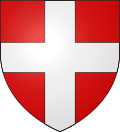 Gules a cross argent (Savoy)
 -
 Gules a saltire argent (Neville)
 -
 Or a cross per fess gules and azure
 -

-
 Sable a cross engrailed or
 -
![Or [tenné] a cross chequy gules and sable](//upload.wikimedia.org/wikipedia/commons/thumb/3/32/Kryzius_02_Sachmatinis.png/120px-Kryzius_02_Sachmatinis.png) Or [tenné] a cross chequy gules and sable
Or [tenné] a cross chequy gules and sable -
 Argent a saltire engrailed azure
 -
![Azure a saltire embattled parted [voided] or (John Allen-Petrie)](//upload.wikimedia.org/wikipedia/commons/thumb/b/b5/Arms_of_John_Michael_Allen-Petrie.svg/120px-Arms_of_John_Michael_Allen-Petrie.svg.png) Azure a saltire embattled parted [voided] or (John Allen-Petrie)
Azure a saltire embattled parted [voided] or (John Allen-Petrie) -
 Or a cross patty throughout sable


.svg)

![Or [tenné] a cross chequy gules and sable](https://en.wikipedia.org/wiki/File:Kryzius_02_Sachmatinis.png)

![Azure a saltire embattled parted [voided] or (John Allen-Petrie)](https://en.wikipedia.org/wiki/File:Arms_of_John_Michael_Allen-Petrie.svg)

The ordinary cross may also be varied in its tincture, it may be party, or chequy, compony, counter-compony, fretty, trellised, vair maçonnée and so on. It may also be of two tinctures, e.g. party per fesse, per pale, or per cross (equivalent to quarterly), mostly in connection with the partition of the field (i.e. counter-charged).
The term quarter-pierced (quarterly pierced) is used when the center of the cross has a separate tincture. Some heraldists have used quarter-voided or square-pierced for cases where the center of the cross is given the tincture of the field, or alternatively chequy of nine panes (French équipollée). A cross quadrate has a square at the intersection point.
-
 Argent a cross azure pierced of the field
 -
 Argent a cross vert quarter pierced of the field
 -
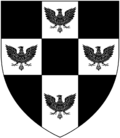 Sable on a cross argent quarter pierced of the field four eagles displayed of the first (Buller)
 -
 Argent a cross gules quarterly pierced nine crosses crosslet, three, three, and three counterchanged (the first quarter ermine for distinction) (Mary Ann Harvey Bonnell 1841)


The cross voided (also une fausse croix) has the same tincture of the field with only a narrow border outlining the limbs. This is equivalent to superimposing one cross upon another (croix chargée, or remplie) when the second cross is of the tincture of the field.[9]
-
 Argent a cross voided sable
 -
 Or a cross triple parted vert
 -
 A cross triple parted fretted in the municipal coat of arms of Nova Crnja (Serbia)
 -
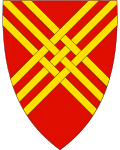 A saltire triple parted fretted in the municipal coat of arms of Hjelmeland (Norway)


A voided cross might also be blazoned as fimbriated. Fimbriated crosses are more common in vexillology, e.g. the fimbriated crosses in the national flags of the United Kingdom, of Norway and of Iceland. The German Balkenkreuz, introduced originally as identification for German Luftstreitkräfte in 1918 and later used as a vehicle emblem by the Wehrmacht, if used heraldically might be blazoned as a cross double fimbriated, or as a voided cross superimposed by a second cross. The "Bundeswehr cross" is a variant of the Balkenkreuz using a cross patty.
Named variants
[edit]Equal limbs
[edit]| Picture | Name | Description |
|---|---|---|
 |
Cross hummetty (couped, alaisée, alésée) | When the ordinary cross is couped it acquires aspects of a charge (rather than an ordinary), i.e. a Greek cross with equal limbs. |

|
Cross pattée (patty, formée, formy) |
A cross pattée (or formée/formy) has arms narrowing towards the centre, but with flat ends. It is usually found with curved inside edges as in the 13th c. arms of Baron Berkeley (see also Iron Cross); but sometimes encountered with straight edges (triangular arms). A cross pattée must be blazoned as throughout or fixed (passant), if it is intended that the four arms of the cross should reach to the edges of the shield. |

|
Cross potent |
This cross has a crossbar at the end of each of its arms. "Potent" is an old word for a crutch, and is used in heraldic terminology to describe a T shape. |

|
Cross cercelée (recercely) |
A cross recercely seems to be a cross moline parted or voided throughout—though it may be a cross moline very curly.[11] |

|
Cross moline (anchory) |
In a cross moline, the ends of the arms are bifurcated, split and curved back, also called a cross ancré or anchory. As a mark of cadency in English and Canadian heraldry, it marks an eighth son.[citation needed] Found in the coats of arms of Molyneux and of the House of Broglie. |

|
Cross fourchy (fourchée) |
One form of the heraldic cross fourchy or cross fourche (croix fourchée meaning "forked"). An example is the South African Postal Association[12] |

|
Maltese cross |
With arms which narrow towards the center, and are indented at the ends, also known as the eight-pointed cross (with no curved lines). This is a gradual evolution of the eight-pointed cross moline. The sharp vertex of the modern "four-arrowhead" design is gradual, and takes place during the 15th to 16th century. The "Rhodian cross" of the early 16th century had almost, but not quite, achieved the "sharp arrowhead appearance". The modern form is known as the Maltese cross for its use by the Sovereign Military Order of Malta. |

|
Cross crosslet |
A cross with the ends of each arm crossed. A prominent early example is in the arms of the Beauchamp earls of Warwick. In early armory it is not always distinguished from a cross bottony. A variant is the cross crosslet double crossed,[13] with two bars crossing each arm, as in the arms of Robert Willoughby, 1st Baron Willoughby de Broke (d.1502) sculpted on his tomb at Callington Church, Cornwall. The religious symbol of Latvian religion Dievturība called a krustu krusts in Latvian. |

|
Cross bottony (trefly) |
A cross with the ends of the arms bottony (or botonny, i.e. "furnished with knobs or buttons"), i.e. shaped like a trefoil—and so it is sometimes called a cross trefly. In early armory it is not always distinguished from a cross crosslet. It occurs counterchanged on the flag of Maryland; a saltire botonny can be seen in the coat and flag of the Village of New Maryland, New Brunswick;[14] and a Latin cross trefly can be seen in the coat of Isidore Popowych, it also appears in the canton of the arms and flag of the Episcopal Church, where it is blazoned as "cross crosslet".[15] |

|
Cross fleury (flory) |
A cross whose arms end in fleurs-de-lys – as in the coats of arms of the Municipalité de la Paroisse de Saint-Philémon in Canada and the Borough of Woking in England. In early armory it was not consistently distinguished from the cross patoncé. A version of the cross flory is used by the Romanian Order of Michael the Brave. Another version, the "Cross of Saint Julian" (Cruz de San Julián) is a special form of the cross fleury used by the Spanish Order of Alcántara, Order of Calatrava and Order of Montesa. |

|
Cross patoncé |
A cross patoncé (or patonce) is more or less intermediate between a cross pattée and a cross flory (or fleury). The ends of its limbs are trifurcated into leaf shapes, and seems to come in two sorts: one where the limbs are the same width all along as in the coat of Godfrey McCance Gransden;[14] and the other where the limbs gently widen from the centre (but do not curve) as in the coat of John Chiu] (both of Canada).[14] A medieval example is shown on the seal of William de Fortibus (d.1260). The name is derived from French patte d'once (“ounce's paw”).[16] |

|
Cross pommy |
A cross pommy (croix pommée) has a round knob at the end of each arm, as in the coat of Penwith District Council,[17] England. The name is derived from French pommé, "grown round like an apple."[18] |

|
Cross gamma (gammate, cramponny) |
Upright cross with truncated angled arms; essentially a variant of the swastika; uncommon, but can be found in the arms of Gordon of Hallhead.[19] Also known as a cross cramponny or cramponée, a fylfot, a gammate or gammadion cross, or tetragammadion, as it were combining four capital Greek letters Γ (gamma). |

|
Cross barby |
In the coat of Tillie in Cornwall.[20] The symbol is also called a "barbed cross" or an "arrow cross". An arrow cross in green was also the symbol of the Arrow Cross Party of Hungary. |

|
Cross erminée |
A cross erminée is a cross of four ermine-spots, with the heads meeting, sharing their spots. Historically borne by Hurston (Cheshire, England) c. 1490 and others[21] |

|
Avellane cross |
A form of cross which resembles four hazel filberts in their husks or cases, joined together at the great end. The term comes from the Latin name for the hazel, originally Nux avellana. It was fairly rare in English heraldry. |

|
Order of Christ Cross |
A form of cross which resembling a mix between a cross pattée or the cross potent. Also known as a "Portuguese Cross", it is associated with the Portuguese discoveries. It is fairly common in Portuguese heraldry and Brazilian heraldry. |
Unequal limbs
[edit]| Picture | Name | Description |
|---|---|---|

|
Latin cross | The Latin cross has an elongated lower limb. Media related to Latin crosses in heraldry at Wikimedia Commons
|

|
Cross of Saint Peter | The inverted Latin cross is known as the Cross of Saint Peter. Media related to Cross of Saint Peter in heraldry at Wikimedia Commons
|

|
Cross of Saint Philip | The sideways Latin cross is associated with Philip the Apostle.[citation needed] |

|
Cross portate | The oblique Latin cross, known as cross portate ("carried"),[22] is associated with Saint Gilbert of Sempringham. |

|
Calvary cross | A Latin cross standing on steps (mostly three in number) is known as Calvary cross. Media related to Calvary cross in heraldry at Wikimedia Commons
|

|
Cross fitchy | A cross fitchy has the lower limb pointed, as if to be driven into the ground.[23][24] From French fiché, "fixed."[25] |
|
|
Cross pattée fitchée |
A cross pattée fitchée is a cross pattée with a sharp point added to the lower limb, as if for use in staking into the ground |

|
Cross fleury fitchy (Cross of Saint James) | A special form of the cross flory fitchy is used by the order of Santiago. Also found in the Scottish arms of Mulino from Venezuela[26] and in the coats of Santa Cruz de Tenerife, Spain;[27] and Caracas, Venezuela;[27] Santiago de Tete, Mozambique.[27] |

|
Cross crosslet fitchy |
Shown here is a cross crosslet fitchy, a very frequent charge in British and French armory, appearing in the arms of the House of Howard, the Marquess of Ailsa, the Earl Cathcart, Macpherson of Cluny, Rattray of that Ilk, among many others. This is probably the most common form of the cross fitchy but others do exist, such as the crosses formy fitchy found between the antlers of the stag supporters of South Buckinghamshire District Council, England.[28] |

|
Patriarchal cross | The patriarchal cross or double cross was used in Byzantine seals since the early medieval period. It was adopted in the coat of arms of Hungary in the late 12th century, and also appears on the more recent coat of arms of Slovakia. |

|
Two-barred cross |
A Latin cross with an extra bar added. The lengths and placement of the bars (or "arms") vary, and most of the variations are interchangeably called either of the cross of Lorraine, the patriarchal cross, the Orthodox cross or the archiepiscopal cross. It appears in the arms of the Jagiellonian dynasty, which itself appears in the modern arms of Lithuania. |

Additional charges
[edit]In some cases, a separate name is given to the ensemble of a heraldic cross with four additional charges in the angles.
| Picture | Name | Description |
|---|---|---|

|
Cross-and-crosslets (a cross potent between four plain crosslets); Jerusalem cross) |
The symbol of the Crusader Kingdom of Jerusalem, which existed for almost two hundred years after the First Crusade; in the rendering at left, the large cross is shown slightly "potent" (i.e., with T-shaped ends), but that is not always the case. The four smaller crosses are said to symbolize either the four books of the Gospel or the four directions in which the Word of Christ spread from Jerusalem. Alternatively, all five crosses can symbolize the five wounds of Christ during the Passion. This symbol is used in the flag of Georgia. Also found in the coat of arms of the Papal Equestrian Order of the Holy Sepulchre of Jerusalem, Vatican City (matriculated in Scotland as "Argent; a Jerusalem cross cantoned between four crosses couped, gules"—Scots Public Register, volume 75, page 112)—to be seen at various EOHSJ websites; also in the Canadian coat of Robert Gerald Guest (Canadian Public Register Volume III, page 85). |

|
Tetragrammatic cross |
A Greek cross with the letter beta (Β) in each of its angles, which represent the imperial motto of the Palaiologos dynasty (mid-13th century, βασιλεὺς βασιλέων, βασιλεύων βασιλευόντων - Basileus Basileōn, Basileuōn Basileuontōn "King of Kings, Ruling Over Kings"). The Serbian cross variant (Само Слога Србина Спашава - Only Unity Saves The Serbs) with four "firesteel" shapes develops in the early modern Illyrian Armorials. |
Flags
[edit]

Flags with crosses are recorded from the later Middle Ages, e.g. in the early 14th century the insignia cruxata comunis of the city of Genoa, the red-on-white cross that would later become known as St George's Cross, and the white-on-red cross of the Reichssturmfahne used as the war flag of the Holy Roman Emperor possibly from the early 13th century.[citation needed]
Crosses on flags become more widespread in the Age of Sail, as maritime flags, and from this tradition develop into national flags in the 18th to 19th century, the British Union flag (as naval flag) was introduced in 1606, after the Union of the Crowns. The Nordic cross is a modern cross variant used on rectangular flags only, introduced for rectangular civil ensigns for Denmark in 1748. This is to be distinguished from the (rare) heraldic charge of a horizontal Latin cross, known as the "Cross of Saint Philip".
Several national flags are based on late medieval war flags, including the white-on-red crosses of the flag of Denmark and the flag of Switzerland. The elongated Nordic cross originates in the 18th century due to the rectangular shape of maritime flags.
The Red Cross flag originates in 1906 as a colour-switched version of the flag of Switzerland.
Further reading
[edit]- Seymour, William Wood (1898). "The Cross in Heraldry". The Cross in Tradition, History, and Art.
See also
[edit]References
[edit]- ^ Round Shield Designs (vikingage.org): "simple cross": Bayeux Tapestry, "flared cross" Arras, BM MS 559 (435), vol. 1 (c. 1000–1050).
- ^ see e.g. The Publications of the Harleian Society, Volume 100 (1950), p. 169.
- ^ Red crosses seem to have been used as a distinguishing mark worn by English soldiers from the reign of Edward I (1270s). Perrin (1922) concludes that the introduction of the Cross of St George as a "national emblem" is originally due to Edward I. By 1300, there was also a greater "banner of St George", but not yet in a prominent function; the king used it among several banners of saints alongside the royal banner. "Among the greater banners that of St George was not as yet supreme; it was indeed only one of four, for when the Castle of Carlaverock was taken in the year 1300: Puis fist le roy porter amont / Sa baniere et la Seint Eymont / La Seint George et la Seint Edwart [...]" Perrin 1922, p. 37 "The first step towards the promotion of St George to a position of predominance seems to be due to Edward III, who in gratitude for his supposed help at the Battle of Cregy founded the Chapel of St George at Windsor in 1348." Perrin 1922, pp. 37f. Perrin (1922), British Flags, p. 37
- ^ "heraldic writers have in their ingenuity multiplied the forms. In giving a summary of the chief forms only we are met with the difficulty of many synonyms occurring, for practically the same form is often much varied by incorrect drawing, and much confusion has arisen from blunders of heraldic writers in misreading or misunderstanding the terms employed. The French terms are more varied still than the English, and the correlation of the two series can only be attempted approximately." James Parker, A Glossary of Terms Used in Heraldry (1894)
- ^ The 14th-century Zürich armorial has no family coats of arms with crosses, but shows plain crosses in the flags of several cities, including Constance, Speier, Trier and Mainz.
- ^ "Edmund Spenser's Poem: The Faerie Queene, Book I, Canto 1". Archived from the original on 2016-03-04. Retrieved 2016-02-27. Retrieved February 27, 2016
- ^ The offices of Hochmeister (grand master, head of the order) and Deutschmeister (Magister Germaniae) were united in 1525. The title of Magister Germaniae had been introduced in 1219 as the head of the bailiwicks in the Holy Roman Empire, from 1381 also those in Italy, raised to the rank of a prince of the Holy Roman Empire in 1494, but merged with the office of grand master under Walter von Cronberg in 1525, from which time the head of the order had the title of Hoch- und Deutschmeister. Bernhard Peter (2011) Archived 2015-09-23 at the Wayback Machine
- ^ Helmut Nickel, "Über das Hochmeisterwappen des Deutschen Ordens im Heiligen Lande", Der Herold 4/1990, 97–108 (mgh-bibliothek.de). Marie-Luise Heckmann, "Überlegungen zu einem heraldischen Repertorium an Hand der Hochmeisterwappen des Deutschen Ordens" in: Matthias Thumser, Janusz Tandecki, Dieter Heckmann (eds.) Edition deutschsprachiger Quellen aus dem Ostseeraum (14.-16. Jahrhundert), Publikationen des Deutsch-Polnischen Gesprächskreises für Quellenedition. Publikacje Niemiecko-Polskiej Grupy Dyskusyjnej do Spraw Edycij Zrodel 1, 2001, 315–346 (online edition). "Die zeitgenössische Überlieferung verdeutlicht für dieses Wappen hingegen einen anderen Werdegang. Der Modelstein eines Schildmachers, der unter Hermann von Salza zwischen 1229 und 1266 auf der Starkenburg (Montfort) im Heiligen Land tätig war, und ein rekonstruiertes Deckengemälde in der Burgkapelle derselben Festung erlaubten der Forschung den Schluss, dass sich die Hochmeister schon im 13. Jahrhundert eines eigenen Wappens bedient hätten. Es zeigte ein auf das schwarze Ordenskreuz aufgelegtes goldenes Lilienkreuz mit dem bekannten Adlerschildchen. Die Wappensiegel des Elbinger Komturs von 1310 bzw. 1319, ein heute in Innsbruck aufbewahrter Vortrageschild des Hochmeisters Karl von Trier von etwa 1320 und das schlecht erhaltene Sekretsiegel desselben Hochmeisters von 1323 sind ebenfalls jeweils mit aufgelegtem goldenem Lilienkreuz ausgestattet."
- ^ a b c James Parker, A Glossary of Terms Used in Heraldry (1894).
- ^ "we are met with the difficulty of many synonyms occurring, for practically the same form is often much varied by incorrect drawing, and much confusion has arisen from blunders of heraldic writers in misreading or misunderstanding the terms employed." Parker (1894).
- ^ Brooke-Little An heraldic alphabet, p 77
- ^ "National Archives of South Africa (NASA) Database Selection". www.national.archsrch.gov.za.
- ^ Terminology of Robson, Thomas, The British Herald
- ^ a b c General, Office of the Secretary to the Governor (November 12, 2020). "The Public Register of Arms, Flags, and Badges of Canada". The Governor General of Canada.
- ^ "Journal of the General Convention of the Protestant Episcopal Church in the United States of America" (PDF). The Episcopal Church. 1940. p. 288.
- ^ "Patonce Cross". www.seiyaku.com.
- ^ "CIVIC HERALDRY OF ENGLAND AND WALES - CORNWALL (1974 - 2009)". www.civicheraldry.co.uk.
- ^ "Pommee Cross". www.seiyaku.com.
- ^ Scots Public Register volume 31, page 20
- ^ cited in Parker's Glossary, s.v. Cross barby
- ^ "A Glossary Of Terms Used In Heraldry By James Parker". Heraldsnet.org. Retrieved 2013-06-13.
- ^ "portate — definition, examples, related words and more at Wordnik". Wordnik.com.
- ^ Gilman, D. C.; Peck, H. T.; Colby, F. M., eds. (1905). . New International Encyclopedia (1st ed.). New York: Dodd, Mead.
- ^ Rines, George Edwin, ed. (1920). . Encyclopedia Americana.
- ^ "Shirley Association Genealogical Research Website". www.shirleyassociation.com.
- ^ Scots Public Register. Vol. 87. p. 0.
- ^ a b c "Heraldry of the World (HOTW) - the largest site on heraldry". Heraldry of the World. December 28, 2022.
- ^ "South Buckinghamshire District Council".
External links
[edit] Media related to Crosses in heraldry at Wikimedia Commons
.svg)
.svg)

.svg)
.svg)

.svg)


.svg)


.svg)

.svg)
.svg)


.svg)
.svg)
.svg)


.svg)


.svg)
.svg)

.svg)

.svg)
.svg)
.svg)
.svg)
.svg)
.svg)
.svg)
.svg)
.svg)


.svg)
.svg)
.svg)


.svg)
.svg)
.svg)


.svg)
.svg)
.svg)
.svg)
.svg)
.svg)


.svg)
.svg)
.svg)
.svg)
.svg)


.svg)


.svg)


.svg)

.svg)


.svg)
.svg)


.svg)
.svg)


.svg)


.svg)


.svg)
.svg)
.svg)


.svg)
.svg)


.svg)

_Swastika_(%D0%A1%D0%B2%D0%B0%D1%81%D1%82%D0%B8%D0%BA%D0%B0)_-_Rodnovery.svg)


.svg)


.svg)


| Types | |||||||||||||||
|---|---|---|---|---|---|---|---|---|---|---|---|---|---|---|---|
| Topics | |||||||||||||||
| Achievement | |||||||||||||||
| Charges | |||||||||||||||
| Tinctures |
| ||||||||||||||
| Applications | |||||||||||||||
| Related | |||||||||||||||
| |||||||||||||||


