Hubbry Logo
search
logo
1823633

Apasmara

logo
Community Hub0 Subscribers
Read side by side
from Wikipedia

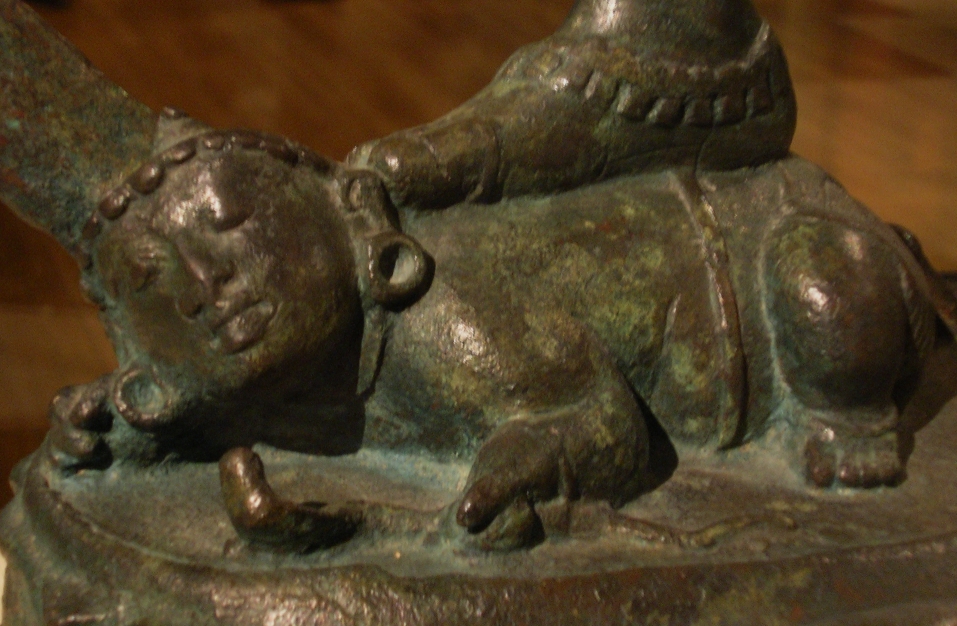
Apasmara, clutching a cobra and trampled beneath the foot of Nataraja (Shiva as lord of dance).

Apasmara (Sanskrit: अपस्मार, IAST: Apasmāra) is a diminutive man who represents spiritual ignorance and ahamkara in Hindu mythology.[1][2] He is also known as Muyalaka or Muyalakan.

Etymology and definition

[edit]

The suffix smāra (from smaranam) means memory. The compound apasmāra means loss of memory, which corresponds to conditions such as dementia or amnesia. It can also imply gibberish (unintelligible speech) or ego (Ahamkara).[3] Apasmara in Ayurveda referred to neurological disorders characterized by memory loss rather than speech issues. Due to the lack of modern diagnostic tools such as brain scanning at the time, the exact conditions described remain uncertain.

Theological and symbolic significance

[edit]
Nataraja dancing the cosmic dance of creation, destruction and moksha (ultimate liberation) upon the prone body of Apasmara, the demon of avidya (ignorance or lack of spiritual insight) – Chola bronze, Musée Guimet.

Apasmara, depicted as a diminutive man, is often shown in Hindu iconography clutching a cobra, which symbolizes (ahamkara) in Shaivite tradition.[4]

Ahamkara, literally means the "I-maker", and is the faculty by which jivas (souls) identify with the physical body rather than their higher self.[5] The Shiva Purana describes ahamkara as originating from Prakriti (nature).[6] Apasmara symbolizes the ignorance of selfhood (ahamkara), a universal, cosmic form of ignorance essential for jivas to function in samsara across their countless rebirths by forgetting past lives and identifying with a new body each time. This "necessary evil" of Apasmara is part of the cosmic balance between spiritual knowledge and the inherent ignorance in one's sense of self, and cannot be eradicated without disrupting the cosmic order. Killing Apasmara would represent gaining spiritual knowledge without the effort, will, and dedication required, thereby devaluing that knowledge itself.[2]

To enable moksha (transcendence) while preserving the cosmic balance between spiritual knowledge and ignorance inherent in samsara, Apasmara must be subdued rather than killed.[2] To suppress Apasmara, Shiva assumes the form of Nataraja—the Lord of Dance—and performs the cosmic dance of tāṇḍava. During this dance, Shiva subdues Apasmara under his right foot, symbolizing the subjugation of ignorance and ahamkara. Apasmara is believed to remain eternally subdued beneath Nataraja's foot, with Shiva perpetually maintaining this balance through his cosmic dance.[2][7] Similar symbolism is seen in representations of Dakshinamurti, another form of Shiva as a guru, where Apasmara is subdued under Shiva’s right foot.

English writer and philosopher, Aldous Huxley has described and summarized the symbolism of Nataraja and Apasmara, also known as Muyalaka in his utopian novel, Island:

Nataraja's right foot is planted squarely on a horrible little subhuman creature - the demon, Muyalaka. A dwarf, but immensely powerful in his malignity, Muyalaka is the embodiment of ignorance, the manifestation of greedy, possessive selfhood. Stamp on him, break his back! And that's precisely what Nataraja is doing. Trampling the little monster down under his right foot. But notice that it isn't at this trampling foot that he points his finger; it's at the left foot, the foot that, as he dances, he's in the act of raising from the ground. And why does he point at it? Why? That lifted foot, that dancing defiance of the force of gravity - it's the symbol of release, of moksha, of liberation.[8]

Disease concept in Ayurveda

[edit]

The concept of Apasmara in Āyurveda relates to a group of neurological disorders, one of which may be identified as epilepsy:[9][10] according to Maharṣi Caraka, there are 4 types of apasmāra.[10] These 4 types of apasmara are Vataja, Pitaja, Kapahaja and Sannipataja.These can be related to conditions associated with loss of memory like amnesia and dementia or temporal lobe epilepsy with fugue states or hysteria.[11] Charakhas instituted this classification depending upon the different doshas of the body.

See also

[edit]

References

[edit]

Sources

[edit]
Revisions and contributorsEdit on WikipediaRead on Wikipedia
from Grokipedia
Apasmara (Sanskrit: अपस्मार, IAST: Apasmāra) is a multifaceted concept in Hindu tradition, embodying both a mythological demon and a medical condition in Ayurveda. In Hindu mythology, Apasmara is depicted as a diminutive dwarf-like demon representing spiritual ignorance (avidyā), ego (ahamkāra), selfishness, and laziness, who is eternally trampled under the raised foot of Shiva in his iconic Nataraja form as the cosmic dancer, symbolizing the triumph of divine knowledge and cosmic rhythm over chaos and forgetfulness.[1] In Ayurvedic medicine, Apasmara specifically denotes epilepsy, defined as the negation or loss (apa) of memory or consciousness (smara), manifesting as recurrent seizures with symptoms including sudden falls, convulsions, foaming at the mouth, eye-rolling, and temporary amnesia, classified into four types based on the dominant doshas (vāta, pitta, kapha, or sannipāta).[2][3] The mythological narrative of Apasmara draws from Puranic texts such as the Skanda Purana, where the demon—sometimes called Muyalaka or Muyalakan—is portrayed as an immortal being born from the curse or black magic of sages, challenging Shiva's ascetic form as Bhikshatana before being subdued in the cosmic dance at Chidambaram, illustrating the eternal cycle of creation, preservation, and destruction.[1] This iconography, prominent in Chola-era bronze sculptures from the 10th–11th centuries, underscores Apasmara's coarse features, protruding eyes, and childlike body, evoking not just abstract ignorance but also physical ailments like epilepsy, thereby bridging spiritual allegory with ancient medical understanding.[4] In Ayurvedic literature, including the Charaka Samhita and Sushruta Samhita, Apasmara is considered a vata-dominant disorder arising from imbalances in the doshas, often triggered by etiological factors such as improper diet, suppressed urges, mental trauma, or supernatural influences like demonic possession, with prodromal auras (poorva roopa) involving delusions, auditory hallucinations, or a dream-like state preceding full attacks.[3] Treatments emphasize holistic approaches, including purification therapies (shodhana), medicated ghees (snehapana), herbal formulations to pacify vata, and lifestyle regimens to restore mental clarity, reflecting an integrated view of body, mind, and spirit that parallels the mythological subjugation of Apasmara by Shiva's dance.[2] This dual significance highlights Apasmara's enduring role in Hindu cosmology and healing traditions, influencing art, ritual, and therapeutics across centuries.[4]

Etymology and Historical Context

Linguistic Origins

The term Apasmara originates from Sanskrit, where it is a compound word derived from the prefix apa-, signifying negation, privation, or removal, and smāra (from the root smṛ, meaning "to remember" or "recollection"), denoting the resulting state of "loss of memory" or "amnesia."[2][5][6] This etymological structure underscores a core semantic implication of forgetfulness, extending beyond literal amnesia to encompass lapses in cognitive or spiritual recollection in classical Indian philosophical discourse.[1] In philosophical contexts, Apasmara is associated with ahamkara (ego or the sense of individualized selfhood), where excessive egoism is viewed as a causal factor in the "loss of memory" regarding one's true nature, leading to spiritual ignorance or obscured awareness.[7] This linkage highlights how ahamkara fosters a distorted recollection, binding the individual to illusory identifications rather than universal consciousness.[8] Linguistically, the term exhibits variations across related Indic languages; in Pali, it appears as apasmāra, retaining the connotation of memory loss or epilepsy-like states. In Tamil-influenced traditions, it manifests as Muyalaka or Muyalakan, a transliteration emphasizing the demonic aspect symbolizing ignorance in regional mythological narratives.[9] These adaptations reflect the term's semantic evolution while preserving its foundational theme of negation of remembrance.

Evolution in Ancient Texts

Allusions to seizure-like states and loss of consciousness appear in Vedic literature, dating to the pre-1000 BCE period. In the Atharvaveda (c. 1200–900 BCE), one of the Vedic texts, hymns invoke divine protection against afflictions resembling epilepsy, such as the condition known as Mṛgī involving sudden falls and deranged behavior attributed to supernatural influences or imbalances in the body and mind.[10][11] This early Vedic reference to Mṛgī as a condition involving unconsciousness and falls laid the groundwork for the more detailed conceptualization of Apasmara in subsequent Ayurvedic texts. These descriptions reflect a spiritual understanding of such conditions as disturbances in cosmic harmony rather than a formalized medical entity. By the time of the Upanishads (c. 800–200 BCE), the notion evolved to link memory loss and forgetfulness with deeper spiritual ignorance, known as avidya, which obscures true knowledge of the self (atman). Texts like the Brihadaranyaka Upanishad discuss states of delusion and loss of recollection as barriers to enlightenment, providing a philosophical basis for later interpretations of conditions like Apasmara not merely as physical ailments but as metaphors for existential forgetfulness. This shift emphasized conceptual ties between cognitive impairment and the soul's journey toward wisdom, influencing later symbolic representations. The development of Apasmara as a distinct entity appears in the classical epics and Puranas, where it transitions into a personified demon. In the Mahabharata (c. 400 BCE–400 CE), episodes of sudden unconsciousness and memory lapses are described in contexts of curses or divine trials, such as characters afflicted by temporary madness or possession, foreshadowing the term's medical and mythological duality.[3] The Shiva Purana (c. 8th–10th century CE) portrays Apasmara as a dwarf demon (Apasmara-purusha) symbolizing ahamkara (ego), associated with cosmic ignorance subdued by Shiva's cosmic dance.[12][1] Here, Apasmara embodies nonsensical speech and delusion, trampled under Shiva's foot in the Nataraja form to restore balance. Over centuries, the textual evolution of Apasmara traces a progression from the Vedic era's vague spiritual allusions around 1500–1000 BCE, through the Upanishadic philosophical framing by 500 BCE, to the integrated medical-spiritual discourse in Ayurvedic compendia like the Charaka Samhita (c. 200 BCE–200 CE), which defines it clinically as episodic loss of memory and consciousness due to doshic imbalances.[3] By the medieval period, particularly in 8th-century Shaiva Agamas and Tantric texts during the Pallava era (7th–9th century CE), it fully manifests as an iconographic symbol of impaired consciousness and egotism, as seen in depictions under Jnana Dakshinamurti, marking a return to predominantly theological connotations of triumph over ignorance. This trajectory highlights a broadening from purely ritualistic healing in Vedic times to a multifaceted emblem in Shaiva theology.

Mythological and Iconographic Aspects

Role in Hindu Mythology

In Hindu mythology, Apasmara is characterized as a dwarf demon, often depicted with the body of a child, embodying avidya (ignorance), selfishness, and laziness.[13] He is also known by alternative names such as Muyalaka or Muyalakan in Tamil traditions.[13] This diminutive figure represents a profound challenge to spiritual enlightenment, personifying the obstacles that hinder the pursuit of divine knowledge.[14] Apasmara's narrative role centers on his creation and subjugation by Lord Shiva, illustrating the demon's integral place in the cosmic order. According to accounts in the Skanda Purana and related texts like the Tamil Kovil Puranam and Chidambaram Sthala Puranam, Apasmara emerged from a yagna (sacrificial ritual) performed by arrogant sages in the Deodar Forest, alongside other creatures such as a serpent, tiger, and lion, intended to oppose Shiva.[1] Shiva, in his form as Bhikshatana accompanied by Vishnu as Mohini, confronted these manifestations of ego and illusion, slaying the other beasts but choosing to subdue Apasmara by placing him underfoot during the Ananda Tandava, the dance of cosmic bliss.[14] This act underscores Apasmara's immortality, as his complete destruction would eliminate ignorance entirely, thereby disrupting the cycle of samsara and the necessary struggle toward wisdom.[14] Rather than annihilation, Shiva's eternal subjugation of the demon—trampling him perpetually in the Nataraja form—ensures that ignorance persists as a foil to enlightenment, sustaining the worldly illusion (maya) while demonstrating the supremacy of cosmic awareness.[15] This motif of controlled opposition highlights Apasmara's role as an indispensable antagonist in Shiva's mythology, where balance is maintained through ongoing vigilance rather than total eradication.[14]

Depictions in Art and Sculpture

In Hindu iconography, Apasmara is typically portrayed as a diminutive dwarf figure, positioned beneath Shiva's right foot in the Nataraja form to signify suppression. This figure frequently clutches a cobra or naga in one hand, representing ego or primal forces, while lying prostrate in a dynamic pose that contrasts with Shiva's graceful dance.[16][17] Regional variations in Apasmara's depiction highlight differences between South Indian and North Indian artistic traditions. In South Indian Chola bronzes from the 10th to 12th centuries, Apasmara appears as a dwarf figure in highly refined copper alloy sculptures, emphasizing intricate details like the snake and Shiva's poised trampling during processional use. In contrast, North Indian temple carvings, such as those in the Ellora Caves (8th-9th century, Rashtrakuta period), show Apasmara in rock-cut reliefs within Kailash Temple (Cave 16), where the figure is repeatedly integrated into multi-armed Nataraja panels in the bhujangatrasa posture, reflecting earlier monolithic stone techniques. These evolutions trace from rock-cut architectures to portable three-dimensional bronzes, adapting to devotional and ritual contexts across periods.[18][19] Notable examples include the 10th-11th century Chola bronze Nataraja at the Art Institute of Chicago, where Apasmara is rendered as a demon of darkness under Shiva's right foot, capturing the dynamic suppression in a classic processional icon. Temple motifs in Tamil Nadu, such as those evoking the Chidambaram narrative, and in Kerala, feature similar dwarf forms in murals and carvings, underscoring the figure's role in regional Shaiva temple art.[20][17]

Symbolic and Theological Dimensions

Representation of Ignorance and Ego

In Hindu philosophy, Apasmara embodies avidya (ignorance), which is regarded as the fundamental cause of human suffering and spiritual bondage, often manifesting through delusion and loss of self-awareness. This ignorance is closely intertwined with ahamkara (ego), the sense of individual selfhood that fosters forgetfulness and obscures true consciousness, leading to a distorted perception of reality.[14][21] Apasmara stands in stark contrast to jnana (knowledge), representing a "necessary evil" that sustains worldly existence by shielding individuals from overwhelming enlightenment, which could disrupt the cycle of learning and growth. This duality underscores ignorance not as mere absence but as an active force essential for navigating samsara (the cycle of rebirth), allowing gradual progression toward wisdom.[14][22] Drawing from Advaita Vedanta, Apasmara personifies the ego as an illusion (maya), which perpetuates attachment to the phenomenal world and hinders moksha (liberation), yet remains indispensable for the embodied experience within samsara. In this non-dual framework, overcoming Apasmara symbolizes the dissolution of illusory separateness, revealing the unity of the self (atman) with the ultimate reality (Brahman).[21][22]

Connection to Shiva and Cosmic Balance

In the iconography of Nataraja, the form of Shiva as the Lord of Dance, Apasmara is depicted as a dwarf-like demon subdued beneath Shiva's right foot during the performance of the Ananda Tandava, or dance of bliss. This eternal subjugation symbolizes the dominance of divine knowledge over spiritual ignorance (avidya), without its complete eradication, as Shiva's cosmic dance perpetuates the rhythmic flow of universal forces.[23][18][14] Theologically, this act underscores the necessity of balance in the cosmic order: complete destruction of Apasmara, granted immortality through a divine boon, would eliminate ignorance entirely, thereby prematurely concluding the cycle of samsara—the endless wheel of birth, death, and rebirth—and halting the processes of creation (srishti), preservation (sthiti), and dissolution (samhara). Instead, Shiva's ongoing suppression ensures the continuation of these cycles, allowing ignorance to serve as the catalyst for spiritual evolution and the pursuit of enlightenment within the manifest universe. In Shaiva philosophy, this dynamic reflects Shiva's role as both destroyer and restorer, maintaining equilibrium where ignorance propels the soul's journey toward realization.[14][18] Within Shaiva traditions, Apasmara forms an integral attribute of Shiva, embodying the interplay between pralaya—the cosmic dissolution that clears the path for renewal—and ananda—the profound bliss arising from transcendence amid the dance. This perpetual treading upon Apasmara illustrates how Shiva integrates ignorance into the divine lila (play), fostering the eternal rhythm of manifestation and liberation without which the universe's harmonious cycles could not sustain.[14][24]

Ayurvedic Medical Framework

Definition and Dosha-Based Classification

In Ayurveda, Apasmara is defined as a neuropsychiatric disorder involving the transient loss of memory (smriti) accompanied by loathsome or abnormal actions (bibhatsa chesta), such as convulsions or blackouts, resulting from the vitiation of the mind (manas) and intellect (buddhi).[25] This condition is classically described in the Charaka Samhita as "the going away of memory characterized by black-outs and revolting movements caused by the conglomeration of the intellect and the mind."[25] The term etymologically links to memory loss, with "apa" denoting negation and "smara" referring to recollection.[3] Apasmara is classified into four types based on the predominant dosha(s) involved, reflecting the Ayurvedic tridosha theory where imbalances in Vata, Pitta, or Kapha (or their combination) manifest distinct clinical presentations.[25] The Vataja type features nervous, jerky movements including trembling, teeth grinding, frothing at the mouth, and gasping, often with hallucinations of rough, dark objects.[25] Pittaja Apasmara presents with feverish, aggressive symptoms such as yellowish discoloration of the body, froth, and eyes, accompanied by thirst, heat sensations, and visions of fire or red objects.[25] Kaphaja involves sluggish, mucus-related signs like whitish froth, heaviness, stiffness, coldness, and slow recovery, with hallucinations of white objects.[25] The Sannipataja type combines features of all three doshas, leading to severe, mixed symptoms and is often considered incurable, particularly in chronic or emaciated patients.[25] While Apasmara closely correlates with epilepsy in modern medicine—characterized by recurrent seizures—it encompasses a broader spectrum of neurological and cognitive impairments, including amnesia, dementia-like states, and temporal lobe epilepsy with fugue or automatism.[26][27] This Ayurvedic framework emphasizes derangement of memory and consciousness beyond mere convulsive episodes, distinguishing it from the narrower focus on electroencephalographic abnormalities in contemporary diagnostics.[3]

Etiology, Symptoms, and Diagnosis

In Ayurveda, Apasmara is primarily caused by the vitiation of the three doshas—Vata, Pitta, and Kapha—either individually or in combination (Sannipataja), which afflicts the manovaha srotas, the subtle channels connecting the heart (hridaya) and brain, thereby disrupting mental faculties and consciousness.[5] Causative factors include dietary indiscretions such as consumption of unwholesome, impure, decomposed, or untimely foods that contradict physiological needs; lifestyle errors like suppression of natural urges, excessive physical or mental strain, and improper daily regimens; and psychological triggers including intense worry, grief, anger, fear, or anxiety that exacerbate Rajas and Tamas gunas.[28] The symptoms of Apasmara manifest as recurrent episodes of transient loss of consciousness (moha), memory impairment (smriti bhramsha), and loathsome or abnormal behaviors (bibhatsa chesta), including convulsions, foaming at the mouth, involuntary movements, and blackouts.[5] Prodromal signs, or aura (purvarupa), often precede seizures and include contraction of eyebrows, irregular eye movements or visions, excessive salivation, anorexia, bodily weakness, heart palpitations, perspiration, and vivid or terrifying dreams.[28] Type-specific symptoms vary by dominant dosha: in Vataja Apasmara, patients exhibit dry mouth, fearfulness, incoherent speech, unstable gait, and frequent episodes with frothy expectoration; Pittaja involves yellowish or greenish discoloration, burning sensations, thirst, and terrifying hallucinations; Kaphaja features infrequent attacks, pallor or whiteness, heaviness in body and mind, nausea, and mucus vomiting; while Sannipataja combines all features and is considered incurable.[29] Diagnosis of Apasmara relies on a comprehensive assessment through observation of clinical presentation, prodromal signs, and episodic history to identify doshic involvement and differentiate it from other Vata-dominant disorders like unmada (insanity) or pakshaghata (hemiplegia).[5] Nadi pariksha (pulse examination) is employed to evaluate dosha vitiation, while history of recurrence and aura patterns further confirm the condition.[30] Ashtavidha pariksha (eightfold examination), including interrogation (prashna) on diet and lifestyle, provides additional context for accurate typing and prognosis.[30]

Treatment Principles and Therapies

In Ayurvedic tradition, the management of Apasmara adheres to the principles of Shodhana (purification therapies) followed by Shamana (pacification measures), with regimens customized according to the predominant dosha to restore mental clarity and doshic balance.[25] Shodhana aims to eliminate accumulated doshas from the heart, channels, and mind through Panchakarma procedures, such as Virechana (therapeutic purgation) for Pitta-dominant cases, Vamana (medicated emesis) for Kapha dominance, and Basti (enema therapy) for Vataja Apasmara.[25] Shamana therapies focus on pacifying aggravated doshas using herbal formulations, with examples including Brahmi Ghrita—prepared from Brahmi (Bacopa monnieri), Vacha (Acorus calamus), and other herbs—for Vataja types to enhance cognitive function and reduce seizures.[25] Other key preparations are Panchagavya Ghrita and Mahapanchagavya Ghrita, administered orally or nasally to nourish the nervous system and prevent recurrences.[25] Dietary recommendations emphasize sattvic foods like fresh grains, milk, and ghee to support mental stability, while avoiding tamasic items such as meat and alcohol.[25] Lifestyle interventions include yoga asanas, pranayama, and daily routines to promote psychological resilience, alongside protective measures like avoiding exposure to water, fire, or uneven terrain.[25] In severe cases involving psychological distress, Daivavyapashraya therapies incorporate mantra recitation and counseling to alleviate fear and restore confidence.[25] Contemporary applications of these principles, drawn from Charaka Samhita, demonstrate efficacy in case studies; for instance, a 52-year-old male with bimonthly seizures experienced reduced frequency and improved quality of life after one month of Panchakarma (Shirodhara, Nasya, Basti) combined with Brahmi Ghrita and yoga, without adverse effects.[31] Similarly, in a pediatric case of Vata-Pitta Apasmara, Shodhana and Shamana therapies led to decreased seizure duration and no recurrences after two months.[32] These approaches complement modern epilepsy management by incorporating nonpharmacological elements like yoga, which has shown anticonvulsant potential akin to standard drugs in reducing convulsion phases, though further research is needed.[27][33] Recent systematic reviews, as of 2024, have evaluated the efficacy and safety of Ayurvedic interventions for epilepsy, indicating promising outcomes in seizure reduction and quality of life improvement.[34][35]

References

User Avatar
No comments yet.