Hubbry Logo
Psidium guajavaPsidium guajavaMain
Open search
Psidium guajava
Community hub
Psidium guajava
logo
8 pages, 0 posts
0 subscribers
Be the first to start a discussion here.
Psidium guajava
Psidium guajava
from Wikipedia

Common guava
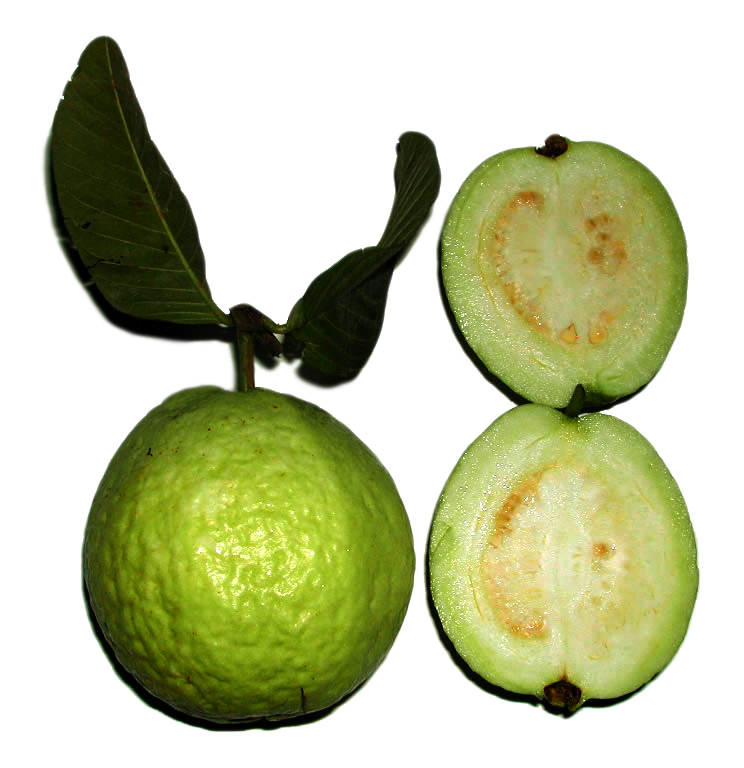
Common guava fruit
Scientific classification Edit this classification
Kingdom: Plantae
Clade: Tracheophytes
Clade: Angiosperms
Clade: Eudicots
Clade: Rosids
Order: Myrtales
Family: Myrtaceae
Genus: Psidium
Species:
P. guajava
Binomial name
Psidium guajava

Psidium guajava, the common guava,[2] yellow guava,[2] lemon guava,[2] or apple guava is an evergreen shrub or small tree native to the Americas. It is pollinated by insects. When cultivated, it is pollinated mainly by the common honey bee, Apis mellifera.

Description

[edit]

Widely cultivated in tropical and subtropical regions around the world, guava fruits can range in size from as small as an apricot to as large as a grapefruit. Various cultivars have white, pink, or red flesh; a few varieties feature red (instead of green or yellow) skin.

When cultivated from seed, guavas are notable for their extremely slow growth rate for several months, before a very rapid acceleration in growth rate takes over. From seed, common guavas may bloom and set fruit in as few as two years or as many as eight. Cuttings, grafting, and air layering are more commonly used as a propagation method in commercial groves. Highly adaptable, guavas can be easily grown as container plants in temperate regions, though their ability to bloom and set fruit is somewhat less predictable.[citation needed]

Chemistry

[edit]

The leaves of P. guajava contain the flavonol morin, morin-3-O-lyxoside, morin-3-O-arabinoside, quercetin and quercetin-3-O-arabinoside.[4]

Distribution and habitat

[edit]

Guava is native to the Caribbean, Central America and South America.[2]

It is a perennial tree that grows well under sun or warm temperatures. Therefore, it appears in numerous countries that have tropical weather or subtropical. Guava has a habitat contributing along roadside, grassland, or near sea level to 1,600 metres (5,200 ft) and it is more prevalent in humid grassland.[5]

Ecology

[edit]

In some tropical locations, guavas can become invasive. It has become a major problem in the Galápagos Islands.[6]

Uses

[edit]

Guava is an edible fruit, and can be eaten raw or cooked. The processing of the fruits yields by-products that can be fed to livestock. The leaves can also be used as fodder.[7] It is also used by phasmid breeders to feed various stick insect species, including Extatosoma tiaratum, Eurycnema goliath, as well as various leaf insect species such as Pulchriphyllium giganteum, Pulchriphyllium bioculatum, and Phyllium monteithi.[8]

Guava wood from Hawaii is commonly used for the smoking of meat. The wood is resistant to insect and fungal attack. The density of oven-dry wood is about 670 kg/m3 (1,130 lb/cu yd) and has been found suitable for roof trusses in Nigeria.[9]

Psidium guajava has been used in traditional medicine by many cultures throughout Central America, the Caribbean, Africa, and Asia.[10] It is used for inflammation, diabetes, hypertension, caries, wounds, pain relief, fever, diarrhea, rheumatism, lung diseases, and ulcers.[10]

The plant is used in many different shampoo products for its scent. It is also becoming a popular bonsai species and is currently quite popular in India and Eastern Asia.[11]

References

[edit]
[edit]
Revisions and contributorsEdit on WikipediaRead on Wikipedia
from Grokipedia
Psidium guajava L., commonly known as , is an shrub or small tree in the family , native to tropical America from southward to and . It typically reaches heights of 3 to 10 meters, featuring a slender trunk with smooth green to red-brown bark, opposite elliptical leaves 5–15 cm long that are pubescent when young, and white flowers about 2.5 cm in diameter borne on current season's growth. The is a , usually round to pear-shaped and 4–10 cm in diameter, with thin yellowish skin enclosing white to pinkish, aromatic flesh surrounding numerous hard seeds. Guava has been widely introduced and naturalized across tropical and subtropical regions worldwide, including parts of , , and the Pacific, where it often grows as a weedy species in disturbed areas. It thrives in a variety of well-drained soils, from sandy loams to heavy clays, and tolerates a wide pH range of 4.5 to 8.5, though it prefers neutral to slightly acidic conditions. Propagation is commonly achieved through seeds, which germinate readily, or by cuttings, grafting, or air-layering for selected cultivars. Major commercial production occurs in countries such as , , , , and , with the United States cultivating it in , , and . The guava fruit is highly valued for its nutritional profile, providing approximately 228 mg of per 100 g—over four times the amount in —along with significant levels of (5.4 g per 100 g), (417 mg per 100 g), and other minerals like magnesium and . It is consumed fresh, in juices, desserts, or processed products like jams, jellies, and pastes, prized for its sweet-tart flavor and high content that aids in gelling. Beyond culinary uses, various parts of the plant, particularly and fruit, exhibit medicinal properties; guava leaf extracts demonstrate , , antidiabetic, and activities, supporting traditional remedies for gastrointestinal issues and . Ongoing research highlights its potential in managing conditions like and due to bioactive compounds such as and phenolics.

Taxonomy

Classification

Psidium guajava belongs to the kingdom Plantae, subkingdom Tracheobionta, superdivision Spermatophyta, division Magnoliophyta, class Magnoliopsida, order Myrtales, family Myrtaceae, genus Psidium, and species guajava. The species name "guajava" derives from the Spanish "guayaba," which originates from the Arawak word "guayabo," referring to the guava tree in indigenous languages of the Caribbean. Carl Linnaeus first described Psidium guajava in his 1753 work , establishing its based on specimens from cultivated plants in the . Within the genus Psidium, which comprises about 100 tropical species, P. guajava is closely related to species such as Psidium cattleianum (strawberry guava); these are distinguished primarily by fruit type—P. guajava produces larger, pyriform berries, while P. cattleianum yields smaller, spherical ones—and leaf arrangement, with both exhibiting opposite, simple leaves but varying in size and pubescence. Phylogenetic studies using nuclear and plastid DNA sequences have confirmed the of within , with no major taxonomic revisions to P. guajava's placement as of 2025; it resides in section Psidium, one of four major clades in the , alongside approximately ten other , supported by analyses of over 150 accessions that highlight rapid diversification in the Neotropics.

Varieties and cultivars

Wild forms of exhibit variation in size and shape, with historical recognition of forms such as var. pomifera (round-fruited) and var. pyrifera (pear-shaped), though no infraspecific varieties are widely accepted in modern taxonomy. These wild forms represent the natural genetic base from which cultivated forms have been derived, with the species predominant across its native range in the . Numerous cultivars have been developed through selection, particularly in tropical and subtropical regions, to enhance desirable traits such as fruit quality and yield. In , 'Allahabad Safeda' is a prominent white-fleshed known for its high fruit yield, sweet flavor, and adaptability to various soils, originating from selections in . Similarly, 'Lucknow-49' is a prolific bearer with greenish-yellow fruits featuring milky white, sweet pulp and a thick, rough , selected for its consistent productivity. In , 'Thai White' produces white-fleshed fruits with crisp texture, while 'Thai Maroon' yields red-fleshed varieties rich in antioxidants like and polyphenols. In the United States, 'Ruby Supreme' stands out as a low-seeded or seedless pink-fleshed , valued for its sweet, juicy fruits and relative resistance to certain fungal pathogens like . Interspecific hybrids between Psidium guajava and have been developed primarily to confer disease resistance, particularly against root-knot s such as Meloidogyne enterolobii, leveraging the immunity of P. cattleyanum. These hybrids exhibit improved vigor and nematode tolerance while retaining some fruit quality traits from P. guajava, with successful crosses achieved through controlled and techniques. Breeding efforts for Psidium guajava intensified in the , beginning around the early 1900s with selections for larger size, reduced seed content, and enhanced pest resistance, primarily through conventional methods like open-pollinated progeny testing and clonal . These programs, conducted in countries like , , and the , have focused on intraspecific hybridization to address limitations in wild forms, resulting in over 400 named cultivars worldwide by the late .

Description

Morphology

Psidium guajava is an or small that typically reaches heights of 3 to 10 meters, though it can occasionally grow up to 12 meters under optimal conditions. It features a slender, often crooked trunk with smooth, light brown to reddish-brown bark that peels off in thin flakes, revealing a mottled appearance. The branches are numerous, low-drooping, and characteristically quadrangular in cross-section, contributing to the plant's dense, rounded canopy. The leaves are , simple, and elliptic to ovate in , measuring 5 to 15 cm in length and 3 to 6 cm in width, with entire margins and prominent lateral veins. They are leathery in texture, glossy dark green on the upper surface, and paler beneath, supported by short petioles of 0.5 to 1 cm. New leaves often emerge reddish before maturing to their characteristic green hue. Flowers are white, hermaphroditic, and measure 2 to 3 cm in , borne singly or in small clusters of 1 to 3 at the axils of leaves. Each flower has five sepals, five petals that are obovate and soon , and numerous conspicuous stamens with white filaments and yellow anthers, clustered around a superior . The calyx is glandular-pubescent, and the peduncles are stout, about 1 to 2 cm long. The is a that varies from round to pyriform or ovoid, typically 4 to 10 cm in diameter and weighing 20 to 500 grams, depending on the . The thin, tough skin ripens from green to yellow, enclosing a juicy, white to pink or red flesh with a central core containing numerous small, hard, reniform seeds embedded in a pulpy matrix. The fruit surface may be smooth or slightly rough, and ripening occurs 2 to 4 months after flowering. The is shallow and fibrous, primarily superficial with extensive lateral spread that often extends beyond the canopy drip line, though some deeper may penetrate up to 1 meter in loose soils. Lacking a prominent , it is adapted for anchorage in tropical, well-drained soils but can be susceptible to uprooting in windy conditions.

Chemical composition

The fruit of Psidium guajava is renowned for its high nutritional value, particularly its exceptional content, which ranges from 200 to 400 mg per 100 g of fresh weight, surpassing that of many fruits. It also provides substantial , approximately 5-6 g per 100 g, along with essential minerals such as at about 417 mg per 100 g. Red-fleshed varieties are notably rich in , with levels reaching up to 5.2 mg per 100 g, contributing to their properties. Psidium guajava contains a diverse array of bioactive compounds across its parts, including such as and , which are prominent in leaves and fruits. , including gallic and ferulic acids, are abundant, alongside terpenoids like β-caryophyllene. Leaves are particularly noted for their essential oils, which include and contribute to the plant's aromatic and potential therapeutic profile. The aroma of Psidium guajava fruit arises from over 30 volatile compounds, with key contributors including ethyl hexanoate, responsible for fruity notes, and β-caryophyllene, imparting spicy undertones. These volatiles, identified through gas chromatography-mass spectrometry analyses, vary by and maturity but collectively define the characteristic scent. Chemical composition varies significantly by plant part; leaves are rich in tannins, comprising up to several percent of dry weight and conferring astringency. In contrast, seeds contain high lipid levels, up to 10% on a dry basis, primarily unsaturated fatty acids like linoleic and oleic acids, making them a potential source for oil extraction.

Distribution and habitat

Native range

Psidium guajava, commonly known as , is native to tropical regions of the , with its original distribution spanning from southern through to northern , including countries such as , , and , as well as various islands. This range encompasses diverse ecosystems where the species has been documented since pre-Columbian times, with archaeological evidence indicating its presence in northern , the , and dating back approximately 2,600 calibrated years . Older macroremains from southwestern Amazonia suggest even earlier human interactions with the plant around 9,490–6,505 calibrated years , highlighting its long-standing role in the region's natural and cultural landscapes. In its native habitats, P. guajava thrives in tropical and subtropical forests, along riverbanks, and in disturbed areas such as forest edges and . It is commonly found at elevations from up to about 1,500 meters, though it can occasionally reach higher altitudes in suitable microclimates. The plant prefers well-drained soils in humid to sub-humid environments, tolerating a variety of soil types including sandy, loamy, and clayey textures, but it performs best in slightly acidic to neutral conditions. Climatically, P. guajava is adapted to warm temperatures ranging from 20°C to 30°C on average, with the species capable of withstanding brief periods of but highly sensitive to . Annual rainfall in its native range typically falls between 1,000 and 2,000 mm, distributed throughout the year to support consistent growth, though it can endure short dry spells due to its deep root system. These conditions reflect the species' in lowland tropical biomes, where it often forms part of mixed vegetation communities.

Introduced regions

Psidium guajava was introduced beyond its native tropical American range primarily by Spanish and explorers during the , who transported the plant eastward across the Pacific to and westward to and via trade routes such as the Acapulco-Manila . By the 17th century, it had established in , including the , , and , where it spread rapidly due to its adaptability and utility as a . Portuguese dissemination further facilitated its entry into , with early records of cultivation in regions like and by the colonial era. In , introductions occurred through and traders, reaching in the early and by the mid-19th century, leading to widespread distribution today. The species has naturalized extensively in introduced regions, forming self-sustaining populations in diverse ecosystems. In and , it thrives in disturbed areas and agricultural margins, while in and subtropical —such as and —it is commonly cultivated for fruit production but has escaped into wild areas. However, Psidium guajava has become invasive in several locations, including and , where prolific fruiting and bird-dispersed seeds enable rapid colonization, outcompeting native vegetation and altering habitats. Control efforts, including mechanical removal, application, and monitoring programs, are implemented in these areas to mitigate ecological impacts. Adaptation to new climates has contributed to its success, with tolerance for a wide range of conditions, including levels from 5.5 to 7.0, allowing growth in both acidic and neutral substrates common to tropical and subtropical zones. It performs well in varied soils but encounters challenges from in coastal or irrigated introductions, where electrical conductivity at an ECi50 of 10.25 dS m⁻¹ reduces growth by 50%, with significant reductions at higher levels, classifying it as moderately salt-tolerant overall.

Ecology

Reproduction and pollination

Psidium guajava exhibits continuous flowering in tropical regions, with blooms occurring on newly emerging lateral shoots throughout the year, though peaks often align with the onset of the rainy season in many cultivation areas. The flowers are hermaphroditic, featuring petals and numerous stamens, and are self-compatible, allowing for autogamous . However, cross- is preferred for optimal fruit set and yield, with studies indicating rates of 25.7% to 41.3% in natural conditions. Primary pollinators of P. guajava are bees, including the honeybee (Apis mellifera) and native stingless bees, which facilitate pollen transfer and contribute significantly to cross-pollination. Other insects such as flies and, to a lesser extent, bats also visit flowers, though bees dominate the pollination process. Self-pollination occurs but is less efficient without insect assistance, resulting in lower fruit set compared to open-pollinated flowers. Pollen remains viable for up to 42 hours, while stigmas are receptive for about 2 days post-anthesis. Following successful , fruit development in P. guajava proceeds from flower to maturity in approximately 11 weeks, though this can extend to 14–20 weeks depending on and environmental factors. Mature fruits are berries containing 100–500 small, hard embedded in the pulp, with seed viability remaining high for up to one year when stored at 8°C and low . These enable effective , supporting the plant's in natural settings. Asexual reproduction in P. guajava occurs naturally through limited vegetative spread via root suckers, which can regenerate new plants from established root systems, though this mode is less common than seed dispersal in wild populations.

Ecological interactions

Psidium guajava experiences significant herbivory from a variety of insects, with over 80 species documented to attack the plant in regions like India, including fruit flies such as the Mediterranean fruit fly (Ceratitis capitata), Oriental fruit fly (Bactrocera dorsalis), Mexican fruit fly (Anastrepha ludens), Caribbean fruit fly (Anastrepha suspensa), and guava fruit fly (Anastrepha striata), which primarily target fruits and cause substantial damage. Other notable insect pests include scale insects, mealybugs, bark-eating caterpillars, and the castor capsule borer (Conogethes punctiferalis), which affect leaves, shoots, and bark. Fruits are also consumed by vertebrate herbivores, including birds, mammals such as monkeys, rodents, bats, ungulates, and marsupials, which facilitate seed dispersal through endozoochory while exerting selective pressure on fruit production. The plant forms mutualistic associations with arbuscular mycorrhizal fungi (AMF), which enhance and other nutrient uptake, promoting growth in nutrient-poor tropical soils. Additionally, P. guajava serves as a source for pollinators, particularly such as honey bees (Apis mellifera) and various wild bees, supporting their needs in tropical ecosystems, though these interactions extend beyond direct to broader community dynamics. In introduced regions, P. guajava acts as an by forming dense thickets that outcompete native vegetation, reducing and altering structure in disturbed tropical habitats. Its modifies soil chemistry, often increasing , organic matter, and nutrient levels such as and , which favor its own proliferation while disadvantaging less adaptable native plants. In some disturbed areas, it provides temporary and resources, contributing to resilience during succession, though overall it disrupts native community assembly. Within its native range in tropical America, P. guajava faces conservation threats from loss due to and , which fragment its preferred open forest and riparian environments. Despite these pressures, the plant benefits by serving as a key food source for frugivorous birds and mammals, supporting their and dispersal networks in increasingly disturbed landscapes.

Cultivation

Growing requirements

Psidium guajava thrives in tropical and subtropical climates, with optimal growth occurring at temperatures between 20°C and 30°C. The plant is frost-sensitive, with growth slowing below 15°C (60°F). Young trees suffer severe damage or death below -3°C (27°F), while mature trees can tolerate brief exposures to -4°C (25°F) without severe injury. Annual rainfall requirements range from 1,000 to 2,000 mm, distributed evenly to support consistent growth, though it can adapt to slightly drier conditions with supplemental . The species prefers well-drained loamy or sandy soils with pH 4.5–7.0, tolerating up to 8.5 with iron supplementation. It exhibits tolerance to soils of low fertility but responds positively to balanced fertilization to enhance vigor and productivity. Guava requires full sun exposure for optimal development and fruiting, receiving at least 6-8 hours of direct sunlight daily. In orchard settings, plants are typically spaced 3 to 6 meters apart to allow for canopy expansion and air circulation, with windbreaks recommended in exposed locations to prevent physical damage. Guava can be cultivated up to 1,500–2,000 m elevation in suitable climates. Once established, Psidium guajava demonstrates moderate , but during dry periods significantly improves yields and fruit quality. It possesses moderate tolerance, withstanding electrical conductivity up to approximately 4-5 dS/m before growth reductions occur, making it suitable for mildly saline environments with proper .

Propagation methods

Psidium guajava can be propagated through both sexual and asexual methods, with the choice depending on whether true-to-type of specific cultivars is desired or if development is the goal. Sexual propagation via is straightforward and cost-effective for producing rootstocks, while asexual techniques such as air-layering, cuttings, and ensure clonal offspring that retain desirable parental traits, which is essential for commercial fruit production. Seed propagation involves sowing fresh seeds extracted from ripe fruits, as viability decreases rapidly with storage. Seeds are typically planted 6 mm deep in a well-drained sandy soil medium, with germination occurring in 15-20 days under warm conditions (25-30°C), achieving rates up to 90% without the need for stratification. Scarification, such as brief exposure to 10% hydrochloric acid for 2 minutes, can enhance germination to around 54% by overcoming the hard seed coat, though mechanical scarification is also effective. Seedlings are transplanted to nursery beds or pots once they reach 3-4 cm in height, typically after 3-4 weeks, and are ready for field planting at 30-35 cm after 6-7 months, with about 70% retaining parental characteristics. However, this method introduces genetic variability, making it unsuitable for uniform cultivar propagation. Vegetative propagation is preferred for maintaining cultivar integrity and accelerating fruiting. Air-layering, also known as marcottage, involves wounding a , applying rooting , and wrapping with moist moss or , yielding success rates of 70-90% within 4-6 weeks, particularly when treated with 5000-10000 ppm (IBA). Semi-hardwood cuttings, taken from current-season growth in spring or (e.g., June-August), root best when dipped in 3000-4000 ppm IBA, achieving up to 75% sprouting and rooting in a sand-perlite (1:1) mix under intermittent mist, though success is lower (around 50%) compared to air-layering. Grafting techniques, such as cleft, wedge, or T-budding onto seedling rootstocks, are widely used for elite s; wedge in October-November yields up to 59% success with early sprouting in 11-13 days under protected conditions. Propagation faces several challenges that can reduce success rates. Seedlings exhibit high variability in fruit quality and vigor, while excessive during rooting leads to , particularly in heavy soils. Nematodes, such as Meloidogyne enterolobii and Meloidogyne javanica, infest nursery soils and cause galls, stunting growth and leading to up to 50% losses in infested areas. Anthracnose, caused by gloeosporioides, affects young propagules, causing leaf spots and dieback, with pre-harvest fruit losses reaching 20-30% if unmanaged. Best practices mitigate these issues through careful timing, media selection, and care. Cuttings and air-layers perform best in spring (March-May) or rainy season for humidity, using sterile sand-perlite or mixes to promote and prevent rot. Post-propagation, rooted plants require partial shade for 2-4 weeks, regular watering (every 2-3 days initially), and applications (e.g., copper-based) against anthracnose; nematode-prone sites should use fumigated soil or resistant rootstocks before transplanting at 4.5-7.5 m spacing.

Uses and production

Culinary applications

The fruit of Psidium guajava, commonly known as , is widely consumed fresh due to its sweet-tart flavor and crisp texture, often eaten whole with the edible skin and seeds, or sliced for salads and snacks. It is also processed into juices, smoothies, and beverages like punches, where the pulp provides a tropical aroma and natural thickness. In culinary preparations, guava features in jams, jellies, and preserves, leveraging its high content for natural gelling, while in desserts it appears in pies, ice creams, and custards across tropical cuisines. A notable processed form is guava paste, a thick, concentrated pulp sweetened and cooked down, known as dulce de guayaba in or guava cheese in , used as a spread, filling for pastries, or paired with cheese in appetizers. India is the leading producer of guava, with approximately 5.3 million metric tons in 2022–2023, cultivated across about 350,000 hectares. Other major producers include , , , and , though specific volumes vary; for instance, produced around 200,000–400,000 tons in recent years. Yields vary by region and conditions, typically ranging from 10 to 30 tons per hectare under optimal cultivation, though adverse weather can reduce this to as low as 9 tons per hectare. Global guava production is estimated at about 8.9 million tons as of 2022 (15% of the combined , , and guava category), with modest growth projected into 2024 despite climate challenges impacting yields in . Economically, the market was valued at approximately USD 7.2 billion in 2023, driven by both fresh consumption and processed products, with exports primarily from tropical regions like , , and to meet demand in and . Post-harvest handling is critical, as guava's tropical nature makes it susceptible to chilling injury during cold storage and , manifesting as skin pitting and internal browning, which necessitates temperatures above 5–10°C and techniques like modified atmosphere packaging to extend . This sensitivity impacts trade logistics but supports a growing industry focused on value-added exports such as purees and pastes. In diets, plays a key nutritional role due to its exceptionally high content, providing about 228 mg per 100 g of fruit—more than 2.5 times the daily recommended intake for adults—making it a valuable source for immune support and formation. Historically, has been used in and to prevent and treat , a deficiency disease, by incorporating the fresh fruit into local diets before the widespread recognition of alternatives. This nutritional profile enhances its integration into everyday meals, such as fruit salads or beverages, in regions where it is abundant.

Medicinal and therapeutic uses

Psidium guajava, commonly known as , has been utilized in across tropical and subtropical regions for centuries, particularly for gastrointestinal ailments. In folk medicine systems, including those in , , and , leaf decoctions are commonly employed to treat , , and stomachaches due to their properties from . Fruits are traditionally consumed to aid and provide support, while in , various parts of the plant are used for managing , coughs, and wounds. Pharmacological studies have substantiated several traditional applications, highlighting the plant's bioactive compounds such as and other . For antidiabetic effects, leaf extracts demonstrate blood glucose-lowering activity by inhibiting alpha-glucosidase and improving insulin sensitivity, as evidenced in animal models and limited human trials. Evidence for these effects is supportive but primarily derived from small studies or observational data, with results varying by individual; overconsumption of guava fruit could add calories or natural sugars, potentially affecting blood sugar control, while extracts may interact with diabetes medications by lowering blood sugar excessively, risking hypoglycemia. Individuals with diabetes should always consult a doctor or dietitian for personalized advice. Antimicrobial properties are notable against pathogens like and , supporting its use for infectious diarrhea, with in vitro studies showing inhibition zones comparable to standard antibiotics. Antioxidant activity, driven by polyphenols and , contributes to effects, while clinical trials up to 2025, including one on guava leaf oil emulgel, have confirmed efficacy in accelerating through enhanced formation and reduced in excision models and cases. Common preparations include aqueous decoctions or teas from 5-10 g of dried leaves per day for purposes, and topical extracts or gels for care, with pulp used fresh or as for nutritional . Based on traditional use and preliminary evidence, extracts have been studied for symptomatic relief in acute diarrheal diseases, particularly in children. Safety profiles indicate general tolerability when used short-term, but potential may interact with antidiabetic medications, and rare allergic reactions have been reported; long-term human studies remain limited, highlighting research gaps in chronic use and standardized dosing.

References

Add your contribution
Related Hubs
User Avatar
No comments yet.