


Community hub
Recent from talks
Contribute something
Nothing was collected or created yet.
Atrani
View on Wikipedia | This article needs additional citations for verification. (September 2023) |
Atrani is a city and comune on the Amalfi Coast in the province of Salerno in the Campania region of south-western Italy. It is located to the east of Amalfi, several minutes' drive down the coast.
Key Information


The municipality of Atrani has a land area of 12 ha (30 acres), making it the smallest in Italy. Its population was 832 in 2020. It is one of I Borghi più belli d'Italia ("The most beautiful villages of Italy").[3]
Geography
[edit].jpg)

The town is located between the Civita Hill and Aureo Hill. Atrani is along the valley of the river Dragone, named for a legend saying there once was a terrible dragon that would breathe fire and would hide himself there.[citation needed]
Though it is part of the Amalfi Coast, it is the only town along the coast to preserve intact its antique, traditional characteristics.[citation needed]
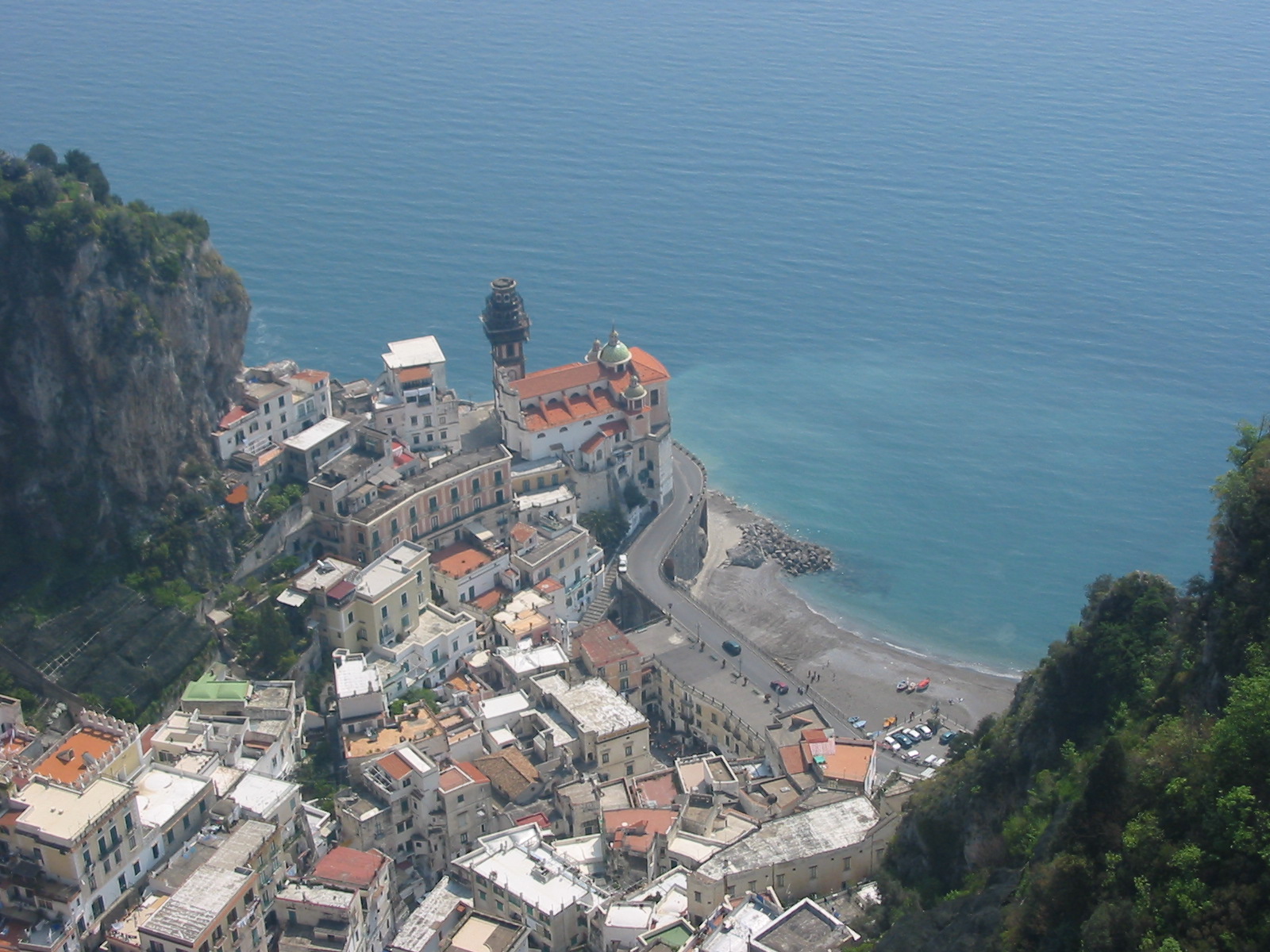
The initial houses face the beach directly. They are grouped around the square and move around the church of San Salvatore and the marble fountain before going up towards the valley and climbing along the rocky mountain and crossing the gardens and the lemon fields. Atrani is isolated from automobile traffic because it is protected by its antique houses with flowered balconies. The central square of Atrani leads directly to the beach and the sea by crossing an antique passageway created to save boats from sea storms.[citation needed]
Climate
[edit]Atrani boasts a Mediterranean climate, with mild and rainy winters and summers that are moderately hot, very sunny and almost never foggy.[citation needed]
For the 30-year period from 1961 to 1990 the average temperature of the coldest month, January, was 10.7 degrees Celsius (51 degrees F); the temperature of the hottest month, August, was 26.8 degrees Celsius (80 degrees F).[citation needed]
Demographics
[edit]Historical population | |||||||||||||||||||||||||||||||||||||||||||||||||||||||
|
| ||||||||||||||||||||||||||||||||||||||||||||||||||||||
| Source: ISTAT | |||||||||||||||||||||||||||||||||||||||||||||||||||||||
History
[edit]Early history and Roman period
[edit]The origins of Atrani are still unknown. Archeological research discovered ruins remaining from the 1st century AD. Roman villas existed along the Amalfi Coast and were covered in debris from the eruption of Vesuvius in 79 AD. The debris was deposited on the mountains encircling Atrani and from there it was dumped into the valley. In the 5th century AD, barbarians attacked and numerous Romans escaped from the cities. They fled onto Monti Lattari and created stable settlements. The first documented proof of the existence of Atrani is represented by a letter by the Pope Gregory I to Bishop Pimenio of Amalfi dated 596 AD.[citation needed]
Duchy of Amalfi
[edit]The Duchy of Amalfi extended from Positano to Cetara and also included Agerola, Pimonte, Lettere, Capri and the archipelago of Sirenuse (Li Galli). Within this territory Atrani was a village that boasted the title of city, the twin city of Amalfi was seat of the aristocracy. The Pantaleoni, the richest and most powerful family of Amalfi, the Alagno, the Mauro Comite, the Comite Iane, the Augustariccio, and the Viarecta families resided there. Its inhabitants preserved their identity as Atranese (from Atrani), unlike all the other inhabitants of the duchy, who were merely called Amalfitani.[citation needed]
Only Amalfi and Atrani had the right to elect or depose the leaders of the towns. Amalfi was first ruled by counts, then by prefects, judges, and then finally by the Dukes (not doges, as is sometimes erroneously said). The Duke concentrated in his person both civil and military power. The symbol of his power was a hat, the "birecto", which the dukes were awarded in a coronation in the palatine chapel of S. Salvatore de Birecto of Atrani.[citation needed]
The village of Atrani was more extensive than its current borders and protected by massive fortifications. It extended as far as Castiglione (now part of the municipality of Ravello), and was so named from the castellio, which was a large castle situated on the promontory where the collegiate church of St. Mary Magdalene stands today. In the Civita area there was the Castle of Supramonte, which was destroyed by attacks by the Republic of Pisa between 1135 and 1137. There was also the coastal tower of "Tumulo" or "San Francisco", built in 500[citation needed] by Don Parafan de Ribera to defend against the Turks who, after the defeat of the Christian fleet at Djerba near Tunis in 1560, would eventually overrun the coast.[citation needed]
Atrani contributed to the economic and social development of the duchy. Atrani had prosperous pasta and fabric factories that produced sajette and precious fabrics. This commerce made Atrani the pride of the coast. They were particularly active east of the duchy, in Paestum, Cava de' Tirreni and Vietri sul Mare. Atrani's economic success saw it plagued by many raids by the Republic of Pisa in the 12th century.
In 987 Amalfi was promoted to the rank of archdiocese by Pope John XV. The first archbishop Leone di Sergio di Urso Comite, who was from Atrani. Atrani had a flourishing religious life, with about three hundred churches and chapels in the city. Monte Maggiore (now Mount Aureo) housed six monasteries, the oldest of the region.[citation needed]
In the second half of 1100, Manfredi punished Atrani for siding in favour of the pope in the struggle between the papacy and the empire and sent 1000 Alexandrian sailors against Atrani. The inhabitants of Atrani fled to Amalfi, and the mercenaries settled in the village, and it would be many years before they abandoned it. The departure of the mercenaries is attributed to the intercession of St. Mary Magdalene. Small traces of the occupation still remain today, in the cadence of the local dialect and a handful of words.[citation needed]
The Earthquake of 1343 struck the Tyrrhenian Sea, and the resultant tsunami ravaged the ports along the Amalfi Coast, including Atrani's. The effects of the tsunami were observed by the poet Petrarch, whose ship was forced to return to port, and recorded in the fifth book of his Epistolae familiares.[4] In the years that followed, Atrani's fortunes were tied to those of Amalfi, whose duchy had fallen and been incorporated into the Principality of Salerno.[citation needed]
Modern era
[edit]In 1647, Masaniello, instigator of an uprising in Naples against Spanish control, was hunted by soldiers of the Duke of Arcos, the Viceroy of Naples. He returned to Atrani to hide in what has since been called the 'Cave of Masaniello', a cave not far from the hero's mother's house. Born in Naples in 1620, Masaniello, whose full name was Tommaso Aniello d'Amalfi, was the son of Francis of Amalfi and Antonia Gargano of Atrani. He was a fishmonger, but was known in the Piazza del Mercato in Naples for his skill as a smuggler.[citation needed]
The Neapolitan Republic or 'Royal Republic' (Italian: Real Repubblica) was proclaimed under the protection of France and Masaniello was acclaimed as "Captain-General of the Neapolitan People." The power went to his head and he fell into a series of excesses that made him unpopular with the people. On July 16, 1647, he was killed. The Neapolitan Republic lasted until the following April, when it succumbed to the Spanish.[citation needed]
In 1643 the Great Plague killed many Atranese. On 22 June 1807, Joseph Bonaparte, King of Naples, went on an official visit to the Amalfi Coast. Struck by the beauty of the place in Amalfi and Atrani in particular, he promised to build a road that would make it easier to access the Kingdom of the Amalfi. This road, begun by Joachim Murat in 1816, was only completed in 1854.[citation needed]
Floods
[edit]
On 10 September 2010 the Dragone burst its banks following a flood and overflowed along the main street of the city. The river was full of mud, and carried away everything in its path. A girl named Francesca Mansi died. Her body was found months later near the Aeolian Islands.[citation needed]
Main sights
[edit]Church of San Salvatore de' Birecto
[edit]Built in the 10th century, the church has a square plan with front porch and is divided into three naves with barrel vaults. It was originally facing west (entrance in Via Arte della Lana). In the Baroque period the current facade was built with the clock, the staircase and atrium. At the time of the Amalfi Republic, the church was the palace chapel where they were crowned the dukes and where they deposited their ashes.[citation needed]
The oldest pieces in the church are a tombstone of the 14th century, depicting the noble lady Atranese Filippa Napolitano and a marble slab of the 12th century, depicting two peacocks. The peacock, sacred to Juno, was revered by many Eastern peoples as a symbol of vanity and pride, well represented by the people and goods of Amalfi. The peacocks are also a symbol of resurrection. Doors of bronze, made in 1087, were donated to the church by Pantaleone III, a nobleman from Amalfi.[5] The door is divided into tiles of depicted scenes, containing the image of Christ, the Madonna and some saints. It is now housed in the church of Santa Maria Maddalena.[citation needed]
Church of the Immaculate Conception
[edit]Located next to the church of San Salvatore de' Birecto, it consists of a single nave with a barrel vault. Curiously, the main altar in polychrome marble is facing west, in contrast to the medieval model. Embedded in the wall there is a Roman cinerary urn used as a water reservoir. Originally the bronze doors of the church of San Salvatore de' Birecto were destined for this church.[citation needed]
Collegiate Church of St. Mary Magdalene Penitent
[edit]
The Collegiate Church of St Mary Magdalene was founded in 1274 on the ruins of a medieval fortress on the initiative of Atrani. Over time the church has undergone considerable restoration. In 1570, near collapse, funds were raised by special taxes on wheat and export of manufactured goods to restore the church.[6]
The building underwent a second operation almost a century later, in 1669. On that occasion it also repaired the sacristy which was equipped with an external counter. In 1753, as the population grew the church was enlarged and expanded by donations from private citizens in addition to the contribution of municipal regiment. It was during this work that the fortress was finally demolished in order to free up additional space enlargement. In recent times, it was renovated by the architect Lorenzo Casalbore of Salerno.[citation needed]
The church is decorated with two transepts. One ceiling is covered externally with tiles; the other has a flat roof. There are numerous statues and paintings placed in various side chapels: The Madonna shepherdess (famous sculpture of 1789) and The Incredulity of St. Thomas (work of the 16th century Salerno Andrea Sabatini). The facade of the church is considered "the only example of Rococo on the Amalfi Coast". The terrace of the sacristy overlooks the Gulf of Salerno as the Belvedere of Villa Cimbrone. The bell tower, with its brown tuff, is reminiscent of the Madonna del Carmine in Naples.[citation needed]
Church of San Michele Arcangelo ("Camposantino")
[edit]This is St. Michael's Outside the Walls because it is located outside the ancient walls of the city, near the North Gate, bordering Ravello. It was built between the 11th and 12th centuries, deriving from a cavity from Mount Civita. It is reached via a flight of stairs and at the top there is the bell tower. The interior of the church is trapezoidal and shows the sloping walls of the rock. The church was used as a cemetery (until 1927) and was a mass grave during the plague of 1656. The altar was created in the Baroque style and is a painting of Cretella dated 1930, depicting the Holy Warrior. To the left of the altar, a staircase leads to a small chapel, very similar to the chapel in the abbey of Santa Maria Oleari.[citation needed]
Torre dello Ziro
[edit]The fortress is situated on the Monte Aureo, overlooking the town of Amalfi and Atrani and is located on the territory of Scala. The exact date of construction is unknown, but the imprint Aragonese suggests the 15th century. The structure, flanked by bastions and turrets, was made in conjunction with another castle on the north, near Pontoon. The ruins of this castle can still be seen.[6]
The fame of the construction is related to the story of Giovanna d'Aragona, Duchess of Amalfi. She was the granddaughter of Ferdinand I of Aragon. At twelve years old, in 1490, she married Alfonso I Piccolomini, Duke of Amalfi, who in 1498, left her a widow and mother of a newborn son at the helm of the Duchy, which at that time was in poor financial shape. The young woman, against the will of his brothers, married Antonio Bologna, her butler, with whom she had a passionate love affair. The brothers tried to suppress the scandal and, after many deviations and daring escapes, imprisoned Giovanna and their children in the Torre dello Ziro. Here they were starved to death or, according to the most reliable report, strangled, while Bologna was stabbed to death at the hands of assassins. These events inspired Matteo Bandello to write his twenty-fourth novel. Two tragedies were taken from this: The Duchess of Malfi by John Webster and El Mayordomo de la Duquesa de Amalfi by Lope de Vega.[6]
Church of Our Lady of Mount Carmel
[edit]Built in 1601 on the initiative of Scipio Cretella and Giambattista Vollaro, the church's façade is quite simple, though bell-tower built in Moorish style is valuable. The interior is decorated in Baroque style, consisting of a single nave with a barrel vault. On the altar is a 15th-century fresco depicting the Madonna, which tradition says was caused by a kiosk that stood in the place of the church. The building houses a Nativity scene, set up during the holiday season, whose characters are faithful reproductions of Atrani men and women during this period. The location and size of the statues are directly proportional to the wealth represented: they were in fact the same people who commissioned and paid the characters.[6]
Cave and House of Masaniello
[edit]Tradition has it that a man, Masaniello, was hunted by soldiers of the viceroy of Naples and took refuge in this cave. It has been proven however, that a house not far from this belonged to the maternal family of Masaniello, who then was half Atranese.[citation needed]
Church of Santa Maria del Bando
[edit]This church was built in the 10th century on top of Mount Aureo. Restoration was carried out between the 12th and 13th centuries and therefore it has motifs typical of that era. The church has a single nave with a small sacristy. The floor was constructed in the 19th century, with square tiles with geometric patterns, from the Collegiate Church of Santa Maria Maddalena. The church is so named because legend tells that the Virgin pardoned a man, who was banished unjustly and sentenced to be hanged. The incident is depicted in the fresco above the altar, which depicts the Madonna and Child on the left and a man about to be hanged.[citation needed]
Inside the building is preserved cinerary urn of white marble, dating from the Julio-Claudian dynasty, belonged to a freedman of Claudius or Nero. The inscription of the urn testifies to the liberation that an imperial freedman, a noble of the royal family, granted to a woman who therefore, it is often assumed, has become her master's wife (a custom particularly common in the period between Augustus and Marcus Aurelius).[citation needed]
Grotto of the Saints
[edit]Below and not far from the Tower of Ziro is the Grotto of the Saints. It is a small natural cave, which opens onto a terrace planted with lemon trees. Its perimeter is an irregular quadrilateral and the walls are decorated with Byzantine-style frescoes, dating from the 12th century and depicting the four Evangelists. This cave is what remains of the Benedictine monastery of Saints Quirico and Giuditta male, founded in 986 by Archbishop Leo I.[citation needed]
Religion
[edit]The majority of the population is Roman Catholic belonging to the Archdiocese of Amalfi-Cava de' Tirreni.[citation needed]
In popular culture
[edit]In her novel The Talented Mr. Ripley, Patricia Highsmith, places key character Dickie Greenleaf living in Altrani with his girl friend Marge Sherwood.
M. C. Escher's first depiction of Atrani was his early and realistic work Atrani, Coast of Amalfi, a lithograph first printed in August 1931. Although that work is relatively unknown, the image of Atrani recurs several times in Escher's work, most notably in his much more famous series of Metamorphosis prints: Metamorphosis I, II and III.[citation needed]
Atrani was featured in a Fiat 500 USA advert entitled "Immigrants".[7][8]
In the film The Equalizer 3, Atrani features as the fictional village of Altamonte.[9]
In the Netflix streaming series Ripley, Atrani is where Dickie Greenleaf and his girlfriend Marge Sherwood are living.[10]
Twin towns
[edit] Uggiano la Chiesa, Italy, since July 2006

See also
[edit]References
[edit]- ^ "Superficie di Comuni Province e Regioni italiane al 9 ottobre 2011". Italian National Institute of Statistics. Retrieved 16 March 2019.
- ^ "Monthly Demographic Balance". ISTAT.
- ^ "Campania" (in Italian). Retrieved 1 August 2023.
- ^ Tateo, F. (2010). "Horribile dictu: environmental catastrophes and writing in the late Middle Ages". In Mattheus M. (ed.). Le calamità ambientali nel tardo Medioevo europeo: realtà, percezioni, reazioni. Centro studi sulla civiltà del Tardo Med (in Italian). Vol. 12. Firenze University Press. p. 111. ISBN 9788884534996. Retrieved 21 June 2012.
- ^ Perkins, Charles C. (1868). Italian Sculptures: Being a History of Sculpture in Northern, Southern, and Eastern Italy. London: Longmans, Green and Co. p. 32 – via Internet Archive.
- ^ a b c d "Atrani Travel Guide". Tour Italy Now. Archived from the original on 2022-09-28. Retrieved 2023-09-24.
- ^ Video on YouTube Fiat 500 "Immigrants" Commercial
- ^ Elliott, Stuart (2012-07-16). "Fiat 500s Ride a Wave of Immigration Onto American Shores". The New York Times. ISSN 0362-4331. Archived from the original on 2021-04-26. Retrieved 2023-09-24.
- ^ Johnson, Kirsty (September 8, 2023). "The Equalizer 3 interview: Production designer on Italian architecture and scouting for the perfect town to shoot". Nine Network. Sydney. Archived from the original on September 9, 2023. Retrieved April 12, 2024.
- ^ Boulter, Liz. "‘This coast is saturated’: Italian village braces for post-Ripley crowds", The Guardian. April 12, 2024.
External links
[edit]

| International | |
|---|---|
| Other | |

Atrani
View on GrokipediaPhysical Setting
Geography
Atrani is situated on the Amalfi Coast in the province of Salerno, within the Campania region of southern Italy. Its geographic coordinates are approximately 40°38′N 14°37′E, placing it along the Tyrrhenian Sea coastline.[4] The comune borders Amalfi to the west, with which it shares an immediate adjacency, and is in close proximity to Ravello to the northeast.[5] As the smallest municipality in southern Italy by land area, Atrani covers just 0.12 km² (0.046 sq mi), encompassing a compact territory that highlights its status as one of the tiniest administrative units in the country.[6] Nestled in the narrow valley of the Dragone River, Atrani lies between the steep slopes of Mount Civita to the east and Mount Aureo to the west, creating a dramatic ravine that funnels down to the sea, at an elevation of approximately 21 meters above sea level.[7] This terrain features sheer limestone cliffs rising sharply from the coastline, framing a small pebble beach at the river's mouth.[8] The surrounding landscape includes terraced hillsides historically used for agriculture, while the turquoise waters of the Tyrrhenian Sea lap against the base of the cliffs, contributing to the area's scenic allure.[9] The village's layout consists of narrow, winding streets and stairways that weave through densely packed, traditional whitewashed houses clinging to the hillsides, adapting to the rugged topography.[10] Atrani forms part of the UNESCO World Heritage Site "Costiera Amalfitana," designated in 1997 for its outstanding cultural landscape that exemplifies the harmonious integration of human settlement with the Mediterranean coastal environment.[2] This recognition underscores the preservation of its natural features, including the interplay of cliffs, valleys, and sea, which have shaped the village's intimate scale and visual harmony.[11]Climate
Atrani features a Mediterranean climate classified as Csa according to the Köppen-Geiger system, characterized by mild, wet winters and warm, dry summers.[12] The average annual temperature stands at 18.5°C, with mild winters featuring a January low of 8°C and hot summers marked by an August high of 31°C.[4] Precipitation totals approximately 1,200 mm annually, concentrated primarily during the rainy season from November to March, while summers remain dry and sunny with low humidity levels.[13] This climate supports the cultivation of olives and citrus fruits, integral to the local agrarian heritage along the Amalfi Coast.[14] However, the seasonal precipitation patterns contribute to coastal erosion and heightened flood risks within the Dragone valley, influenced by the area's steep topography.[15] The geographic confinement of Atrani amplifies these microclimate effects, drawing peak tourism during the favorable summer weather.[4]History
Ancient and Roman Period
The Amalfi Coast region, including Atrani, shows evidence of pre-Roman settlements dating back to the 1st century BC, with influences from Greek and Etruscan trading activities. The origins of Atrani itself remain uncertain, with possible Greek influences suggested by name etymology.[1] By the 1st century AD, Roman control solidified over the area, incorporating Atrani into the province of Campania within the broader administrative framework of Roman Italy. The settlement served as a minor coastal port supporting local agriculture and fishing, as indicated by archaeological discoveries of villa remnants, pottery, and other artifacts along the coast. These finds, including sumptuous patrician villas buried under debris from the 79 CE eruption of Mount Vesuvius, underscore the area's role as a residential and economic outpost for Roman elites. Excavations have revealed structures evidencing maritime and agrarian use, with similar villas documented in nearby Positano spanning over 2.25 acres and featuring high-quality frescoes and stucco decorations.[16][17][18] Atrani's name likely derives from the Latin "ater," meaning "dark," possibly referring to the shadowy cliffs overlooking the Tyrrhenian Sea, highlighting its integration into Roman linguistic and cultural norms. The area connected to the Roman road network through routes like the Via Popilia, which facilitated trade and military movement from Capua southward, enhancing accessibility for coastal communities like Atrani. By the 4th century AD, early Christian influences began to emerge in the region, laying the groundwork for later religious sites amid the transition from pagan Roman practices.[19] Following the fall of the Western Roman Empire, Romans fleeing barbarian invasions in the 5th century settled on the Lattari Mountains and along the coast, establishing stable communities including Atrani. The village is first documented in 596 AD in a letter from Pope Gregory the Great to Bishop Pimenio of Salerno.[1]Medieval Period and Duchy of Amalfi
The Duchy of Amalfi emerged in the 9th century as an independent maritime republic, gaining autonomy from the Duchy of Benevento following the assassination of Duke Sicard on September 1, 839, amid the fragmentation of Byzantine authority in southern Italy.[20] Atrani, with its natural harbor and strategic position adjacent to Amalfi, functioned as a vital fortified port and administrative hub, hosting ducal residences and serving as the political core of the duchy during its zenith in the 10th and 11th centuries, while Amalfi focused more on religious and commercial roles.[21] This period marked Atrani's rise as a residential area for the aristocracy, leveraging its defensible terrain to support the duchy's governance until the Norman conquest in 1073. From the 10th to 11th centuries, the duchy experienced an economic flourishing driven by extensive maritime trade, exporting grain from southern Italy, timber, iron, and slaves to the Arab world in North Africa and the Levant, while importing luxury goods such as silk from Byzantium.[22] Amalfitan merchants, including those based in Atrani, established trading colonies in key ports like Cairo and Palermo, fostering wealth that funded urban development and fortifications along the coast.[23] To safeguard this commerce from Saracen pirate raids, the duchy constructed a network of defensive watchtowers, including structures like the Torre dello Ziro overlooking Atrani, which exemplified the era's emphasis on coastal vigilance.[24] The duchy's independence ended with the Norman conquest in 1073, when Robert Guiscard, Duke of Apulia and Calabria, besieged and captured Amalfi after a prolonged conflict, integrating the territory—including Atrani—into the emerging Norman Kingdom of Sicily by 1130.[25] This shift subordinated local autonomy to feudal rule, though the region's trade networks persisted under Norman oversight. Further decline came in 1343, when a massive earthquake off the Tyrrhenian Sea triggered a tsunami that ravaged the Amalfi Coast, destroying ports and much of the coastal infrastructure in Amalfi and Atrani, severely eroding the area's economic and political stature.[26][27] The disaster, which swallowed a third of Amalfi's land and inundated adjacent settlements like Atrani, marked a pivotal reduction in the former duchy's maritime prominence.[16]Early Modern and Contemporary Era
Following the dissolution of the Duchy of Amalfi in the medieval period, Atrani entered a phase of prolonged decline during the 16th and 17th centuries under Spanish Habsburg rule in the Kingdom of Naples. The town's maritime economy, once bolstered by medieval trade networks, suffered from shifting global commerce routes, recurrent piracy threats from Barbary corsairs, and the burdens of Spanish taxation and military levies, leading to depopulation and economic stagnation across the Amalfi Coast.[28][29] A notable episode in this era occurred in 1647 amid the Neapolitan revolt against Spanish fiscal oppression, led by fisherman Tommaso Aniello, known as Masaniello, whose mother hailed from Atrani. According to local tradition, Masaniello sought refuge in a cave near the Sanctuary of Santa Maria del Bando overlooking the town while fleeing authorities during the uprising, an event that later inspired folklore and cultural narratives in the region.[30][31] The 19th century marked a turning point with Italy's unification in 1861, when Atrani's population peaked at 2,579 residents, reflecting a brief stabilization before broader southern Italian challenges. As the Kingdom of the Two Sicilies integrated into the new nation-state, the Amalfi Coast, including Atrani, began transitioning from agrarian and fishing-based livelihoods toward tourism, attracting Romantic-era artists, writers, and Grand Tour travelers drawn to its scenic cliffs and historic charm.[32][33] In the 20th and 21st centuries, post-World War II economic hardships triggered significant emigration waves from southern Italy, contributing to Atrani's population decline from over 2,700 in the late 19th century to around 800 by the 2020s. This trend was offset by cultural recognitions that bolstered preservation: Atrani joined the association I Borghi più belli d'Italia in 2004, highlighting its architectural and historical integrity, while the broader Amalfi Coast's inscription as a UNESCO World Heritage Site in 1997 has supported ongoing conservation initiatives, including landscape protection and sustainable development efforts extending into 2025.[32][34][2]Natural Disasters
Atrani's location along the Amalfi Coast has exposed it to significant natural disasters, particularly tsunamis, floods, and seismic activity, shaped by its proximity to tectonic boundaries and steep coastal topography. One of the most devastating events was the tsunami of November 25, 1343, triggered by a major earthquake in the Tyrrhenian Sea rather than the Strait of Messina. The waves ravaged coastal settlements, including Atrani, destroying ships in the harbor, damaging infrastructure, and causing widespread submersion that led to long-term reshaping of the shoreline through sediment deposition and erosion.[26][16] This disaster disrupted medieval trade networks vital to the region's economy, as ports like Atrani's were key hubs for maritime commerce.[35] In the 20th and 21st centuries, recurrent floods have posed the primary threat, exacerbated by the Dragone valley's narrow, steep geography that funnels intense rainfall into destructive debris flows. The flood of October 25, 1954, part of a broader storm affecting the Salerno-Amalfi area, caused extensive inundation and landslides in Atrani, amid a regional toll of 318 fatalities.[36] More recently, on September 9, 2010, torrential rains—over 130 mm in three hours—triggered the Dragone River to burst its banks, unleashing a flash flood that swept through Atrani's main street, destroying homes, vehicles, and businesses while claiming the life of 25-year-old Francesca Mansi, who was working in a local bar.[37] The event deposited up to 30 meters of shoreline progradation and highlighted vulnerabilities in the urbanized riverbed.[37] In response to the 2010 disaster, mitigation efforts in the 2010s focused on river engineering, including the restoration of historic Bourbon-era containment basins along the Dragone and plans for a secondary artificial channel to improve water flow and reduce overflow risks during heavy rains.[38][39] Atrani also faces ongoing seismic risks stemming from its position near the convergent boundary between the Eurasian and African plates in the Tyrrhenian Sea region, where extensional tectonics and subduction contribute to moderate earthquake activity.[40] No major earthquakes (magnitude >6.0) have struck directly in the immediate vicinity since the 1980 Irpinia event (magnitude 6.9), which was felt but caused limited local damage.[41] The Italian Civil Protection Department conducts continuous monitoring through seismic networks to assess and mitigate these hazards.Demographics and Administration
Population and Demographics
Atrani's population has experienced a significant historical decline, dropping from 2,579 residents in 1861 to 802 in 2021, according to Italian National Institute of Statistics (ISTAT) census data.[42] This trend continued into the 2020s, with the population estimated at 757 as of late 2025, reflecting an aging demographic structure characterized by a median age of approximately 48 years and a low birth rate of around 5 per 1,000 inhabitants in recent years.[43] The birth rate stood at 5.0 per 1,000 in 2023, contributing to a natural population decrease when combined with higher death rates of 11.3 per 1,000 that year.[44] The demographic composition of Atrani features a slight female majority, with women comprising 52.5% of the population as of 2023.[43] A high proportion of elderly residents, around 25% over the age of 65, underscores the town's aging profile, consistent with broader patterns in small Italian coastal municipalities.[45] This shift has been influenced by substantial emigration during the 20th century, as residents moved to northern Italy and abroad in search of economic opportunities, leading to sharp population reductions between censuses such as from 2,746 in 1881 to 1,058 in 1931.[42][46] With a land area of just 0.12 square kilometers, Atrani exhibits one of Italy's highest population densities at approximately 6,683 inhabitants per square kilometer based on 2021 figures.[45] Housing in the compact urban core consists primarily of family-owned homes, typical of the tightly clustered architecture in this historic seaside village, supporting a resident population of around 355 households.[43] Foreign residents account for about 5.3% of the total, adding a small degree of diversity to the otherwise homogeneous community.[43]Local Government
Atrani functions as an autonomous comune within the province of Salerno in the Campania region of Italy, operating under the standard administrative framework for Italian municipalities.[47] The local government is headed by a mayor (sindaco), who serves as the chief executive, and a town council (consiglio comunale) comprising elected councilors responsible for policy-making and oversight; both are elected directly by residents every five years through local elections. As of 2025, the mayor is Michele Siravo, who was elected on June 9, 2024, leading the local electoral list Atrani Futura, which garnered 76.76% of the valid votes in a landslide victory.[48][49][50] Municipal offices oversee key public services, including waste management, water distribution, and the preservation of historical and cultural heritage sites. Waste services have been enhanced through targeted initiatives, such as the 2025 allocation of a €75,000 regional grant to develop a specialized collection center for electrical and electronic waste (RAEE), ranking Atrani among the top national recipients for such funding. Water supply is coordinated with regional entities like Ausino spa, involving maintenance of local reservoirs to ensure reliable potable water delivery to residents. Heritage preservation is a core responsibility, with efforts centered on maintaining structures and landscapes integral to the town's medieval character.[51][52][53] The comune's budget depends heavily on regional and national grants tied to tourism, which fund operational needs and infrastructure improvements. Governance policies prioritize sustainability, exemplified by advancements in eco-friendly waste handling and adherence to UNESCO protocols for the Costiera Amalfitana World Heritage site, including regular site monitoring and conservation to safeguard against environmental degradation. In response to 2020s tourism pressures, the administration has implemented measures aligned with broader Amalfi Coast strategies, such as visitor flow regulations to mitigate overcrowding and preserve community livability.[51][2][54] Atrani's compact scale facilitates hands-on governance, enabling close coordination between officials and residents on local issues like disaster preparedness.[47]Economy and Tourism
Economy
Atrani's traditional economic base revolves around small-scale fishing conducted with local boats, focusing on specialties like anchovies for colatura di alici and tuna, alongside agriculture centered on terraced hillside cultivation of lemons and olives. These activities are severely constrained by the steep, rocky terrain of the Amalfi Coast, which limits arable land and mechanization.[55][2] The economy has transitioned toward the service sector, where tourism predominates, accounting for the majority of economic activity, supplemented by artisan crafts such as ceramics influenced by historical Arabic styles and limoncello production derived from local lemons. The regional GDP per capita for Campania, encompassing Atrani, stood at approximately €23,300 in 2023, reflecting the broader economic context of the area.[2][56] Key challenges include seasonal employment patterns tied to tourism fluctuations, which exacerbate limited job opportunities and contribute to demographic emigration. Post-COVID recovery efforts are bolstered by EU Recovery and Resilience Facility funds allocated for sustainable tourism and green initiatives, with implementation extending through 2025 to enhance environmental resilience and local crafts. Geographic constraints further hinder economic expansion, confining development to the narrow coastal strip.[57]Tourism
Atrani serves as a serene escape on the Amalfi Coast, attracting visitors primarily for its tranquil beach, accessible hiking paths like the scenic Amalfi-Atrani trail that winds along cliffs offering panoramic sea views, and its role as an easy day-trip spot from the bustling town of Amalfi. Tourism peaks during the summer months, when the village's compact harbor and pebbled shoreline draw crowds seeking respite from larger resorts, though its small size—home to around 760 residents as of 2024—keeps the experience intimate compared to neighbors like Positano.[58][59][60][61] The local tourism infrastructure remains modest, featuring fewer than 20 small hotels, boutique guesthouses, and family-run establishments that emphasize personalized service, complemented by waterfront restaurants offering fresh seafood dishes and regional wines from nearby vineyards. In 2024, the Netflix series Ripley, which extensively filmed in Atrani to capture its 1960s charm, sparked a notable surge in interest, resulting in a 93% increase in bookings across the Atrani area—including nearby Ravello—and extending appeal into off-season months by highlighting the village's cinematic allure. This media exposure has helped diversify visitor profiles, drawing more cultural enthusiasts beyond traditional summer beachgoers.[62][60][63] Sustainability challenges have intensified with overtourism straining the Amalfi Coast's narrow roads and resources, prompting local concerns in Atrani about capacity limits and leading to broader Italian initiatives for visitor management, including potential caps and expanded traffic controls set for 2025 to curb peak-season congestion. To address environmental impacts, efforts include promoting eco-friendly practices along coastal paths, such as guided sustainable hikes and certifications for low-impact tours that preserve the area's natural trails and biodiversity. These measures aim to balance tourism's economic benefits with the preservation of Atrani's delicate coastal ecosystem.[64][65][66]Cultural Heritage
Main Sights
Atrani's main sights are characterized by a blend of medieval, Byzantine, and Baroque architecture, reflecting its historical role in the Amalfi Republic and its integration into the rugged coastal landscape. The town's landmarks are compactly situated within its narrow alleys and cliffs, offering visitors a glimpse into its layered past through churches, defensive structures, and unique historical sites. These attractions emphasize Atrani's spiritual and strategic importance along the Amalfi Coast.Churches
The Church of San Salvatore de' Birecto, dating to 940 AD, served as the site for the investiture of Amalfi Republic doges, with "Birecto" referring to the ducal cap placed on their heads during ceremonies.[67] This 10th-century structure exhibits Byzantine influences in its three-nave layout with cross-vaulted ceilings and an incomplete Baroque facade featuring a clock and belfry.[68] Key features include a bronze portal from 1087 crafted by Pantaleone di Mauro, adorned with 24 biblical panels, and a 12th-century pluteus depicting peacocks and symbolic animals.[68] Excavations have uncovered 13th-century arches and a semi-open room, highlighting its evolution over centuries.[68] The Collegiate Church of St. Mary Magdalene, founded in 1274 on the remnants of a medieval watchtower, stands as Atrani's patronal church and the only Rococo-style monument on the Amalfi Coast.[68] Its 18th-century facade features soft relief stuccoes and a three-nave interior with a yellow-and-green majolica-tiled dome, while Baroque elements include frescoes and sculptures such as Andrea da Salerno's 16th-century The Incredulity of Thomas.[68] The Chapel of the Sacrament boasts rich decorations, and the church houses relics including bone fragments of St. Mary Magdalene, strands of her hair, and a piece of the True Cross.[68] An unpublished musical score by Leonardo Leo is also preserved here.[68] The Church of the Immaculate Conception, a small 17th-century Baroque chapel, is seamlessly integrated into the buildings surrounding Piazza Umberto I, adjacent to the Church of San Salvatore de' Birecto.[69] It consists of a single hall with a cross-vaulted roof and a trefoiled window, centered around a marble altar displaying a canvas of the Virgin and Child crowned with pearls.[69] A sacristy lies behind the altar, and the site serves as home to a local congregation, though it opens mainly on Thursdays and during seasonal novenas.[69]Towers and Defenses
The Torre dello Ziro, a 15th-century watchtower built on 12th-century ruins, functioned as a defensive outpost against Saracen raids, offering panoramic views of Atrani, Amalfi, and the surrounding valleys from its position on Monte Aureo.[70] Its cylindrical form, possibly derived from Arabic terms for storage vessels, includes remnants of crenelated walls, bastions, and turrets amid castle ruins.[70] The site is linked to 16th-century legends, including the imprisonment and murder of Giovanna d'Aragona, Duchess of Amalfi, which inspired John Webster's 1614 play The Duchess of Malfi.[70] The Grotto of the Saints is a natural cave near Torre dello Ziro, accessible via terraces lined with lemon trees, featuring 12th-century Byzantine frescoes of the four Evangelists on its walls.[71] The site incorporates remains of a Benedictine monastery established in 986 by Archbishop Leo I, blending natural formation with early medieval religious art.[71]Other
The House of Masaniello, a 17th-century structure located 500 steps above Atrani's center, was the residence of the mother of Neapolitan revolutionary Tommaso Aniello (Masaniello, 1620–1647), serving as a refuge during his uprisings against Spanish rule.[72] The Church of Santa Maria del Bando, first documented in 1187 and possibly originating in the 10th century during the Amalfi Republic, was used for public proclamations and announcements, functioning in a manner akin to a medieval signal point.[73] Perched on a rocky spur of Monte Aureo, this fortress-like edifice features solid walls, compact volumes, small windows, and an east-facing orientation symbolizing Christ; 18th-century Baroque renovations added stuccoes and cornices.[73] Its 1886 altar supports a 15th-century fresco depicting a legendary Marian intervention, and the floor consists of 18th-century Neapolitan polychrome maiolicas.[73] The Camposanto, Atrani's hilltop cemetery, provides sweeping sea views from its elevated position overlooking the town and coast, serving as a serene historical burial ground integrated into the cliffs.[74]Religion and Traditions
Atrani's residents are predominantly Roman Catholic, with the local parish integrated into the Archdiocese of Amalfi-Cava de' Tirreni, which oversees religious life along the Amalfi Coast.[75] The town's patron saint is Saint Mary Magdalene, whose feast day on July 22 draws the community together for a major annual celebration featuring a solemn procession from the Collegiate Church of Santa Maria Maddalena, culminating in fireworks over the Tyrrhenian Sea.[76][68] Key religious traditions in Atrani revolve around Catholic liturgical cycles, including elaborate Holy Week observances that emphasize penance and communal devotion. On Holy Thursday and Good Friday, hooded participants known as the Battenti lead processions through the narrow streets, carrying statues of the Virgin Mary and Christ while rhythmically beating their chests in a ritual of atonement, drawing locals and visitors to reflect on the Passion.[77][78] Another longstanding custom is the Regata Storica delle Antiche Repubbliche Marinare, a historic boat race honoring the medieval maritime dukes and republics of Amalfi, Pisa, Genoa, and Venice; the event's ceremonial procession of costumed figurants begins in Atrani's piazza before proceeding to Amalfi, symbolizing the town's enduring ties to its seafaring heritage.[79][80] Folklore in Atrani intertwines with religious narratives, particularly through local legends associated with sacred sites like the Grotta di Masaniello near the Sanctuary of Santa Maria del Bando. According to tradition, the cave served as a refuge for Tommaso Aniello (Masaniello), the 17th-century Neapolitan rebel leader whose mother hailed from Atrani, during the 1647 revolt against Spanish rule; this story of resistance and exile is preserved in oral histories and enhances the site's spiritual allure as a place of contemplation.[81][82] The parish plays a vital role in sustaining social cohesion within Atrani's compact community of around 800 inhabitants, organizing religious events that unite families and preserve cultural identity amid seasonal tourism fluctuations. These activities, from feast-day preparations to weekly liturgies in historic churches, reinforce interpersonal bonds and transmit generational values in this tightly knit coastal village.[77][83]Culture and Media
In Popular Culture
Atrani's distinctive topography of cliffs, narrow alleys, and steep staircases has inspired visual artists, notably Dutch graphic artist M.C. Escher during his 1931 visit to the Amalfi Coast. Escher created several works capturing the town's architecture, including the lithograph Atrani, Coast of Amalfi (August 1931), which depicts the town with a collection of rocks in the sea, and Dilapidated Houses in Atrani (November 1931), portraying the bell tower and church of the Collegiata di Santa Maria Maddalena with its long nave and round domes amid weathered structures clustered against sheer rock faces.[84] These pieces highlight Atrani's labyrinthine layout, with prominent staircases featured in Escher's color drawing Atrani (May 25, 1931), where he documented climbing a major flight of steps leading to the church's shortened nave.[84] Later, elements of Atrani's church and townscape reappeared in Escher's Metamorphosis series, such as Metamorphosis I (woodcut, 1937), where the bell tower initiates a transformation sequence.[84] In film and television, Atrani has served as a picturesque backdrop for international productions. The 2023 action-thriller The Equalizer 3, directed by Antoine Fuqua and starring Denzel Washington, filmed key scenes in Atrani, using the village to represent the fictional Sicilian town of Altomonte, including locations like the Piazza Umberto I square and surrounding narrow streets.[85] Similarly, the 2024 Netflix miniseries Ripley, adapted from Patricia Highsmith's novel and starring Andrew Scott as Tom Ripley, prominently features Atrani as the initial Italian setting where the protagonist arrives to locate Dickie Greenleaf (Johnny Flynn), with the village's ungentrified, working-class ambiance enhancing the 1960s period authenticity during filming in 2021.[86] The release of Ripley has significantly elevated Atrani's global profile, driving a surge in tourism interest. Airbnb reported a 93% increase in bookings to the Atrani area, including nearby Ravello, following the series' April 2024 premiere, prompting local concerns about overtourism in the already crowded Amalfi Coast destination with its population of around 800.[60] As of 2025, overtourism pressures on the Amalfi Coast continue, with locals advocating for sustainable visitation to mitigate crowding and infrastructure strain.[87]Twin Towns
Atrani maintains no formal international twin town or sister city partnerships, reflecting its status as one of Italy's smallest municipalities with a population under 1,000, which limits extensive diplomatic engagements. Historically, however, the town is often referred to as the "twin" of neighboring Amalfi due to their intertwined medieval heritage, shared maritime republic past, and geographical proximity separated only by a short mountain ridge, fostering a deep local cultural bond rather than official twinning.[83][88]References
- https://commons.wikimedia.org/wiki/Data:Historical_population_Atrani.tab