


Community hub
Recent from talks
Contribute something
Nothing was collected or created yet.
| Auks Temporal range: Late Eocene – recent
| |
|---|---|

| |
| Parakeet auklets (Aethia psittacula) | |
Scientific classification 
| |
| Kingdom: | Animalia |
| Phylum: | Chordata |
| Class: | Aves |
| Order: | Charadriiformes |
| Suborder: | Lari |
| Family: | Alcidae Leach, 1820 |
| Type species | |
| Alca torda | |
| Subfamilies | |
| |
Auks or alcids are birds of the family Alcidae in the order Charadriiformes.[1] The alcid family includes the murres, guillemots, auklets, puffins, and murrelets. The family contains 25 extant or recently extinct species that are divided into 11 genera. Auks are found throughout the Northern Hemisphere.[1][2]
Apart from the extinct great auk, all auks can fly, and are excellent swimmers and divers (appearing to "fly" in water), but their walking appears clumsy.
Names
[edit]Several species have different English names in Europe and North America. The two species known as "murres" in North America are called "guillemots" in Europe, and the species called little auk in Europe is referred to as dovekie in North America.
Etymology
[edit]The word "auk" /ɔːk/ is derived from Icelandic álka and Norwegian alka or alke from Old Norse ālka from Proto-Germanic *alkǭ (sea-bird, auk).[3][4]
Taxonomy
[edit]The family name Alcidae comes from the genus Alca given by Carl Linnaeus in 1758 for the razorbill (Alca torda) from the Norwegian word alke.[5]
Description
[edit]Auks are superficially similar to penguins, having black-and-white colours, upright posture, and some of their habits. Nevertheless, they are not closely related to penguins, but rather are believed to be an example of moderate convergent evolution. Auks are monomorphic (males and females are similar in appearance).
Extant auks range in size from the least auklet, at 85 g (3 oz) and 15 cm (5.9 in), to the thick-billed murre, at 1 kg (2.2 lb) and 45 cm (18 in). Due to their short wings, auks have to flap their wings very quickly to fly.
Although not to the extent of penguins, auks have largely sacrificed flight, and also mobility on land, in exchange for swimming ability; their wings are a compromise between the best possible design for diving and the bare minimum needed for flying. This varies by subfamily, with the Uria guillemots (including the razorbill) and murrelets being the most efficient under the water, whereas the puffins and auklets are better adapted for flying and walking.
Feeding and ecology
[edit]The feeding behaviour of auks is often compared to that of penguins; both groups are wing-propelled, pursuit divers. In the region where auks live, their only seabird competition are cormorants (which are dive-powered by their strong feet). In areas where the two groups feed on the same prey, the auks tend to feed further offshore. Strong-swimming murres hunt faster, schooling fish, whereas auklets take slower-moving krill. Time depth recorders on auks have shown that they can dive as deep as 100 m (330 ft) in the case of Uria guillemots, 40 m (130 ft) for the Cepphus guillemots and 30 m (98 ft) for the auklets.
Breeding and colonies
[edit]Auks are pelagic birds, spending the majority of their adult lives on the open sea and going ashore only for breeding, although some species, such as the common guillemot, spend a great part of the year defending their nesting spot from others.
Auks are monogamous, and tend to form lifelong pairs. They typically lay a single egg, and they use the nesting site year after year.
Some species, such as the Uria guillemots (murres), nest in large colonies on cliff edges; others, such as the Cepphus guillemots, breed in small groups on rocky coasts; and the puffins, auklets, and some murrelets nest in burrows. All species except the Brachyramphus murrelets are colonial.
Evolution and distribution
[edit]
Traditionally, the auks were believed to be one of the earliest distinct charadriiform lineages due to their characteristic morphology, but genetic analyses have demonstrated that these peculiarities are the product of strong natural selection, instead; as opposed to, for example, plovers (a much older charadriiform lineage), auks radically changed from a wading shorebird to a diving seabird lifestyle. Thus today, the auks are no longer separated in their own suborder (Alcae), but are considered part of the Lari suborder, which otherwise contains gulls and similar birds. Judging from genetic data, their closest living relatives appear to be the skuas, with these two lineages separating about 30 million years ago (Mya).[6][7][8] Alternatively, auks may have split off far earlier from the rest of the Lari and undergone strong morphological, but slow genetic evolution, which would require a very high evolutionary pressure, coupled with a long lifespan and slow reproduction.
The earliest unequivocal fossils of auks are from the late Eocene, some 35 Mya.[9] The genus Miocepphus (from the Miocene, 15 Mya) is the earliest known from good specimens. Two very fragmentary fossils are often assigned to the Alcidae, although this may not be correct: Hydrotherikornis (Late Eocene) and Petralca (Late Oligocene). Most extant genera are known to exist since the Late Miocene or Early Pliocene (about 5 Mya). Miocene fossils have been found in both California and Maryland, but the greater diversity of fossils and tribes in the Pacific leads most scientists to conclude they first evolved there, and in the Miocene Pacific, the first fossils of extant genera are found. Early movement between the Pacific and the Atlantic probably happened to the south (since no northern opening to the Atlantic existed), with later movements across the Arctic Ocean.[10] The flightless subfamily Mancallinae, which was apparently restricted to the Pacific Coast of southern North America and became extinct in the Early Pleistocene, is sometimes included in the family Alcidae under some definitions. One species, Miomancalla howardae, is the largest charadriiform of all time.[11]

The family contains 25 extant or recently extinct species that are divided into 11 genera.[2] The extant auks (subfamily Alcinae) are broken up into two main groups - the usually high-billed puffins (tribe Fraterculini) and auklets (tribe Aethiini), as opposed to the more slender-billed murres and true auks (tribe Alcini), and the murrelets and guillemots (tribes Brachyramphini and Cepphini). The tribal arrangement was originally based on analyses of morphology and ecology.[12] mtDNA cytochrome b sequences, and allozyme studies[6][7] confirm these findings except that the Synthliboramphus murrelets should be split into a distinct tribe, as they appear more closely related to the Alcini; in any case, assumption of a closer relationship between the former and the true guillemots was only weakly supported by earlier studies.[12]
Of the genera, only a few species are placed in each. This is probably a product of the rather small geographic range of the family (the most limited of any seabird family), and the periods of glacial advance and retreat that have kept the populations on the move in a narrow band of subarctic ocean.
Today, as in the past, the auks are restricted to cooler northern waters. Their ability to spread further south is restricted as their prey hunting method, pursuit diving, becomes less efficient in warmer waters. The speed at which small fish (which along with krill are the auk's principal prey) can swim doubles as the temperature increases from 5 to 15 °C (41 to 59 °F), with no corresponding increase in speed for the bird. The southernmost auks, in California and Mexico, can survive there because of cold upwellings. The current paucity of auks in the Atlantic (six species), compared to the Pacific (19–20 species) is considered to be because of extinctions to the Atlantic auks; the fossil record shows many more species were in the Atlantic during the Pliocene. Auks also tend to be restricted to continental-shelf waters and breed on few oceanic islands.
Hydotherikornis oregonus (Described by Miller in 1931), the oldest purported alcid from the Eocene of California, is actually a petrel (as reviewed by Chandler in 1990) and is reassigned to the tubenoses (Procellariiformes). A 2003 paper, "The Earliest North American Record of Auk (Aves: Alcidae) From the Late Eocene of Central Georgia", reports a Late Eocene, wing-propelled, diving auk from the Priabonain stage of the Late Eocene. These sediments have been dated through Chandronian NALMA {North American Land Mammal Age}, at an estimate of 34.5 to 35.5 million years on the Eocene time scale for fossil-bearing sediments of the Clinchfield Formation, Gordon, Wilkinson County, Georgia. Furthermore, the sediments containing this unabraded portion of a left humerus (43.7 mm long) are tropical or subtropical as evidenced by a wealth of warm-water shark teeth, palaeophied snake vertebrae, and turtles.
Systematics
[edit]| Cladogram of the Alcidae family[9] |
- Basal and incertae sedis
- Miocepphus (fossil: Middle Miocene of CE USA)
- Miocepphus mcclungi Wetmore, 1940
- Miocepphus bohaskai Wijnker and Olson, 2009
- Miocepphus blowi Wijnker and Olson, 2009
- Miocepphus mergulellus Wijnker and Olson, 2009
- Miocepphus (fossil: Middle Miocene of CE USA)
- Subfamily Alcinae
- Tribe Alcini – typical auks and murres
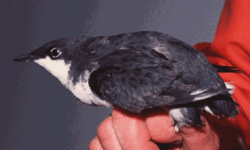
The synthliboramphine Xantus's murrelet (Synthliboramphus hypoleucus) is quite distinct from the brachyramphine murrelets. - Uria
- Common murre or common guillemot, Uria aalge
- Thick-billed murre or, Brünnich's guillemot, Uria lomvia
- Alle
- Little auk or dovekie, Alle alle
- Pinguinus
- Alca
- Razorbill, Alca torda
- Uria
- Tribe Synthliboramphini – synthliboramphine murrelets

Black guillemot (Cepphus grylle, a true guillemot) in summer (front) and winter plumage - Synthliboramphus
- Scripps's murrelet, Synthliboramphus scrippsi – formerly in S. hypoleucus ("Xantus's murrelet")
- Guadalupe murrelet, Synthliboramphus hypoleucus – sometimes separated in Endomychura
- Craveri's murrelet, Synthliboramphus craveri – sometimes separated in Endomychura
- Ancient murrelet, Synthliboramphus antiquus
- Japanese murrelet, Synthliboramphus wumizusume
- Synthliboramphus
- Tribe Cepphini – true guillemots

Marbled murrelet (Brachyramphus marmoratus, a brachyramphine murrelet) in breeding plumage - Cepphus
- Black guillemot or tystie, Cepphus grylle
- Pigeon guillemot, Cepphus columba
- Kurile guillemot, Cepphus columba snowi
- Spectacled guillemot, Cepphus carbo
- Cepphus
- Tribe Brachyramphini – brachyramphine murrelets
- Brachyramphus
- Marbled murrelet, Brachyramphus marmoratus
- Long-billed murrelet, Brachyramphus perdix
- Kittlitz's murrelet, Brachyramphus brevirostris
- Brachyramphus
- Tribe Alcini – typical auks and murres
- Subfamily Fraterculinae
- Tribe Aethiini – auklets

Tufted puffin (Fratercula cirrhata) - Ptychoramphus
- Cassin's auklet, Ptychoramphus aleuticus
- Aethia
- Parakeet auklet, Aethia psittacula
- Crested auklet, Aethia cristatella
- Whiskered auklet, Aethia pygmaea
- Least auklet, Aethia pusilla
- Ptychoramphus
- Tribe Fraterculini – puffins
- Cerorhinca
- Rhinoceros auklet, Cerorhinca monocerata
- Fratercula
- Atlantic puffin, Fratercula arctica
- Horned puffin, Fratercula corniculata
- Tufted puffin, Fratercula cirrhata
- Cerorhinca
- Tribe Aethiini – auklets


Biodiversity of auks seems to have been markedly higher during the Pliocene.[10] See the genus accounts for prehistoric species.
See also
[edit]- Kiviak, a traditional Inuit food from Greenland that is made of auks preserved in seal skin
- Tradeoffs for locomotion in air and water
References
[edit]- ^ a b Myers, P.; Espinosa, R.; Parr, C. S.; Jones, T.; Hammond, G. S.; Dewey, T. A. (2022). "Alcidae". Animal Diversity Web. University of Michigan Museum of Zoology. Retrieved 31 December 2022.
- ^ a b Gill, Frank; Donsker, David; Rasmussen, Pamela, eds. (August 2022). "Noddies, gulls, terns, skimmers, skuas, auks". IOC World Bird List Version 12.2. International Ornithologists' Union. Retrieved 10 November 2022.
- ^ "Definition of Auk". Merriam-Webster.
- ^ "Definition of auk". Dictionary.com.
- ^ Jobling, James A. (2010). "Alca" (PDF). The Helm Dictionary of Scientific Bird Names. London, United Kingdom: Christopher Helm. p. 40. ISBN 978-1-4081-2501-4.
- ^ a b Friesen, V.L.; Baker, A.J. & Piatt, J.F. (1996). "Phylogenetic Relationships Within the Alcidae (Charadriiformes: Aves) Inferred from Total Molecular Evidence". Molecular Biology and Evolution. 13 (2): 359–367. doi:10.1093/oxfordjournals.molbev.a025595. PMID 8587501.
- ^ a b Moum, Truls; Arnason, Ulfur & Árnason, Einar (2002). "Mitochondrial DNA Sequence Evolution and Phylogeny of the Atlantic Alcidae, Including the Extinct Great Auk (Pinguinus impennis)". Molecular Biology and Evolution. 19 (9): 1434–1439. doi:10.1093/oxfordjournals.molbev.a004206. PMID 12200471.
- ^ Thomas, Gavin H.; Wills, Matthew A. & Székely, Tamás (2004). "A supertree approach to shorebird phylogeny". BMC Evolutionary Biology. 4 (1): 28. doi:10.1186/1471-2148-4-28. PMC 515296. PMID 15329156. Supplementary Material
- ^ a b Smith, N.A. (2011). "Taxonomic revision and phylogenetic analysis of the flightless Mancallinae (Aves, Pan-Alcidae)". ZooKeys (91): 1–116. Bibcode:2011ZooK...91....1S. doi:10.3897/zookeys.91.709. PMC 3084493. PMID 21594108.
- ^ a b Konyukhov, N.B. (2002). "Possible Ways of Spreading and Evolution of Alcids". Biology Bulletin of the Russian Academy of Sciences (in Russian). 29 (5): 447–454. Bibcode:2002BioBu..29..447K. doi:10.1023/A:1020457508769. S2CID 36133751.
- ^ Smith, N. A. (2015). "Evolution of body mass in the Pan-Alcidae (Aves, Charadriiformes): the effects of combining neontological and paleontological data". Paleobiology. 42 (1): 8–26. doi:10.1017/pab.2015.24. S2CID 83934750.
- ^ a b Strauch J.G. Jr. (1985). "The phylogeny of the Alcidae" (PDF). The Auk. 102 (3): 520–539. doi:10.1093/auk/102.3.520. JSTOR 4086647.
Further reading
[edit]- Collinson, Martin (2006). "Splitting headaches? Recent taxonomic changes affecting the British and Western Palaearctic lists". British Birds. 99 (6): 306–323.
- Gaston, Anthony J.; Jones, Ian L. (1998). The Auks : Alcidae. Oxford: Oxford University Press. ISBN 0-19-854032-9.
- Paton, T.A.; Baker, A.J.; Groth, J.G.; Barrowclough, G.F. (2003). "RAG-1 sequences resolve phylogenetic relationships within charadriiform birds". Molecular Phylogenetics and Evolution. 29 (2): 268–278. Bibcode:2003MolPE..29..268P. doi:10.1016/S1055-7903(03)00098-8. PMID 13678682.
- Diving Birds of North America by Paul Johnsgard
External links
[edit] Media related to Alcidae at Wikimedia Commons
- . Encyclopædia Britannica. Vol. III (9th ed.). 1878. p. 85.

| International | |
|---|---|
| National | |
| Other | |

Names and taxonomy
Etymology
The term "auk" derives from the Old Norse word álka, referring to a seabird resembling a goose or diver, which entered English in the 1670s through influences from Icelandic, Danish, and Faroese languages, initially describing the extinct great auk of the North Atlantic.[5][6] This Norse root traces back to Proto-Germanic alkǭ, denoting a sea-bird, and ultimately to Proto-Indo-European h₁el-, associated with certain bird types.[7] Common names for alcid species evolved from descriptive or imitative features. "Puffin," first recorded in Middle English around the mid-14th century, originally applied to the swollen, fatty nestlings of unrelated shearwaters prepared as food, later transferring to the seabirds due to their plump chicks and colorful, pouch-like bill pouches used for carrying fish.[8][9] "Murre," used for species like the common murre (Uria aalge), likely originated as an onomatopoeic imitation of the birds' guttural calls, with roots in obscure European dialects possibly akin to Scots "marrot" for similar auks.[10] For the great auk (Pinguinus impennis), the common name simply combines "great" with "auk" to distinguish its size, while its genus name stems from Latin pinguis ("fat" or "plump"), reflecting its robust build.[6] Regional naming variations highlight cultural influences, particularly among Indigenous North American peoples. In Alutiiq (Sugpiaq) communities of Alaska, puffins are called tunngaq, emphasizing their role as a traditional food and material source for clothing and tools.[11] In Yup'ik regions like Scammon Bay, the horned puffin (Fratercula corniculata) is known as quengacuar(aq), meaning "little nose," alluding to its distinctive beak.[12] These local terms contrast with European-derived names and underscore the birds' ecological significance in coastal Indigenous cultures. The introduction of binomial nomenclature by Carl Linnaeus in the 18th century standardized scientific naming for auks, reducing confusion from vernacular variations. For instance, Linnaeus classified the great auk as Alca impennis in 1758, later reassigned to Pinguinus impennis, establishing a Latin-based system that persists in modern taxonomy for the Alcidae family.[13][14]Taxonomic history
The taxonomic history of auks traces back to Carl Linnaeus's Systema Naturae (10th edition, 1758), where he classified several species, including the razorbill (Alca torda) and great auk (Alca impennis), within the genus Alca under the order Grallae, a broad group that encompassed long-legged waders, gulls, and other shorebirds; this order later contributed to the modern Charadriiformes. Early European naturalists frequently confused Northern Hemisphere auks with Southern Hemisphere penguins (family Spheniscidae), attributing superficial similarities in flightless forms like the great auk, such as their upright stance, black-and-white coloration, and wing-propelled swimming, leading to the great auk being commonly known as the "northern penguin" in 18th- and early 19th-century literature.[15] In the 19th century, ornithologists refined auk classification amid growing specimen collections and the urgency spurred by the great auk's extinction in 1844, the last confirmed individuals killed off Iceland. William Elford Leach formally established the family Alcidae in 1820 to distinguish these wing-propelled diving birds from other Charadriiformes, emphasizing their unique adaptations for marine life. Charles Lucien Bonaparte further advanced the taxonomy through his comparative lists and conspectuses, such as the 1838 A Geographical and Comparative List of the Birds of Europe and North America, where he grouped auks into distinct genera within Alcidae and highlighted their separation from gulls and waders based on morphology and distribution.[16] The 20th and 21st centuries saw significant shifts driven by molecular phylogenetics, confirming Alcidae's monophyly and placement within the suborder Lari of Charadriiformes, sister to skuas (Stercorariidae) and gulls (Laridae). Key studies in the 1990s and 2000s, such as Friesen and Baker's 1996 analysis of mitochondrial cytochrome b sequences across 22 extant species, resolved internal relationships into lineages like auklets, murres, and puffins, supporting two main subfamilies: Alcinae and Fraterculinae. Later multilocus DNA research in the 2010s, including Ksepka et al.'s 2011 combined molecular-morphological phylogeny incorporating the extinct great auk, refined subfamily divisions and proposed the clade Pan-Alcidae for fossil flightless forms outside the crown group. Ongoing 2020s debates, informed by expanded genomic data, continue to evaluate subfamily boundaries, particularly the placement of ancient auklets and murrelets relative to puffins, as seen in updated phylogenies integrating paleontological evidence.[17][18][19]Current classification
The family Alcidae belongs to the order Charadriiformes and encompasses 24 extant species distributed across 10 genera, such as Aethia (auklets), Fratercula (puffins), and Uria (murres).[20][4] These genera reflect the family's diversity in form and ecology, with species adapted to marine environments across the North Pacific and Atlantic.[21] Current taxonomy divides Alcidae into two subfamilies: Aethiinae (auklets, including genera Aethia and Ptychoramphus) and Alcinae (true auks, murres, guillemots, puffins, and allies, including Alca, Alle, Cepphus, Brachyramphus, Synthliboramphus, Uria, Cerorhinca, and Fratercula).[4] Within Alcinae, puffins and allies are sometimes further divided into the tribe Fraterculini. Phylogenetic analyses based on genomic data from the 2020s support these divisions, revealing a basal split within the family and subsequent radiations.[22] Molecular clock estimates indicate that the Alcidae diverged from its sister group, the skuas (Stercorariidae), approximately 35 million years ago in the late Eocene, with internal subfamily divergences occurring between 30 and 40 million years ago.[22] This timeline aligns with fossil evidence of early alcid-like birds in the Oligocene.[23] The linear sequence of genera was revised in 2022 by the IOC World Bird List based on phylogenetic analyses of Černý & Natale (2022).[24] Among extinct members, the great auk (Pinguinus impennis) represents a prominent species in the subfamily Alcinae, driven to extinction in the mid-19th century due to human exploitation.[4] Recent taxonomic refinements include the 2010 confirmation of the type locality for the whiskered auklet (Aethia pygmaea) in the Aethiinae, revising it from St. Matthew Island to the Commander Islands based on historical specimen analysis, which has implications for understanding subspecies variation.[25] No additional subspecies of A. pygmaea are currently recognized, but this reclassification underscores ongoing refinements in alcid taxonomy.[26]Physical description
Morphology and adaptations
Auks, members of the family Alcidae, exhibit a wide size range among extant species, from the diminutive least auklet (Aethia pusilla), measuring 13–19 cm in length and weighing 75–115 g, to the larger thick-billed murre (Uria lomvia), reaching 40–48 cm and up to 1.3 kg. The extinct great auk (Pinguinus impennis) represented the upper extreme, standing 70–85 cm tall and weighing approximately 5 kg.[27] Their bodies are characteristically compact and streamlined, with short necks and tails, facilitating efficient movement through water while contributing to a somewhat clumsy gait on land.[3] The plumage is dense and waterproof, consisting of tightly packed contour feathers that trap air for insulation and buoyancy during submersion.[28] A primary morphological adaptation in auks is their wing structure, which is short, narrow, and stiffened to function as flippers for propulsion during underwater "flight."[29] This design enables powerful strokes in water but compromises aerial efficiency, particularly in larger species; for instance, the razorbill (Alca torda) experiences higher energy demands for flight due to its relatively high wing loading compared to smaller alcids, limiting sustained aerial travel.[30] These wings, along with robust pectoral muscles, allow auks to pursue prey at high speeds beneath the surface.[29] Bills in auks vary by species but are specialized for grasping marine prey; in puffins (Fratercula spp.), the colorful, triangular bill features transverse grooves and backward-facing spines on the palate and tongue, enabling the bird to hold multiple small fish crosswise without dropping them during repeated dives.[31] Their feet are webbed and positioned far rearward on the body, providing effective steering and thrust for swimming, which supports deep foraging excursions.[3] For example, the thick-billed murre can dive to depths exceeding 200 m, relying on these adaptations to access vertically migrating prey in the water column.[32]Plumage and variation
Auks exhibit a characteristic black-and-white plumage pattern featuring countershading, with dark dorsal surfaces and pale ventral areas that enhance camouflage during underwater foraging by minimizing silhouettes against light from above or below. This adaptation is evident across the family Alcidae, as seen in species like the common murre (Uria aalge), where the black back and wings contrast with the white breast and belly.[33][34] In breeding adults, many auks develop conspicuous bright ornaments on bare skin or adjacent feathers to facilitate recognition in dense colonies. A representative example is the Atlantic puffin (Fratercula arctica), which displays vibrant orange legs and multicolored bill plates during the breeding season, contrasting sharply with its otherwise black upperparts and white underparts. These seasonal features are shed post-breeding via molt, reverting to duller tones.[35] Sexual dimorphism in plumage is negligible throughout Alcidae, with both sexes sharing identical feather patterns and colors in all life stages, distinguishing the family from more dichromatic avian groups. Juveniles emerge from the egg covered in soft, downy gray plumage that provides initial camouflage on nesting grounds; this transitions to the first pennaceous feathers through a complete prebasic molt typically completed 1–3 months after hatching, resulting in a scaled or brownish juvenile plumage resembling a subdued version of the adult basic pattern.[36][37] Plumage shows limited intraspecific variation, often clinal in response to environmental gradients, such as subtle differences in bill color intensity from Arctic to subarctic populations in the horned puffin (Fratercula corniculata). Rare pigmentation anomalies, including albinism (total lack of melanin, resulting in white plumage and pinkish bare parts) and leucism (partial or full white plumage with normal-colored bare parts), occur sporadically in wild alcid populations, as documented in species like the razorbill (Alca torda) and black guillemot (Cepphus grylle), though such individuals face higher predation risks.[38]Distribution and habitat
Geographic range
Auks of the family Alcidae are endemic to the Northern Hemisphere, occurring primarily along coastal and marine environments from the high Arctic regions of Alaska and Siberia southward to temperate latitudes in the North Atlantic and North Pacific Oceans, with no established populations in the Southern Hemisphere unlike the distantly related penguins.[39][40] Core distributions vary by genus: murres (Uria spp.) and guillemots exhibit circumpolar ranges across low-Arctic and boreal waters of both the Atlantic and Pacific, while puffins (Fratercula spp.) are concentrated in the North Atlantic, where Iceland supports approximately 60% of the global Atlantic puffin (F. arctica) population. Auklets (Aethia spp.), in contrast, are largely restricted to the Bering Sea and adjacent northern Pacific areas, including the Sea of Okhotsk.[39][41][42] Post-Pleistocene warming led to range contractions for many auk species as glacial retreats altered marine habitats, with the extinct great auk (Pinguinus impennis) once extending southward to the Mediterranean Basin—as indicated by Neolithic bone remains from coastal North Africa—before its overhunting-driven extinction around 1844.[43][44] Ongoing climate change is prompting northward range shifts among extant auks, including black guillemots (Cepphus grylle), driven by warming seas that alter prey availability and habitat suitability within their northern breeding grounds. As of 2025, continued warming has led to further northward shifts in some alcid distributions, with implications for breeding and foraging habitats.[45][46][47]Habitat preferences
Auks predominantly inhabit cold, nutrient-rich marine environments in the Northern Hemisphere, particularly boreal and Arctic waters where upwelling currents bring nutrient-laden deep water to the surface, fostering high prey abundance for these planktivorous and piscivorous seabirds.[48] These species avoid warmer tropical zones, as their physiological adaptations, including dense plumage and limited heat dissipation mechanisms, make them vulnerable to overheating in higher temperatures.[3] Nesting occurs primarily on remote coastal islands and cliff faces, providing protection from terrestrial predators, with preferences for steep slopes, rocky ledges, or soft-soiled tundra for burrow excavation.[3] Species like puffins (Fratercula spp.) dig burrows 1–2 m deep into friable soil or turf, often lining the chamber with vegetation and feathers for insulation.[49] Colonies can achieve extraordinary densities, such as the least auklet (Aethia pusilla) colony on St. George Island, Alaska, with historical estimates of around 390,000 individuals (as of 1982).[50][51] Foraging habitats vary by species, with pursuit-diving auks like murres (Uria spp.) targeting pelagic zones in open ocean waters up to several hundred meters deep, while smaller auklets (Aethia spp.) favor nearshore areas with tidal fronts, upwellings, and productive features like kelp forests that concentrate zooplankton prey.[52][53] Auks show sensitivity to environmental changes such as ocean acidification, which disrupts prey populations in the North Pacific; studies indicate threats to marine ecosystems supporting alcids through impacts on calcifying plankton and forage fish.[54][47]Behavior and ecology
Feeding and foraging
Auks in the family Alcidae are predominantly piscivorous, relying primarily on small schooling fish such as capelin (Mallotus villosus) and sand eels (Ammodytes spp.), though the proportion varies by species (often 50-90% fish in piscivorous species), with crustaceans (e.g., euphausiids) and squid serving as supplementary prey depending on availability and species-specific preferences.[55] For instance, the Atlantic puffin (Fratercula arctica) captures multiple small fish during dives, often carrying 10–20 individuals crosswise in its specialized bill for transport back to the nest or immediate consumption.[56] Foraging primarily involves pursuit diving, where auks propel themselves underwater using modified wings as flippers to chase prey, with typical dive durations ranging from 20 to 60 seconds to pursue and capture schools of fish or zooplankton in shallow to mid-depth waters (up to 50–100 m).[55] These birds frequently aggregate into loose groups floating on the surface near prey concentrations. Seasonal and ontogenetic variations in diet reflect energetic demands; chicks receive lipid-rich fish like sand eels to fuel rapid growth and development, while adults shift toward higher-energy prey items, such as fattier fish or amphipods, during the post-breeding molt to support feather replacement under elevated metabolic costs.[56] In cold marine environments, energy budgets of diving auks allocate a substantial portion of their energy to thermoregulation, offsetting heat loss through dense plumage and subcutaneous fat layers that enhance insulation during prolonged submersion.[55] This adaptation, tied to their streamlined morphology for efficient diving, underscores the interplay between foraging efficiency and thermal maintenance in Arctic and subarctic waters.[55]Breeding biology
Auks typically form socially monogamous pairs that bond for multiple breeding seasons, often lasting 1–5 years or longer, with high mate fidelity in species such as the Atlantic puffin (Fratercula arctica) and common murre (Uria aalge).[57][1] Courtship involves elaborate displays to reaffirm or establish pairs, including billing where partners rub and shake their colorful bills together, as seen in puffins upon returning to colonies.[58][59] Clutch sizes are generally 1–2 eggs across the family, with over half of the 22 species laying a single egg; exceptions include the ancient murrelet (Synthliboramphus antiquus) and other murrelets, which typically produce two.[1][60] Incubation periods range from 25–40 days on average, shared by both parents in shifts, with the egg's pyriform shape preventing it from rolling off ledges in open-nesting species like murres.[4][1] Nesting strategies vary but emphasize minimal construction; puffins and auklets are burrow-nesters, excavating tunnels in soil or turf without added materials, while murres and guillemots use rock crevices or bare cliff ledges, relying solely on the site's natural protection.[3][1] The chick-rearing phase lasts 20–60 days depending on species, with semi-precocial young guarded biparentally against predators such as gulls; in crevice- or burrow-nesters, parents alternate foraging trips to provision chicks with fish, while in ledge-nesters like murres, one parent often remains to defend the site.[1][61] Breeding in colonies is highly synchronous, with eggs often laid within a narrow window driven by photoperiod cues and social stimulation that align arrival and laying times across the population. Fledging success averages 40–60% in many populations, influenced by factors including predation and food availability; in two-egg species like the ancient murrelet, asynchronous hatching leads to sibling competition, where the larger first chick often outcompetes the smaller second for food, resulting in brood reduction.[1][62]Social and migratory behavior
Auks exhibit highly social behaviors, often forming large colonies that provide benefits such as enhanced predator vigilance and collective foraging opportunities. Many species, including common murres (Uria aalge), nest in dense aggregations numbering in the thousands or more, with birds maintaining close physical contact on cliff ledges during breeding.[63] Some populations, like those of common murres, engage in year-round roosting in groups of thousands on coastal ledges, facilitating social interactions outside the breeding season.[64] Within these colonies, vocalizations play a key role in communication and defense; for instance, little auks (Alle alle) produce rasping and croaking calls to signal territory boundaries and alarm contexts, helping to maintain spacing in crowded environments.[65] Pair bonds are reinforced through allopreening, where mates mutually preen feathers, particularly around the head and neck, as observed in razorbills (Alca torda), promoting cooperation and fidelity.[66] Migration in auks is typically partial, with many species being short- to medium-distance migrants that shift from northern breeding grounds to more southern wintering areas in response to ice formation and food availability. Some Arctic-breeding species undertake journeys of up to 5,000 km to reach wintering grounds along the Pacific continental shelf, where they exploit productive zooplankton blooms.[67] These movements are often irregular, with irruptive patterns occurring during periods of food shortages, such as when prey like copepods decline due to environmental variability, prompting birds to disperse farther than usual.[68] Timing varies by latitude; northern populations initiate southward migration in late summer, while southern breeders may remain resident or make shorter dispersals. Interspecific interactions among auks frequently involve mixed-species flocks, particularly at sea during non-breeding periods, where grouping with other alcids enhances anti-predator vigilance through collective detection of threats like gulls or marine mammals.[69] However, competition intensifies in breeding colonies with limited burrow or crevice sites, leading to aggressive encounters; crested auklets (Aethia cristatella), for example, display frequent agonistic behaviors, including pecking and chasing.[70] Such aggression underscores the trade-offs of coloniality, balancing social advantages against resource competition.Evolution and conservation
Evolutionary history
The auk family (Alcidae) traces its origins to the late Eocene, approximately 35 million years ago, when it diverged from its sister taxon, the skuas (Stercorariidae), within the order Charadriiformes.[22] This split occurred as charadriiform ancestors adapted to marine environments in the North Pacific, marking the beginning of the Pan-Alcidae radiation.[22] The earliest unequivocal fossils of auks date to the late Eocene from deposits in Georgia, USA, providing evidence of their initial diversification among early seabirds.[71] The fossil record expands significantly in the Miocene, revealing a variety of extinct forms that highlight early morphological diversity within Alcidae. Notable examples include the flightless Mancallinae from the Pacific coast of California, such as Mancalla californiensis, which represent some of the largest known auks and demonstrate early adaptations for wing-propelled diving in coastal niches.[72] These Miocene fossils indicate that alcid diversity peaked during this epoch, with subsequent differential extinction shaping the lineage through the Pliocene–Pleistocene boundary.[22] Diversification accelerated during the Pleistocene glaciations, as auks colonized expanding cold marine habitats in the North Atlantic and Pacific amid fluctuating ice ages.[22] Glacial cycles promoted isolation in refugia, driving adaptive radiations into specialized foraging and breeding strategies suited to boreal and arctic seas. Molecular clock analyses suggest that major subfamily divergences, such as those separating the murre-like Alcinae from the auklet-containing Aethiinae and puffin-containing Fraterculinae, occurred in the Oligocene to Miocene, with post-Pleistocene expansions contributing to the current 23 extant species.[22] Key evolutionary innovations include the evolution of flightlessness in the great auk (Pinguinus impennis), a convergent trait with penguins (Spheniscidae) that enhanced underwater propulsion but limited aerial mobility.[73] This adaptation arose independently in northern hemisphere auks, reflecting parallel responses to similar selective pressures in polar marine ecosystems. Post-glacial recolonizations following the Last Glacial Maximum further influenced lineage dynamics, with genomic studies in related Beringian seabirds indicating occasional hybridization events that blurred species boundaries in dynamic island environments.Conservation status and threats
The family Alcidae encompasses 23 extant species, with one extinct member, the great auk (Pinguinus impennis), driven to extinction in the mid-19th century primarily by human hunting for food, feathers, and eggs.[74] According to the IUCN Red List, seven species (approximately 30% of the family) are currently at risk, including three classified as Vulnerable—Scripps's murrelet (Synthliboramphus scrippsi), Craveri's murrelet (Synthliboramphus craveri), and Japanese murrelet (Synthliboramphus wumizusume)—and two as Endangered: marbled murrelet (Brachyramphus marmoratus) and Guadalupe murrelet (Synthliboramphus hypoleucus).[75][76][77] The global population of auks is estimated at around 50 million individuals, though Pacific auklets (genus Aethia) have experienced approximately a 30% decline since the early 2000s due to climate-induced changes in prey availability and habitat suitability.[4] Primary threats to auks include climate-driven shifts in prey distribution, which disrupt foraging and breeding success. For instance, the 2014–2016 northeast Pacific marine heatwave known as "The Blob" led to widespread reproductive failure and high chick mortality, with estimates of up to 50% chick loss in common murre (Uria aalge) colonies in the Gulf of Alaska due to reduced forage fish abundance.[78] Oil spills pose another significant risk, as demonstrated by the 1989 Exxon Valdez disaster in Prince William Sound, Alaska, which killed an estimated 250,000–500,000 seabirds, predominantly auks such as common murres (accounting for 74% of recovered oiled birds).[79] Fisheries bycatch remains a persistent danger, with global longline fisheries incidentally killing over 100,000 auks annually through entanglement, particularly affecting species like the black guillemot (Cepphus grylle) and Atlantic puffin (Fratercula arctica) in the North Atlantic.[80] Conservation efforts focus on habitat protection, bycatch mitigation, and population recovery initiatives. Marine protected areas play a crucial role, such as the Alaska Maritime National Wildlife Refuge, which safeguards breeding sites for millions of auks across the Aleutian Islands and Bering Sea, encompassing nearly 80% of Alaska's nesting seabird populations.[81] Since the 2010s, international agreements and national policies have implemented reduced fishing quotas and gear modifications in longline fisheries to minimize bycatch, including the use of bird-scaring lines and weighted lines in the North Pacific and Atlantic. Experimental reintroduction trials using proxies for the great auk, such as grafting great auk-like embryos onto razorbill (Alca torda) eggs, have been proposed to explore de-extinction potential and restore ecological roles in North Atlantic ecosystems.[82]References
- https://en.wiktionary.org/wiki/auk