Hubbry Logo
Avignon CathedralAvignon CathedralMain
Open search
Avignon Cathedral
Community hub
Avignon Cathedral
logo
8 pages, 0 posts
0 subscribers
Be the first to start a discussion here.
Contribute something
Avignon Cathedral
Avignon Cathedral
from Wikipedia

Detail of a drawing by Étienne Martellange dating from the first quarter of the 17th century. The cathedral is at the top left, beyond the Palais des Papes.

Key Information

Avignon Cathedral (French: Cathédrale Notre-Dame des Doms d'Avignon; Occitan: Catedral Nòstra Dama dels Dòms d'Avinhon) is a Roman Catholic church located next to the Palais des Papes in Avignon, France. The cathedral is the seat of the Archbishop of Avignon.

The cathedral is a Romanesque building, constructed primarily in the second half of the 12th century.[1] The bell tower collapsed in 1405 and was rebuilt in 1425. In 1670–1672 the apse was rebuilt and extended.[2] The extension led to the destruction of the medieval cloister.[3]

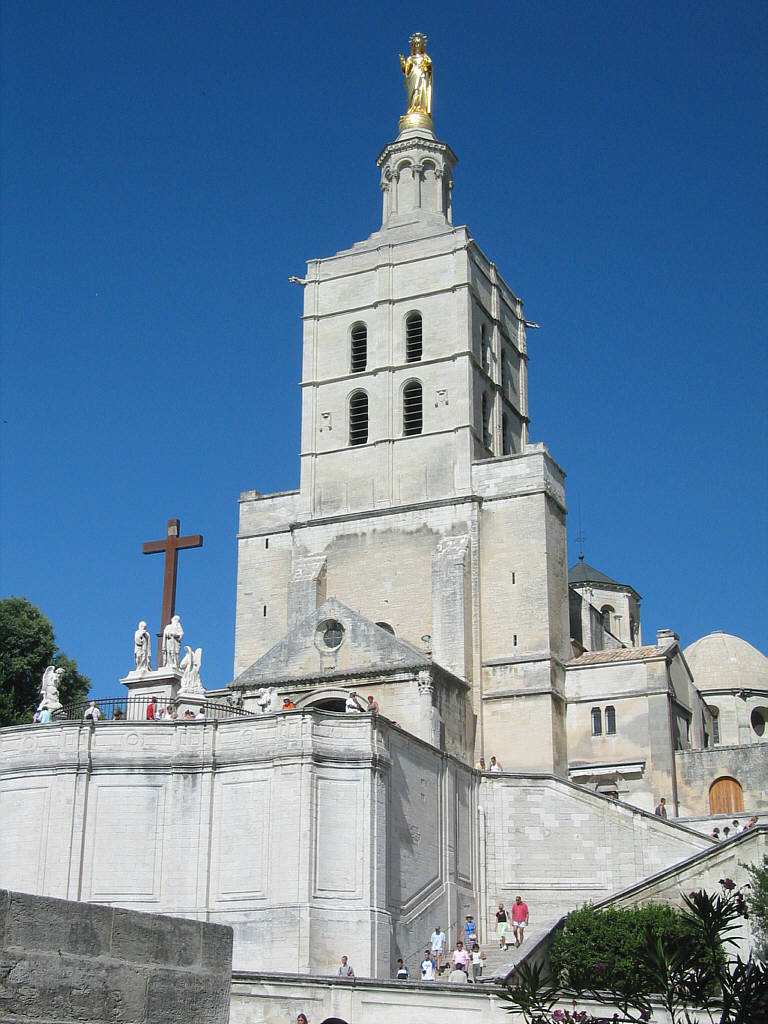
The building was abandoned and allowed to deteriorate during the Revolution, but it was reconsecrated in 1822 and restored by the archbishop Célestin Dupont in 1835–1842.[4] The most prominent feature of the cathedral is a gilded statue of the Virgin Mary atop the bell tower which was erected in 1859.[4] The interior contains many works of art. The most famous of these is the mausoleum of Pope John XXII (died 1334), a 14th-century Gothic edifice. It was moved in 1759, damaged during the Revolution, and restored to its original position in 1840.[5] The cathedral was listed as a Monument historique in 1840.[6] In 1995, the cathedral, along with the Palais des Papes and other historic buildings in the Avignon city center, became a UNESCO World Heritage Site because of its outstanding architecture and its importance during the 14th and 15th centuries.[3]

See also

[edit]

References

[edit]

Sources

[edit]
  • Girard, Joseph (1958). Évocation du Vieil Avignon (in French). Paris: Les Éditions de Minuit. OCLC 5391399.

Further reading

[edit]
[edit]
Revisions and contributorsEdit on WikipediaRead on Wikipedia
from Grokipedia
The Cathédrale Notre-Dame des Doms d'Avignon, commonly known as Avignon Cathedral, is a Romanesque cathedral perched atop the Rocher des Doms overlooking the Valley in , . Built primarily in the mid-12th century on the site of earlier religious structures dating back to the , it exemplifies Romanesque architecture with later Gothic and additions, including a 15th-century cupola rebuilt in Byzantine style after a collapse and 17th-century galleries. The cathedral's bell tower is crowned by a 19th-century gilded lead statue of the Virgin Mary, standing 6 meters tall, and it houses a carillon of 35 bells that rings daily. As the principal seat of the Archdiocese of since the and first documented in 1037, the cathedral played a central role during the (1309–1377), when seven successive French popes resided in the city and several papal coronations took place within its nave, beginning with in 1352. It contains Flamboyant Gothic tombs of three Avignon popes—John XXII (d. 1334), Benedict XII (d. 1342), and Clement VI (d. 1352)—along with medieval murals, altarpieces, and a treasury of liturgical artifacts. The structure was enlarged with side chapels in the , sacked during the , and underwent major restorations in the 19th and 21st centuries, reopening in 2016 after extensive work to preserve its frescoes and stonework. Recognized as part of the World Heritage-listed Historic Centre of since 1995, the forms the episcopal ensemble alongside the , symbolizing the city's medieval papal legacy and architectural evolution from Romanesque origins to influences. Its , inspired by Roman triumphal arches, and interior spaces dedicated to saints like Agricol ('s first ) highlight its enduring spiritual and cultural significance in history.

History

Origins and Construction

The Avignon Cathedral, known as Notre-Dame des Doms, was constructed beginning around 1150 on the Rocher des Doms, a rocky outcrop overlooking the Valley that had previously hosted religious structures dating back to at least the . This site, elevated and strategically positioned, served as the foundational location for the cathedral, which replaced earlier buildings and established itself as the principal seat of the of . The structure was dedicated to Notre-Dame, reflecting its Marian devotion, and embodied the Romanesque style characteristic of southern French , with its emphasis on robust forms and regional stonework. The cathedral's construction unfolded in three successive phases during the 12th and early 13th centuries, marking its evolution from a basic Romanesque edifice to a more complex ensemble. The initial phase, in the mid-12th century, focused on erecting the and the , providing the core framework for worship and processions within the growing episcopal ensemble. This period aligned with the second half of the 12th century's broader Romanesque developments in , where local masons adapted Lombard influences to create wide, barrel-vaulted interiors suited to the region's seismic considerations. In the late 12th century, the second phase introduced the octagonal dome capped by a lantern tower, enhancing the cathedral's verticality and illumination while maintaining Romanesque proportions. This dome, a hallmark of Provençal Romanesque engineering, symbolized divine light and structural innovation, drawing on traditions seen in nearby structures like the baptistery of Saint-Trophime in Arles. The final phase, in the early 13th century, added the Gothic-influenced porch at the entrance, blending emerging pointed arches with the existing Romanesque facade to accommodate increasing liturgical and communal needs. These phases solidified the cathedral's role as Avignon's spiritual center, later gaining prominence during the Avignon Papacy in the 14th century.

Avignon Papacy Era

The , spanning from 1309 to 1377, marked a pivotal era when seven successive popes—beginning with Clement V—established their residence in , , rather than , due to political instability and French royal influence. During this period, the nearby served as the administrative and residential center of the , while Avignon Cathedral, known as Notre-Dame des Doms, functioned as the primary site for major ecclesiastical ceremonies, including at least 11 papal coronations in its nave beginning with in 1352, as well as papal masses, consistories, and significant liturgical events that underscored the city's role as the de facto capital of . The cathedral's proximity to the papal palace integrated it into the daily operations of the , transforming it from a local diocesan church into a focal point for international religious and ritual. Pope John XXII (reigned 1316–1334), the second Avignon pope and a former bishop of Avignon, played a particularly prominent role in enhancing the cathedral's interior to reflect papal prestige. He commissioned several elements, including expansions to the existing Romanesque structure and preparations for his eventual mausoleum, which was designated within the cathedral as a site of perpetual commemoration. These additions emphasized the cathedral's evolving status as a papal sanctuary, blending functionality with symbolic grandeur during a time of administrative centralization under his leadership. A key feature utilized by the Avignon popes was the 12th-century marble papal located at the , which served as the seat for enthronements, councils, and other solemn assemblies, symbolizing continuity with earlier traditions amid the papacy's relocation. This , carved with symbolic motifs, hosted rituals that affirmed papal , such as the installation ceremonies for subsequent popes like Benedict XII in 1334. As the ecclesiastical core of the papal city, Cathedral forms an integral part of the Historic Centre of , designated a World Heritage Site in 1995 for its exemplary medieval architecture and historical testimony to the . This ensemble, encompassing the and the episcopal complex, highlights the cathedral's enduring function as the spiritual heart of the era's papal administration.

Later Modifications and Restorations

In 1405, the cathedral's collapsed, likely due to structural weakness or seismic activity, necessitating a complete rebuild that was completed by 1425. During the late , significant alterations were made to the eastern end of the cathedral. Between 1670 and 1672, the was reconstructed and extended to form a larger , a project that required the demolition of the adjacent medieval to accommodate the expansion. The cathedral suffered neglect during the , beginning with its abandonment in 1791 and subsequent deconsecration amid widespread anti-clerical measures; it was reconsecrated in 1822 following the end of the , marking its return to active religious use. Further deterioration prompted major restorations from 1835 to 1842 under the oversight of Archbishop Jacques-Marie-Antoine-Célestin Dupont, which included interior cleaning, structural reinforcements to address humidity and damage from the revolutionary period, and decorative enhancements such as frescoes in the Chapel of the Blessed Sacrament by artist Eugène Devéria. In 1840, the cathedral was officially classified as a , providing legal protection and underscoring its national importance. The most visible 19th-century addition came in 1859, when a large gilded statue of the Virgin Mary, weighing approximately 4.5 tons and standing 6 meters tall, was erected atop the to serve as a protective symbol over the city. In the 21st century, the cathedral underwent extensive restorations from 2014 to 2016 focused on preserving its frescoes and stonework, after which it reopened to the public on March 24, 2016.

Architecture

Exterior Elements

The Avignon Cathedral exemplifies Provençal Romanesque architecture with subtle Languedoc Gothic influences evident in its exterior form, constructed primarily from local limestone quarried in the surrounding region. The façade features twin towers flanking the entrance, creating a balanced and imposing presence that integrates harmoniously with the adjacent . An early 13th-century porch protrudes from the façade, featuring frescoes by depicting scenes such as the Saviour Blessing and the Madonna of Humility, originally painted around 1343 (now largely deteriorated with sinopias preserved). Rising prominently above the nave is an octagonal dome, a distinctive element visible from much of the city, topped by a lantern tower that allows for diffusion while enhancing the structure's vertical emphasis. The , with its square base dating to the , incorporates upper levels rebuilt in Gothic style around 1425 following an earlier collapse, culminating in a gilded lead statue of the Virgin Mary erected in 1859. This 6-meter-tall statue, weighing 4.5 tons and symbolizing divine protection over the city, dominates the skyline and was regilded in 2000 to preserve its luster. Strategically positioned on the elevated Rocher des Doms, the cathedral's defensive-like placement on this rocky outcrop not only provided historical security but also offers panoramic views of the Rhône Valley and the nearby , integrating the building into Avignon's medieval urban landscape. The tower houses a of 35 bells, installed in the and ranking as the third-largest peal in , which rings liturgical melodies throughout the year and during local festivals to mark religious and cultural events. This octagonal dome forms part of the overall vaulting system that subtly links to the interior spatial organization. The dome, rebuilt in 1425 after a , features a structure that admits diffused light, illuminating the vaults and emphasizing the space's verticality, in a Byzantine-style with stacked arches.

Interior Structure

The interior of Avignon Cathedral follows a plan characteristic of Provençal Romanesque architecture, featuring a central flanked by side aisles supported by robust arcades dating to the . These arcades, constructed from local stone, provide and divide the space into distinct bays, allowing for processional movement and communal . Later modifications introduced Gothic ribbed vaults over the and aisles, enhancing height and distributing weight more efficiently during the 14th and 15th centuries amid the . The and were significantly extended in 1671, incorporating radiating chapels arranged in a polygonal configuration to facilitate liturgical processions and enclose the eastern end. This Baroque renovation replaced the original Romanesque , creating a more expansive semicircular that encircles the , with vaulted ceilings supported by decorative ribs and capitals. The area features an elevated platform reserved for , seamlessly integrated with the rear wall where the 12th-century veined white marble episcopal throne, known as the , is embedded as a of authority. Natural lighting permeates the interior through windows along the nave's upper walls and the oculus of the octagonal dome crowning the eastern , fostering a bright, luminous atmosphere typical of ecclesiastical design. Overall, the was designed with sufficient capacity to accommodate large papal assemblies during the , including adaptations for ceremonial processions.

Art and Furnishings

Tombs and Monuments

The mausoleum of , who died in 1334, stands as the most prominent sepulchral monument in Avignon Cathedral, exemplifying 14th-century Gothic funerary art tied to the . Constructed shortly after his death, the features a recumbent in beneath a canopy of , with architectural elements including arches, ogival forms, and niches originally holding figures of apostles and virtues that have since been removed and are now housed in the adjacent museum. The design draws on English royal tomb influences, such as those of Edward II, to emphasize papal authority through a synthesis of secular and sacred motifs, serving as visual for the legitimacy of the Avignon pontiffs. Originally positioned behind the main altar in the chapel of Saint John, the was relocated within the in 1759 to accommodate structural changes. It suffered damage during the , including the replacement of the effigy's head, but was subsequently restored to preserve its intricate Gothic detailing. These modifications highlight the tomb's enduring role in linking the to the papal era, where it continues to symbolize Avignon's status as a center of ecclesiastical power from 1309 to 1377. The cathedral also houses the Flamboyant Gothic tomb of (d. 1342), constructed shortly after his death and featuring a recumbent and ornate canopy that underscore the continuity of the Avignon papacy's architectural patronage. Beyond these papal mausolea, the cathedral contains several papal-era burials, including those of related cardinals and figures like John XXII's nephew Jacques de Via, interred nearby to underscore familial and curial ties to the court. analyses from seven such 14th-century tombs of popes and cardinals confirm the material's prevalence in these commemorative structures, reflecting international artistic exchanges during the period. In the 19th century, restorations reconsecrated the cathedral in 1822 under Archbishop Célestin Dupont, introducing minor monuments and plaques that honor the efforts to safeguard its papal heritage amid post-Revolutionary neglect. These additions reinforce ' symbolic function in perpetuating Avignon's legacy as a pivotal site of , blending medieval grandeur with modern preservation.

Decorative Features and Artifacts

The Avignon Cathedral's interior is enriched by a variety of decorative features and artifacts spanning the medieval and later periods, primarily integrated into the and spaces. Central to the is the 12th-century papal , a seat of pure white marble symbolizing ecclesiastical authority through its carvings of the bull of St. Luke and the lion of St. Mark. Originally used by the popes during liturgical ceremonies, it now serves the and exemplifies the cathedral's role in the 14th-century papacy. The cathedral's musical heritage is represented by two organs that contribute both functional and ornamental value. The prominent gallery organ features a gilded wooden adorned with decorative and surmounted by a wooden statue of King David, reflecting influences in its elaborate design; constructed in 1818 by the Italian builder Giovanni Antonio Piantanida from , it draws on 18th-century stylistic traditions for its ornate casing. Complementing this is a smaller 19th-century organ in the , employed for liturgical accompaniment and integrated into the wooden ensemble. Sculptural details abound in the Romanesque , where capitals exhibit intricate foliage patterns alongside biblical motifs, such as a notable example depicting the journey of to from the Book of , underscoring theological narratives through symbolic imagery. The choir area includes 113 richly carved wooden stalls of workmanship, forming an elaborate screen that encloses the space for chapter and officiants, with detailed bas-reliefs enhancing the decorative scheme. Paintings and altarpieces provide vivid artistic highlights, including 15th-century fresco fragments in side chapels, such as the Baptism of Jesus Christ near the entrance and remnants in the John XXII chapel illustrating papal-era scenes. The main altar, set within the 17th-century Baroque apse rebuilt in 1671–1672, features a pseudo-classical reredos with sculpted angelic figures, though critiqued for its modern adaptations amid the Romanesque surroundings. Among the cathedral's treasures are reliquaries and vestments from the papal period, preserved as part of the diocesan collection and displayed in side chapels like that of John XXII, where they include liturgical ornaments underscoring Avignon's historical ecclesiastical prominence.

Significance and Legacy

Religious and Cultural Importance

Avignon Cathedral, known as Notre-Dame des Doms, serves as the metropolitan and principal seat of the Archdiocese of Avignon, a status it has held since the diocese's elevation to metropolitan rank in 1475, though its role as episcopal seat dates to the . As the central venue for the , it hosts key diocesan events including ordinations, chrismal masses, and other major liturgical celebrations that draw and faithful from across the region. This enduring ecclesiastical position underscores its prestige, rooted briefly in its historical use during the as a focal point for papal worship and administration. The cathedral maintains vibrant liturgical traditions, particularly the annual Feast of the Assumption on August 15, which honors the Virgin Mary—its patroness—and is enhanced by the prominent gilded statue crowning the , installed in 1859 as a of over the city. Commemorations of the Avignon Popes also feature prominently, with special masses and reflections on their legacy. The cathedral's bells ring out during religious holidays, marking occasions like and with traditional peals that resonate across , fostering communal participation in the faith. Culturally, the cathedral embodies Romanesque artistry, its robust stonework and integrated Gothic elements representing a pivotal fusion in southern French sacred architecture that influenced regional church design. It stands as an enduring emblem of the , often termed the "" in historical literature—a phrase popularized by to evoke the popes' 70-year residence in from 1309 to 1377, evoking themes of exile and ecclesiastical power in works of art and poetry that depict the era's tensions. This legacy permeates local culture. In the community, the cathedral functions as a multifaceted hub, accommodating weddings that unite couples in its historic amid its spiritual ambiance, as well as sacred music concerts featuring choral and organ works that attract both locals and visitors. It also supports through its proximity to the diocesan seminary structures, including the Redemptoris Mater Seminary near , where future priests train and engage in formation activities linked to the cathedral's liturgical life. These roles reinforce its position as a living center of Christian practice and Provençal heritage.

Modern Recognition and Visitor Experience

In 1995, Avignon Cathedral was inscribed on the World Heritage List as part of the "Historic Centre of Avignon: Papal Palace, Episcopal Ensemble and Avignon Bridge" (site 228), alongside the adjacent and other structures, honoring the site's exceptional preservation of 14th-century papal architecture and its role in radiating Gothic influences across . This recognition underscores the cathedral's integrity as a testament to the era, emphasizing its Romanesque core and subsequent modifications that maintain historical authenticity. Ongoing conservation efforts in the are overseen by the French Ministry of Culture through the regional Directorate for Culture, focusing on structural maintenance to ensure the cathedral's longevity as an active and heritage site. These initiatives build on earlier restorations, incorporating modern reinforcements to mitigate seismic risks in the region's tectonically active zone. Digital documentation projects, aligned with national heritage strategies, support detailed and virtual preservation of the cathedral's features, facilitating future interventions without compromising its fabric. The , known as Notre-Dame des Doms, welcomes visitors Tuesday through Sunday from 8:30 a.m. to 5:30 p.m. as of 2025, closed Mondays, offering free entry to its and , though a suggested of €2 supports upkeep; access is closed during religious services. Guided walking tours of Avignon's historic center often include the , highlighting its proximity to the —just a two-minute walk away—though separate tickets are required for the palace (€12 for adults). The adjacent terrace provides panoramic views of the River and surrounding landscapes, while the bell tower's 35-bell plays liturgical melodies throughout the year, adding an auditory dimension to the visit. Accessibility enhancements since the , including ramps and adapted pathways, have improved entry for visitors with disabilities, reflecting broader site-wide upgrades. As a key draw within Avignon's UNESCO-listed ensemble, the cathedral attracts hundreds of thousands of visitors annually, contributing to the city's status as a major European heritage destination that sees over a million tourists each year. Highlights like the carillon performances and terrace vistas enhance the immersive experience, often integrated into broader itineraries with the . In recent years, the cathedral has hosted cultural events tied to Avignon's European heritage legacy, including organ and choir concerts during the 2025 "Land of Culture" program marking the 25th anniversary of its 2000 designation as , as well as participation in European Heritage Days focused on architectural preservation.

References

Add your contribution
Related Hubs
Contribute something
User Avatar
No comments yet.