Hubbry Logo
Palais des PapesPalais des PapesMain
Open search
Palais des Papes
Community hub
Palais des Papes
logo
8 pages, 0 posts
0 subscribers
Be the first to start a discussion here.
Palais des Papes
Palais des Papes
from Wikipedia

The Palais des Papes (English: Palace of the Popes; lo Palais dei Papas in Occitan) in Avignon, Southern France, is one of the largest and most important medieval Gothic buildings in Europe.[1] Once a fortress and palace, the papal residence was a seat of Western Christianity during the 14th century. Six papal conclaves were held in the Palais, leading to the elections of Benedict XII in 1334, Clement VI in 1342, Innocent VI in 1352, Urban V in 1362, Gregory XI in 1370 and Benedict XIII in 1394. In 1995, the Palais des Papes was classified as a UNESCO World Heritage Site for its outstanding architecture and historical importance for the papacy.[2]

Key Information

Description

[edit]

The Palais is actually two joined buildings: the old palais of Benedict XII, which sits on the impregnable rock of Doms, and the new palais of Clement VI, the most extravagant of the Avignon popes. Together they form the largest Gothic building of the Middle Ages. It is also one of the best examples of the International Gothic architectural style. The construction design was the work of two of France's best architects, Pierre Peysson and Jean de Louvres, and the lavish ornamentation was the work of two of the best students of the School of Siena (Italy), Simone Martini and Matteo Giovanetti.

In addition, the papal library housed in the Palais (the largest in Europe at the time with over 2,000 volumes), attracted a group of clerics passionate in the study of "belles-lettres", amongst them the founder of humanism, Petrarch. At the same time, composers, singers and musicians were drawn to the Great Chapel of the Palais. It was there that Clement VI used the Mass of Notre-Dame of Guillaume de Machaut, there that Philippe de Vitry at the pope's invitation presented his Ars Nova, and there that Johannes Ciconia came to study.

Due to its immense size, the Palais was also the place where the general organisation of the Church began to change. It facilitated the centralisation of services and the adaptation of operations in order to suit the needs of the papacy, creating a truly central administration for the Church.[3] The manpower of the Curia (Church administration), while 200 at the end of the 13th century, surpassed 300 at the beginning of the 14th century and reached 500 people in 1316. To this were added over 1,000 lay officials working within the Palais.[4]

Despite this, the Palais became obsolete when the papacy found it necessary to return to Rome. The hope of reuniting Latin and Orthodox Christians, along with the achievement of peace in the Papal States in Italy, made the case for returning stronger. Added to that was the strong conviction of both Urban V and Gregory XI that the seat of the papacy could only be the tomb of St Peter. Despite strong opposition from the Court of France and the College of Cardinals, both popes found the means to return to Rome, the first, on 30 April 1362, the second on 13 September 1370. This time, the return was absolute.[4]

In the following centuries, the Palais lost all of its former glory, despite serving as the seat of two anti-popes and many cardinals. It retained, however, a "work of destruction" aspect that French poets and writers such as Charles Forbes René de Montalembert have referred to over the centuries, with its powerful sense of beauty, simplicity, grandeur and immortality.[5]

History

[edit]
Plan of the palace in 1914.

The palace's groundbreaking began in AD 1252. Under Philip IV of France who had conflict with Pope Boniface VIII which ended in his death and Pope Benedict XI a mere puppet of Philip who only lasted eight months, Avignon would become the residence of succeeding pontiffs in 1309, when the Gascon Bertrand de Goth, as Pope Clement V, unwilling to face the violent chaos of Rome after his election (1305), moved the Papal Curia to Avignon during the "Avignon Papacy". Clement lived as a guest in the Dominican monastery at Avignon, and his successor Pope John XXII set up a magnificent establishment there, but the reconstruction of the old bishops' palace was begun in earnest by Pope Benedict XII (1334–42) and continued by his successors to 1364. The site, on a natural rocky outcrop at the northern edge of Avignon, overlooking the river Rhône, was that of the old episcopal palace of the bishops of Avignon. The Palais was built in two principal phases with two distinct segments, known as the Palais Vieux (Old Palace) and Palais Neuf (New Palace). By the time of its completion, it occupied an area of 11,000 m2 (118,403 sq ft). The building was enormously expensive, consuming much of the papacy's income during its construction.

The Palais Vieux was constructed by the architect Pierre Poisson of Mirepoix at the instruction of Pope Benedict XII. The austere Benedict had the original episcopal palace razed and replaced with a much larger building centred on a cloister, heavily fortified against attackers. Its four wings are flanked with high towers.

The Grand Chapel, where the Avignon popes worshipped.

Under Popes Clement VI, Innocent VI and Urban V, the building was expanded to form what is now known as the Palais Neuf. An architect, Jean de Louvres, was commissioned by Clement VI to build a new tower and adjoining buildings, including a 52-metre (171 ft) long Grand Chapel to serve as the location for papal acts of worship. Two more towers and a bridge were built under Innocent VI. Urban V completed the main courtyard (known as the Court of Honor) with further buildings enclosing it. The interior of the building was sumptuously decorated with frescos, tapestries, paintings, sculptures, and wooden ceilings.

The façade of the palais neuf

The popes departed Avignon in 1377, returning to Rome, but this prompted the Papal Schism during which time the antipopes Clement VII and Benedict XIII made Avignon their home until 1403. The latter was imprisoned in the Palais for five years after being besieged in 1398 when the army of Geoffrey Boucicaut occupied Avignon. The building remained in the hands of antipapal forces for some years – it was besieged from 1410 to 1411 – but was returned to the authority of papal legates in 1433.

Although the Palais remained under papal control (along with the surrounding city and Comtat Venaissin) for over 350 years afterward, it gradually deteriorated despite a restoration in 1516. When the French Revolution broke out in 1789 it was already in a bad state when it was seized and sacked by revolutionary forces. In 1791 it became the scene of a massacre of counter-revolutionaries, whose bodies were thrown into the Tour des Latrines in the Palais Vieux.

Cour d'honneur

The Palais was subsequently taken over by the Napoleonic French state for use as a military barracks and prison. Although it was further damaged by the military occupation, especially under the anti-clerical Third Republic when the remaining interior woodwork was cleared away for use of the structure as a stables – the frescos were covered over and largely destroyed – this ensured the shell of the building's physical survival. It was vacated in only 1906, when it became a national museum. It has been under virtually constant restoration ever since.

Charles Dickens describes a tour around this building in his book, Pictures from Italy. He describes his guide as a she-devil with flashing black eyes who glories in the gory past when the building was used as a torture chamber.[6]

Present

[edit]
Le palais des Papes

The Palais today is a historical and architectural landmark and primarily a tourist attraction, drawing around 650,000 visitors per annum, putting it regularly in the top ten most visited attractions in France.[7] It also houses a large convention centre and the archives of the département of Vaucluse, which include a research centre on the papacy of Avignon, organised jointly by the École française de Rome and the institut de recherche et d'histoire des textes.

The Palais regularly serves as an exhibition centre. The first major exhibition was initiated by René Char, in the Grand Chapel between 27 and 30 June 1947. Entitled "Exposition de peintures et sculptures contemporaines" (Exposition of contemporary painters and sculptors), it was the starting point for what would later become the Festival d'Avignon.[8]

The courtyard of the Palais des Papes is a central performance location during the Festival d'Avignon, which is held every year in July. It is also the site of many cultural and economic events including exhibitions, shows, and conventions.

The Palais is also home to the International Congress Centre,[9] which was established in 1976 and today hosts a large number of events annually. These include congresses, parliaments, symposia, reunions and other gatherings, with the largest room, the 'Grande Audience', able to hold up to 700 guests.

Architecture

[edit]

With 15,000 square metres (160,000 sq ft) of floor space, the Palais is the largest Gothic palace in all of Europe[10] and, due to its many architectural merits, one of the most important in the world. These merits were highlighted by Viollet-le-Duc, author of "Dictionnaire raisonné de l'architecture française du XIe au XVIe siècle" (Dictionary of French architecture from the 11th to the 16th century), who referred extensively to the Palais, including the thickness and height of its towers, the strength of its crenelated walls, the use of arches for support on its façades and its ability to withstand heavy and drawn-out sieges.

The towers

[edit]
The Palais des Papes and its towers – from the east
1 – "tour de Trouillas" (tower of Trouillas, a village in the Pyrenees frequented by the Knights Templar)
2 – "tour des Latrines" (lavatory tower) or "de la Glacière" (icehouse tower)
3 – "tour des Cuisines" (kitchen tower)
4 – "tour Saint-Jean" (Saint John tower)
5 – "tour de l'Étude" (study tower)
6 – "tour des Anges" (angels' tower) or "tour du pape" (Pope's tower)
7 – "tour du Jardin" (garden tower)
8 – "tour de la Garde-Robe" (wardrobe tower)
9 – "tour Saint-Laurent" (Saint Lawrence tower)
10 – "tour de la Gache" (waste tower) (behind the palace)
11 – "tour d'angle" (angle tower) or "tour des Grands Dignitaires" (great dignitaries' tower) (underneath the roofline)
12 – "tour de la Campane" (bell tower)

Clément VI studium

[edit]
Detail of the paintings

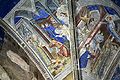
The studium, or private study of Clement VI, is commonly called the chambre du cerf (room of the stag), on account of the celebrated 14th-century frescoes, depicting courtly hunting scenes, that decorate the walls and vaults. The subject matter, while common in contemporary secular art, is as unexpected in a room supposedly dedicated to study as it is for a room in a papal apartment. The frescoes were probably painted by French artists, who were either highly influenced by Sienese art or assisted by Simone Martini and/or Matteo Giovanetti, both of whom served as Clement's court painter.

The Great Tinel

[edit]

This room was used primarily as a reception room. Covered with tapestries on starry blue background, there is actually nothing left of these decorations. Indeed, a fire destroyed the palace in the 14th century: many parts have been restored or rebuilt.

During conclaves, it was in this room that the cardinals met to elect a new pope. For the occasion, the room was walled and only a small aperture was left open to provide all the necessary food. After each conclave, the temporary walls were destroyed, revealing a vaulted room opening to the rest of the palace.

The chapels

[edit]

Saint-Martial chapel

[edit]
Inside the Saint-Martial chapel

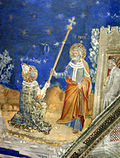
Located on the second level of the Saint-Jean tower, the Saint-Martial chapel relates through painting the main parts of Saint Martial's life. Matteo Giovanetti worked there in 1344 and 1345. The reading direction of the painting should be made from top to bottom.[11]

Saint-Jean chapel

[edit]
Inside the Saint-Jean chapel

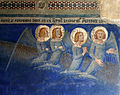
From 1347 to 1348, Matteo Giovannetti was in charge of the Saint-Jean chapel, located under the Saint-Martial chapel.[12] In contrast to the local holy figure Martial this chapel is dedicated to John the Baptist as well as John the Evangelist and is sometimes even implied to be a link back to Rome and Rome´s St. John Lateran. In this chapel painted by Matteo Giovannetti complex architecture in "perspective construction and developed fictitious rooms and places that are more illusionistic than any pictures before them" according to Dieter Blume an art historian and professor at the university of jena.[13]

Since the chapel is quite limited in space just like the one of Staint Martial, the painter used all available space to make the stories of the two saints known. This is why on the ceiling you can see both holy men and their parents, grandmothers who are half-sisters according to the bible and therefore ad strong familiar bonds between the two saints. The north and east walls are filled with the stories of John the Baptist while John the Evangelist resides over the south and west walls of the 5,6 m x 5,3 m and 10 m high chapel.[13][14]

Art exhibitions at the Palais des Papes

[edit]

The Palais des Papes regularly hosts art exhibitions. The tradition began in 1947, when the art critic Christian Zervos and the poet René Char organised an exhibition of the likes of Matisse, Picasso, Braque and Mondrian.[15] The exhibitions shown since then include two exhibitions of Picasso (in 1970 and 1973), the comprehensive 2000 exhibition "La beauté in fabula"[16] and, more recently, the exhibition "Les Papesses" (2013) and single exhibitions of Miquel Barceló (2010) and Stefan Szczesny (2014).

See also

[edit]

Notes and references

[edit]
[edit]
Revisions and contributorsEdit on WikipediaRead on Wikipedia
from Grokipedia
The Palais des Papes is a Gothic palace-fortress in , , constructed primarily between 1335 and 1352, which served as the chief residence and administrative center for seven popes during the from 1309 to 1377. Spanning approximately 15,000 square meters—equivalent in scale to four Gothic cathedrals—it represents the largest such palace built in , embodying a fusion of military defensiveness and ecclesiastical grandeur under architects like Pierre Poisson and Jean de Louvres. Erected in two phases—the austere Old Palace by Benedict XII and the more ornate New Palace by his successor Clement VI—the structure features thick walls, towering ramparts, and lavishly decorated interiors by artists such as and Matteo Giovanetti, reflecting the popes' assertion of temporal and spiritual authority amid political exile from . The papacy's relocation to stemmed from Pope Clement V's decision in 1309, driven by 's violent instability and the influence of French King Philip IV, who leveraged the French-born pope's election to shift ecclesiastical power northward, resulting in a predominantly Gallic curia that centralized church administration but eroded 's traditional primacy. This period, derisively called the by critics, intensified perceptions of papal dependence on French monarchy, fostering administrative reforms yet sowing seeds for the (1378–1417) after Gregory XI's return to , when rival claimants fractured Christendom's unity. Today, as a within Avignon's historic center, the Palais stands as a testament to medieval power dynamics, attracting visitors to its frescoed chapels and vast halls that once orchestrated papal diplomacy and doctrine.

Historical Context

Origins of the Avignon Papacy

The origins of the Avignon Papacy trace back to the intensifying conflict between Pope Boniface VIII and King Philip IV of France, which undermined papal authority in Italy. Boniface's assertion of spiritual supremacy in the 1302 bull Unam Sanctam clashed with Philip's expansion of royal power, culminating in Philip's orchestration of Boniface's arrest and physical assault by supporters in Anagni on September 7, 1303, events that hastened the pope's death later that year. This episode exposed the vulnerability of the papacy to secular interference and Italian factionalism, setting the stage for a shift northward. After the short reign of Benedict XI (1303–1304), the College of Cardinals elected Bertrand de Got, the French-born Archbishop of Bordeaux, as Pope Clement V on June 5, 1305, following a contentious conclave influenced by Philip IV's preferences for a pliable candidate. Consecrated in Lyon on November 14, 1305, Clement—afflicted by health problems and wary of Roman violence—eschewed the traditional move to Rome, instead itinerating through French territories such as Bordeaux, Poitiers, and Toulouse. Philip's leverage grew amid the king's campaign against the Knights Templar; Clement convened the Council of Vienne (1311–1312) at Philip's urging and authorized the order's suppression in 1312 via the bull Vox in excelso, further entrenching papal dependence on French protection. By March 1309, Clement relocated the papal curia from to in the , a territory under nominal papal sovereignty but effectively within France's orbit due to its proximity and Angevin overlordship. This decision, driven by ongoing Italian instability—including Guelph-Ghibelline strife—and Philip's sustained pressure, initiated the (1309–1377), during which seven consecutive French popes governed from the city, prioritizing administrative efficiency over Roman residency. Critics later dubbed it the "" for perceived nationalistic capture of the universal church, though contemporaries noted practical benefits like curial centralization amid feudal fragmentation.

Papal Relocation from Rome

, originally Bertrand de Got, Archbishop of , was elected pope on June 5, 1305, following the short pontificate of Benedict XI, amid ongoing tensions between the papacy and the French monarchy after the violent confrontation between and King Philip IV in 1303. Rather than traveling to for consecration, Clement was ordained in , , on November 14, 1305, reflecting his reluctance to enter the unstable Italian political landscape dominated by Guelph-Ghibelline factionalism and anti-papal violence. This decision was influenced by Philip IV's pressure, as the French king sought greater control over papal affairs following his suppression of the Knights Templar, which Clement had endorsed, and the king's role in Boniface's humiliation and death. The relocation to Avignon crystallized in 1309, when Clement established the papal court there permanently, citing safety concerns from Rome's chaos and the convenience of proximity to French royal protection without direct subjugation to the crown. Avignon, then under the nominal sovereignty of the Angevin kings of Naples (allied with France) but functioning as a papal fief, provided a defensible enclave free from Italian noble interference, allowing administrative continuity while accommodating French cardinals who dominated the curia—seven of the nine electors in Clement's conclave were French. This move effectively shifted papal governance northward, prioritizing geopolitical security over traditional Roman centrality, as Clement never set foot in Rome during his reign (1305–1314). Subsequent popes, all French, perpetuated the residence until Gregory XI's return to in 1377, entrenching French monarchical influence over ecclesiastical decisions, including taxation and appointments, which fueled contemporary criticisms of the papacy's "" to secular power. The relocation underscored causal factors of political expediency: the papacy's weakened post-Boniface, combined with Italy's endemic disorder—exemplified by over 100 murders in in 1304 alone—made Avignon's fortified position a pragmatic , though it alienated Italian factions and diminished papal prestige in its historic seat.

Construction Phases

Benedict XII's Old Palace

The Old Palace, or Palais Vieux, forms the northern core of the Palais des Papes, constructed under Pope Benedict XII from 1335 to 1342 as a fortified residence emphasizing austerity and defense. Benedict XII, born Jacques Fournier and a former Cistercian monk elected pope on 30 December 1334, sought to replace the inadequate episcopal structures inherited from predecessors like John XXII, demolishing much of the prior palace on the Rocher des Doms to build a new quadrilateral complex enclosing a central courtyard. The design reflected his monastic background, prioritizing functional severity over ornamentation, with thick stone walls up to 5 meters thick and minimal openings to deter attacks amid the political instability of the Avignon Papacy. Construction was overseen by architect Pierre Poisson of Mirepoix, who integrated elements of the earlier layout while expanding southward onto the rocky outcrop for strategic elevation. Key structural elements included four primary towers: the conical Trouillas Tower for private papal quarters, the cylindrical Valais Tower housing archives and utilities, the angular La Pigne Tower for defense, and the Seigneuriale Tower anchoring the eastern facade. The complex encompassed administrative wings such as the Consistory (for public audiences), the Hall of the Familiars (for papal council), and the Chapel of Saint John, arranged around the courtyard for efficient governance of the Curia. Interiors featured simple Gothic vaults and ribbed ceilings, with frescoes limited to functional motifs rather than lavish decoration, aligning with Benedict's reforms against clerical excess. The total floor area of the Old Palace spanned approximately 7,000 square meters, utilizing local limestone quarried nearby to ensure rapid completion within Benedict's lifetime, at an estimated cost of 200,000 gold florins funded by papal revenues and indulgences. This phase established the palace's role as a self-contained enclave, housing up to 300 and staff while serving and diplomatic functions, though its stark militarized aesthetic drew contemporary critiques for resembling a fortress more than a spiritual seat. Benedict XII's design influenced subsequent expansions but preserved a core of restraint, contrasting with the opulence added later by Clement VI.

Clement VI's New Palace and Expansions

![Grand Chapel in the Palais des Papes][float-right] Clement VI, from 1342 to 1352, initiated major expansions to the Palais des Papes shortly after his election, constructing the Opus Novum or New Palace adjacent to Benedict XII's austere Old Palace. This phase transformed the complex into a more opulent residence, reflecting Clement's preference for grandeur amid the challenges of the and the in 1348. Under the supervision of architect Jean de Louvres, who managed approximately 600 workers, the works emphasized Gothic ribbed vaults, sculptures, and moldings. Key additions included the completion of the Trouillas Tower in March 1346, a new kitchen tower, and the Tour de la Garde-Robe adjoining the Pope's Tower. The Grand Dignitaries Wing was erected to enclose the Cour d'Honneur, creating a semi-public courtyard. Above the Grande Hall, the Grand —a vast structure measuring 52 meters long, 15 meters wide, and 20 meters high—was built as an feat with exceptional acoustics and light from stained glass. The Grand Promenade topped this ensemble, providing elevated walkways. These expansions, begun around 1345, were largely finished by Clement's death in 1352, integrating seamlessly with the existing fortress while adding luxurious interiors later adorned with frescoes by Matteo Giovannetti. The New Palace's scale and decorative potential underscored the Papacy's administrative and symbolic power, though funded amid fiscal strains from papal indulgences and loans.

Architectural Features

Defensive Structure and Towers

The Palais des Papes incorporates defensive architecture suited to the turbulent 14th-century context, blending fortress elements with palatial design on the elevated Rocher des Doms rock outcrop, which enhanced natural defensibility through sheer cliffs and limited access points. Thick stone walls, battlements, and crenellations provided protection against potential assaults, reflecting the popes' need for security amid . under Benedict XII, beginning in 1335, prioritized austere, fortress-like solidity over ornamentation, with massive masonry emphasizing durability over aesthetics. The structure is fortified by ten principal towers, serving roles in , defense, and , which collectively underscore its character despite its primary function as a papal residence. Key towers include the Tour de Trouillas, erected between 1341 and 1354 to a height of 52 meters, featuring restored crenellations for defensive parapets and standing as one of the tallest medieval towers in the complex. The Tour des Cuisines, built from 1342 to 1344, integrates utilitarian spaces within its defensive form, while the Tour du Pape and Tour de la Garde-Robe, constructed 1335–1342, dominate the ensemble with their imposing elevations and terraces suited for oversight. These towers, along with others like those flanking the Cour d'Honneur, formed a perimeter that deterred incursions, though the palace's overall design prioritized administrative and functions over pure . Clement VI's expansions from the 1340s onward added further towers and reinforced the defensive perimeter without fundamentally altering the Benedictine core's martial emphasis, maintaining the palace's role as a self-contained stronghold capable of withstanding sieges. The integration of spiral staircases, armories, and elevated walkways in these towers facilitated rapid troop movement and command, evidencing causal adaptations to contemporaneous threats from rival factions and monarchs.

Principal Interior Spaces

The principal interior spaces of the Palais des Papes encompass ceremonial halls for and administrative functions as well as private , reflecting the dual role of the structure as both fortress and residence during the from 1309 to 1377. These spaces, primarily constructed between 1334 and 1342 under Popes Benedict XII and Clement VI, feature with limited surviving decorations due to later damage from military use and restorations. Key areas include the Consistory Hall in the Old Palace and the Grande Audience in the New Palace, alongside intimate chambers like the Pope's Room and the Chambre du Cerf. The Consistory Hall, located in the Palais Vieux built by Benedict XII starting in 1334, served as a primary venue for meetings of the , known as consistories, where papal decisions on doctrine and governance were deliberated. This vast hall, adjacent to the Chapel of St. John, exemplifies austere Cistercian-influenced design with high vaults and minimal ornamentation, though it includes frescoes attributed to Matteo Giovannetti active under Clement VI from the 1340s. Its strategic placement underscores the integration of administrative and liturgical functions in the papal court. In the Palais Neuf, the Grande Audience, or Hall of Justice, constructed around 1342 under the direction of architect Jean de Louvres, measures approximately 52 meters in length and functioned as the primary space for papal audiences, judicial proceedings, and receptions of dignitaries. Situated in , this chamber features Gothic ribbed vaults and remnants of frescoes depicting prophets, painted by Matteo Giovannetti in 1352, symbolizing divine authority over temporal matters. The hall's monumental scale accommodated large gatherings, reinforcing the pope's role as supreme arbiter in a period of centralized Church administration. The private , accessed via restricted corridors, provided secluded spaces for daily papal activities and reflection, contrasting the public halls' grandeur. The 's Room, part of Clement VI's expansions completed by 1342, contains fragile painted decorations preserved without photography to prevent deterioration, reflecting personal papal . Adjacent, the Chambre du Cerf— Clement VI's study or day room—bears extensive 1343 frescoes by an Italian team led by Matteo Giovannetti, illustrating , , and rustic pursuits across its walls, evoking leisure amid governance and possibly alluding to the pope's origins. These interiors, spanning about 15,000 square meters total palace floor space, highlight the blend of functionality and symbolic artistry in 14th-century papal life.

Chapels and Decorative Elements

The Palais des Papes features several chapels integral to its ecclesiastical functions, most notably the Grande Chapelle and the smaller Chapelle Saint-Jean and Chapelle Saint-Martial, which preserve significant 14th-century cycles. These spaces, constructed primarily during the reigns of Popes Benedict XII and Clement VI, served for papal liturgies, private devotions, and consistorial meetings, reflecting the Papacy's emphasis on visual piety and artistic patronage. The Grande Chapelle, erected by Benedict XII between 1334 and 1342 as part of the Old Palace, measures approximately 40 meters in length and features a high-vaulted with a wooden supported by crossbeams, designed to accommodate large assemblies during solemn masses and conclaves. Its austere prioritizes functionality over ornamentation, though historical records indicate it originally housed altarpieces and liturgical furnishings, many of which were lost during later secular uses. The chapel's walls bear traces of medieval polychromy, but no extensive programs survive, underscoring its role as a utilitarian space amid the palace's more elaborately decorated private areas. The Chapelle Saint-Jean, adjacent to the and completed under Clement VI around 1340, exemplifies Sienese-influenced decoration through frescoes executed by the Italian artist Matteo Giovannetti between 1343 and 1348. These include allegorical and hagiographic scenes, such as representations of virtues and saints, rendered in a refined, courtly style that integrates and vibrant pigments for luminous effect. Giovannetti's work here, commissioned to elevate the space for the pope's daily oratory, demonstrates the court's fusion of Italian trecento techniques with Provençal motifs, prioritizing narrative clarity and symbolic depth over narrative exuberance. Similarly, the Chapelle Saint-Martial, also under Clement VI's and frescoed by Giovannetti's from 1344 to 1345, narrates the life of Saint Martial, the legendary first bishop of , across its vaults and walls in a cycle of 18 scenes depicting miracles, preachings, and apostolic commissions. The program, spanning the north, south, and west walls, employs a hierarchical composition with Christ and apostles in dominant registers, using technique on to achieve durability amid the palace's humid climate; surviving elements reveal meticulous detailing in folds and architectural perspectives, though partial degradation occurred from 16th-century occupations. This chapel's , rooted in Limousin , served to legitimize the papacy's spiritual authority through localized saintly veneration. Beyond frescoes, decorative elements across these chapels and adjacent interiors include carved wooden wainscoting, marble revetments, and remnants of in lancet windows, which filtered light to enhance atmospheric solemnity during rituals. Tapestries and reliquaries, though largely dispersed post-14th century, complemented the painted programs, as evidenced by inventory records from Clement VI's listing imported Arras weaves depicting biblical themes. These features collectively manifest the palace's dual role as fortress and cultural hub, where artistic investment—totaling thousands of florins in commissions—reinforced papal prestige amid geopolitical tensions.

Ecclesiastical and Administrative Role

Daily Papal Functions

The Palais des Papes functioned as the nerve center for the Avignon popes' and administrative oversight from 1309 to 1377, accommodating the expanded papal that processed petitions, issued decrees, and managed church finances. The 's chancery, responsible for drafting, registering, and dispatching papal letters and bulls, operated within the palace's dedicated spaces, handling routine correspondence and legal acts that sustained the church's centralized authority. Similarly, the Camera Apostolica oversaw financial operations, including taxation and collections from across , reflecting the period's emphasis on bureaucratic efficiency amid the popes' relocation. Central to daily papal functions were consistories held in the Consistory Hall of the Palais Vieux, where popes convened cardinals for deliberations on doctrinal, disciplinary, and administrative issues. Secret consistories allowed confidential discussions on sensitive matters, such as appointments and policy, while public consistories facilitated formal announcements, including the creation of new cardinals and hearings for advocates pleading ecclesiastical causes. These gatherings, often occurring weekly or as needed, underscored the palace's role in maintaining hierarchical order, with the pope presiding from an elevated throne amid a structured protocol that evolved during the era to assert papal prestige. Liturgical duties formed another core aspect, with daily masses and private devotions conducted in chapels like the Saint-Jean Chapel, serving as the oratory for consistory participants and the pope's personal . The Grande Chapelle hosted solemn liturgies, including high masses and occasional funerals, integrating spiritual routine with the court's ceremonial life. Private audiences and banquets in halls such as the Grande Audience further enabled the popes to receive ambassadors, petitioners, and dignitaries, blending with the dispensation of graces and indulgences that characterized the curia's petition-driven operations. This daily rhythm, supported by the palace's fortified yet opulent interiors, highlighted the papacy's shift toward a more courtly, administratively intensive model of governance.

Artistic and Cultural Patronage

(r. 1342–1352) emerged as the primary patron of arts during the , commissioning works that elevated the Palais des Papes as a hub for Italian-influenced Gothic decoration. He recruited Sienese master to around 1339, where Martini produced frescoes blending courtly elegance with religious themes, including surviving fragments and attributions within the palace complex. Martini's style, characterized by refined figures and gold accents, influenced subsequent papal commissions and marked the introduction of elements to art. Matteo Giovannetti, an Italian painter from appointed as official court artist in 1343, executed the most extensive surviving programs under Clement VI's patronage. Between 1344 and 1348, Giovannetti and his workshop adorned the Chapels of Saint Martial and Saint John with vivid cycles depicting the life of Saint Martial, miracles, and apostolic scenes, employing innovative spatial illusions and narrative detail across vaults and walls. These works, preserved in the palace, showcase a fusion of Italian trecento techniques with local traditions, funded directly from papal allocations for decorative enhancements during the New Palace construction. Beyond , Clement VI's cultural patronage extended to and letters, fostering an environment that attracted intellectuals and performers to the papal court. He supported the style by employing composers like , whose theoretical and polyphonic innovations were performed in the palace chapels. The court also hosted literati such as Francesco Petrarch, who benefited from papal libraries and patronage, contributing to early humanistic revivals amid the palace's administrative and ceremonial functions. This multifaceted sponsorship, while lavish, aligned with the popes' role in maintaining ecclesiastical prestige through demonstrable cultural refinement.

Controversies and Legacy in Church History

Criticisms of Corruption and French Influence

The (1309–1377) drew sharp rebukes for institutional corruption, including rampant and , which manifested in the opulent construction and maintenance of the Palais des Papes. (r. 1342–1352), who oversaw major expansions to the palace, elevated by appointing six relatives as cardinals and distributing ecclesiastical benefices to kin and allies, practices that intensified perceptions of the as a self-serving rather than a spiritual authority. These excesses were financed through escalated taxes on and , such as the annates (first-year revenues from benefices), which critics argued veered into —the sale of spiritual offices—and fueled a culture of fiscal exploitation amid widespread exacerbated by events like the in 1348. Such administrative contributed to clerical disillusionment, as documented in contemporary accounts decrying the papacy's drift from toward princely . Italian humanist Francesco Petrarch vociferously condemned the court in letters from the 1340s, portraying it as a den of avarice where prelates amassed gold, purple vestments, and spoils from princes, far removed from evangelical simplicity; he equated the era to the , symbolizing spiritual enslavement and moral decay. Petrarch's rhetoric, echoed by figures like , highlighted how the palace's grandeur—its fortified towers and frescoed halls—served as a physical emblem of this corruption, diverting resources from pastoral duties to architectural vanity and courtly splendor. While some later apologists attributed these flaws to individual popes rather than systemic rot, the prevalence of such critiques from non-French observers underscored a causal link between unchecked and eroding credibility. French influence compounded these charges, as the papacy's relocation to stemmed from King Philip IV's coercion after his 1303 assault on , positioning the within France's orbit and subordinating it to monarchical pressures. All seven popes were French-born, with the shifting to over 70% French composition by mid-century, enabling the crown to sway elections—such as Clement V's 1305 selection—and policy, including exemptions from interdicts and support against imperial rivals like Emperor Henry VII. This Gallic dominance alienated Italian and German factions, fostering accusations that the popes prioritized national interests over universal pastoral governance, as evidenced by curial favoritism toward French benefices and reluctance to confront royal encroachments on church autonomy. Critics argued this proximity eroded papal independence, transforming into a French appendage rather than the impartial seat of Christendom's .

Contribution to the Western Schism

The , during which the Palais des Papes served as the fortified residence of seven popes from 1309 to 1377, centralized ecclesiastical administration under heavy French monarchical influence, alienating much of Western Christendom through perceived corruption, fiscal exactions, and neglect of Roman traditions. This 68-year "," as termed by critics like , entrenched a French-dominated —18 of 20 at the time of Gregory XI's death—whose loyalties prioritized national interests over universal Church unity, setting the stage for schismatic fracture upon the papacy's relocation. Gregory XI's return to Rome in January 1377 and death on March 27, 1378, prompted the Roman election of Bartolomeo Prignano as Urban VI on April 8, 1378, whose reformist zeal and abrasive demeanor provoked backlash among the French cardinals. Withdrawing to , they declared Urban's election invalid due to duress from Roman mobs and, on September 20, 1378, elected Robert of Geneva as Clement VII, who promptly retreated to and reoccupied the as his seat of power. The palace, with its expansive halls, chapels, and defensive towers constructed under Benedict XII and Clement VI, facilitated the rapid reestablishment of a rival , complete with administrative , financial mechanisms, and diplomatic apparatus that mirrored the Roman papacy. This dual occupancy of the Palais des Papes by Clement VII (1378–1394) and later Benedict XIII (1394–1417, though frequently displaced) symbolized and sustained the Avignon obedience, drawing allegiance from , , , and parts of and , while exacerbating geopolitical divisions—, the , and most of supported the Roman line. The palace's role as a self-contained fortress enabled the antipopes to maintain independence amid sieges and political pressures, such as the 1398 French withdrawal of support from Benedict XIII, yet it perpetuated the by embodying the entrenched Avignon factionalism that resisted reconciliation efforts like the in 1409, which only multiplied claimants to three. The schism's prolongation until the (1414–1418), which deposed the Avignon claimant John XXIII (a Pisan electee) and Benedict XIII, deposing the Roman Gregory XII voluntarily, underscored how the Palais des Papes' legacy as a nexus of French-papal undermined the Church's universal authority, fueling conciliarist theories and proto-Reformation critiques of centralized power devoid of spiritual legitimacy. Empirical from conciliar acts and papal registers reveal that 's administrative innovations, honed in the palace, enabled fiscal and jurisdictional competition that deepened the 39-year crisis, affecting an estimated 60% of European Christendom's divided loyalties by national lines.

Post-Papal Era

Transition to Secular Use

Following the return of the papacy to under in 1377 and the end of the Avignon line of antipopes by 1403, the Palais des Papes no longer functioned as a primary residence for the but continued under papal ownership, primarily accommodating legates and visiting ecclesiastical dignitaries while portions of the structure gradually deteriorated due to neglect. The surrounding enclave, including , persisted as extraterritorial papal territory until the late , limiting any immediate shift to non-religious control. The decisive transition to secular use occurred amid the , when revolutionary forces annexed the and in September 1791, incorporating into French national property and stripping it from Church authority. The building was subsequently sacked by revolutionaries, who also perpetrated a of counter-revolutionary prisoners there in October 1791, marking a violent rupture from its ecclesiastical past. Post-seizure, the palace was repurposed for military functions, serving as barracks for French troops, including under Napoleon Bonaparte's regime, where it additionally housed horse stables and a , reflecting the era's utilitarian demands on former religious sites. This military persisted until 1906, when the structure began shifting toward preservation and public access, though its core adaptation from sacred to state-controlled utility had been cemented by the revolutionary confiscation.

Military and Political Occupations

Following the return of the papacy to Rome in 1377, the Palais des Papes served as the residence for papal legates and vice-legates, functioning as a political outpost of the in until the late 18th century. These representatives administered papal territories in the , maintaining ecclesiastical authority amid regional tensions with French royal power. The marked a sharp shift, with Avignon's annexation to France on September 16, 1791, leading to the seizure of from papal control. Revolutionaries looted the structure, demolishing statues and symbols of power, and it became the site of the Glacière on September 16-17, 1791, where approximately 90 counter-revolutionaries were killed and their bodies disposed of in 's latrine tower. Thereafter, the building was repurposed as a , prison, and military barracks, reflecting the revolutionary government's anti-clerical policies. Under the Napoleonic regime from 1799 to 1815, the palace continued in military use as and a detention facility, with partitions installed in grand halls to accommodate troops. This usage persisted through the , including during the anti-clerical Third Republic (1870-1940), causing structural damage from adaptations and neglect. French military forces occupied the site until 1906, after which it transitioned to public access as a historic .

Preservation and Contemporary Use

Restoration Efforts and UNESCO Designation

Following the cessation of military occupation in 1906, the Palais des Papes was converted into a national museum, initiating a period of continuous restoration to address centuries of degradation from use as and . Architects Nodet père et fils oversaw major rehabilitation from 1901 to 1944, focusing on structural reinforcement and recovery of original medieval features amid the site's transition to public access. Subsequent targeted efforts preserved artistic elements, including the 2005 restoration of frescoes in the Saint-Martial Chapel, which revealed 14th-century paintings by Matteo Giovanetti. In 2017, the Verger Urbain V garden underwent redevelopment, retaining historical pathways while enhancing public usability since its designation as a garden in 1927. A comprehensive conservation plan launched in January 2022 by the City of addressed nearly 3,900 square meters of painted decorations across the palace, marking the first phase of a multi-year initiative to safeguard medieval frescoes and vaults from environmental wear. In 1995, the Historic Centre of —including the Palais des Papes, episcopal ensemble, and Avignon Bridge—was inscribed on the World Heritage List under criteria (i), (ii), and (iv). This designation recognizes the palace as an outstanding exemplar of 14th-century Gothic ecclesiastical, administrative, and military architecture (i); a hub for artistic and architectural exchanges across during the (ii); and a cohesive ensemble of late medieval structures pivotal to a defining episode in papal history (iv). The listing underscores the palace's austere fortress design combined with lavish interior decorations by artists like and Matteo Giovanetti, emphasizing its role in dominating Avignon's urban landscape.

Tourism, Exhibitions, and Cultural Impact

The Palais des Papes draws approximately 650,000 visitors each year, establishing it as one of France's ten most frequented historical sites. Its designation as a in 1995, encompassing the Historic Centre of , underscores its architectural and historical significance, attracting tourists interested in medieval Gothic structures and papal history. Visitors typically engage in self-guided audio tours or thematic guided visits exploring the palace's vast interiors, including the Grande Chapelle and private papal apartments adorned with 14th-century frescoes. The site functions as a dynamic venue for temporary exhibitions, with the Grande Chapelle serving as the primary space for annual displays since the early . Notable past exhibitions include Picasso's works in 1970, Pierre Mignard's paintings in 1979, and a retrospective on in 1992. Recent installations feature , such as Jean-Michel Othoniel's " ou Les Fantômes de l'Amour" in 2025 and a tribute to Miss Tic titled "To life, to love" from June 2024 to January 2025. These exhibitions integrate modern interpretations with the palace's medieval context, often drawing on its historical role as a center of artistic patronage. Culturally, the Palais des Papes hosts concerts, conventions, and educational events that extend its influence beyond tourism, supporting Avignon's annual through performances and related programming. It also houses the Musée de l'Œuvre, preserving artifacts from the papal era, and facilitates research centers focused on medieval history. This multifaceted use reinforces the palace's ongoing role in fostering cultural exchange and economic activity in , with events contributing to the region's appeal as a hub for .

References

Add your contribution
Related Hubs
User Avatar
No comments yet.