Hubbry Logo
AyamonteAyamonteMain
Open search
Ayamonte
Community hub
Ayamonte
logo
8 pages, 0 posts
0 subscribers
Be the first to start a discussion here.
Ayamonte
Ayamonte
from Wikipedia

Ayamonte (Spanish pronunciation: [aʝaˈmonte]; Portuguese: Aiamonte) is a town and municipality of Spain belonging to the province of Huelva, Andalusia. It is located near the border with Portugal on the mouth of the Guadiana River. According to the 2015 census, the city had a population of 20,357 inhabitants.

Key Information

History

[edit]

In the municipality are located parts of the megalithic site La Torre-La Janera which is assumed to date back to the 5th millennium BC.[2] The town was seized away from Muslim control in 1240 during the reign of Sancho II of Portugal, and it was donated afterwards to the Order of Santiago.[3] Ayamonte became part of the Crown of Castile in 1263.[4]

Fishing and salting of tuna and sardine was already practised in Ayamonte since the Middle Ages.[5] The town suffered due to the War with Portugal and the plague pandemics in the 17th century.[6] In the following century, Catalans and other eastern merchants installed in the town and gave impetus to the local canning and salt industry.[6]

Location

[edit]

The township of Ayamonte preserves its old medieval quarter in the central district of the town, with many very narrow streets and historical buildings; this central area is a designated car-free zone.

The beach area of Ayamonte is Isla Canela and is reached by a causeway across the Marismas del Guadiana; the marismas (salt marshes) are a wildlife reserve, providing a home to many waterfowl, including herons and flamingos. Isla Canela is built along several kilometers of sandy beaches, and provides an area for windsurfing, kitesurfing and sailing. There are a number of golf courses in and around the area, including one built into the Marismas itself.

Transport

[edit]

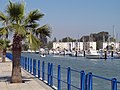
The ferry link between Ayamonte and Vila Real de Santo António was the traditional crossing point between Spain and Portugal. A modern bridge over the Guadiana River has now been built to the north of the town, linking the motorway systems of both countries, but the ferry still runs and provides an inexpensive mode of transport between the two countries.

Culture

[edit]

The city is also famous for its local festivities, the "Fiestas de las Angustias", in honor of their patron "Nuestra Señora de las Angustias". The festivities in the beginning of September are a moment of celebration not only from the Ayamontin population, but also for many Andalucians, and Portuguese. The festivities are graced by the local band, "Banda Ciudad de Ayamonte" and the Portuguese "Banda da Sociedade Filarmónica Progresso e Labor Samouquense" from the Portuguese village of Samouco.

Sights

[edit]

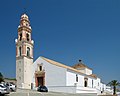
There are several historical monuments in the city, such as the 16th-century fortifications of the Baluarte de las Angustias, the 16th-century church of Nuestra Señora de las Angustias and the 17th-century church of Nuestra Señora de las Mercedes. The Plaza de la Laguna, which dates back to the 18th century, is home to many ornate azulejo tiles.[7]

[edit]

Climate

[edit]

Ayamonte has a hot summer-mediterranean climate (Köppen: Csa) with mild, somewhat wet winters and dry, hot summers. Autumn is the wettest season.[8]

Climate data for Ayamonte (1991-2020 normals, 1991-present extremes)
Month Jan Feb Mar Apr May Jun Jul Aug Sep Oct Nov Dec Year
Record high °C (°F) 24.6
(76.3)
26.0
(78.8)
29.7
(85.5)
34.9
(94.8)
37.5
(99.5)
39.4
(102.9)
42.7
(108.9)
42.2
(108.0)
36.5
(97.7)
34.7
(94.5)
27.6
(81.7)
23.8
(74.8)
42.7
(108.9)
Mean daily maximum °C (°F) 16.5
(61.7)
17.3
(63.1)
19.4
(66.9)
21.4
(70.5)
24.7
(76.5)
27.8
(82.0)
30.3
(86.5)
30.8
(87.4)
27.8
(82.0)
24.6
(76.3)
19.9
(67.8)
17.1
(62.8)
23.1
(73.6)
Daily mean °C (°F) 11.8
(53.2)
12.5
(54.5)
14.5
(58.1)
16.7
(62.1)
19.6
(67.3)
22.7
(72.9)
24.8
(76.6)
25.3
(77.5)
22.9
(73.2)
19.9
(67.8)
15.4
(59.7)
12.6
(54.7)
18.2
(64.8)
Mean daily minimum °C (°F) 7.2
(45.0)
7.7
(45.9)
9.5
(49.1)
11.9
(53.4)
14.4
(57.9)
17.5
(63.5)
19.2
(66.6)
19.8
(67.6)
17.9
(64.2)
15.2
(59.4)
10.8
(51.4)
8.0
(46.4)
13.3
(55.9)
Record low °C (°F) −0.4
(31.3)
0.0
(32.0)
2.8
(37.0)
6.3
(43.3)
7.5
(45.5)
11.7
(53.1)
15.0
(59.0)
15.2
(59.4)
13.6
(56.5)
7.2
(45.0)
2.4
(36.3)
1.1
(34.0)
−0.4
(31.3)
Average precipitation mm (inches) 37.0
(1.46)
48.8
(1.92)
61.9
(2.44)
47.6
(1.87)
27.4
(1.08)
3.7
(0.15)
0.2
(0.01)
3.9
(0.15)
14.6
(0.57)
60.7
(2.39)
94.1
(3.70)
46.9
(1.85)
446.8
(17.59)
Average precipitation days (≥ 1 mm) 4.7 5.4 6.4 6.3 4.1 0.9 0.1 0.3 1.9 6.0 7.6 4.8 48.5
Source: Agencia Estatal de Meteorologia[8]

Demographics

[edit]
Historical population
YearPop.±%
199916,980—    
200016,939−0.2%
200117,084+0.9%
200217,292+1.2%
200317,402+0.6%
200417,623+1.3%
200518,001+2.1%
200618,636+3.5%
200719,380+4.0%
200819,738+1.8%
200920,334+3.0%
201020,597+1.3%
201120,763+0.8%
201220,968+1.0%
201320,406−2.7%
201419,690−3.5%
201520,357+3.4%
201620,629+1.3%
201720,714+0.4%
201820,883+0.8%
201920,946+0.3%
202021,104+0.8%
202121,510+1.9%
202221,725+1.0%
202321,645−0.4%
202420,597−4.8%
Source: [1] [user-generated source] [2]

People

[edit]

See also

[edit]

References

[edit]
[edit]
Revisions and contributorsEdit on WikipediaRead on Wikipedia
from Grokipedia
Ayamonte is a coastal in the , , , situated at the mouth of the River on the border with , serving as a key entry point to the region. With a population of approximately 20,540 residents as of 2024, it forms part of the of the , a cross-border cooperation area with Portuguese municipalities like and . Historically, Ayamonte's origins trace back to the , with influences from Greek settlers who named it "Anapote" (meaning "on the river"), followed by Roman occupation evidenced by fort remains, and later rule until its reconquest by in 1239. It passed to the of Castile in 1335, was elevated to villa status in 1664 by King Philip IV, and played a significant role in the Spanish War of Independence against , as well as in the transatlantic trade during the colonial era. During the 16th and 17th centuries, it emerged as a major urban center along Huelva's coastline, shifting in the toward fishing and seafood canning industries before evolving into a prominent hub. Geographically, Ayamonte spans the estuary of the River and includes areas within the Marismas de Isla Cristina Natural Beauty Spot, featuring marshlands rich in birdlife and golden beaches like those at and Punta del Moral. Located 51 kilometers southwest of city, it benefits from a Mediterranean-Atlantic with mild winters and hot summers, connected by major roads such as the A-49 and a 1991 international bridge to , alongside traditional ferry services. The economy blends traditional fishing—renowned for white prawns and tuna—with a growing sector that highlights its , including 16th-century churches like Nuestra Señora de las Angustias and , the ruins of a Roman now housing a parador hotel, and vibrant festivals such as the and processions, declared an Andalusian Festival of Tourist Interest in 1999. Ayamonte's reflects its coastal position, emphasizing fresh in a fusion of Andalusian and influences, while its strategic location fosters cross- and cultural exchange.

Geography

Location

Ayamonte is a in the , , , covering an area of 141.3 km² and situated at the mouth of the River, which forms a natural boundary with . The town's central coordinates are approximately 37°12′N 7°24′W, with an average elevation of 63 meters above across the municipal territory. Positioned along the , Ayamonte lies in close proximity to the Atlantic Ocean, featuring the expansive beach area characterized by fine golden sands stretching several kilometers. The estuary serves as a key geographical feature, delineating the international border and creating a dynamic coastal environment where river and sea meet. The of Ayamonte consists primarily of flat coastal plains near the shoreline, gradually rising into low hills toward the interior, which supports a mix of urban development and agricultural landscapes. This terrain divides the into a compact urban center along the riverfront and expansive rural zones encompassing marshes and farmlands.

Climate

Ayamonte features a hot-summer (Köppen Csa), marked by hot, dry summers and mild, wetter winters influenced by its coastal position. The region receives an average annual of approximately 446 mm, with the bulk—over 70%—concentrated in the winter months from to , leading to drier conditions during the summer. Temperatures typically range from summer highs of 30–35°C (86–95°F) in July and August to winter lows of 5–10°C (41–50°F) from December to February, with an annual average of 17.5°C that supports a relatively comfortable year-round environment. Proximity to the Atlantic Ocean moderates the by tempering extremes and contributing to higher winter , while the Guadiana River exacerbates occasional flooding risks during intense rainfall events and fosters localized microclimates that enhance in surrounding areas, such as through milder protection for crops.

History

Early History

The earliest evidence of in the Ayamonte area dates back to the period, with megalithic structures indicating organized communities in the Bajo Guadiana region. Archaeological surveys have uncovered dolmens, menhirs, tumuli, and cists constructed from local stone, particularly at sites like La Torre-La Janera near Ayamonte and Villablanca. These monuments, associated with funerary practices and possibly ritual enclosures integrating natural outcrops, reflect a transition from to societies around the 5th millennium BC, highlighting the area's role in early monumental architecture in southwestern Iberia. During the Roman era, Ayamonte served as a minor port at the mouth of the River, known in classical sources as Ostium Fluminis Anae, within the province of . It marked the starting point of the Roman road itinerary XXIII (Item ab ostio fluminis Anae Emeritam usque), connecting the to Emerita Augusta (modern Mérida) via stations like Praesidium and Onuba, facilitating and movement along the Atlantic coast. Archaeological remains, including a at Punta del Moral, underscore its function as a coastal outpost for commerce in metals and goods from inland mining regions. Following the fall of the in the 5th century AD, the area fell under Visigothic control as part of the Kingdom of Toledo, where Roman infrastructure likely persisted amid a shift to more localized agrarian economies, though specific Visigothic artifacts in Ayamonte remain sparse. With the Muslim conquest of the in the early , Ayamonte integrated into under Umayyad rule, becoming part of the by the 10th century. The settlement, then likely a modest coastal village, contributed to the region's economy through —cultivating cereals, olives, and vines on fertile Guadiana floodplains—and in the river and Atlantic, supporting broader trade networks within the caliphal system. Defensive structures, precursors to the later castle, may have been established during this period to guard the frontier against Christian incursions. The Christian reconquest of Ayamonte occurred in 1240, when forces under King captured the town from Muslim control amid the broader advance into the . However, in 1263, as part of negotiations resolving border disputes, King received Ayamonte as a from , incorporating it definitively into the Crown of Castile and initiating its repopulation under Christian lordship. This transfer solidified the town's strategic border position, setting the stage for its medieval development.

Modern Era

In the 19th century, Ayamonte experienced significant economic shifts as agricultural and shortages prompted a pivot toward and the emerging industry, which became central to the local economy. This development positioned the town as a hub for processing and exporting products, particularly and sardines, to markets across , including northern regions, leveraging its coastal location on the River. The industry's growth was supported by traditional techniques like trap-net , which had persisted but expanded commercially during this period. During the (1936–1939), Ayamonte's strategic position along the -Spain border amplified its role in regional conflicts, with the nearby Huelva-Ayamonte railway line—completed just before the war—seized by Nationalist forces in August 1936 for military transport and logistics. The town's proximity to the frontier facilitated minor cross-border movements, including the passage of fighters and refugees seeking safety in , though direct large-scale battles were limited in the area. province, encompassing Ayamonte, suffered broader wartime disruptions, including economic strain and infrastructure damage from the conflict's fallout. Post-World War II modernization transformed Ayamonte's economy, with emerging as a key sector in the 1960s through the development of . Initiated in 1964 by the Compañía Urbanizadora Municipal de Ayamonte (CUMASA), this project urbanized the adjacent island into a area with beaches, hotels, and residential zones, attracting visitors to the and boosting cross-border appeal near the . Spain's integration into the in 1986 further catalyzed growth, enabling EU-funded cross-border initiatives that reduced trade barriers and enhanced mobility, such as the formation of the grouping Ayamonte with Portuguese municipalities like . These efforts promoted joint economic projects in and , fostering regional cohesion despite persistent disparities. In the and , advancements solidified Ayamonte's connectivity, including rehabilitation and expansion projects around the 1991 Guadiana International Bridge to accommodate rising cross-border traffic. This era also saw shift with an influx of workers daily for opportunities in Ayamonte's services and sectors, contributing to modest demographic growth in coastal areas amid broader regional migration patterns. By the 2020s, initiatives gained prominence, particularly for the ; in 2025, the Punta del Moral Fisheries Producers Organization in Ayamonte earned "Friend of the Sea" certification for sustainable white shrimp , marking a pioneering effort in to integrate environmental responsibility with artisanal practices and combat climate impacts on local fisheries.

Government and Demographics

Local Government

Ayamonte functions as a within the in the autonomous community of , . It is governed by the Ayuntamiento de Ayamonte, the local city council comprising 21 councilors elected by every four years through . As of November 2025, the mayor (alcalde) is , a member of the Partido Popular (PP), who assumed office following the 2023 municipal elections where his party secured an absolute majority with 13 seats. The municipality encompasses the core urban area of Ayamonte along with several peripheral districts and pedanías, such as Pozo del Camino and the Barriada de Canela in . In alignment with regional governance, the implements policies set by the Junta de Andalucía, particularly in sectors like and public services. Among its primary responsibilities, the local government oversees essential services including through ordinances regulating solid urban and treatment, as well as via the dedicated Urbanismo y Medio Ambiente department. Additionally, it promotes cross-border cooperation with the adjacent Portuguese municipality of as part of the Eurociudad del , focusing on joint territorial planning, initiatives, and EU-funded projects to enhance regional cohesion.

Population

Ayamonte's population stood at 21,622 inhabitants as of January 1, 2024, according to official figures from the Instituto Nacional de Estadística (INE), with estimates projecting relative stability through 2025 amid regional demographic trends. The municipality has shown consistent growth over recent decades, rising from 16,979 residents in 1999 to the current level, reflecting broader patterns of and economic opportunities near the Portuguese border. Foreign residents make up approximately 9% of the population as of 2022, including a notable Portuguese community due to the border location. Spanning 141.3 km², Ayamonte has a of approximately 153 inhabitants per km², with the majority concentrated in the central town area and surrounding coastal zones; this figure rises seasonally due to influxes during summer months. The demographic structure features a median age of about 44 years, indicating an aging population typical of rural Spanish municipalities. distribution is nearly even, with approximately 50% males and 50% females, influenced by migration patterns that include cross-border commuters from nearby , where residents often travel daily for work across the River. Socioeconomic indicators reveal challenges common to the , with an rate of 15.6% in Ayamonte as of 2023—lower than the provincial average approaching 20% in 2024—largely tied to seasonal employment in and . In the , education levels among adults show around 24% with higher education attainment as of 2021, below national averages but supported by local institutions; statistics indicate over 8,000 units, with about 20% serving as secondary or vacation homes, contributing to urban pressure in peak seasons.

Economy and Infrastructure

Economy

Ayamonte's economy relies heavily on traditional sectors such as and along the River, where activities include the capture and processing of and sardines, though the has been declining in recent decades. is emerging as a key alternative, with local enterprises highlighting the high potential of the in the region, supported by visits from provincial officials to facilities in Ayamonte. Agriculture also plays a role, particularly through greenhouse cultivation of strawberries in the broader area encompassing Ayamonte, contributing to the province's status as a major European producer of berries. Tourism dominates the local , serving as the primary engine for and growth, with over 86% of business establishments linked to the sector and a focus on sun-and-beach attractions that draw cross-border visitors from . In 2024, the , where Ayamonte is a key coastal , recorded 1.5 million tourists in the third quarter alone, underscoring the area's appeal and Ayamonte's contribution through its 14,000 lodging places achieving up to 80% occupancy during peak periods like . Emerging industries include projects, such as the announced Ayamonte Hybrid solar farm and operational wind farms generating up to 78 GWh annually to power around 29,000 households. benefits from the international bridge facilitating trade with , while EU-funded initiatives, including the DUSI strategy for , promote diversification in , activities, and environmental protection. The faces challenges from seasonal fluctuations, with over 97% of contracts being temporary and high reliance on summer leading to elevated rates outside peak periods. Ayamonte's stands at approximately €21,866 (2022 data), reflecting adjustments from regional averages in province.

Transport

Ayamonte's primary road connection to is provided by the International Bridge, a cable-stayed structure that spans the River and links the town directly to . Opened on August 22, 1991, the bridge forms part of the A-49 motorway in , which merges with the European route E-73 and continues as the A22 in , facilitating seamless cross-border vehicular travel. It handles significant daily traffic, averaging around 5,939 vehicles per day as recorded in regional transport assessments. In addition to the bridge, ferry services offer an alternative river crossing between Ayamonte and , operated year-round by Transporte Fluvial del . These shuttles run multiple times daily, with departures typically every 30 to 60 minutes from early morning to evening, and frequency increases during the summer tourist season to accommodate higher demand. The short 15-minute voyage provides a scenic option for pedestrians, cyclists, and vehicles, with fares ranging from €2 to €7 depending on the mode. Public transportation in Ayamonte relies on a local managed by DAMAS, connecting the town to key regional destinations without any direct rail service, as the former Gibraleón-Ayamonte railway line ceased passenger operations in 1987. Buses operate several routes daily, including the M-310 line to , which takes approximately 1.5 hours for the 60-kilometer journey, with services departing up to three times a day. Connections to in are available via regional buses, such as those coordinated with VAMUS, covering the roughly 50-kilometer route in about 1 hour and 40 minutes, often requiring a transfer in or . As of 2025, discussions are underway for enhanced transport infrastructure in the region. The Sevilla-Huelva line is in the project development phase, with contracts awarded in October 2025 for its 95 km route at speeds up to 350 km/h, including over 30 viaducts and a 2 km , and an investment of €1.608 billion. Discussions continue for a potential extension to the Portuguese border at Faro, though no firm completion date has been set. Additionally, port expansions at Ayamonte's facilities focus on and modernization for safer navigation, with approvals granted in October 2025 to restore depths in the marina basin and entrance channel, supporting limited freight and maritime activities alongside .

Culture and Heritage

Cultural Traditions

Ayamonte's cultural traditions are deeply rooted in its Andalusian heritage, enriched by its proximity to , fostering a vibrant blend of religious devotion, music, , and communal gatherings. The most prominent annual event is the Fiestas de las Angustias, held in early September to honor the town's patroness, Nuestra Señora de las Angustias. This week-long celebration, typically from the 5th to 9th, features solemn processions of the Virgin through the streets on the 8th, accompanied by a floral offering the previous day, and culminates in a grand fireworks display known as the gran traca at midnight on the 9th. Local and Portuguese musical bands from towns like Samouco, , and participate in welcoming parades and performances, highlighting the cross-border ties that define the festivities. Family-oriented elements include two "Días del Niño" with reduced prices on fairground attractions and quiet hours to accommodate , alongside sports, cultural activities, and concerts by artists such as Sergio Contreras and Laura Gallego. The town's musical scene reflects a fusion of Andalusian traditions with Portuguese influences, particularly , nurtured through regular performances and festivals. Ayamonte hosts the annual Festival Internacional de Música Ciudad de Ayamonte, which features renowned flamenco artists like Arcángel and alongside fado performers such as Sara Paixão, showcasing the emotional depth shared between these genres. Traditional flamenco shows occur in open-air venues, emphasizing the genre's passionate rhythms and saetas, while cultural centers and events like the Día del on November 16 feature exhibitions and performances that integrate these border-spanning styles weekly or during seasonal programs. Culinary traditions in Ayamonte center on its coastal bounty, with fresh dominating local markets and dishes that evoke the region's maritime and agricultural roots. Signature preparations include chocos en su tinta, a stew of cooked in its own with onions, , tomatoes, and wine, often served over rice—a staple reflecting the town's heritage and celebrated in eateries like Mesón El Choco. , the chilled tomato-based soup typical of , appears alongside Iberian products like and cheeses at weekly markets, emphasizing seasonal, fresh ingredients during events such as the June Ruta de la Tapa, where participants sample these flavors in a communal tasting route. Community life revolves around hermandades or religious brotherhoods, which organize both devotional and social events, reinforcing family bonds and collective identity. The Hermandad de Nuestra Señora de las Angustias leads the September fiestas, coordinating processions, masses, and gatherings that draw families together for prayers, feasts, and shared meals. These groups also oversee Semana Santa processions and host congresses, such as the 2025 XI Congreso Nacional de Hermandades de las Angustias, which unite nearly 200 members from across for eucharistic celebrations and cultural exchanges, underscoring their role in preserving traditions through intergenerational participation.

Tourist Attractions

Ayamonte boasts several historical and natural attractions that appeal to visitors seeking a blend of and outdoor experiences. The Baluarte de las Angustias, a 16th-century fortification in the La Villa neighborhood, represents remnants of the town's coastal defensive system against piracy, offering panoramic views of the Guadiana River from its elevated position near the defensive walls. The town's religious architecture highlights its and influences. The Church of Nuestra Señora de las Angustias, constructed in the second quarter of the , serves as an emblematic temple housing Ayamonte's , the Virgen de las Angustias; its design incorporates reminiscences, featuring three separated by semicircular arches, a main , and a niche from 1761. Nearby, the Church of , part of a Franciscan founded in 1417 and officially established in 1527, preserves a 14th-century polychrome wooden roof from the Seville school, a porch doorway, and a late- main ; it once safeguarded the Sacred of the Holy Shroud, brought to Ayamonte in 1578 by the Marquis of Ayamonte, though the structure was damaged in the , leaving only the central intact. In the heart of the old town, the Plaza de la Laguna stands as a charming central square, surrounded by historic buildings and serving as a hub for local markets and leisurely evening promenades amid its palm and citrus trees. Ayamonte's natural attractions provide opportunities for relaxation and eco-tourism. The beaches of Isla Canela, extending approximately 1,270 meters with fine golden sands and moderate waves, are family-friendly due to shallow waters and offer activities such as windsurfing, paddle surfing, and surfing; the area holds Ecoplaya and Bandera Azul certifications for its accessibility and amenities, including showers, parking, and a children's play area. Adjacent to these shores, the Guadiana marshes, part of the Isla Cristina Marshlands Natural Site, feature diverse ornithological habitats ideal for birdwatching, with guided routes, boat trips, and river cruises along the Guadiana providing insights into the region's wetland ecosystem.

References

Add your contribution
Related Hubs
User Avatar
No comments yet.