


Community hub
Recent from talks
Contribute something
Nothing was collected or created yet.
BCIM Economic Corridor
View on Wikipedia

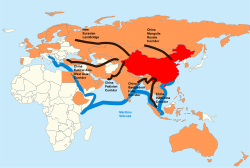
The Bangladesh, China, India and Myanmar Economic Corridor (BCIM) was a proposed road, rail, water and air link connecting India and China through Myanmar and Bangladesh as a corridor.[2][3]
In 2015, China proposed including the corridor as part of its vision for the Belt and Road Initiative, China's signature global connectivity initiative. The BRI was boycotted by India from the start. In May 2019, the BCIM was not mentioned in a list of 35 corridors and projects in a joint communique issued by state leaders attending the 2nd Belt and Road Forum, indicating the BCIM had been dropped from the BRI. In the same year India has sought to keep the BCIM intact by sending a delegation to the 13th BCIM Forum in Yuxi, noting however the corridor predates the BRI.[4] Ultimately, the corridor was abandoned due to BCIM's ties to the Belt and Road and the sharp deterioration in Sino-Indian relations.[5]
The proposed corridor will cover 1.65 million square kilometres, encompassing an estimated 440 million people in China's Yunnan province, Bangladesh, Myanmar, and West Bengal in Eastern India through the combination of road, rail, water and air linkages in the region.[6] The BCIM envisages greater market access for goods, services and energy, elimination of non-tariff barriers, better trade facilitation, investment in infrastructure development, and joint exploration and development of mineral, water, and other natural resources.[7]
History
[edit]Background
[edit]The concept of economic cooperation within the BCIM region was first developed by Rehman Sobhan who advocated that multi-modal transport connectivity and supported by other initiatives and infrastructure development could significantly reduce transaction costs, stimulate trade and investment and consequently accelerate growth and poverty alleviation in this region.[7]
Sobhan's pioneering ideas would eventually lead to the development of the platform in the 1990s which came to be known as the "Kunming Initiative". The first meeting of the Initiative was convened in 1999 in Kunming; presided by a number of representative organisations such as The Centre for Policy Dialogue (CPD) from Bangladesh, Centre for Policy Research (CPR) from India and Yunnan Academy of Social Sciences in Kunming, China; from the Myanmar side it was the Ministry of Trade which represented the country.[7]
The Kunming Initiative evolved into the BCIM Forum for Regional Cooperation during its first with the objective to create a platform where major stakeholders could meet and discuss issues in the context of promoting economic growth and trade in the BCIM region; identify specific sectors and projects which would promote greater collaboration among the BCIM nations; and strengthen cooperation and institutional arrangements among the concerned key players and stakeholders to deepen BCIM ties.[8]
Over the years, the Kunming initiative developed into what came to be popularly known as the BCIM Forum. Successive BCIM Forums were held annually making a seminal contribution in raising awareness about the potential benefits accruing from the BCIM cooperation. BCIM cooperation also started to feature in intergovernmental discussions, at highest political levels, as was recounted above. The initial vision of the Kunming initiative was to gradually steer the endeavour from an essentially civil society (Track II) to an intergovernmental (Track I) one where political buy-in and intergovernmental ownership would be key to realising the vision and the objectives of the initiative.[7]
Initial steps
[edit]One of the most recent developments to the BCIM came to fruition during the meeting between Chinese Premier Li Keqiang and Indian Prime Minister Manmohan Singh in 2013.[9] Li's visit marked the first time high-ranking officials had discussed the trade corridor. Furthermore, earlier in the year, the first ever BCIM car rally was held between Kolkata and Kunming via Dhaka to highlight road connectivity in the four countries.[9]
On 18 December 2013, the four nations drew up a long discussed plan, emphasizing the need to quickly improve physical connectivity in the region, over two days of talks in the south-western Chinese city of Kunming – the provincial capital of Yunnan, which borders Myanmar – on Wednesday and Thursday.[10] This marked the formal endorsement of the BCIM EC by the four nations, whereby it was agreed that the corridor would run from Kunming to Kolkata, linking Mandalay in Myanmar as well as Dhaka and Chittagong in Bangladesh.[10]
The deep water port being enhanced at Kyaukphyu, Myanmar is viewed as a gateway to the Bangladesh-China-India-Myanmar (BCIM) Economic Corridor.[11]: 67
Economic advantages
[edit]The economic advantages of the BCIM trade corridor are considerable, most notably: access to numerous markets in Southeast Asia, improvement of transportation infrastructure and creation of industrial zones.[8][12]
The construction of industrial zones will have a twofold benefit. Firstly, it will lead to industrial transfer boosting industries such as processing, manufacturing and commerce logistics. Secondly, as labour costs rise in China, labour-intensive industries such as textile and agro processing will eventually be shifted out of China. These industries will need to be transferred to new regions with lower labour costs. Companies operating in China will likely give priority to the trade corridor region given its established infrastructure, improved logistics and ease of access[8][12]
India's isolated eastern and north-eastern states also stand to gain by higher trade and connectivity with China and the rest of Asia.[12]
Priority sector
[edit]The eleven BCIM Forums, organised in rotation by the aforesaid institutions in the four countries, have highlighted the potential benefits of closer cooperation among the four countries in such areas as connectivity, trade, investment, energy, water management, tourism and other areas.[7] The four countries also agreed to encourage greater cooperation and exchanges in the BCIM region in the areas of education, sports and science and technology.[2]
Leadership and representation
[edit]The Bangladesh–China–India–Myanmar Forum for Regional Cooperation (BCIM) is a sub-regional organisation of Asian nations aimed at greater integration of trade and investment between the four countries and the economic corridor has grown out of it.[13][14]
Key Information


During the last held session in 2013, India was represented at this week's talks by Joint Secretary (East Asia) at the Ministry of External Affairs Gautam Bambawale, who was joined by the Deputy Planning Minister of Bangladesh, the Vice Chairman of China's National Development and Reform Commission, and a Senior economic affairs official from Myanmar.[10]
Cooperation with other corridors
[edit]Through linking the ASEAN Free Trade Area, ASEAN–China Free Trade Area and the ASEAN–India Free Trade Area, the corridor would constitute as one of the largest free trade areas. Bangladesh, China, India and Myanmar hope to create a corridor that would effectively combine road, rail, water and air linkages in the region.[8] This will also improve foreign trade of the BCIM countries and empower bilateral trading.[12]
See also
[edit]References
[edit]- ^ China Britain Business Council: One Belt One Road Archived 2017-07-13 at the Wayback Machine
- ^ a b Dasgupta, Saibal (December 20, 2013). "Plan for economic corridor linking India to China approved". Times of India. Retrieved June 9, 2014.
- ^ "The BCIM economic corridor: Prospects and challenges". Observer Research Foundation. Retrieved February 10, 2017.
- ^ "Kunming meet revives BCIM link plan". Economic Times. June 24, 2019.
- ^ Antara, Ghosal Singh (May 4, 2022). "China's Evolving Strategic Discourse on India • Stimson Center". Stimson Center. Retrieved July 8, 2023.
- ^ "Bangladesh–China–India–Myanmar Economic Corridor Builds Steam". Asia Briefing. Dezan Shira and Associates. Retrieved July 1, 2014.
- ^ a b c d e Rahman, Mustafizur (March 15, 2015). "BCIM-economic corridor: An emerging opportunity". The Daily Star. Retrieved June 9, 2014.
- ^ a b c d "The Bangladesh–China–India–Myanmar Trade Corridor". Asia Briefing. Dezan Shira and Associates.
- ^ a b Rashid, Harun Ur (November 12, 2013). "BCIM Economic Corridor: A Giant Step towards Integration". Institute of Peace and Conflict Studies (4172). Retrieved July 2, 2014.
- ^ a b c Krishnan, Anant (December 21, 2013). "BCIM corridor gets push after first official-level talks in China". Kasturi & Sons Ltd. The Hindu. Retrieved July 2, 2014.
- ^ Curtis, Simon; Klaus, Ian (2024). The Belt and Road City: Geopolitics, Urbanization, and China's Search for a New International Order. New Haven and London: Yale University Press. ISBN 9780300266900.
- ^ a b c d Lal, Neeta (November 6, 2013). "India and China Seek Economic Integration Via Burma, Bangladesh". The Irrawady. Retrieved July 2, 2014.
- ^ "Experts hope for greater integration among Bangladesh, India, China and Myanmar in trade, investment". Xinhua. February 21, 2012. Archived from the original on March 4, 2016. Retrieved May 1, 2012.
- ^ "India Has a 'Look East Policy' Too". International.to. April 30, 2012. Archived from the original on August 12, 2019. Retrieved May 1, 2012.
External links
[edit]

BCIM Economic Corridor
View on GrokipediaOverview
Definition and Core Objectives
The Bangladesh–China–India–Myanmar (BCIM) Economic Corridor is a proposed regional connectivity initiative involving the four named countries, focused on developing overland infrastructure to link their economies through a network of roads, railways, and economic hubs spanning approximately 2,800 kilometers from Kunming in China's Yunnan Province to Kolkata in India, passing through Mandalay in Myanmar and Dhaka in Bangladesh.[12][13] Originating from discussions in the Kunming Initiative of 1999, it seeks to integrate underdeveloped border regions and foster subregional economic cooperation without formal binding agreements among all participants, though it has been positioned by China as compatible with the Belt and Road Initiative.[14][15] The core objectives center on enhancing physical connectivity to reduce transport costs and time, thereby boosting cross-border trade in goods and services, which remains hindered by inadequate infrastructure and non-tariff barriers in the region.[16][15] Investment facilitation, including joint financing mechanisms for projects in energy, logistics, and industrial parks, aims to attract private and public capital to underdeveloped areas, while environmentally sustainable development principles are intended to mitigate ecological risks from corridor expansion.[15] People-to-people exchanges, such as cultural and educational programs, are prioritized to build mutual trust and support labor mobility.[15][3] These objectives derive from feasibility studies emphasizing economic complementarity—China's manufacturing exports paired with India's services and the resource bases of Bangladesh and Myanmar—but implementation faces hurdles like geopolitical tensions, particularly India's concerns over unequal benefits and strategic dependencies, underscoring the corridor's status as an aspirational framework rather than an operational reality.[3][2]Geographical Coverage and Participating Countries
The BCIM Economic Corridor involves four participating countries: Bangladesh, China, India, and Myanmar. These nations share contiguous land borders and maritime proximity in South and Southeast Asia, facilitating proposed overland and coastal connectivity. The corridor's framework emphasizes subregional cooperation among strategically located areas, including China's Yunnan Province, India's northeastern states and West Bengal, Bangladesh's central and eastern regions, and Myanmar's central and border zones.[15][17] Geographically, the corridor spans approximately 2,800 kilometers, linking key urban and economic hubs across diverse terrains ranging from mountainous borders to riverine deltas and coastal ports. The primary route originates in Kunming, the capital of China's Yunnan Province, proceeds southward through Myanmar's Mandalay and Lashio regions, connects to Bangladesh's Dhaka and Chittagong, and terminates in Kolkata, India, with extensions to northeastern Indian cities like Imphal in Manipur and Silchar in Assam. This path integrates inland trade routes with potential maritime links via the Bay of Bengal, targeting underdeveloped border economies and resource-rich peripheries.[2][15][16]| Country | Key Regions and Connectivity Points |
|---|---|
| China | Yunnan Province (Kunming as northern terminus) |
| Myanmar | Central and border areas (Mandalay, Lashio) |
| Bangladesh | Eastern and central zones (Dhaka, Chittagong ports) |
| India | Northeastern states (Assam, Manipur: Imphal, Silchar); West Bengal (Kolkata as southern terminus) |
Historical Background
Ancient Trade Routes and Precedents
The Southwestern Silk Road, also referred to as the Southern Silk Road, represents a primary ancient precedent for connectivity across the BCIM regions, linking southwestern China with Myanmar, northeastern India, and Bengal through overland trade networks established as early as the 3rd century BCE. Documented by the Han envoy Zhang Qian in 122 BCE during his explorations, these routes originated in Chengdu, Sichuan, and extended southward via Yunnan province—entering modern-day Myanmar at points like Ruili, proceeding through Mogok and Bagan, and reaching Assam and Bogra in Bengal—facilitating exchanges over distances that required up to 71 days from Pyè (in Myanmar) to Dali (in Yunnan) during the late Tang period (618–907 CE).[20][21] Trade along these paths involved diverse commodities, with China exporting items such as qiong bamboo, Shu brocade, ironware, and cinnabar, while importing glassware, gemstones, pearls, horses (up to 1,500 annually to Kaifeng during the Song era, 960–1279 CE), gold, salt, and cowry shells sourced from Bengal and Indian Ocean networks. Cowries, used as currency in Yunnan and Bay of Bengal areas from the 9th to mid-17th centuries, underscored economic ties linking Bengali markets to Yunnanese traders via Myanmar, as evidenced by Chinese records and archaeological findings. These exchanges persisted through dynasties including the Han (202 BCE–220 CE), Nanzhao/Dali kingdoms (937–1253 CE), and into the Song, with routes like the Old Yak Road branching toward Tibet but converging on southern paths to India.[20][22][21] Beyond commerce, the routes enabled cultural transmissions, notably the spread of Buddhism from India to China starting in the 3rd century CE, with pilgrims and missionaries traversing them; notable examples include Faxian's journey (399–414 CE) influencing Nanzhao and Dali realms through Theravada, Mahayana, and Tibetan variants. Ports like Tamralipta (modern Tamluk, West Bengal) integrated maritime extensions, connecting overland flows to broader Indian Ocean trade until the networks waned by the 7th century CE due to political disruptions, though elements revived sporadically in later periods.[20][22][21]Modern Origins: Kunming Initiative (1999)
The Kunming Initiative originated as a track-II (non-governmental) forum for sub-regional cooperation among Bangladesh, China, India, and Myanmar, with its inaugural conference held in August 1999 in Kunming, the capital of China's Yunnan Province.[23] The event was jointly convened by the China Institute of Contemporary International Relations and the Yunnan Academy of Social Sciences, bringing together scholars, policymakers, and experts from the four countries to discuss economic connectivity, trade enhancement, and infrastructure linkages in the shared border regions.[23] [3] This gathering laid the groundwork for ongoing dialogues aimed at fostering multilateral ties, initially focusing on practical issues like cross-border transport, energy cooperation, and market integration without formal governmental commitments.[1] The initiative emerged from China's provincial-level efforts in Yunnan to expand economic outreach toward South and Southeast Asia, reflecting Yunnan's strategic position as a gateway for overland trade routes.[3] Participants emphasized the potential for a contiguous economic zone spanning from China's southwest to India's northeast via Myanmar and Bangladesh, drawing on historical precedents of regional exchanges while prioritizing contemporary challenges such as underdeveloped transport networks and untapped resource synergies.[23] Although lacking official endorsement at inception, the forum produced recommendations for joint studies on feasibility projects, including road and rail connectivity, which influenced subsequent bilateral and multilateral discussions.[1] By establishing an annual meeting structure, the Kunming Initiative transitioned into the Bangladesh-China-India-Myanmar (BCIM) Forum for Regional Cooperation, holding subsequent sessions that built consensus on sub-regional priorities despite varying levels of enthusiasm among participants—particularly India's reservations over sovereignty-sensitive border areas.[3] Early outputs included joint research on economic complementarities, such as China's manufacturing strengths pairing with India's services sector and the resource bases of Myanmar and Bangladesh, though implementation remained aspirational due to geopolitical frictions and domestic priorities in the involved states.[23] This foundational effort underscored a bottom-up approach to regionalism, contrasting with top-down state-led models, and set the stage for the corridor's formal elevation in later decades.[24]Evolution into Formal Proposal (2013–Present)
In May 2013, during Chinese Premier Li Keqiang's visit to India, the BCIM Economic Corridor was formally proposed as a sub-regional connectivity initiative linking Kunming in China's Yunnan Province with Kolkata in India via Myanmar and Bangladesh, emphasizing enhanced trade, infrastructure, and people-to-people exchanges.[25] This built on earlier Track II discussions but marked an official elevation to government-level dialogue.[3] The proposal gained further traction in the India-China Joint Statement issued on October 23, 2013, following Indian Prime Minister Manmohan Singh's visit to China, which reaffirmed commitment to exploring the corridor for mutual economic benefits while addressing connectivity gaps in the region.[26] To advance the initiative, the four countries established a Joint Study Group (JSG) mechanism. The inaugural JSG meeting occurred on December 18–19, 2013, in Kunming, where participants outlined priorities including physical connectivity via roads, railways, and waterways, alongside cooperation in sectors like agriculture and tourism; the meeting produced a framework document identifying short-, medium-, and long-term actions.[27] The second JSG meeting took place on December 17–18, 2014, in Cox's Bazar, Bangladesh, focusing on refining the corridor's route—spanning approximately 1,700 kilometers—and addressing institutional mechanisms, though consensus on funding and implementation timelines remained elusive.[28] Subsequent engagements included the third JSG meeting on April 24–25, 2017, in Kolkata, India, which reviewed progress reports and proposed upgrading discussions to a higher-level track, but yielded no binding agreements.[29] Despite these diplomatic steps, the corridor has seen no substantive infrastructure development or formal treaty ratification as of 2023, primarily due to India's persistent reservations over sovereignty risks in its northeastern states, potential Chinese strategic encirclement via debt-financed projects, and security concerns amid border tensions.[6] [30] India has maintained that while economic cooperation is welcome, the BCIM must not compromise territorial integrity or enable undue foreign influence, leading to de facto stalling; Bangladesh and Myanmar have expressed support but lack independent capacity to drive unilateral progress.[31] [15] China has continued advocating the BCIM as an integral component of its Belt and Road Initiative since 2013, denying any abandonment in 2019 despite its omission from key BRI communiqués, yet practical hurdles—including Myanmar's political instability post-2021 coup and trilateral India-China-Myanmar coordination gaps—have prevented evolution beyond conceptual proposals.[32] [33] No further JSG meetings have been publicly confirmed after 2017, underscoring the initiative's transition from active multilateral dialogue to a largely dormant framework amid geopolitical frictions.[34]Proposed Infrastructure and Mechanisms
Key Connectivity Projects
The BCIM Economic Corridor envisions enhanced multimodal connectivity through roads, railways, waterways, and energy infrastructure to link southwestern China with northeastern India, Myanmar, and Bangladesh. The flagship initiative is the approximately 2,800-kilometer Kunming-Kolkata (K2K) highway, which would traverse Yunnan Province in China, Mandalay and other areas in Myanmar, connect to Bangladesh's road networks, and extend to Kolkata in India via the Asian Highway 1 and 2 systems.[35] By 2015, significant portions of this artery were reportedly near completion, including links from India's Dibrugarh and Guwahati regions, though a roughly 200-kilometer stretch between Kalewa and Monywa in Myanmar required further development.[35] [36] Railway networks form another core component, with proposals for high-speed and standard rail lines integrating existing and new tracks to facilitate freight and passenger movement across the corridor. These include potential extensions from China's Kunming rail hub through Myanmar's Lashio and Mandalay to Bangladesh and India's northeast, aiming to complement road links for efficient cross-border trade.[17] Ports such as Myanmar's Kyaukphyu deep-sea facility and Bangladesh's Chittagong harbor are designated as key maritime gateways, with upgrades planned to handle increased cargo volumes and serve as hubs for corridor traffic, including potential integration with energy pipelines like the China-Myanmar oil and gas lines from Kyaukpyu to Kunming.[26] [37] Energy and telecommunication infrastructure underpin these transport projects, with envisioned pipelines for natural gas and oil to support regional resource flows, alongside fiber-optic and digital networks to boost data connectivity. Despite these outlines, progress remains limited, as implementation hinges on multilateral agreements amid geopolitical hurdles, with many elements still in feasibility or planning stages as of the mid-2010s.[4] [38]Priority Economic Sectors
The BCIM Economic Corridor prioritizes cooperation in trade, transport, energy, and tourism, reflecting an evolution from the initial "3-Ts" framework (trade, transport, tourism) established in early discussions to a broader "TTE" agenda incorporating energy by the mid-2010s.[3][39] These sectors target complementarities among the economies of Bangladesh, China, India, and Myanmar, such as China's manufacturing strengths, India's services and agriculture, Myanmar's resources, and Bangladesh's labor-intensive industries, to foster integrated value chains and reduce dependency on external markets.[17] In the trade sector, emphasis is placed on eliminating non-tariff barriers, improving customs facilitation, and expanding market access for goods and services, potentially linking over 440 million consumers across 1.65 million square kilometers.[6] Proposals include harmonizing standards and leveraging historical Southern Silk Road routes to boost intra-regional exchanges, with joint study groups formed in 2013 to assess feasibility and recommend policy alignments.[3][40] The transport sector focuses on multi-modal infrastructure, including a proposed 2,800-kilometer highway from Kolkata to Kunming via Dhaka and Mandalay, supplemented by rail, air, inland waterways, and port upgrades like those at Sittwe in Myanmar.[6] Demonstration events, such as the 2011 and 2013 Kunming-Kolkata car rallies, highlighted connectivity potential, while integration with projects like India's Kaladan Multi-Modal Transit Transport (linking Mizoram to Kolkata via Myanmar's coast) aims to cut transit times and costs.[3][41] Energy cooperation prioritizes hydropower development, mineral extraction, and pipeline networks, drawing on India's Northeast resources like Arunachal Pradesh's rivers and Myanmar's gas fields to supply regional demands.[15] This includes cross-border electricity trade and joint ventures to address deficits, with China's Yunnan province positioned as a hub for transmission infrastructure.[3] Tourism seeks to capitalize on shared cultural heritage and natural sites, promoting cross-border circuits to enhance people-to-people ties and generate revenue, though specific targets remain underdeveloped amid geopolitical hesitations.[3] In a 2017 forum, delegates outlined 11 cooperation areas, but implementation has lagged, prioritizing these four for their potential to drive GDP growth through synergies rather than isolated projects.[1]Institutional and Leadership Frameworks
The Bangladesh–China–India–Myanmar (BCIM) Forum for Regional Cooperation, originating as the Kunming Initiative in August 1999, serves as the primary institutional platform for the economic corridor's development.[23] This Track II mechanism engages scholars, business leaders, tourism officials, strategic analysts, and select government representatives from the four countries to foster dialogue on connectivity, trade, and regional integration.[23] Coordination occurs through affiliated think tanks, including China's Yunnan Academy of Social Sciences, India's Institute of Chinese Studies and Centre for Policy Research, Bangladesh's Centre for Policy Dialogue, and Myanmar counterparts, which organize seminars, exchanges, and working groups without a centralized secretariat.[23] In December 2013, following the May 2013 India-China Joint Statement during Chinese Premier Li Keqiang's visit to India, the initiative transitioned partially to Track I (official) engagement with the establishment of the BCIM Economic Corridor Joint Study Group (JSG).[3] The JSG's inaugural meeting in Kunming focused on building consensus for infrastructure and economic cooperation, with subsequent sessions—such as the third meeting—addressing feasibility studies and priority sectors.[3] [29] China and Myanmar participate at the official level, with leadership from Yunnan's provincial government and Myanmar's central authorities, while India and Bangladesh maintain a hybrid approach blending official and expert input.[3] Leadership remains decentralized and consensus-driven, lacking a formal rotating chair or executive body, with China often hosting and agenda-setting due to its provincial stake in Yunnan.[3] Delegations are typically headed by senior diplomats or experts, as seen in the 2009 Nay Pyi Taw meeting led by India's Ambassador Eric Gonsalves.[23] No binding multilateral agreements or permanent institutions have materialized, despite discussions of a framework accord around 2014; the structure relies on periodic bilateral and multilateral dialogues, with JSG reports informing national policies rather than supranational decisions.[16] This informal setup has constrained implementation, as evidenced by stalled JSG activities post-2015 amid geopolitical tensions.[16]Economic Rationale and Potential Benefits
Trade Enhancement and Market Integration
The BCIM Economic Corridor aims to enhance trade by fostering physical and institutional connectivity, thereby reducing logistical barriers and transportation costs among Bangladesh, China, India, and Myanmar. Proponents argue that improved multimodal transport links—encompassing roads, railways, and ports—could lower trade expenses significantly, with current intra-regional trade utilizing only about 40% of its estimated potential as of assessments around 2012–2014.[42] This enhancement is projected to boost bilateral and multilateral exchanges, as evidenced by the rapid growth in India-China trade, which reached $70 billion by 2014, though marked by India's $45 billion trade deficit that year.[15] Trade facilitation measures, including streamlined customs and reduced non-tariff barriers, are central to these objectives, drawing parallels to successful regional blocs like ASEAN, where intra-trade exceeds 35%.[42][43] Market integration under the BCIM framework seeks to create a more cohesive economic space by promoting cross-border investment, energy trade, and supply chain linkages, potentially laying the groundwork for a unified regional market. This involves greater participation from public and private sectors in joint ventures, which could attract foreign direct investment and expand access to markets encompassing over 400 million consumers in the corridor's core areas, including China's Yunnan province, India's Northeast, Bangladesh, and Myanmar.[17] Economic analyses, such as those employing gravity models, indicate substantial untapped trade potential among the four countries, driven by geographical proximity and complementary sectors like agriculture, manufacturing, and resources, though realization depends on overcoming current low intra-BCIM trade shares—around 5% of total trade in 2012.[44][42] For instance, enhanced connectivity could integrate Bangladesh's ready-made garments and Myanmar's natural resources with China's manufacturing base and India's services sector, fostering regional production networks.[45] Specific benefits include compounded annual growth rates in sub-regional trade, such as India's 21.9% CAGR with Bangladesh, China, and Myanmar from 2000–2016, signaling scalability if barriers are addressed.[15] However, empirical data underscores that without dedicated integration mechanisms, such as harmonized standards or preferential tariffs, these gains remain theoretical, as bilateral imbalances persist—e.g., China's $99 billion total BCIM trade versus India's $78 billion in 2016.[15] Overall, the corridor's trade rationale hinges on causal links between infrastructure investment and volume increases, akin to precedents in East Asia, but requires verifiable progress in facilitation to achieve deeper integration.Infrastructure and Development Gains
The BCIM Economic Corridor envisions a multimodal infrastructure network, including upgraded highways, new railway lines, pipelines, and port facilities, to link China's Yunnan Province (via Kunming) with India's Northeast and eastern states (terminating at Kolkata), traversing Myanmar and Bangladesh. This setup aims to shorten trade routes by reviving elements of the ancient Southern Silk Road, potentially cutting overland travel distances and times between eastern China and South Asia compared to maritime alternatives.[15][3] Specific components include enhancements to cross-border highways like the Stilwell Road (linking India-Myanmar-China) and proposed rail corridors integrating Bangladesh's network with Myanmar's under-developed lines, alongside energy interconnections such as oil and gas pipelines from China's southwest to Indian Ocean ports.[47][37] Initial feasibility estimates peg the total investment at approximately $22 billion, focusing on physical connectivity to facilitate freight movement of goods like minerals, agricultural products, and manufactured items.[4] These developments are projected to yield gains in regional economic efficiency by lowering logistics costs, which currently hinder intra-BCIM trade volumes—estimated at under 5% of the participating countries' total external trade despite complementary resource endowments (e.g., China's manufacturing capacity pairing with India's services and Bangladesh's textiles).[45] Infrastructure upgrades could reduce transport costs by up to 30% for land-based routes in the corridor's underdeveloped segments, based on analogous connectivity projects in Asia, enabling faster market access and supply chain integration.[48] In Myanmar and Bangladesh, port expansions—such as at Kyaukpyu—would support transshipment capacities exceeding 10 million tons annually, fostering ancillary industries like warehousing and processing.[47] Development benefits extend to under-served border regions, where construction phases alone could generate thousands of direct jobs in engineering, labor, and materials supply, with multiplier effects in local economies through increased demand for services.[49] For India's Northeast states, often isolated by terrain and poor roads, the corridor promises elevated GDP growth rates via inbound investment in hydropower and agro-processing, potentially lifting per capita incomes in these areas lagging national averages by 20-40%.[2] Similarly, Myanmar's connectivity gains could stabilize its peripheral economies by linking resource-rich areas to larger markets, though realization depends on coordinated funding and execution amid varying national priorities. Overall, proponents argue these enhancements promote balanced resource utilization—e.g., channeling Myanmar's natural gas to energy-deficient partners—driving sustained annual trade expansion of 10-15% within the bloc if barriers to implementation are addressed.[17][38]Resource Utilization and Regional Synergies
The BCIM Economic Corridor envisions optimized utilization of the sub-region's natural resources through enhanced cross-border infrastructure, enabling efficient extraction, transport, and processing. Myanmar possesses vast natural gas reserves—estimated at over 20 trillion cubic feet as of 2014—and significant hydropower potential exceeding 100,000 megawatts, which could be channeled via upgraded pipelines and rail links to industrial hubs in China's Yunnan province and India's eastern states.[2] Northeast India's mineral wealth, including coal, limestone, and uranium deposits in states like Arunachal Pradesh and Meghalaya, would gain market access for export and value addition, addressing current logistical bottlenecks in landlocked areas.[38] Bangladesh's domestic hydrocarbon output, primarily natural gas from fields like Bibiyana producing around 1,000 million cubic feet per day in the mid-2010s, could integrate into regional energy grids facilitated by inland waterways and proposed connectivity projects.[2] These resource assets underpin regional synergies by leveraging economic complementarities: China's manufacturing prowess and investment capital pair with Myanmar's primary commodities and low-cost labor, Bangladesh's textile and ready-made garment sectors requiring affordable energy inputs, and India's service-oriented economy and consumer base.[2] For example, hydroelectric exports from Northeast India could meet Bangladesh's power deficits, while Myanmar's gas diversification reduces reliance on single markets, fostering integrated supply chains for downstream industries like Yunnan's agro-processing linked to West Bengal's agricultural trade.[2] Infrastructure enhancements, including the 1,800-kilometer Stilwell Road revival, are anticipated to cut transport costs by approximately 30% between India and China, promoting joint ventures in resource development and mitigating underutilization in peripheral border economies.[2] Such synergies target poverty alleviation in resource-rich yet underdeveloped areas by integrating them into broader Asian trade networks.[3]Geopolitical Challenges and Criticisms
Sovereignty and Security Risks
India has consistently voiced apprehensions over the BCIM corridor's potential to undermine its security in the northeastern states, where ethnic insurgencies and cross-border threats persist, viewing the initiative as a conduit for expanded Chinese strategic access to sensitive border areas amid ongoing Sino-Indian territorial disputes.[15][50] These concerns are compounded by fears that infrastructure linkages could enable covert support for insurgent groups or facilitate intelligence operations, drawing parallels to China's activities in other regional projects.[51] In Myanmar, sovereignty risks arise from the corridor's overlap with conflict-prone ethnic territories, where armed insurgencies and junta-rebel clashes have repeatedly disrupted projects, raising prospects of foreign powers exploiting instability for territorial or resource control.[52] Chinese dominance in funding and operations, as seen in related China-Myanmar Economic Corridor elements, heightens vulnerabilities to debt leverage and concessions over strategic assets, mirroring patterns in other initiatives where host nations cede operational rights.[53] Local skepticism and public protests further amplify these threats, potentially eroding national control over borderlands.[52] Broader security hazards include non-traditional threats like drug trafficking, human smuggling, and terrorism along the proposed routes, which could intensify with increased cross-border connectivity and strain bilateral relations between China and India, the corridor's primary geopolitical rivals.[54][1] Bangladesh faces secondary risks from Myanmar's volatility spilling over, including Rohingya-related tensions and potential Chinese naval influence via ports, though its government has prioritized economic gains over explicit sovereignty critiques.[37] Overall, the asymmetrical power dynamics, with China as the principal financier, foster dependencies that could compromise participant autonomy in decision-making and resource allocation.[51]India's Strategic Reservations
India has maintained strategic reservations toward the Bangladesh-China-India-Myanmar (BCIM) Economic Corridor, primarily due to its association with China's Belt and Road Initiative (BRI), which India has not endorsed owing to sovereignty concerns exemplified by the China-Pakistan Economic Corridor (CPEC) traversing Pakistan-occupied Kashmir. Although BCIM itself does not directly infringe on disputed territories, Indian policymakers view it as advancing Chinese geopolitical influence in South Asia, potentially encircling India through enhanced connectivity bypassing sensitive border areas like Arunachal Pradesh, which China claims as South Tibet. These apprehensions were underscored by India's decision to boycott the 2019 Belt and Road Forum, contributing to BCIM's subsequent delisting from official BRI project enumerations.[7][6][31] Security risks constitute a core objection, with fears that the corridor could facilitate Chinese strategic access to the Bay of Bengal and amplify influence in India's insurgency-prone Northeast region, where historical Chinese support for separatist groups lingers in memory. Incidents such as the 2017 Doklam standoff have deepened mistrust, raising concerns over infrastructure projects enabling dual-use capabilities or socio-cultural disruptions that might weaken Northeast states' integration with mainland India. External Affairs Minister Sushma Swaraj emphasized in 2016 that connectivity initiatives require mutual trust and cooperative intent as preconditions, reflecting India's cautious approach despite early participation in BCIM study groups from 2013 to 2015.[6][31] Economically, India worries about exacerbating its substantial trade deficit with China—reaching $51 billion in 2015—and the influx of low-cost Chinese goods via overland routes, which could undermine domestic industries while offering asymmetric benefits favoring China's Yunnan province over the other participants. In response, India has prioritized alternative frameworks excluding China, such as the Bangladesh-Bhutan-India-Nepal (BBIN) initiative and the Bay of Bengal Initiative for Multi-Sectoral Technical and Economic Cooperation (BIMSTEC), alongside partnerships like the Asia-Africa Growth Corridor with Japan, to foster regional connectivity on terms preserving strategic autonomy. As of 2025, these reservations have contributed to BCIM's stagnation, with no substantive progress involving Indian commitment.[6][31]Myanmar's Instability and Other Hurdles
Myanmar's political crisis intensified following the military coup on February 1, 2021, which ousted the elected government and sparked widespread armed resistance, resulting in over 6,000 civilian deaths, more than 20,000 arbitrary detentions, and the displacement of millions.[55] This instability has directly undermined the feasibility of the BCIM Economic Corridor by disrupting essential infrastructure projects, including roads, railways, and energy pipelines traversing conflict-prone border regions like Kachin, Shan, and Rakhine states.[9] Security threats from ethnic armed organizations and anti-junta forces have led to attacks on Chinese-funded initiatives overlapping with BCIM routes, such as the China-Myanmar Economic Corridor (CMEC), exacerbating delays and cost overruns.[52] Ethnic conflicts and insurgencies, longstanding in Myanmar's periphery, compound these issues by controlling key transit areas critical for BCIM connectivity between China, India, and Bangladesh. For instance, ongoing clashes in northeastern Myanmar have halted construction on strategic highways and threatened the safety of the Myanmar-China oil and gas pipelines, which form potential backbones for regional trade flows.[56] Public skepticism toward foreign investments, fueled by perceptions of exploitation and environmental damage, has manifested in protests and sabotage against Chinese projects, further deterring multinational collaboration required for BCIM.[9] The Rohingya crisis, involving mass displacement into Bangladesh since 2017, adds bilateral tensions that impede cross-border cooperation on economic linkages.[57] Beyond instability, other hurdles include chronic funding shortages in Myanmar, where economic sanctions and governance breakdowns limit fiscal capacity for large-scale infrastructure, estimated to require billions in investments for BCIM viability.[15] Coordination challenges among the four nations persist, with Myanmar's junta prioritizing regime survival over regional integration, leading to stalled Track II dialogues and joint ventures as of 2025.[51] These factors, rooted in causal failures of state control and ethnic fragmentation rather than external interference alone, render Myanmar the primary bottleneck, overshadowing potential synergies in resource extraction and trade.[3]Current Status and Progress
Achievements and Partial Implementations
The BCIM Economic Corridor has seen limited tangible achievements, primarily confined to diplomatic and consultative mechanisms rather than large-scale joint infrastructure development. Established through the BCIM Forum for Regional Cooperation, initiated in 1999, the initiative has held multiple track-two dialogues and expert meetings to discuss connectivity, trade, and economic integration. For instance, the 11th BCIM Forum meeting in Dhaka emphasized the need for a dedicated BCIM fund to address infrastructure deficits and enhance regional links, though no such fund has materialized as of October 2025.[58] These forums have promoted awareness of shared economic potentials, such as leveraging Yunnan's resources and Northeast India's growth, but have not translated into binding multilateral agreements or unified projects.[15] Partial implementations are evident in bilateral efforts that align with BCIM objectives but lack coordinated quadrilateral execution. China's investments in Myanmar under the China-Myanmar Economic Corridor (CMEC), including oil and gas pipelines operational since 2017 and the Kyaukpyu deep-sea port project advancing despite local conflicts, indirectly support BCIM connectivity goals by linking Kunming to the Indian Ocean.[9] Similarly, India-Myanmar bilateral initiatives, such as the Kaladan Multi-Modal Transit Transport Project, which aims to connect Kolkata to Sittwe port via road and inland waterways with partial commissioning of segments by 2023, offer potential BCIM synergies but face delays due to terrain and security issues.[59] Bangladesh has advanced border infrastructure with India, including 14 operational land customs stations and rail links by 2024, facilitating intra-regional trade volumes that reached approximately $10 billion annually among BCIM countries, though dominated by bilateral China-Bangladesh exchanges exceeding $20 billion in 2023.[60] These developments represent incremental progress in physical and trade connectivity but fall short of the envisioned integrated corridor spanning 1.65 million square kilometers. India's strategic reservations have constrained fuller implementation, with participation limited to non-BRI forums while rejecting the corridor's subsumption under China's Belt and Road Initiative since 2017. Myanmar's post-2021 political instability has further stalled joint ventures, as ethnic conflicts disrupt planned routes through Rakhine and Sagaing regions. Despite these hurdles, proponents note initial outcomes like enhanced policy dialogues yielding soft infrastructure gains, such as standardized trade protocols discussed in forums, which have marginally boosted non-tariff measure harmonization among participants. Overall, as of 2025, BCIM remains more conceptual than operational, with achievements overshadowed by geopolitical frictions and uneven bilateral momentum.[61][9]Stagnation Factors as of 2025
India's persistent strategic reservations have significantly impeded BCIM advancement, stemming from concerns over Chinese influence in its northeastern states and potential sovereignty erosion through infrastructure projects that could facilitate dual-use access.[51] These apprehensions intensified following the 2020 Galwan Valley clash, leading India to distance itself from BCIM integration into China's Belt and Road Initiative, viewing it as an extension of encirclement strategies amid broader India-China border tensions that persisted into 2025 despite partial diplomatic thaws.[62][63] Myanmar's deepening political and ethnic conflicts, exacerbated by the 2021 military coup and ongoing civil war, have disrupted connectivity projects critical to BCIM, including segments of the China-Myanmar Economic Corridor (CMEC), with security threats halting construction and investment flows as of late 2024.[9] Ethnic insurgencies and the Rohingya crisis further compound border instability, deterring cross-border infrastructure development and trade facilitation.[57] Divergent national priorities and funding shortfalls have contributed to inertia, with uneven economic capacities among participants—particularly in Myanmar and Bangladesh—resulting in inadequate capital for proposed highways, railways, and ports as highlighted in regional discussions through 2025.[15][64] In Bangladesh, domestic political voices in early 2025 raised alarms over BCIM's strategic routing, reflecting hesitancy amid competing alliances like the Indo-Pacific framework.[65] Social and ethnic unrest in India's northeast and Myanmar's border regions adds layers of resistance, as local insurgencies and separatist sentiments undermine project feasibility, with no substantive multilateral agreements advancing beyond forums by mid-2025.[51] These factors collectively explain the corridor's stalled status, prioritizing bilateral over quadrilateral cooperation in the absence of resolved trust deficits.[34]Future Prospects and Alternatives
India's persistent opposition, rooted in concerns over territorial integrity and Chinese strategic encirclement, has effectively stalled multilateral advancement of the BCIM Economic Corridor as of October 2025. Despite potential economic synergies—such as linking markets serving approximately 440 million people across 1.65 million square kilometers—the corridor remains unimplemented beyond preliminary bilateral infrastructure projects.[1][3] Ongoing Sino-Indian border disputes, exacerbated by the 2020 Galwan clash and subsequent military buildups, diminish incentives for cooperation, while Myanmar's post-2021 coup instability disrupts route viability through conflict zones.[31] Recent diplomatic overtures, including Yunnan province officials' discussions with Bangladesh on October 21, 2025, signal niche interests in connectivity enhancements like Chittagong port linkages, but lack broader endorsement from India or a stable Myanmar framework.[66][11] Analysts attribute stagnation to mismatched priorities: China's Belt and Road Initiative expansion versus India's security-centric Act East Policy, which prioritizes Northeast India development without external dependencies.[67] Full realization would require geopolitical thaw, unlikely amid escalating great-power competition, potentially relegating BCIM to symbolic or partial bilateral tracks.[3] Prominent alternatives encompass sub-regional initiatives like the Bangladesh-Bhutan-India-Nepal (BBIN) framework, operationalized through motor vehicles agreements since 2015 to boost intra-group trade without Chinese involvement.[31] The Bay of Bengal Initiative for Multi-Sectoral Technical and Economic Cooperation (BIMSTEC), uniting seven nations including Bangladesh, India, and Myanmar, offers a diversified platform for energy, transport, and trade integration, evidenced by its 2022 charter adoption and ongoing projects like cross-border power grids.[31] For China, the China-Myanmar Economic Corridor (CMEC) serves as a viable subset, advancing pipelines and ports bilaterally since 2013, circumventing Indian reservations while tapping Myanmar's resources.[1] These options underscore causal trade-offs: narrower scopes mitigate risks but forgo BCIM's envisioned scale, aligning with empirical patterns of fragmented regionalism in South Asia.[68]References
- https://www.sasec.asia/index.php?page=[news](/page/News)&nid=232&url=bangladesh-china-india-myanmar-economic-corridor-could-deepen-economic-integration