


Community hub
Band matrix
View on WikipediaIn mathematics, particularly matrix theory, a band matrix or banded matrix is a sparse matrix whose non-zero entries are confined to a diagonal band, comprising the main diagonal and zero or more diagonals on either side.
Band matrix
[edit]Bandwidth
[edit]Formally, consider an n×n matrix A=(ai,j ). If all matrix elements are zero outside a diagonally bordered band whose range is determined by constants k1 and k2:

then the quantities k1 and k2 are called the lower bandwidth and upper bandwidth, respectively.[1] The bandwidth of the matrix is the maximum of k1 and k2; in other words, it is the number k such that if .[2]


Examples
[edit]- A band matrix with k1 = k2 = 0 is a diagonal matrix, with bandwidth 0.
- A band matrix with k1 = k2 = 1 is a tridiagonal matrix, with bandwidth 1.
- For k1 = k2 = 2 one has a pentadiagonal matrix and so on.
- Triangular matrices
- For k1 = 0, k2 = n−1, one obtains the definition of an upper triangular matrix
- similarly, for k1 = n−1, k2 = 0 one obtains a lower triangular matrix.
- Upper and lower Hessenberg matrices
- Toeplitz matrices when bandwidth is limited.
- Block diagonal matrices
- Shift matrices and shear matrices
- Matrices in Jordan normal form
- A skyline matrix, also called "variable band matrix" – a generalization of band matrix
- The inverses of Lehmer matrices are constant tridiagonal matrices, and are thus band matrices.
Applications
[edit]In numerical analysis, matrices from finite element or finite difference problems are often banded. Such matrices can be viewed as descriptions of the coupling between the problem variables; the banded property corresponds to the fact that variables are not coupled over arbitrarily large distances. Such matrices can be further divided – for instance, banded matrices exist where every element in the band is nonzero.
Problems in higher dimensions also lead to banded matrices, in which case the band itself also tends to be sparse. For instance, a partial differential equation on a square domain (using central differences) will yield a matrix with a bandwidth equal to the square root of the matrix dimension, but inside the band only 5 diagonals are nonzero. Unfortunately, applying Gaussian elimination (or equivalently an LU decomposition) to such a matrix results in the band being filled in by many non-zero elements.
Band storage
[edit]Band matrices are usually stored by storing the diagonals in the band; the rest is implicitly zero.
For example, a tridiagonal matrix has bandwidth 1. The 6-by-6 matrix
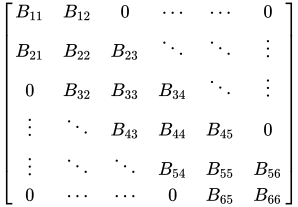
is stored as the 6-by-3 matrix
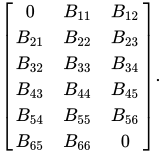
A further saving is possible when the matrix is symmetric. For example, consider a symmetric 6-by-6 matrix with an upper bandwidth of 2:
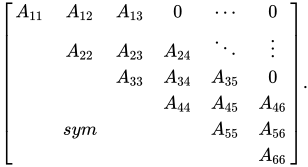
This matrix is stored as the 6-by-3 matrix:

Band form of sparse matrices
[edit]From a computational point of view, working with band matrices is always preferential to working with similarly dimensioned square matrices. A band matrix can be likened in complexity to a rectangular matrix whose row dimension is equal to the bandwidth of the band matrix. Thus the work involved in performing operations such as multiplication falls significantly, often leading to huge savings in terms of calculation time and complexity.
As sparse matrices lend themselves to more efficient computation than dense matrices, as well as in more efficient utilization of computer storage, there has been much research focused on finding ways to minimise the bandwidth (or directly minimise the fill-in) by applying permutations to the matrix, or other such equivalence or similarity transformations.[3]
The Cuthill–McKee algorithm can be used to reduce the bandwidth of a sparse symmetric matrix. There are, however, matrices for which the reverse Cuthill–McKee algorithm performs better. There are many other methods in use.
The problem of finding a representation of a matrix with minimal bandwidth by means of permutations of rows and columns is NP-hard.[4]
See also
[edit]Notes
[edit]- ^ Golub & Van Loan 1996, §1.2.1.
- ^ Atkinson 1989, p. 527.
- ^ Davis 2006, §7.7.
- ^ Feige 2000.
References
[edit]- Atkinson, Kendall E. (1989), An Introduction to Numerical Analysis, John Wiley & Sons, ISBN 0-471-62489-6.
- Davis, Timothy A. (2006), Direct Methods for Sparse Linear Systems, Society for Industrial and Applied Mathematics, ISBN 978-0-898716-13-9.
- Feige, Uriel (2000), "Coping with the NP-Hardness of the Graph Bandwidth Problem", Algorithm Theory - SWAT 2000, Lecture Notes in Computer Science, vol. 1851, pp. 129–145, doi:10.1007/3-540-44985-X_2.
- Golub, Gene H.; Van Loan, Charles F. (1996), Matrix Computations (3rd ed.), Baltimore: Johns Hopkins, ISBN 978-0-8018-5414-9.
- Press, WH; Teukolsky, SA; Vetterling, WT; Flannery, BP (2007), "Section 2.4", Numerical Recipes: The Art of Scientific Computing (3rd ed.), New York: Cambridge University Press, ISBN 978-0-521-88068-8, archived from the original on 2016-03-04, retrieved 2011-08-08.
External links
[edit]- Information pertaining to LAPACK and band matrices
- A tutorial on banded matrices and other sparse matrix formats


Band matrix
View on GrokipediaFundamentals
Definition
A band matrix is a square matrix whose non-zero entries are confined to a diagonal band comprising the main diagonal and a limited number of adjacent subdiagonals and superdiagonals. Formally, for an $ n \times n $ matrix $ A = (a_{ij}) $, $ A $ has lower bandwidth $ p $ and upper bandwidth $ q $ if $ a_{ij} = 0 $ whenever $ i > j + p $ or $ j > i + q $, where $ p $ and $ q $ are non-negative integers.[7] The main diagonal consists of the entries $ a_{ii} $ for $ i = 1, \dots, n $, while the subdiagonals (below the main diagonal) and superdiagonals (above it) form the band's extent, with all entries outside this region being zero. This structured sparsity arises naturally in applications involving discretized differential equations, where the band's width reflects the order of the discretization.[8] Band matrices differ from general sparse matrices in that their non-zero entries follow a predictable, contiguous pattern around the main diagonal rather than occurring in arbitrary positions.[1] Visually, a band matrix appears as a central strip of potential non-zero values flanked by blocks of zeros in the corners, as illustrated in the following generic example for a matrix with $ p = 1 $ and $ q = 2 $: $$ \begin{pmatrix}- & * & * & 0 & 0 \
- & * & * & * & 0 \ 0 & * & * & * & * \ 0 & 0 & * & * & * \ 0 & 0 & 0 & * & * \end{pmatrix} $$
Bandwidth
In a band matrix , the lower semi-bandwidth is defined as the smallest non-negative integer such that whenever , meaning all non-zero entries below the main diagonal are confined to at most the subdiagonals. Similarly, the upper semi-bandwidth is the smallest non-negative integer such that whenever , restricting non-zero entries above the main diagonal to at most the superdiagonals. These semi-bandwidths quantify the sparsity of the matrix by measuring the extent of the non-zero band around the diagonal.[9] The total bandwidth of the matrix is then given by , representing the total number of diagonals (including the main diagonal) that may contain non-zero entries. Another common formulation defines the bandwidth as , which aligns with the maximum distance from the main diagonal to any non-zero entry and equals . These measures are fundamental for assessing the sparsity and enabling efficient storage and computation for band matrices.[10] To minimize the bandwidth of a sparse matrix, which can improve numerical algorithms by reducing the effective sparsity pattern, reordering techniques are employed. The reverse Cuthill-McKee (RCM) algorithm, a refinement of the original Cuthill-McKee method, achieves this by permuting the rows and columns to cluster non-zero entries closer to the diagonal, thereby decreasing the semi-bandwidths and total bandwidth while aiming to limit fill-in during factorizations. This reordering is particularly valuable in applications like finite element methods, where the initial matrix ordering from mesh connectivity may yield large bandwidths.[11]Properties
Algebraic properties
Band matrices exhibit desirable algebraic properties under basic operations, preserving their sparse structure to varying degrees. The sum of two band matrices and , where has lower bandwidth and upper bandwidth , and has lower bandwidth and upper bandwidth , results in a band matrix with lower bandwidth and upper bandwidth .[7] This preservation ensures that the sparsity pattern is maintained within the widest band of the operands. In contrast, the product of two band matrices yields a band matrix whose lower bandwidth is at most and upper bandwidth is at most .[7] For an matrix with bandwidths multiplied by an matrix with bandwidths , the product's bandwidths are bounded by for the lower and for the upper.[12] Symmetric band matrices, characterized by , possess additional structure that enhances their utility in numerical methods. Such matrices arise frequently in applications like finite difference discretizations and maintain symmetry under addition and multiplication by symmetric band matrices, with the resulting bandwidth following the rules above.[7] If a symmetric band matrix is positive definite, it admits a Cholesky factorization , where is a lower triangular band matrix with the same lower bandwidth as , thus preserving the band structure without fill-in beyond the original bandwidth.[7] This property is particularly valuable for efficient computation, as the factorization requires operations compared to for dense matrices.[7] Regarding rank and determinant, band matrices that are strictly diagonally dominant—meaning for each row—are nonsingular and thus have full rank for an matrix.[13] The banded structure does not alter this nonsingularity condition, ensuring invertibility under diagonal dominance. For positive definite symmetric band matrices, the Cholesky factorization not only confirms full rank but also allows computation of the determinant as the product of the squares of the diagonal entries of , .[7] This direct link between structure and determinant computation underscores the algebraic advantages of band matrices in ensuring well-conditioned operations.Numerical stability in operations
Band matrices exhibit favorable numerical stability in common linear algebra operations due to their limited non-zero structure, which confines computations and reduces the propagation of rounding errors compared to dense matrices. In particular, the LU decomposition of a band matrix with lower bandwidth and upper bandwidth preserves the band structure, yielding a lower triangular factor with lower bandwidth and an upper triangular factor with upper bandwidth . This preservation minimizes storage and computational requirements, with the factorization requiring approximately floating-point operations for an matrix where .[14] During Gaussian elimination without pivoting, no fill-in occurs outside the original band, ensuring that the sparsity pattern is maintained exactly within the enlarged envelope of width . This lack of extraneous fill-in contrasts sharply with dense matrices, where elimination can introduce new non-zeros, and it directly contributes to numerical stability by limiting the scope of error accumulation. However, to enhance robustness against small pivots, partial pivoting is often employed, which may increase the effective bandwidth of to but still confines fill-in within a predictable envelope, with no additional non-zeros beyond the band structure.[14][15][15] The condition number of a band matrix, which measures sensitivity to perturbations, is often well-behaved when the matrix is diagonally dominant, as the limited off-diagonal elements restrict the growth of singular values. For example, diagonally dominant band matrices with constant diagonal entries (e.g., 100) and ones elsewhere in the band typically exhibit condition numbers between 1 and 3, indicating excellent numerical conditioning. Rounding errors in operations like LU factorization are bounded in terms of the bandwidth, with backward error analyses showing perturbations on the order of machine epsilon times the bandwidth-scaled norm of the matrix, thus scaling more gracefully than for full matrices.[16][16][14] For eigenvalue computations, symmetric tridiagonal band matrices (with , total bandwidth 3) possess real eigenvalues, a direct consequence of the spectral theorem for symmetric matrices. The QR iteration applied to such matrices maintains the tridiagonal structure and converges stably, with each iteration requiring operations and numerical errors controlled by the orthogonal transformations inherent to the method. Specialized parallel QR variants further ensure stability for large-scale problems, delivering accurate eigenvalues with low communication overhead and work efficiency comparable to sequential implementations.[17][14][18]Examples
Low-bandwidth matrices
Low-bandwidth matrices represent the simplest forms of band matrices, where the non-zero entries are confined to a narrow diagonal band, facilitating straightforward analysis and computation. These matrices are particularly useful for illustrating the core structure of band matrices due to their sparse nature and minimal fill-in during operations. A diagonal matrix is the most basic low-bandwidth example, possessing a bandwidth of $ b = 1 $, with all off-diagonal elements strictly zero such that $ a_{i,j} = 0 $ for $ i \neq j $.[19] In this form, the matrix consists solely of the main diagonal, making it exceptionally simple and equivalent to a collection of independent scalar entries.[8] Bidiagonal matrices extend this simplicity slightly, featuring a bandwidth of $ b = 2 $, where non-zero entries appear only on the main diagonal and one adjacent off-diagonal.[8] Upper bidiagonal matrices have non-zeros on the main and superdiagonal, while lower variants have them on the main and subdiagonal; this structure maintains sparsity while introducing limited coupling between consecutive elements.[20] Tridiagonal matrices, with a bandwidth of $ b = 3 $, allow non-zero entries on the main diagonal, the immediate subdiagonal, and the superdiagonal, creating a tight band that captures nearest-neighbor interactions.[8] A prominent example is the discrete Laplacian matrix arising from finite difference approximations of the second derivative in one dimension, typically of the formHigher-bandwidth cases
Pentadiagonal matrices represent a case of higher-bandwidth band matrices with a total bandwidth of 5, where non-zero entries are confined to the main diagonal and the two nearest subdiagonals and superdiagonals. These matrices commonly emerge in finite difference discretizations of partial differential equations, such as higher-order approximations for boundary value problems that achieve a truncation error of order , resulting in systems that require solving pentadiagonal structures for improved accuracy in resolving solution features.[23] For a more general illustration, consider a 5×5 band matrix with lower bandwidth (two subdiagonals) and upper bandwidth (one superdiagonal), yielding a total bandwidth of 4. The non-zero entries are restricted such that if or , producing a sparse structure like: $$ \begin{pmatrix}- & * & 0 & 0 & 0 \
- & * & * & 0 & 0 \
- & * & * & * & 0 \ 0 & * & * & * & * \ 0 & 0 & * & * & * \end{pmatrix} $$