


Community hub
Recent from talks
Contribute something
Nothing was collected or created yet.
Flag of Belgium
View on Wikipedia
 | |
| Use | National flag    |
|---|---|
| Proportion | 13:15 |
| Adopted | 23 January 1831 |
| Design | A vertical tricolour of black, yellow, and red. |
.svg) | |
| Use | Civil ensign  |
| Proportion | 2:3 or similar |
| Design | A vertical tricolour of black, yellow, and red. |
The national flag of the Kingdom of Belgium is a tricolour consisting of three equal vertical bands displaying the national colours: black, yellow, and red. The colours were taken from the coat of arms of the Duchy of Brabant, and the vertical design may be based on the flag of France. When flown, the black band is nearest the pole (at the hoist side). It has the unusual proportions of 13∶15, and therefore, unlike the flags of Switzerland and the Vatican City, it is not a perfect square.
In 1830, the flag, at that time non-officially, consisted of three horizontal bands, with the colors red, yellow and black. On 23 January 1831, the National Congress enshrined the tricolor in the Constitution, but did not determine the direction and order of the color bands. As a result, the "official" flag was given vertical stripes with the colors black, yellow and red.
Previous flags
[edit]After the death of Charlemagne, the present-day territory of Belgium (except the County of Flanders) became part of Lotharingia, which had a flag of two horizontal red stripes separated by a white stripe.[1] The territory then passed into Spanish hands, and after the coronation of Charles V, Holy Roman Emperor, yellow and red, the colours of Spain, were added. From the 16th century to the end of the 18th century, the colours of what is now Belgium were red, white and yellow.[1] Occasionally, the red Cross of Burgundy was placed on the white section of the flag.[1]
During the period of Austrian rule, a number of different flags were tried. Eventually, the Austrian emperor imposed the Austrian flag. The population of Brussels was opposed to this, and, following the example of France, red, yellow and black cockades began to appear, those being the colours of Brabant.[1] The colours thus correspond to the red lion of Hainaut, Limburg and Luxembourg, the yellow lion of Brabant, and the black lion of Flanders and Namur.[1]
Independence and adoption of current flag
[edit]
 Flag of the Brabant Revolution (1789–1790)
.svg) Flag of the Belgian Revolution (1830–1831)
Flag of the Belgian Revolution (1830–1831)On 27 August 1830, the day after the rioting at the La Monnaie theatre and the start of the Belgian Revolution, the flag of France flew from the city hall of Brussels. The insurgents hastily replaced it with a tricolour of red, yellow, and black horizontal stripes (similar to the one used during the Brabant Revolution[1] of 1789–1790 which had established the United States of Belgium) made at a nearby fabric store. As a result, Article 193 of the Constitution of Belgium describes the colours of the Belgian nation as Red, Yellow, and Black, the reverse order shown in the official flag.[citation needed]
On 23 January 1831, the stripes changed from horizontal to vertical, and on 12 October, the flag attained its modern form, with the black placed at the hoist side of the flag.[1]
Design and specifications
[edit]The official guide to protocol in Belgium states that the national flag measures 2.6 m (8.5 ft) tall for each 3 m (9.8 ft) wide,[1] giving it a ratio of 13:15. Each of the stripes is one-third of the width of the flag. The yellow is in fact yellow and not the darker gold of the flag of Germany, which is a black-red-gold tricolour, striped horizontally.
| Colour scheme | Black | Yellow | Red |
|---|---|---|---|
| Pantone[1] | Black | Yellow 115 | Red 32 |
| CMYK[1] | 0-0-0-100 | 0-6-87-0 | 0-86-63-0 |
| RGB[2] | 0-0-0 | 253-218-36 | 239-51-64 |
| Hex triplet | #000000 | #FDDA24 | #EF3340 |
Variants
[edit]

National flag and civil ensign
[edit]The national flag has the unusual proportions of 13:15.
The 2:3 flag is the civil ensign, the correct flag for use by civilians at sea.[citation needed]
-
 Flag of Belgium
 -
 Civil flag of Belgium
Government Ensign of Belgium
[edit]The Belgian government ensign is used by state-owned vessels and government agencies operating at sea, including customs, police, and coast guard vessels, as well as official transport ships for Belgian authorities and maritime service vessels like those for pilotage, hydrography, and lighthouse maintenance. It distinguishes these ships from civilian vessels (which use the national flag) and navy.
The Belgian government ensign consists of a vertical tricolour of black, yellow, and red defaced by a lion rampant ensigned by a crown, both sable (black), the lion armed and langued gules (red).
-
 Government Ensign of Belgium

Naval ensign and jack
[edit]The naval ensign of Belgium has the three national colours in a saltire, on a white field, with a black crown above crossed cannons at the top and a black anchor at the bottom. It was created in 1950, shortly after the Belgian Navy was re-established, having been a section of the British Royal Navy during World War II, and it is reminiscent of the White Ensign of the Royal Navy.[citation needed]
There is also an official Belgian naval jack, which is the same as the national flag, except in a 1:1 ratio, making it square.[citation needed]
-
 Naval Jack of Belgium
 -
 Belgian Naval pennant
 -
 The Belgian Naval Auxiliary Ensign


Royal standard and flags on the royal palaces
[edit]The royal standard of Belgium is the personal standard of the current king, Philippe, and features his monogram, an 'F' (for the Dutch 'Filip'), crossed with a 'P' in the four corners. The designs of royal standards of past monarchs have been similar.[citation needed]
The flags are flown above the palaces when the monarch is in Belgium, not necessarily just in one of the palaces. The flags are not flown if the monarch is on a state visit overseas or on holiday outside of Belgium. There have been exceptions to this rule, but, in general, presence or absence of the flag is a reasonably reliable indicator of whether or not the monarch is in the country.
-
 Flag of Belgium (with crown)
 -
 Royal Standard of King Philippe of Belgium
.svg)

Military flags of Belgium
[edit]The flags of the Belgian Land, Air, and Naval Components represent their different branches in the Belgian military.
The flag of the Belgian Land Component was adopted on september 1st 1982 The flag is white with the Army shield topped by a Royal crown. The Army shield is red with a black embattled wall. The shield is charged with a raised sword hold by two hands, the sinister one being bare and the dexter one covered with a gauntlet. The dexter hand is placed over the sinister one. The sword and the hands are all yellow.The Royal crown is yellow with a red cap, decorated with white pearls and gems. The number, shape and colour of the pearls and gems vary from flag to flag
The flag of the Belgian Air Force was adopted on 4 February 1948. The flag of the Belgian Air Component is the badge of the air force and roundel of the Air force on a blue field.
The flag of the Belgian Navy was adopted on 2nd of march 1950. The ensign reminds the White Ensign of the Royal Navy, from which the Belgian Navy was re-established.The St. Andrew's cross was derived from the Cross of Burgundy, which decorated the ensigns of the Belgian ships during the Burgondian rule. The colours of the cross are the national colours.The crossed cannons highlight the military status of the ensign. The crown is the emblem of the kingdom, The anchors symbolize the ship's crews.
-
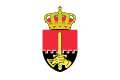 Flag of the Belgian Land Component
 -
 Air Force Ensign of Belgium
 -
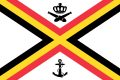 Naval Ensign of Belgium


Historical flags
[edit]Belgium has had several flags throughout its history, reflecting different periods of smaller and bigger kingdoms such as the Duchy of Brabant (1183 – 1795) and the County of Flanders (863 – 1794) ... Or full rule over all Belgians like the Austrian Netherlands (1556 – 1715), Spanish Netherlands (1715 – 1795) and much more up until the independence of Belgium in 1831 after the Belgian revolution.
-
 Imperial Orilflamme of Charlemagne (800 – 888)
 -
 Flag of the County of Flanders (863 – 1794)
 -
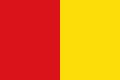 Flag of the Prince-Bishopric of Liège (980 – 1795)
 -
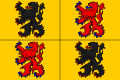 Flag of the County of Hainaut (1071 – 1795)
 -
 Flag of the Duchy of Brabant (1183 – 1795)
 -
 Flag of the Spanish Netherlands (1556 – 1715)
 -
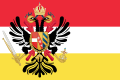 Flag of the Austrian Netherlands (1715 – 1795)
 -
 Flag of the United Belgian States (1789 – 1790)
 -
 First Belgian flag (1830 – 1831)
 -
Belgian flag (1831 – present)


Revolutionary flags
[edit]These flags were used during Belgian (or Brabantian) revolution, when the Belgian people fought for their independence:
-
 Flag during the Brabant revolution, with lion (1789 – 1790)
 -
 Flag of volunteers of Liege (1830 – 1831)
.png)

Protocol
[edit]
As Belgium is a federal state, the flag of Belgium and the flags of the communities or regions in principle occupy the same rank.[1] Nonetheless, when flags are raised and lowered or carried in a procession, the national flag takes precedence over all the others.[1]
The order of precedence is:[1]
- The national flag of Belgium
- The flag of the community or region of Belgium
- The European Flag
- The flags of the provinces of Belgium, in alphabetical order in the local language, if more than one is flown
- The flag of the municipality
If there is a visiting head of state, that country's flag may be set second in precedence, all other flags dropping a rank.[1]
See also
[edit]
References
[edit]External links
[edit]
| Sovereign states |
|  |
|---|---|---|
| States with limited recognition | ||
| Dependencies and other entities | ||
| Other entities | ||
Flag of Belgium
View on GrokipediaHistorical Development
Flags Under Foreign Rule
The territories of modern Belgium, as part of the Low Countries, fell under Habsburg rule following the acquisition by Philip the Good, Duke of Burgundy, in the mid-15th century, adopting a horizontal tricolor of red, white, and yellow derived from Burgundian heraldry.[1] This design persisted through the Eighty Years' War and into Spanish Habsburg governance of the Spanish Netherlands from 1556 to 1714, where it served as the civil ensign, often bearing the red Cross of Burgundy—a jagged saltire on white—superimposed on the central white stripe to signify loyalty to the Spanish crown.[4][5] After the War of the Spanish Succession and the Treaty of Utrecht in 1713, sovereignty transferred to the Austrian Habsburgs, establishing the Austrian Netherlands from 1714 to 1797; the red-white-yellow tricolor remained in use as the primary provincial flag, augmented by Austrian imperial devices such as the double-headed black eagle and quartered shields representing Austria, Burgundy, and Lorraine on the obverse or in the canton.[6] In 1781, a formalized civil ensign was decreed, featuring the tricolor with a detailed coat of arms at the hoist, including the Cross of Burgundy behind the eagle, though enforcement varied amid growing local autonomy demands.[6] From 1794 onward, during the French Revolutionary invasions, the Austrian Netherlands were annexed into the French Republic and later the Napoleonic Empire until 1815, requiring the vertical blue-white-red tricolour as the official banner, supplanting local designs in administrative and military contexts.[7] Post-Napoleonic reorganization under the Congress of Vienna placed the region within the United Kingdom of the Netherlands from 1815 to 1830, where the Dutch prince's flag—a horizontal orange-white-blue tricolor—inherited from the Dutch Republic, was imposed, though red gradually substituted for orange in practice by the late 1820s amid tensions leading to Belgian secession.[1] These foreign flags underscored the absence of a unified Belgian identity, with provincial banners like those of Brabant or Flanders occasionally used locally but lacking national precedence.[1]Revolutionary Influences and Early Tricolors
The colors black, yellow, and red of early Belgian tricolors derived from the coat of arms of the Duchy of Brabant, featuring a golden lion with red claws and tongue on a black field, symbolizing regional historical identity in the Low Countries.[8] These hues gained revolutionary prominence during the Brabant Revolution of 1789–1790, an uprising by Statists against Austrian Habsburg rule in the Austrian Netherlands, inspired by Enlightenment ideals and the contemporaneous American and French revolutions that popularized tricolor designs as emblems of popular sovereignty and anti-monarchical sentiment.[3] Insurgents first employed these colors in cockades and banners as early as 1787 in Brussels protests against Joseph II's reforms, but systematic tricolor use emerged in October 1789 amid armed rebellion, with horizontal stripes of red, black, and yellow raised over captured fortresses to signify unity and defiance.[9] The arrangement—often red at the top, followed by black and yellow—reflected practical adaptations of heraldic elements rather than codified symbolism, though black evoked the lion's field, yellow its body, and red its accents, fostering a sense of Brabantian particularism amid broader anti-imperial fervor.[9] Following the revolution's initial successes, the United Belgian States, declared on January 11, 1790, as a confederation of provinces, incorporated the tricolor into provisional emblems, including variants with a Brabant lion device, though designs varied locally due to the short-lived nature of the entity, which dissolved by December 1790 after Austrian reconquest.[3] This period marked the inaugural nationalistic application of the tricolor in Belgian territories, predating formal statehood and establishing the color triad's association with independence movements, untainted by later French annexation influences during the 1790s when horizontal layouts persisted under revolutionary republics.[10]Adoption During Independence
The Belgian Revolution erupted on 25 August 1830 in Brussels, sparked by unrest at the Théâtre de la Monnaie following a performance of Daniel Auber's opera La Muette de Portici, leading revolutionaries to seek separation from the United Kingdom of the Netherlands. To distinguish their cause from the Dutch orange-white-blue flag, insurgents adopted black, yellow, and red colors, derived from the coat of arms of the Duchy of Brabant—a historical region encompassing much of modern Belgium—which featured a golden lion on a black field with red accents. These hues evoked medieval heraldic ties and regional identity, fostering unity among Flemish, Walloon, and Brussels participants amid the uprising.[11][2] On 26 August 1830, the first Belgian tricolor flag was reportedly sewn by Marie Abts, a local resident, and hoisted over Brussels city hall, marking an early emblem of the provisional independence movement. Initially configured as horizontal stripes of red over yellow over black—possibly influenced by existing regional banners—the design quickly evolved toward a vertical tricolor to align with contemporary European standards, such as the French flag's layout. By late 1830, as revolutionary forces consolidated control, the black-yellow-red vertical variant gained prominence, symbolizing the break from Dutch hegemony and the aspiration for a constitutional monarchy.[12][11] The flag's formal adoption occurred amid the National Congress's deliberations; on 23 January 1831, Article 72 of the Belgian Constitution enshrined the tricolor colors without specifying stripe orientation or exact proportions, leaving practical standardization to later decrees. This provisional endorsement preceded full international recognition of Belgian independence via the 1831 Treaty of London, after which the vertical black (hoist-side), yellow, and red arrangement—measuring in a 13:15 ratio—became the enduring national standard. The choice reflected pragmatic symbolism over ideological novelty, prioritizing historical continuity from Brabantine heraldry to legitimize the new state's sovereignty.[13][3]Design and Technical Specifications
Composition and Proportions
The flag of Belgium is a vertical tricolour featuring three equal-width bands: black adjacent to the hoist, yellow in the center, and red at the fly.[14][1] This composition derives from the colors of the Duchy of Brabant, adapted during the Belgian Revolution of 1830.[14] Official proportions specify a height-to-width ratio of 13:15, equivalent to 2.60 meters in height by 3 meters in width for standard flags.[1][14] This ratio results in a rectangular flag that is shorter relative to its width compared to most national flags, which commonly use 2:3 proportions.[1] In practice, the exact 13:15 ratio is rarely observed, with 2:3 or similar approximations employed for manufacturing and display due to practical considerations, including reduced wear on the fly edge.[1][7] Belgian protocol permits these variants for civil use while maintaining the official standard for state purposes.[1]Colors: Origins, Pantone Equivalents, and Heraldic Basis
The colors of the Belgian flag—black, yellow, and red—originate from the coat of arms of the Duchy of Brabant, which features a lion or (gold or yellow) armed and langued gules (red) on a field sable (black).[8] These heraldic tinctures provided the basis for the tricolor during the late 18th-century struggles against Austrian Habsburg rule, with black-yellow-red cockades appearing in Brussels as early as 1787 and a horizontal variant adopted by revolutionaries in 1789 amid the Brabant Revolution.[3] The vertical arrangement, mirroring the French tricolor but with these specific colors, was officially adopted by the provisional government on January 23, 1831, following the Belgian Revolution of 1830.[10] In heraldic tradition, the black (sable) represents constancy or prudence, yellow (or) signifies generosity and elevation of mind, and red (gules) denotes warrior strength and magnanimity, though these symbolic interpretations postdate the flag's practical adoption from regional arms.[15] The Belgian national coat of arms perpetuates this basis with the Brabant lion (Sable, a lion rampant or, armed and langued gules), encircled by the colors in a ribbon, affirming their derivation from medieval Low Countries heraldry rather than ideological invention.[16] For precise reproduction, the Official Guide to Belgian Protocol specifies Pantone Black for the hoist-side stripe, Pantone Yellow 115 for the center, and Pantone Red 032 for the fly-side, with corresponding CMYK values of (0,0,0,100), (0,8.5,79,0), and (0,94,87,0) respectively.[1]| Color Position | Heraldic Tincture | Pantone | CMYK Equivalent |
|---|---|---|---|
| Black (hoist) | Sable | Black | 0-0-0-100 |
| Yellow (center) | Or | 115 C | 0-8.5-79-0 |
| Red (fly) | Gules | 032 C | 0-94-87-0 |
Symbolism and Interpretations
Core Symbolic Meanings
The colors of the Belgian flag—black, yellow, and red—derive directly from the coat of arms of the Duchy of Brabant, a medieval territory encompassing much of present-day central Belgium and parts of the Netherlands, featuring a golden lion with red claws and tongue on a black field.[8][1] This heraldic basis symbolized regional identity and historical continuity for revolutionaries seeking autonomy from foreign rule, as the Duchy represented a core area of cultural and political unity in the Low Countries.[3] The vertical tricolor arrangement, with black nearest the hoist, yellow in the center, and red on the fly, first emerged during the Brabantine Revolution of 1789–1790, where cockades and banners in these colors expressed opposition to Austrian Habsburg control and aspirations for a sovereign United Belgian States.[3][1] Retained during the Belgian Revolution of 1830 against the United Kingdom of the Netherlands, the design evoked revolutionary fervor akin to the French tricolore but substituted Brabant-specific colors to assert distinct national heritage rather than importing foreign symbolism.[1] Article 193 of the 1831 Belgian Constitution declares "red, yellow and black" as the national colors without prescribing order, yet the black-yellow-red vertical layout became standard through provisional government decree on October 23, 1830, prioritizing visual distinction from the Dutch Prinsenvlag.[1] Heraldically, black (sable) traditionally denotes constancy or prudence, yellow (or) generosity or elevation of mind, and red (gules) military strength or magnanimity, though Belgian sources emphasize the colors' composite representation of Brabant pride over individualized abstract virtues.[8] Post-adoption interpretations occasionally ascribe black to the people's resilience amid hardship, yellow to prosperity from Flemish and Walloon industry, and red to bloodshed for liberty, but these lack attestation in founding documents and reflect later patriotic embellishments rather than original intent.[15] The flag thus embodies causal ties to pre-modern feudal loyalties repurposed for modern nationalism, underscoring Belgium's emergence from composite regional identities rather than invented ideological motifs.Regional and Political Viewpoints
In Flanders, the Belgian tricolor is frequently supplanted by the regional flag—a black lion rampant on yellow with red claws and tongue—as a preferred symbol of identity, particularly during cultural events and political rallies. This regional preference reflects longstanding Flemish nationalist sentiments favoring autonomy or independence from Wallonia, driven by economic disparities and cultural divergences, with the national flag often perceived as emblematic of an imposed federal compromise rather than genuine unity.[17] Separatist groups, such as those aligned with Vlaams Belang, have employed the all-black variant of the Flemish lion to explicitly reject Belgian symbolism, associating the tricolor with historical subjugation under Walloon-influenced governance.[17] Walloon viewpoints contrast with this, exhibiting greater allegiance to the tricolor as a bulwark against Flemish separatism, amid a political landscape where socialist-leaning parties emphasize solidarity and fiscal interdependence within the Belgian state. In Wallonia, the flag's red stripe resonates with French revolutionary influences and regional heraldry, reinforcing its role as a unifying emblem despite autonomist undercurrents that promote supplementary symbols like the Walloon rooster.[18] This attachment underscores Walloon reliance on national institutions for economic support, viewing the flag as integral to preserving the confederal balance against northern devolution demands.[19] Politically, the flag's symbolism fractures along ideological lines, with Flemish parties like N-VA and Vlaams Belang subordinating it to regional icons in pursuit of confederal reforms or partition, citing the tricolor's Brabant origins as insufficiently representative of modern Flemish self-determination.[20] Pro-federal factions across both regions, however, deploy the flag to advocate institutional stability and EU-aligned integration, though its limited prominence during crises—such as the sparse displays following the March 22, 2016, Brussels attacks—reveals underlying national disunity rooted in veto-prone federalism.[21] These viewpoints highlight the flag's causal tie to Belgium's fragmented polity, where regional vetoes and linguistic quotas perpetually challenge its unifying intent.[19]Variants and Derivative Designs
Civil and National Ensigns
The civil ensign of Belgium is a vertical tricolour featuring equal bands of black, yellow, and red, with the black band positioned at the hoist, in a standard maritime proportion of 2:3. This flag is flown by Belgian-registered merchant ships and civilian vessels to signify their nationality during international voyages.[22][23] It was officially established for this purpose by Royal Decree on 28 November 1936, as regulated under Article 54 of the subsequent Royal Decree of 4 November 1976 concerning the organization of maritime signaling.[22] In contrast to the land-based national flag, which employs proportions of 13:15, the civil ensign's 2:3 ratio aligns with conventional naval practices for better visibility and handling at sea. The national flag's unique dimensions, specified in the Belgian Constitution of 1831 and subsequent decrees, are reserved primarily for governmental and ceremonial displays on terra firma, though the core design remains identical.[22][24] The term "national ensign" in Belgian vexillology often encompasses the civil ensign for non-military state representation at sea, distinguishing it from specialized governmental or naval variants. Private and commercial entities must adhere to protocols mandating its display from the stern during daylight hours when underway, ensuring compliance with international maritime conventions such as those under the United Nations Convention on the Law of the Sea.[22][25] No defacements or alterations are permitted on the civil ensign, preserving its simplicity for unambiguous identification.[22]Governmental and State Ensigns
The state ensign of Belgium, employed for official governmental displays on land, mirrors the civil ensign as a vertical tricolour of black, yellow, and red stripes in a 13:15 proportion. This design is hoisted atop federal institutions, administrative centers, and during state functions as stipulated in Belgian protocol guidelines.[1] Distinct from the standard state ensign, the governmental ensign designates non-military state vessels, incorporating the tricolour overlaid centrally on the yellow band with a yellow disc outlined in black, containing a sable (black) lion rampant crowned, armed and langued gules (red claws and tongue). This variant identifies ships operated by agencies such as customs, police, and coast guard services.[26] Historically, elements of the governmental ensign draw from the national coat of arms, with the lion symbolizing the Duchy of Brabant heritage integrated post-independence in 1830. Its maritime application ensures differentiation from civilian and purely naval craft, maintaining operational clarity in Belgian waters.[1]Naval, Military, and Jack Flags
The naval ensign of Belgium features a white field with a saltire composed of the national colors—black, yellow, and red—extending to the edges, and at the center, a black royal crown positioned above two crossed cannons in black. This design symbolizes naval sovereignty and has been in use since the establishment of the Belgian Navy in the 19th century, with the current form standardized post-World War II. The naval jack is a square 1:1 version of the national flag, displaying vertical stripes of black, yellow, and red, flown at the bow of warships to indicate nationality. According to the Official Guide to Belgian Protocol, it mirrors the civil flag in design but in square proportions for maritime use.[27] The commissioning pennant consists of a triangular red pennant with black and yellow stripes, used to denote commissioned vessels. Belgium's Naval Component also employs an auxiliary ensign for support vessels, typically blue with the naval ensign in the canton and a white anchor surmounted by a crown in the fly; a new variant was introduced for sovereignty ships under Marine command as of recent updates.[28] The flag of the Belgian Land Component, adopted on September 1, 1982, is white with the component's emblem—a stylized lion in gold on black—centered, flanked by the national colors. It serves as the standard for army units and formations. The Air Force ensign, introduced on February 4, 1948, and modified in 1955 by removing yellow fimbriation, is a blue field bearing the Belgian roundel (black-yellow-red circles) with wings, representing aerial defense capabilities. These military flags adhere to protocols ensuring distinct identification in joint operations within NATO frameworks.Royal Standards and Institutional Flags
The Royal Standard of the King of the Belgians consists of a square purple field, the color derived from the ribbon of the Order of Leopold, Belgium's highest chivalric order, bearing the greater coat of arms of Belgium at the center and the monarch's cypher—typically the intertwined initials "FP" for Philippe—in each corner.[29][30] This design was adopted upon King Philippe's accession to the throne on July 21, 2013, following the abdication of his father, Albert II, whose standard used a red field with similar elements personalized to "AII".[29] The standard measures approximately 3.2 by 3.2 meters when flown over the Royal Palace of Laeken and 4 by 4 meters over the Royal Palace of Brussels during the sovereign's residence.[31] The Royal Standard of Queen Mathilde features a square crimson (rouge ponceau) field with the royal arms at the center, personalized with the queen's monogram or elements linked to the king's cypher, in use since 2013.[32] Standards for other senior royals, such as the Duke of Brabant (the heir apparent), follow analogous patterns with personalized cyphers on colored fields, though less frequently documented in official protocol.[33] Institutional flags for Belgian royal and governmental bodies primarily utilize the national tricolour, often in specific ratios and sizes tailored to buildings. Over the Royal Palace of Brussels, the national flag flies in a 4:3 height-to-width ratio—taller and narrower than the standard 13:15 proportion—measuring 4 by 3 meters, hoisted when the sovereign is absent; it is replaced by the royal standard during the king's presence.[34][31] Similarly, the Royal Palace of Laeken displays the national flag at 3.2 by 2.4 meters under the same protocol.[31] Parliament and other federal institutions, such as the Palais de la Nation, fly the national flag alongside regional or EU ensigns, adhering to etiquette that prioritizes the tricolour for official state representation without distinct institutional variants beyond dimensional adaptations.[35]Usage, Protocol, and Cultural Role
Official Etiquette and Display Rules
The Belgian national flag is hoisted on public buildings during official holidays and significant ceremonies, as per established protocol, with private individuals permitted to display it provided due respect is maintained.[36] The flag takes precedence over regional, communal, or foreign flags, positioned in the place of honor—typically to the observer's left when facing the arrangement or in the center for an odd number of flags.[37] At royal residences such as the Palaces of Brussels and Laeken, the flag flies when the King is present within Belgian territory.[1] For vertical display against a wall or facade, the black stripe is oriented uppermost, with yellow in the middle and red at the bottom, ensuring the hoist-side black remains nearest the staff if applicable.[38] The recommended proportions are a height of 13 units to a width of 15 units, as specified in the official protocol guide.[1] The flag must be kept clean and repaired if damaged, avoiding contact with the ground or any disrespectful handling. Half-masting occurs as a sign of national mourning, initially hoisted to the peak before being lowered to half-staff; the procedure is reversed upon raising.[39] Official protocol associates this with the death of the King, Queen, or former monarchs, though the federal government may declare broader periods of deuil national for events such as major catastrophes or the passing of high officials, prompting flags on public edifices to be lowered accordingly.[40][41]Political Usage and Historical Contexts
The colors black, yellow, and red of the Belgian flag trace their origins to the coat of arms of the Duchy of Brabant, featuring a golden lion with red claws and tongue on a black field, which symbolized opposition to centralized authority during the Brabant Revolution of 1789–1790 against the reforms imposed by Holy Roman Emperor Joseph II in the Austrian Netherlands.[2] Revolutionaries adopted these colors as a tricolor emblem of resistance and aspirations for greater autonomy, marking an early political assertion of regional identity distinct from Habsburg rule.[8] These same colors were revived during the Belgian Revolution of 1830, which erupted in Brussels on August 25 against the United Kingdom of the Netherlands under King William I, driven by grievances over linguistic, religious, and economic policies favoring Dutch interests. On August 26, 1830, insurgents hastily fashioned the first Belgian flags in horizontal red-yellow-black stripes, but the provisional government decreed the vertical black-yellow-red tricolor on September 30, 1830, to differentiate it from merchant variants and align with revolutionary cockades; this design was officially confirmed on January 23, 1831, embodying the push for constitutional monarchy and independence formalized by the Treaty of London on November 15, 1831.[3][13] The flag thus became a potent symbol of national liberation and unity across linguistic divides, waved by revolutionaries in street fighting and subsequent independence celebrations. In later historical contexts, the flag served as a marker of Belgian sovereignty amid foreign occupations and internal political strife. During World War I, Belgian forces under King Albert I defended against German invasion from 1914, with the tricolor raised upon partial liberation in 1918; similarly, in World War II, following the 1940 capitulation, the government-in-exile in London maintained the flag as a sign of continuity, while resistance groups covertly displayed it during the Nazi occupation until full liberation by Allied forces in 1944–1945.[1] Postwar, the flag's vertical orientation sparked minor constitutional debate, as Article 193 of the 1831 Constitution references the "colours of the Duchy of Brabant" without specifying arrangement, leading some to argue for horizontal red-yellow-black to better evoke the lion's charges, though the vertical design has prevailed by convention and repeated legal affirmation since 1924.[42] Politically, the flag has underscored efforts to preserve national cohesion against regionalist pressures, particularly in Flemish nationalist movements favoring the black-yellow Brabant lion over the tricolor, yet it remains a unifying emblem in federal institutions and international diplomacy, as evidenced by its mandatory display at protests affirming Belgian integrity during the 2010–2011 government formation crisis amid separatist rhetoric.[17] Its historical role continues to evoke the causal link between revolutionary sacrifice and state formation, prioritizing empirical symbols of endurance over ideological reinterpretations.Modern Significance and Debates
In contemporary Belgium, the flag serves primarily as an official state symbol, flown at government buildings, embassies, and during diplomatic events to represent the Kingdom's sovereignty and participation in international organizations like the European Union and NATO. Its display is mandated by protocol on national holidays, such as July 21 commemorating Leopold I's oath in 1831, and at royal ceremonies, underscoring continuity with the post-independence era. However, empirical data on national attachment reveal limited enthusiasm; a global survey ranks Belgium among the lowest in patriotism, with only 19% of respondents expressing strong pride in their nationality, correlating with sparse private flag usage outside sports victories or EU-related contexts.[43] Regional divides have eroded the flag's unifying role, particularly in Flanders, where the yellow field with black lion—derived from medieval heraldry—predominates in public and private displays, often outnumbering Belgian tricolors at local events and residences. This preference stems from economic and cultural factors: Flanders contributes disproportionately to GDP (around 60% as of recent federal budgets) yet perceives the national framework as subsidizing Wallonia, fostering subnational loyalty. Flemish-majority areas exhibit higher visibility of regional symbols during festivals or protests, with the Belgian flag sometimes viewed as an imposed relic of the 1830 revolution, which Flemish narratives frame as Francophone-dominated.[17][44] Debates over the flag highlight tensions in Belgium's federal structure. Nationalist parties like Nieuw-Vlaamse Alliantie (N-VA), which garnered 24.2% in the 2024 federal elections, advocate confederal reforms that could diminish national symbols' prominence, proposing greater emphasis on regional emblems in public institutions to reflect devolved competencies. Instances of flag burning by Flemish extremists, though rare and not representative, underscore rejection among hardline separatists who associate the tricolor with a "failed state." Additionally, a niche legal contention persists that the vertical orientation contravenes the 1830 provisional government's horizontal decree, technically rendering it unconstitutional since the 1831 constitution specifies colors without endorsing the shift—yet no court has invalidated it, and usage remains unchanged.[45][46][42] These dynamics reflect causal pressures from linguistic separatism and fiscal imbalances, eroding the flag's potency as a centripetal force; polls show majorities favor preserving Belgium but prioritize regional identities, with the tricolor more symbolic in Brussels and Wallonia.[47]References
- https://commons.wikimedia.org/wiki/File:RoyalPalaceBrusselsFlag.jpg