


Community hub
Recent from talks
Contribute something
Nothing was collected or created yet.
Flag of Europe
View on Wikipedia
 | |
| European flag Flag of the Council of Europe Flag of the European Union Circle of stars | |
| Use |
|
|---|---|
| Proportion | 2:3 |
| Adopted | 9 December 1955[1][2] (CoE) 29 June 1985[3] (EEC) |
| Design | A circle of twelve five-pointed yellow stars on a blue field. |
| Designed by | Collaborative effort involving various people, including Arsène Heitz and Paul M. G. Lévy |
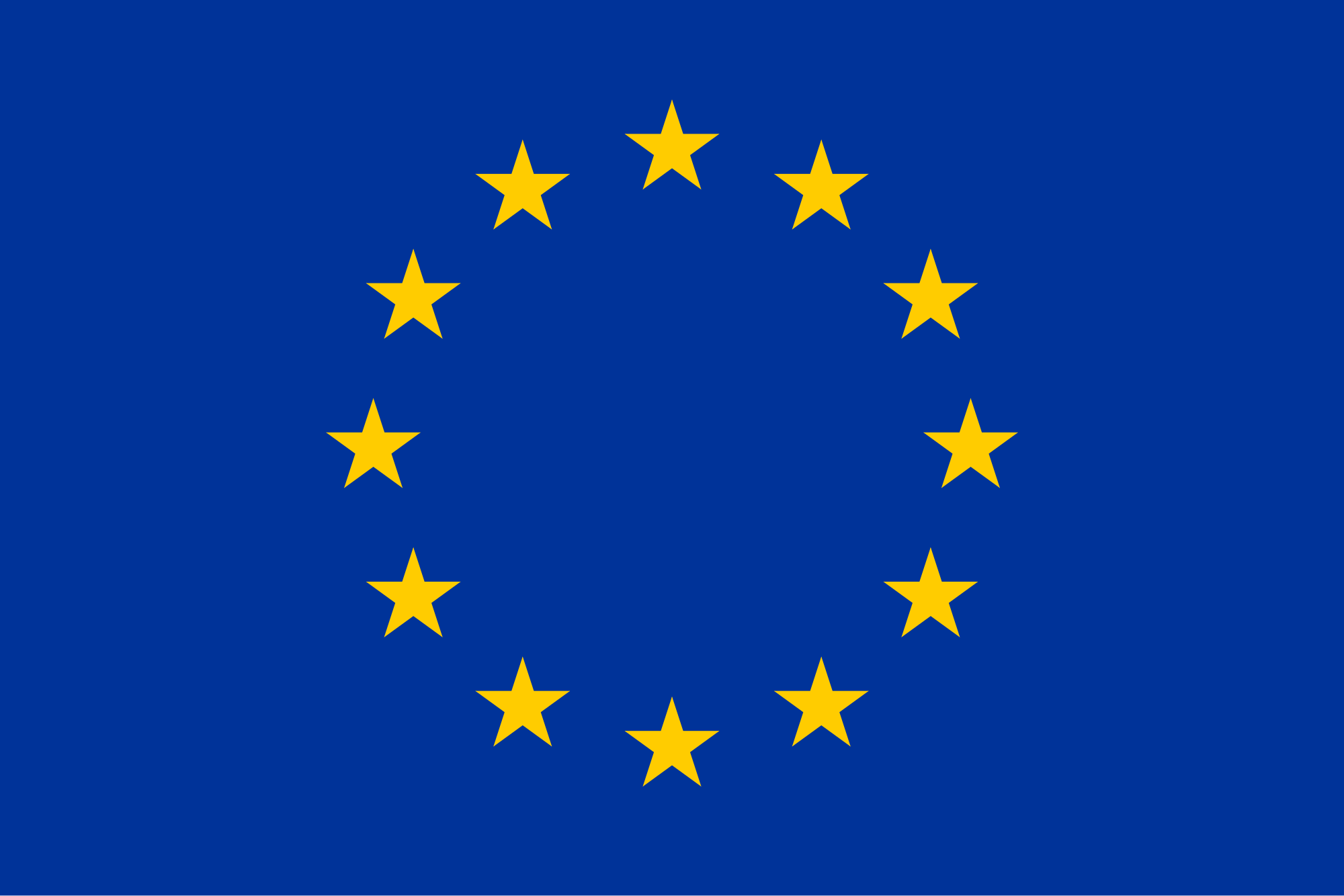
The flag of Europe or European flag[note 1] consists of twelve golden stars forming a circle on a blue field. It was designed and adopted in 1955 by the Council of Europe (CoE) as a symbol for the whole of Europe.[1]
Since 1985, the flag has also been a symbol of the European Union (EU), whose 27 member states are all also CoE members, although in that year the EU had not yet assumed its present name or constitutional form (which came in steps in 1993 and 2009). Adoption by the EU, or EC as it then was, reflected a long-standing CoE desire to see the flag used by other European organisations.[1] Official EU use widened greatly in the 1990s. Nevertheless, the flag has to date received no status in any of the EU's treaties. Its adoption as an official symbol was planned as part of the 2004 Treaty establishing a Constitution for Europe but this failed to be ratified. Mention of the flag was removed in 2007 from the text of the Treaty of Lisbon, which was ratified. On the other hand, 16 EU members that year, plus France in 2017, have officially affirmed (by Declaration No. 5224) their attachment to the flag as an EU symbol.
The flag is used by other European entities, such as unified golf teams under the rubric Team Europe.[4]
Blazon
[edit]In 1955, the Parliamentary Assembly of the Council of Europe unanimously chose the blazon for the European flag and emblem of '12 gold stars not touching, on an azure blue background. The stars represent perfection, completeness and the months of the year.[5][6]
Symbolism
[edit]The flag used is the Flag of Europe, which consists of a circle of twelve golden stars on a blue background. Originally designed in 1955 for the Council of Europe, the flag was adopted by the European Communities, the predecessors of the present European Union, in 1986. The Council of Europe gave the flag a symbolic description in the following terms,[7] though the official symbolic description adopted by the EU omits the reference to the "Western world":[8][9]
Against the blue sky of the Western world, the stars symbolise the peoples of Europe in a form of a circle, a sign of union. Their number is invariably twelve, the figure twelve being the symbol of perfection and entirety.
— Council of Europe. Paris, 7–9 December 1955.
Other symbolic interpretations have been offered based on the account of its design by Paul M. Levy. The five-pointed star is used on many national flags and represents aspiration and education. Their golden colour is that of the sun, which is said to symbolise glory and enlightenment.[10]
Their arrangement in a circle represents the constellation of Corona Borealis and can be seen as a crown and the stability of government. The blue background resembles the sky and symbolises truth and the intellect. It is also the colour traditionally used to represent the Virgin Mary. In many paintings of the Virgin Mary as Stella Maris she is crowned with a circle of twelve stars.[10]
Marian interpretation
[edit]

In 1987, following the adoption of the flag by the EC, Arsène Heitz (1908–1989), one of the designers who had submitted proposals for the flag's design, suggested a religious inspiration for it. He stated that the circle of stars was based on the iconographic tradition of showing the Blessed Virgin Mary as the Woman of the Apocalypse, wearing a "crown of twelve stars".[11][14]
Heitz also made a connection to the date of the flag's adoption, 8 December 1955, coinciding with the Feast of the Immaculate Conception of the Blessed Virgin Mary.
Paul M. G. Lévy, then Director of Information at the Council of Europe responsible for designing the flag, in a 1989 statement maintained that he had not been aware of any religious connotations.[15]
In an interview given 26 February 1998, Lévy denied not only awareness of the Marian connection, but also denied that the final design of a circle of twelve stars was Heitz's. To the question "Who really designed the flag?" Lévy replied:
I did, and I calculated the proportions to be used for the geometric design. Arsène Heitz, who was an employee in the mail service, put in all sorts of proposals, including the 15-star design. But he submitted too many designs. He wanted to do the European currencies with 15 stars in the corner. He wanted to do national flags incorporating the Council of Europe flag.[14]
Carlo Curti Gialdino (2005) has reconstructed the design process to the effect that Heitz's proposal contained varying numbers of stars, from which the version with twelve stars was chosen by the Committee of Ministers meeting at Deputy level in January 1955 as one out of two remaining candidate designs.[14]
Lévy's 1998 interview apparently gave rise to a new variant of the Marian anecdote. An article published in Die Welt in August 1998 alleged that it was Lévy himself who was inspired to introduce a Marian element as he walked past a statue of the Blessed Virgin Mary.[16]
An article posted in La Raison in February 2000 further connected the donation of a stained glass window for Strasbourg Cathedral by the Council of Europe on 21 October 1956. This window, a work by Parisian master Max Ingrand, shows a blessing Madonna underneath a circle of 12 stars on dark blue ground.[17] The overall design of the Madonna is inspired by the banner of the cathedral's Congrégation Mariale des Hommes, and the twelve stars are found on the statue venerated by this congregation inside the cathedral (twelve is also the number of members of the congregation's council).[18] The Regional Office for Cultural Affairs describe this stained glass window called "Le vitrail de l'Europe de Max Ingrand" (The Glass Window of Europe of Max Ingrand).[19]
Specifications
[edit]
According to graphical specifications published online by the Council of Europe in 2004, the flag is rectangular with 2:3 proportions: its fly (width) is one and a half times the length of its hoist (height). Twelve yellow stars are centred in a circle (the radius of which is a third of the length of the hoist) upon a blue background. All the stars are upright (one point straight up), have five points and are spaced equally, like the hour positions on the face of a clock. The diameter of each star is equal to one-ninth of the height of the hoist.[20]
The colours are regulated in the 1996 guide by the EC,[21] and equivalently in the 2004 guide by the Council of Europe.[20] The base colour of the flag is defined as Pantone "Reflex Blue", while the golden stars are portrayed in Pantone "Yellow":
| Azure | Gold | |
|---|---|---|
| Pantone | Reflex Blue | Yellow |
| RGB | #003399[22]
|
#FFCC00[22]
|
| CMYK | 100.80.0.0[23] | 0.21.100.0[23] |
The 2013 logo of the Council of Europe has the colours:[24]
| Azure | Gold | |
|---|---|---|
| Pantone | PMS 287[25] | PMS 116[25] |
| RGB | #1E448A
|
#FDCB0B
|
| CMYK | 100.67.0.40 | 0.20.100.0 |
Adoption and usage
[edit]The twelve-star "flag of Europe" was designed in 1950 and officially adopted by the Council of Europe in 1955. The same flag was adopted by the European Parliament in 1983. The European Council adopted it as an "emblem" for the European Communities in 1985. Its status in the European Communities was inherited by the European Union upon its formation in 1993. The proposal to adopt it as official flag of the European Union failed with the ratification of the European Constitution in 2005, and mention of all emblems suggesting statehood was removed from the Treaty of Lisbon of 2007, although sixteen member states signed a declaration supporting the continued use of the flag.[26] In 2007, the European Parliament officially adopted the flag for its own use.[27][contradictory]
1950–present: Council of Europe
[edit].jpg)
The Council of Europe in 1950 appointed a committee to study the question of adopting a symbol. Numerous proposals were looked into.[28]
Among the unsuccessful proposals was the flag of Richard von Coudenhove-Kalergi's International Paneuropean Union, which he had himself recently adopted for the European Parliamentary Union.[29] The design was a blue field with a red cross inside an orange circle at the centre. Kalergi was very committed to defending the cross as "the great symbol of Europe's moral unity", the Red Cross in particular being "recognized by the whole world, by Christian and non-Christian nations[,] as a symbol of international charity and of the brotherhood of man",[30] but the proposal was rejected by Turkey (a member of the Council of Europe since 1949) on grounds of its religious associations[31] in spite of Kalergi's suggestion of adding a crescent alongside the cross to overcome the Muslim objections.[32]
Other proposals included the flag was the European Movement, which had a large green E on a white background,[33] a design was based on the Olympic rings, eight golden rings on a blue background, rejected due to the rings' similarity with "dial", "chain" and "zeros", or a large yellow star on a blue background, rejected due to its equality with the flag of the Belgian Congo.[31]
The Consultative Assembly narrowed their choice to two designs. One was by Salvador de Madariaga, the founder of the College of Europe, who suggested a constellation of stars on a blue background[28] (positioned according to capital cities, with a large star for Strasbourg, the seat of the council). He had circulated his flag round many European capitals and the concept had found favour.[34] The second was a variant by Arsène Heitz, who worked for the council's postal service and had submitted dozens of designs,[35] one of which was accepted by the Assembly. The design was similar to Salvador de Madariaga's, but rather than a constellation, the stars were arranged in a circle.[28] Arsène Heitz was one of several people who proposed a circle of gold stars on a blue background.[36][37] None of his proposals perfectly match the design that was adopted.[38] Paul Levy claims that he was the one who designed the template for the flag, not Arsène Heitz. In 1987, Heitz would claim that his inspiration had been the crown of twelve stars of the Woman of the Apocalypse, often found in Marian iconography (see below).[11]
On 25 September 1953, the Consultative Assembly of the Council of Europe recommended that a blue flag with fifteen gold stars be adopted as an emblem for the organisation, the number fifteen reflecting the number of states of the Council of Europe.[39] West Germany objected to the fifteen-star design, as one of the members was Saar Protectorate, and to have its own star would imply sovereignty for the region.[34][better source needed] The Committee of Ministers (the council's main decision-making body) agreed with the Assembly that the flag should be a circle of stars, but opted for a fixed number of twelve stars, "representing perfection and entirety".[28] The Parliamentary Assembly of the Council of Europe on 25 October 1955 agreed to this. Paul M. G. Lévy drew up the exact design of the new flag.[40] Officially adopted on 8 December 1955, the flag was unveiled at the Château de la Muette in Paris on 13 December 1955.[3][28]
- Unsuccessful proposals
-
 Kalergi's Paneuropean Union proposal
 -
 "Eight rings" proposal, reminiscent of the Western Union Standard
 -
 "Single-star" proposal
 -
 Madariaga's "constellation" proposal
 -
 Fifteen-star proposal adopted by the Consultative Assembly in 1953


For the flag of the Council of Europe, many stylistic proposals were made in regards to colours and symbolism. These first proposals were made 19 January 1950 by Paul Levy in a letter to the Secretary-General. He proposed that the flag should contain a cross for several reasons. Firstly, the cross symbolizes roads crossing, and also represents the east, the west, the north, and the south with its arms. Furthermore, the cross appears in most of the European Council members' flags, and it is the oldest and most noble symbol in Europe. Moreover, the cross depicted Christianity. As far as the colours are concerned, he proposed them to be white and green, colours of the European Movement, which was of great significance since 1947. Green also depicted hope, and the green cross over a white background was a design that had not been used yet. Finally, Levy proposed that the arms of Strasbourg was an important element to be added as it represented where the council would be, and being located in the heart of the cross meant that the council was the point where the European roads met.[41]
Shortly after this design considerations by Paul Levy, on 27 July 1950, Richard Coudenhove-Kalergi, president of the Pan-European movement wrote a memorandum which contained some rules that a flag for such union should follow. The rules he stated where:[42]
- It should be a symbol of our common civilisation.
- It should present a European emblem.
- It should not provoke any national rivalry.
- It should represent tradition.
- It should be beautiful and dignified.
After these statements, Coudenhove-Kalergi proposed that the Pan-European movement flag would be the perfect one to fit these criteria[43]
15 July 1951, the consultative assembly put forward a final memorandum on the European flag. The symbols proposed where the following[44]
- A cross: Symbol of Christianity, Europe's crossroads, reminiscent of the crusades, and present in half of the member state's flags.
- An "E": Used by the European Movement.
- A white star in a circle: Symbol used in 1944–45 by the armies of liberation.
- Multiple stars: Each star could represent a member. They could be green on a white background, white stars on a red background, or silver stars for associate members, and golden stars for full members.
- Strasbourg's Coat of Arms: To symbolize the official seat of the Council of Europe.
- A sun: It would represent dawning hope.
- A triangle: It would represent culture.
Furthermore, several colours were also proposed:
- Multi-coloured: It was proposed that the flag could contain all the colours the flags of the member states had.
- Green and White: These were the colours of the European Movement.
- Blue: Symbol of peace and neutrality, as other colours were already used for other movements such as black for mourning, red for bolshevism, or green for Islam.
In the end, the flag of Europe was chosen to have 12 five-pointed golden stars in a circle over a blue background, probably inspired by the Pan-European flag and other designs such as Salvador de Madariaga's and Arsène Heitz's proposals.
| Flag | Date[a] | Designer | Description | Sources[b][45][46] |
|---|---|---|---|---|
.svg) .svg) |
1920 | Unknown | Obverse and reverse of the European flag proposed in an anonymous pan-European brochure from 1920. | [47] |
.svg) |
1930 | Unknown | Anonymous sketch flag for the United States of Europe | [48] |
.svg) |
23 August 1949 | Camille Manné | Flag proposal by Camille Manné, a Strasbourg Citizen, which incorporated all the colours of the European flags, made by doing a statistical analysis of the colours of the European flags. Its design is in the form of four horizontal stripes, blue, green, yellow and black, and a chevron horizontally divided in red and white adjacent to the hoist. The chevron also has the colours of Strasbourg. | [49][50][51][52][53] |
 |
5 June 1950 | Coudenhove-Kalergi | The count Richard Coudenhove-Kalergi proposed to Jacques-Camille Paris, Secretary General of the European Council, about using the Paneuropean movement flag. | [54][55] |
.svg)
|
15 July 1951 | Martin-Levy | One of the curators of the Strasbourg Museum and member of the Secretariat-General, Martin-Levy, proposed a white ground with a green cross bearing in the centre the coat-of-arms of the Town of Strasbourg. The cross is shifted slightly towards the hoist in the manner of Scandinavian flags. | [41][51][52][53] |
.svg) |
Coudenhove-Kalergi | The Count Coudenhove-Kalergi proposed a white flag bearing a red symmetrical cross, also known as the flag of St. George. | [51] | |
.svg)
|
Prince de Schwarzenberg | The Prince de Schwarzenberg proposed that the "first European symbol", the labarum of Constantine, should be adopted. A red flag with a yellow symmetrical cross. | [51][53] | |
.svg) |
Lucien Philippe | Fifteen five-pointed green stars in three rows on a white ground. | [51][52][53] | |
_(Original).svg)
|
Louis Wirion | Louis Wirion, Luxembourg expert in heraldry, proposed a design based on the Martin-Levy proposal, reversing the colours and doing away with the Strasbourg coat of arms.
However he agreed that the white ground should be left with a green cross provided the Strasbourg coat of arms at the centre was only used for the pennants of Council personages and flags flown on Council buildings, and omitted in all other cases. |
[51][56] | |
.svg)
|
Sommier of Neuilly | Sommier proposed a design based in the European Movement flag, with a green "E" detached from the hoist over a white ground. | [51] | |
.svg)      
|
Alwin Mondon. | Alwin Mondon, a cartographer of Bad Godesberg, proposed a white triangle, symbol of culture, on various fields. | [51] | |

|
Another Mondon project. | [57] | ||

|
Another Mondon project using fleur-de-lis. | [57] | ||
.svg)
|
Muller of Wiesbaden | Muller of Wiesbaden proposed a red flag bearing the word "Europa" in gold lettering, with a golden sun and a white hand making the sign of the oath. | [51][52][53] | |
.svg)
|
Harmignies | Harmignies suggested creating a new heraldic device: a Cross of Europe. This cross would consist of four "E"s backed on to a square. He proposed a flag consisting of a green Cross of Europe on a white ground. | [51][52][53] | |
.svg)
|
Poucher | Poucher proposed a federal flag which was virtually the reverse of the flag of the United States of America, with blue bands and a red quarter in one corner. | [51][52][53] | |
.svg)
|
H.C.? | H.C. proposed a horizontally-divided blue-red flag, the upper blue and the lower red. This is the international code sign of the letter "E". Furthermore, these two colours also correspond to those generally adopted by the right and left wing parties respectively. | [51][52][53] | |
.svg)
|
26 September 1951 | Coudenhove-Kalergi | A slight variation of the Paneuropean movement flag that the count Cudenhove-Kalergi proposed but later verbally expressed his intention of withdrawing his proposal. | [52][53] |
.svg)
|
J. E. Dylan | In January 1951 J.E.Dylan proposed on a letter this and other flag with the Star of Liberation surrounded by stars (one for each union member). He also proposed these two designs to have a blue background.
The council put forward this proposal, which had a green flag with a white and red Star of Liberation, and the Strasbourg coat of arms on the upper left-hand corner. The star in a circle was in 1944-5 the insignia of the armies of Liberation. |
[52][53][58] | |
.svg)
|
Unknown[c] | A similar design to Louis Wirion's flag proposal, but the cross is symmetrical. This design was proposed by those who believed that a green cross on a white background would be too easily soiled. | [52][53] | |
_(2).svg)
|
Unknown | A white Cross of St. Andrew over a green ground. The cross represents one of the oldest and most popular European emblems which has
appeared in the case of the Cross of Burgundy, emblem of the "Grand Duchy of the West". |
[52][53] | |
.svg)
|
15 October 1951 | Arsène Heitz | Arsène Heitz proposed a green flag, colour of Charlemagne's standard which the Pope Leo III gave to him at his coronation, and a red cross fimbriated in yellow. Red depicts the bloodshed in fratricidal struggles and yellow being the colour of the Pope and Christianity. | [53][59][60] |
.svg)
|
Arsène Heitz | Slight variation of the Cross of St.George, with the heart of the cross located closer to the hoist, in the style of the Nordic Cross. Probably inspired or derived from Count Coudenhove-Kalergi's proposal, so that it wasn't a replica of England's flag. | [52][53][60][61] | |
.svg)
|
1 December 1951 | Salvador de Madariaga | Salvador de Madariaga chose to depict each capital of the member states at that time with a star. The bigger star depicted Strasbourg. Stars were chosen as they depicted the country, but without the need of frontiers. Furthermore, they were eight-pointed depicting the eight chief directions of the compass. | [62] |
.svg)
|
5 January 1952 | Arsène Heitz | A green standard, colour of Charlemagne's standard, with a red cross fimbriated with gold. Each member state, when using the flag, could insert their coat of arms in the heart of the cross. | [61][63] |
.svg)
|
12 May 1952 | Paul Levy | Turkey objected to the Paneuropean proposal due to the fact that there was Christian representation with the red cross, but no Islamic representation. Therefore, Paul Levy proposed adding a small crescent at one of the upper corners of the sun in the flag. | [64][65][66][67] |
_(15_November_1952).svg)
|
15 November 1952 | Arsène Heitz | Set of European flags which start to resemble more the actual flag of the EU. They show circles of yellow five-pointed stars on a blue field. Heitz, as in his previous January proposal, he suggested that each member state could add its own flag to the design. | [61][68] |
_(15_November_1952).svg)
|
[61][69] | |||
_(15_November_1952).svg)
|
[61][70] | |||
.png)
|
25 September 1953 | Members of the Council of Europe | Fifteen golden five-pointed stars in a circle representing union, over a blue (azure) background.
(on the official documents, "sky-blue" does not refer to the shade, but to the symbolism of the colour. The French translation, the heraldic description and hatching pattern,[71] and colour illustrations[72] make it clear that the background was azure (blue) and not light blue.) |
[73][74] |
.svg)
|
12 November 1954 | Arsène Heitz | Blue flag with a yellow eight-pointed star in a red circle. The design is probably inspired in the Paneuropean flag, but instead of having a yellow cross, the shape of a compass rose is added to represent all of Europe. | [61][75] |
.svg)
|
25 December 1954 | Blue flag with a red and white eight-pointed compass rose in the middle, probably chosen so that all member states felt represented. | [61][76] | |
.svg)
|
11 September 1955 | Blue flag with a star in the middle surrounded by twelve secondary stars. This is the most similar flag to the current one, with 12 stars instead of 15, and a star in the middle to probably represent Strasbourg or union. | [61][77] | |
|
|
9 December 1955 | Committee of European Ministers | Blue field with a five-pointed 12-star circle | [78] |
_(Martin-Levy_Modification).svg)
1983–present: From European Communities to European Union
[edit] | This article appears to be slanted towards recent events. (August 2019) |
.svg)
Following Expo 58 in Brussels, the flag caught on and the Council of Europe lobbied for other European organisations to adopt the flag as a sign of European unity.[28] The European Parliament took the initiative in seeking a flag to be adopted by the European Communities. Shortly after the first direct elections in 1979 a draft resolution was put forward on the issue. The resolution proposed that the Communities' flag should be that of the Council of Europe[3] and it was adopted by the Parliament on 11 April 1983.[28]

The June 1984 European Council (the Communities' leaders) summit in Fontainebleau stressed the importance of promoting a European image and identity to citizens and the world. The European Council appointed an ad hoc committee, named "Committee for 'a People's Europe'" (Adonnino Committee).
This committee submitted a substantial report, including wide-ranging suggestions, from organising a "European lottery" to campaigning for the introduction of local voting rights for foreign nationals throughout Europe.[79] Under the header of "strengthening of the Community's image and identity", the Committee suggested the introduction of "a flag and an emblem", recommending a design based on the Council of Europe flag, but with the addition of "a gold letter E" in the center of the circle of stars.[80] The European Council held in Milan on 28/29 June 1985 largely followed the recommendations of the Adonnino Committee. But as the adoption of a flag was strongly reminiscent of a national flag representing statehood and was extremely controversial with some member states (in particular the United Kingdom, as the proposed flag closely resembled the Queen's personal standard), the Council of Europe's "flag of Europe" design was adopted, without the letter E, only with the official status of a "logo".[81] This compromise was widely disregarded from the beginning, and the "European logo", in spite of the explicit language of giving it the status of a "logo", was referred to as the "Community flag" or even "European flag" from the outset.[82]
The Communities began to use the "emblem" as its de facto flag from 1986, raising it outside the Berlaymont building (the seat of the European Commission) for the first time on 29 May 1986.[83]
The European Union, which was established by the Maastricht Treaty in 1992 to replace the European Communities and encompass its functions, has retained de facto use of the "Community logo" of the EC.[3] Technically and officially, the "European flag" as used by the European Union remains not a "flag" but "a Community 'logo' — or 'emblem' — [...] eligible to be reproduced on rectangular pieces of fabric".[84]
In 1997, the "Central and Eastern Eurobarometer" poll included a section intending to "discover the level of public awareness of the European Union" in what were then candidate countries in Central and Eastern Europe. Interviewees were shown "a sticker of the European flag" and asked to identify it. Responses considered correct were: the European Union, the European Community, the Common Market, and "Europe in general". 52% of those interviewed gave one of the correct answers, 15% gave a wrong answer (naming another institution, such as NATO or the United Nations), and 35% could or would not identify it.[85]
.svg)
In 2002, Dutch architect Rem Koolhaas designed a symbol, dubbed the "barcode", which displayed the colours of the national flags of the EU member states in vertical stripes. It was reported as a replacement for the European flag, which was not the intention. It was not adopted by the EU or any other organisation at the time, but an updated version was used in the visual identity of the Austrian EU Presidency in 2006.[86][87][88]
The official status of the emblem as the flag of the European Union was to be formalised as part of the Treaty establishing a Constitution for Europe. However, as the proposed treaty failed ratification, the mention of all state-like emblems, including the flag, were not included in the replacement Treaty of Lisbon, which entered into force in 2009.
Instead, a separate declaration by sixteen Member States was included in the final act of the Treaty of Lisbon stating that the flag, the anthem, the motto and the currency and Europe Day "will for them continue as symbols to express the sense of community of the people in the European Union and their allegiance to it."[89]
In reaction to the removal of the flag from the treaty, the European Parliament, which had supported the inclusion of such symbols, backed a proposal to use these symbols "more often" on behalf of the Parliament itself; Jo Leinen, MEP for Germany, suggested that the Parliament should take "an avant-garde role" in their use.[90][clarification needed]
In September 2008, the Parliament's Committee on Constitutional Affairs proposed a formal change in the institution's rules of procedure to make "better use of the symbols". Specifically, the flag would be present in all meeting rooms (not just the hemicycle) and at all official events.[91] The proposal was passed on 8 October 2008 by 503 votes to 96 (15 abstentions).[92]
In 2015, a set of commemorative Euro coins was issued on the occasion of the 30th anniversary of the adoption of the emblem by the European Communities.[93]
In April 2004, the European flag was flown on behalf of the European Space Agency, by Dutch astronaut André Kuipers while on board the International Space Station, in reference to the Framework Agreement establishing the legal basis for co-operation between the European Space Agency and the European Union.[94]
Following the 2004 Summer Olympics, President Romano Prodi expressed his hope "to see the EU Member State teams in Beijing [viz., the 2008 games] carry the flag of the European Union alongside their own national flag as a symbol of our unity".[95] Use of the flag has also been reported as representing the European team at the Ryder Cup golf competition in the early 2000s, although most European participants preferred to use their own national flags.[96]
The flag has been widely used by advocates of European integration since the late 1990s or early 2000s. It is often displayed in the context of Europe Day, on 9 May. Outside the EU, it was used in the context of several of the "colour revolutions" during the 2000s. In Belarus, it was used on protest marches alongside the white-red-white flag and other flags of opposition movements, such as Zubr, during the protests of 2004–2006.[97] The flag was used widely in a 2007 pro-EU march in Minsk.[98] Similar uses were reported from Moldova in 2009.[failed verification][99]
In Georgia, the flag has been on most government buildings since the coming to power of Mikheil Saakashvili (2007),[100] who used it during his inauguration,[101] stating: "[the European] flag is Georgia's flag as well, as far as it embodies our civilisation, our culture, the essence of our history and perspective, and our vision for the future of Georgia."[102]
It was used in 2008 by pro-western Serbian voters ahead of an election.[103]

The flag became a symbol of European integration of Ukraine in the 2010s, particularly after Euromaidan. Ukraine is not a part of the EU but is a member of the Council of Europe. The flag is used by the Cabinet of Ukraine, Prime Minister of Ukraine, and MFA UA during official meetings.[104] It was flown during the 2013 Euromaidan protests in Ukraine,[105][106][107] and in 2016 by the pro-EU faction in the EU membership referendum campaigns in the United Kingdom.
The flag has also been adopted as a symbol for EU policies and expansionism by EU-sceptics. In an early instance, Macedonian protesters burned "the flag of the EU" in the context of EU involvement in the 2001 insurgency in the Republic of Macedonia.[108] In the 2005 Islamic protests against the Jyllands-Posten Muhammad cartoons, the Danish flag was most frequently burned, but (as the cartoons were reprinted in many European countries), some protesters opted for burning "the EU flag" instead.[109] Protesters during the Greek government-debt crisis of 2012 "burned the EU flag and shouted 'EU out' ".[110] Burning of the EU flag has been reported from other anti-EU rallies since.[111]
By the 2010s, the association of the emblem with the EU had become so strong that the Council of Europe saw it necessary to design a new logo, to "avoid confusion", officially adopted in 2013.[24]
The EU emblem ("EU flag") is depicted on the euro banknotes.[112] Euro coins also display a circle of twelve stars on both the national and common sides.[113]
It is also depicted on many driving licences and vehicle registration plates issued in the Union.[114] Diplomatic missions of EU member states fly the EU flag alongside their national flag. In October 2000, the then-new British Embassy in Berlin sparked controversy between the UK and Germany and the EU when the embassy did not have a second external flagpole for the EU flag. After diplomatic negotiations, it was agreed that the outside flagpole would have the diplomatic Union Flag while inside the embassy, the EU flag would accompany the UK flag.[115] Some member states' national airlines such as Lufthansa have the EU flag alongside their national flags on aircraft as part of their aircraft registration codes, but this is not an EU-mandated directive.[116]
A number of logos used by EU institutions, bodies and agencies are derived from the design and colours of the EU emblem.[117]
Other emblems make reference to the European flag, such as the EU organic food label that uses the twelve stars but reorders them into the shape of a leaf on a green background. The original logo of the European Broadcasting Union used the twelve stars on a blue background adding ray beams to connect the countries.
There was a proposal in 2003 to deface national civil ensigns with the EU emblem. The proposal was rejected by Parliament in 2004.[118]
The flag is usually flown by the government of the country holding the rotating presidency Council of Ministers. In 2009, Czech President Václav Klaus, a eurosceptic, refused to fly the flag from his castle. In response, Greenpeace projected an image of the flag onto the castle and attempted to fly the flag from the building themselves.[119]
Extraordinary flying of the flag is common on Europe Day, celebrated annually on 9 May.[103][120][121] On Europe Day 2008, the flag was flown for the first time above the German Reichstag.[103]
The flag has also been displayed in the context of EU military operations (EUFOR Althea).[122]
-

-

-
 Flag of the EU in the top left corner of a 100 euro banknote (second series)
 -

-
 The EU uses the emblem in a number of ways, here on vehicle registration plates. The "D" in this photo indicates Germany (Deutschland).
 -
 In Italy the European Flag must be displayed alongside the national flag in official ceremonies and over public buildings.
 -
 The European Flag is placed on numerous municipal flagpoles in Paris, on a par with the flag of France; here in front of the Louvre Palace (flown upside down).
 -
 Order of precedence at the state visit of Greek prime minister Antonis Samaras in Berlin (24 August 2012): The Greek flag takes the first order of precedence, followed by the German flag on the right (seen on the left when facing the building) and the European flag in third order, on the left.
 -
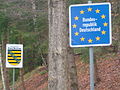 German border sign
 -
 Driving licences in the EU feature the twelve stars on a blue background with the country's distinguishing sign.
 -
 From 2021, identity cards issued in the EU display an EU flag with their two-letter country code.


.jpg)

.jpg)

.jpg)

Sixteen out of twenty-seven member states in 2007 signed the declaration recognising "the flag with a circle of twelve golden stars on a blue background" as representing "the sense of community of the people in the European Union and their allegiance to it."[123] In 2017, president of France Emmanuel Macron signed a declaration endorsing the 2007 statement,[124] so that, as of 2018, 17 out of 27 member states have recognised the emblem as a flag representing "allegiance to the EU": Austria, Belgium, Bulgaria, Cyprus, France, Germany, Greece, Hungary, Italy, Lithuania, Luxembourg, Malta, Portugal, Romania, Slovakia, Slovenia and Spain.
Italy has incorporated the EU flag into its flag code. According to an Italian law passed in 2000, it is mandatory for most public offices and buildings to hoist the European Flag alongside the Italian national flag (Law 22/1998 and Presidential Decree 121/2000). Outside official use, the flag may not be used for "aims incompatible with European values".[114] The 2000 Italian flag code expressly replaces the Italian flag with the European flag in precedence when dignitaries from other EU countries visit – for example the EU flag would be in the middle of a group of three flags rather than the Italian flag.[125] In Germany, the federal flag code of 1996 is only concerned with the German flag,[126] but some of the states have legislated additional provisions for the European flag, such as Bavaria in its flag regulation of 2001, which mandates that the European flag take the third order of precedence, after the federal and state flags, except on Europe Day, where it is to take the first order of precedence.[127]
In Ireland[128][129] on occasions of "European Union Events" (for example, at a European Council meeting), where the European flag is flown alongside all national flags of member states, the national flags are placed in alphabetical order (according to their name in the main language of that state) with the European flag either at the head, or the far-right, of the order of flags.
In most member states, use of the EU flag is only de facto and not regulated by legislation, and as such subject to ad hoc revision. In national usage, national protocol usually[clarification needed] demands the national flag takes precedence over the European flag (which is usually displayed to the right of the national flag from the observer's perspective). In November 2014, the speaker of the Hungarian Parliament László Kövér ordered the removal of the EU flag from the parliament building, following an incident in which a member of parliament had "defenestrated" two EU flags from a fourth story window.[130] In November 2015, the newly elected Polish government under Beata Szydło removed the EU flag from government press conferences.[131]
Derivative designs
[edit]The design of the European flag has been used in a variation, such as that of the Council of Europe mentioned above, and also to a greater extent such as the flag of the Western European Union (WEU; now defunct), which uses the same colours and the stars but has a number of stars based on membership and in a semicircle rather than a circle. It is also defaced with the initials of the former Western European Union in two languages.[132]
The European Parliament used its own flag from 1973, but never formally adopted it. It fell out of use with the adoption of the twelve-star flag by the Parliament in 1983. The flag followed the yellow and blue colour scheme however instead of twelve stars there were the letters EP and PE (initials of the European Parliament in the six community languages at the time) surrounded by a wreath.[133] Sometime later, the Parliament chose to use a logo consisting of a stylised hemicycle and the EU flag at the bottom right.
The flag of Bosnia and Herzegovina, imposed by High Representative Carlos Westendorp after the country's parliament failed to agree on a design, is reminiscent of the symbolism of the EU flag, using the same blue and yellow colours; also, the stars (although of a different number and colour) are a direct reference to those of the European flag.[134]
Likewise, Kosovo uses blue, yellow and stars in its flag, which has been mocked as a "none too subtle nod to the flag of the European Union, which is about to become Kosovo's new best friend as it takes over protector status from the United Nations".[135]
The flag of the Brussels-Capital Region (introduced in 2016) consists of a yellow iris with a white outline upon a blue background. Its colours are based on the colours of the Flag of Europe, because Brussels is considered the unofficial capital of the EU.[136][137]
-
![The blue and yellow colours of the Brussels flag are those of the European Union, of which Brussels is the de facto capital city.[137]](//upload.wikimedia.org/wikipedia/commons/thumb/b/bc/Flag_of_the_Brussels-Capital_Region.svg/250px-Flag_of_the_Brussels-Capital_Region.svg.png) The blue and yellow colours of the Brussels flag are those of the European Union, of which Brussels is the de facto capital city.[137]
The blue and yellow colours of the Brussels flag are those of the European Union, of which Brussels is the de facto capital city.[137] -
 The flag of Bosnia and Herzegovina was partly based on the European flag.[138]
 -
 Logo of the Council of Europe
 -
 Flag of the European Coal and Steel Community (1958–1972)
 -
 Flag of the European Coal and Steel Community (1973–1980)
 -
 Flag of the European Coal and Steel Community (1981–1985)
 -
 Flag of the European Coal and Steel Community (1986–2002)
 -
 The flag of Kosovo was partly based on the European flag.
 -
 Flag of the Western European Union (1993–1995)
 -
 Flag of the Western European Union (1995–2011)
 -
 Flag of the Assembly of the Western European Union
 -
 Flag of the European Parliament (1973–1983)
 -
 Flag of the European Maritime Safety Agency
 -
 Flag of the European Monitoring Centre for Drugs and Drug Addiction (until 2024)
 -
 EU emblem for certification of organic agricultural products
![The blue and yellow colours of the Brussels flag are those of the European Union, of which Brussels is the de facto capital city.[137]](https://en.wikipedia.org/wiki/File:Flag_of_the_Brussels-Capital_Region.svg)

.svg)


.svg)


.svg)


Heraldry
[edit]The coat of arms of the chairman of the European Union Military Committee (CEUMC), the highest-ranking officer within the EU's Common Security and Defence Policy (CSDP), depicts the European emblem as a coat of arms, i.e. emblazoned on an escutcheon. In heraldic terms, this makes the European flag is the banner of arms, i.e. the flag form of this coat of arms. In English blazon, the arms is Azure, a circle of 12 mullets or, their points not touching.[139]
Several EU publications related to the CSDP generally, and its prospective development as a defence arm, have also displayed the European emblem in this manner, albeit as a graphical design element rather than an official symbol.[140]
-
 Chairman Michail Kostarakos wearing the heraldic badge
 -
 Heraldic badge
 -
 Moldovan and Ukrainian flags displayed as supporters, symbolising the EU's border assistance mission since 2005
 -
 The European emblem emblazoned on a chair at the occasion of the 2004 signing of the European Constitution in Rome
 -
 The European emblem emblazoned on the Eiffel Tower in 2008
 -
 The European emblem emblazoned on the carpet in the European Court of Human Rights
._Arrivals_Michail_Kostarakos_(36892148436).jpg)


.jpg)
.JPG)
Incorrect versions
[edit]- Wrong flags
-
 The stars are upside down.
 -
 The stars point outwards instead of in one direction.
 -
 The stars should be arranged like a face of a clock, which is not the case in this flag.


- Correct flag
-
 Correct flag
See also
[edit]- Flags of the European Union's precursors
- Flag of the Western Union
- Flag of the Western European Union
- Flag of the European Coal and Steel Community
- Flags of other European unification movements
- Flag of the Paneuropean Union (adopted 1922)
- Hertensteiner Cross of the federalist movements (used in 1946)
- Federalist flag of the European Movement (adopted 1948)
- Other continental flags
Notes
[edit]- ^ Alternatively, it is sometimes called the flag of the European Union when representing the EU. The name "flag of the European Union" is used in e.g. the Italian law no. 22 of 5 February 1998 (bandiera dell'Unione europea), and by the Centre virtuel de la connaissance sur l'Europe (Le drapeau de l'Union européenne, 2016).
- ^ Some flags were proposed on several occasions. Therefore, the dates shown are the oldest dates on which the flag was first recorded.
- ^ Most of the documents sourced are from the Council of Europe webpage. Furthermore, some reconstructions were assisted by images of the flag sketches stored in the Digital Research in European Studies. Other reconstructions were made from descriptions in the documents and images provided by the European Council.
- ^ Probably Louis Wirion, who had already talked about reverting the colours in his first proposal.
References
[edit]- ^ a b c "The European flag". Council of Europe. Retrieved 8 December 2020.
- ^ "Emblème du Conseil de l'Europe". Council of Europe. 9 December 1955. Retrieved 8 December 2020.
- ^ a b c d "Council of Europe's Emblems". Council of Europe. Archived from the original on 7 August 2007. Retrieved 16 August 2007.
- ^ "Teams at the 2020 Ryder Cup at Whistling Straits, Kohler, WI, Sept. 22-27 brought to you by Rydercup.com". Archived from the original on 15 June 2019. Retrieved 3 October 2019.
- ^ name=1996guide>(in French) Guide graphique relatif à l'emblème européen (1996), p. 3: Description symbolique: Sur le fond bleu du ciel, les étoiles figurant les peuples d'Europe forment un cercle en signe d'union. Elles sont au nombre invariable de douze, symbole de la perfection et de la plénitude...Description héraldique: Sur fond azur, un cercle composé de douze étoiles d'or à cinq rais, dont les pointes ne se touchent pas. cf. "Graphical specifications for the European Emblem". European Commission. Archived from the original on 22 June 2006. Retrieved 4 August 2004.
- ^ https://www.coe.int/en/web/about-us/the-european-flag/
- ^ "Thirty-sixth meeting of the ministers' deputies: resolution (55) 32" (PDF). Council of Europe. 9 December 1955. Archived from the original (PDF) on 28 May 2009. Retrieved 2 February 2008.
- ^ "Guide graphique relatif à l'emblème européen" (in French). 1996. p. 3.
Description symbolique: Sur le fond bleu du ciel, les étoiles figurant les peuples d'Europe forment un cercle en signe d'union. Elles sont au nombre invariable de douze, symbole de la perfection et de la plénitude...Description héraldique: Sur fond azur, un cercle composé de douze étoiles d'or à cinq rais, dont les pointes ne se touchent pas.
- ^ "Graphical specifications for the European Emblem". European Commission. Archived from the original on 22 June 2006. Retrieved 4 August 2004.
- ^ a b "European Union Flag : University of Dayton, Ohio". udayton.edu. Retrieved 20 February 2019.
- ^ a b c "Real politics, at last?". The Economist. 28 October 2004. Retrieved 14 August 2011.
- ^ "Large full version of the window". venez-chez-domi.fr. Archived from the original on 27 February 2009. Retrieved 28 January 2009.
- ^ p. 309 of "Armorial des prélats Français du XIXème siècle"
- ^ a b c Carlo Curti Gialdino, I Simboli dell'Unione europea, Bandiera – Inno – Motto – Moneta – Giornata. Roma: Istituto Poligrafico e Zecca dello Stato S.p.A., 2005. ISBN 88-240-2503-X, pp. 80–85. Gialdino is here cited after a translation of the Italian text published by the Centre Virtuel de la Connaissance sur l'Europe (cvce.eu):
Irrespective of the statements by Paul M. G. Levy and the recent reconstruction by Susan Hood, crediting Arsène Heitz with the original design still seems to me the soundest option. In particular, Arsène Heitz himself, in 1987, laid claim to his own role in designing the flag and to its religious inspiration when he said that 'the flag of Europe is the flag of Our Lady' [Magnificat magazine, 1987]. Secondly, it is worth noting the testimony of Father Pierre Caillon, who refers to a meeting with Arsène Heitz. Caillon tells of having met the former Council of Europe employee by chance in August 1987 at Lisieux in front of the Carmelite monastery. It was Heitz who stopped him and declared "I was the one who designed the European flag. I suddenly had the idea of putting the 12 stars of the Miraculous Medal of the Rue du Bac on a blue field. My proposal was adopted unanimously on 8 December 1955, the Feast of the Immaculate Conception. I am telling you this, Father, because you are wearing the little blue cross of the Blue Army of Our Lady of Fatima".
- ^ "European Union: Myths on the flag". Flags of the World. 2002 [1995]. Retrieved 4 August 2007. "While Count Coudenhove-Kalergi in a personal statement maintained that three leading Catholics within the Council had subconsciously chosen the twelve stars on the model of Apocalypse 12:1, Paul M.G. Lévy, Press Officer of the Council from 1949 to 1966, explained in 1989 that there was no religious intention whatsoever associated with the choice of the circle of twelve stars." Peter Diem, 11 June 2002.
- ^ Pinzka, Thomas (26 August 1998). "Der Sternenkranz ist die Folge eines Gelübdes" [The crown of stars is the result of a vote]. Die Welt (in German). Retrieved 3 November 2018.
- ^ "L'origine chrétienne du drapeau européen" (in French). atheisme.org. Archived from the original on 8 March 2014. Retrieved 21 January 2009.
- ^ "Congrégation Mariale des Hommes" (in French). Cathédrale Notre-Dame de Strasbourg. 4 February 2004. Archived from the original on 14 November 2008. Retrieved 24 January 2009.
- ^ "Le vitrail de l'Europe de Max Ingrand" (in French). DRAC Alsace. Retrieved 14 October 2017.
- ^ a b "Graphical specifications for the European flag". Council of Europe. Archived from the original on 12 June 2004. "PANTONE REFLEX BLUE corresponds in the web-palette colour RGB:0/0/153 (hexadecimal: 000099) and PANTONE YELLOW corresponds in the web-palette colour RGB:255/204/0 (hexadecimal: FFCC00)."
- ^ (in French) Guide graphique relatif à l'emblème européen (1996), p. 3: Description symbolique: Sur le fond bleu du ciel, les étoiles figurant les peuples d'Europe forment un cercle en signe d'union. Elles sont au nombre invariable de douze, symbole de la perfection et de la plénitude...Description héraldique: Sur fond azur, un cercle composé de douze étoiles d'or à cinq rais, dont les pointes ne se touchent pas. cf. "Graphical specifications for the European Emblem". European Commission. Archived from the original on 22 June 2006. Retrieved 4 August 2004.
- ^ a b The 1996 guideline does not include any recommendation for RGB values.
The 2004 guideline published online by the CoE recommends "RGB:0/51/153 (hexadecimal: 003399)" for "PANTONE REFLEX BLUE" and "RGB:255/204/0 (hexadecimal: FFCC00)" for "PANTONE YELLOW" for the web palette (the limited 12 bit color space popular at the time).
These recommendations are by no means objective or universal. Other recommendations for "Reflex Blue" include:
- #0c1c8c (pantonecolors.org Archived 5 December 2017 at the Wayback Machine)
- #001489 (pantone.com Archived 14 August 2016 at the Wayback Machine)
- #00209F (colourlovers.com)
- #001789 (e-paint.co.uk)
- #171796 (encycolorpedia.com)
- ^ a b (in French) Guide graphique relatif à l'emblème européen (1996), p. 6: Le jaune est obtenu avec 100% de «Process Yellow». En mélangeant 100% de «Process Cyan» avec 80% de «Process Magenta», on obtient un bleu très semblable au Reflex Blue Pantone.
- ^ a b Council of Europe's new visual identity- Guide, Council of EUrope, 2013.
- ^ a b RGB and CMYK values are those given in the 2013 recommendation. Pantone recommendations for PMS 287: RGB #003087, CMYK 100.75.2.18 (pantone.com Archived 1 August 2021 at the Wayback Machine); for PMS 116: RGB #FFCD00, CMYK 0.14.100.0 (pantone.com Archived 25 July 2021 at the Wayback Machine).
- ^ Final Act, Official Journal of the European Union, 2007 C 306–2, p. 267 Declaration 52, consolidated EU treaties.
- ^ "EU Parliament set to use European flag, anthem". EU Business. 11 September 2008. Archived from the original on 12 September 2008. Retrieved 12 September 2008. The proposal was passed on 8 October 2008 by 503 votes to 96 (15 abstentions). Kubosova, Lucia (9 October 2008). "No prolonged mandate for Barroso, MEPs warn". EUobserver. Retrieved 9 October 2008.
- ^ a b c d e f g CVCE (ed.). "The European flag: questions and answers". Retrieved 25 June 2014.
- ^ (in French) Letter to the secretary general of the Council of Europe from Richard Coudenhove-Kalergi, Council of Europe.
- ^ Johan Fornäs, Signifying Europe (2012), p. 131.
- ^ a b Council of Europe fahnenversand.de
- ^ (in French) Letter from Richard Coudenhove-Kalergi regarding a Muslim modification to the Pan-Europa flag design, Council of Europe.
- ^ European Movement crwflags.com Proposals for the European flag Archived 15 July 2007 at the Wayback Machine crwflags.com
- ^ a b Murphy, Sean (25 January 2006). "Memorandum on the Role of Irish Chief Herald Slevin in the Design of the European Flag". Centre for Irish Genealogical and Historical Studies. Archived from the original on 5 December 2008. Retrieved 2 February 2009.
- ^ "Lettre d'Arsène Heitz à Filippo Caracciolo (Strasbourg, 5 janvier 1952)". CVCE. Retrieved 25 June 2014.
- ^ "Weekly broadcast of the Council of Europe, 6th October, 1953". Council of Europe. Retrieved 17 August 2021.
- ^ Rejected: Designs for the European Flag. Wirklichkeit Books. 10 December 2020. pp. 103–108. ISBN 9783948200039.
- ^ "Proposals for European flags from Arsène Heitz (1952–1955)". CVCE. 8 November 2011. Retrieved 17 August 2021.
- ^ "Recommendation 56(1) of the Consultative Assembly on the choice of an emblem for the Council of Europe (25 September 1953)". CVCE. Retrieved 25 June 2014.
- ^ "Account by Paul M. G. Lévy, a Belgian Holocaust survivor on the creation of the European flag". CVCE. Retrieved 25 June 2014.
- ^ a b "Memorandum from Paul Levy to Jacques-Camille Paris (Secretary General) about having a cross on the European flag". Council of Europe. 19 January 2020.
- ^ "Memorandum from Richard Coudenhove-Kalergi on the European flag (Gstaad, 27 July 1950)". CVCE.EU by UNI.LU. 12 March 2012. Retrieved 31 January 2021.
- ^ "Memorandum presented to the Council of Europe by Richard Coudenhove-Kalergi". Council of Europe. 26 January 2020.
- ^ "Memorandum of the Secretariat General on the European Flag". Council of Europe. 26 January 2020.
- ^ "European Flag". Council of Europe. 3 January 2020.
- ^ "CVCE.eu". CVCE.eu. 3 January 2020.
- ^ "Das Neue Europa Mit Dem Dauernden Frieden. Die Unionisierung Mitteleuropas. [The New Europe With Lasting Peace. The Central European Union.]". Cornell University Library. 3 January 2020.
- ^ "Sketch of a flag for the United States of Europe ("Union Stati Europa")". Council of Europe. 3 January 2020.
- ^ "Proposal by Camille Manné (Founder of the SICOP printing firm, Bischheim, Alsace, France)". Council of Europe. 3 January 2020.
- ^ "Flag showing the design by Camille Manet (Founder of the SICOP printing firm, Bischheim, Alsace, France)". Council of Europe. 3 January 2020.
- ^ a b c d e f g h i j k l "Memorandum of the Secretariat General on the European Flag". 3 January 2020.
- ^ a b c d e f g h i j k l "Proposals for flags submitted to the Consultative Assembly of the Council of Europe (December 1951)". CVCE.eu. 3 January 2020.
- ^ a b c d e f g h i j k l m n "Memorandum from Paul Levy to Antoine Fischer (Saisons d'Alsace?) – 12 proposals for a flag". Council of Europe. 3 January 2020.
- ^ "Letter from Richard Coudenhove-Kalergi to Jacques-Camille Paris (Secretary General) about using the red cross of the united states of Europe". Council of Europe. 3 January 2020.
- ^ "Memorandum presented to the Council of Europe by Richard Coudenhove-Kalergi about using the red cross of the United States of Europe". Council of Europe. 3 January 2020.
- ^ "etter from Louis Wirion (Luxembourg) to Paul Levy – proposals for a flag". Council of Europe. 3 January 2020.
- ^ a b von Lenthe, Jonas (2020). Rejected Designs for the European Flag. Wirklichkeit Books. ISBN 9783948200039.
- ^ "Letter from J. Dynan (Associated Press) to Paul Levy – proposals for a flag". Council of Europe. 3 January 2020.
- ^ "Letter from Arsène Heitz to Paul Levy. He proposes a red cross". council of Europe. 3 January 2020.
- ^ a b "European Flag: Memorandum by the Secretariat-General". Council of Europe. 3 January 2020.
- ^ a b c d e f g h "Proposals for European flags from Arsène Heitz (1952–1955)". CVCE.eu. 3 January 2020.
- ^ "Salvador de Madariaga proposes a design for the European flag". Council of Europe. 3 January 2020.
- ^ "Letter from Arsène Heitz to F. Caracciolo (Clerk of the Assembly). He proposes a red cross on a green background, inspired by Charlemagne's standard". Council of Europe. 3 January 2020.
- ^ "Extract of a letter from George Coedes on the Turks and the cross". Council of Europe. 3 January 2020.
- ^ "Letter from Paul Levy to Salvador de Madariaga on Turkish opposition to a cross". Council of Europe. 3 January 2020.
- ^ "Letter from Paul Levy to Richard Coudenhove-Kalergi on Turkish opposition to a cross". Council of Europe. 3 January 2020.
- ^ "Letter from Paul Levy to Richard Coudenhove-Kalergi. He suggests how to proceed as regards his proposal for a crescent shape to be added". Council of Europe. 3 January 2020.
- ^ "Design by Arsène Heitz – blue flag with the Turkish flag surrounded by stars in the top left-hand corner". Council of Europe. 3 January 2020.
- ^ "Design by Arsène Heitz – blue flag with the British flag on the top left, and 15 stars laid out in two concentric circles in the middle". Council of Europe. 3 January 2020.
- ^ "Design by Arsène Heitz – blue flag with the French flag on the top left, and 15 stars laid out in two concentric circles in the middle". Council of Europe. 3 January 2020.
- ^ "REPORT on the choice of an emblem for the Consultative Assembly of the Council of Europe". Council of Europe. 21 September 1953.
- ^ "Emblem adopted by the Consultative Assembly of the Council of Europe in 1953". Centre virtuel de la connaissance sur l'Europe. 25 September 1953.
- ^ "Azure design with a wreath of 15 stars in the middle". Council of Europe. 3 January 2020.
- ^ "The Assembly adopts a heraldic description of the flag design". Council of Europe. 3 January 2020.
- ^ "Design by Arsène Heitz – Blue flag with a yellow eight-pointed star in a red circle". Council of Europe. 3 January 2020.
- ^ "Design by Arsène Heitz – Blue flag with a red and white eight-pointed compass rose in the middle". Council of Europe. 3 January 2020.
- ^ "Design by Arsène Heitz – Blue flag with a star in the middle surrounded by twelve secondary stars". Council of Europe. 3 January 2020.
- ^ "The Committee of Ministers chooses the 12-star flag on an azure background as the European Flag. The European Community adopt the same flag in 1986". Council of Europe. 3 January 2020.
- ^ a b Regarding The "Adonnino Report" – Report to the European Council by the ad hoc committee "On a People's Europe", A 10.04 COM 85, SN/2536/3/85.
- ^ "bearing in mind the independence and the different nature of the two organizations, the Committee proposes to the European Council that the European Community emblem and flag should be a blue rectangle with, in the center, a circle of twelve five-pointed gold stars which do not touch, surrounding a gold letter E, of the design already used by the Commission." Adonnino Report, p. 31.
- ^ Tobias Theiler, Political Symbolism and European Integration, Manchester University Press, 2005 p. 61–65.
- ^ "not a compromise that the Commission itself cared much to abide by: from the outset, it generally used the terms 'Community flag' or, bolder still, 'European flag'." Tobias Theiler, Political Symbolism and European Integration, Manchester University Press, 2005 p. 6.
- ^ "Raising of the European flag in front of the Berlaymont (Brussels, 29 May 1986)". CVCE. 8 December 2011. Retrieved 25 June 2014.
- ^ Nicole Scicluna, European Union Constitutionalism in Crisis, Routledge (2014), p. 56.
- ^ Countries polled: Czech Republic, Estonia, Hungary, Latvia, Lithuania, Poland, Slovakia, Slovenia (joined 2004), Bulgaria and Romania (joined 2007). Central and Eastern Eurobarometer, Issue 8, European Commission, March 1998.
- ^ "Down with EU stars, run up stripes". BBC News. 8 May 2002.
- ^ "EU barcode". OMA projects.
- ^ "Austrian EU Presidency Logo". Dexigner. 21 October 2005.
- ^ "Belgium, Bulgaria, Germany, Greece, Spain, Italy, Cyprus, Lithuania, Luxembourg, Hungary, Malta, Austria, Portugal, Romania, Slovenia and the Slovak Republic declare that the flag with a circle of twelve golden stars on a blue background, the anthem based on the 'Ode to Joy' from the Ninth Symphony by Ludwig van Beethoven, the motto 'United in diversity', the euro as the currency of the European Union and Europe Day on 9 May will for them continue as symbols to express the sense of community of the people in the European Union and their allegiance to it." Final Act, Official Journal of the European Union, 2007 C 306–2, p. 267
- ^ Beunderman, Mark (11 July 2007). "MEPs defy member states on EU symbols". EUobserver. Retrieved 12 July 2007.
- ^ "EU Parliament set to use European flag, anthem". EU Business. 11 September 2008. Archived from the original on 12 September 2008. Retrieved 12 September 2008.
- ^ Kubosova, Lucia (9 October 2008). "No prolonged mandate for Barroso, MEPs warn". EUobserver. Retrieved 9 October 2008.
- ^ "To mark the 30th anniversary of the decision by EU leaders to adopt the flag as an EU emblem, the 19 euro area countries are issuing a special commemorative coin. Following an online competition held in 2015 by the European Commission, citizens and residents of the euro area selected the design created by Georgios Stamatopoulos, an engraver at the Bank of Greece. It comprises 12 stars that morph into human figures embracing the birth of a new Europe." (europa.eu)
- ^ "Further steps towards a European space policy". European Space Agency. Retrieved 11 February 2009.
- ^ Olympic Games 2004 – Congratulations from President Prodi, European Commission, 30 August 2004.
- ^ "While some fans of the European players in golf's Ryder Cup unfurl the flag of the European Union, many persist in waving their national flags despite the multinational composition of the European team." Alan Bairner, Sport, Nationalism, and Globalization: European and North American Perspectives (2001), p. 2. Rachman, Gideon (22 September 2006). "The Ryder Cup and Euro-nationalism". Financial Times. Retrieved 17 August 2008.
- ^ Mite (20 October 2004). "Belarus: Scores Arrested, Opposition Leader Hospitalized After Minsk Protests". Radio Free Europe/Radio Liberty. Retrieved 5 August 2007. Myers, Steven Lee; Chivers, C.J. (20 March 2006). "Election is landslide for leader of Belarus". International Herald Tribune. Archived from the original on 15 May 2008. Retrieved 9 July 2016.
- ^ "Belarusians had European March in Minsk". charter97.org. 14 October 2007. Retrieved 25 November 2007.
- ^ "Romania slams Moldova's sanctions". News.bbc.co.uk. 9 April 2009. Retrieved 12 December 2017.
- ^ Petersen, Alex (1 May 2007). "Comment – Georgia: Brussels on its mind". EUobserver. Retrieved 1 May 2007.
- ^ Gutterman, Steve (26 January 2004). "Saakashvili Sworn in as New President". The Moscow Times. Archived from the original on 5 December 2018. Retrieved 5 December 2018.
- ^ Petersen, Alexandros (2 May 2007). "Georgia: Brussels on its mind". Global Power Europe. Archived from the original on 28 September 2007. Retrieved 25 August 2007.
- ^ a b c "Photo from Reuters Pictures". Reuters Images, on Daylife. 9 May 2008. Archived from the original on 25 June 2008. Retrieved 9 May 2008.
- ^ "Government portal :: November 26, a meeting of the Government". Archived from the original on 3 March 2016. Retrieved 8 January 2015.
- ^ Grätz, Jonas (9 December 2013). "Revolution on Euromaidan". Foreign Affairs. ISSN 0015-7120. Retrieved 3 April 2018.
- ^ "Politics of brutal pressure". The Economist. 23 November 2013. Archived from the original on 25 December 2016.
- ^ "The Evolution Of Euromaidan". Radio Free Europe/Radio Liberty. 19 November 2014. Archived from the original on 3 April 2018.
- ^ The Times 27 June 2001, p. 14, cited after Ian Jeffries, The Former Yugoslavia at the Turn of the Twenty-First Century: A Guide to the Economies in Transition, Routledge (2003), p. 296.
- ^ G. Delanty in: David Denney (ed.), Living in Dangerous Times: Fear, Insecurity, Risk and Social Policy (2009), p. 124.
- ^ Blaming Sara B. Hobolt, James Tilley, Europe?: Responsibility Without Accountability in the European Union (2014), p. 3.
- ^ e.g. Jess Casey, Cork group burns flag during anti-EU rally outside City Hall, Evening Echo, 10 May 2017
- ^ "The euro". European Central Bank. Archived from the original on 6 August 2007. Retrieved 4 August 2007.
- ^ "Euro coins". European Central Bank. Archived from the original on 24 December 2007. Retrieved 28 December 2007.
- ^ a b "European Union: Legal use of the flag". Flags of the World. 10 September 2005. Archived from the original on 18 November 2009. Retrieved 29 November 2009.
- ^ Helm, Toby. "Embassy flagpole flies in the face of EU diplomacy". The Daily Telegraph. Archived from the original on 12 January 2022. Retrieved 13 April 2019.
- ^ Reid, Jenni. "Lufthansa flies a pro-European message ahead of EU elections". Retrieved 17 February 2020.
- ^ "Emblems". Europa (web portal). Retrieved 28 December 2007.
- ^ "Rejected proposal of a European civil ensign". Flags of the World. Retrieved 14 April 2008.
- ^ "Greenpeace screen EU flag on Prague Castle". Aktuálně.cz. 7 January 2009. Archived from the original on 18 October 2022. Retrieved 18 October 2022.
- ^ Rasmussen, Rina Valeur. "Celebration of Europe Day 9 May 2007 in Denmark". Politeia. Archived from the original on 29 September 2007. Retrieved 4 August 2007.
- ^ Rasmussen, Rina Valeur (9 May 2007). "London Eye lights up in colours of the European flag". Europa (web portal). Archived from the original on 19 August 2007. Retrieved 4 August 2007.
- ^ "EUFOR Welcome Ceremony/Unfolding EU flag". NATO. Archived from the original (PDF) on 11 June 2008. Retrieved 14 April 2008.
- ^ "Official Journal of the European Union, 2007 C 306–2, p. 267".
- ^ "Meeting of the EUROPEAN COUNCIL held on 19 October 2017". European Council. 17 January 2018. Retrieved 3 February 2018.EDER, FLORIAN (19 October 2017). "Manu joins EU flag club". Retrieved 3 November 2017. Cross, Tony (20 October 2017). "Macron squares up to Eurosceptics on EU flag, Brexit". Retrieved 3 November 2017.
- ^ The Rules of Protocol regarding national holidays and the use of the Italian flag (2001) Archived 19 December 2008 at the Wayback Machine Presidency of the Council of Ministers, Department of Protocol (2001). LAW No. 22 of 5 February 1998: "General Rules Governing the Use of the Flags of the Italian Republic and the European Union".
- ^ FlaggAO (BGBl. I S. 1729) 13. November 1996.
- ^ Flaggen-Verwaltungsanordnung (VwAoFlag) in der Fassung der Bekanntmachung vom 4. Dezember 2001 "§ 3 (1) Grundsätzlich werden die bayerische Staatsflagge, die Bundesflagge und, soweit möglich, die Europaflagge gemeinsam gesetzt. (2) 1 Der Bundesflagge gebührt die bevorzugte Stelle. 2 Sie ist grundsätzlich in der Mitte zu setzen, rechts anschließend, vom Innern des Gebäudes mit dem Blick zur Straße gesehen, die bayerische Staatsflagge und links die Europaflagge. 3 Am Europatag ist die Europaflagge an bevorzugter Stelle zu hissen."
- ^ "An Bhratach Náisiúnta / The National Flag". Department of the Taoiseach. Archived from the original (RTF) on 28 November 2007. Retrieved 28 December 2007.
- ^ "Order for European Union Events The European Union Flag: The national flags in order of their name in their primary local language." "Flying Flags in the United Kingdom" (PDF). Flag Institute. March 2010.
- ^ President of Hungarian parliament orders removal of EU flag Archived 22 May 2021 at the Wayback Machine, The Budapest Beacon 17 November 2014.
- ^ "EU flags disappear from Polish government press briefings". Business Standard India. Business Standard. 24 November 2015. Retrieved 31 January 2021.
- ^ "Western European Union". Flags of the World. Retrieved 11 February 2009.
- ^ "European Parliament". Flags of the World. 28 October 2004. Retrieved 4 August 2007.
- ^ "New flag imposed on Bosnians". BBC News. Archived from the original on 15 June 2018. Retrieved 6 April 2017. "Bosnia and Herzegovina – The 1998 Flag Change – Westendorp Commission – The Choice". Flags of the World. Archived from the original on 30 April 2008. Retrieved 11 February 2009.
- ^ "Kosovo's fiddly new flag". The Economist. 18 February 2008. Retrieved 11 February 2009.Quetteville, Harry de (19 February 2008). "Kosovo will need more than a new flag". The Daily Telegraph. Archived from the original on 12 January 2022. Retrieved 12 December 2017."flag of Kosovo". Encyclopædia Britannica. Retrieved 12 December 2017.
- ^ "Un nouveau look pour la région Bruxelles-capitale". brusselslife.be (in French). Retrieved 23 December 2016.
[Sander Vermeulen ajoute :] "Quant aux couleurs, elles rappellent celles du drapeau de l'Union européenne dont Bruxelles est la Capitale"
- ^ a b "Gewest gaat voor nieuwe vlag met hartjeslogo" [Region goes for new flag with hearts logo]. brusselsnieuws.be (in Dutch). Brussels. 17 December 2014. Retrieved 1 January 2015.
- ^ "BBC News | Europe | New flag imposed on Bosnians". Archived from the original on 15 June 2018. Retrieved 16 June 2017.
- ^ "Publications Office – Interinstitutional Style Guide – Annex A1 – Graphics guide to the European emblem". publications.europa.eu. Retrieved 28 December 2021.
- ^ "European Commission" (PDF). Archived from the original (PDF) on 29 June 2019. Retrieved 14 August 2019.
External links
[edit]
- Council of Europe on the flag
- EU's graphical specifications for the flag
- The symbols of the European Union: The flag of the Council Europe. Virtual Centre for Knowledge on Europe
- European Union at Flags of the World
- Memorandum on design and designer of European flag
| Sovereign states |
|  |
|---|---|---|
| States with limited recognition | ||
| Dependencies and other entities | ||
| Other entities | ||


Flag of Europe
View on GrokipediaDesign and Specifications
Official Elements and Blazon
The flag of Europe comprises a blue rectangular field bearing twelve identical five-pointed golden stars arranged symmetrically in a circle. The rectangle maintains a standard proportion of 2:3, wherein the fly (width) measures one and a half times the hoist (height). The stars, rendered in Pantone Yellow, are positioned at equal angular intervals along an imaginary circle centered on the flag, with the circle's radius equivalent to one-third of the flag's height. Each star features five equidistant points, the width of each point measuring one-ninth of the circle's diameter, ensuring the stars neither overlap nor touch. The background field employs Pantone Reflex Blue. Official descriptions from the Council of Europe and European Union emphasize these geometric and chromatic standards to guarantee uniform reproduction, though no traditional heraldic blazon exists; the design is instead defined through precise construction guidelines akin to a technical emblem specification.[3][6]Colors, Proportions, and Construction Standards
The flag of Europe is rectangular with a standard proportion of 2:3, meaning the height (hoist) to width (fly) ratio is 2:3.[7] Twelve five-pointed golden stars are arranged in a circle centered on the flag, with the centers of the stars positioned at equal intervals of 30 degrees around a circle whose radius equals one-third of the flag's height.[7] Each star is inscribed within a circle of diameter one-twelfth that of the circumscribing circle of star centers, equivalent to a radius of one-twenty-fourth the flag's height, and all stars are oriented with one point directed upwards.[7] The official colors are defined using the Pantone Matching System for precise reproduction: Reflex Blue (Pantone code not numerically specified in primary sources but equivalent to a deep blue) for the background field and Yellow (Pantone 116C or Process Yellow) for the stars.[7][8] For digital and print applications, approximate equivalents include RGB values of (0, 51, 153) for blue and (255, 204, 0) for yellow, with CMYK (100, 80, 0, 0) for blue and (0, 20, 100, 0) for yellow, though these are not official and variations existed in reproductions prior to the 1980s standardization efforts.[9][10] Construction standards mandate strict adherence to these proportions and positioning to prevent distortion or alteration, with tolerances limited to minor deviations in color shades due to medium constraints but prohibiting changes in star count, arrangement, or overall geometry.[7] Official guidelines from the Council of Europe and European Union emphasize using the international Pantone range for consistency across reproductions, ensuring the emblem's integrity in institutional and public displays.[11]Symbolism and Interpretations
Official Secular Symbolism
The European flag's official symbolism, as proclaimed by the Council of Europe on 8 December 1955 and later affirmed by the European Communities in 1986, centers on ideals of unity, solidarity, and harmony among Europe's peoples, independent of religious or numerical political affiliations. The design comprises twelve golden five-pointed stars arranged in a circle on an azure blue field, with the fixed number twelve denoting perfection, completeness, and totality—drawn from longstanding symbolic traditions—rather than reflecting the count of member states, which stood at fifteen for the Council of Europe at adoption and has since varied.[6][1] The circle of stars embodies the collective union of Europe's diverse peoples, positioned equidistantly to signify equality without hierarchy and their shared orientation toward perpetual cohesion and concord, evoking an ancient motif of wholeness.[12][13] The stars themselves symbolize these peoples as interdependent entities advancing common European aspirations, forming a dynamic emblem of solidarity that transcends specific institutional boundaries.[1] The blue background, selected to mirror the clear sky of the Western world, conveys vastness, serenity, and openness, aligning with heraldic conventions for evoking expansive horizons and peaceful expanse akin to Mediterranean and celestial expanses integral to European identity.[13][1] This secular interpretation underscores the flag's role as a neutral banner for continental collaboration, deliberately avoiding ties to any fixed geopolitical count to accommodate Europe's evolving political landscape.[6]Religious and Alternative Interpretations
Arsène Heitz, a devout French Catholic artist among those who submitted designs to the Council of Europe in the early 1950s, later revealed that his proposal of twelve golden stars on a blue field drew inspiration from Revelation 12:1, depicting a woman crowned with twelve stars, interpreted in Catholic tradition as the Virgin Mary, or Woman of the Apocalypse.[14] Heitz disclosed this connection in 1987, noting the flag's adoption on December 8, 1955, coincided with the Catholic Feast of the Immaculate Conception, though he had not publicized the biblical influence during the selection process.[15] This interpretation emerged amid post-World War II Europe's reconstruction under Christian Democratic leaders like Robert Schuman and Konrad Adenauer, who emphasized moral and spiritual renewal, yet the Council of Europe's official records show no endorsement of religious symbolism in the final choice. Alternative readings extend the twelve stars to represent the apostles, evoking early Christian symbolism of completeness and divine order, or the twelve months, symbolizing cyclical unity independent of religious doctrine.[3] These hypotheses parallel elements in the institution's description of twelve as a number denoting perfection—recalling apostles, months, or sons of Jacob—but diverge by prioritizing theological over secular connotations without institutional support.[3] In June 2025, Italian Foreign Minister Antonio Tajani asserted the flag embodies Europe's Judeo-Christian foundations, linking the blue background to Mary's mantle and the stars to the twelve tribes of Israel alongside the apostles.[16] Official fact-checks and Council of Europe statements refute this as unsubstantiated, attributing such views to cultural persistence rather than design intent, with no archival evidence of Judeo-Christian encoding.[16] These non-official interpretations stem from Heitz's personal piety and Europe's historical Christian matrix, but lack causal proof of deliberate institutional adoption, remaining speculative amid the flag's documented secular rationale.Historical Development
Origins with the Council of Europe (1949–1955)
The Council of Europe was established on May 5, 1949, in London by ten founding member states, emerging from post-World War II initiatives to promote human rights, democracy, and the rule of law across Europe without pursuing supranational political authority. Inspired in part by Winston Churchill's September 19, 1946, Zurich speech calling for a "United States of Europe" to foster reconciliation between historic rivals like France and Germany, the organization prioritized cultural and moral unity over economic or federal integration, reflecting a consensus among its intergovernmental structure.[17] [18] As early as 1950, amid growing pan-European cooperation efforts, the Council sought a symbolic flag to represent unity; numerous proposals were submitted informally to its Secretariat-General, including designs by French postal official Arsène Heitz, who contributed 21 entries between 1950 and 1955, and Belgian collaborator Paul M. G. Lévy, who suggested a circle of stars motif.[19] These submissions, totaling 101 by 1955, emphasized reconciliation and shared European heritage rather than institutional power, aligning with the Council's human rights mandate under the 1950 European Convention on Human Rights. On October 25, 1955, the Parliamentary Assembly unanimously approved a design featuring twelve golden stars in a circle on a blue field, selected for its evocation of completeness and harmony without reference to specific member counts.[3] The Committee of Ministers formally adopted it on December 8, 1955, as the Council's emblem, with the flag first hoisted shortly thereafter in Strasbourg, the organization's seat, to signal a post-war commitment to non-federal cultural solidarity.[1] This adoption underscored the flag's role in promoting voluntary cooperation among sovereign states, distinct from emerging economic communities like the 1951 European Coal and Steel Community.Adoption and Evolution in European Integration (1955–1986)
The European flag, established by the Council of Europe in 1955 as a cultural emblem of unity, began intersecting with the political framework of the European Communities in the ensuing decades, reflecting aspirations for deeper integration beyond mere economic cooperation. Its visibility increased following the 1958 Brussels Universal Exhibition, where it appeared in displays promoting Community ideals, signaling an early linkage between the flag's symbolism and supranational endeavors despite the absence of formal endorsement by the European Economic Community (EEC) or Euratom at the time.[20] The momentum for adoption accelerated after the first direct elections to the European Parliament on 7–10 June 1979, which introduced universal suffrage and heightened calls for visible symbols of a nascent European polity. The Parliament, seeking to cultivate a collective identity amid the Communities' expansion to nine members in 1973 and ongoing customs union completion, informally incorporated the flag into its proceedings and formally resolved its use in 1983, explicitly recommending that the European Communities embrace it as their emblem to underscore solidarity in economic policymaking.[3][1] This parliamentary initiative faced reticence from some member states prioritizing national sovereignty, yet progressed when the European Council—heads of state or government of the ten member states—endorsed the flag at the Milan summit on 28–29 June 1985, designating it the official emblem of the European Communities and thereby elevating its status from a voluntary cultural motif to a standardized institutional marker. The approval, occurring parallel to negotiations on internal market liberalization, highlighted a causal shift toward political cohesion, even as it navigated tensions between intergovernmental caution and federalist impulses within Community institutions.[2][21] Formal implementation followed on 29 May 1986, when the flag was raised for the first time outside the Berlaymont, the European Commission's Brussels headquarters, establishing de facto protocols for its display in official settings and symbolizing the Communities' alignment with the Council of Europe's design amid preparations for the Single European Act. This step consolidated the flag's role in projecting unity to 271 million citizens across the member states, bridging cultural heritage with emerging supranational governance without yet extending to a full political union.[1][21]Post-Adoption Developments and Usage Expansion
The flag's role in European integration advanced symbolically following the 1986 adoption by the European Communities, though it lacks explicit mention in primary EU treaties. The 2004 Treaty establishing a Constitution for Europe proposed enshrining the flag alongside other symbols in Part II on Union values, but the treaty failed ratification via referendums in France (55.7% against on May 29, 2005) and the Netherlands (61.6% against on June 1, 2005), leading to its abandonment.[22] Subsequent efforts under the 2007 Lisbon Treaty omitted formal symbol incorporation, relying instead on political declarations and institutional practice for continuity, with the European Parliament affirming its use in resolutions such as the 1985 decision on emblems.[1] Digital adaptations emerged in the 2010s to accommodate modern communication, including the approval of the 🇪🇺 flag emoji as a regional indicator sequence (U+1F1EA U+1F1FA) in Unicode 9.0 on June 21, 2016, enabling standardized representation across platforms without altering the core design.[23] This facilitated broader online visibility, aligning with EU efforts to digitize official symbols amid expanding internet usage, though no modifications to proportions, colors, or star configuration occurred post-1955 specifications.[1] Usage extended beyond EU institutions via the Council of Europe, which originated the flag in 1955 and maintains it as a pan-European emblem for its 46 member states as of 2025, including 19 non-EU countries such as the United Kingdom, Turkey, and Ukraine.[3] This framework promotes human rights and democracy across diverse political contexts, distinguishing the flag's general European application from EU-specific protocols while avoiding overlap with supranational integration symbols.[24] In 2025, the EU marked 40 years of institutional flag-flying since its initial raising in 1985, underscoring sustained expansion without substantive redesign.[21]Usage and Protocol
Official Institutional Applications
The European flag functions as the official emblem of the European Union, mandating its display at the organization's institutions, including the European Commission's headquarters in Brussels, the European Parliament's plenary sessions in Strasbourg, and additional facilities in Brussels and Luxembourg.[21] Institutions began hoisting the flag on 29 May 1986, following its formal adoption by the European Council on 28–29 June 1985 as the emblem of the European Communities, the EU's predecessor.[2] It is prominently featured at European Council summits and meetings of EU bodies, ensuring visual representation of unity during official proceedings.[1] As the enduring emblem of the Council of Europe since its adoption on 8 December 1955, the flag is utilized in the organization's institutional settings, such as its headquarters in Strasbourg, and accompanies events upholding the European Convention on Human Rights.[3] The Council of Europe's statutes implicitly endorse this usage through recognition of the flag as a core symbol of shared European values, distinct from but harmonized with EU applications.[3] Protocol for display within these institutions stipulates consistent positioning to maintain precedence and respect; when combined with member states' national flags, the latter are arranged in alphabetical order of country names, while the European flag holds a central or observer's right position to signify its supranational status.[1] This arrangement applies at bilateral EU engagements and multilateral forums hosted by adopting organizations, promoting standardized ceremonial practice across 27 EU member states and the Council of Europe's 46 members.[21] The flag's elements, notably the circle of twelve golden stars, also integrate into euro currency designs, appearing on banknotes introduced on 1 January 2002, with initial concepts dating to 1996.[25]National, Public, and International Contexts
In national contexts within EU member states, the flag is frequently displayed alongside national flags at public buildings and official events to signify alignment with European integration. For instance, Italian legislation mandates its use in conjunction with the tricolor at regulated sites, reflecting a formal integration of supranational symbolism into domestic protocol.[26] Similarly, anecdotal reports from various member states indicate routine flying on public offices, often positioned to the right of the national flag when viewed from the front, though prevalence varies by country and is not universally enforced beyond institutional guidelines.[27] At multinational events involving member states, such as the Olympic Games, the flag's display has been intermittent and subject to negotiation, underscoring its secondary role to national representations. Efforts to feature it prominently date back to at least 2004, when European Commission President Romano Prodi advocated for EU athletes to show it alongside national flags; this culminated in its first major appearance at the 2024 Paris Olympics, where it was displayed with the host nation's flag to represent the 27 member states collectively.[28][29] Pre-Brexit reluctance was evident in the United Kingdom's 2000 Berlin embassy opening, where the absence of a second flagpole for the EU flag—opting instead for the Union Flag alone outside and the EU flag indoors—sparked diplomatic friction with Germany and EU partners over perceived insufficient acknowledgment of shared membership.[30] In public spheres, the flag appears at sports competitions organized by bodies like UEFA, which, founded in 1954 shortly before the flag's 1955 design by the Council of Europe, incorporates it in events to evoke continental unity, predating formal EU adoption. Cultural gatherings, such as the Last Night of the Proms in the UK, have seen distribution of thousands of EU flags among attendees as of 2024, signaling grassroots enthusiasm amid post-Brexit dynamics.[31] Internationally, the flag accompanies the EU's enhanced observer status at the United Nations General Assembly, granted in 2011, where it is displayed by the EU delegation during sessions and events to denote its role in presenting unified positions on global issues.[32] Surveys reveal modest but observable attachment patterns; a 2022 Eurobarometer poll found 65% of Europeans viewing EU membership positively—the highest since 2007—while academic analysis posits that routine exposure to symbols like the flag fosters "banal Europeanism," a subtle, everyday supranational identification without overt political mobilization.[33][34]Instances of Restriction or Opposition in Practice
In May 2024, the European Broadcasting Union (EBU), organizer of the Eurovision Song Contest, prohibited the display of the EU flag by audience members during the grand final in Malmö, Sweden, citing rules to maintain political neutrality by allowing only flags of participating countries or rainbow pride flags.[35] This decision prompted strong backlash from the European Commission, which described it as a "completely regrettable mistake" and a "gift to the enemies of Europe," urging the EBU to rectify it for future events.[36] [37] The EBU later adjusted its policy for the 2025 contest to permit EU flags among fans in audience areas, though restrictions remained for onstage displays.[38] The EU imposes no legal requirement or enforcement mechanism for the display of its flag by member states or institutions, rendering its use entirely voluntary under established protocols.[39] In the United Kingdom, following Brexit's completion on February 1, 2020, the EU flag was systematically removed from official public buildings, including the lowering ceremony at the Senedd (Welsh Parliament) to symbolize the end of EU membership.[40] Commercial demand for EU flags in Britain plummeted by 90% after the 2016 referendum, reflecting reduced public and institutional prominence aligned with sovereignty restoration.[41] Eurosceptic protests have included acts of symbolic opposition to the EU flag, such as its burning by pro-Brexit demonstrators in London on March 29, 2019, amid frustrations over parliamentary delays in implementing the referendum result.[42] Such incidents underscore practical resistance in public settings, though they remain isolated and unprotected by any EU-wide prohibition on desecration, as flag disrespect lacks uniform penalties across member states.[43]Variants and Derivatives
Heraldic and Official Adaptations
The official heraldic blazon of the Flag of Europe is "Azure, a circle of twelve mullets Or, their points not touching," where the blue field (azure) represents the sky of the Western world and the twelve golden five-pointed stars (mullets) symbolize unity, perfection, and completeness among European peoples.[4] This description, formalized upon the flag's adoption by the Council of Europe on December 8, 1955, enables its adaptation as a charge or banner of arms in heraldic contexts without altering the core tinctures or arrangement, allowing integration into escutcheons for supranational bodies while adhering to traditional rules of tincture for visibility and contrast.[44] European Union institutions have incorporated the flag's elements into their heraldic representations, such as escutcheons featuring the circle of twelve mullets on an azure field to denote affiliation, as seen in official seals and emblems of bodies like the European Commission and European Parliament, where the design serves as a supranational overlay without supplanting institutional or national arms.[45] These adaptations maintain the flag's proportions—stars arranged in a circle with diameter equal to one-third the flag's hoist—and Pantone 280C blue with Pantone 013C gold, per specifications established in the 1980s to ensure uniformity across heraldic and vexillological uses.[1] The Council of Europe employs official derivatives for specific programs, such as defaced versions with overlaid text or logos (e.g., a stylized green "e" emblem for organizational branding), applied to the standard blue field and stars for initiatives like youth exchanges or cultural awards, provided the modifications do not obscure the twelve-star circle or alter symbolic intent.[46] Guidelines mandate retention of the flag's elemental integrity in these adaptations, prohibiting changes to star count, color, or positioning to preserve heraldic neutrality and avoid implications of expansionism or exclusion, as reinforced in EU emblem protocols adopted in 2017.[47] In member state insignia, such as regional escutcheons or EU-coordinated badges, the circle of stars is quartered or bordured alongside sovereign symbols, ensuring no dilution of national heraldry while signaling integrative cooperation.[48]Unofficial Versions and Common Errors
A frequent error in depictions of the European flag involves altering the number of stars to match the count of EU member states at a given time, such as using 15 stars during the mid-1990s enlargement period or 27 stars after Croatia's accession in 2013, under the misconception that the stars represent countries rather than a fixed symbol of unity and completeness. [1] The official design specifies exactly twelve golden stars arranged in a circle, a number chosen in 1955 for its historical associations with perfection in European culture, independent of membership fluctuations.[3] Color deviations commonly arise in reproductions, including faded or overly dark blue backgrounds (Pantone 286 C) and stars in shades deviating from Pantone 013 C yellow, often due to poor printing quality or unauthorized digital edits; such inaccuracies have been documented in public displays and media graphics since the flag's wider adoption in the 1980s. Other errors include inverting the flag, causing stars to appear rotated outward rather than uniformly oriented, or misalignment where stars fail to form a perfect circle.[48] Unofficial variants emerge in activist contexts, such as defaced flags with overlaid nationalist symbols or text during anti-EU protests; for instance, in March 2023, Georgian radicals from groups like Alt-Info removed and burned the flag outside parliament while adding inflammatory markings to protest foreign agent laws perceived as EU-influenced.[49] [50] Post-2016 Brexit memes proliferated digital alterations, like animations depicting a single star detaching to symbolize the UK's departure, amplifying the erroneous state-representation myth despite official debunkings.[51] To address proliferation of these errors via low-quality prints and online sharing, the European Commission issued updated communication guidelines in the 2010s, providing vector files and precise Pantone specifications for accurate reproduction in projects and public materials.[1] [52]Reception and Controversies
Achievements as a Unifying Symbol
The European flag has contributed to post-World War II reconciliation by embodying a shared commitment to peace and cooperation among nations previously divided by conflict, as evidenced by its adoption in 1955 amid efforts to foster continental solidarity through the Council of Europe.[3][5] Its display has aligned with integration milestones, such as the 1985 Schengen Agreement, which enabled passport-free travel across participating states and reinforced practical expressions of unity symbolized by the flag's circle of stars.[2][1] Experimental research indicates that exposure to the flag subtly enhances pro-European sentiment and perceptions of elite attachment to the European project, with incidental viewing activating affective components of identity similar to national flags.[53] Prolonged interaction with EU symbols, including the flag, has been shown to intensify feelings of European identity, supporting its role in gradual identity-building.[54] In public events, the flag promotes solidarity, as seen in its use during sports competitions like UEFA matches and cultural gatherings that highlight collective European achievements beyond national rivalries.[55] Adopted by the Council of Europe's 46 member states, the flag aids advocacy for human rights and democratic standards, serving as a visual anchor for transnational initiatives that transcend national boundaries.[3] Within the EU, it underpins campaigns for cohesion, such as those emphasizing skills development and mobility, where its presence reinforces messages of shared progress and opportunity across member states.[2][56]Criticisms Regarding Sovereignty and Imposition
Critics from Euroskeptic and nationalist perspectives have portrayed the EU flag as a symbol of supranational overreach that erodes national sovereignty by prioritizing federalist integration over independent state identities. In this view, the flag's mandatory or prominent display in public institutions represents an elite-driven push for centralized authority, detached from grassroots democratic consent in member states. For example, during European Parliament protests, members of the UK Independence Party (UKIP) explicitly rejected the flag, describing it as emblematic of "servitude inside a political union which the British people reject," framing it as antithetical to national self-determination.[57] Such sentiments gained traction in the UK during the 1990s and intensified through the Brexit campaign, where Euroskeptics contrasted the EU flag with national symbols to argue that its adoption signaled the subordination of domestic laws and borders to unelected Brussels bureaucracies. Similarly, in post-2010 Hungary under Prime Minister Viktor Orbán, government rhetoric has lambasted EU directives as impositions on sovereign decision-making, with symbolic displays like the flag seen as extensions of this perceived external control, despite public opinion polls showing majority support for EU membership amid elite-level contestation.[58][59] Empirical manifestations include protests where the flag has been targeted as a proxy for "traitorous" alignment with supranationalism; following Italy's 2022 national elections, which brought a Euroskeptic-leaning government to power, footage emerged of individuals removing EU flags from municipal buildings and replacing them with the Italian tricolor, acts interpreted as assertions of reclaimed autonomy. Surveys and discourse analyses further indicate uneven attachment, particularly in Eastern Europe, where the flag often evokes associations with regulatory bureaucracy rather than organic unity, reinforcing arguments that its promotion bypasses national priorities in favor of top-down convergence.[60][34]References
- https://commons.wikimedia.org/wiki/Armorial_of_the_European_Union