


Community hub
Recent from talks
Contribute something
Nothing was collected or created yet.
Bhowali
View on Wikipedia
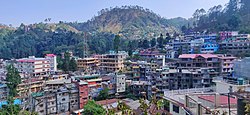
Bhowali (Kumaoni: Bhoāli)[bʱəʋaːli] is a town and municipal board in Nainital District in the state of Uttarakhand, India. It is situated at a distance of 11 km (6.8 mi) from the city of Nainital, the district headquarters; at an average elevation of 1,654 m (5,427 ft) from sea level. It is the seat of Bhowali tehsil, one of the eight subdivisions of Nainital district.
Key Information


Bhowali is most known for its T. B. sanatorium, established here in 1912.
Geography
[edit]Bhowali is located at 29°23′N 79°31′E / 29.38°N 79.52°E.[2] It has an average elevation of 1,654 metres (5,426 feet). Bhowali is a gateway to many places in the Kumaon division like Almora and Bageshwar for people coming from the Haldwani route. Many lakes neighbour Bhowali like Bhimtal, Sat Tal, Naukuchiyatal, Nal Damyanti Tal, Sukha Tal, and Khurpa Tal. It is 1706 meters above sea level and 11 km away from Nainital.
| Climate data for Bhowali | |||||||||||||
|---|---|---|---|---|---|---|---|---|---|---|---|---|---|
| Month | Jan | Feb | Mar | Apr | May | Jun | Jul | Aug | Sep | Oct | Nov | Dec | Year |
| Mean daily maximum °C (°F) | 11.1 (52.0) |
12.8 (55.0) |
17.2 (63.0) |
21.9 (71.4) |
25.2 (77.4) |
24.1 (75.4) |
21.2 (70.2) |
20.8 (69.4) |
20.8 (69.4) |
19.8 (67.6) |
17.0 (62.6) |
13.6 (56.5) |
18.8 (65.8) |
| Daily mean °C (°F) | 6.3 (43.3) |
7.6 (45.7) |
11.6 (52.9) |
16.0 (60.8) |
19.4 (66.9) |
19.3 (66.7) |
17.9 (64.2) |
17.6 (63.7) |
17.1 (62.8) |
14.9 (58.8) |
11.6 (52.9) |
8.4 (47.1) |
14.0 (57.2) |
| Mean daily minimum °C (°F) | 1.5 (34.7) |
2.4 (36.3) |
6.0 (42.8) |
19.1 (66.4) |
13.6 (56.5) |
14.6 (58.3) |
14.7 (58.5) |
14.5 (58.1) |
13.5 (56.3) |
10.0 (50.0) |
6.3 (43.3) |
3.3 (37.9) |
10.0 (49.9) |
| Average rainfall mm (inches) | 79 (3.1) |
51 (2.0) |
53 (2.1) |
25 (1.0) |
64 (2.5) |
246 (9.7) |
653 (25.7) |
517 (20.4) |
285 (11.2) |
122 (4.8) |
6 (0.2) |
26 (1.0) |
2,127 (83.7) |
| Source: Climate-Data.org[3] | |||||||||||||

Economy
[edit]
Bhowali is an important fruit market for all the neighbouring regions.
Education
[edit]
Uttarakhand Judicial and Legal Academy is the latest addition to the infrastructure of Bhowali. The foundation stone was laid on 19 December 2004 by R.C. Lahoti, the Chief Justice of India in the presence of N.D. Tiwari, the Chief Minister of Uttarakhand and V.S. Sirpurkar, the Chief Justice of Uttarakhand High Court and now the Judge of Supreme Court of India.
Demographic
[edit]| Year | Pop. | ±% |
|---|---|---|
| 1921 | 1,074 | — |
| 1931 | 705 | −34.4% |
| 1941 | 1,018 | +44.4% |
| 1951 | 1,895 | +86.1% |
| 1961 | 1,457 | −23.1% |
| 1971 | 2,193 | +50.5% |
| 1981 | 3,212 | +46.5% |
| 1991 | 4,364 | +35.9% |
| 2001 | 5,512 | +26.3% |
| 2011 | 6,309 | +14.5% |
| Source: District Census Handbook: Nainital[4]: 509–510 | ||
As of 2001[update] India census,[5] Bhowali had a population of 5302. Males constitute 54% of the population and females 46%. Bhowali has an average literacy rate of 80%, higher than the national average of 59.5%; with male literacy of 83% and female literacy of 77%. 11% of the population is under 6 years of age.
Transport
[edit]Bhowali is well connected by motorable roads with major destinations of Uttarakhand state and northern India. It is an important road junction, from where roads lead to neighbouring hill stations, like Nainital, Bhimtal, Mukteshwar, Ranikhet and Almora. Bhowali lies on the National Highway 109, which connects Rudrapur in Udham Singh Nagar district, Uttarakhand with Karnaprayag in Chamoli district. Uttarakhand Transport Corporation runs buses from Bhowali bus station to cities like Delhi and Dehradun.
The nearest airport is Pantnagar Airport, located at a distance of approx 65 km from the city. Indira Gandhi International Airport, located in Delhi is the nearest international Airport. Kathgodam railway station, located at a distance of approx 35 km is the nearest railway station. Kathgodam is the last terminus of the broad gauge line of North East Railways that connects Kumaon with Delhi, Dehradun and Howrah.
See also
[edit]References
[edit]- ^ "Bhowali Pin code". pin-code.net. Retrieved 26 June 2021.
- ^ Falling Rain Genomics, Inc - Bhowali
- ^ "Climate Bhowali: Temperature, Climate graph, Climate table for Bhowali - Climate-Data.org". en.climate-data.org. Retrieved 2 July 2019.
- ^ District Census Handbook Nainital Part-A (PDF). Dehradun: Directorate of Census Operations, Uttarakhand.
- ^ "Census of India 2001: Data from the 2001 Census, including cities, villages and towns (Provisional)". Census Commission of India. Archived from the original on 16 June 2004. Retrieved 1 November 2008.
External links
[edit]
 Bhowali travel guide from Wikivoyage
- Official Website of Nainital District

| International | |
|---|---|
| National | |
| Other | |

Bhowali
View on GrokipediaHistory
Origins and Early Settlement
The region encompassing Bhowali, situated in the Kumaon Himalayas, witnessed early human habitation by indigenous Kumaoni communities, who established scattered settlements along the hilly terrains to support pastoral and agricultural lifestyles. These communities, comprising Khasa and other local groups of mixed Indo-Aryan and Tibeto-Burman descent, adapted to the rugged landscape by building villages near water sources and fertile valleys, facilitating seasonal migrations and resource gathering. Archaeological evidence from the broader Kumaon area, including coin finds from the Kuninda period (2nd century BCE), indicates organized settlements emerging around trade hubs by the 4th century BCE, with patterns emphasizing communal land use and proximity to natural passes.[5] Ancient trade routes traversing the Kumaon hills played a pivotal role in shaping settlement patterns around the region, serving as vital links between the Gangetic plains and Tibetan plateaus. These paths, active from at least the early centuries CE, involved exchanges of goods like salt, wool, grains, and metals, navigated by Bhotia traders during summer months through challenging terrains such as shankupatha (steep inclines). The area's location at strategic junctures in these routes fostered small habitations for rest and barter, as evidenced by numismatic remains in nearby Almora.[5] Historical records point to pre-18th century habitation through enduring religious sites, such as the Prachin Jabar Mahadev Temple in Bhowali, featuring an ancient wooden Shivling symbolizing long-standing Shaivite worship among local communities. Similarly, the nearby Golu Devta Temple at Ghorakhal, dating to the Katyuri dynasty era (7th-11th centuries), underscores indigenous devotion to the deity as an incarnation of Shiva and arbiter of justice, with its construction reflecting early architectural and cultural practices in the region.[6][7] During the medieval period, under the Chand dynasty (circa 10th-18th centuries), the Kumaon kingdom integrated local settlements into a networked economy, supporting internal trade and administrative movements between capitals like Champawat and Almora. Hill passes in the region aided the flow of resources and pilgrims, reinforcing communal ties without significant urban development in peripheral areas.Colonial Era and Modern Development
During the British colonial period, Bhowali emerged as a significant health retreat in the Kumaon hills, primarily due to the establishment of the King Edward VII Sanatorium in 1912. This facility, the first government-run tuberculosis sanatorium in India, was designed to leverage the region's high altitude and fresh air for open-air treatment of TB patients, initially focusing on European soldiers and civilians but later extending to Indian patients.[8] The sanatorium's creation reflected broader colonial efforts to address public health challenges in hill stations, transforming Bhowali from a peripheral village into a recognized medical hub.[9] In the early 20th century, Bhowali developed further as a key road junction, facilitating connectivity between Nainital and other parts of the Kumaon region. British infrastructure initiatives, including the expansion of roads from Nainital to Bhowali and beyond to Kathgodam and Kaladhungi, enhanced its role as a transit point for administrative, commercial, and military movements.[10] This positioning solidified Bhowali's strategic importance within the colonial network of hill stations, supporting the flow of goods and people across the Himalayan foothills.[11] Following India's independence in 1947, Bhowali underwent gradual modernization while retaining its historical functions. The town's integration into the newly formed state of Uttarakhand in 2000 marked a pivotal shift, aligning it with state-level development policies aimed at balanced growth in the hill regions. Recent urban planning efforts, such as those under the Nainital Lake Region Special Area Development Authority (established in 1989 and expanded in 1994 to include Bhowali), have focused on sustainable infrastructure, land use regulation, and environmental resilience to manage rapid urbanization and tourism pressures.[12] These initiatives, including integrated urban development projects funded by international bodies, emphasize controlled expansion to preserve Bhowali's ecological and historical integrity.[13]Geography and Environment
Location and Topography
Bhowali is located in the Nainital district of Uttarakhand, India, at coordinates 29°23′N 79°31′E, serving as a key gateway to the Kumaon division of the Himalayas.[14] Situated at an elevation of 1,654 meters above sea level, it lies in the Lesser Himalayan foothills, characterized by undulating terrain that transitions from lower valleys to higher ridges.[6] This positioning places Bhowali approximately 11 kilometers northeast of Nainital, the district headquarters, facilitating its role as a transitional hub between the plains and the higher Kumaon hills.[15] The surrounding landscape includes prominent nearby lakes such as Bhimtal, Sat Tal, and Naukuchiyatal, which are nestled within 10-15 kilometers and contribute to the region's scenic undulations.[16] Encircled by rolling hills and ridges, Bhowali's topography features steep slopes and plateaus that rise toward the snow-capped Himalayan peaks to the north, offering panoramic views of the Kumaon range.[6] These hills, often cloaked in dense oak and deodar forests, form natural barriers and corridors that enhance the area's rugged yet accessible character.[6] Topographically, Bhowali is part of a dendritic drainage pattern typical of the tectonically active Bhimtal-Naukuchiatal basin, where local streams like the Shipra River channel surface runoff southward into larger Kumaon waterways such as the Kosi.[17] This network supports the regional hydrology by facilitating efficient water flow from the forested uplands, mitigating erosion in the variable Himalayan relief.[18] The oak and deodar-dominated forests, prevalent on the slopes, play a stabilizing role in this drainage system, binding soils and regulating seasonal flows.[6]Climate and Biodiversity
Bhowali experiences a temperate hill station climate characterized by distinct seasonal variations. Summers from April to June are mild and pleasant, with average daytime temperatures ranging from 24°C to 30°C and cooler nights around 15°C. Winters, spanning December to February, are cold, with daytime highs of 10°C to 15°C and nighttime lows occasionally dropping to 0°C or below -7°C in extreme cases. The monsoon season from July to September brings heavy rainfall, contributing to an annual precipitation of approximately 1,200 to 1,600 mm, which supports the lush vegetation but can lead to landslides.[19][20][21] The region's biodiversity reflects its location in the Himalayan foothills, featuring diverse flora dominated by coniferous and broadleaf forests. Prominent tree species include deodars (Cedrus deodara), oaks (Quercus spp.), pines (Pinus roxburghii), and rhododendrons, which form dense canopies providing habitat for various understory plants and medicinal herbs. Fauna is equally rich, with over 200 species of birds such as the Himalayan monal and cheer pheasant, alongside mammals including leopards, barking deer, and langurs; reptiles and insects further enhance the ecological complexity. Nearby protected areas, such as the Pangot and Kilbury Bird Conservation Reserve, safeguard these species and serve as corridors for migratory birds.[22][23][24] Environmental challenges in Bhowali include risks of deforestation from anthropogenic activities like fuelwood collection and grazing, which threaten oak-dominated forests vital for soil conservation and water retention. Climate change exacerbates these issues through increased forest fires and altered precipitation patterns, leading to biodiversity loss. Conservation efforts by the Uttarakhand Forest Department, including compensatory afforestation under the CAMPA program in the Bhowali Range, aim to mitigate these threats by planting native species and promoting community involvement in habitat restoration.[25][26][27]Demographics
Population Trends
Bhowali's population has shown steady growth over the decades, reflecting broader trends in Uttarakhand's hill regions. According to the 2001 Indian census, the town had a total population of 5,512, with males comprising 53.8% (2,963) and females 46.2% (2,549).[28] By the 2011 census, this figure rose to 6,309, marking a decadal growth rate of 14.46%, driven by natural increase and limited inward migration.[29] Of the 2011 total, males numbered 3,304 (52.4%) and females 3,005 (47.6%), indicating a slight shift toward a more balanced sex ratio. The literacy rate in 2011 was 93.07% (male: 96.47%, female: 89.27%).[30]| Census Year | Total Population | Male Population | Female Population | Decadal Growth Rate (%) |
|---|---|---|---|---|
| 2001 | 5,512 | 2,963 | 2,549 | - |
| 2011 | 6,309 | 3,304 | 3,005 | 14.46 |