Hubbry Logo
BhimtalBhimtalMain
Open search
Bhimtal
Community hub
Bhimtal
logo
8 pages, 0 posts
0 subscribers
Be the first to start a discussion here.
Bhimtal
Bhimtal
from Wikipedia

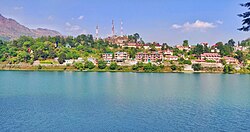
Bhimtal (Kumaoni: Bhīmtāl) is a town and a nagar palika, near Nainital city in Nainital district in the state of Uttarakhand, India. It is situated at an altitude of 1370 meters above sea level and is about 22 kilometers from Nainital. The city is near Bhimtal Lake.

Key Information

Climate

[edit]

The climate of Bhimtal is pleasant and salubrious during summers but very cold during winters. Summer temperatures range from 15 °C to 29 °C, while winter temperatures range from 4 °C to 18 °C.

History

[edit]

Bhimtal is an ancient place named after Bhima of Mahabharata. Bhimeshwara Mahadev Temple, an old Shiva temple on the bank of Bhimtal lake, is believed to have been built when Bhima visited the place during the banishment (vanvas) period of Pandavas. The present temple was built in the 17th century, by Baz Bahadur (1638–78 AD), a King of the Chand dynasty, and the Raja of Kumaon.[1][2]

Bhimtal is older than nearby Nainital as the city of Nainital is just 150–160 years old. Bhimtal was a stoppage on an old pedestrian road, which connects nearby Kathgodam to all Kumaon region cities and Nepal and Tibet.

Institutions

[edit]
Kumaon campus of Graphic Era Hill University

The government constructed the Vikas Bhawan building in Bhimtal and most of the District Administration offices of Nainital District are located in the complex.

There are many government and private institutions in Bhimtal, including Tasar Regional Research Center (Ministry of Textile, Govt. of India), National Cold Water Fisheries Institute, Jan Sikshan Sansthan, and Birla Institute of Applied Sciences.

Demographics

[edit]

As of 2011 India census,[3] Bhimtal had a population of 7722, a 31.46% increase in population compared to 2001. Sex ratio is 885. Bhimtal has an average literacy rate of 93.67%, higher than the national average of 74.04%; with male literacy of 95.28% and female literacy of 91.79%. 11% of the population is under 6 years of age. The major first language is Kumaoni.

The dam by the Bhimtal Lake and the Bhim temple at Bhimtal, 1895

See also

[edit]

References

[edit]
Revisions and contributorsEdit on WikipediaRead on Wikipedia
from Grokipedia
Bhimtal is a picturesque town and its namesake lake in the Kumaon region of , , , located at an elevation of 1,370 meters and approximately 22 kilometers from . The lake, the largest in the area at 47 hectares and C-shaped, is renowned for its emerald green waters, serene surroundings of and forests, and as a central hub for , blending natural beauty with mythological significance. Named after the brother from the epic, legend holds that he created the lake during his exile, making it a site of cultural and historical resonance. Geographically, Bhimtal lies nestled amid terraced hills and verdant landscapes, offering panoramic vistas and serving as a with over 240 species of and a haven for migratory birds during winter months. The lake's pristine environment supports activities like and , while nearby sites such as the 17th-century Bhimeshwar Mahadev Temple complex, located near a 40-foot-high , add to its spiritual allure. The town also features an island in the lake, 91 meters from the shore, housing an aquarium that showcases local aquatic life, accessible via paddle boats. Historically, Bhimtal may have been a on the ancient silk route connecting to and , evidenced by its strategic location and preserved colonial-era bungalows alongside traditional Kumaoni architecture. The Folk Culture Museum (Lok Sanskriti Sangrahalaya), established in , preserves the region's ethnographic heritage, including artifacts from local communities. As an educational center, it hosts several institutions, contributing to its year-round appeal beyond peak tourist seasons of to and to . Bhimtal's attractions extend to adventure and eco-tourism, including trekking to Hidimba Parvat, over the lake, and at nearby Padampuri, while the Stargate Observatory, just 3 kilometers away, facilitates stargazing. Surrounding lakes like Naukuchiatal (4 kilometers away, known for its nine corners) and Nal Damyanti Tal enhance its status as part of the Lakes of Kumaon circuit, drawing visitors for and nature trails. Accessible by road from (28 kilometers) or rail from station (22 kilometers), it remains a tranquil retreat emphasizing amid its rich ecological and cultural tapestry.

Geography

Location and Topography

Bhimtal is situated in the of , , approximately 22 km northeast of the district headquarters at . The town lies at geographical coordinates 29°21′N 79°34′E and reaches an elevation of 1,370 meters (4,495 ft) above sea level, positioning it as a key in the region. This placement within the places Bhimtal at the intersection of accessible transport routes and natural landscapes, facilitating its role as a gateway to nearby attractions. Topographically, Bhimtal occupies the foothills of the Kumaon Himalayas, characterized by undulating terrain with terraced hills formed through geological uplift and erosion processes. The area is enveloped by dense forests of and , which cloak the surrounding slopes and contribute to its verdant, forested ambiance. Geologically, Bhimtal forms part of the Himalayan , where intramontane deposits of fluvio-lacustrine and colluvial origins have shaped the valley floors and basins over time. The is further defined by its proximity to other water bodies, including Naukuchiatal about 4 km to the south and roughly 12 km away, creating a interconnected amid the hilly landscape. Administratively, Bhimtal operates as a nagar palika, or municipal council, overseeing an area of 18.4 square kilometers that incorporates the town center and extends to include adjacent villages within its boundaries. This municipal jurisdiction supports local governance while preserving the integrated rural-urban fabric of the region. The central serves as a defining topographic feature, influencing the settlement patterns and valley contours around it.

Bhimtal Lake

Bhimtal Lake is a freshwater body situated in the Kumaon region of the , serving as the central natural feature of the surrounding town. Formed through natural damming processes, it exemplifies the intramontane lakes characteristic of this tectonically active zone. The lake's clear waters and stable contribute to its role as a vital ecological asset, supporting a diverse and influencing the local by moderating and variations. Geologically, the lake originated during the Pleistocene epoch, approximately 40,000 years , due to the blocking of a by massive debris flows associated with tectonic activity and landslips in the Lesser Himalayan belt. This event, linked to fault movements and seismic influences in the Kumaon Lesser Himalaya, created a natural basin that has persisted amid ongoing tectonic deformation. The surrounding of steep slopes and forested hills enhances the lake's scenic isolation, funneling runoff into the basin while protecting it from excessive . In terms of dimensions, the lake measures approximately 1.8 km in length and 0.4 km in width, with a surface area of approximately 0.48 square kilometers (47.8 hectares) and a maximum depth reaching 26.5 meters. Its catchment spans 11.4 square kilometers, primarily comprising forested uplands that contribute to its hydrological balance. The lake is fed mainly by underground springs and seasonal , with subsurface inflows accounting for 35 to 80 percent of the total input during and non-monsoon periods, respectively. Outflow occurs via a narrow stream that drains into the Gaula River, maintaining water levels and preventing stagnation. Hydrologically, Bhimtal Lake exhibits oligotrophic to mesotrophic characteristics, with low nutrient levels and minimal , attributed to limited anthropogenic inputs and effective natural filtration through its spring-fed system. This supports a balanced , fostering in , , and invertebrate communities while contributing to regional . The lake's role in the local is evident in its capacity to retain heat and moisture, which helps stabilize ambient conditions in the adjacent valley.

Climate

Overview

Bhimtal features a under the Köppen Cwa, marked by distinct seasonal variations influenced by its Himalayan . This climate type is characterized by warm to hot summers, cool winters, and significant rainfall, with the elevated moderating temperatures relative to lower-lying regions. The annual average temperature in Bhimtal ranges between 15°C and 20°C, reflecting a temperate profile shaped by the altitude of approximately 1,370 meters, which results in cooler conditions than the nearby plains. Summer months from to see daily high temperatures of 25–30°C, while winter periods from to bring lows of 5–10°C. typically varies from 60% to 80% throughout the year, with fog and mist frequently occurring in winter due to the mountainous setting. Annual precipitation averages 1,500–2,000 mm, predominantly concentrated during the monsoon season from to , which accounts for the bulk of the yearly total. These patterns show a slight upward trend in temperatures, linked to broader effects in the Himalayan region, with recent studies confirming continued warming into the 2020s.

Seasonal Variations

Bhimtal experiences distinct seasonal weather patterns influenced by its location in the Kumaon at an of approximately 1,370 meters, leading to variations in temperature, precipitation, and environmental conditions that affect visibility, , and local habitability. During summer from to , the region features warm days with average highs reaching 25–28°C and clear skies that enhance visibility for outdoor pursuits, though occasional heatwaves can push temperatures up to 32°C, particularly in May and . This period supports vibrant growth, with blooming contributing to a habitable environment conducive to agricultural activities and daily life, though higher toward signals the onset of . The monsoon season from July to September brings heavy rainfall, accounting for about 70–80% of the annual precipitation total of around 1,500–1,700 mm, transforming the landscape into lush greenery with dense foliage that improves air quality but also heightens landslide risks along the hilly slopes. Reduced visibility from frequent clouds and mist during intense downpours can disrupt travel and habitability, with saturated soils leading to potential erosion and temporary isolation of communities. Bhimtal Lake levels fluctuate notably with this seasonal rainfall, rising significantly during peak months like July and August. In recent years, including 2024 and 2025, monsoons have become more erratic with intense bursts following dry spells. Winter spans October to February, characterized by cool and dry conditions with average highs of 15–20°C dropping to lows of 5–10°C, and rare snowfall at this altitude, though frost occurrences are common in December and January, occasionally coating vegetation in a thin layer that limits early morning mobility. Post-monsoon autumn in October offers vibrant foliage with trees displaying shades of red, orange, and yellow, boosting scenic visibility and creating a serene, habitable atmosphere that draws residents outdoors despite the cooling trend. Fog often reduces visibility in valleys during mornings, but overall drier air supports comfortable living with minimal precipitation disruptions. Recent climate reports from the 2020s indicate increasing erratic monsoons in , with prolonged dry spells followed by intense bursts of rain exacerbating landslide vulnerabilities and altering vegetation cycles, while frost events in winter remain a notable hazard for frost-sensitive crops and infrastructure. In 2025, the Himalayan region, including , experienced unusual summer scorching with higher-than-average temperatures. These trends underscore shifting habitability challenges, including heightened risks during unpredictable wet periods contrasted with clearer, more stable conditions in other seasons.

History

Etymology and Legends

The name Bhimtal derives from , the second brother renowned for his immense strength in the Hindu epic , combined with "tal," a Kumaoni term meaning lake. Local lore attributes the town's naming to Bhima's purported visit to the region during the Pandavas' exile, where he is said to have either created or discovered the lake as a vital source. In the , the name is rendered as Bhīmtāl, reflecting its deep roots in regional nomenclature for water bodies. Central to Bhimtal's legends is the myth of Bhima using his gada, or mace, to form the lake. According to one oral tradition, during the Pandavas' forest exile in the Kumaon hills, Draupadi grew parched and demanded water; unable to find any, Bhima struck the ground with his mace, causing a crater that miraculously filled with spring water to create the lake. An alternate version recounts Bhima's duel with the demon Hidimba near the site; victorious but exhausted, he thrust his mace into the earth, from which water gushed forth, forming Bhimtal as a symbol of his prowess. Another account describes Bhima hearing a divine voice while traversing the Himalayas, prompting him to construct the nearby Bhimeshwara Mahadev Temple before striking the ground with his mace to summon a fountain that birthed the lake, thereby linking the site to both natural and spiritual origins. These narratives hold significant cultural resonance in Kumaoni folklore, embodying themes of strength, devotion, and , and they connect Bhimtal to broader Mahabharata-inspired tales prevalent in the Himalayan region, including associations with nearby sacred sites.

Historical Development

Bhimtal, located in the Kumaon region, formed part of the medieval Kumaon Kingdom governed by the Chand dynasty from the 10th to the , during which the area served as a vital link in regional networks. The town's strategic position facilitated trade routes connecting the Himalayan hills to the plains of , acting as a key stopover for caravans from and en route to , potentially integrating into broader ancient pathways like the silk route. This role underscored Bhimtal's importance in the exchange of goods such as salt, wool, and grains, supporting the economic vitality of the Chand rulers, who maintained control over Kumaon despite mid-18th century invasions by forces, until the Gorkha conquest in 1790. Following the decline of the Chand dynasty, the Gorkha Kingdom conquered Kumaon in 1790 and ruled until their defeat by the British in 1815 during the . A notable from the Chand era is the Bhimeshwar Temple, an ancient shrine reconstructed in the 17th century under King of the Chand dynasty, symbolizing the integration of religious sites into the kingdom's administrative and . During the British colonial period, Bhimtal gained prominence as a transit point on and routes to , with European settlers establishing bungalows along the lake shores that blended colonial architecture with local Kumaoni styles. Following the annexation of Kumaon in 1815, the British enhanced , including the of the Victoria Dam in 1883 near the Bhimeshwar Temple, which not only regulated water flow for and drinking supply but also enabled activities, transforming the lake into a recreational hub. This development positioned Bhimtal as a serene retreat amid the expanding network, though it remained secondary to nearby until the late 19th century. Post-independence, Bhimtal was part of the United Provinces, renamed in 1950, as part of the , experiencing steady growth as a residential and tourist of driven by increased domestic travel. The 1970s and 1980s marked an infrastructure surge, with expansions in housing, roads, and hospitality facilities catering to rising visitor numbers, fueled by 's emerging economy. The formation of as a separate state in 2000 further accelerated development, including the establishment of the Folk Culture Museum in 1983 to preserve regional artifacts, and post-2010 initiatives promoting eco-tourism through lake conservation and sustainable activities like aquariums and adventure sports. These efforts have solidified Bhimtal's evolution from a historical node to a balanced eco-destination.

Demographics

Population Statistics

According to the , Bhimtal had a total of 7,722, consisting of 4,157 males and 3,565 females. This marked a decadal growth rate of 31.46% from the 2001 of 5,873. The was 857 females per 1,000 males, and the child aged 0-6 years accounted for 852 persons, or 11.0% of the total. stood at 1,955 persons per square kilometer over an area of 3.95 square kilometers. As a , Bhimtal is classified as an . The rate was 83.4%, surpassing the Uttarakhand state average of 78.82%. The 2021 Census of India was postponed and has not been conducted as of 2025; thus, the 2011 data remains the most recent official figures. Assuming an annual growth rate of approximately 2.8% based on the 2001-2011 trend, the is to reach about 11,300 by 2025. Demographic trends show increasing in-migration from surrounding rural areas, driven primarily by opportunities in .

Cultural Composition

The cultural composition of Bhimtal reflects the broader Kumaoni heritage of the Kumaon region in , where the majority of residents are of Indo-Aryan descent, known for their deep connection to the Himalayan landscape and traditional agrarian lifestyles. Migrant workers from the plains, attracted by the sector, add layers to the local social fabric. Kumaoni serves as the primary language in Bhimtal, spoken widely among the local population, while functions as the and is used in administration and daily interactions. English is commonly employed in educational institutions and tourism-related contexts. Local dialects of Kumaoni exhibit influences from neighboring Garhwali, reflecting the region's linguistic interconnections. Hinduism dominates the religious landscape, with approximately 90.8% of Bhimtal's residents following the faith, centered around temples such as the Bhimeshwar Mahadev Temple overlooking the lake. Festivals like , marking the onset of the monsoon and new harvests through rituals involving seed sowing and folk dances, and , celebrated with unique Kumaoni customs such as lighting oil lamps around homes, underscore this heritage. Minority communities, including (about 0.3%) and (around 8.2%), maintain their own traditions, such as Gurpurab and Eid, fostering interfaith harmony in the town. Socially, Kumaoni families in Bhimtal traditionally adhere to joint family structures, where the eldest male often serves as the head, emphasizing collective decision-making and support. Gender roles are evolving, particularly through increased access to and women's participation in community activities, though traditional practices like arranged marriages with matching persist. Cultural preservation is evident in the continuation of , such as the resonant Jhoras and dances performed during festivals, and handicrafts like Aipan floor art, which embody the region's artistic legacy.

Economy and Tourism

Local Economy

The local economy of Bhimtal is predominantly agrarian, with serving as the primary sector and supporting a significant portion of the through cultivation on terraced slopes. Key crops include potatoes, apples, and off-season such as tomatoes, , and peas, which are promoted in the Bhimtal block to leverage the region's and altitude for year-round production. These activities contribute substantially to household livelihoods, with farming as the primary income source for approximately 39% of households in the area. Small-scale complements , involving the sale of local produce in nearby markets, while traditional handicrafts like —featuring intricate Likhai designs on deodar and wood—and ringaal () weaving provide supplementary income for artisans in the Kumaon hills. Employment patterns reflect the rural character of Bhimtal, where around 60% of the rural workforce engages in and allied activities, including from and surrounding ponds. The informal sector dominates, encompassing family-based farming, seasonal labor, and artisanal work, which accounts for the majority of job opportunities in the absence of large-scale industry. Fisheries, supported by the ICAR-Central Institute of Coldwater Fisheries Research (ICAR-CICFR) based in Bhimtal, generate an estimated 50-100 tons of fish annually from local water bodies, including and species, providing direct to fishers and indirect jobs in processing and transport. In February 2025, the ICAR-DCFR was elevated to the status of ICAR-Central Institute of Coldwater Fisheries Research, enhancing its role in coldwater fisheries development. Average annual incomes in these sectors range from ₹50,000 to ₹70,000 per household, based on 2023 estimates for rural hill economies in , though actual earnings vary with crop yields and market access. Economic challenges include seasonal during off-peak farming periods, exacerbated by the hilly terrain's limitations on diversified cropping, leading to temporary migration for work. Local producers often depend on larger markets in for selling surplus goods, which exposes them to price fluctuations and transportation costs. To address these issues, initiatives like the Mission for Integrated Development of Horticulture (MIDH) and the Horticulture Mission for North East and (HMNEH), launched post-2015, have promoted protected cultivation techniques and high-density planting in Bhimtal to enhance productivity and reduce vulnerability. Recent developments emphasize eco-friendly practices, such as sustainable through ICAR-CICFR's breeding programs and community-led to support long-term resource conservation, aiming to lessen over-reliance on external factors like .

Tourist Attractions and Activities

Bhimtal Lake serves as the centerpiece of the town's , offering boating experiences that allow visitors to navigate its serene waters and reach the central island featuring an aquarium showcasing local aquatic species. The aquarium, part of the island development, highlights the lake's , including various endemic to the Kumaon region. The Bhimeshwar Temple, a historic from the built by the Chand dynasty, situated on the lake's banks, draws pilgrims and tourists with its architectural significance, including medieval artifacts from the 11th-12th century. Nearby, Parvat provides a accessible via a short two-kilometer trek, offering panoramic vistas of the surrounding hills and lake. The Butterfly Research Centre, a privately owned facility on a overlooking the lake, houses India's fourth-largest collection of and moths, promoting education on and conservation. Popular activities include launches from sites near the lake, following a brief 15-minute trek, providing aerial views of the valley. Trekking routes to nearby hills, such as Parvat, cater to nature enthusiasts, while opportunities abound with over 240 species recorded in the Bhimtal area, including migratory birds during winter. Adventure options like zip-lining have gained traction in recent years, enhancing the thrill for visitors. Eco-tourism trails through lush forests encourage sustainable exploration of the region's . Tourism infrastructure supports a growing influx, with approximately 50 hotels and resorts available, ranging from budget stays to luxury retreats. The peak season from to sees the highest visitor numbers, coinciding with mild weather ideal for outdoor pursuits; water sports like require local permits for safety and regulation. Post-COVID recovery has seen rebound, though specific annual figures for Bhimtal remain integrated within broader statistics exceeding 40 million domestic visitors pre-2020. Conservation efforts for the lake, intensified since the 1990s in response to pressures, include measures to mitigate and from increased human activity. authorities promote Bhimtal as one of the cleaner lakes in the Kumaon region, emphasizing sustainable practices to preserve its ecological balance.

Infrastructure

Education and Institutions

Bhimtal's educational landscape includes a mix of government and private schools that serve local communities, with curricula incorporating regional languages such as Hindi and Kumaoni alongside English to promote cultural preservation and global competitiveness. Government institutions like L.P. Government Inter College and Atal Utkrisht Leelawati Pant Government Inter College, a CBSE-affiliated senior secondary school, provide accessible education from secondary levels, focusing on foundational skills for over 1,000 students annually. Private CBSE-affiliated schools, including Hermann Gmeiner School—established in 1984 as a co-educational residential facility—and Kendriya Vidyalaya Bhimtal, emphasize holistic development, collectively enrolling more than 2,000 students across major institutions and contributing to the area's high educational standards. Higher education in Bhimtal is anchored by institutions offering diverse programs tailored to regional needs, including technical and vocational training. Graphic Era Hill University Bhimtal Campus, founded in 2011, provides over 60 undergraduate and postgraduate courses in , sciences, and , with a strong emphasis on research, , and international collaborations through tie-ups with global universities. The campus supports local access via merit-based scholarships and fee waivers exceeding 30 rupees for Uttarakhand-domiciled students, particularly those from hilly regions. Mind Power University, a private institution in Bhimtal, offers 50+ programs across , , and , including specialized vocational degrees like the Bachelor of Vocation in and Management, which equips students for eco-tourism roles through practical training in sustainable practices and hotel operations. Additional facilities such as Birla Institute of Applied Sciences and Government Polytechnic Bhimtal, established in 2014, focus on applied sciences and diploma courses in , fostering industrial development in the Kumaon hills. Research institutions in Bhimtal advance environmental and ecological studies, complementing formal with specialized knowledge. The ICAR-Central Institute of Coldwater Fisheries (ICAR-CICFR), based in Bhimtal and elevated from directorate status in February 2025, conducts assessments and ecological on upland aquatic habitats, including lake conservation and , supporting since its operational focus on coldwater ecosystems began in the late 1980s. Nearby in the , the G.B. Pant High Altitude Zoo, established in 1984 at 2,100 meters elevation, serves as a center for Himalayan studies, housing like snow leopards and red pandas while facilitating on high-altitude . Vocational and skill-based scholarships, often tied to university programs, aid hill students in accessing these opportunities, with institutions like Graphic Era providing targeted support for economically disadvantaged youth. Bhimtal's adult literacy rate stands at 93.67% as of the 2011 , surpassing the state average of 78.82% and reflecting strong community emphasis on , with male literacy at 95.28% and female at 91.79%. Post-2020, national digital initiatives under the PM e-Vidya program have bolstered local access through online resources, smart classrooms, and multi-mode learning platforms, enhancing equity in remote hilly areas like Bhimtal.

Transportation and Accessibility

Bhimtal is primarily accessible by road through National Highway 109, which links it to the nearby of , approximately 22 kilometers away, with a typical drive time of 45 to 60 minutes depending on traffic and weather conditions. To the south, the highway connects to , about 30 kilometers distant and reachable in around 40 minutes by car, serving as the primary gateway for travelers from , which lies roughly 300 kilometers away and requires 7 to 8 hours by road. Public transportation options include regular bus services operated by the (UTC), with routes from major cities like and , alongside private taxis and shared cabs that provide flexible and affordable connectivity. For rail travel, the nearest station is , located 22 kilometers from Bhimtal, offering connections to and other northern Indian cities via daily trains. The closest airport is , situated 58 kilometers away, with taxi services available for the approximately 1.5- to 2-hour journey to Bhimtal. Additionally, seasonal helicopter services operate under regional connectivity schemes, linking to nearby helipads such as Naukuchiatal, about 10 kilometers from Bhimtal, providing quicker access during peak tourist periods. Within Bhimtal, local mobility relies on auto-rickshaws and cycle-rickshaws for short trips around the lake and town center, offering economical options for visitors navigating the compact layout. Boating across serves as a popular and scenic intra-town transport mode, with pedal boats and motorboats available for hire from the lakeside promenade. The town's hilly presents occasional challenges to routes, including narrow winding paths prone to landslides during monsoons, though ongoing efforts help mitigate disruptions. Recent infrastructure developments include the installation of charging stations to support eco-friendly tourism, with several operational sites in and around Bhimtal as of 2023.

References

Add your contribution
Related Hubs
User Avatar
No comments yet.