Hubbry Logo
GashaponGashaponMain
Open search
Gashapon
Community hub
Gashapon
logo
8 pages, 0 posts
0 subscribers
Be the first to start a discussion here.
Gashapon
Gashapon
from Wikipedia

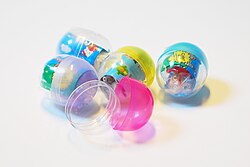
Gashapon capsules
Japanese schoolgirls at gashapon

Gashapon (ガシャポン), also called gachapon (ガチャポン), is a kind of vending machine-dispensed capsule toy manufactured and sold by Bandai. It originated in the 1960s and is popular in Japan.[1]

The word Gashapon, a Bandai trademark, is onomatopoeic from two sounds, gasha (or gacha) for the hand-cranking action of a toy-vending machine, and pon for the toy capsule landing in the collection tray.[2] Gashapon is used for both the machines themselves and the toys obtained from them.

Popular capsule toy manufacturers include Tomy (which uses the trademark gacha (ガチャ, gacha) for their capsule machines) and Kaiyodo. In many countries and territories including Japan, China, the United States, the European Union (European Union trade mark) and the United Kingdom, Gashapon is a registered trademark of Bandai.[3][4][5][6][7] The capsule toy model has been adapted digitally into numerous gacha video games, such as mobile phone games and massively multiplayer online games (MMOs).

History

[edit]

Capsule vending machines originate with small vending machines for gumballs that were first invented in the United States. They were eventually expanded to include the sale of small toys in capsule-shaped containers. This trend became popular in the United States. They were exported to Japan in 1965 from the United States and spread throughout the country in the 1970s.[8]

Capsule toy machines located inside Wakayama Electric Railway cars

As more manufacturers entered the market, the popularity of capsule toys continued to grow, especially with the introduction of licensed character-themed items in addition to original toys. They are often installed in candy stores and supermarkets, and there are often multiple machines in one location. With the rise in popularity of collectible figures, the variety of capsule toys has also increased significantly. Since the 2000s, there have been specialty stores that exclusively feature dozens to over one hundred capsule vending machines. Additionally, they are often installed in tourist destinations to offer local souvenirs and goods.[9][10][11]

Capsule toy machines lined up in Narita International Airport

Unique examples of places where these machines have been installed include a train cabin of Wakayama Electric Railway's Toy Train as well as West Japan Railway's sightseeing Green Loop Bus. Furthermore, especially before COVID-19, they were also installed in departure lobbies of airports with many international flights, such as at Narita Airport and Kansai Airport. Since foreign currency exchange is generally limited to banknotes, these capsule vending machines were strategically placed so that travelers could use their unexchangeable 100 yen and 500 yen coins as a way to buy souvenirs.[citation needed]

As of the 2020s, adults are expressing Shōwa nostalgia by collecting capsule toys.[12]

Description

[edit]
Capsule toy machines in Hong Kong
At Regent Place, Sydney, Australia, a Japanese mall in the CBD

Gashapon machines typically sell toys at prices ranging 100–500 Japanese yen[13] (US$0.69–3.45). The toys are often constructed from high-grade PVC plastic, and contain detailed molding and intricately painted features. They are engineered for high quality, small size, and minimal manufacturing cost; many do not turn a profit for their producers.[clarification needed] Some gashapon are considered collector's items.[14]

Gashapon toys are often licensed from popular characters in Japanese manga, video games or anime, or from the American entertainment industry. These highly detailed toys have found a large following among all generations in Japan, and the trend is spreading elsewhere in the world, especially among adult collectors. It is not uncommon for sets marketed specifically for adults to feature risqué female figurines.[15]

Virtually all gashapon are released in sets—each series will have a number of figures to collect. They are by nature a blind purchase; people insert coins and may hope to get a toy or figure they desire. Such an amusement element may become frustrating, as one risks obtaining the same item repeatedly.

Enthusiastic collectors will buy sets from gashapon stores in places such as Tokyo's Akihabara or Osaka's Nipponbashi (Den-Den Town). Depending on the store, the sets are usually cheaper than buying them randomly out of a machine.

Bandai has been selling Gashapon toys since at least 1977. As of March 2021, Bandai Namco has sold 3.711 billion Gashapon toys for ¥100–500 each, generating approximately between ¥371–1,860 billion in estimated sales revenue, since 1977.[16]

Gashapon figures and items are available outside of Japan, including through officially licensed repackagings in the form of blind bags, sold in stores like the US retail chains Five Below and Target.[17] Dedicated gashapon stores also exist, including officially licensed Bandai Gashapon stores like the one in the American Dream mall in New Jersey,[18][19] and individual gashapon machines in various stores and malls.

Contents

[edit]

In the past, the encapsulated toys were mostly marketed towards kindergarten to mid-elementary school children, similar to products made by early capsule toy manufacturers in Japan, such as Value Merchandise (Nissho Boeki) and Cosmos. For example, there were erasers based on popular items and characters, such as supercars, Kaiju monsters, Kinnikuman, Super Deformed Gundam or other anime characters, and professional wrestlers. (Though, most of the time those "erasers" were just PVC rubber figures that did not actually erase.) Additionally, there are also machines that have a chance to dispense special prizes that are too large or valuable to be included directly within a capsule. In this case, the machine would dispense a winning capsule (or a winning ticket enclosed within a capsule) that can be exchanged at a store for the prize. For non-winning items, there are often participation prizes like Glico’s bonuses (similar to small toys previously common in cereal boxes in the U.S.). Subsequently, products like Bandai's Gashapon HG series helped capsule toys gain recognition in society, and other companies like Yujin joined in as well, resulting in numerous series becoming highly successful merchandise platforms. Since the late 1990s, the market has expanded to include not only children, but also older age groups, and the quality of merchandize has been improved (with slightly higher prices due to the higher quality). Since 2010, the primary reason for the price increase has been the rising manufacturing costs in China. While there are many niche products based on dramas, manga, anime, and games, there is also a wide variety of items ranging from traditional children's toys to realistic and surreal ones.[citation needed]

Furthermore, due to the growing societal awareness of promoting the healthy development of youth, companies have voluntarily been enforcing self-regulation by introducing age restrictions to limit the purchase of products featuring weapons or unsuitable character figures to ages 15 and above. However, age verification mechanisms are yet to be implemented in vending machines, allowing children below the age to purchase such items, which has raised concerns similar to those of adult magazine vending machines.

A sign in Tokyo encouraging people to use leftover coins for capsule toys.

Since the 2000s, some capsule vending machines installed in tourist areas and specific regions have included limited-edition products (pins, straps, drawstring bags, coupons, etc.) as local goods.[20][21][22] Japan Airlines (JAL) has previously offered limited edition capsule toys containing parts from retired aircraft.[23]

Due to the nature of this sales format, buyers cannot choose the specific item of their choice. Instead, they often exchange duplicates with others to collect a complete set. Because of this practice, these types of toys are sometimes referred to as trading toys or trading figures, similar to items like collectible food toys, where customers also cannot choose the contents.[citation needed]

Types

[edit]

Blind-boxes

[edit]

Capsule toys can now also refer to blind-box trading figures, which are essentially the same product sold randomly out of sealed cardboard packages instead of a machine.[24] Chinese toy brand Pop Mart, which does designer toys in blind boxes, is very popular with teenagers and young adults.[25] Kidrobot is another company famous for their blind boxes,[26] in particular the Dunny series[27] as well as collaborations with various popular franchises.[28] Dreams Inc. uses blind boxes for its Sonny Angel and Smiski figurines.[29] Pop Mart is also famous for their Labubu dolls, which became popular in 2025 due to celebrities like Lisa from K-pop group Blackpink showing pictures of her with the keyring and a big version of the doll.

Blind bags are a similar concept but with a disposable bag instead of a cardboard box. This is one way that Gashapon figures make it to the US, as companies like Bandai release their Gashapon figures as blind bags for American audiences.[17] Lego also used blind bags for their collectible Minifigure series, before switching to blind boxes due to environmental concerns.[30]

This is based on fukubukuro, a grab bag of randomized items for a set price that originated in Japan in the 1980s.[31]

Bottle cap figures

[edit]

Another variety of capsule toys is bottle cap figures. These small figures are mounted atop plastic bottle caps, as might be found on soda bottles. They are sold both in machine capsules and blind boxes. The caps are not functional as they lack screw threads to secure them to the mouth of the bottle.

Video games

[edit]

Gacha mechanism in gacha games

[edit]

Games—often freemium—largely based on a gacha mechanism of monetization are referred to as gacha games.[32][33] Gacha mechanism, or gacha, is essentially a monetization model which the user pays with in-game currency to enter a draw in order to obtain the character or item they want.[34] If a player does not obtain what they hoped for, there is the option of paying with their own money for more draws, and this is the main way to monetize the Gacha games.[34] The gacha game model arose in the early 2010s, faring particularly well in Japan.[32][33]

Gacha can be free to play. Rare or valuable gaming items often need to be obtained through special gacha purchased with real money.[35] The games may feature different tiers of gacha pulls, which give different sets of rewards.[32][36] Examples of gacha games include Dragon Collection,[33] Fire Emblem Heroes,[32][37] Genshin Impact,[38] and Puzzle & Dragons.[32]

Many free-to-play massively multiplayer online games (MMOs) and mobile games also use gacha mechanics, with randomly generated items of varying market values being acquired via microtransactions. In addition, paid console games have included gacha-style progression based on random items but with no in-app purchases, such as Work Time Fun.

The anime-oriented subculture surrounding the production of gacha games has also given birth to the term gacha pop, referring to J-pop songs in diverse genres, from those of pop act Yoasobi to rock musician Kenshi Yonezu, associated with anime soundtracks or aesthetics sought by a global audience.[39]

Impact of gacha mechanism on players

[edit]

Gacha mechanism has come under scrutiny for its resemblance to gambling. Similar to gambling, gacha manipulates the emotional state of the player, specifically the player’s sense of luck, satisfaction and insecurity, as well as the player’s financial stability and dopamine release to ultimately cause a gaming addiction and encourage continued game play.[34] Problematic use of gacha have also indicated to high levels of gambler’s fallacy,[34] a luck-related erroneous belief that a certain event is less or more likely to occur, based on a previous series of events.[40]

Winning high ranking virtual items in gacha is extremely rare and unpredictable. As a result, this can ultimately trigger the gambler’s fallacy in players. To minimize the relationship between gambling and the use of gacha, in 2016, the Computer Entertainment Supplier's Association (CESA) passed a law stating that companies must disclose the probability of drawing items in paid gachas so consumers can understand their chances of winning.[41][42]

Besides gambling, gacha games are also commonly associated with a social phenomenon called parasocial relationships,[43] whereby a sense of attachment between receivers and media characters develops.[43] In terms of gacha games, Gacha players develop a parasocial relationship with in-game characters which players obtain through gacha mechanism.[35][43] This parasocial relationship is primarily developed based on the character’s aesthetic and rich narrative element.[35] Rentia and Karaseva’s study demonstrated how players are initially attracted to gacha games due to the games' aesthetic although moving forward, players grow to greatly value the narrative elements associated with the gacha characters.[35]

When a new character is introduced for the first time in a game, many gacha games will release a quest that follows the character’s life events, including the character’s life, intentions and aspirations, giving the opportunity for players to get acquainted with the characters. In Genshin Impact for example, when players pull a character, they receive more information and backstory about that specific character.[35][44] Players can also read information on what characters think about other characters and their relationships.[35][44] It is at this stage in which some players develop an intense emotional connection and as a result, engage in a parasocial relationship with an in-game character. For many players, the charming anime-style design of gacha characters create a strong attraction, which in time evolves into a strong emotional connection, then a parasocial relationship with the character.[35][43]

As a result of parasocial relationships with in-game characters, gacha players will personify the probability of drawing characters.[43] Mackenzie and Lax’s study discovered how gacha communities traditionally referred to the successful acquisition of a desired character as the character ‘coming home.’[43] This reflects how, because of the strong emotional attachment they feel towards the character, gacha players will personify or give human life to character so much so the character develops a human capacity to acknowledge the player’s desire, and therefore returns home to where they belong.[43]

See also

[edit]

References

[edit]
[edit]
Revisions and contributorsEdit on WikipediaRead on Wikipedia
from Grokipedia
Gashapon (ガシャポン) is a trademarked of capsule toys produced by the Japanese , dispensed randomly from coin-operated s that require users to insert payment and turn a crank to receive a small capsule containing a miniature toy or collectible. The name "Gashapon" is onomatopoeic, derived from the "gasha" sound of cranking the machine's handle and the "pon" sound of the capsule dropping into the tray. Bandai launched its first Gashapon series in 1977, capitalizing on the existing popularity of capsule toy machines in Japan, which trace their local origins to installations in the 1960s inspired by earlier American vending devices for candy and small items. These toys, often themed around popular anime, manga, food replicas, or novelty items, have become a cultural staple in Japan, with machines ubiquitous in public spaces like train stations, stores, and arcades, fostering a collectibles market driven by the thrill of randomization and rarity. Gashapon's success lies in its blend of accessibility—typically costing a few hundred yen per capsule—and high production quality, leading to billions of units sold annually and expansions into international markets, including licensed collaborations with global brands.

History

Early Inspirations and Invention

The precursors to gashapon emerged from early 20th-century Western vending machine innovations, particularly coin-operated devices that dispensed small prizes such as , gum, or inexpensive toys encased in plastic balls or capsules. These machines, which originated as simple automated dispensers in the late 1800s and evolved by the mid-1900s to include novelty items, provided the mechanical foundation for random prize delivery but lacked refinements like reliable toy enclosure and engaging user interaction. In , entrepreneur Ryuzo Shigeta—later dubbed the "Grandfather of Gachapon" or "Gacha Gacha Oji-san"—encountered these American vending machines through a in the early and sought to adapt them for local appeal by emphasizing durable capsules over perishable , while enhancing the dispensing mechanism for a smoother, more audible "gasha" sound. Shigeta's improvements addressed limitations in the U.S. models, such as inconsistent prize visibility and quality, by introducing transparent capsules that protected contents and built anticipation through partial reveals. On an unspecified date in , Shigeta installed Japan's inaugural gachapon machine at his shop in Tokyo's Ward, marking the formal invention of the format as a dedicated toy-vending system and establishing Penny Shokai as the country's first such enterprise. This debut shifted focus from mere novelty to collectible miniatures, laying groundwork for widespread adoption amid Japan's postwar economic growth and rising consumer interest in affordable . By refining the core mechanics—coin insertion yielding randomized, encapsulated toys—Shigeta's innovation transformed imported hardware into a culturally resonant product, though the specific term "gashapon" would later be trademarked by in 1977 following their mass commercialization.

Rise in Japan

The gashapon vending machines debuted in in 1965, when entrepreneur Ryuzo Shigeta installed the country's first unit outside a sweets shop in Tokyo's Taito Ward, adapting imported American prize-dispensing technology to vend small toys encased in transparent plastic capsules. These early machines, operated by companies like Penny Shōkai, drew immediate crowds of children with their novelty and low cost, typically requiring coins for randomized prizes, though initial adoption remained localized and modest. Bandai's entry into the market in 1977 catalyzed broader growth, as the company trademarked "Gashapon," raised prices to ¥100 per capsule to support higher-quality items, and pioneered licensed character toys tied to popular media like and . This shift emphasized collectibility and surprise elements, aligning with Japan's expanding toy industry and vending infrastructure, which proliferated machines in urban areas during the late 1970s. The 1980s marked gashapon's explosive rise, fueled by synergies with the boom; Bandai's 1983 release of erasers (Keshigomu) sold more than 180 million units, establishing the format's commercial viability and sparking the first major popularity wave among children and collectors. Additional entrants like Yūjin in 1988 further diversified offerings, with machines spreading nationwide and emphasizing durable, themed figures that capitalized on media franchises for repeat purchases. By decade's end, gashapon had transitioned from niche amusement to a staple of Japanese consumer culture, driven by vending ubiquity and cultural affinity for randomized, affordable novelty.

Post-2000 Expansion and Innovations

Since the early 2000s, the Gashapon sector has undergone substantial growth, marked by a surge in dedicated vending sites and broader international reach. In , the proliferation of specialty stores housing dozens to over a hundred machines became common, allowing consumers access to extensive series in one location. This trend accelerated with large-scale facilities, such as the Gashapon Department Stores opened by Bandai Namco in Hakata and in August 2020, stocking a wide array of capsules. The Gashapon Department Store, launched in February 2021, exemplifies this expansion, featuring roughly 3,000 machines and earning a World Record for the largest concentration in one venue. Internationally, Gashapon machines extended beyond —where adoption began in regions like , , and during the 1990s—into global markets post-2000, appearing in shopping malls and entertainment districts. Presence grew in Western countries, with installations in , the , and , often tied to and pop culture hubs. advanced this through official overseas outlets, including the Gashapon Bandai Official Shop in Singapore's Plaza Singapura on July 20, 2023, and in Mitsukoshi BGC, , on November 8, 2023. Additional stores followed in the UK and by 2025. Innovations post-2000 emphasized product variety and machine enhancements to sustain engagement. Bandai Namco ramped up collaborations with intellectual properties, releasing over 1,200 new Gashapon series annually by the 2020s, with cycles as short as one to two months to capitalize on trends. Vending technology evolved with additions like digital screens for previews, LED lighting, app interactions, and cashless payments, blending tradition with modern convenience while preserving the crank's tactile surprise. In 2022, Bandai debuted Flat Gashapon, enabling dispensing of planar items such as cards and stickers, diversifying beyond three-dimensional toys. These developments, alongside nostalgia-driven collectibility and IP tie-ins, propelled market vitality amid rising global interest.

Mechanics and Production

Vending Machine Design

Gashapon vending machines employ a mechanical dispensing system, often utilizing a wire cable mechanism to release sealed plastic capsules containing toys upon coin insertion and handle activation. These machines are engineered for reliability, incorporating patented internal components to minimize jams and ensure consistent operation. Standard designs accommodate capsules measuring approximately 50 mm in diameter, with storage capacities varying by model; desktop variants typically hold 50-100 capsules in a height of 12-16 inches. Operation begins with users inserting coins into a slot, which unlocks a crank or ; turning the engages the dispenser, propelling a single capsule through a chute for collection. Transparent viewing windows allow visibility of the capsules, enhancing user anticipation as they observe the dispensing process. Larger commercial units, such as those measuring 26 cm wide by 29 cm deep by 53 cm high, can store up to 150 capsules of 4.8 cm size alongside 800-1000 coins, supporting high-traffic locations without frequent refills. Design modularity is common, enabling stacking or alignment of multiple units for varied product displays, while sturdy bases provide stability in public settings. Early models featured hand-crank mechanisms, evolving to coin-operated systems that maintain mechanical precision without reliance on in basic configurations. Advanced variants may integrate electronic coin validators for broader currency acceptance, though core functionality prioritizes simple, jam-resistant mechanics.

Capsule Toys: Manufacturing and Contents

Capsule toys dispensed by gashapon machines are contained within small capsules, standardly measuring 48-50 mm in diameter to fit most vending mechanisms, though specialized series employ larger sizes up to 90 mm for bulkier items. These capsules are manufactured from (PP), a transparent chosen for its impact resistance and ease of production via injection molding, where pellets are melted, injected under into dual molds for the upper and lower halves, cooled, and assembled by snapping together. The toys themselves are typically produced from high-grade (PVC), selected for its flexibility in molding fine details and compatibility with painting. The process begins with injecting molten PVC into precision molds to form individual parts, followed by cooling, ejection, trimming of excess , and application of colors—often by hand or automated sprayers for multi-layered effects—to achieve lifelike representations in miniature form. Assembly may involve gluing or clipping components, such as articulated limbs on figurines, before encapsulation. Major manufacturers like leverage real-time sales data from gashapon vending machines to inform design iterations, enabling and adjustments to consumer preferences within development cycles. Contents vary widely but center on collectible novelties, including detailed figurines of characters, keychains with elements, miniature vehicle models, and accessory replicas like food items or tools, often released in themed series with rare variants to drive repeat engagement. These items emphasize high detail relative to their 3-5 cm scale, prioritizing visual appeal and thematic tie-ins to licensed properties from video games, films, and original designs. Sustainability efforts include capsule programs; , a dominant producer since trademarking the gashapon name in 1977, collects about 42 tons of empty capsules yearly, grinding them into pellets for reuse in new manufacturing, reducing raw material demands. Other firms like Takara Tomy and follow similar plastic-centric processes, adapting molds for series-specific outputs while adhering to safety standards for small parts.

Types and Variations

Core Capsule Formats

Standard gashapon capsules are typically cylindrical or slightly ovoid containers, measuring 45 to 65 mm in diameter, designed to encase small collectible toys such as figurines, keychains, or accessories. These core formats prioritize compactness for dispensing, with the capsule's two halves secured by a twist-lock or clasp mechanism that allows easy opening post-purchase. Materials are predominantly injection-molded (PVC) or (ABS) for durability and transparency options, enabling visibility of contents in clear variants while opaque versions maintain surprise. Common standardized sizes within core formats include 48 mm, 50 mm, 55 mm, 65 mm, and 75 mm diameters, accommodating toys up to approximately 40-60 mm in height to fit vending chute constraints. The 50 mm size aligns closely with traditional 2-inch (48-50 mm) capsules used in Japanese gashapon machines, ensuring compatibility across Bandai's standard dispensers. These dimensions have remained consistent since the format's popularization in the , balancing portability, production efficiency, and consumer appeal without requiring machine modifications. While core capsules maintain a uniform spherical profile for reliable vending mechanics, subtle variations exist in wall thickness (1-2 mm) and color assortments—red, blue, yellow, green, or black—to enhance visual appeal or obscure contents. Clasp-style closures predominate in standard formats for secure transport, differing from premium or thematic series that may incorporate hinges or seals. , the primary manufacturer, adheres to these formats for , with over 90% of gashapon output utilizing 50-65 mm capsules to standardize inventory and machine operations.

Thematic and Collaborative Series

Gashapon series are typically organized around unified themes, featuring multiple capsule designs that form cohesive collectible sets, often requiring multiple purchases to complete. These themes range from everyday objects reimagined in miniature form, such as or accessories, to intricate dioramas like animals in saunas or scaled-down construction equipment. Popular motifs include anthropomorphic animals, particularly s in various poses or outfits, which dominate sales in regions like alongside food-inspired items. adaptations form a core pillar, with series replicating characters and accessories from franchises such as Demon Slayer: Kimetsu no Yaiba, , , and Pokémon, where figures capture key poses or props to appeal to fans seeking detailed replicas. Collaborative series extend these themes through licensed partnerships, merging gashapon's capsule format with external intellectual properties or brands to broaden market reach. , the primary producer, frequently collaborates with anime studios and toy lines, such as the 2025 Hatsune Miku x rubber mascots, which fuse singer designs with elements for a crossover appeal targeting overlapping fanbases. Similarly, characters have been rethemed as traditional Japanese in 's capsule line, released around mid-2025, transforming cute icons like into supernatural variants while retaining collectible charm. Cross-industry tie-ins include food brands, exemplified by Lee Kum Kee's July 2025 partnership with to produce miniature replicas of Hong Kong-style sauces, blending culinary nostalgia with toy novelty. These collaborations often limit production runs to heighten scarcity, driving demand among collectors who value rarity over individual items. Such series foster serial purchasing, as capsules are blind-packaged within themed assortments—typically 4 to 12 variants per set—prompting repeat engagements to avoid duplicates and achieve full sets. Bandai's official categories, updated regularly, highlight ongoing themes like or , ensuring alignment with current pop culture trends for sustained relevance. This structure not only sustains the industry's output, exceeding thousands of series annually, but also adapts to global tastes by incorporating international IPs, though domestic Japanese media remains predominant.

Cultural and Social Impact

Domestic Popularity in Japan

Gashapon maintains strong domestic appeal in Japan, with the capsule toy market expanding from ¥65 billion in fiscal year 2023 to ¥80 billion in fiscal year 2024. Bandai, holding approximately 57% market share, shipped 220 million units across 1,530 varieties in fiscal 2024, reflecting sustained consumer demand. Over 360,000 vending machines operate nationwide, ubiquitous in urban areas, train stations, and dedicated stores, fostering impulse purchases and habitual engagement. Popularity spans demographics, initially targeting children with character-based toys but increasingly attracting adults through and collectible series. While children favor affordable, playful items like dolls and figures, adults pursue detailed miniatures and limited editions, contributing to market maturation beyond juvenile play. Specialized stores, such as Tokyo's flagship with 3,000 machines, exemplify this, drawing local enthusiasts for variety and rarity hunts. Culturally, gashapon embodies Japan's affinity for compact, randomized novelties, integrating into daily routines and hobbyist subcultures without the stigma of adult collecting seen elsewhere. The format's crank-operated mechanism evokes tactile satisfaction, reinforcing repeat visits amid monthly releases tied to , , and trends. Projections indicate continued growth to ¥105-110 billion by 2025, driven by innovation in themes and adult-oriented designs. Gashapon vending machines proliferated across East and following their establishment in , with , , and developing dense networks of installations in malls, transit hubs, and recreational areas. In these regions, the format adapted to local preferences while retaining its core appeal of randomized, affordable collectibles, contributing to significant market growth during the late 20th and early 21st centuries. saw a parallel surge in popularity through analogous "blind box" toys, fueling a multimillion-dollar industry driven by millennial collectors and speculative trading. The trend extended to Western markets amid the of Japanese anime and pop culture, prompting manufacturers like to pursue aggressive expansion. In April 2024, announced plans to triple its international specialty stores from 43 to over 123 outlets across , , and additional Asian sites, prioritizing the as a high-potential region. In the United States, official Gashapon Official Shops now operate in states such as , , and New York, supplemented by online sales, pop-up events, and availability at select retailers. features similar outlets, including the Namco Cross Store in the , where capsule toys are marketed as miniature collectibles. International adoption reflects tourism's role in familiarizing consumers with gashapon during Japan visits, leading to sustained demand for imported or locally vended products abroad. This growth targets and , who value the surprise element and detailed craftsmanship of capsule toys as extensions of hobbyist collecting influenced by media franchises. While overseas machine density lags behind Japan's estimated 500,000 units, market analyses forecast continued expansion, supported by integration and cross-cultural IP collaborations.

Economic Dimensions

Industry Scale and Key Players

The Japanese capsule toy industry, encompassing gashapon and similar products, reached a exceeding 120 billion yen (approximately $784 million USD) in 2024, reflecting rapid expansion driven by collector demand among adults and innovations in thematic series. This growth follows a trajectory from 29.7 billion yen in 2016 to 65 billion yen in 2023, fueled by dedicated retail outlets and proliferation in urban areas. Bandai Namco stands as the dominant player, originating the Gashapon brand in 1977 and operating over 200 dedicated stores in Japan as of 2024, with its capsule toys comprising a significant share of industry output through licensed collaborations and original designs. Other major manufacturers include Takara Tomy, known for diverse capsule lines targeting children and hobbyists, and Kaiyodo, specializing in detailed figurines that appeal to adult collectors. Together, these firms, alongside smaller entities like Kitan Club and Amuse Inc., control much of the production and distribution, with Bandai, Takara Tomy, and Kaiyodo estimated to account for 40-50% of global capsule toy volume.

Market Growth and Projections

The Japanese capsule toy market, encompassing gashapon products, has demonstrated robust expansion amid shifting consumer demographics and innovative merchandising. In 2022 (ending March 2023), the sector was valued at 61 billion yen, reflecting a 35.6% year-over-year increase driven by post-pandemic recovery in retail foot traffic and appeal to adult collectors. This momentum continued into 2023, with market size reaching approximately 65 billion yen—a 44% rise attributed to collaborations with and gaming franchises—before climbing to 80 billion yen in 2024. Projections for 2025 forecast the surpassing 100 billion yen, potentially hitting 105-110 billion yen by year-end, fueled by expanded deployments, premium collectible lines, and sustained demand from non-traditional buyers such as working adults seeking affordable novelty items. Globally, while data remains fragmented due to varying regional definitions of capsule toys, the sector benefits from Japan's export influence, with overseas adaptations in markets like , the , and contributing to ancillary growth estimated at a 5-7% compound annual rate through 2030, though precise international valuations lag behind domestic figures. This trajectory aligns with broader Japanese industry resilience, which achieved a record 1.1 trillion yen in fiscal despite declining birth rates, as capsule toys capture a disproportionate share of adult-oriented spending over child-focused segments. Key drivers include technological enhancements in machine design for higher throughput and data analytics for inventory optimization, positioning gashapon as a low-risk, high-margin vending niche resistant to disruption.

Digital Extensions

Origins of Gacha in Video Games

The gacha mechanic in video games emerged as a digital adaptation of the randomization inherent in Japan's physical gashapon vending machines, which dispense capsule toys for a fee via a crank mechanism producing a distinctive "gacha" sound. This system translates to video games as probabilistic reward draws, where players expend in-game or real currency for a chance at rare items, characters, or cards, often with no guaranteed outcomes. Early implementations appeared in Japanese mobile and social platform games during the late 2000s, leveraging emerging smartphone capabilities and freemium models to monetize player engagement through uncertainty and rarity tiers. The inaugural widespread use of gacha in video games is attributed to , a mobile card battler developed by and released on November 12, 2010, exclusively on Japan's GREE social networking platform for feature phones and early smartphones. In this title, players paid to "pull" from gacha machines that randomly yielded monster cards for deck-building and battles, mirroring physical gashapon's surprise element while integrating social features like trading and competing with friends. The game's success, amassing millions of users within months, stemmed from its low entry barrier—free to start, with optional microtransactions—and the addictive pursuit of completing collections amid mechanics, prompting competitors to replicate the formula across platforms. Following , gacha proliferated rapidly in Japan's mobile ecosystem, with titles like (released February 20, 2012, by ) refining the mechanic by combining it with puzzle gameplay and monster fusion systems, where orb-matching battles unlocked further summons. This hybrid approach drove explosive growth, as generated over ¥100 billion (approximately $1 billion USD at the time) in revenue by 2013, primarily from gacha pulls for rare "monster orbs." The mechanic's appeal lay in psychological hooks such as variable reward schedules, akin to slot machines, fostering repeated plays despite low odds for top-tier items (often below 1% probability), which industry analysts credit for shifting mobile gaming toward sustained over one-time purchases. By 2013, gacha had become a staple in social and games, influencing global titles and sparking debates on its predatory potential, though early adopters viewed it as an innovative evolution of game traditions.

Mechanics and Implementation

Gacha mechanics in video games replicate the randomized dispensing of physical gashapon capsules through digital summons or "pulls," where players expend premium currency—often purchasable with real money—for a chance at characters, weapons, or items stratified by rarity tiers, typically ranging from common (e.g., 1- or 2-star) to ultra-rare (e.g., 5-star). Drop rates for higher rarities are low, often below 1% for top-tier outcomes, with outcomes determined by pseudorandom number generators (PRNGs) seeded server-side to ensure verifiability and prevent client-side manipulation. In jurisdictions like , developers are legally required to disclose these rates publicly, fostering transparency, whereas global implementations vary, sometimes omitting full details to maintain competitive edges. Implementation typically involves banner systems, where limited-time pools feature specific desirable assets alongside permanent options, encouraging timed spending; pulls can be single or multi-roll (e.g., 10x for bonus guarantees), with animations simulating physical capsule openings to heighten anticipation. To counter the variance inherent in pure randomness—which can lead to extended "dry streaks" without rewards—many systems incorporate : soft pity escalates probabilities after a threshold (e.g., increased 5-star odds post-70 pulls), while hard pity enforces a guarantee (e.g., a 5-star item after 90 consecutive pulls). These are coded as cumulative counters tied to player accounts, resetting selectively per banner type, such as a 50/50 chance for the featured character on the pity trigger in games like , with carryover for subsequent duplicates. Economically, implementation balances retention and revenue by tying gacha to progression: rare pulls often yield power-defining elements essential for endgame content, implemented via probabilistic tables weighted toward lower rarities (e.g., 90%+ common drops). Server-side validation logs each transaction for auditing, with anti-abuse measures like to deter exploits, while refines rates based on player data analytics. Step-up gachas add progression layers, offering escalating guarantees (e.g., better odds or free pulls after initial spends), implemented as tiered contracts to simulate value accumulation without altering core RNG. Overall, these systems prioritize loops, where failed pulls fuel psychological via sunk-cost effects, though verifiable fairness relies on disclosed algorithms and independent verifications absent in opaque designs.

Controversies and Debates

Comparisons to Gambling

Gashapon machines dispense random capsule for a fixed price, typically ranging from 100 to 500 per capsule as of 2023, creating an element of chance akin to 's uncertainty. Users insert coins and receive one of several possible without knowing which in advance, fostering and occasional if duplicates or undesired items result, much like the variable rewards in slot machines that trigger responses. This mechanic, originating in the with Sankei's UFO precursors and popularized by , encourages repeated purchases to complete sets, paralleling the "near-miss" effect in where partial successes propel further engagement. Psychologically, the surprise element in gashapon activates reward pathways similar to those in low-stakes , with studies on related blind box purchases indicating that randomness can lead to compulsive buying driven by collection urges and fallacy, where buyers continue spending to avoid perceived waste from duplicates. Empirical analysis of gashapon consumers shows that psychological motivations, such as seeking novelty and achievement from rare pulls, correlate with higher spending, though effects are generally milder than in monetary due to capped per-purchase . Unlike 's potential for unlimited losses, gashapon limits exposure to the initial outlay, reducing risk, but critics note that the thrill of rarity— with some series featuring chase items at 1/100 odds—mirrors dynamics that have drawn disorder parallels in behavioral research. Legally, gashapon evades classification in , where strict anti- laws prohibit wagering on chance for monetary gain, as each purchase yields a tangible of approximate equal value without probabilistic financial upside. This contrasts with regulated "kompu gacha" schemes in 2012 mobile games, which bundled random pulls to complete sets and were deemed akin to illegal for incentivizing bulk buys; physical gashapon avoids such bundling, maintaining for all ages despite occasional duplicates prompting extra spends. Proponents argue it promotes harmless , with no verifiable evidence of widespread epidemics tied to physical machines, unlike digital variants where microtransactions amplify risks. Debates persist among consumer advocates, who liken the "just one more" impulse to fallacies, though empirical data prioritizes fixed-cost safeguards as distinguishing it from true wagering.

Regulatory Responses Worldwide

In , gashapon machines operate without classification as under national laws, as they dispense non-monetary toy prizes rather than wagers with financial risk, distinguishing them from prohibited activities under the Penal Code. , such as guidelines from the Computer Entertainment Supplier's Association adapted from digital gacha practices, emphasizes transparency in rarity probabilities to mitigate perceived elements, though these are voluntary and not legally binding for physical capsules. China has implemented targeted restrictions on blind box toys, akin to gashapon, amid concerns over compulsive purchasing. In January 2022, authorities capped individual blind box prices at 200 yuan (approximately $31) and prohibited unsupervised sales to children under eight years old, requiring adult accompaniment for younger buyers. Nationally, June 2023 guidelines from the banned using blind boxes to disguise or promote , mandated clear disclosure of product contents and rarity rates, and urged "reasonable pricing" to prevent addiction-like behaviors, with further state media warnings in June 2025 highlighting youth "addiction" risks. Elsewhere, regulatory scrutiny remains limited, with gashapon treated primarily under general toy safety frameworks rather than gambling statutes. In the , the impending Toy Safety Regulation, set for enforcement in 2026, strengthens chemical and mechanical standards but does not address randomness or prize uncertainty specifically. The Consumer Product Safety Commission enforces hazards testing for toys, including vending machine outputs, without provisions targeting blind dispensing mechanics. In jurisdictions like the , some analyses suggest blind boxes could qualify as gambling if redeemable for value, prompting voluntary age restrictions by sellers, though no blanket prohibitions exist. Overall, global responses prioritize over reclassification as gambling, reflecting the low-stakes, toy-centric nature of gashapon.

Evidence on Consumer Behavior and Risks

The randomized dispensing mechanism of gashapon encourages repeated purchases as consumers seek to complete collections, often resulting in acquisition of duplicate items and escalated spending. This stems from the hedonic appeal of , where the of rare variants activates reward pathways akin to variable-ratio schedules in behavioral . Empirical analysis of analogous blind box collectibles, which employ similar , reveals that perceived heightens enjoyment but also propels tolerance for repeated consumption, potentially straining finances as buyers chase elusive outcomes. Market data underscores this engagement: Japan's capsule toy sector, dominated by gashapon, generated substantial retail value, reflecting habitual consumer investment in low-unit-cost items that accumulate over time. For instance, enthusiasts frequently purchase in bulk from specialized stores to circumvent duplicates, amplifying total expenditure despite individual capsules costing 300–500 yen (approximately $2–3 USD). While direct longitudinal studies on gashapon-specific spending are limited, the mechanism's design—originating physical capsule toys and inspiring digital gacha—fosters persistence through intermittent , as evidenced in monetization research tracing behavioral patterns back to origins. Risks include financial overextension and , particularly among dedicated collectors. Analogous research on blind box over-engagement among adolescents links frequent participation to elevated risk, with odds ratios of 2.05 for those buying over 10 items monthly, attributing this to escalating tolerance that exacerbates deterioration alongside monetary loss. For gashapon, from duplicates can compound into habitual visits, though the capped per-pull cost tempers extremes seen in unbounded digital variants; nonetheless, cumulative spending on series with low rarity rates (e.g., 1:72 for premiums) poses realistic hazards for impulse-prone individuals. Peer-reviewed inquiries emphasize that while benefits like sensory delight exist, unmitigated pursuit risks and diminished , warranting caution absent robust regulatory oversight.

References

Add your contribution
Related Hubs
User Avatar
No comments yet.