Hubbry Logo
Scraper (kitchen)Scraper (kitchen)Main
Open search
Scraper (kitchen)
Community hub
Scraper (kitchen)
logo
8 pages, 0 posts
0 subscribers
Be the first to start a discussion here.
Scraper (kitchen)
Scraper (kitchen)
from Wikipedia
Kitchen scrapers

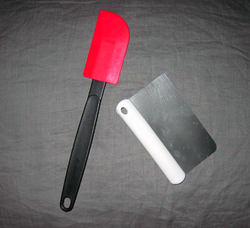
A kitchen scraper is a kitchen implement made of metal, plastics (such as polyethylene, nylon, or polypropylene), wood, rubber or silicone rubber. In practice, one type of scraper is often interchanged with another or with a spatula (thus scrapers are often called spatulas) for some of the various uses.

Types

[edit]

Bowl

[edit]
A long-handled scraper can be used as a bowl scraper.

Bowl scrapers (also known as rubber feet) are, as the name suggests, used to remove material from mixing bowls. Often, a plate scraper is used for this purpose, particularly since the long handle allows it to be used to remove contents of bowls as well as jars, such as mayonnaise jars; however, for bowls, dedicated scrapers are available, lacking the handle, and consisting of a flat, flexible piece of plastic or silicone rubber sized for convenient holding with the palm and fingers, with a curved edge to match the curvature of the average bowl. The degree of curvature can vary from a slight curvature along one edge of a rectangle, to a complex shape composed of changing radii to adapt better to bowls of different sizes. Sometimes a hole is provided in one corner, to allow for hanging the utensil, as well as for placement of the thumb to allow for more secure grip. Prices vary from below one American dollar, to as much as US$20.

The technique for use of either form of bowl scraper is essentially intuitive.[citation needed]

Dough

[edit]
Dough scraper

Dough scrapers, or pastry scrapers, are more rigid implements, often made of a metal rectangle with a wooden, plastic, or metal handle running along one long edge not only for more comfortable grip, but also to add rigidity; some bowl scrapers, however, are designed to be stiff enough to serve a dual purpose and are sold as such. Occasionally, an implement resembling a putty knife is sold for this purpose.

This implement is used to manipulate raw dough, by scraping it from a surface on which it has been rolled, as well as to slice it. It can also be called a spatula.[citation needed]

A dough scraper is a tool used by bakers to manipulate dough and to clean surfaces on which dough has been worked. It is generally a small sheet of stainless steel (approximately 8 centimetres (3.1 in) by 13 centimetres (5.1 in)) with a handle of wood, plastic, or simply a roll in the steel blade along one of the long sides.[citation needed]

Bakers and pastry chefs use this tool to help pick up, turn, and portion dough. When finished, the dough scraper can be used to scrape up the little bits of dough that have dried onto the kneading surface during the forming process. It can also be used in a more generic kitchen role to transfer sliced or diced foods from cutting board to pan. Additionally, the scraper is also used by pastry chefs to give sharp and smooth edges to the cakes while decorating them.[1]

This tool is known by a variety of names, including dough scraper, dough cutter, dough knife, pastry cutter, bench scraper, board scraper, and bench knife.[citation needed]

Some modern varieties of this tool have handles of nylon or silicone and even feature both straight and curved edges. These are intended primarily for the use of scraping cutting boards and bowls rather than working dough. These uses have introduced further variants of the name, including terms such as bowl scraper or chopper, scooper, scraper.[citation needed]

Grill

[edit]

A grill scraper is a device used to clean cooking grills by scraping stuck particles of food from their surface. For flat surfaced grills, their design can vary from similar to a putty knife, to a more complex device with provision to protect the hands from the hot grill surface, targeted to professional cooks and chefs, to even more complex models. Varieties sold for cleaning wire grills are also available, with notches in the edge of the blade to match the wires of the grill.[citation needed]

Plate

[edit]

A plate scraper consists of a plastic, wooden, or metal handle attached to a flexible rubber head. Although the original use of the implement was to remove food from plates before washing,[2] its use has evolved to more of a utilitarian implement, the bowl scraper.[citation needed]

Pan

[edit]
A spatula may be used as a pan scraper.

The pan scraper is, as the name suggests, an implement designed for the forcible removal of tightly stuck or burned food from the bottom of pots and pans before washing. They usually resemble a putty knife with a metal blade and a metal, wood, or plastic handle, sometimes with the handle mounted at an angle to the blade to allow for more vigorous scraping parallel to the surface; others, however, are a wedge shaped piece of hard plastic molded to fit the hand and with a slightly rounded sharp edge.

Shellfish

[edit]

A shellfish scraper is a specialized utensil used for removing meat from cooked shellfish at the dining table. It consists of a stainless steel rod about ten inches in length, with a flattened tip at one end and a forked tip at the other.

Crumb

[edit]

Although not a cooking utensil, a crumb scraper is used during a meal to remove crumbs and other unwanted small debris from the surface of table, for cleanliness. Although historically, when crumb scrapers were mostly used in homes, ornate designs were used,[3] the variety most often seen currently is sized and shaped for a waiter to carry in a breast pocket, and consists of a piece of sheet metal bent into a semi-cylindrical shape closely resembling a laboratory scoopula, which is dragged across the table so that the debris is dragged towards the edge, where it can be disposed of.[4]

See also

[edit]

References

[edit]
[edit]
Revisions and contributorsEdit on WikipediaRead on Wikipedia
from Grokipedia
A kitchen scraper, also known as a bench scraper, dough scraper, or pastry scraper, is a versatile handheld tool featuring a flat, rectangular blade—typically made of durable —attached to a crafted from materials like , , or for ergonomic grip. This design allows it to perform multiple functions beyond simple scraping, such as precisely dividing sticky into portions (e.g., halves, thirds, or smaller sections) without altering its hydration or texture, which is essential for bakers aiming for consistent results in or making. Historically favored by professional bakers for dough work, the tool has evolved into a staple for home cooks due to its multifunctionality in meal preparation and cleanup. Common applications include transferring chopped vegetables, herbs, or chocolate from a cutting board to a pot or bowl without damaging knife edges; rough-chopping soft ingredients like garlic; leveling dry ingredients in measuring cups; and even creating chocolate curls or frosting cakes evenly. Many modern versions incorporate practical features, such as a sharp cutting edge on the blade for slicing tasks and an etched ruler (often in inches and centimeters) for accurate measurements during portioning. Its wide surface also excels at scraping flour, dough remnants, or debris from countertops and cutting boards, promoting a hygienic workspace and reducing waste by directing scraps to compost or disposal. Available in various sizes—typically with blades measuring 5 to 6 inches wide and 4 to 5 inches tall—kitchen scrapers are praised for their dishwasher-safe construction and longevity, outperforming fragile plastic alternatives that can warp or dull over time. While traditionally associated with , its utility extends to general cooking, making it an indispensable item in both professional and amateur for streamlining tasks and minimizing mess.

Introduction

Definition and Purpose

A kitchen scraper is a flat-bladed utensil designed for removing residues from curved or flat surfaces in food preparation and cleanup without causing scratches or damage. It typically features a blade made of materials like , rubber, , metal, or wood, which can be flexible to conform to bowl contours or rigid for straight-edge tasks, paired with an ergonomic or grip for secure control. This simple yet versatile tool minimizes waste by efficiently collecting the last remnants of ingredients, making it essential in both home and professional . The primary purposes of a kitchen scraper revolve around streamlining cooking processes and maintenance. It excels at transferring sticky batters, doughs, or mixtures from mixing bowls to pans or countertops, ensuring no material is left behind. Additionally, it removes adhered food particles from cookware, such as pots, pans, or cutting boards, facilitating easier without methods. In serving scenarios, scrapers aid portion control by neatly dividing and lifting foods like cakes or pastries. Kitchen scrapers are distinct from similar utensils like spatulas, which focus on flipping, turning, or spreading ingredients on hot surfaces, whereas scrapers prioritize precise scraping and gathering of residues. They also differ from spoons, which are suited for scooping loose or liquid items but lack the edge needed for adhered materials on surfaces. This specialization enhances efficiency in tasks requiring clean separation and transfer.

Common Features

Kitchen scrapers often feature ergonomic handles or grips designed for comfortable use, which may be contoured and incorporate cushioning materials like or rubber in some models to reduce fatigue during extended tasks. The blades of kitchen scrapers vary in flexibility to suit different needs, with softer, pliable options for curved surfaces like interiors and stiffer blades for flat areas or heavier tasks; beveled edges on many models facilitate smooth gliding and reduce adhesion. Many scrapers are engineered for heat resistance, with and models typically withstanding temperatures up to 400°F (204°C), allowing safe use with hot cookware or baked goods. To enhance performance, scraper blades often possess non-stick properties through materials like or specialized coatings that promote easy release of sticky substances such as or batter, minimizing residue and simplifying cleanup. These features contribute to the tool's versatility across a range of preparation activities.

History and Development

Origins in Ancient and Medieval Kitchens

While general scraping tools for cleaning vessels and processing ingredients existed in ancient and medieval kitchens, the modern kitchen scraper, particularly the bench or scraper, developed later. In medieval European kitchens from approximately 1000 to 1500 CE, wooden implements and knives were primary aids for bread-making, used to divide and scrape work surfaces during and shaping. These tools reflected the labor-intensive nature of grain processing in feudal households and bakeries, relying on wood for its availability and non-reactivity with food. By the late 18th and early 19th centuries, multi-use dough scrapers emerged in European kitchens, often wooden or early metal tools for pulling together and portioning , marking a direct precursor to modern designs. In the transition to the , metal tools became more common for durability in cleaning and food preparation.

Modern Innovations and Patents

In the , kitchen scrapers evolved with the adoption of blades for enhanced durability, particularly in applications where robust tools were needed for handling. A notable early U.S. for a bench scraper, issued in 1891 to Philo C. Atwood (US465825A), featured a wooden handle with an adjustable blade secured by , designed for cleaning butchers' blocks and food preparation surfaces in professional kitchens. This design marked a shift toward mass-producible, interchangeable components that improved efficiency in commercial environments. A significant advancement came in 1902 with U.S. Patent 691,801, granted to Wesley S. Palmer for a "Kettle or Dish Scraper or Cleaner." The invention utilized a handle formed from two twisted wires diverging into arms that held a blunt metal scraping blade at one end and a rubber cleaning block at the other, allowing versatile use for removing residues from cookware without scratching surfaces. This patented structure influenced the development of modern pan scrapers by combining affordability with dual functionality, facilitating easier cleaning in both home and industrial settings. Following , material shortages prompted a transition to synthetic alternatives, with and rubber bowl scrapers emerging in the late and to conserve metals for military production. U.S. Patent 2,380,186, issued in 1945 to Beatrice S. Mayer, exemplified this shift by introducing a finger-mounted scraper for pots and pans, offering a lightweight, non-metallic option that protected users' hands while effectively removing food buildup. These flexible designs quickly became staples for scraping mixing bowls, addressing wartime while providing hygienic, easy-to-clean tools for postwar home . In the late , ergonomic innovations enhanced user comfort, particularly for prolonged professional use. U.S. Patent 4,974,286, granted in 1990 to General Housewares Corp., described a universal soft-grip handle adaptable to scrapers and other utensils, featuring elastomeric material to reduce hand fatigue and improve control during repetitive tasks like division. By the 2000s, heat-resistant integrations further advanced scraper technology; for instance, U.S. Patent 5,491,869 from 1996 detailed blades paired with reinforced handles, capable of withstanding temperatures up to 500°F without degrading or sticking to non-stick cookware. These developments prioritized safety and versatility, solidifying scrapers as essential, durable tools in contemporary kitchens.

Types

Bowl Scraper

A bowl scraper is a flexible designed for efficiently handling soft mixtures, featuring a thin typically measuring 4 to 5 inches in width and constructed from durable, nonporous materials such as , , or to ensure and prevent sticking. Its is engineered with a slight curve or asymmetrical D-shape, including one rounded edge and one straighter side, allowing it to adapt seamlessly to the rounded contours of mixing s. Primarily, the bowl scraper excels at removing batter, frosting, or from the interiors of mixing bowls by gliding along surfaces to collect every last bit of mixture. In pastry work, it supports delicate tasks such as folding ingredients like whipped or glazes into batters, preserving texture without overmixing. Key advantages of the bowl scraper include its ability to conform flexibly to curved bowl surfaces, which minimizes food waste by capturing residues that rigid tools might miss, and its nonporous construction that resists . Additionally, most models are dishwasher-safe, facilitating easy cleaning after use with sticky substances. Variations in bowl scrapers often involve blade configurations, such as one-sided designs with a single curved edge suited for smaller bowls and two-sided options providing multiple beveled edges for accommodating a range of bowl sizes and shapes.

Dough Scraper

The dough scraper, commonly referred to as a bench scraper, is a rigid kitchen tool designed primarily for handling firm dough in baking environments. It consists of a straight, stiff blade typically crafted from stainless steel or durable plastic, measuring 6 to 8 inches in length and about 3 to 4 inches in height, which ensures effective cutting and scraping without bending. Attached to one edge of the blade is a handle made of wood or reinforced plastic, providing ergonomic leverage and a secure grip during repetitive tasks. This construction allows the tool to withstand the pressures of professional use while maintaining precision. In professional and home , the dough scraper's primary applications revolve around managing portions and maintaining workspace . It excels at cleanly cutting through chilled or firm , such as or mixtures, to divide it into even sections for shaping or proofing. Bakers also use it to lift and transfer large masses from work surfaces to or baking sheets, preventing loss of material and reducing mess. Additionally, its sharp edge efficiently scrapes residual or from benches, ensuring a tidy preparation area that facilitates subsequent steps in recipes. One key advantage of the dough scraper is its ability to produce clean, non-stick cuts, as the smooth surface minimizes even with sticky doughs, outperforming knives in bulk handling. Many models incorporate etched markings along the blade's edge, enabling it to function as an impromptu ruler for portioning to specific sizes, which streamlines workflows without requiring additional tools. This versatility makes it indispensable in high-volume settings like commercial bakeries. The scraper originated in professional bakeries as a specialized tool to boost efficiency in and production, with historical references tracing its use back to the benches employed by bakers for centuries in dough manipulation tasks. Early versions emphasized sturdy metal construction for durability in demanding environments, evolving into the standardized designs seen today.

Grill Scraper

A grill scraper is a robust cleaning tool tailored for grill maintenance, consisting of a heavy-duty metal blade affixed to an extended handle for user safety. The blade, commonly constructed from or , measures approximately 4 to 6 inches in width and is designed to withstand rigorous scraping without deforming. variants offer durability and corrosion resistance, while blades provide a gentler action that minimizes scratching on delicate grill surfaces such as porcelain-enameled grates. The , typically made of aluminum or heat-resistant , extends 12 to 18 inches in , allowing operators to maintain from heat sources during use. Many models incorporate an ergonomic grip for better control and leverage, with some featuring a raised nub or beveled edge on the blade for enhanced pressure application. An angled blade configuration, often at 30 to 45 degrees, enables precise access between grill to dislodge embedded debris effectively. Primarily applied in post-cooking cleanup, the grill scraper excels at removing grease, carbonized particles, and residue from hot grill grates, ensuring hygienic surfaces for subsequent uses. It is especially suited for commercial settings like restaurants and trucks, where frequent high-volume demands quick, efficient maintenance without interrupting operations. The tool's metal construction supports direct application on surfaces up to 500°F or higher, typical of operating grill temperatures, while avoiding damage to the grate material. Key advantages include exceptional heat tolerance in the , which remains functional amid intense grill conditions, and the extended that prevents burns by insulating the user's hand from radiant —handles often rated to 450°F for prolonged contact. This promotes safer, more effective compared to shorter tools, reducing injury risk in busy environments. Additionally, replaceable blades in some models extend the tool's lifespan, making it a cost-effective for heavy-duty applications.

Plate Scraper

A plate scraper is a specialized tool designed for efficiently removing residues from used dishware in high-volume food service environments. It typically features a short, rigid measuring 3 to 4 inches in width and length, constructed from durable materials such as or heat-resistant vinyl, paired with an ergonomic handle made of plastic or for comfortable grip during repeated use. Many models incorporate color-coding on the handle—such as red for raw proteins, blue for cooked s, or green for produce—to align with HACCP hygiene protocols, minimizing cross-contamination risks in commercial operations. In primary applications, the plate scraper is employed to scrape uneaten scraps directly from plates into disposals or collection bins, facilitating pre-rinsing stages in dishwashing lines. This process occurs at the end of service counters or in dedicated scraping stations, where staff use the tool to clear plates before they enter automated washers, ensuring smoother workflow in busy settings like cafeterias and institutional dining halls. The tool offers key advantages in speed and , allowing workers to process plates rapidly without excessive physical effort, while its rigid blade effectively dislodges residues without damaging dishware. By enabling manual pre-scraping, it reduces water consumption in subsequent rinsing, lowering operational costs and environmental impact in water-intensive commercial kitchens. Plate scrapers have become a standard fixture in commercial food service since at least the late , with patented designs integrating them into dish cleaning tables for efficient waste recovery and maintenance in restaurants and cafeterias.

Pan Scraper

A pan scraper is a specialized tool designed to remove residues from the interiors and edges of cookware, featuring a compact with multiple edges—typically straight for broad surfaces, curved for rounded interiors, and pointed for corners—to accommodate diverse pan geometries. Constructed primarily from durable, food-grade or , these materials ensure the tool remains lightweight and effective without compromising the integrity of sensitive surfaces. Its primary applications involve scraping away stuck-on food particles from frying pans, pots, and baking sheets, particularly after cooking processes that leave baked-in residues, all while preventing scratches on metal or coated interiors. This makes it especially suitable for non-stick cookware, where metal utensils could cause damage, allowing users to clean efficiently without additional abrasives. Key advantages include non-scratching edges that preserve the longevity of non-stick coatings and a compact size—often around 3-4 inches—for easy storage in drawers or utensil holders. The tool's versatility extends to various cookware types, with some designs incorporating hooked or crevice edges for accessing tight spaces, enhancing its utility in routine kitchen maintenance.

Shellfish Scraper

A shellfish scraper is a specialized dining utensil used for removing from cooked at the table. It consists of a rod about 15 cm (6 in) long, with a flat triangular head about 2 cm (3/4 in) wide featuring a blunt edge for safe use. This design allows for precise extraction of shellfish without sharp risks, making it suitable for formal dining settings where is served. It is particularly useful for , , or other shell-on preparations, aiding in clean removal to maintain and . Key advantages include its simple, hygienic construction that is easy to clean and its compact size for table service. The tool promotes efficient dining by reducing mess from shell remnants.

Crumb Scraper

A crumb scraper, also known as a table crumber, is a specialized dining tool designed for swiftly removing loose from tabletops during meals. Typically measuring 5 to 6 inches in and about 0.5 inches in thickness, it features a flat or slightly curved with a beveled or for efficient sweeping, often equipped with a pocket clip for easy portability by servers. Commonly constructed from durable metals such as aircraft-grade aluminum or , the blade ensures longevity, corrosion resistance, and straightforward cleaning, while variations may include enamel coatings in colors like white, maroon, or black for aesthetic appeal in professional settings. These materials allow the tool to glide smoothly over surfaces without scratching, making it suitable for use on delicate tablecloths. The primary application of a crumb scraper involves gathering crumbs, minor spills, or small particles from tablecloths or hard surfaces and directing them into a or collection tray, particularly in environments to maintain tidiness between courses. This practice supports overall dining hygiene by preventing debris from accumulating on floors or contaminating subsequent servings, as outlined in standard maintenance protocols. Key advantages include its gentleness on fabrics, avoiding damage to linens that harsher tools might cause, and its compact, lightweight design that fits easily into a server's pocket for on-the-go use. Unlike kitchen preparation utensils, the crumb scraper serves exclusively as a post-service or inter-course cleaning aid in dining areas, not for handling or mixing food ingredients.

Materials and Construction

Common Materials

Kitchen scrapers are commonly constructed from a variety of materials chosen for their durability, , and functionality in handling , batter, or residues without damaging cookware or surfaces. These materials include plastics, metals, s, and rubbers or silicones, each offering distinct properties suited to flexible or rigid designs. Plastics and synthetics, such as and , are widely used for flexible blades in and scrapers due to their lightweight construction, affordability, and non-scratching nature on non-stick surfaces. provides a smooth, silky finish that does not react with , resists better than wood or metal alternatives, and is dishwasher-safe for easy . offers similar flexibility, conforming to curved surfaces during scraping, while being chemical- and corrosion-resistant, FDA-compliant for food contact, and capable of withstanding temperatures from -40°F to 176°F without degrading. These synthetics are favored for their low cost and versatility in everyday tasks. Metals like stainless steel and brass form the rigid blades of bench and pan scrapers, prized for their durability and heat conductivity that allows safe use near hot pans or ovens. Stainless steel excels in robustness and ease of cleaning, with at least 11% chromium content providing anti-rust and corrosion resistance, ensuring longevity in high-use environments. Brass, often employed in non-marring applications, is non-sparking, non-corrosive, and softer than steel to prevent surface scratches, though it may require periodic polishing to avoid tarnish from moisture exposure. Both metals conduct heat efficiently but demand proper drying to mitigate potential rust in stainless varieties. Hardwoods, particularly , are frequently selected for scraper handles owing to their natural grip, ergonomic comfort, and antibacterial qualities that inhibit compared to plastics. Beech wood boasts a Janka hardness rating of 1,300 lbf, offering high strength, resistance, and a fine, uniform grain for a professional feel, while remaining relatively lightweight for prolonged use. However, its porous makes it susceptible to water absorption and potential cracking if not dried thoroughly after washing, necessitating regular or oiling for longevity. Rubbers and silicones provide heat-resistant, flexible edges for versatile scraping, often in or pan tools, with FDA approval ensuring safe contact and non-reactivity. stands out for its superior flexibility, non-stick properties, and ability to withstand temperatures exceeding 500°F—up to 600°F in many formulations—without melting or releasing toxins, making it ideal for high-heat baking scenarios. It is also water-resistant, non-absorbent, and more durable than nylon in prolonged heat exposure, though it may lack the rigidity of metal for heavy-duty tasks.

Design Variations

Kitchen scrapers exhibit diverse blade shapes tailored to specific tasks, with straight edges commonly used for bench scraping to provide a firm, even surface for dividing or gathering ingredients on flat work areas. Curved blades, in contrast, adapt to the contours of mixing bowls, facilitating efficient removal of sticky batters without leaving residue. Beveled or sharpened edges appear in precision designs, allowing for cleaner cuts through denser materials like or firm doughs, though unsharpened straight blades suffice for general cleaning to avoid surface damage. Handle designs vary to enhance and functionality, with offset handles providing elevated leverage for rigid scrapers during heavy-duty bench work, reducing wrist strain. Integrated handles, often molded as one piece with the blade, promote flexibility in bowl scrapers, enabling seamless bending to match curved surfaces while maintaining durability. These configurations, frequently constructed from materials like or as discussed in common material overviews, balance grip comfort with tool stability. Size variations accommodate different scales of use, with compact models around 4 to 6 inches in blade length suiting kitchens for everyday and prep tasks. Extended versions exceeding 10 inches, such as those with broader 6-by-3-inch blades, cater to commercial environments handling large batches, offering greater coverage for efficient portioning and surface clearing. Optimal dimensions like 6 by 3 inches strike a balance for versatility across scales. Recent designs incorporate eco-friendly elements, utilizing biodegradable for pot and bowl scrapers that decompose naturally without environmental harm. Sustainable woods such as olivewood or provide renewable alternatives in handle-integrated models, enhancing longevity while minimizing use. Though recycled metals remain less prevalent in scraper construction, FSC-certified ensures traceability and reduced impact in these variations.

Usage and Maintenance

Techniques in Baking and Cooking

In baking, bowl scrapers, often flexible rubber or tools, are essential for folding batters to incorporate ingredients gently while preserving air bubbles for light textures. The technique involves cutting through the center of the batter with the scraper's edge, then scraping from the bottom to the side of the bowl and folding the mixture over itself in a sweeping motion. This method ensures even distribution without deflating the batter, as demonstrated in and brownie recipes where overmixing can lead to dense results. Dough scrapers, typically rigid metal or bench tools, facilitate precise portioning and transferring of in processes. For portioning, the divides into equal sections—such as for rolls or pastries—by pressing down cleanly without tearing, promoting uniform . Transferring involves sliding the flat under portions to lift and move them to sheets, minimizing sticking and waste, which is particularly useful for sticky doughs like or bases. In cooking, pan scrapers excel at deglazing skillets to capture —the flavorful browned bits left after meats or —for enriching sauces. After removing , add like wine or to the hot pan and use the scraper's rigid edge to loosen and incorporate the , creating a base for or gravies without surfaces. This technique transforms simple pan residues into complex flavors, as seen in professional sauce-making where the scraper ensures complete extraction. Efficiency in scraper use is enhanced by angling the blade at approximately 45 degrees to the surface for optimal leverage during scraping, allowing better control and reduced effort when lifting or folding. Combining scraping with mixing—such as folding batter while scraping sides—yields uniform results faster, preventing unincorporated pockets in or batter. In professional high-volume , scrapers accelerate workflows by enabling quick portioning of large batches. cooks benefit from their precision in smaller recipes, ensuring consistent shapes and easier cleanup without the speed demands of commercial settings.

Cleaning and Storage

Proper cleaning of kitchen scrapers is essential to maintain and prevent bacterial growth, particularly after contact with raw s. For metal scrapers, such as those made of , hand-washing with hot, soapy using a soft or cloth is recommended immediately after use to remove residues without the surface; avoid abrasive pads or chloride-based cleaners, which can cause . Plastic or nylon scrapers are often dishwasher-safe due to their durable, non-porous construction, allowing for thorough cleaning in the top rack, though hand-washing with mild dish provides gentler care for extended use. Wooden scrapers should be hand-washed promptly with warm and mild , then thoroughly dried to prevent warping or cracking, as prolonged soaking can lead to material degradation. Disinfection enhances , especially for scrapers used with raw proteins like , where pathogens such as may be present. After cleaning, utensils can be sanitized by soaking in a solution of 1 unscented per of water for at least 1 minute, followed by rinsing and air-drying, or by running through a dishwasher's sanitizing cycle if the material permits. For scrapers, this step is critical after handling raw seafood to mitigate cross-contamination risks, aligning with general guidelines for equipment exposed to high-risk foods. metal or heat-resistant plastic scrapers in water for 1-2 minutes offers an alternative chemical-free method for disinfection. Effective storage prolongs scraper usability by preventing moisture buildup and physical damage. Air-dry scrapers completely before storing in a dry, well-ventilated area, such as hanging from hooks or in utensil organizers, to inhibit mold and bacterial proliferation. Store metal scrapers separately from non-stick or ones using drawer dividers or protective sheaths to avoid scratches and edge dulling during stacking. The lifespan of kitchen scrapers depends on material quality and maintenance adherence, with well-cared-for items lasting several years before showing signs of wear. Replace scrapers if blades warp, edges dull beyond sharpening, or handles crack, as these compromise hygiene and functionality; proper cleaning and storage can extend usability, particularly for durable plastics and metals. Wooden variants may require more frequent inspection due to vulnerability to moisture-induced splitting.

References

Add your contribution
Related Hubs
User Avatar
No comments yet.