Hubbry Logo
Bob InglisBob InglisMain
Open search
Bob Inglis
Community hub
Bob Inglis
logo
8 pages, 0 posts
0 subscribers
Be the first to start a discussion here.
Bob Inglis
Bob Inglis
from Wikipedia

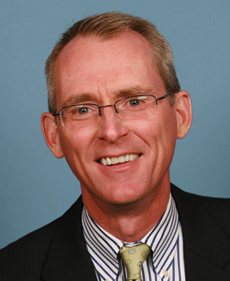
Robert Durden Inglis Sr. (born October 11, 1959) is an American politician who was the U.S. representative for South Carolina's 4th congressional district from 1993 to 1999 and again from 2005 to 2011. He is a moderate member of the Republican Party. Inglis was unseated in the Republican primary runoff in 2010 after losing to Trey Gowdy by a landslide.

Key Information

In 2012, Inglis launched the Energy and Enterprise Initiative, a nationwide public engagement campaign promoting conservative and free-enterprise solutions to energy and climate challenges.[1] E&EI is based in George Mason University in Fairfax, Virginia, and attempts to build support for energy policies that are dictated by conservative concepts of limited government, big business, accountability, reasonable risk-avoidance, and free enterprise capitalism. He argues that conservatives should accept the scientific consensus on climate change and advocates market-based solutions like a revenue-neutral carbon tax, to be paid for by a reduction in income and payroll taxes.[2] He is executive director of republicEN, a group of conservatives promoting free market fixes to climate change.[3]

Early life, education, and law career

[edit]

Inglis was born in Savannah, Georgia, the son of Helen Louise (née McCullough) and Allick Wyllie Inglis Jr. His ancestry is Scottish and English.[4] He grew up in Bluffton, South Carolina, near Hilton Head Island. He earned his undergraduate degree from Duke University in Durham, North Carolina. He obtained his Juris Doctor from the University of Virginia School of Law in Charlottesville, Virginia. Upon his graduation from law school, he worked for a number of years as a lawyer in private practice, and served on the executive committee of the Greenville County Republican Party.[5]

U.S. House of Representatives

[edit]

Elections

[edit]
1992

Inglis made his first run for elected office when he won the Republican nomination for the 4th District. In the general election, he defeated three-term incumbent Democrat Liz J. Patterson, who had earlier defeated Bill Workman and Knox H. White, two Republicans who were successive mayors of Greenville, with White still in the position. In this election, incumbent President George H. W. Bush carried the state with 48% of the vote, although he lost nationally, and South Carolina's majority of voters made it one of the strongest Republican-voting states. Although the 4th District had been trending Republican for some time, Patterson had deep family ties in the district as the daughter of the late, longtime U.S. Senator Olin D. Johnston. Additionally, she had won her first three terms under unfriendly conditions for Democrats.

1994–1996

Proving just how Republican this district had become, Inglis was re-elected in 1994 and 1996 with no substantive opposition, both times winning more than 70 percent of the vote.

1998

Inglis had promised during his initial bid for the seat to serve only three terms. Accordingly, he vacated the seat in 1998 to run for the Senate against Democratic incumbent Ernest Hollings, who had been in office since 1966, as successor to Olin Johnston. Inglis gave Hollings his third close race in a row, holding the longtime Senator to 53 percent of the vote. After losing the race, Inglis returned to work as a lawyer, practicing commercial real estate and corporate law. He was succeeded in the House by Jim DeMint, who had been an informal adviser to Inglis.

2004

In 2004, DeMint opted to run for Hollings's open Senate seat instead of seeking re-election to the House. Inglis chose to try for his old House seat. He easily won a three-way Republican primary with 85 percent of the vote, all but assuring his return to Congress. He faced the founder of the HBCU Classic and first African American Democratic candidate to run for the 4th District seat, Brandon P. Brown from Taylors, in the general election. Inglis was re-elected with little difficulty in 2006 and 2008.

2010

Inglis faced four challengers in the Republican primary—the real contest in this heavily Republican district. It was the first time he faced substantive primary opposition as an incumbent. The challengers included 7th Circuit (Spartanburg) Solicitor Trey Gowdy, state Senator David L. Thomas, college professor and former Historian of the U.S. House Christina Jeffrey, and businessman Jim Lee.[6]

In the June 8, 2010, primary election, Inglis finished second with 27 percent of the vote, well behind first-place finisher Gowdy's 39 percent. Inglis was forced into a June 22 run-off election against Gowdy.[7] Although he had "racked up a reliably conservative record" during his six terms in the House,[8] Inglis had been criticized by his primary opponents for certain votes, including his support for the Emergency Economic Stabilization Act of 2008 (which earned him the nickname "Bailout Bob")[9] and his opposition to the Iraq War troop surge of 2007, and was portrayed as removed from the interests of the district.[7][10] Inglis had attacked Gowdy's conservatism and questioned his opponent's support for creating a costly lake in Union County, South Carolina.[7]

In the runoff, Gowdy defeated Inglis in a landslide, 71–29 percent.[11] Following his defeat in the Republican primary, Inglis criticized the Tea Party movement, which had supported his opponent's campaign, as well as the Republican Party for courting the movement, stating, "It's a dangerous strategy, to build conservatism on information and policies that are not credible."[12]

Tenure

[edit]

Inglis's 2010 Republican primary opponents asserted that his voting record in his second House tenure was more moderate than his first. He was one of seventeen House Republicans who voted for a Democratic resolution opposing the Iraq War troop surge of 2007, and spoke against climate change denial, offshore oil drilling and warrantless surveillance after his return to the House.[13] In response, Inglis pointed to his 93.5% lifetime rating from the American Conservative Union[14] and his endorsements from the NRA Political Victory Fund[15] and National Right to Life Committee.[6] He touts his conservative credentials: "Ninety-three American Conservative Union lifetime rating, 100% Christian Coalition, 100% National Right to Life, A with the NRA, zero with the Americans for Democratic Action, the liberal group, and 23, by some mistake, with the AFL-CIO, the labor union - I was really hoping for a zero."[16]

On climate change, Inglis said that conservatives should go with the facts and the science, and accept the National Academy of Sciences' conclusion that climate change is caused by human activities and poses significant risks, which 97 percent of climate scientists agree with.[17] He proposes eliminating all energy subsidies and replacing income and payroll taxes with a revenue neutral carbon tax.[18] In 2009, he introduced the Raise Wages, Cut Carbon Act.[19]

Inglis is a staunch advocate of a federal prohibition of online poker. He also supported actions to aid people in war-torn Darfur. In 2006, he co-sponsored H.R. 4411, the Goodlatte-Leach Internet Gambling Prohibition Act[20] and H.R. 4777, the Internet Gambling Prohibition Act.[21]

In October 2007, before the South Carolina 2008 Republican presidential primary, Inglis told presidential candidate Mitt Romney, a Mormon, "[Y]ou cannot equate Mormonism with Christianity; you cannot say, 'I am a Christian just like you.'" Inglis stated "If he [Romney] does that, every Baptist preacher in the South is going to have to go to the pulpit on Sunday and explain the differences."[22][23]

On September 15, 2009, Inglis was one of seven Republicans to cross party lines in voting to disapprove fellow South Carolina Republican Joe Wilson for a lack of decorum during President Obama's address to a joint session of Congress.[24] He was one of eight House Republicans to support the DREAM Act.

Committee assignments

[edit]

In the 111th Congress:

Electoral history

[edit]

South Carolina's 4th congressional district, 1992:[25]

South Carolina's 4th congressional district, 1994:[26]

  • Bob Inglis, Republican – 109,626 (73.5%)
  • Jerry L. Fowler, Democrat – 39,396 (26.1%)
  • Write-in candidates – 154 (0.1%)

South Carolina's 4th congressional district, 1996:[27]

  • Bob Inglis, Republican – 138,165 (70.9%)
  • Darrell E. Curry, Democrat – 54,126 (27.8%)
  • C. Faye Walters, Natural Law – 2,501 (1.3%)

United States Senate election in South Carolina, 1998 – Republican primary:[28]

  • Bob Inglis – 115,029 (74.6%)
  • Stephen Brown – 33,530 (21.8%)
  • Elton Legrand – 5,634 (3.7%)

United States Senate election in South Carolina, 1998:[29]

  • Ernest Hollings, Democrat – 563,377 (52.7%)
  • Bob Inglis, Republican – 488,238 (45.7%)
  • Richard T. Quillian, Libertarian – 16,991 (1.6%)
  • Write-in candidates – 457 (nil)

South Carolina's 4th congressional district, 2004:[30]

  • Bob Inglis, Republican – 188,795 (69.8%)
  • Brandon P. Brown, Democrat – 78,376 (29.0%)
  • C. Faye Walters, Green – 3,273 (1.2%)
  • Write-in candidates – 150 (0.1%)

South Carolina's 4th congressional district, 2006:[31]

  • Bob Inglis, Republican – 115,553 (64.2%)
  • William Griff Griffith, Democrat – 57,490 (32.0%)
  • John Cobin, Libertarian – 4,467 (2.5%)
  • C. Faye Walters, Green – 2,336 (1.3%)
  • Write-in candidates – 85 (0.1%)

South Carolina's 4th congressional district, 2008 – Republican primary:[32]

South Carolina's 4th congressional district, 2008:[33]

  • Bob Inglis, Republican – 184,440 (60.1%)
  • Paul Corden, Democrat – 113,291 (36.9%)
  • C. Faye Walters, Green – 7,332 (2.4%)
  • Write-in candidates – 1,865 (0.6%)

South Carolina's 4th congressional district, 2010 – Republican primary:[34]

  • Trey Gowdy – 34,103 (39.2%)
  • Bob Inglis – 23,877 (27.5%)
  • Jim Lee – 11,854 (13.6%)
  • David Thomas – 11,073 (12.7%)
  • Christina Jeffrey – 6,041 (7.0%)

South Carolina's 4th congressional district, 2010 – Republican primary runoff:[35]

  • Trey Gowdy – 54,412 (70.7%)
  • Bob Inglis – 22,590 (29.3%)

Views on climate change

[edit]

On December 27, 2008, Inglis and Art Laffer coauthored an op-ed in The New York Times in support of a revenue neutral carbon tax: "We need to impose a tax on the thing we want less of (carbon dioxide) and reduce taxes on the things we want more of (income and jobs). A carbon tax would attach the national security and environmental costs to carbon-based fuels like oil, causing the market to recognize the price of these negative externalities."[2] He made the case in a Bloomberg Businessweek op-ed, noting that "small particulates from coal-fired plants cause 23,600 premature deaths in the U.S. annually, 21,850 hospital admissions, 26,000 emergency room visits for asthma, 38,200 heart attacks that are not fatal, and 3,186,000 lost work days". He writes:

conservatives know that there’s no such thing as a free lunch, we know that we’re paying for those deaths and illnesses. We pay for them through government programs for the poor and elderly, and when the costs of the uninsured are shifted onto the insured. We pay all right, but just not at the electric meter.

We pay the full cost of petroleum in hidden ways, too. We pay to protect the supply lines coming out of the Middle East through the blood of the country’s best and though the treasure that comes from our taxes or, worse, from deficit financing. We pay in the risk to our national security. We pay the cost of lung impairments when the small-particulate pollution comes from tailpipes just like we pay when the small particulates come from power plants. We just don’t pay at the pump.

What if we attached all of the costs -- especially the hidden costs -- to all fuels? What if we believed in accountability? What if we believed in the power of free markets?[18]

He "figures prominently"[36] in the 2014 Merchants of Doubt documentary as an interviewee exposing the methods of science deniers. He also appears in the documentary series Years of Living Dangerously.

He made the case in a TED talk: "We want to insist that polluters pay. They pay for these emissions, and the marginal harm they are causing for that last ton of CO2." He proposes ending energy subsidies, including "the biggest subsidy of all: the ability to belch and burn for free without accountability."[37]

Awards and honors

[edit]

Inglis was the recipient of the 2015 Profile in Courage Award from the John F. Kennedy Library Foundation "for the courage he demonstrated when reversing his position on climate change after extensive briefings with scientists, and discussions with his children, about the impact of atmospheric warming on our future."[38]

Personal life

[edit]

Inglis and his wife Mary Anne have five grown children, and they live on a small farm near Travelers Rest, north of Greenville. He is a member of St. John in the Wilderness, an Episcopal congregation in Flat Rock, NC. In 2015, he signed an amicus brief calling for the recognition of same-sex marriage.[39]

On October 2, 2023, Inglis wrote an op-ed in the New York Times urging his fellow Republicans to consider the long range consequences of their votes, and arguing that when they "grow up" and look back on their careers they will ask themselves "Was I an agent of chaos in a house divided, or did I work to bring America together, healing rifts and bridging divides?"[40]

Opposition to Donald Trump

[edit]

In October 2016, Inglis was one of thirty GOP ex-lawmakers to sign a public letter condemning Republican presidential candidate Donald Trump.[41][42] He had previously said, in a May 2016 interview with Chris Hayes, that "under no circumstances" could he vote for Trump.[43][44] Commenting on Trump's campaign after the election, Inglis said: "It's one thing to represent people and give a voice to their fears. It is quite another to amplify those fears—that is surely the worst possible kind of leadership. It's demagoguery. The real sadness for me is that we knew it, and yet we voted for it. In a very real sense, the whole country has lost this election."[45]

Six months later, after House Speaker Paul Ryan accused Democrats of partisan bias in calling for Trump's impeachment over the firing of FBI director James Comey, then investigating possible links between Trump's campaign and Russia, Inglis chastised Ryan on Twitter, saying, "you know this isn't true" since Republicans would have had, in his opinion, ample grounds for considering impeachment if a Democratic president had done the things Trump was accused of.[46] Reminded that he had, as a member of the House Judiciary Committee, voted to impeach President Bill Clinton in 1998, he said that was "for matters less serious than the ones before us now."[47]

In 2024, Inglis endorsed Kamala Harris over Trump in the presidential election. According to him, if Harris wins, it would be great for the Republican Party, restoring its rationality to be the credible free enterprise, small government party again.[48]

References

[edit]
[edit]
Revisions and contributorsEdit on WikipediaRead on Wikipedia
from Grokipedia

Robert Durden Inglis Sr. (born October 11, 1959) is an American Republican politician who served as the U.S. Representative for from 1993 to 1999 and from 2005 to 2011. Born in , Inglis graduated from and the University of South Carolina School of Law before entering politics as a fiscal and social conservative.
During his congressional tenure, Inglis focused on , free markets, and , serving on the , , and Committee and as ranking Republican on its Energy and Environment Subcommittee. His support for cap-and-trade legislation and public acknowledgment of human contributions to —after initially questioning the extent of anthropogenic influence—marked a significant evolution in his views, emphasizing from scientific inquiry over partisan orthodoxy. This stance, coupled with advocacy for revenue-neutral carbon taxes to incentivize innovation and reduce emissions through market mechanisms, alienated elements of his conservative base and led to his 20-point primary defeat in to challenger . Post-Congress, Inglis founded and serves as of republicEn.org, an dedicated to persuading conservatives to address risks via free-enterprise solutions rather than regulatory mandates. His efforts highlight a commitment to first-principles reasoning, prioritizing verifiable data on energy innovation and economic incentives over ideological conformity, earning recognition such as the 2015 from the Library Foundation for principled stands amid political cost.

Early life and education

Childhood and family

Robert Durden Inglis Sr., known as Bob Inglis, was born on October 11, 1959, in Savannah, Georgia. He spent his formative years in Bluffton, South Carolina, a small town in the Lowcountry region characterized by its rural, Southern setting and proximity to industrial operations like paper mills. Inglis's father worked as an industrial engineer at Union Camp Corporation, managing aspects of a that produced the distinctive odors his mother often downplayed in social contexts as a dutiful company spouse. This family dynamic reflected a traditional Southern , with the father as primary breadwinner in a technical profession and the mother maintaining home responsibilities amid the economic realities of mill-town life. Such an environment, rooted in self-sufficient labor and community ties in coastal , aligned with cultural emphases on personal responsibility and resourcefulness prevalent in mid-20th-century Southern families.

Academic pursuits

Inglis attended , graduating summa cum laude with a in in 1981. His coursework emphasized analytical frameworks for governance and policy, fostering a foundation in structured reasoning applicable to public affairs. Subsequently, Inglis enrolled at the School of Law, earning his in 1984. This legal training honed his skills in constitutional interpretation and statutory analysis, aligning with his emerging interest in principles.

Initial professional development

After earning his J.D. from the School of Law in 1984, Bob Inglis joined the , law firm of Leatherwood, Walker, Todd & Mann, P.C., specializing in commercial transactions. His practice encompassed , bond work, and related business law matters in the Upstate region, an area dominated by industries including textiles. By 1990, Inglis had advanced to in the firm, gaining practical experience in contract negotiation, , and economic aspects of trade that informed his later emphasis on free enterprise and . This period of private practice, spanning from 1984 until his successful congressional campaign, built Inglis's foundation in rule-of-law advocacy within commercial litigation and transactions, fostering a perspective rooted in market-driven solutions over intervention. He handled cases involving disputes and financing in a competitive economic environment, which highlighted the importance of predictable legal frameworks for enterprise growth.

Political career

First congressional term (1993–1999)

Robert Durden Inglis, a Greenville-based attorney entering politics without prior elected experience, secured the Republican nomination for in 1992 by sweeping 70 percent of the primary vote. He then achieved an upset victory over three-term Democratic incumbent Liz Patterson in the November , flipping the conservative-leaning district to Republican control for the 103rd Congress beginning January 1993. Inglis campaigned as an outsider emphasizing fiscal restraint and , defeating Patterson despite her internal polls indicating a lead. During his initial term, Inglis established himself as a fiscal hawk, returning $219,000 in unspent office funds from his budget to underscore commitment to taxpayer efficiency. He advocated for a , participating in House debates on the measure in the mid-1990s as part of broader Republican efforts to curb federal deficits. Inglis opposed earmarks, pushing for a to eliminate pork-barrel spending from appropriations bills. He also supported legislation, aligning with the 1996 Personal Responsibility and Work Opportunity Reconciliation Act that replaced Aid to Families with Dependent Children with state block grants and work requirements. Inglis demonstrated early skepticism toward expansive environmental regulations, earning low scores from the League of Conservation Voters—40 percent in 1993 and 12 percent in 1994—reflecting votes against measures favoring stringent federal oversight on , emissions, and resource extraction. His positions prioritized economic growth over regulatory burdens, consistent with his broader conservative stance during the 103rd through 105th Congresses. Reelected in 1994 amid the Republican wave, Inglis contributed to the House GOP's agenda by backing term limits amendments, though such proposals fell short of passage. He declined to seek reelection in 1998, opting instead for a unsuccessful U.S. bid.

Hiatus and return (1999–2005)

Following his defeat in the 1998 general election for , Inglis returned to private legal practice in Greenville, specializing in commercial real estate law from 1999 to 2004. This interlude enabled him to sustain involvement with the region's interests, particularly manufacturing firms reliant on and stability. Inglis leveraged this time to cultivate a network of conservative supporters advocating free-market principles and restrained federal intervention, fostering momentum for political reentry. By 2004, these efforts culminated in a dominant in the Republican primary for his former seat, where he captured 84 percent of the vote in a three-way field against minimal opposition. The lopsided victory highlighted his resilience and persistent alignment with district priorities on fiscal discipline and , securing his path back to Washington in January 2005.

Second congressional term (2005–2011)

Inglis reclaimed seat in the November 2, 2004, , defeating Democratic challenger Brandon P. Brown by capturing 69.77% of the vote in a district long dominated by Republicans. He began his second tenure in the 109th on January 3, 2005, focusing on core conservative priorities amid a Republican-controlled and . Reelected in the November 7, 2006, midterm elections during a national Democratic wave that flipped both chambers of , Inglis prevailed with over 60% of the vote against Democrat Jr. In the November 4, 2008, , coinciding with Barack Obama's presidential victory and further Democratic gains, he again won decisively with approximately 65% against Democrat Paul C. DeMarco Jr. A proponent of free-market policies, Inglis championed expanded trade liberalization, including the Central America-Dominican Republic Free Trade Agreement (CAFTA-DR). Initially skeptical due to potential impacts on South Carolina's textile industry, he shifted to support after securing commitments in July for stricter to curb Chinese fabric through CAFTA nations, enhanced yarn-forward provisions, and commercial availability safeguards for U.S. manufacturers. He voted in favor of CAFTA-DR on July 27, , contributing to its narrow House passage by a 217-215 margin, arguing it represented a calculated to promote and counterprotectionism despite domestic sector concerns. On immigration, Inglis emphasized enforcement and border security as prerequisites for reform, advocating at a October 2005 town hall for comprehensive that would mandate English as the , bolster physical barriers, and prioritize deportations of criminal undocumented immigrants over broad paths. He supported measures to strengthen interior enforcement and opposed unchecked inflows, aligning with Republican efforts to address vulnerabilities exposed post-9/11 without diluting sovereignty or wage pressures on American workers. In response to the , Inglis voted for the Emergency Economic Stabilization Act on October 3, 2008, authorizing the $700 billion to purchase distressed assets and avert systemic collapse, a yea tally in the 263-171 House passage. While acknowledging the intervention's necessity to restore liquidity and prevent Depression-era failures, he critiqued it as a reluctant deviation from free-market principles, stressing subsequent repayment mechanisms, executive pay restrictions, and avoidance of perpetual government backstops in favor of private-sector discipline and accountability.

Committee roles and legislative focus

During his first congressional term from 1993 to 1999, Inglis served on the House Committee on the Judiciary, contributing to oversight of antitrust enforcement through participation in hearings examining competition in sectors such as and the . These efforts highlighted concerns over monopolistic practices and their economic impacts, including potential precedents applicable to emerging technology firms like , amid the Department of Justice's antitrust case against the company in 1998. In his second term from 2005 to 2011, Inglis was assigned to the House Committee on Science and Technology, where he chaired the Subcommittee on Research and later served as of the Subcommittee on Energy and Environment. He also held positions on the House Committee on Foreign Affairs, influencing legislative scrutiny of international economic policies. Through these roles, Inglis advocated for empirical evaluation of federal research and energy programs, pushing for audits to identify inefficiencies and wasteful spending in government operations. Inglis sponsored and co-sponsored legislation targeting regulatory burdens and fiscal oversight, such as the Regulatory Transition Act amendments in the 104th Congress to extend moratoriums on certain rulemaking for small businesses, aiming to curb excessive federal regulations. He co-sponsored the Government Waste Reduction Act of 2005, which sought to mandate reviews and eliminations of duplicative or ineffective federal programs through systematic audits. These initiatives reflected his emphasis on data-driven reforms to enhance and reduce taxpayer burdens from unchecked government expansion.

Electoral history and defeat

Key elections and victories

Inglis secured his initial entry to Congress by defeating three-term Democratic incumbent Liz Patterson in the November 3, 1992, for , capturing a decisive victory in a district shifting toward Republican dominance following . His campaign centered on core conservative principles, including commitments to reduce the federal budget, impose term limits, and reject (PAC) contributions, which resonated with voters disillusioned by perceived fiscal excesses in Washington. This approach broadened his appeal beyond traditional Republicans to include Reagan-era Democrats in the conservative Upstate region, where turnout favored fiscal restraint advocates amid national anti-incumbent sentiment. He consolidated his position with resounding re-elections in subsequent cycles, winning 74% against Democrat Lester Kasle in 1994 amid the Republican "" wave, reflecting the district's solidifying GOP base. margins consistently exceeded 60%, as demonstrated in 1996 when Inglis garnered over two-thirds of the vote against Democratic challenger Paul Eckhardt, underscoring his strong hold on the district's conservative electorate through unwavering advocacy for and traditional values. After a self-imposed hiatus to pursue a U.S. Senate bid in 1998, Inglis staged a comeback by challenging incumbent Republican Gresham Barrett in the 2004 Republican primary, advancing from the June 8 initial ballot and prevailing in the June 22 runoff with 52% of the vote in a contest emphasizing fiscal discipline and opposition to congressional earmarks. This intra-party victory, fueled by superior fundraising exceeding $370,000 and grassroots support in Greenville County—which comprised a majority of primary turnout—reaffirmed his conservative credentials in a safely Republican district. In the November general election, Inglis defeated Democrat Lester Hutchins with a margin surpassing 60%, securing the seat through broad voter alignment with his record of principled conservatism.

2010 primary challenge and loss

In the Republican primary for on June 8, 2010, incumbent Bob Inglis advanced to a runoff against Spartanburg County Solicitor after a five-candidate field, with Gowdy receiving the most votes at approximately 39% and Inglis at 29%. Gowdy's campaign drew significant backing from Tea Party activists, who mobilized against Inglis amid broader anti-incumbent fervor following the and midterm election dynamics. The runoff election occurred on June 22, 2010, where Gowdy defeated Inglis decisively, securing 53,829 votes (71%) to Inglis's approximately 21,988 votes (29%), with total turnout in the reflecting the statewide Republican runoff participation rate of about 15%. Despite Inglis outspending Gowdy—having raised and expended more campaign funds through early 2010—the lower runoff turnout amplified the enthusiasm of Gowdy's supporters, contributing to the challenger's margin in a district with roughly 250,000 registered voters. Inglis conceded the race on election night, acknowledging the results as Gowdy claimed victory in a that underscored the district's pivot toward candidates emphasizing populist anti-Washington themes. This defeat ended Inglis's bid for a seventh term, paving the way for Gowdy's unopposed win later that year.

Factors contributing to electoral outcomes

Inglis's electoral successes in general elections from 1993 to stemmed from South Carolina's 4th congressional district's strong Republican lean, characterized by a predominantly white (approximately 75-80% in the ), rural-suburban electorate in the Upstate region, including manufacturing-heavy areas like Spartanburg and Greenville counties, where conservative voters outnumbered Democrats by margins often exceeding 2:1. This demographic alignment favored Republican incumbents in low-turnout general elections, with district-wide GOP registration advantages and minimal Democratic opposition enabling Inglis to secure victories by double-digit percentages, such as 62% in . National trends reinforcing party loyalty in safe districts further insulated him from broader anti-Republican waves, as seen in the 1994 GOP midterm surge and post- realignments. The 2010 Republican primary loss highlighted the district's intra-party dynamics amid the Tea Party movement's rise, which mobilized a subset of voters prioritizing fiscal austerity and ideological purity over incumbency, rejecting aspects of Inglis's record perceived as insufficiently orthodox, including internationalist leanings that clashed with emerging isolationist sentiments within the faction. Low primary turnout—statewide at 24.1% for the June 22 first round and 15.3% for the June 22 runoff—amplified the influence of highly motivated activists, with only about 25,000 votes cast in the district's runoff, favoring challenger Trey Gowdy's 79.6% to Inglis's 20.4%. Media characterizations of Inglis as a "RINO" (Republican In Name Only) in conservative outlets, based on select votes diverging from party-line orthodoxy, further energized primary challengers by framing the race as a purity test. The Great Recession's lingering effects, including unemployment peaking at 10.2% nationally in October 2009 and South Carolina's rate hitting 12.3% that year, intensified voter demands for uncompromising in 2010 primaries, channeling economic discontent into challenges against incumbents associated with prior bailouts and spending measures. This national anti-incumbent fervor, evident in Tea Party-backed defeats of over a dozen GOP incumbents or candidates, intersected with district-specific grievances, eroding Inglis's base among voters seeking doctrinal alignment over nuanced positions amid recession-fueled polarization. Earlier hiatus factors, such as his 2000 Senate primary loss to amid party shifts toward populism, presaged these dynamics but were mitigated by his 2004 comeback in a special context with less mobilized opposition.

Core political views

Fiscal conservatism and economic policies

Inglis maintained a lifetime rating of 93 percent from the American Conservative Union, reflecting his alignment with fiscal restraint and principles throughout his congressional tenure. He opposed expansive federal stimulus measures, voting against the $192 billion additional anti-recession stimulus spending in 2009 and criticizing unchecked borrowing to fund non-essential programs beyond entitlements and debt interest. During his 1998 campaign for the Fourth District seat, Inglis proposed a 17 percent rate, allowing exemptions up to $33,300 for a of four earning $48,125 annually, with taxes applied only to the remaining $14,825 of income to simplify the code and promote . Inglis advocated for entitlement reforms to address long-term fiscal solvency, vowing support for radical overhauls of budget, tax, and entitlement systems through spending cuts and co-sponsoring proposals like the Ryan Roadmap, which aimed to restructure Social Security and Medicare without increasing deficits. On trade, he critiqued as contrary to free-market principles, ultimately supporting expansions like the Central American Free Trade Agreement (CAFTA) in 2005 after initial reservations, viewing it as a calculated step to open markets despite risks modeled on NAFTA.

Foreign policy and national security

Inglis served on the House Foreign Affairs Committee during the 110th and 111th Congresses, where he focused on realist conservative principles prioritizing deterrence against threats, robust alliances, and avoidance of overextended interventions. He supported the Authorization for Use of Military Force Against Resolution (H.J. Res. 114) on October 10, 2002, with a vote of 296-133 in the House, framing the invasion as a necessary response to Saddam Hussein's regime and its ties to . Later, however, Inglis critiqued aspects of prolonged U.S. involvement, voting against President George W. Bush's 2007 troop surge proposal, which aimed to bolster forces for stabilization and , and expressing reservations about extensive efforts that risked remaking foreign societies in America's image. He argued that Iraqis should determine their own political future, emphasizing limited U.S. commitments over indefinite occupation. Inglis opposed isolationist tendencies within conservatism, advocating instead for strengthened alliances and cooperative security measures. He affirmed an "unbreakable" U.S.- bond in statements to pro-Israel groups and voted to cooperate with as a in September 2008, supporting civil nuclear agreements to foster strategic partnerships in . On national security threats, he backed declaring part of the broader war on terror without an exit timeline in June 2006, endorsed making the permanent in December 2005 for intelligence continuity, and favored sanctions on in April 2009 to curb its nuclear ambitions, reflecting a preference for multilateral pressure over unilateral withdrawal. He voted against unconditional support for democratic institutions in in June 2009, prioritizing targeted over broad institutional aid amid concerns over Pakistani stability. Inglis linked foreign policy to economic leverage, championing with allies as a tool for building partnerships and countering adversaries. He voted for the Free Trade Agreement (CAFTA) in July 2005 after initial reservations, viewing it as a "reasonable risk" to expand markets and alliances in the , and supported the Peru in November 2007 to promote prosperity and influence. These positions aligned with his rejection of , favoring open markets to enhance U.S. geopolitical standing. Energy policy featured prominently in Inglis's national security outlook, with emphasis on achieving independence through innovation rather than government mandates. In February 2009, he addressed on "moving from energy insecurity to ," arguing that market incentives for domestic production and technological advances in transportation fuels would diminish reliance on volatile foreign suppliers, thereby bolstering U.S. leverage against oil-exporting regimes. He highlighted this as a pathway to improved by reducing vulnerability to supply disruptions and funding for terrorist networks.

Energy and environmental perspectives

Inglis initially expressed skepticism toward anthropogenic during his early congressional service, viewing it as potentially overstated amid broader conservative doubts about environmental alarmism. His perspective shifted following congressional trips organized by the House Science Committee, including visits to in 2006 and 2008, where he observed researchers extracting ice cores revealing historical levels correlating with temperature changes over 800,000 years, and to the Great Barrier Reef in 2008, where he witnessed attributed to warming oceans during snorkeling with climate scientist Scott Heron. These empirical observations, combined with briefings from scientists, led Inglis to accept that human activities, particularly emissions, contribute significantly to recent global warming trends, though he emphasized data-driven realism over catastrophic predictions. On policy, Inglis advocated for a revenue-neutral carbon fee applied upstream at sources like refineries and mines, starting at $15 per ton and escalating to $100 over 30 years, with revenues rebated to households or used to offset income taxes to maintain fiscal neutrality and avoid expanding government. He critiqued cap-and-trade systems, such as the 2009 American Clean Energy and Security Act, which he opposed in a House vote, as inefficient due to their reliance on bureaucratic allocation of permits that distorted markets and invited , preferring transparent to internalize costs. Inglis also called for eliminating all energy subsidies—spanning fossil fuels, solar, and —to level the playing field and promote genuine market competition rather than government favoritism. Framing his stance as a conservative alternative, Inglis argued that accurate carbon pricing would signal true costs to innovators, spurring private-sector and technological breakthroughs in cleaner energy without mandates or central planning, which he saw as antithetical to free enterprise and prone to overreach. This approach, he contended, aligned with principles of by harnessing market incentives for resilience, such as through enhanced and efficiency gains, rather than subsidizing unproven renewables or imposing regulatory burdens that stifled .

Critiques of party shifts and leadership

Inglis has critiqued the Republican Party's shift toward Tea Party-influenced as a departure from fiscal discipline and principled , arguing that demagoguery distracted from addressing core issues like budget deficits and . He described such rhetoric—exemplified by figures like and —as the "lowest form of political leadership," accusing party leaders of acquiescing to fear-mongering that eroded credibility and hindered solutions, likening partisan divisions to intractable sectarian conflicts. This evolution, in Inglis's view, veered into excessive populism, comparable to the French Revolution's excesses, where blame-shifting toward figures like President Obama substituted for substantive policy proposals. He lamented the redefinition of conservatism into entitlement-driven demands, such as a perceived "God-given right to oil," rather than emphasizing and individual responsibility, warning that without fostering consensus amid crises, the party risked perpetuating dysfunction over genuine reform. In the Trump era, Inglis opposed personality-driven politics, endorsing in 2024 as a bulwark against what he termed Trump's "danger" to free markets, trade principles, and . He urged Republicans to abandon immature , such as shutdown threats over spending bills, which he saw as authoritarian rejection of pluralism and substantive governance in favor of crowd-pleasing rivalries that undermined fiscal stewardship. Inglis advocated evidence-based approaches over ideological denialism, positioning traditional as prioritizing market realities and long-term solvency against short-term political expediency.

Post-Congress advocacy

Founding of conservative climate initiatives

Following his defeat in the 2010 Republican primary and departure from Congress in January 2011, Inglis dedicated himself to advancing conservative approaches to climate issues, establishing the Energy and Enterprise Initiative (E&EI) as a 501(c)(3) educational organization. Hosted initially at George Mason University and formally launched there in July 2012, the initiative aimed to promote free-enterprise solutions to energy and climate challenges, emphasizing market-driven innovation over government mandates. Inglis positioned E&EI as a counter to left-leaning regulatory frameworks, arguing that acknowledging human causation in climate change—supported by empirical data from sources like satellite measurements and ice core records—necessitated competitive responses such as carbon pricing mechanisms that reward efficiency without central planning. The organization's core activities centered on conservative outreach, including data-focused briefings and regional tours to engage Republican audiences skeptical of alarmist narratives often amplified in and academic circles, which Inglis critiqued for overstating uncertainties while underplaying potential. These efforts rejected command-and-control policies in favor of revenue-neutral carbon fees paired with rebates to households, fostering enterprise-led transitions to lower-emission technologies like and . By 2014, E&EI rebranded as republicEn.org to underscore its Republican roots and broaden appeal among conservatives, maintaining a focus on first-principles analysis of causal factors—such as CO2's confirmed by spectroscopic data—while prioritizing economic realism over ideological denial. This founding work laid the groundwork for Inglis's advocacy, drawing on his congressional experience to bridge empirical science with free-market principles.

Key campaigns and revenue-neutral proposals

Following his departure from Congress, Inglis championed the approach as a revenue-neutral to internalize the external costs of carbon emissions without expanding or relying on command-and-control regulations. In this framework, a is levied upstream on fossil fuels at the point of extraction, importation, or production, starting at levels such as $15 per metric of CO2 equivalent and gradually increasing to signal long-term price certainty for innovation. The full revenue is then distributed equally to households as dividends, offsetting impacts on lower-income families and creating a market for consumers and producers to shift toward lower-carbon alternatives, while border adjustments impose equivalent fees on imports and rebate them on exports to protect domestic competitiveness. Inglis lobbied Republican lawmakers and co-sponsored bipartisan legislation, such as efforts with Representative to revive measures that paired emission fees with reductions, aiming to stimulate economic growth by lowering labor costs while curbing emissions. He argued this approach avoids fiscal expansion, contrasting it with regulatory overreach, and critiqued subsidies for both fuels—estimated at billions annually—and renewables as distortions that prop up inefficient players and hinder true market signals. Through public engagements and testimony, Inglis urged businesses to embrace voluntary adoption of internal carbon pricing and practices, citing empirical data on cost savings from energy efficiency measures, such as reduced operational expenses via optimized resource use, to demonstrate alignment with conservative principles of innovation and profitability over mandates.

Recent engagements and public discourse (2011–2025)

In 2025, Inglis participated in a public conversation with climatologist at the University of Pennsylvania's Energy Week, moderated by Sanya Carley, emphasizing conservative perspectives on climate policy and the need for good-faith dialogue across partisan lines based on empirical data such as temperature records and emissions trends. He argued for market-driven innovations to address verifiable environmental shifts, highlighting business-led decarbonization efforts like corporate adoption of carbon pricing without mandating federal regulations. That October, Inglis spoke at Harvard T.H. Chan School of Public Health's event on bipartisan climate solutions, alongside former EPA administrator , advocating revenue-neutral carbon fees as a free-market alternative to regulatory mandates, drawing on economic data showing potential for innovation in energy transitions. In a related Harvard studio discussion uploaded to on October 10, he reiterated the conservative case for carbon taxation, citing enterprise-led responses to cost signals over coercive government interventions. Inglis has critiqued Republican Party extremism through op-eds, such as his October 2, 2023, New York Times piece urging Republicans to prioritize over factional disruptions, attributing congressional to a minority of hardliners resistant to data-informed policy. He has sustained public discourse via platforms like republicEn.org's EcoRight Outlook newsletter, including the October 2025 edition, which promoted conservative, free-market climate actions amid observable trends in private-sector emissions reductions. These engagements underscore his focus on bridging ideological divides through evidence from thermometers, satellite data, and economic models rather than ideological purity tests.

Recognition and criticisms

Awards for principled stances

In 2015, former U.S. Representative Bob Inglis received the from the Library Foundation, presented on May 3 in . The honor specifically commended Inglis for publicly reversing his prior denial of anthropogenic climate change after reviewing scientific evidence during congressional briefings, and for advocating revenue-neutral carbon fees to internalize costs—positions that defied prevailing Republican orthodoxy and led to his 2010 primary loss to by a 66%–34% margin. This recognition underscored Inglis's prioritization of empirical data over partisan loyalty, as he urged conservatives to address risks through market mechanisms rather than regulatory mandates, despite facing electoral repercussions for challenging leaders on the issue. In accepting the award, Inglis emphasized bridging with conservative principles, stating his intent to promote carbon pricing as a tool for and fiscal discipline, free from government revenue grabs. Inglis's career also drew acclaim from conservative organizations for fiscal restraint, including a lifetime 100% score from the National Taxpayers Union for votes advancing balanced budgets and spending cuts during his tenure from to 1999 and 2005 to 2010. Such evaluations highlighted his resistance to deficit expansion, even when aligning with party majorities on defense or entitlements, reflecting a consistent application of limited-government tenets amid budgetary pressures.

Conservative achievements and legislative impacts

Inglis consistently advocated for fiscal restraint, earning recognition from the National Taxpayers Union as a "Taxpayers' Friend" in 1993 for votes limiting taxes and curbing spending growth. During the 104th Congress, he backed H.Con.Res. 67, the congressional budget resolution for fiscal years 1996–2000, which prioritized spending cuts and deficit reduction, contributing to the era's balanced budgets and eventual surpluses by enforcing discipline on discretionary outlays. In 2005, he co-sponsored H.R. 4526, the Government Waste Reduction Act, which mandated federal agencies to identify and eliminate duplicative programs and inefficient expenditures, targeting billions in potential savings through enhanced accountability mechanisms. On trade policy, Inglis supported the Central American Free Trade Agreement (CAFTA-DR) in 2005 after securing amendments addressing South Carolina-specific concerns, such as safeguards, which facilitated expanded export opportunities for the state's automotive and agricultural sectors; South Carolina's exports to CAFTA nations grew by over 200% in the decade following implementation, bolstering local manufacturing hubs like BMW's Spartanburg plant. His subcommittee roles in the House Judiciary and Science Committees enabled oversight that scrutinized regulatory overreach, leading to deregulatory measures in areas like and environmental permitting, where empirical data showed reduced compliance costs for small businesses without compromising core standards. Inglis's pre-Tea Party tenure modeled limited-government principles for incoming Republicans, influencing junior members through advocacy for first-principles fiscal discipline amid the 1990s ; his high-profile push for term limits and amendments inspired a cohort of lawmakers to prioritize structural reforms over short-term , as evidenced by the adoption of similar rhetoric in early 2000s conservative platforms.

Repercussions and ideological clashes

Inglis faced significant backlash from conservative activists, who labeled him a RINO (Republican In Name Only) for acknowledging anthropogenic and supporting market-based responses like cap-and-trade in , positions that diverged from the party's growing . This culminated in his defeat in the June 22, 2010, Republican primary runoff against , whom he trailed 20.3% to 79.7%, a margin exceeding 59 points amid the Tea Party insurgency. Critics on the right accused him of , arguing his views reflected detachment from working-class voters reliant on fossil fuels and ignored party orthodoxy on denying climate alarmism as a . His later criticisms of , including signing a letter from 30 former GOP lawmakers denouncing the candidate's character and signing an op-ed decrying Trump's "transactional view of life," intensified accusations of disloyalty and alignment with establishment moderates over the populist base. From the left, Inglis encountered critiques for perceived inconsistencies between his free-market rhetoric and advocacy for any carbon pricing mechanism, even revenue-neutral ones, which some viewed as insufficiently redistributive or transformative compared to regulatory mandates and green subsidies. His 2009-2010 proposals for a revenue-neutral carbon tax, intended to replace payroll taxes while internalizing emissions costs, garnered limited Democratic support, with bipartisan bills failing to advance amid demands for revenue allocation to social programs rather than tax rebates. Observers noted this reflected broader progressive wariness of tax swaps that prioritize market signals over direct government intervention, contributing to negligible cross-aisle buy-in during his tenure. Such narratives portraying Inglis's positions as capitulation overlook favoring carbon pricing's efficiency over command-and-control alternatives; studies indicate revenue-neutral reduce emissions at lower GDP costs—e.g., 0.1-0.3% annual drag versus 1-2% for regulations—by leveraging price signals to spur without expanding fiscal footprints. His emphasis on removal across fuels aligns with causal mechanisms where distorted prices hinder adaptation, as data from partial implementations like British Columbia's show emissions drops of 5-15% without net economic harm, underscoring over ideological purity.

Personal life

Family and personal relationships

Inglis married Mary Anne, whom he met while attending , following his first year of law school at the ; the couple wed in 1982 and have maintained a stable spanning over four decades. They have five children—one son and four daughters—raised in a family-oriented that underscores traditional conservative emphases on marital fidelity and parental responsibility. The family has resided primarily in , including a small farm in northern Greenville County, reflecting Inglis's deep-rooted connections to the state amid various relocations tied to his education and early professional moves, such as a brief period in , shortly after marriage. Inglis was born in , on October 11, 1959, but grew up in Bluffton in South Carolina's Lowcountry, a region known for its close-knit, rural communities that shaped his early with limited public elaboration to preserve family privacy. This longstanding family stability has provided a consistent personal foundation amid his public career transitions.

Religious and community involvement

Inglis is a devout Presbyterian and longtime member of the Presbyterian Church in America, attending Redeemer Presbyterian Church in Travelers Rest, South Carolina, near his Spartanburg-area base. He has held leadership roles within the church, including service as an elder and on the pastor nominating committee, positions that underscore his commitment to Reformed theological principles emphasizing personal responsibility and moral order. These roles have shaped Inglis's approach to ethical , integrating Presbyterian emphases on covenantal duty and scriptural authority into his public life without overt proselytizing. In community contexts, his church involvement reflects broader in , fostering local ties through faith-based service rather than formal secular boards. Inglis frames as a biblical mandate drawn from teachings on humanity's responsibility to tend creation, as articulated in Genesis, viewing it as compatible with scientific evidence and conservative values like intervention. He has publicly linked this principle to policy, arguing that faith reveals divine intent through observable natural order, thus bridging religious conviction with empirical calls for .

References

Add your contribution
Related Hubs
User Avatar
No comments yet.