Hubbry Logo
Boops boopsBoops boopsMain
Open search
Boops boops
Community hub
Boops boops
logo
8 pages, 0 posts
0 subscribers
Be the first to start a discussion here.
Boops boops
Boops boops
from Wikipedia

Boops boops
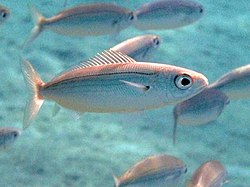
Close-up of one specimen in a school of bogue underwater. It is a small fish with large round eyes and a flat body and small fins.
School of bogues off the coast of Greece
Scientific classification Edit this classification
Kingdom: Animalia
Phylum: Chordata
Class: Actinopterygii
Order: Acanthuriformes
Family: Sparidae
Genus: Boops
Species:
B. boops
Binomial name
Boops boops
Synonyms
  • Boops canariensis (Valenciennes, 1839)
  • Box boops (Linnaeus, 1758)
  • Box vulgaris (Valenciennes, 1830)
  • Sparus boops Linnaeus, 1758

Boops boops (/ˈb.ɒps/ BOH-ops; from Ancient Greek βόωψ, lit.'ox-eyed'), commonly called the boce, bogue, or bogue bream,[2] is a species of seabream native to the eastern Atlantic.[3]

Taxonomy

[edit]

In the fourth century BCE, Boops boops was documented by Aristotle as box (Ancient Greek: βῶξ) in his Historia Animalium.[4] The common name boce is thus ultimately derived from the Greek via the Latin bōca.[5] In the early third century CE, Athenaeus, in his Deipnosophistae, also called the fish box and suggested that the name came from the sound that the fish makes (Ancient Greek: βοή, lit.'roar'). The name boops (Ancient Greek: βόωψ, lit.'ox-eyed') is mentioned due to the fish's large eyes.[6][7] The first scientific description comes from Carl Linnaeus in the tenth edition of Systema Naturae as Sparus boops. It was later reclassified under the genus Boops.[8]

Distribution and habitat

[edit]

The species is found off the coasts of Europe, Africa, the Azores and the Canary Islands, from Norway to Angola, and in the Mediterranean and Black Seas. It avoids brackish waters such as the Baltic Sea. A demersal and semi-pelagic feeder, it can generally be found at a depth of 100 m (330 ft), and infrequently down to 350 m (1,150 ft).[9]

Ecology

[edit]

It consumes seaweed, crustaceans, and some plankton, in schools that rise to the surface at night. Individuals can reach 36 cm (14 in), but average 20 cm (7.9 in).

Sex determination in the bogue is unclear. It has variously been described as a rudimentary intersex organism, with a few intersex individuals, or a protogynous intersex, with individuals starting out life as females, and some becoming male later on.[9]

Human use

[edit]

The species is commercially fished, with 37,830 tonnes taken in 2008.[3] European Commission standards include three size categories for Boops boops, from size 3, which is between 32 and 70 fish per kilogram, to size 1, which is no more than 5 fish per kilogram.[10]

When cleaned and pan fried, broiled or baked fresh, they are good tasting, but when stored their gut flora soon spread unpleasant flavors to their flesh.

Their shelf life is limited, as when stored at freezing (0 °C) for a week, or slightly above freezing for 2 to 4 days, the taste after cooking becomes of "unacceptable quality".[11] Much of the catch is used for fishmeal or tuna fishing bait.[citation needed] Boops boops has been used as an indicator of microplastic pollution in the Mediterranean sea.[12][13]

Parasites

[edit]

The bogue is host to a wide variety of parasites, ranging from metazoans such as monogenean flatworms (e.g. Microcotyle isyebi[14] and Cyclocotyla bellones) acanthocephalan spiny-headed worms, nematode roundworms, isopod and copepod crustaceans and myxozoan cnidarians to the unicellular dinoflagellate Ichthyodinium chabelardi, a parasite lethal to eggs developing in ovaries. At least 67 metazoan parasite species have been reported from the species.[15] In the aftermath of the 2002 Prestige oil spill, the community of parasitic species inhabiting bogue caught off the coast of Spain was noticeably altered.[16]

[edit]

References

[edit]
[edit]
Revisions and contributorsEdit on WikipediaRead on Wikipedia
from Grokipedia
Boops boops, commonly known as the bogue, is a medium-sized marine fish belonging to the family , native to the coastal waters of the eastern and the . It features a slender, body with 3-5 golden longitudinal stripes along its sides and a distinctive black spot at the base of the pectoral fin, growing to a maximum length of 40 cm, though commonly reaching 20 cm. This species is demersal to semi-pelagic, inhabiting depths from the surface to 350 m, typically over sandy, muddy, rocky, or seagrass-covered bottoms in subtropical and temperate waters. Its distribution spans from southern and the southward to , including the , , , and the entire Mediterranean and Black Seas, with oceanodromous migrations. Boops boops is gregarious, often forming schools and ascending to the surface at night, and occupies an intermediate position in the marine pelagic as an , primarily consuming benthic crustaceans, mollusks, and planktonic organisms. Reproduction occurs via in open water, with the species exhibiting debated sexuality, reported as protogynous hermaphroditism or gonochoristic, reaching at around 13.6-16.6 cm in length and living up to 11 years. Ecologically, B. boops serves as both prey for larger predators and a sentinel for environmental pollutants like due to its high rates. It faces low exploitation rates in some regions, such as the Northern , where fishing mortality is minimal (0.06 year⁻¹), contributing to its IUCN Least Concern status (assessed in 2009). Of commercial significance, Boops boops is targeted by fisheries using handlines, gillnets, and purse seines, valued fresh, frozen, or as bait for species like sharks and tunas; it is also used in Mediterranean aquaculture feeds.

Description

Physical characteristics

Boops boops exhibits a body shape, characterized by a streamlined, elongated form that is relatively low and slightly compressed laterally, with the anterior portion appearing subcylindrical in cross-section; this morphology facilitates efficient swimming and is well-suited to its schooling behavior in pelagic environments. The body is covered in small scales, which are smooth-edged and provide flexibility during rapid movements. Along the , there are 69 to 80 scales, aiding in sensory detection of water movements and prey. The possesses large, prominent eyes, with the typically greater than the length, a feature that contributes to the name , derived from the Greek boōps meaning "ox-eyed," reflecting their bulging appearance adapted for enhanced vision in dimly lit waters. The is small and slightly oblique, equipped with a single row of sharp, incisor-like teeth in both jaws—approximately 10-12 in the upper jaw and 8-10 in the lower—that are pointed and slightly recurved inward, enabling the to grasp and hold onto slippery prey such as crustaceans. The is divided into a spinous portion with 13-15 strong spines and a soft-rayed portion with 12-16 rays, while the features 3 spines followed by 14-16 soft rays; these configurations support agile maneuvering in schools and during . The body features a black spot at the base of the pectoral . Coloration patterns, including longitudinal stripes, are addressed in subsequent descriptions.

Size and coloration

Boops boops typically attains a maximum total length of 40 cm, though individuals commonly reach 20 cm in length. specimens average around 60 g in weight, with a maximum reported weight of up to 986 g. Growth in Boops boops follows the von Bertalanffy model, with parameters varying by location; in Saros Bay, the growth equation is given by L(t)=27.9(1e0.21(t(1.57)))L(t) = 27.9 \left(1 - e^{-0.21(t - (-1.57))}\right) cm, where L=27.9L_\infty = 27.9 cm and K=0.21K = 0.21 year1^{-1}, reflecting moderate growth rates influenced by environmental factors such as water temperature and food availability in the northeastern . These parameters indicate that approach asymptotic length by around 6-7 years of age, with faster initial growth in warmer coastal waters. The coloration of Boops boops features a bluish-green back transitioning to silvery sides with golden reflections, providing in the variable light conditions of its coastal and pelagic habitats; there are 3-5 weak golden longitudinal stripes along the sides. Juveniles exhibit paler overall tones with more pronounced darker stripes along the body, which may aid in avoiding predators in shallow, vegetated areas during early life stages. Sexual dimorphism in Boops boops is minimal and varies by region; while some studies report males slightly larger in mean size, length at maturity differs, with females maturing at smaller sizes (around 12-13 cm) compared to males (around 15 cm). The species' reproductive strategy is debated, with reports of both protogynous hermaphroditism and a gonochoristic nature.

Taxonomy and evolution

Etymology

The binomial name Boops boops originates from the species' initial description by Carl Linnaeus in 1758 as Sparus boops in the tenth edition of Systema Naturae. In 1814, Georges Cuvier established the genus Boops with Sparus boops designated as the type species by tautonymy, thereby formalizing the current scientific name. The generic and specific epithets "Boops" derive from the Ancient Greek term βοώψ (boōps), literally meaning "ox-eyed" or "cow-eyed," a reference to the fish's notably large eyes. Common names for Boops boops include bogue, boce, and bogue bream, reflecting its recognition in various European fisheries and regional dialects.

Classification and phylogeny

Boops boops belongs to the domain Eukaryota, kingdom Animalia, phylum Chordata, class , order Spariformes, family , genus , and B. boops. The genus , established by Cuvier in , was long considered monotypic with B. boops as its sole , but it now includes two recognized species: B. boops in the eastern Atlantic and Mediterranean, and B. lineatus in the western . The original description of Boops boops was provided by Linnaeus in 1758 under the name Sparus boops, with subsequent synonyms including Box boops (Linnaeus, 1758) and Box vulgaris (, 1830). Phylogenetically, B. boops is embedded within the diverse family , a of perciform-like fishes characterized by deep-bodied forms adapted to coastal environments. A 2022 molecular study using the mitochondrial control region () identified three distinct lineages within B. boops across its range, indicating high and ongoing without a significant barrier between Atlantic and Mediterranean populations.

Distribution and habitat

Geographic range

Boops boops is native to the eastern , with its range extending from southern southward to , encompassing offshore islands such as the , , the , , and . The species is also widespread throughout the , including the margins of the where it occurs, albeit less commonly. Within its Atlantic distribution, Boops boops is particularly abundant from the to the , where it forms significant populations in coastal and shelf waters. Northward occurrences become rarer, with only occasional records reported from the , , and regions. These northern sightings have been documented sporadically since the 20th century, including post-2000 observations in the southern . Recent environmental changes, including warming waters associated with climate change, have been linked to potential range expansions for Boops boops into the North Sea, with projections indicating increased environmental suitability for the species in this area over the 21st century.

Habitat preferences

Boops boops inhabits a wide depth range from 0 to 350 meters, though it is most commonly found between 0 and 100 meters, exhibiting a benthopelagic lifestyle where individuals remain closer to the bottom during the day. This species prefers coastal and shelf environments in temperate to subtropical waters, often associating with structured habitats that provide cover and foraging opportunities. The preferred substrates for Boops boops include sandy and muddy bottoms, rocky areas, beds, and regions covered by macroalgae or seaweeds, which support its omnivorous feeding habits and offer refuge from predators. These microhabitats are typically found along continental shelves and insular slopes, where the fish forms schools amid varied benthic features. Boops boops thrives in marine conditions, showing tolerance to fluctuations in coastal zones influenced by river inflows or . Water temperatures in its preferred range span 11.7 to 27.7°C, with an average of 17.8°C, aligning with its distribution in dynamic nearshore areas subject to from waves and currents. The species exhibits , descending to deeper waters near the substrate during daylight hours and ascending toward the surface at night to feed on and other resources.

Ecology and life history

Diet and feeding

Boops boops exhibits an omnivorous diet, primarily consisting of benthic , planktonic organisms, and plant material. Studies in the indicate that crustaceans, such as amphipods and decapods, form a significant portion of the diet, comprising approximately 49% of the food items, followed by porifera at 22.7%, coelenterates at 10.2%, seagrasses at 9.2%, and molluscs at 8.1%. These proportions highlight a reliance on bottom-dwelling prey like annelids and molluscs alongside pelagic components, including copepods and siphonophores within the coelenterates. The feeding strategy of B. boops is opportunistic, with the species displaying planktophagous behavior particularly at night when schools ascend to the surface. This nocturnal is facilitated by the fish's large eyes, adapted for low-light detection, allowing efficient capture of in dim conditions. Ontogenetic shifts in diet occur, with juveniles showing a higher proportion of planktonic prey, such as coelenterates (up to 46.7% in smaller size classes of 9.5-11.4 cm), while adults incorporate more benthic items like crustaceans (increasing to 42.5% in larger individuals of 29.5-31.4 cm) and porifera. Prey size also increases with fish length, reflecting changes in capabilities. B. boops exhibits high levels of microplastic ingestion, with studies from the 2010s reporting an average of 3.75 microplastic particles per fish in 68% of examined gastrointestinal tracts from the Balearic Islands. More recent studies (2020-2023) report similar high ingestion rates, with microplastics found in up to 80% of specimens from various Mediterranean sites, primarily fibers and fragments. This accumulation is attributed to the fish's planktivorous habits, as microplastics in the size range of 1 nm to 5 mm mimic plankton and are inadvertently consumed.

Reproduction and development

Boops boops is reported to exhibit protogynous hermaphroditism in several studies, with individuals initially developing as females before transitioning to males at a size of approximately 17-21 cm total length; however, other studies suggest it is primarily gonochoric with only rare cases of hermaphroditism. This is evidenced by the predominance of females in smaller size classes and males in larger ones, with intersexual individuals observed during the transition phase. The overall is typically close to 1:1, though it can skew toward males during the spawning period in some populations. The species is oviparous, releasing pelagic eggs into the water column during spawning. Spawning occurs as a batch process, with multiple clutches of oocytes released over an extended period, typically from January to May in Mediterranean and eastern Atlantic waters, peaking in February-March. In warmer regions such as the , the season aligns similarly but may extend slightly due to elevated temperatures. Fecundity varies by population and female size, ranging from 36,600 to 445,200 eggs per female, with representative values of 50,000-100,000 eggs in mature individuals. Size at first maturity is around 16.7 cm for males and 17.9 cm for females in Atlantic populations, though it can be smaller (12.5-15.8 cm) in some Mediterranean areas. Following spawning, eggs develop into planktonic larvae that remain pelagic for 16-20 days on average before settlement. Larvae settle at sizes of 1.5-2 cm total length, transitioning to demersal habitats and integrating into juvenile populations. This brief pelagic phase supports localized dispersal while minimizing offshore losses in coastal environments.

Behavior

Social behavior

Boops boops exhibits a highly gregarious , forming large schools that can number in the hundreds to thousands of individuals, primarily for predator avoidance and enhanced efficiency. These schools are typically observed in mid-water pelagic zones during the day, with the ascending closer to the surface at night, possibly to exploit planktonic resources. Juveniles display age-specific grouping patterns, forming dense shoals in shallower coastal littoral areas, particularly at night in anthropogenically modified habitats such as those near urban shorelines in the Mediterranean. These juvenile aggregations show seasonal abundance variations but remain consistent in their nocturnal timing, independent of lunar phases, and occur in smaller, more localized groups compared to adult formations. In terms of interspecific interactions, B. boops commonly associates with other members of the family, such as Diplodus vulgaris and Sarpa salpa, in shared coastal nursery habitats where juveniles co-occur and exhibit diet overlap, leading to potential competition for resources like crustaceans and mollusks. Adults participate in mixed pelagic groups with similar sparids.

Movement patterns

Boops boops exhibits pronounced , remaining at greater depths during the day and ascending toward the surface at night to access prey resources such as . This behavior is observed in both juveniles and adults across its range in the eastern Atlantic and Mediterranean, where schools typically occupy mid-water columns by day and move into shallower, surface-oriented positions (<10 m) nocturnally to exploit vertically migrating zooplankton. Seasonally, the species undertakes inshore-offshore shifts, with adults forming large shoals that migrate to deeper offshore waters (>100 m) during winter and spring for spawning, which peaks between and May. In contrast, during summer months, groups approach shallower coastal areas, aligning with shifts in foraging opportunities over varied bottom types like sand, rocks, and beds. Latitudinal migration remains limited, consistent with its oceanodromous nature, though genetic studies reveal no strong barrier to between Atlantic and Mediterranean populations, facilitating subtle range connectivity without extensive poleward displacements.

Parasites and diseases

Parasite species

Boops boops harbors a diverse community of metazoan parasites, with more than 14 documented across various studies, primarily comprising platyhelminths, nematodes, and crustaceans. In 2024, a new genus and of monogenean, Polyopisthocotyla bouops (Polyopisthocotylea: Microcotylidae), was described from the gills of B. boops in the western Mediterranean. Among these, digenean trematodes represent the most prevalent group, with at least eight recorded, including Wardula bartolii (Mesometridae), a specific to sparids in the NE Atlantic, and Lepidapedon spp. (Lepidapedidae), which infect the intestinal tract. Other notable digeneans include Lecithaster confusus, Aponurus laguncula, and Accacladium serpentulum, often as accidental infections. Nematodes are less diverse, with a single primary species, Anisakis simplex (Anisakidae), commonly found in the viscera and serving as a zoonotic concern due to its larval stages. parasites include five species of isopods, such as Ceratothoa oestroides and Ceratothoa capri (Cymothoidae), which attach to the buccal or branchial cavities and can cause tissue damage, including gill erosion and . Prevalence of digenean infections typically ranges from 20% to 40% in examined hosts, varying by location and host condition, while isopod infestations are lower, around 9-10%, but lead to notable branchial . Many of these parasites, particularly digeneans, exhibit complex life cycles involving intermediate hosts like crustaceans and mollusks, which are ingested by B. boops during feeding, facilitating transmission. Parasite diversity and composition show regional variation, with higher species richness (up to 37 metazoans) in Mediterranean populations compared to fewer records in the Atlantic, reflecting differences in prey availability and environmental factors.

Environmental influences on parasites

The Prestige oil spill in 2002 significantly altered metazoan parasite communities in Boops boops along the affected Galician coast, leading to lower and diversity compared to unaffected sites. These changes were attributed to the spill's impact on intermediate hosts, such as benthic , disrupting the life cycles of complex parasites like digeneans, while favoring simpler ectoparasites. Follow-up assessments in 2003–2005 confirmed a persistent decrease in community diversity and an increase in dominance by certain taxa, reflecting ongoing environmental stress on the host and its . By 2014–2015, approximately 12–13 years post-spill, univariate and multivariate analyses indicated partial ecological recovery, with parasite community structure approaching pre-spill conditions, though some long-term shifts in composition remained detectable. Recent studies from the 2020s have documented high microplastic ingestion in B. boops across Mediterranean and Atlantic waters, correlating with physiological stress and potential immune suppression in affected . Microplastics can indirectly elevate parasite loads, including nematodes, by compromising host immunity and altering gut microbiomes, as observed in experimental exposures and field surveys of marine teleosts. In B. boops, such pollution may exacerbate vulnerability to endoparasites, though direct causal links require further investigation. Ocean warming associated with is projected to enhance parasite transmission in B. boops by promoting range expansions of intermediate hosts and vectors, increasing overlap with the fish's distribution in the Mediterranean and eastern Atlantic. Elevated temperatures can accelerate parasite development rates and survival of free-living stages, potentially leading to higher intensities for trophically transmitted . These effects underscore the role of B. boops parasites in signaling broader climatic disruptions to marine webs. Parasite communities in B. boops serve as effective bioindicators for monitoring , with shifts in diversity and abundance providing early warnings of and degradation. Post-spill trends in this species have demonstrated the utility of such metrics for assessing recovery trajectories and informing conservation efforts in coastal environments.

Conservation and human relations

Conservation status

Boops boops is classified as Least Concern (LC) on the , with the assessment conducted on 14 August 2009 (published 2014) and annotated as needing an update; no subsequent global assessment has been conducted, though recent data indicates declining landings that may affect stability as of 2025. This status reflects its widespread distribution across the eastern Atlantic and , where it remains common without evidence of significant population declines at the level. Population trends for Boops boops vary regionally; while generally considered stable per the IUCN assessment, local stock assessments indicate and declining catches in some areas, such as the western Algerian coast and Egyptian Mediterranean waters, with no major declines reported in others like the Northern . The species has medium resilience with a minimum doubling time of 1.4–4.4 years. Minor threats include and in commercial fisheries, as well as habitat degradation from coastal development and , though these do not currently limit populations at a species-wide level. Accumulation of in individuals has been documented, particularly along Mediterranean coasts, but this is not considered a primary driver of population-level impacts. The species occurs within several Marine Protected Areas (MPAs) in the Mediterranean, such as the Gulf of Patti near Cape in , where monitoring supports its stable presence amid localized conservation efforts. Overall, Boops boops faces low risk due to its abundance and adaptability, with ongoing helping to mitigate pressures.

Fisheries and other uses

Boops boops is primarily targeted in commercial fisheries across the , where it is captured using purse seines, bottom trawls, gillnets, and beach seines. These methods often yield the species in association with other , contributing to multispecies catches in coastal and shelf waters. Annual landings in the Mediterranean averaged approximately 28,800 tonnes between 2009 and 2011, representing about 3% of total regional landings; more recent data indicate lower totals, with an average of 18,333 tonnes (2018–2020) across the GFCM area, though variability persists in country-specific catches such as around 5,000 tonnes per year in Algerian waters and 2,310 tonnes in Turkish waters in 2022. The is typically marketed fresh or frozen for human consumption. In recreational fisheries, Boops boops serves as a gamefish targeted by anglers, particularly in coastal areas of the Mediterranean, due to its abundance and accessibility. It is also utilized as bait for capturing larger predatory species. Other uses include its role in traditional Mediterranean cuisine, where it is prepared pan-fried, broiled, or baked. Minor trials in aquaculture have explored its potential, though commercial production remains limited; the species often aggregates around offshore fish cages, potentially influencing local wild populations. Fisheries management in EU waters involves quotas and total allowable catches (TACs) under the Common Fisheries Policy, coordinated through the General Fisheries Commission for the Mediterranean (GFCM) to regulate exploitation. Boops boops frequently appears as bycatch in purse seine and trawl operations targeting tuna and other pelagics.

References

Add your contribution
Related Hubs
User Avatar
No comments yet.