


Community hub
Recent from talks
Contribute something
Nothing was collected or created yet.
Beer glassware
View on Wikipedia

Beer glassware comprise vessels, today usually made of glass, designed or commonly used for serving and drinking beer. Styles of beer glasses vary in accord with national or regional traditions; legal or customary requirements regarding serving measures and fill lines; such practicalities as breakage avoidance in washing, stacking or storage; commercial promotion by breweries; artistic or cultural expression in folk art or as novelty items or usage in drinking games; or to complement, to enhance, or to otherwise affect a particular type of beer's temperature, appearance and aroma, as in the case of its head. Drinking vessels intended for beer are made from a variety of materials other than glass, including pottery, pewter, and wood.
In many countries, beer glasses are served placed on a paperboard beer mat, usually printed with brand advertising, in commercial settings.
International styles
[edit]Pilsner glass
[edit]

A pilsner glass is used for many types of light beers, including pale lager or pilsner. Pilsner glasses are generally smaller than a pint glass, usually in 200 millilitres (7.0 imperial fluid ounces), 250 ml (8.8 imp fl oz), 300 ml (11 imp fl oz), 330 ml (12 imp fl oz) or 400 ml (14 imp fl oz) sizes. In Europe, 500 ml (18 imp fl oz) glasses are also common. They are tall, slender and tapered. The slender glass reveals the colour, and carbonation of the beer,[1] and the broad top helps maintain a beer head.[2]
Weizen glasses are sometimes mistakenly called pilsner glasses because they are somewhat similar in appearance, but true pilsner glasses have an even taper without any amount of curvature.[3]
Pint glass
[edit]The definition of a pint differs by country, thus a pint glass will reflect the regular measure of beer in that country. In the UK, law stipulates that a serving of beer be fixed at the imperial pint (568 ml or 1.20095 US pints). Half-pint glasses of 10 imp fl oz (284 ml) and one-third pint glasses of 189ml are generally smaller versions of pint glasses. Quarter-pint glasses of 5 imp fl oz (142 ml) also exist, and are popular in Australia (now 140 ml from metrication), where they are known as a "pony". These may simply be smaller pint glasses, or may be a special pony glass. In the US, a pint is 16 US fl oz (473 ml), but the glasses may vary somewhat, and glasses of 500 ml are also called pints in American parlance.
The common shapes of pint glasses are:
- Conical glasses are shaped, as the name suggests, as an inverted truncated cone around 6 inches (15 cm) tall and tapering by about 1 inch (25 mm) in diameter over its height.
- The nonic, a variation on the conical design, where the glass bulges out a couple of inches from the top; this is partly to improve the grip, partly to prevent the glasses from sticking together when stacked, and partly to give strength and stop the rim from becoming chipped or "nicked".[4] The term "nonic" derives from "no nick".
- Jug glasses, or "dimple mugs", are shaped more like a large mug with a handle. They are moulded with a grid pattern of thickened glass on the outside, somewhat resembling the segmentation of a WWII-era hand grenade. The dimples prevent the glass slipping out of the fingers in a washing-up bowl, and the design of the glass emphasises strength, also to withstand frequent manual washing. These design features became less important when manual washing was superseded by machine washing from the 1960s onwards. Dimpled glasses are now rarer than the other types and are regarded as more traditional.[5] This sort of glass is also known as a "Handle" due to the handle on the glass. They are popular with the older generation and people with restricted movement in their hands which can make holding a usual pint glass difficult. They have recently started to make a comeback, especially in northern Britain.[6]
-
 British dimpled glass pint mug
 -
 "Conical" pint glass
 -
 "Nonic" pint glass
 -
 Current Guinness glass


.svg)

Connoisseur's glassware
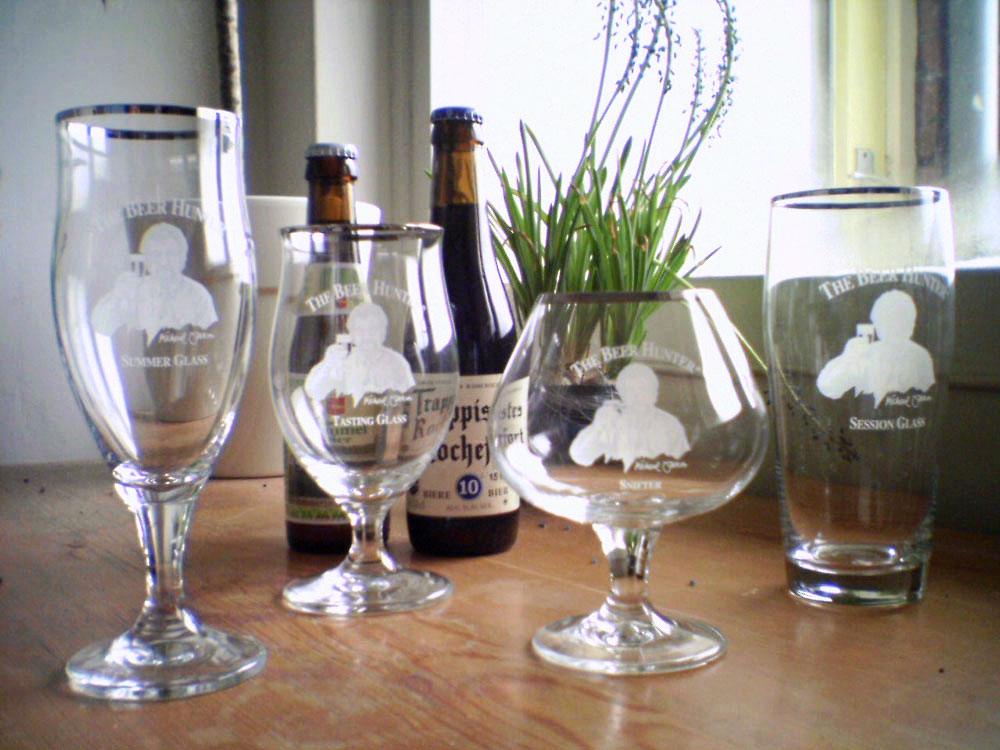
[edit]Beer connoisseurs sometimes invest in special, non-traditional glassware to enhance their appreciation. An example was the range marketed by Michael "Beer Hunter" Jackson.
Snifters
[edit]
Typically used for serving brandy and cognac, a snifter is ideal for capturing the volatiles of aromatic beers such as Double/Imperial IPAs, Belgian ales, barley wines and wheat wines. The shape helps trap the volatiles, while allowing swirling to agitate them and produce an intense aroma.
Taster glasses
[edit]Tasting glasses, also known as testers, are small, versatile glasses designed for sampling a variety of beers in small amounts. These glasses are a staple at beer festivals, tasting events, and breweries, allowing drinkers to explore different styles without committing to a full glass. Glasses holding 1/3 of a pint or less may be used to:
- Try a beer in a pub or café before purchasing a full measure
- Split a bottle of rare or strong beer between friends
- Sample multiple beers without becoming inebriated. For instance a brewpub might provide a sampler of three different brews in 1/3 pint measures, or a beer festival might provide small capacity glasses for patrons.
Plastic
[edit]Plastic beer vessels are usually shaped in imitation of whichever glasses are usual in the locality. They are mainly used as a substitute for glass vessels where breakages would be particularly problematic or likely, for instance at outdoor events.
German, Austrian, and Swiss styles
[edit] | This section needs additional citations for verification. (January 2019) |
Weizen glasses
[edit]
A weizen glass is used to serve wheat beer.[7] Originating in Germany, the glass is narrow at the bottom and slightly wider at the top; the width both releasing aroma, and providing room for the often thick, fluffy heads produced by wheat beer.[8] It tends to be taller than a pint glass, and generally holds 500 ml (7⁄8 imp pt) with room for foam or "head". In some countries, such as Belgium, the glass may be 250 ml (1⁄2 imp pt) or 330 ml (5⁄8 imp pt).[citation needed]
Wheat beers tend to foam a lot, especially if poured quickly. In pubs, if the bottle is handed to the patron for self pouring, it is customary for the glass to be taken to the patron wet or with a bit of water in the bottom to be swirled around to wet the entire glass to keep the beer from foaming excessively.[citation needed]
Beer stein
[edit]Beer stein or simply "stein" (/ˈstaɪn/ STYNE) has been for over a century an English expression for a traditional German beer mug made out of stoneware, whether simple and serviceably sturdy, or elaborately ornamental with either a traditionally cultural theme, or so embellished as to be sold as a souvenir or a collectible. The former may be made out of stoneware, but rarely the inferior earthenware or wood, while the latter is usually of glazed pottery, but often porcelain or pewter, or even silver or crystal. It may have either an uncovered mouth or a hinged pewter lid with a thumb-lever. The capacity of a German "stein" indicated by its fill line on its side ranged from "0.4l" (4 deci-litre), through "0.5l" (half a litre) or a full litre (or comparable historic sizes). Like decorative tankards, steins are often decorated in a culturally nostalgic, often German or Bavarian, theme. Some believe the lid that excludes flies from the beer today was originally intended for those so diseased in the age of the Black Plague.[9]
Maßkrug
[edit]
The Maß ([ˈmas]) is a one-litre (1.8-imperial-pint; 34-US-fluid-ounce) quantity of beer, most commonly used in Bavaria and Austria.[10] It is served in a Maßkrug (pl. Maßkrüge), which is sometimes simply referred to as a Maß. As a feminine noun, it is die Maß, though commonly confused with the grammatically neuter noun das Maß, meaning "measure". The unit of volume is typically used only for measuring beer sold for immediate on-site consumption. Because the Maß is a unit of measure, it can come in the form of a glass or stoneware mug.
The endurance sport of Maßkrugstemmen involves holding a filled, 2.4-kilogram (5.3 lb) Maß at arm's length.[11] The world record is 45 minutes and 2 seconds.[12]
Stangen
[edit]
The high, narrow and cylindrical Stange (German for "stick" or "rod", plural Stangen) is traditionally used for Kölsch. A Becher, traditionally used for Altbier, is similar, though slightly shorter and fatter. The Stange usually holds between 100 and 200 ml (1⁄8 and 3⁄8 imp pt), though larger ones are now sometimes used to reduce serving work. Stangen are carried by slotting them into holes in a special tray called a Kranz ("wreath").[citation needed]
Willibecher
[edit].jpg)
The Willibecher or Willybecher[13] ("Willi glass") is common in Germany. Its invention in 1954 is commonly attributed to an employee of Ruhrglas GmbH named Willy Steinmeier.[14] It is characterized by its shape: conical to the top portion where it curves inward to converge back to the top of a smaller diameter opening. The Willibecher is produced in sizes of 200, 250, 300, 400, and 500 ml (0.35, 0.44, 0.53, 0.70, and 0.88 imp pt; 6.8, 8.5, 10.1, 13.5, and 16.9 US fl oz).
Beer boot
[edit]
Boot- and shoe-shaped drinking vessels have been found at archaeological sites dating back to the bronze-age Urnfield cultures. Modern beer boots (German: Bierstiefel) have over a century of history and culture behind them. It is commonly believed that a general somewhere promised his troops to drink beer from his boot if they were successful in battle. When the troops prevailed, the general had a glassmaker fashion a boot from glass to fulfill his promise without tasting his own feet and to avoid spoiling the beer in his leather boot. Since then, soldiers have enjoyed toasting to their victories with a beer boot. At gatherings in Germany, Austria and Switzerland, beer boots are often passed among the guests for a festive drinking challenge. Since the movie Beerfest premiered in 2006, beer boots have become increasingly popular in the United States.[15]
It is an old joke to hand the boot to a young novice drinker with the toe pointing away from his person, which will result in beer pouring over the drinker's face uncontrollably when air enters the toe; seasoned drinkers always point the toe towards their body until the glass is sufficiently drained.[citation needed]
Pilstulpe
[edit].jpg)
The Pilstulpe ("Pilsner Tulip") or Biertulpe ("Beer tulip") is the traditional glass used for German pilsner beers. Sizes are typically around 300 millilitres (11 imp fl oz; 10 US fl oz), but can be as large as 500 millilitres (18 imp fl oz; 17 US fl oz). When used in restaurant settings, a small piece of absorbent paper is placed around the base to absorb any drips from spilling or condensation.
Gallery
[edit]-
 Elaborate earthenware beer steins
 -
 Common half-litre Humpen or beer mug
 -
 Warsteiner glass
 -
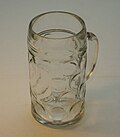 A Maßkrug


Belgian and Dutch styles
[edit] |
Stronger or bottled beers are frequently served in specially made, elaborately branded glassware. In addition to the profusion of glasses provided by brewers, some Belgian beer cafés serve beer in their own "house" glassware, which avoids having to keep a large number of different glass types in stock.
Flute glass
[edit]A vessel similar to a champagne flute is often the preferred serving vessel for Belgian lambics and fruit beers. The narrow shape helps maintain carbonation, while providing a strong aromatic front. Flute glasses display the lively carbonation, sparkling color, and soft lacing of this distinct style.
Goblet or Chalice
[edit]Chalices and goblets are large, stemmed, bowl-shaped glasses considered suitable for serving heavy Belgian ales, German bocks, and other big sipping beers. The distinction between goblet and chalice is typically in the glass thickness. Goblets tend to be thick, while the chalice is thin walled. Some chalices are even etched on the bottom to nucleate a stream of bubbles for maintaining a nice head.
-
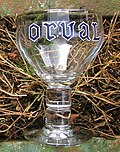 Orval beer's "chalice" glass
 -
 Rochefort beer's "goblet" glass


Tulip glass
[edit]A tulip glass has a shape similar to a brandy snifter. The body is bulbous, like a snifter, but the top flares out to form a lip which helps head retention. It is recommended for serving Scottish ales, American double/imperial IPAs, barley wines, Belgian ales and other aromatic beers. Some pint glasses that taper outwards towards the top are also called tulip glasses, despite having noticeably less curvature.
Gallery
[edit]-
 Geuze lambic beer in a flute glass
 -
 The Belgian ale Duvel in its tulip glass
 -
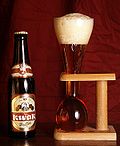 Kwak beer with its unusual glass and stand
 -
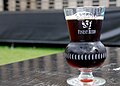 A thistle-shaped glass complements Belgian Scotch ales


British and Irish styles
[edit]Tankard
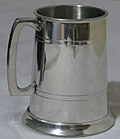
[edit]A tankard is a form of drinkware consisting of a large, roughly cylindrical, drinking cup with a single handle. Tankards are usually made of silver, pewter, or glass, but can be made of other materials, for example wood, ceramic or leather.[16] A tankard may have a hinged lid, and tankards featuring glass bottoms are also fairly common. Tankards are shaped and used similarly to beer steins. Metal tankards were popular in 18th and early 19th century Britain and Ireland, but were largely superseded by glass vessels. They are now seen as collector's items, or may be engraved and presented as a gift. Wooden and leather tankards were popular before the 17th century, but being made of organic materials have rarely survived intact to the present day.
-
 Reconstructed 16 CE wooden tankard
 -
-
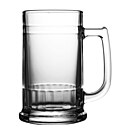 Glass tankard


Yard of ale
[edit]
A yard of ale or yard glass is a very tall glass used for drinking around 2.5 imperial pints (1,400 ml) of beer, depending upon the diameter. The glass is approximately 1 yard (91 cm) long, shaped with a bulb at the bottom, and a widening shaft which constitutes most of the height.[17]
The glass most likely originated in 17th-century England where the glass was known also as a "Long Glass", a "Cambridge Yard (Glass)" and an "Ell Glass". It is associated by legend with stagecoach drivers, though was mainly used for drinking feats and special toasts.[18][19] (Compare with the Pauwel Kwak glass).
Drinking a yard glass full of beer is a traditional pub game. The fastest drinking of a yard of ale in the Guinness Book of Records is 5 seconds.[20]
Capacity
[edit] |
| Volume | France | Belgium | Netherlands | Germany | Austria | Switzerland | Czechia | Italy | Spain | UK | Ireland | Australia | Quebec |
|---|---|---|---|---|---|---|---|---|---|---|---|---|---|
| 125 ml | Galopin, Bock | Benjamin | Pfiff | Birrino | Zurito (Basque) | ||||||||
| 200 ml | Flûte, Hollandais | Fluitje, Buisje, Pijpje | Stange (Cologne, but only for Kölsch) | Galopin (French), Herrgöttli (German) | Birra Piccola | Caña | |||||||
| 250 ml | Demi, Bock | Boerke, Chope, Pintje | Vaasje, Emmertje, Rendsje, Amsterdammertje (though not in Amsterdam), Rotterdammertje (only in Rotterdam) | Botellín | |||||||||
| 284 ml | Middy, Ten, Half | Middy, Ten, Half, Glass | |||||||||||
| 285 ml | Middy, Pot, Handle, Half | ||||||||||||
| 300 ml | Seidl, Seitel, Seiterl | Jonker | Seidl, Seitel, Seiterl | Becher, Stange, Rugeli | |||||||||
| 330 ml | Gourde, Klepke | Canette | Třetinka | Tercio, Mediana | |||||||||
| 400 ml | Birra Media | ||||||||||||
| 425 ml | Schooner | ||||||||||||
| 500 ml | Distingué, Baron, Mini-chevalier, Chope, Pinte, Sérieux | Demi | Pul, Halve leo | Seidel, Seidla, Halbe (Southern Germany) | Krügel, Krügerl, Halbe | Chope (French), Grosses (German) | Půllitr | Pinta | |||||
| 568 ml | Pint | Pint | Chopine | ||||||||||
| 570 ml | Pint | ||||||||||||
| 775/950 ml | Humpen | Holba | Beer stein | ||||||||||
| 1000 ml | Chevalier, Parfait, Double Pinte, Formidable | Corbeau, Lunette, Litron | Maß | Maß | Masse/Litron (French), Mass (German) | Tuplák | Birra grande | Pinte | |||||
| 1138 ml | Quart | Quart | |||||||||||
| 1140 ml | Jug | ||||||||||||
| 2000 ml | Stiefel, Liesl |
Australian measures
[edit]Prior to metrication in Australia, one could buy beer in glasses of size 4, 5, 6, 7, 10, 15 or 20 imperial fluid ounces. Each sized glass had a different name in each Australian state. These were replaced by glasses of size 115, 140, 170, 200, 285, 425 and 570 ml. Progressively, the differences are decreasing. In the 21st century, most pubs no longer have a glass smaller than 200 ml (7 imp fl oz); typically available are 200ml, 285ml and 425ml, and increasingly many pubs also have pints 570 millilitres (20.1 imp fl oz) available.
| Names of beer glasses in various Australian cities[n 1][n 2][n 3] | |||||||||
|---|---|---|---|---|---|---|---|---|---|
| Capacity[n 4] | Sydney | Canberra | Darwin | Brisbane | Adelaide | Hobart | Melbourne | Perth | |
| 115 ml (4 fl oz) | – | – | – | – | - | small beer | foursie | shetland | |
| 140 ml (5 fl oz) | pony | – | – | pony | pony | – | horse/pony | pony | |
| 170 ml (6 fl oz) | – | – | – | – | butcher[n 5] | six (ounce) | – | bobbie/six | |
| 200 ml (7 fl oz) | seven | – | seven | beer | butcher | seven (ounce) | glass | glass | |
| 285 ml (10 fl oz) | middy | middy / half pint | handle | pot[n 6] | schooner[n 7] | ten (ounce) | pot | middy / half pint | |
| 350 ml (12 fl oz) | schmiddy[n 8] | – | – | – | – | – | – | – | |
| 425 ml (15 fl oz) | schooner | schooner | schooner | schooner | pint[n 7] | fifteen / schooner | schooner | schooner[n 9] | |
| 570 ml (20 fl oz) | pint | pint | pint | pint | imperial pint[n 7] | pint | pint | pint | |
Notes:
|
References: | ||||||||
See also
[edit]
References
[edit]- ^ Shepard, Robin (2001). Wisconsin's Best Breweries and Brewpubs: Searching for the Perfect Pint. University of Wisconsin Press. ISBN 978-0299174446. Retrieved 1 March 2010.
- ^ Swierczynski, Duane (2004). The Big Book o' Beer: Everything You Ever Wanted to Know About the Greatest Beverage on Earth. Quirk Books. p. 122. ISBN 1931686491. Retrieved 1 March 2010.
- ^ Garrett Oliver (9 September 2011). The Oxford Companion to Beer. Oxford University Press. p. 304.
- ^ Ford, Richard (24 August 2009). "Last orders for traditional pint glass as search begins for alternatives". The Times. Archived from the original on 17 June 2023.
- ^ Gray, Chris (10 March 2001). "Collapse of Glass Firms Calls Time on Dimpled Jugs". The Independent. Archived from the original on 29 January 2011. Retrieved 17 June 2023.
- ^ Barford, Vanessa; Rohrer, Finlo (30 April 2014). "The return of the dimpled pint glass". BBC News. Retrieved 30 April 2014.
- ^ Ben McFarland, World's Best Beers: One Thousand Craft Brews from Cask to Glass, page 27. Sterling Publishing Company, Inc. 2009. ISBN 978-1402766947. Retrieved 10 March 2010.
- ^ Wright, Chris (August 2007). The Beer Journal. Lulu Enterprises Incorporated. ISBN 9781430312468. Retrieved 10 March 2010.
- ^ Gary Kirsner (1999). "A Brief History of Beer Steins". Archived from the original on 3 June 2009. Retrieved 19 June 2009.
- ^ "Maß". Duden. Retrieved 17 June 2023.
- ^ Bernstein, Joshua M. (21 September 2013). "10 brew-tiful ways to rock Oktoberfest". New York Post. Retrieved 18 October 2019.
- ^ "Weltrekord im Dauer-Maßkrugstemmen". Bayerischer Rundfunk (in German). 11 March 2019. Retrieved 18 October 2019 – via ARD.
- ^ "Willybecher". Gastro Lexikon. Archived from the original on 18 October 2010. Retrieved 17 June 2023.
- ^ "Zahlreiche Gäste bei der Eröffnung der Ausstellung 'Der Willybecher' in der Heimatstube im Neuen Schloss" (PDF). Der Kißlegger (in German). 1 April 2015. p. 6. Archived from the original (PDF) on 4 March 2016 – via Schwäbische Zeitung.
- ^ Thrillist (29 September 2014). "A Brief History of German Beer Boots, and Where You Can Find Them". The Huffington Post. Retrieved 2 August 2015.
- ^ "Tankard at British History Online". Archived from the original on 25 May 2011. Retrieved 11 September 2011.
- ^ Dan Rabin; Carl Forget (1998). The Dictionary of Beer and Brewing. Taylor & Francis. p. 283. ISBN 978-1-57958-078-0.
- ^ "Yard-of-ale glass (drinking glass) – Britannica Online Encyclopedia". britannica.com. Retrieved 10 March 2010.
- ^ "The Yard of Ale : Our History". theyardofale.com. Archived from the original on 4 March 2010. Retrieved 10 March 2010.
- ^ The Guinness book of records 1999. Guinness. 1998. p. 60.
External links
[edit] Media related to Beer glasses at Wikimedia Commons


| International | |
|---|---|
| National | |

Beer glassware
View on GrokipediaHistory and Cultural Significance
Origins and Early Development
The earliest evidence of beer vessels dates back to ancient Mesopotamia and Egypt around 3000 BCE, where clay and ceramic mugs and jars were commonly used for brewing, storing, and consuming beer. In Mesopotamia, archaeological finds such as residue-laden ceramic cups from sites like Godin Tepe in Iran (ca. 3500–3000 BCE) confirm the use of these porous earthenware containers, which facilitated fermentation through their ability to retain moisture and support yeast activity.[2] Similarly, in ancient Egypt, unglazed terracotta jars with wide mouths, exemplified by examples from the Second Intermediate Period (ca. 1650–1550 BCE), allowed for aeration during brewing and were integral to daily consumption, as beer was a staple dietary liquid.[3] Metal vessels, including gold and silver tumblers and jars from elite contexts like the Royal Tombs of Ur (ca. 2500 BCE), also emerged for drinking beer, often paired with elaborate straws to filter sediment from the thick brew.[4] The transition to glass for beer vessels occurred during Roman times in the 1st century CE, coinciding with the invention of glassblowing techniques in the Syro-Palestinian region, which enabled the production of thinner, more elegant drinking cups. By the mid-1st century CE, blown glass cups had largely replaced pottery for tableware, as seen in artifacts such as ribbed bowls and gladiator-themed cups that highlight the material's newfound affordability and versatility.[5] This innovation allowed for mass production of transparent or lightly colored vessels, enhancing the aesthetic appeal of communal drinking in Roman society. In medieval Europe, from the 12th to 15th centuries, beer vessels evolved alongside the resurgence of brewing traditions, particularly in monastic communities that preserved and refined the craft. Monks in orders like the Benedictines and Cistercians brewed beer on a large scale for sustenance and trade, using sturdy tankards and mugs made from wood or pewter to serve the cloudy, unfiltered ales typical of the era. These vessels, often lidded to protect against contamination, reflected the period's practical needs and the growing commercialization of beer in regions like Germany and England; glass was rare and not commonly used for everyday beer consumption.[6][7] A key milestone came in the 15th century with the development of clear glass techniques originating from Venice, where cristallo—a nearly colorless, high-purity glass—was perfected through advanced purification methods like the use of manganese dioxide. Venetian glassblowers' innovations, including the use of refined soda ash and precise blowing, produced delicate goblets and tumblers that influenced European tableware, marking a shift toward more refined beer consumption among the elite.[8][9]Regional Traditions and Evolution
In Germany, the evolution of beer glassware in the 19th century was closely tied to Bavarian standardization efforts and cultural festivals. Between 1809 and 1811, the Kingdom of Bavaria unified its disparate liquid measures—previously numbering 93 different units—into a single standard based on the Munich Maß, equivalent to one liter, which facilitated consistent serving practices across the region.[10] This reform supported the growing beer culture under longstanding regulations like the Reinheitsgebot of 1516, which mandated pure ingredients and reinforced Bavaria's brewing heritage. The inaugural Oktoberfest in 1810, celebrating a royal wedding, marked the early prominence of these standardized vessels, with the Maßkrug—a sturdy, handled one-liter glass mug—becoming iconic for serving Märzen-style beers at the event by the late 19th century.[11][12] In Belgium, beer glassware developed through monastic branding in the 20th century, particularly among Trappist breweries. Modern styles of Trappist beers were developed in the early 1930s by abbeys like Orval (starting production in 1931) and Westmalle (building on commercial brewing since 1856), which emphasized high-strength, bottle-conditioned ales and began associating them with distinctive serving ware to enhance the drinking experience.[13] By the 1920s and 1930s, these breweries introduced custom chalice-style glasses—thick, stemmed goblets designed to capture aromas and support the beer's complexity—often etched with abbey logos as part of early branding efforts that predated the official hexagonal Trappist seal of 1997.[14] This practice reflected Belgium's tradition of brewery-specific glassware, turning vessels into symbols of authenticity and monastic craftsmanship.[15] Britain's pint glass traditions solidified after the Weights and Measures Act of 1824, which standardized imperial volumes, including the pint at 20 fluid ounces (568 ml), to ensure fair trade in public houses.[16] Early 20th-century designs shifted from straight-sided mugs to more ornate forms, with the 10-sided fluted handled pint emerging around 1928 as mass-produced options proliferated. Dimpled mugs, featuring indented patterns for better grip and light refraction to highlight amber ales, gained popularity in the late 1930s and 1940s, evolving from continental influences and becoming a staple in pubs by the post-World War II era.[17] These glasses often bore verification marks, such as "GR" for George Rex, confirming capacity under local regulations.[17] The 19th-century Industrial Revolution transformed beer glassware through advances in manufacturing, enabling widespread adoption of specialized shapes. Techniques like press-molding, pioneered in the 1820s by figures such as John P. Bakewell, allowed for efficient, low-cost production of patterned and clear glass vessels, shifting from handmade pewter or pottery to durable, transparent options suitable for diverse beer styles.[18] This mass production via molds democratized access to refined glassware, proliferating regional designs like tall Pilsner forms in Central Europe as clearer, brighter lagers emerged.[19] The rise of craft beer in the 1970s and 1980s further evolved glassware toward connoisseur-focused designs, driven by small-scale brewers challenging industrial uniformity. In the United States, pioneering operations like New Albion (1976) and Sierra Nevada (1979) sparked a movement that grew from fewer than 100 craft breweries in the early 1980s to over 500 by 1994, emphasizing flavor nuance and prompting the revival of tulip, snifter, and stemmed glasses to optimize aroma retention and presentation.[20][21] This shift mirrored global trends, where enthusiasts adopted specialized ware to appreciate complex ales and lagers, marking a departure from generic pub glasses toward tools that enhanced sensory evaluation.[22]Design Principles and Materials
Shape, Function, and Sensory Enhancement
The shape of a beer glass plays a pivotal role in enhancing the sensory experience by influencing the concentration of aromas. Narrow tops or inward-curving rims trap volatile aroma compounds, directing them toward the drinker's nose for a more intense olfactory perception, while wider bases facilitate the initial release of carbon dioxide (CO₂) to promote foam stability without overwhelming the scent profile.[23] This design leverages the geometry to balance aroma retention and dispersion, allowing subtle hop, malt, and fruit notes to emerge more distinctly during consumption.[1] Foam retention is another critical function shaped by glass design, where etched nucleation points on the base create consistent bubble formation sites, ensuring a stable head typically measuring 2-3 cm in height. These points initiate CO₂ bubble nucleation, which rises through the beer to support the foam collar, preventing rapid dissipation and maintaining effervescence that contributes to mouthfeel and flavor release.[24] The overall geometry, such as a tapered form, further aids by channeling bubbles efficiently, enhancing visual appeal and sensory consistency across pours.[25] Temperature control is optimized through specific structural elements, like stemmed designs that insulate the beer from hand warmth, preserving ideal serving temperatures of 4-7°C for many styles where cooler conditions highlight crisp profiles.[26] Without such features, body heat can accelerate warming, altering solubility and dulling flavors. Ergonomically, beer glasses balance stability, ease of pouring, and aesthetic appeal with typical heights of 15-25 cm, providing a comfortable grip while showcasing the beer's color and clarity.[27] At the scientific core, these enhancements draw from principles like Henry's Law, which describes how CO₂ solubility in beer decreases with reduced pressure upon pouring, with glass geometry modulating the rate of gas release and effervescence to sustain carbonation and sensory attributes.[28] This interplay ensures that the vessel not only holds the liquid but actively refines the tasting experience through controlled physical and chemical dynamics.[29]Common Materials and Manufacturing
Soda-lime glass serves as the primary material for most beer glassware due to its clarity, affordability, and suitability for mass production. This type of glass typically comprises 70-75% silica (SiO₂), along with approximately 15% soda (sodium oxide, Na₂O) to lower the melting point and 10% lime (calcium oxide, CaO) for chemical stability.[30][31] The material is annealed during manufacturing to relieve internal stresses, enhancing its resistance to thermal shock for typical temperature changes encountered in use, such as from room temperature to chilled beverages (delta T ~20-40°C), preventing breakage under normal conditions.[32] For premium or decorative beer glasses, lead crystal offers superior brilliance and sparkle owing to its high lead oxide content, which increases the refractive index. However, in 1991, the U.S. Food and Drug Administration issued warnings restricting everyday use of lead crystal for food-contact due to risks of leaching into acidic beverages, prompting a shift toward lead-free alternatives in everyday glassware.[33][34][35] Non-glass materials have historically played a role in beer vessels, particularly for traditional tankards predating the 20th century. Pewter, an alloy primarily of tin with traces of antimony and copper, was favored for its malleability and tarnish-resistant finish in European steins and mugs from the 14th to 19th centuries.[36] Ceramic, often stoneware or earthenware, provided a robust, insulated option for early tankards, valued for heat retention during communal drinking in pre-industrial eras.[37] In contemporary bar environments, stainless steel has gained popularity for beer glasses due to its exceptional durability, corrosion resistance, and ability to withstand repeated impacts without shattering, making it ideal for high-volume service.[38] Beer glass manufacturing predominantly employs blow molding for artisanal and custom shapes, where molten glass is blown into molds to achieve elegant, thin walls that enhance tactile appeal without compromising strength. Machine-pressed techniques, which revolutionized production in the 1820s by pressing molten glass into molds, enable efficient, high-volume output of standardized glasses with consistent thickness and form.[39][40] Hygiene considerations have shaped modern beer glass design, with dishwasher-safe constructions becoming standard after the 1950s as commercial dishwashers proliferated in hospitality settings. These glasses often feature UV-resistant coatings to inhibit surface degradation and clouding from repeated exposure to detergents and heat, ensuring long-term clarity and sanitation.[41]Capacity and Standardization
Standard Volumes and Measurements
Beer glassware capacities are standardized to facilitate consistent serving sizes across brewing traditions and regulatory frameworks, primarily using metric units in most of the world and imperial or US customary units in specific regions. Common international standards include the 330 ml size, widely adopted as a single serving for lighter beers like pilsners in countries such as France, where it aligns with typical draught pours. The 500 ml half-liter capacity is prevalent in Germany and other Central European markets for robust lagers and ales, reflecting a preference for fuller servings in pub and festival settings. In the United Kingdom and Commonwealth nations, the imperial pint of 568 ml serves as a benchmark for draught beer, ensuring uniformity in public houses.[42][42][16] In the United States, beer glassware often mirrors bottling conventions, with the 12 oz (355 ml) size transitioning from standard bottles to glass pours for sessionable brews, while the 16 oz (473 ml) pint dominates bar service for a balanced pour of ales and IPAs. These capacities promote practical handling and portion control in commercial environments. Key conversions between systems include 1 US pint equaling 473 ml and 1 imperial pint equaling 568 ml, highlighting the volume disparity that affects international trade and consumer expectations.[43][16][16]| Standard Capacity | Description | Equivalent Volume |
|---|---|---|
| 330 ml | Pilsner single serving (international) | ~11.2 US fl oz |
| 500 ml | Half-liter (Central Europe) | ~16.9 US fl oz |
| 568 ml | Imperial pint (UK/Commonwealth) | ~19.2 US fl oz |
| 355 ml | US bottle standard | 12 US fl oz |
| 473 ml | US pint | 16 US fl oz |