Hubbry Logo
ChaliceChaliceMain
Open search
Chalice
Community hub
Chalice
logo
8 pages, 0 posts
0 subscribers
Be the first to start a discussion here.
Chalice
Chalice
from Wikipedia

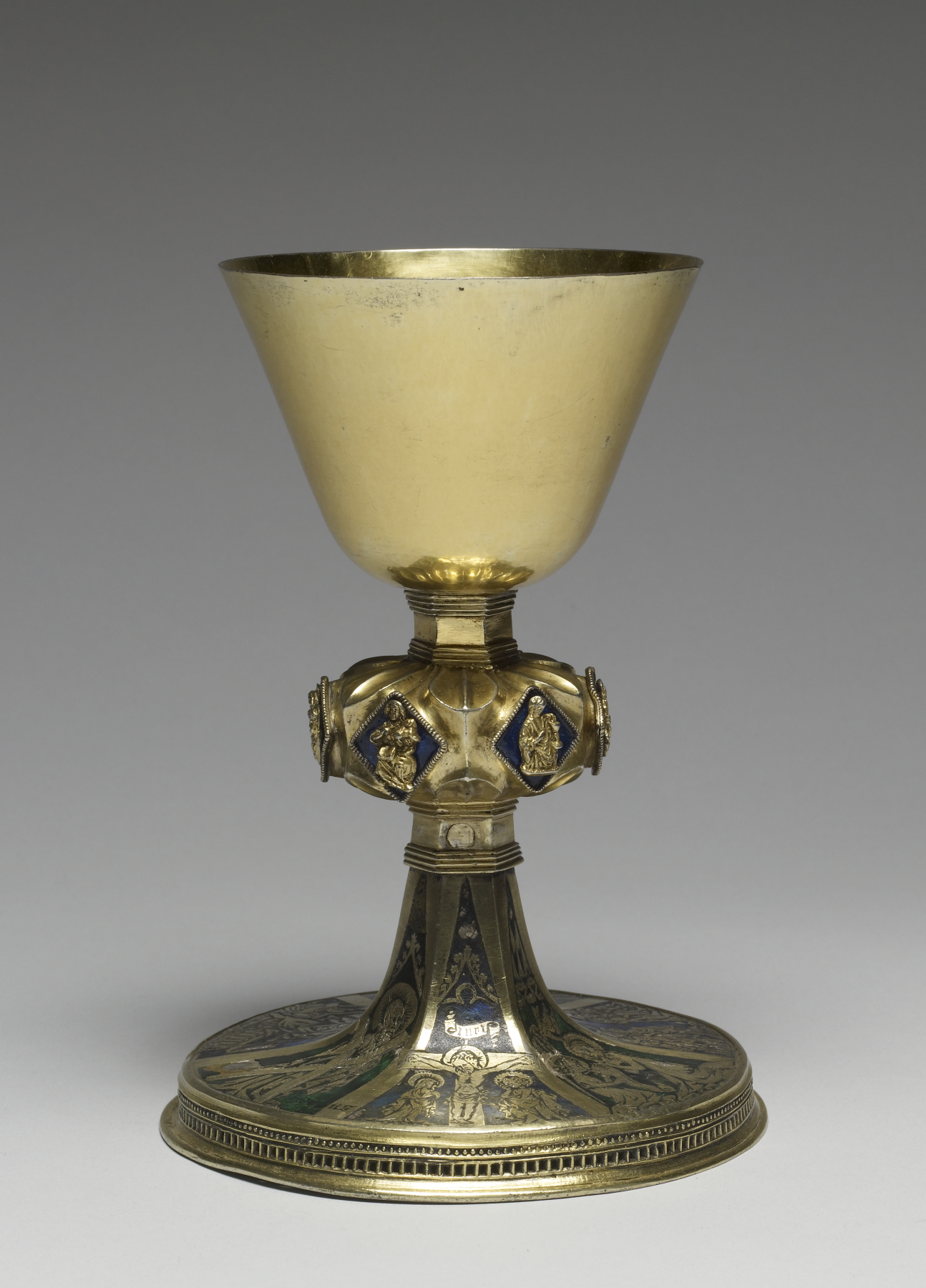
Late medieval chalice in silver-gilt with enamels of Saints and Scenes from the Life of Christ
Diagram showing the parts of a liturgical chalice.

A chalice (from Latin calix 'cup', taken from the Ancient Greek κύλιξ (kylix) 'cup') is a drinking cup raised on a stem with a foot or base. Although it is a technical archaeological term, in modern parlance the word is now used almost exclusively for the cups used in Christian liturgy as part of a service of the Eucharist, such as a Catholic mass. These are normally made of metal, but neither the shape nor the material is a requirement. Most have no handles, and in recent centuries the cup at the top has usually been a simple flared shape.

Historically, the same shape was used for elite secular vessels, and many individual examples have served both secular and liturgical uses over their history, for example the Lacock Cup and Royal Gold Cup, both late medieval cups. Cups owned by churches were much more likely to survive, as secular drinkware in precious metal was usually melted down when it fell out of fashion.

The same general cup shape is also called a goblet (from Old French gobellet, diminutive of gobel 'cup'), normally in secular contexts. This remains current as a term for wineglasses and other stemware, most of which have a goblet shape, with Paris goblet as a trade term for basic rounded wineglasses. The modern French term gobelet has developed differently, and is used for different shapes such as the Gobelet André Falquet and Roman Lyon Cup, both stemless.

Religious use

[edit]

Christian

[edit]
Fresco of a female figure holding a chalice at an early Christian Agape feast. Catacomb of Saints Marcellinus and Peter, Via Labicana, Rome

The ancient Roman calix was a cup or drinking vessel, probably rather vaguely defined as to its exact shape. But most consisted of a bowl on a stem over a foot or base; handles were probably optional. The Greek kylix, at least as defined by modern authorities, was a far wider and more shallow bowl on some sort of stem, with two horizontal handles. It is the most common wine cup seen in paintings of symposium drinking parties. Gradually the term became more or less restricted to cups for liturgical use.[1]

In Roman Catholicism, Eastern Orthodox Church, Oriental Orthodoxy, Anglicanism, Lutheranism and some other Christian denominations, a chalice is a standing cup used to hold sacramental wine during the Eucharist (also called the Lord's Supper or Holy Communion). Chalices are often made of precious metal, and they are sometimes richly enamelled and jewelled. Generally they have no handles.

Chalices have been used since the early Church. Because of Jesus' command to his disciples to "Do this in remembrance of me." (Luke 22:19), and Paul's account of the Eucharistic rite in 1 Corinthians 11:24–25, the celebration of the Eucharist became central to Christian liturgy. Naturally, the vessels used in this important act of worship were highly decorated and treated with great respect. A number of early examples of chalices have a large bowl and two vertical handles, reflecting classical cup shapes such as the kantharos and skyphos. Over time, the size of the bowl diminished and the base became larger for better stability. Eventually, official church regulations dictated the construction, blessing, and treatment of chalices. Some religious traditions still require that the chalice, at least on the inside of the cup, be gold-plated.[2]

In Western Christianity, chalices will often have a knop, pommel or node where the stem meets the cup to make the elevation easier. In Roman Catholicism, chalices of recent centuries tend to have quite narrow cups. Roman Catholic priests will often receive chalices from members of their families when first ordained.

Silver chalice in the museum of the Romanian Orthodox Archbishopy of the Vad, Feleac, and Cluj

In Eastern Christianity (Oriental Orthodox, Eastern Orthodox and Eastern Catholic churches), chalices will often have icons enameled or engraved on them, as well as a cross. In Orthodoxy and Eastern Catholicism, all communicants receive both the Body of Christ and the Blood of Christ. To accomplish this, a portion of the Lamb (host) is placed in the chalice, and then the faithful receive Communion on a spoon. For this reason, eastern chalices tend to have larger, rounded cups. In the Russian Orthodox Church, the faithful will often kiss the "foot" (base) of the chalice after receiving Holy Communion. In other traditions, they will kiss the cup. Although Orthodox monks are not permitted to hold personal possessions, the canons permit a hieromonk (i.e., a monk who has been ordained to the priesthood) to keep a chalice and other vessels necessary to celebrate the Divine Liturgy.

In the early and medieval church, when a deacon was ordained, he would be handed a chalice during the service as a sign of his ministry. In the West the deacon carries the chalice to the altar at the offertory; in the East, the priest carries the chalice and the deacon carries the paten (diskos). Only wine, water and a portion of the Host are permitted to be placed in the chalice, and it may not be used for any profane purpose.

The chalice is considered to be one of the most sacred vessels in Christian liturgical worship, and it is often blessed before use. In the Roman Catholic Church and some Anglo-Catholic churches, it was the custom for a chalice to be consecrated by being anointed with chrism, and this consecration could only be performed by a bishop or abbot (only for use within his own monastery).[3] Among the Eastern Churches, there are varying practices regarding blessing. In some traditions, the very act of celebrating the Sacred Mysteries (Eucharist) is the only blessing necessary; in others, there is a special rite of blessing. In some Eastern traditions, this blessing may be done only by a bishop, in some it may be done by a priest.

The Holy Chalice

[edit]
Chalice with the inscription: "Sanguis meus vere est potus" ('My blood is drink indeed'; John 6:55, KJV), made for the church St John the Baptist in Salinas, Spain. Silver-gilt, 1549

In Christian tradition, the Holy Chalice is the vessel which Jesus used at the Last Supper to serve the wine. New Testament texts make no mention of the cup except within the context of the Last Supper and give no significance whatsoever to the object itself. Herbert Thurston in the Catholic Encyclopedia 1908 concluded that "No reliable tradition has been preserved to us regarding the vessel used by Christ at the Last Supper. In the sixth and seventh centuries pilgrims to Jerusalem were led to believe that the actual chalice was still venerated in the church of the Holy Sepulchre, having within it the sponge which was presented to Our Saviour on Calvary." Several surviving standing cups of precious materials are identified in local traditions as the Chalice.

Holy Grail

[edit]

An entirely different and pervasive tradition concerns the cup of the Last Supper. In this highly muddled though better-known version, the vessel is known as the Holy Grail. In this legend, Jesus used the cup at the Last Supper to institute the Mass. Other stories claim that Joseph of Arimathea used the cup to collect and store the blood of Christ at the Crucifixion.

Unitarian Universalism

[edit]

At the opening of Unitarian Universalist worship services, many congregations light a flame inside a chalice.[4] A flaming chalice is the most widely used symbol of Unitarianism and Unitarian Universalism (UU), and the official logo of the Unitarian Universalist Association (UUA) and other Unitarian and UU churches and societies.[5] The design was originated by the artist Hans Deutsch, who took his inspiration from the chalices of oil burned on ancient Greek and Roman altars. It became an underground symbol in occupied Europe during World War II for assistance to help Unitarians, Jews, and other people escape Nazi persecution.[6] The chalice is often shown surrounded by two linked rings. The two linked rings were used as an early symbol for the Unitarian Universalist Association, signifying the joining of Unitarianism and Universalism.

There is no standardized interpretation of the flaming chalice symbol. In one interpretation, the chalice is a symbol of religious freedom from the impositions of doctrine by a hierarchy and openness to participation by all; the flame is interpreted as a memorial to those throughout history who sacrificed their lives for the cause of religious liberty. In another interpretation, the flaming chalice resembles a cross, symbolic of the Christian roots of Unitarian Universalism.[5]

Wicca

[edit]

In Wicca, a chalice, as a feminine principle, is often used in combination with the Athame (ceremonial black-handled knife), as male principle. Combining the two evokes the act of procreation, as a symbol of universal creativity. This is a symbol of the Great Rite in Wiccan rituals. A chalice is also used in the Small Rite.

Neo-Paganism

[edit]

Some other forms of Neo-Paganism make use of chalices in their rituals as well. A chalice may be placed on an altar or on the ground. The chalice may contain wine, whiskey, water, or other liquids. It is used to represent the genitalia of the goddess or female deity.

Rastafarian

[edit]

Rastafaris sometimes smoke ganja in a chalice (waterpipe or bong) during an activity called reasoning intended to put participants in touch with peaceful feelings, unity, and "consciousness."[citation needed]

Poisoned chalice

[edit]
Treasure of Gourdon, 6th century AD

The term "poisoned chalice" is applied to a thing or situation which appears to be good when it is received or experienced by someone, but then becomes or is found to be bad. The idea was referred to by Benedict of Nursia in one of his exorcisms, found on the Saint Benedict Medal: Vade retro Satana! Nunquam suade mihi vana! Sunt mala quae libas. Ipse venena bibas! ('Begone Satan! Never tempt me with your vanities! What you offer me is evil. Drink the poison yourself!').
William Shakespeare uses the expression in Act I Scene VII of Macbeth. It occurs in the opening soliloquy of the scene when Macbeth is considering the ramifications of the murder he is plotting.

But in these cases
We still have judgment here; that we but teach
Bloody instructions, which, being taught, return
To plague the inventor: this even-handed justice
Commends the ingredients of our poison'd chalice
To our own lips. [1.7.7–12]

Heraldry

[edit]

The use of chalices as heraldic devices is not unusual, especially in ecclesiastical heraldry. A number of cities and regions also make use of the chalice. For instance, the coat of arms of the municipality of Fanas in the district of Prättigau/Davos in the Swiss canton of Graubünden bears a gold chalice on a solid blue background. The coat of arms of Staufen im Breisgau contains the three golden chalices (i.e. drei staufen in ancient German) of the Lords of Staufen [de], advocates of the monastery of St. Trudpert. A golden chalice (or in some instances three or five) on blue background has been used as coat of arms for the Kingdom of Galicia since at least the late Middle Ages, and is still central in its renewed heraldry.

[edit]

Other usage

[edit]
Allegory of the Eucharist by Alexander Coosemans

Québec

[edit]

In French-Canadian culture, particularly in and around Quebec, the use of the names of holy objects such as "câlice" (a variation of calice, which is the French word for chalice) can be an alternate form of cursing. Somewhat equivalent to the American word "goddam" or the phrase "God damn it", the use of "câlice" or "tabarnak" (a variation of tabernacle) as an interjection is not uncommon in Quebec. For example: "Câlice! I forgot to lock the front door" or muttering "tabarnak" under one's breath after they get a flat tire. This is presumably a derivation of "taking the Lord's name in vain".[7]

Czech Republic

[edit]

With reference to the Hussite movement in the Kingdom of Bohemia, besides religious use, the chalice also became one of the unofficial national symbols of the Czechs. It is frequently used in Czech national symbolism and it is part of many historical banners.

See also

[edit]

Notes

[edit]
[edit]
Revisions and contributorsEdit on WikipediaRead on Wikipedia
from Grokipedia
A chalice is a goblet-shaped drinking vessel, typically featuring a stem and footed base, used for ceremonial purposes. The term derives from the Latin calix (or calicem), meaning "cup" or "goblet," which traces back to the Greek kylix or kalyx. In Christian liturgy, particularly the Eucharist across Roman Catholic, Eastern Orthodox, and Anglican traditions, the chalice serves as the sacred container for the wine that, following consecration, symbolizes the blood of Jesus Christ from the Last Supper. Chalices have evolved from simple early Christian forms made of wood, glass, or base metals to elaborate medieval and later examples crafted from gold, silver, or other precious materials, often adorned with engravings, gems, and religious iconography to reflect their theological significance. Prior to use in the Mass, chalices undergo consecration, a rite that imparts sacramental character, underscoring their role beyond mere utility as vessels embodying Christ's sacrifice. While primarily ecclesiastical, the chalice form draws from ancient secular goblets used in elite drinking rituals across cultures, adapting into a symbol of divine communion and communal bonding in religious contexts.

Etymology and Definition

Linguistic Origins and Evolution

The English word chalice originates from the Latin calix (genitive calicis), denoting a "" or "goblet," which traces back to the kylix (κύλιξ), referring to a shallow two-handled drinking vessel used in symposia. This Latin term entered as chalice or the variant calice (a collateral learned form of caliz), reflecting phonetic shifts and influence during the medieval period. In English, the word first appeared as cælic in texts around the , adopted directly as an borrowing from Latin to describe liturgical cups, predating the . By in the 13th–14th centuries, it evolved to chalis or chalice via Anglo-Norman French intermediaries, solidifying its form and expanding usage beyond general vessels to emphasize contexts. The notes dual etymological paths: direct Latin influence and French mediation, with the latter prevailing in secular spellings. Linguistically, the term's evolution reflects Christianity's integration into Romance and , shifting from a broad Proto-Indo-European-rooted concept of containment (though the precise PIE origin of calix remains uncertain) to a specialized signifier of purity and by the late medieval era. In post-Reformation English, chalice retained its primary liturgical denotation for the Eucharistic cup—contrasting with Protestant preferences for "cup"—while secondary meanings emerged, such as a goblet-shaped flower calyx or metaphorical "vessel" in poetry, as in John Keats's (1819). This semantic narrowing in religious discourse persisted, with modern liturgical texts like the (post-1969 revisions) standardizing chalice for the stemmed vessel holding consecrated wine.

Physical Characteristics and Materials

A chalice is characterized by a stemmed cup design, typically comprising four main parts: the cup (or bowl), which holds the contents; the stem, connecting the cup to the base; the node (or knop), a bulge or ornament on the stem for grasping; and the foot (or base), providing stability. This structure elevates the vessel above table level, distinguishing it from simpler goblets, and often lacks handles to facilitate liturgical handling. In liturgical contexts, the is commonly and somewhat shallow in earlier designs, evolving to deeper, bell-shaped forms in later periods for and practical reasons, such as accommodating the paten or purificator. The stem may include decorative elements like lobes or bosses, while the base is frequently hexagonal or lobed to match the stem's profile and prevent tipping. Historically, chalices were crafted from diverse materials including , silver, bronze, tin, lead, or even wood for everyday use, reflecting available resources and status. Liturgical prescriptions, however, mandate precious metals such as or silver for the interior of the cup to signify reverence, with permitted on base metals; breakable substances like or are prohibited to avoid risks. Medieval examples often featured intricate engravings, , and embedded gemstones on or silver exteriors. Modern chalices adhere to these norms, using lined with where feasible, though simpler metal alloys suffice for non-precious exteriors.

Historical Development

Ancient and Pre-Christian Precursors

The chalice, as a stemmed drinking vessel, drew from earlier ancient forms used for libations, offerings, and elite consumption across civilizations predating . In , ritual vessels resembling chalices appeared in funerary contexts, such as the lotus chalice from Tutankhamun's (ca. 1332–1323 BC), carved from a single piece of translucent stone into the shape of a blooming white lotus with two buds, symbolizing rebirth and used possibly for symbolic offerings to sustain the deceased in the . Similar Egyptian cups, employed in temple rituals for pouring liquids to deities, evidenced advanced stoneworking techniques and held religious significance tied to purity and divine favor. In the Indus Valley periphery, the (ca. 1800–1200 BC) produced ceramic goblets at sites like , , featuring stemmed designs around 1300 BC with painted upper sections, indicating early experimentation with elevated drinking forms likely for communal or ceremonial use amid agrarian settlements. These vessels, characterized by coarse ware and linear motifs, reflected a transition toward specialized pottery in societies, predating widespread metal use. Mediterranean precursors included Etruscan ware chalices from the 7th–6th centuries BC, such as high-legged examples with incised or relief decorations like palmettes, crafted from black-burnished clay imitating metal prototypes and deposited in to facilitate banquets in the . These stemmed cups, produced in , influenced Roman calices—open vessels of clay, glass, or metal used for wine in symposia and rituals—bridging Hellenistic forms (shallow, stemmed drinking cups from ca. 600 BC) with later goblet designs. In , simpler libation cups of stone or metal from Sumerian periods (ca. 3000 BC) served priestly pouring rites, establishing the vessel's role in sacred liquid handling long before Christian adoption.

Adoption in Early Christianity

The use of a chalice, or , in early Christian Eucharistic practice originated with the , as described in the accounts where took a of wine, gave thanks, and instructed his disciples to drink from it in remembrance of him, symbolizing the in his blood. This event, dated to approximately 30 AD, is recorded in :27-29, :23-25, Luke 22:17-20, and referenced by Paul in 1 Corinthians 11:23-26, establishing the cup as an integral element of the rite from its inception. Early Christians, gathering in house churches, replicated this practice during communal meals or dedicated Eucharistic celebrations, viewing the cup's contents—wine, often mixed with water—as representing Christ's sacrificial blood. By the late first or early second century, textual evidence confirms the cup's ritual prominence. The Didache, an instructional manual for Christian communities dated to around 50-120 AD, prescribes thanksgiving prayers over the cup before the bread, stating: "First, concerning the cup: We thank thee, our Father, for the holy vine of David Thy servant, which Thou madest known to us through Jesus Thy Servant; to Thee be the glory for ever." This sequence reflects a possible Jewish meal tradition but adapts it to Christian Eucharistic focus, with the cup distributed communally among baptized believers. Similarly, Justin Martyr's First Apology (c. 155 AD) describes Sunday worship in Rome where, after readings and prayers, "the president... offers prayers and thanksgivings... and the people assent... Then we all rise together and pray... And when the prayer is ended, bread and wine and water are brought, and the president offers prayers and thanksgivings... and the deacons give to each of those present to partake." Here, the wine—mixed with water—is served from a shared vessel, emphasizing communal participation without specifying ornate design. Due to intermittent persecution from the first through early fourth centuries, early Christians employed simple, inconspicuous vessels such as glass cups or everyday pottery for the Eucharist, avoiding lavish items that might attract scrutiny or imply idolatry under Roman suspicion. Glass was favored for its affordability and symbolic purity but proved fragile; wooden or basic metal cups supplemented where available. Archaeological finds from this period, including household wares from sites like Dura-Europos (c. 240 AD), suggest no specialized liturgical chalices existed, aligning with textual silence on dedicated objects. The Edict of Milan in 313 AD, legalizing Christianity under Constantine, enabled the construction of basilicas and procurement of durable liturgical goods, marking a shift toward consecrated metal chalices—often silver or base metals gilded inside—for permanence and reverence. By the fifth century, references to such vessels appear in pilgrimage accounts, like those venerating a purported Last Supper chalice in Jerusalem's Holy Sepulchre Church, indicating growing material distinction while preserving the rite's apostolic form.

Medieval and Renaissance Advancements

During the medieval period, chalice design evolved from rudimentary forms to structured components including a , knop, and foot, with the footed emerging around the to facilitate liturgical handling and symbolize elevation in Eucharistic rites. Gothic advancements introduced faceted hexagonal knops and lobed or hexagonal feet, enabling greater stability and space for decorative elements like engravings and . Goldsmithing techniques advanced with the widespread use of drawn wire for intricate by the 9th-10th centuries, alongside inlays, glass studs, and enameling to add color and symbolism. Precious metals dominated high-status examples, with gold and silver-gilt preferred for their durability and luster, often supplemented by gemstones and pearls for opulence reflecting ecclesiastical wealth. The Chalice of Abbot Suger (c. 1137–1140) exemplifies this era's ingenuity, repurposing a 2nd–1st century BCE sardonyx cup from antiquity into a jeweled mount of gold, silver-gilt, cameos, and cabochon gems, inscribed with "SUGER·ABBAS·DECVS·ET·CVSTOS" to denote its donor and guardian role at Saint-Denis Abbey. This spolia technique preserved ancient artifacts while enhancing liturgical prestige, a practice rooted in causal continuity of form and function across eras. Simpler pewter variants emerged for parish use by the later Middle Ages, balancing reverence with economic realism amid fluctuating metal prices. In the Renaissance, chalice craftsmanship integrated revived classical motifs and humanistic naturalism, propelled by Italian goldsmith guilds employing refined techniques like burin engraving for precise figural scenes, chasing for textured reliefs, and openwork for airy elegance. Florentine workshops, building on medieval foundations, produced vessels with balanced proportions echoing Greco-Roman kylix forms, often gilded and set with faceted gems to capture light dynamically. Lost-wax casting enabled complex, seamless nodes and bases, allowing for intricate religious iconography without structural compromise. These advancements, disseminated via trade and patronage from courts like those of the Medici, elevated chalices to sculptural status while adhering to canonical proportions prescribed in liturgical manuals, prioritizing empirical functionality over mere ornamentation.

Notable Historical Examples

The Tassilo Chalice, crafted circa 770-790 AD, represents one of the earliest surviving examples of a Carolingian-era liturgical vessel, donated to Kremsmünster Abbey by Liutperga, wife of Bavarian Duke Tassilo III, likely to commemorate the abbey's founding. Constructed from copper-gilt with intricate engraved scenes and inlays depicting biblical motifs, including the and Nativity, it measures approximately 24 cm in height and exemplifies the fusion of Insular and Continental artistic influences in early medieval metalwork. This chalice continues to be used in commemorative masses at the abbey on Tassilo's memorial day, underscoring its enduring liturgical role. The Chalice of Abbot , assembled around 1137-1140 for the royal of Saint-Denis, features a reused sardonyx cup from 2nd-1st century BCE , , mounted in 12th-century French gilded silver adorned with pearls, garnets, and sapphires, bearing the inscription "SUGER ABBAS" on its jeweled stem. Commissioned by , the influential abbot and regent advisor to Louis VI and VII, this vessel symbolized the theological emphasis on light and divine radiance in Gothic aesthetics, with its materials evoking heavenly splendor during Eucharistic rites. Housed today at the , it highlights the recycling of ancient artifacts into medieval Christian contexts, blending pagan origins with sacramental purpose. The Antioch Chalice, a object dated to circa 500-550 AD and acquired by the in 1933, was initially promoted as an early Christian Eucharistic cup possibly linked to the due to its engraved silver medallions depicting Christ and apostles. Scientific analysis, including chemical tests confirming antiquity, supports its 6th-century Byzantine origin, but scholarly consensus reclassifies it as a standing lamp rather than a chalice, with the plain interior bowl serving as a reservoir rather than a communion vessel. Its discovery in around 1910 and subsequent authentication debates illustrate the challenges in interpreting early Christian artifacts amid romanticized relic claims.

Religious Uses and Significance

In Christianity

In , the chalice functions as the sacred vessel containing the consecrated wine, representing the during the . This practice traces to the , where shared wine as his blood of the , a ritual echoed in early Christian writings such as of Antioch's reference to the "one chalice that brings union in his blood" around 110 AD. Across denominations, including Roman Catholic, Eastern Orthodox, and some Protestant traditions affirming real presence, the chalice underscores the sacrificial and communal unity in Christ's passion. Materials typically include precious metals like gold or silver, with the interior often gilded to honor the Precious Blood, as stipulated in Orthodox custom and Catholic rubrics emphasizing nobility and durability.

Eucharistic Function and Theology

The chalice's primary role is to hold the wine transubstantiated into Christ's blood in Catholic theology or present through consecration in Orthodox doctrine, facilitating the priest's offering and distribution during Mass or Divine Liturgy. Theologically, it embodies the cup of suffering Christ accepted, symbolizing redemption and the theological virtues: its base rooted in faith, stem in hope, and cup in charity. Early patristic texts, like those of Augustine, affirm the chalice's contents as sanctified by God's word to become Christ's blood. In Eastern Orthodox practice, a single common chalice with spoon is used for all communicants, emphasizing shared participation, while multiple chalices may serve larger congregations. Catholic norms require the chalice to be veiled until the offertory, signifying reverence and the transition to the sacrificial rite.

The Holy Chalice and Grail Traditions

The , or , refers to the purported cup from the used by to collect Christ's blood at the , a motif emerging in medieval legends rather than early Christian . Its origins blend Christian narrative with , as scholars debate purely ecclesiastical, Oriental, or pagan roots, with no verifiable historical artifact confirmed as the original. The 12th-century Perceval by popularized the Grail quest in Arthurian lore, evolving from a nourishing dish to a sacred relic symbolizing , though textual evidence points to metaphorical rather than literal intent in some interpretations. Relics claimed as the , such as the vessel venerated since 1437, lack empirical authentication and remain objects of pious tradition, not doctrinal necessity.

Debates on Communion Practices

Controversies over the chalice center on lay reception under both species (bread and wine), mandated by Christ but restricted in medieval Catholicism to due to spillage risks and doctrinal emphasis on the host's sufficiency post-1415 . The 15th-century Hussite movement championed "" — the chalice for — as a of , influencing the Council of Trent's 1562 reaffirmation of priestly both-kinds while permitting lay or cup in specific cases. Protestant reformers like Luther advocated both kinds, rejecting withholding as unscriptural, though many modern Protestant assemblies use individual cups for , viewing communion symbolically or spiritually rather than substantially. Vatican II's (1963) restored optional lay chalice in the Novus Ordo, balancing reverence with participation, amid ongoing discussions on efficacy and symbolism in ecumenical contexts.

Eucharistic Function and Theology

In the Eucharistic liturgy of the Catholic Church, the chalice serves as the primary sacred vessel containing the wine mixed with a small amount of water, which the priest consecrates during the words of institution, transforming it—through transubstantiation—into the Precious Blood of Christ while the appearances remain those of wine. This function echoes the Last Supper, where Jesus took a cup, gave thanks, and declared it his blood of the new covenant poured out for many. The General Instruction of the Roman Missal specifies that the chalice's bowl must be made of non-absorbent material such as metal or glass to ensure reverence for the sacrament it holds. Theologically, the chalice embodies Christ's sacrificial offering and the redemption achieved through his , symbolizing the of the Church as members partake in the one cup, fostering ecclesial communion. In Eastern Orthodox tradition, the chalice similarly holds the consecrated wine administered via spoon during the , underscoring the real presence of Christ's and the mystical participation in his passion. Post-consecration, the chalice is elevated for , veiled to signify its sacred contents, and used for distribution under the species of wine when both kinds are offered to the faithful. This vessel's prominence reflects doctrines articulated in councils like Trent, which affirmed the laity's right to Communion under both while upholding the fullness of grace in either form alone. Across high-church Anglican and Lutheran rites, the chalice retains analogous roles, though interpretations vary from sacramental realism to symbolism.

The Holy Chalice and Grail Traditions

The tradition of the identifies it as the vessel used by Jesus Christ during the to institute the , as described in the accounts of the event around 30 AD. In Catholic piety, this chalice is also linked to the container that collected Christ's blood during the , imbuing it with sacramental significance. Various relics have been proposed as candidates, but none possess direct historical or archaeological verification tying them to the biblical narrative; claims rely on unbroken oral and ecclesiastical traditions rather than contemporary documentation. The most prominent claimant is the Santo Cáliz preserved in , , since 1437. This artifact consists of an cup (approximately 9 cm high, with a capacity of about 250 ml, consistent with ancient Near Eastern cups) mounted on a later gold stem and foot added in the 14th century. Tradition holds that brought the cup to , where it remained in papal use until the 3rd century before being transferred to via and to evade invasions. Historical records first document it explicitly in as part of King Martin I of Aragon's treasury. Scientific analyses, including a 2014 study using on organic residues and stylistic examination, date the cup's material and form to the to AD, aligning with 1st-century Levantine craftsmanship, though such agnostic chalices were common and do not prove a unique biblical provenance. Popes John Paul II (1982) and Benedict XVI (2006) venerated it during Masses, affirming its devotional status within the Church, but scholars emphasize the absence of chain-of-custody evidence from the apostolic era, rendering authenticity a matter of faith rather than empirical confirmation. The tradition, often conflated with the Chalice in later interpretations, originates in medieval European literature rather than relic veneration. Introduced in ' unfinished romance Perceval, le Conte du Graal (c. 1180–1190), the graal appears as a mysterious, jewel-encrusted vessel paraded in a spectral procession at the Fisher King's castle, symbolizing spiritual purity and but without explicit Eucharistic ties. Chrétien's work draws from Celtic motifs of abundant vessels but innovates a Christian quest , where the hero's failure to ask the right question perpetuates the land's wasteland—a for moral and redemptive failure. Wolfram von Eschenbach's (c. 1200–1210) reimagines the Grail as a luminous stone tended by a hidden order, providing sustenance and healing, possibly influenced by Eastern or alchemical ideas rather than strict Chalice lore. Subsequent authors like Robert de Boron (c. 1200) retroactively connect the Grail to transporting the Last Supper cup to Britain, embedding it in Arthurian cycles as a knightly quest object representing chivalric and salvific ideals. These literary developments lack historical substantiation, serving instead as vehicles for exploring themes of , , and enlightenment amid 12th–13th-century Crusader-era ; no physical Grail relic has been credibly linked to these tales, distinguishing them from tangible Chalice claims.

Debates on Communion Practices

In the early Christian centuries, the reception of the Eucharist under both kinds—bread and wine from the chalice—was the normative practice, as evidenced by descriptions in patristic writings and liturgical texts up to the 12th century, after which the laity in the Western Church increasingly received only the bread due to pastoral concerns including the risk of spilling the Precious Blood, potential irreverence, and logistical challenges in large assemblies. This shift prompted significant debate, culminating in the 15th-century Utraquist movement among Bohemian reformers influenced by Jan Hus, who argued that denying the chalice to the laity violated scriptural precedent from the Last Supper (e.g., 1 Corinthians 11:23-26) and diminished the fullness of sacramental participation. The Catholic Church maintained the validity of communion under one kind based on the doctrine of concomitance, which holds that the whole Christ is present substantially in each species, rendering both kinds non-essential for full reception, though it conceded utraquism (both kinds) to certain groups like the Hussites via the Compactata of Basel in 1436. Reformation-era Protestants, including Lutherans and Anglicans, generally restored as a rejection of perceived medieval withholding, viewing it as more faithful to apostolic practice and symbolic of shared fellowship, while Eastern Orthodox traditions continued or spoon-fed administration from the chalice to ensure both species without lay handling. The Second Vatican Council (1962-1965) expanded optional use of the chalice for in the Latin Rite via (no. 55), emphasizing fuller sign value, though not mandating it, amid ongoing theological contention that both kinds better signify the paschal banquet but risk diluting reverence if mishandled. Modern debates center on the chalice's administration, particularly hygiene and method. The common chalice, wiped between communicants, has been empirically assessed as low-risk for transmission, with studies showing negligible microbial transfer compared to everyday contacts like handshakes, as alcohol in the wine and metal surfaces inhibit pathogens; a 2020 review of literature confirmed no significant outbreak linked to it historically. Individual disposable cups, introduced in the amid germ theory fears, gained traction in some Protestant denominations for perceived but face criticism for undermining communal symbolism and generating , with post-COVID-19 data reinforcing the common cup's safety when properly managed. Intinction—dipping the host into the chalice—serves as an alternative in some Anglican and Eastern rites to combine while minimizing direct lip contact, but Catholic norms restrict it to priestly administration to avoid lay contamination of the chalice or incomplete immersion, as self-intinction violates rubrics in the General Instruction of the (no. 285). Proponents argue it enhances and unity, yet detractors cite risks of dripping or uneven distribution, preferring separate sipping for precise reception of the Precious Blood. These practices vary denominationally, with evangelicals often favoring individual cups for and Orthodox maintaining spoon-fed intinction as preserving mystery without compromise.

In Other Spiritual Traditions

Wicca and Neo-Pagan Contexts

In , the chalice functions as a key tool symbolizing the element of and , often representing the Goddess's womb, , and emotional . It is paired ritually with the (a ritual knife representing the masculine God) to enact the symbolic , where the athame is dipped into liquid-filled chalice to signify and abundance. Neo-pagan traditions extend this usage, employing chalices in ceremonies for libations, offerings, or , emphasizing containment of sacred fluids like wine or to invoke balance and subconscious depths.

Unitarian Universalism and Modern Adaptations

employs the as its central emblem, lit during services to signify enlightenment, communal warmth, and the pursuit of truth amid diverse beliefs. Originating in 1940, the design emerged from the Unitarian Service Committee's efforts to aid European refugees during ; Austrian artist Hans Deutsch created it as a logo for aid documents and agent badges, drawing on chalice motifs from Hussite traditions of shared communion to evoke freedom and refuge. By 1941, it formalized as a seal, evolving post-war into a broader symbol of reason, hope, and humanistic spirituality, adaptable in modern rituals for meditation or covenant affirmations without ties to .

Rastafarian Symbolism

Within Rastafari, "chalice" designates a communal pipe—often crafted from coconut shell, bamboo, or chillum—for inhaling cannabis (ganja) vapor during nyabinghi rituals and reasoning sessions, viewed as a sacrament opening pathways to divine wisdom (Irie) and Jah's presence. This practice, rooted in 1930s Jamaica, fosters egalitarian bonding as the chalice passes leftward in circles, embodying livity principles of unity, meditation, and resistance to Babylon's oppression, with steam chalices enhancing inhalation for prolonged spiritual communion. Participants regard the act as herbal healing and prophetic insight, distinct from recreational use, aligning with Rastafari's Ital philosophy prioritizing natural herbs for elevation.

Wicca and Neo-Pagan Contexts

In , the chalice functions as one of the primary tools, symbolizing the element of water and principle, often equated with the Goddess's womb and generative capacities. It is typically positioned on the opposite the , which represents the masculine or fiery aspect, to embody the polarity of energies central to Wiccan cosmology. The chalice may contain water, wine, ale, or remain empty during rituals, serving for libations to deities, ceremonial toasts among members, or as a vessel for offerings that invoke abundance and emotional flow. A prominent ritual application occurs in the symbolic enactment of the , where the is ritually dipped into the chalice—filled with liquid—to represent the of and , fertility, and the integration of opposites without physical consummation. This practice underscores the chalice's associations with intuition, the subconscious, and yin energies, distinguishing it from more active tools like the . In broader Neo-Pagan s, which encompass and reconstructive paths like Ásatrú or Druidry, the chalice retains analogous roles for holding sacred beverages during blots or rites, though its feminine symbolism may vary by , with some emphasizing communal sharing over elemental attribution. These uses trace to mid-20th-century formulations by , who incorporated the chalice into workings as part of Wicca's elemental framework, drawing from influences without direct pre-Christian precedents verified in archaeological records.

Unitarian Universalism and Modern Adaptations

The emerged as the primary symbol of in the mid-20th century, originating from a design created in 1941 by Austrian artist and refugee Hans Deutsch for the Unitarian Service Committee, an organization aiding those fleeing Nazi persecution in Europe. Deutsch's emblem, featuring a chalice with a flame atop an inverted V suggesting a path to freedom, served as a seal on travel documents and a badge for USC agents facilitating escapes, symbolizing humanitarian aid without overt religious connotation to avoid detection. Following , the symbol gained prominence within Unitarian congregations as a representation of enlightenment, refuge, and the pursuit of truth, evolving into an official emblem after the 1961 merger of Unitarian and Universalist denominations to form the (UUA). In contemporary Unitarian Universalist practice, the is lit at the start of most services, accompanied by readings that invoke its meanings—such as the of reason, the warmth of , the of commitment to , or the quest for truth and meaning—reflecting the denomination's non-creedal, pluralistic principles drawn from diverse sources including , , and . Unlike Christian Eucharistic chalices, it holds no function but serves as a focal point for reflection and unity, with physical chalices varying from simple glass vessels to custom metal designs installed in sanctuaries, such as the one crafted by Dennis Golbes in 1984 for a specific fellowship. Congregations adapt rituals for inclusivity, incorporating multilingual readings or child-led elements to emphasize shared values over . Modern adaptations of the symbol include design evolutions by the UUA, such as the 2016 update to its official , which centered the and added radiating lines to evoke and , while many contemporary renditions incorporate interlocking circles representing the Unitarian-Universalist merger. These variations appear in , apparel, and , with some congregations commissioning eco-friendly or LED-lit chalices to align with environmental principles, though interpretations remain decentralized, allowing local emphasis on themes like or personal spirituality. The symbol's wartime humanitarian roots continue to inform UUA initiatives, such as refugee support programs, underscoring its enduring role in fostering ethical action amid pluralism.

Rastafarian Symbolism

In Rastafarianism, the chalice refers to a specialized pipe, often water-cooled and crafted from natural materials like wood, shells, or clay, used for the smoking of (), which adherents view as a holy herb prescribed in biblical texts such as Genesis 1:29 and 104:14 for opening the mind and fostering . This ritual, central to Rastafarian practices since the movement's origins in in , involves passing the chalice—typically featuring a long drawtube and chamber for filtering smoke through water—to participants in a circle, symbolizing unity, equality, and collective elevation toward (God). The act of inhaling ganja through the chalice is interpreted as a form of incense rising to heaven, akin to prayer, that cleanses the spirit, induces introspection, and aligns the user with divine wisdom, drawing from interpretations of Revelation 22:2 where herbs heal nations. Unlike casual consumption, this is a deliberate rite of "head resting with Jah," often accompanied by drumming, chanting, and reasoning sessions to discuss scripture and social justice, underscoring ganja's role in resisting Babylon (oppressive systems) and promoting livity (righteous living). The chalice's design emphasizes harmony with nature, avoiding synthetic materials to preserve ritual purity, and its communal use reinforces Rastafarian ethos of communalism over individualism.

Symbolism and Cultural Idioms

Broader Symbolic Meanings

In alchemical traditions, the chalice functions as a symbolic vessel for the and transmutation of base into higher forms, representing the psychological process of integrating opposites such as spirit and , or conscious and unconscious elements. This imagery underscores the chalice's role in facilitating inner transformation, where the vessel itself—often depicted as sealed and heated—prevents volatile essences from escaping, mirroring the disciplined required for development. Carl Jung interpreted alchemical vessels, including chalice-like forms, as archetypes of the self, embodying the psyche's capacity to hold and unify conflicting forces during the individuation process, a journey toward wholeness evidenced in medieval alchemical texts' recurrent motifs of dissolution and recombination within the container. Jung drew parallels between these symbols and broader human experiences of confronting the shadow, noting that the chalice's endurance under alchemical fire symbolizes resilience in psychological trials, distinct from mere physical operations which he viewed as projections of inner dramas. Beyond esoteric disciplines, the chalice evokes themes of abundance and receptivity in mythological quests, such as the Celtic-derived legends, where it signifies eternal renewal and the pursuit of hidden wisdom, predating Christian overlays and rooted in pre-Christian symbols of and . In literary extensions of these motifs, the chalice represents unfulfilled potential or the vessel awaiting divine infusion, as in quests for spiritual or material plenitude, emphasizing causal sequences from emptiness to fulfillment through heroic endeavor. Culturally, the chalice's form as an open container has connoted and communal sharing in ancient and medieval settings, symbolizing the flow of life-sustaining elements like wine or , which denote and generational continuity, though interpretations vary by context without uniform empirical consensus across societies.

The Poisoned Chalice Metaphor

The "poisoned chalice" refers to a situation, opportunity, or that appears advantageous or honorable but ultimately leads to harm, downfall, or unforeseen difficulties for the recipient. The phrase evokes the image of a ceremonial , such as those used in religious or royal contexts, deliberately tainted with to deceive the drinker. The idiom originated in William Shakespeare's Macbeth (first performed around 1606 and published in the First Folio of 1623), where Macbeth, contemplating the assassination of King Duncan, states: "This even-handed justice / Commends the ingrediants of our poisoned chalice / To our own lips." Here, the metaphor illustrates the principle of retributive justice: the "poison" of the murderous act rebounds on the perpetrator, mirroring the chalice's sacred connotations in Christian liturgy—such as the Eucharistic cup—now subverted into a vessel of self-inflicted doom. Scholars trace its earliest recorded use to this period, predating 1616, with no evidence of the exact phrase in pre-Shakespearean English literature or medieval poison traditions, though chalices historically symbolized both communion and peril in biblical imagery like Christ's agony in Gethsemane (Matthew 26:39). By the , the expression had evolved into a common beyond , applied to political or professional inheritances fraught with traps. For instance, in 1553, Lady Jane Grey's brief queenship of —imposed by her Protestant supporters amid succession disputes following Edward VI's death on July 6—was later described as a "poisoned chalice," as it exposed her to execution by Mary I on February 12, 1554, after only nine days on the . In modern usage, it denotes roles like corporate leaderships or elections where initial prestige yields systemic liabilities, as seen in analyses of post-colonial governance challenges in during the independence wave, where newly empowered leaders inherited unstable economies and ethnic divisions. The persists due to the chalice's dual symbolism of elevation and vulnerability, underscoring causal realism in : apparent gains often mask inherent risks.

Use in Heraldry

In heraldry, the chalice serves as a charge depicting a stemmed , often with a footed base, symbolizing the , Holy Communion, and ecclesiastical faith. It frequently appears in arms associated with , dioceses, or families with ties to the Church, denoting spiritual devotion or involvement in church governance. In blazonry, it is described simply as "a chalice," sometimes specified with a radiant host above to emphasize , and rendered proper in (or) for divine wisdom or silver (argent) for purity from sin. Ecclesiastical heraldry employs the chalice prominently, as seen in the personal arms of (2005–2013), where the shield adopted a —the standard form for such devices—to evoke sacramental themes. This reflects its role in episcopal and papal , where it underscores liturgical centrality without violating rules, often placed on fields of azure or gules to contrast its metallic hues. Civic and regional examples include the coat of arms of Galicia, Spain, featuring a golden chalice surmounted by a host on an azure field, standardized by the 15th century as a representation of the Santo Cáliz tradition tied to the Kingdom of Galicia's apostolic foundations. Similar uses appear in municipal arms like those of Alboraia (Valencia) and Bettingen (Luxembourg), where the chalice denotes historical patronage or miraculous relics, though interpretations vary by locale without universal standardization. Overall, its adoption remains limited compared to crosses or lions, confined largely to Christian contexts post-12th century with the rise of formalized armory.

Archaeological and Modern Contexts

Key Discoveries and Artifacts

One of the most significant chalice artifacts from ancient Egypt is the Lotus Chalice, or Wishing Cup, carved from alabaster and discovered in the tomb of Pharaoh Tutankhamun (KV62) by Howard Carter's expedition on November 4, 1922. This 14th-century BCE vessel, shaped like a blooming lotus flower with a handle formed by a lotus bud, measures approximately 18 cm in height and features low-relief decorations of circles and sepals symbolizing rebirth and the Nile's fertility. Its form aligns with ceremonial drinking vessels used in ritual contexts, though not explicitly Eucharistic. In early medieval , the Treasure of Gourdon, unearthed in near Gourdon in , , yielded a gold chalice dating to the late 5th or early CE, accompanied by a paten, coins from Emperor (minted around 524 CE), and other gold items totaling over 100 solidi. The chalice, standing 7.4 cm tall and adorned with , garnets, and red glass in style, represents Merovingian craftsmanship possibly influenced by Byzantine techniques and was likely used for liturgical purposes. The hoard, auctioned in in 1846 with the chalice acquired by the French state, provides evidence of high-status Christian metalwork during the . The Ardagh Chalice, a masterpiece of , was discovered on September 26, 1868, by local boys Jim Quinn and Paddy Flanagan while digging for potatoes in a at Reerasta near Ardagh, , . This 8th-century silver-gilt vessel, part of a hoard including a bronze cup and four brooches, stands 10 cm tall with intricate , enamel, and inlays depicting Celtic knots and Christian motifs, used for Eucharistic wine in early Irish . Its two-handled form and inscription "A Doisut" (possibly a craftsman's mark) highlight advanced metallurgical skills, and it remains housed in the as a key example of pre-Viking Age ecclesiastical treasure. More recent excavations have uncovered fragments of a 6th-century lead chalice at Vindolanda Roman fort in Northumberland, England, announced on September 1, 2020, etched with early Christian symbols like a fish and chi-rho, suggesting its use by Anglo-Saxon settlers for rudimentary liturgy amid transitioning religious practices. In Hungary, a 14th-century silver communion set comprising a chalice and paten, alongside 70 silver coins, was found in 2024 during research near a medieval church, indicating ecclesiastical hoarding during turbulent times. These finds underscore chalices' role in preserving ritual continuity across eras, though interpretations of function rely on contextual analysis rather than direct textual evidence.

Contemporary and Regional Emblems

In the , the chalice serves as a enduring regional emblem tied to the 15th-century Hussite movement, which advocated for lay access to communion wine alongside bread, known as . This symbol, often rendered as a golden chalice with a radiating sun and Eucharistic host above it, represents resistance to ecclesiastical restrictions and has persisted in national consciousness as a marker of Bohemian religious reform and independence. It appears in contemporary contexts such as the seals of academic institutions like the Protestant Theological Faculty at Charles University, where it underscores the legacy of Czech Reformation thought. Architectural features, including chalice motifs above church entrances, continue to evoke this heritage, as seen in Hussite churches in Prague as recently as 2025. The chalice also functions as a modern emblem in certain Protestant denominations. For the Christian Church (Disciples of Christ), founded in the early 19th century but with an updated logo emphasizing communion's centrality, the chalice intertwined with St. Andrew's X-shaped cross symbolizes shared table fellowship and apostolic witness. This design, promoted through official denominational materials, highlights the chalice's role in weekly Eucharistic practices without hierarchical mediation. In Unitarian Universalist congregations worldwide, the —introduced in 1941 by designer Hans Deutsch for refugee aid operations—has evolved into the official logo of the , lit at services to signify enlightenment, community, and humanitarian outreach. Though rooted in 20th-century exigencies like wartime assistance, its use in digital branding, jewelry, and worship spaces as of 2023 reflects ongoing adaptation as a non-doctrinal emblem of shared values.

References

Add your contribution
Related Hubs
User Avatar
No comments yet.