Hubbry Logo
Box jointBox jointMain
Open search
Box joint
Community hub
Box joint
logo
8 pages, 0 posts
0 subscribers
Be the first to start a discussion here.
Contribute something
Box joint
Box joint
from Wikipedia
Box joint

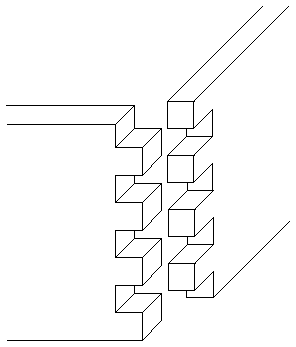
A box joint is a woodworking joint made by cutting a set of complementary, interlocking profiles in two pieces of wood, which are then joined (usually) at right angles, usually glued. The glued box joint has a high glued surface area resulting in a strong bond, on a similar principle to a finger joint. Box joints are used for corners of boxes or box-like constructions, hence the name. The joint does not have the same interlocking properties as a dovetail joint, but is much simpler to make, and can be mass-produced fairly easily.

Creation

[edit]

Box joints are generally created by using the same profile but displaced for both halves. In modern workshops these are often made on table saws,[1] sometimes using a dado set. Custom machinery can cut the entire joint in one pass, using a suitable jig multiple pieces, even of opposing senses, can be cut at once. They were traditionally produced manually using a tenon saw and chisel, and fine cabinet makers still use these methods. Jigs can also be used, as with dovetails, to help produce a consistent result.

Applications

[edit]
Box joint detail from the lid of an Enigma machine

Applications include all sorts of wooden boxes and carcasses. While primarily used for right angle joints it can also be used for hexagonal boxes and other unusual shapes. It is used for the sides of drawers and lids, but not, in general, for joining thin panels to structural members.

See also

[edit]

References

[edit]
Revisions and contributorsEdit on WikipediaRead on Wikipedia
from Grokipedia
A box joint is a woodworking technique that creates a strong corner connection by interlocking rectangular pins and sockets cut into the ends of two boards at a right angle, maximizing glue surface area for enhanced durability. This joint emerged prominently in the 19th century as part of advancements in woodworking machinery, evolving from earlier hand-cut methods to enable efficient production of mass-manufactured items like crates and storage boxes. Though simpler than the dovetail joint, it shares a similar interlocking principle but uses straight, square-edged fingers instead of angled ones, making it easier to produce with tools like table saws or routers. Box joints are commonly employed in constructing drawers, jewelry boxes, tool chests, and small furniture components where both strength and are desired, as the visible adds decorative appeal. Their primary advantages include exceptional mechanical strength from the multiple long-grain glue surfaces, resistance to under load, and relative ease of fabrication using jigs for precise spacing—typically with pins ranging from 1/4 inch to 1/2 inch wide—though they require careful setup to avoid gaps or . Unlike more complex joints, box joints prioritize utility and speed, making them suitable for both traditional craftsmanship and modern CNC applications.

History and Development

Origins

The box joint, a form of interlocking woodworking joint characterized by rectangular fingers and sockets, was primarily developed in the 19th century alongside the rise of industrialization, though it draws on earlier principles of interlocking joinery like ancient dovetails. The joint's first practical applications emerged around the mid-1800s in the production of wooden boxes and crates used for storage and shipping, particularly in Europe and North America where growing trade demanded durable, efficient enclosures—evidenced in early American furniture pieces from the 1820s to 1850s. This period marked a shift from nailed or pegged constructions to more sophisticated joinery suitable for mass production, allowing for stronger assemblies without relying heavily on fasteners. The played a pivotal role in the joint's evolution, as early 19th-century innovations in machinery—such as the (c. 1813) and late 19th-century routers—facilitated accurate, repeatable cuts essential for creating uniform box joints at scale. These tools transformed from labor-intensive craftsmanship to efficient processes, enabling widespread adoption in crate-making industries across industrialized regions.

Modern Evolution

Following , the box joint gained widespread adoption in furniture making, particularly for drawer construction, as the availability of affordable power tools like table saws and routers democratized precise for both professional cabinetmakers and amateur woodworkers. The post-war housing boom and economic expansion spurred a surge in home workshops, where these tools enabled efficient production of durable, interlocking joints that maximized glue surface area for strength. In the late , the development of specialized significantly advanced box joint fabrication, allowing for consistent spacing and sizing on standard equipment. Companies like Leigh Industries introduced innovative jig systems in the 1970s and 1980s, initially focused on dovetails but expanding to include variable-spaced box joints by the early 1990s with the F1 template. These jigs, often used with router tables or table saws equipped with dado sets, made high-quality box joints accessible to hobbyists while supporting professional-scale production. The introduction of CNC machines in the late 1980s and further transformed box joint creation, enabling automated, repeatable precision that surpassed manual methods. Early CNC routers for , such as those from industrial suppliers, allowed for programmable cutting of interlocking profiles, reducing waste and setup time for complex variations. By the , desktop CNC models became viable for small shops, facilitating intricate box joint designs in custom furniture and democratizing advanced for non-experts. In contemporary trends, box joints continue to evolve within sustainable practices and custom , emphasizing mechanical strength without metal fasteners to minimize environmental impact. Their interlocking design promotes efficient material use and disassembly for reuse, aligning with eco-friendly principles in modern timber construction. This integration echoes mid-20th century American craftsmanship, where exposed box joints appeared in furniture for their clean, geometric aesthetic—exemplified in pieces like coffee tables and storage units that highlight the joint's structural and decorative qualities.

Design and Variations

Basic Design Principles

The box joint features interlocking rectangular fingers, also known as pins, that are cut perpendicular to the joint edge and typically oriented at right angles to the faces of the mating wood pieces. These fingers are designed with equal widths and depths across both components to allow for a seamless interlock, where the protruding pins of one piece fit precisely into the corresponding slots of the other. This geometry creates a repeating pattern of alternating face grain and end grain, enhancing both structural integrity and visual appeal. The primary mechanical principle of the box joint lies in maximizing the glue surface area through multiple parallel contact points between the fingers and slots, which distributes shear forces effectively and provides robust strength without relying on mechanical fasteners like screws or nails. This design leverages long-grain gluing surfaces for superior , making the joint resistant to pulling apart under lateral stress while remaining straightforward to assemble. The extensive interlocking area—far greater than in simpler butt joints—ensures the joint's durability in applications like boxes and drawers. Standard proportions for box joints often scale finger dimensions to the material thickness for optimal balance between strength and proportion; for instance, 1/4-inch-wide fingers are commonly used with 3/4-inch-thick to allow multiple fingers per while maintaining adequate glue surface. Precise alignment is essential, with tolerances typically held to within 0.001 inches to prevent gaps or binding, as even minor deviations can compromise the fit and overall performance. This precision ensures the fingers mesh tightly, promoting even glue distribution and long-term stability.

Common Variations

Tapered box joints, also known as angled box joints, modify the standard design by varying the width and angle of the interlocking fingers to accommodate non-perpendicular corners, such as miters in tapered or slanted box structures. This adaptation ensures a precise fit along the angled edge, maintaining the joint's strength while allowing for geometric variations in projects like trapezoidal trays or angled frames. Segmented or unequal finger spacing introduces decorative elements by alternating the widths of pins and sockets, creating visual patterns such as wide and narrow interlocking sections that enhance aesthetic appeal without compromising structural integrity. These variations are particularly suited for ornamental boxes where the joint serves both functional and artistic purposes, often featuring irregular spacings to mimic more complex styles. Hybrid variations combine box joints with bevels for mitered corners, where the fingers are cut along angled surfaces to fit non-perpendicular joints, ideal for streamlined designs like angled . Scaling these joints for different material thicknesses involves adjusting finger dimensions proportionally—thinner pins for delicate items like jewelry boxes (typically 1/8-inch ) versus wider ones for robust applications like crates (up to 1-inch thick)—to optimize glue surface area and fit.

Construction Methods

Required Tools and Materials

Creating box joints requires a selection of specialized woodworking tools to ensure precise, repeatable cuts, along with suitable materials for durable assembly and essential safety gear to mitigate hazards associated with power tools.

Primary Tools

The core equipment for fabricating box joints typically includes a table saw equipped with a stackable dado blade set, which allows for accurate kerf widths matching the joint dimensions. Alternatively, a router mounted in a table with a straight or spiral upcut bit provides clean, controlled cuts, particularly for finer work. A dedicated box joint jig is indispensable for both methods, indexing the workpiece to produce uniform pins and sockets with minimal setup variation; modern jigs, often constructed from plywood or MDF bases with hardwood components, facilitate repeatable results on either machine. Additional accessories such as a miter gauge for the table saw or calipers for measuring pin spacing ensure alignment and precision.

Materials

Stock materials should consist of hardwoods like or , valued for their and resistance to wear in load-bearing applications such as drawers or cabinets. For joining the interlocking fingers, such as (PVA) types like Titebond offers strong, water-resistant bonds suitable for most contemporary projects, while traditional hide glue provides reversibility for antique-style restorations. Clamps, including bar or pipe varieties, are necessary to secure pieces under during the glue-up phase, preventing misalignment as the cures.

Safety Equipment

To address risks from spinning blades and flying debris, push sticks or blocks keep hands at a safe distance from cutting edges on both table saws and router tables. Featherboards maintain consistent workpiece pressure against fences, reducing kickback potential, while blade guards and riving knives on table saws prevent accidental contact. Dust collection systems, connected to the tools, capture fine particles to improve visibility and respiratory during .

Step-by-Step Process

The fabrication of a box joint begins with preparation of the wood pieces. Select whose widths are multiples of the desired pin width to ensure even spacing and across the joint. Mark the front, back, and side pieces clearly, noting the top edges to maintain consistent orientation during cutting. Use a or template to index pin locations precisely on both mating pieces, aligning them for interlocking . For cutting, install a dado blade matching the pin width (e.g., 1/4") on a and attach the to the miter gauge, positioning an indexing pin one pin-width from the . Clamp the first workpiece (typically a side) against the 's pin with its top edge forward, and make the initial cut to form the first socket. Advance the workpiece over the indexing pin to cut subsequent sockets across its width, creating the pin pattern. Repeat for the mating workpiece (e.g., front or back), but first cut a scrap to match the socket depth and use it as a spacer against the indexing pin to offset cuts and form the complementary pins that interlock with the previous sockets. Assembly starts with a dry fit to verify alignment and tight interlock without gaps. Apply glue evenly to all mating surfaces using a small , then tap the pieces together gently with a rubber if needed. Clamp the at 90 degrees using bar clamps across the faces and additional diagonal clamps to square the assembly, applying even pressure with scrap wood protectors. Allow the glue to cure for at least 24 hours. Optionally, the flush once dry for a smooth finish.

Applications and Uses

Primary Applications

Box joints are widely employed in drawer construction for cabinets and furniture, where they form robust corners that interlock precisely to support repeated use and loading without the need for visible fasteners. This application leverages the joint's ability to create strong, square assemblies in items such as or drawers, ensuring durability in everyday environments. In and building, box joints serve as a primary method for constructing storage solutions, including toolboxes and shipping containers, due to their mechanical strength and efficiency in assembly. These joints enable the creation of yet sturdy enclosures for transporting goods or organizing tools, commonly seen in workshop and industrial settings. For frame assembly in small-scale items, box joints provide clean, right-angle joins that enhance both functionality and aesthetics in projects like picture frames or jewelry boxes. The interlocking design ensures precise alignment and a seamless appearance, making it ideal for decorative or personal storage pieces where visual appeal is key.

Notable Examples

In mid-20th century Shaker-inspired furniture, box joints were prominently featured in storage boxes produced by Frye's Measure Mill in . These handmade oval and rectangular boxes, crafted from native woods like , utilized interlocking finger joints secured with tacks to create lightweight yet sturdy containers for and household items. The mill, operating since 1858, emphasized functional craftsmanship in its commercial Shaker-style products during the 1950s and 1960s. Post-2000 revivals of Wright's architectural principles have incorporated box joints in furniture inspired by his style, aligning with his philosophy of organic integration and geometric precision. For instance, contemporary woodworkers have applied box joints in and miniature drafting tables, where the visible interlocking fingers enhance both structural integrity and aesthetic harmony. In early 20th-century industrial applications, box joints enabled scalable production of wooden fruit crates in 's packing industry, particularly for citrus exporters like the California Fruit Growers Exchange. These crates, often constructed from for enhanced strength during , facilitated the shipment of millions of annually, supporting the state's agricultural boom from the 1910s to the 1940s before the shift to . As of 2025, box joints continue to be used in modern , including CNC-machined custom furniture and sustainable projects that emphasize precision and eco-friendly materials.

Advantages and Disadvantages

Key Advantages

Box joints offer high strength due to their extensive fingers, which provide a large surface area for glue , typically up to three times that of a standard . This design creates a robust mechanical interlock that resists pull-apart forces effectively, making the joint suitable for applications like drawers and boxes where tensile stress is common. The visible, uniform pins and sockets of box joints contribute to their aesthetic appeal, producing clean, geometric lines that emphasize the wood's grain and the woodworker's precision without requiring additional hardware or visible fasteners. This straightforward yet decorative appearance enhances the overall craftsmanship of projects such as jewelry boxes or . Production of box joints is relatively straightforward using dedicated s on tools like table saws or routers, allowing for consistent, repeatable cuts that are accessible to beginners while enabling efficient output for larger-scale work. This method significantly reduces the time needed compared to hand-cut alternatives, as the jig ensures precise spacing and depth in a single setup.

Potential Drawbacks

Box joints feature prominent interlocking fingers that remain visible on the assembled surfaces, rendering them unsuitable for designs prioritizing a seamless or concealed appearance. This visibility often necessitates additional decorative elements, such as or work, to enhance in exposed applications. Achieving a strong box joint demands high precision in , with cuts requiring tolerances as tight as 0.1 mm (0.004 inches) to ensure proper alignment and fit. Errors in cut depth, such as protruding fingers exceeding 1/64 inch or insufficient depth leading to loose connections, can compromise the joint's integrity, resulting in gaps that weaken or cause aesthetic flaws even after gluing. These precision needs amplify with multiple fingers, where minor inaccuracies accumulate and demand iterative test cuts for adjustment. Compared to angled joints like dovetails, box joints provide reduced resistance to twisting or racking forces due to their design, which lacks inherent mechanical locking in shear directions. This limitation restricts their application in high-stress structural contexts, such as load-bearing frames, where enhanced torsional stability is critical.

Comparisons to Similar Joints

Versus

The box joint and both serve as interlocking corner joints in , but they differ fundamentally in . The box joint consists of straight, square, or rectangular fingers that interlock perpendicularly, allowing for relatively straightforward cutting using jigs or router setups, though this results in limited mechanical interlock against pulling forces. In contrast, the dovetail joint features angled, trapezoidal pins and tails that create a wedging action, providing superior resistance to tensile forces attempting to draw the apart, but requiring more precise angled cuts typically made with saws and chisels. In terms of strength, particularly when glued as is standard in modern applications, the box joint derives much of its holding power from bonds across its extensive edge-grain surfaces, with tests showing failures often tearing fibers rather than separating the mechanically. Dovetails, however, offer an inherent mechanical lock through their angled , which maintains some even if glue fails, making them less reliant on alone—though glued dovetails still outperform unglued versions significantly. Unglued tests indicate box joints can achieve comparable or higher to dovetails in some configurations (e.g., 170-240 lbs force vs. 162 lbs), but the dovetail's design excels in resisting directional pull. Use cases highlight these differences: box joints are favored for visible, utilitarian corners in boxes, crates, or simple where ease of construction and a clean, repetitive pattern suffice, while dovetails are preferred for high-end applications like hidden drawer fronts in fine furniture, where their aesthetic appeal, longevity, and resistance to wear under repeated opening enhance durability and visual quality.

Versus Finger Joint

While terminology varies and "finger joint" is sometimes used interchangeably with box joint, it often specifically refers to a similar joint used for different applications. The box joint is primarily applied at the corners of wooden assemblies to create 90-degree angles, making it well-suited for constructing boxes, drawers, and frames where end-grain pieces interlock perpendicularly. In contrast, the finger joint is used lengthwise to join shorter boards end-to-end, enabling the creation of longer stock for elements like molding, trim, and edges, often as a cost-effective alternative to solid . Visually and structurally, both joints rely on interlocking rectangular fingers that maximize glue surface area for enhanced strength, but they differ in execution and nuance. Box joints typically feature uniform, square-edged pins and sockets oriented for end-grain focus at corners, providing a clean, repetitive pattern that resists racking forces effectively. Finger joints, however, allow for narrower, more densely repetitive pins along the joint line, facilitating seamless linear connections with minimal visible seams, though they may appear less prominent in cross-section compared to the bolder profile of box joints. While there is occasional overlap in decorative applications, the distinctions in orientation and scale highlight their specialized roles: box joints excel in enclosed, angular constructions like storage boxes and , whereas finger joints are preferred for elongating materials in architectural trim or as substitutes for edges in paneling and framing, offering comparable tensile strength to continuous grain when properly glued.

References

Add your contribution
Related Hubs
Contribute something
User Avatar
No comments yet.