Hubbry Logo
Japanese carpentryJapanese carpentryMain
Open search
Japanese carpentry
Community hub
Japanese carpentry
logo
8 pages, 0 posts
0 subscribers
Be the first to start a discussion here.
Japanese carpentry
Japanese carpentry
from Wikipedia
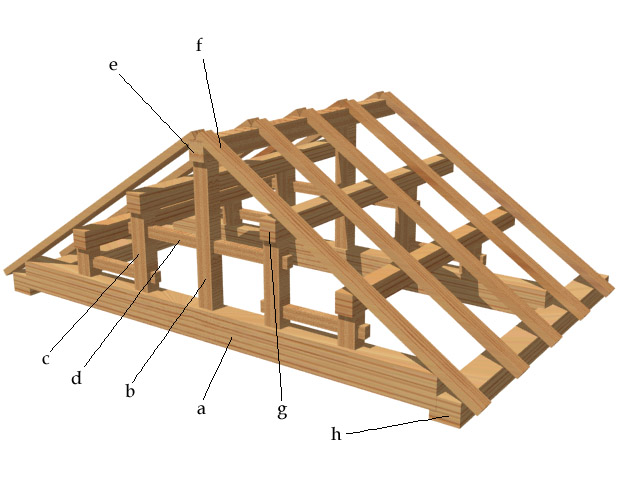
Wagoya type traditional roof framing, a post-and-lintel type of framing.
Yogoya type traditional roof framing, called western style.

Carpentry was first developed more than a millennium ago in Japan. It has been involved in the construction of a wide variety of structures, such as temples, dwellings, and tea houses, as well as furniture, with the use of few nails.[1][2]

Schools of carpentry

[edit]

Though there is a core practice shared by all Japanese carpenters, defined by a vocabulary of tools and joints and a method of working, a carpenter will typically identify with one of four distinct carpentry professions. Miyadaiku (宮大工) practice the construction of Japanese shrines and temples, and are renowned for their use of elaborate wooden joints[3] and the fact that the buildings they construct are frequently found among the world's longest surviving wooden structures. Teahouse and residential carpenters, known as sukiya-daiku (数寄屋大工), are famed for their delicate aesthetic constructions using natural materials and carefully scribed joinery. Furniture makers are known as sashimono-shi (指し物師), and interior finishing carpenters, who build shōji (障子) and ranma (欄間), are termed tateguya (建具屋).[4]

Though it is rare to find a sashimono-shi or tateguya practising outside of their field, it is not uncommon for a carpentry workshop to work simultaneously as both miyadaiku and sukiyadaiku.

Tools

[edit]

The tools commonly used by Japanese carpenters are divided into a few basic families, within which there are found a multitude of variations and specializations geared toward particular tasks:

Ryoba
  • Japanese saw (, nokogiri), which cuts on the pull stroke, rather than the otherwise globally prevalent push stroke. This allows the blades to be quite thin in comparison to the Western saw. There are two main kinds of cutting teeth on Japanese saws: crosscut (横挽き, yokobiki) and rip (縦挽き, tatebiki). The rip and crosscut are combined in one blade, known as a ryoba (両刃; lit.'dual edge'). The rip and crosscut patterns are also made in single-edged saws, kataha nokogiri (片刃), both with stiffening back pieces and without. The stiff-backed saws, known as douzuki (胴付き; lit.'attached trunk') are typically used in cutting fine joinery. There are many other types of Japanese saws as well: osae-biki (押さえ引き鋸; lit.'press-cut saw'), used for flush-cutting pegs to a surface without marring the surface. The saw teeth have no set to one or both sides to accomplish this feat.[5] There is the azebiki (畔挽き; lit.'ridge saw'), which has cutting both rip and crosscut teeth, and is short and rounded in profile. It is used for sawing in confined areas and starting cuts in the middle of surfaces. There are many other types and sub-types of saw. Most saws sold in the West are mass-produced items with induction-hardened teeth and relatively cheap replaceable blades. The handmade forged saws are very laborious to make and involve more manufacturing steps in the forging to complete than planes or chisels.[2]
Kanna
  • Japanese plane (, kanna), is most commonly a wooden block, or dai () containing a laminated blade, sub-blade, and securing pin. In the Japanese plane, the blade is fixed in position primarily by the plane's abutments that are cut in the sides of the dai. This is similar to a still manufactured type of European wooden plane, in which the blade is fixed in place by tapping down upon a wooden wedge. Unlike a western plane, the support bed for the blade is not a flat surface in a Japanese plane - rather it is convex. The blade itself is tapered in thickness so as to wedge tightly into the dai when tapped down into place. The blade is also tapered in width to allow its projection to be adjusted by tapping it from side to side, so that a uniform shaving thickness can be attained. Japanese planes are generally operated by pulling rather than pushing, and work can be done in the seated position or using the whole body for more power.[2][5]
    • Considered part of the kanna family, the yarigana is an archaic type of Japanese plane resembling a spear. The yarigana is a single piece of steel with one end being used as a handle and the other forged into a leaf shaped blade. The carpenter holds the yarigana with two hands, perpendicular to his arms, and pulls towards his body producing a concave gouge in the timber. The yarigana was in universal use prior to the introduction of the block-mounted wood plane to Japan, and is today typically reserved for use on large circular columns or in cases where a more rustic appearance is desired in the final element.[5]
Chisels
  • Japanese chisel (, nomi). There are bench chisels, paring chisels, striking chisels, heavy timber chisels and slicks, and myriad others for specialized applications. Like the planes, the blades are of laminated hard steel/soft steel construction. Bevel angle varies from 20˚ to 35˚ typically, with mortising and heavy chisels featuring steep angles, and paring chisels having shallower angles. It is common in Japan to work with softwoods, so many chisels are made with that in mind, and require the bevels be steepened if employed for harder woods.[2]
  • Japanese gimlet (, kiri). The kiri is used for boring circular holes in a timber, often as the first stage in the hollowing out of a mortise. Though seemingly simple to use, the kiri is commonly considered one of the most difficult tools to master.[5]
Sumitsubo (and sumi-sashi, wooden brushes)
  • Inkpot (墨壺, sumitsubo). The sumitsubo is used for marking long straight lines onto various surfaces. A thread (tsuboito) is tied to a rounded piece of wood with a needle fixed at the end (karuko). The other end of the thread is passed through the small opening at the end of the sumitsubo (itoguchi), through the depression containing ink (ike) and wound around a spool (itomaki-guruma). The ink is stored in the ike soaked in silk wadding. Silk threads are used as tsuboito. To draw a line, the sumitsubo is held in the left hand and the karuko's needle is fixed onto the surface determining the position of one end of the thread. The sumitsubo is gradually moved away from the karuko until the required length of the thread is unreeled at which point the rotation of the spool is stopped using the thumb. With the index finger the thread is pressed down at the required end point of the line. Using the right hand, the thread is pulled upwards into tension and then suddenly released, consequently hitting the surface and leaving a straight line of ink onto any surface, regardless of any surface irregularities.[6]
  • Japanese axe and adze (ono () and chōna ()).[5]
  • Japanese hammer (玄能; Genno or Gennoh). There are several types of carpentry hammers. Some hammers are used for chisel work, some for positioning hand plane blades, some for hammering and pulling nails, and others for tapping out laminated hardened steel from base of plane blades and chisels.[5]
  • Tools for measuring and marking include the bamboo pen (墨さし, Sumisashi), carpenter's square (差し金, Sashigane), marking knife (切り出し, Kiridashi), the traditional single and multi-blade marking gauges (罫引; Kebiki and Kinshiro), among others. Measuring tools are commonly marked in centimeters and millimeters. For traditional work, squares marked in customary units sun () (1/330 m = 3.03 cm) and bu () (1/1/3300 m = 3.03 mm) are available.[7][8][better source needed]

Blades

[edit]

Though a carpenter will typically fashion handles and woodblocks and set and sharpen their blades themselves, the blades themselves are forged by steel smiths and provided unmounted to the carpenter. Japanese steel has long enjoyed a high level of refinement, without which the fine surfaces and detail for which Japanese woodwork is renowned would not be possible. The blades used in the Japanese chisel and the Japanese plane shares similar constructive principles to the Japanese sword. A thin piece of extremely hard blade metal called ha-gane (; lit.'edge metal') is forge-welded to a softer piece of metal called ji-gane (地金; lit.'base metal'). The function of the softer base metal is to absorb shock, and to protect the more brittle ha-gane from breaking. This technology allows for the use of steels in the hagane which are harder than in use in Western chisels, typically Rockwell 62 and up, and also allows for the honing of a much finer edge than is typically known in carpentry outside Japan. When sharpening a blade, a Japanese carpenter will typically use three or more whetstones of varying coarseness, progressing from the roughest stone to the finest.[5]

The blades of both planes and chisels are distinguished by the hollow, ura in their flat side. This hollow portion has a number of functions. The primary function is that it ensures a high degree of flatness when sharpening, in that when the flat side is polished it cannot rock or develop a curve because it is only contacting the stone on either side of its width. This then improves the precision with which cuts can be made by the chisel, and in the case of planes ensures smooth contact with the wedge and therefore even support across the full width of its blade. The hollow also greatly reduces the amount of metal needed to be removed to achieve flatness on the back of the blade, which shortens initial set-up and subsequent re-sharpening considerably. Secondly, in the case of chisels, it reduces the frictional resistance as the chisel is driven into or extracted from the wood. Thirdly, the interaction of the leading edge of the hollow with the edge of the blade is a changing relationship as the tool is re-sharpened.[5] With plane blades, as the edge is sharpened down to the rim of the hollow, the edge can then be 'tapped-out' (ura-dashi), a process where a pointed hammer is used to depress the ha-gane downward slightly along the bevel of the blade. When the blade's back is re-flattened after ura-dashi, the hollow is re-established; thus the hollow acts as a sort of gauge for sharpening as a means of prolonging the life of the thin piece of cutting steel as long as possible. This in turn tends to keep the geometry of the blade consistent over time, which keeps it fitting the dai over time.

There are many types of steel used for the ha-gane of Japanese planes and chisels:

  • White steel, shiro-gami; a nearly pure steel that takes a very keen edge and resharpens easily. There are several types of white steel, #1 and #2 being the most common.[5]
  • Blue Steel, ao-gami; a steel with alloyed elements such as molybdenum to enhance the durability of the edge. This steel is a little more difficult to sharpen than the white, and does not take quite as keen an edge, but is more durable in use. The common blue steels used are #1, #2, and "Super-Blue"[5]
  • Tama-hagane; this steel derives from the smelting of a special iron-rich river sand and is normally reserved for use in sword-making, however some does find use in saws, chisels and planes.
  • Togo-Reigo: this steel was produced by the Andrews Company of Sheffield England in the 1920s and some found its way to Japan where it has been used for making plane blades
  • Swedish Steel

Vise

[edit]
A traditional Japanese vise from Japanese Homes and Their Surroundings by Edward S. Morse

The traditional Japanese vise was a wedge of wood tied to a post with a coil of rope. The wood was inserted under the wedge and the wedge hammered down.[5]

Vises of any sort are used far less in traditional Japanese carpentry than would be the case for equivalent tasks in the traditional crafts of the West. Many tasks in Japanese carpentry associated with building, involve very large pieces of timber, and in general, the weight of the timber and of the carpenter are used to stabilize the piece on which the carpenter is working. For this reason the carpenter's horses used in Japan are much lower than their Western counterparts, and carpenters must always position themselves over their work.[5] Much of the work on smaller pieces of material can be done in the seated position, and relies on the fact that the saws and planes both cut on the pull stroke, enabling stabilization of the work using the body or shooting board.

Lumber

[edit]

Woods used in Japanese carpentry and woodwork, as well as tool construction, include sugi (), akamatsu (赤松), hinoki (檜 or 桧), Camphor Laurel, Magnolia obovata, keyaki () and kiri ().

See also

[edit]

References

[edit]
[edit]
Revisions and contributorsEdit on WikipediaRead on Wikipedia
from Grokipedia
Japanese carpentry, often referred to as daiku or tategu, encompasses a millennia-old tradition of woodworking that employs intricate, interlocking joinery techniques to build structures, furniture, and artifacts without nails, screws, or adhesives, relying instead on the friction, geometry, and precision of wood-to-wood connections for durability and flexibility in Japan's seismic and humid environment. Originating in prehistoric times with the Jōmon period's pit dwellings around 9,000–10,000 years ago and evolving through the Yayoi era's elevated pile structures (circa 200 BCE–250 CE), Japanese carpentry reached sophisticated heights with the introduction of in 552 CE, which spurred the construction of enduring timber-frame temples like , the world's oldest surviving wooden building from the early . By the (1603–1868), standardized modular systems like the ken grid (typically 6 shaku or about 1.8 meters per bay) refined residential styles such as , integrating post-and-lintel frameworks with exposed joinery for aesthetic and functional harmony. Central to this craft are numerous specialized joints, with over 200 documented variations, categorized into tsugite (for elongating members) and shiguchi (for assembling frames), including the foundational mortise-and-tenon, lapped dovetails like koshikake ari tsugi, and complex scarfs such as kanawa tsugi, which provide soft moment connections that absorb earthquakes while allowing disassembly for repairs or rebuilding. Specialized branches include miyadaiku for temple construction, sukiya-daiku for tea houses, sashimono-shi for furniture using reversible joints, and tateguya for screens and doors, all guided by principles of material knowledge—selecting woods like Japanese cypress for their stability—and proportional systems like kiwari for structural balance. Tools such as the kanna hand plane, nokogiri pull-saw, and sashigane square ensure millimeter-level precision, honed through rigorous apprenticeships lasting up to 15 years, reflecting Zen and Shinto influences on harmony with nature and impermanence. Recognized by as an in 2020, these skills emphasize sustainability—such as periodic rebuilding of shrines like Ise Jingū every 20 years—and community involvement in maintenance, adapting to Japan's approximately 68% forested landscape while preserving amid modernization. Techniques like shou sugi ban for fire resistance and thatch renewals every 30-40 years for traditional roofs underscore the craft's resilience, fostering social cohesion through collaborative repairs in a climate demanding constant adaptation.

History and Origins

Early Development

Japanese carpentry emerged during the (circa 300 BCE–300 CE), characterized by the construction of basic wooden structures such as pit dwellings and elevated pile dwellings for residential and storage purposes. These pit dwellings featured simple wooden frameworks lashed together and covered with thatched roofs, while pile dwellings were raised on posts to protect against flooding and pests, reflecting adaptations to agricultural lifestyles in river valleys. In the subsequent (circa 300–538 CE), construction techniques advanced with the widespread adoption of raised-floor houses, replacing earlier subterranean forms and incorporating timbered walls for more stable and diverse dwellings that indicated growing . The (538–710 CE) marked a pivotal shift with the arrival of Chinese and Korean immigrants, who introduced advanced carpentry techniques for building the first permanent Buddhist temples, including the renowned temple founded in 607 CE. These immigrants, particularly Korean carpenters, brought expertise in complex wooden frameworks inspired by continental architecture, enabling the erection of multi-storied pagodas and cloisters that blended foreign styles with local adaptations. exemplifies this fusion, housing some of the world's oldest surviving wooden structures from the late 7th century, demonstrating early mastery in durable timber assembly. Buddhism's introduction during the profoundly influenced carpentry by prioritizing the construction of enduring temples as symbols of imperial patronage and spiritual unification, with designs emphasizing earthquake resistance to suit Japan's seismic environment. Structures like Hōryū-ji's five-storied incorporated a central pillar known as the , which acts as a flexible core to absorb vibrations, allowing the temple to withstand fires and earthquakes for over 1,300 years. This focus on resilient, non-nail promoted longevity in sacred architecture, setting precedents for future developments. Early methods relied on basic iron tools introduced in the , such as axes and adzes for rough shaping of logs by hewing along the grain to prepare timber before assembling finer frameworks. Adzes, in particular, were essential for carving and smoothing wood in these initial phases, facilitating the transition from rudimentary dwellings to more sophisticated temple constructions without metal fasteners.

Evolution Across Eras

Nara Period

The Nara period (710–794 CE) saw significant advancements in large-scale temple construction, building on Asuka foundations with massive projects like , completed in 752 CE. This era refined the tokyō bracket system, featuring complex interlocking wooden brackets that supported expansive roofs and distributed loads for greater stability in seismic conditions. These innovations emphasized modular post-and-lintel frameworks using mortise-and-tenon joints, promoting durability and aesthetic grandeur in imperial-sponsored . During the Heian period (794–1185 CE), Japanese carpentry advanced significantly in palace and temple architecture, incorporating influences from Chinese models while adapting to local seismic conditions and aesthetic preferences. Key innovations included the development of curved roofs and further refinement of the tokyō bracket system, which consisted of interlocking wooden brackets supporting overhanging eaves and distributing structural loads effectively. These bracket complexes, often stacked in multi-tiered arrangements, allowed for flexibility in earthquake-prone regions and emphasized modular construction using mortise-and-tenon joints without nails. This era marked a shift toward more refined, slender timber elements and precise joinery techniques, such as the use of wedges and adzes for hewing, enhancing both durability and aesthetic harmony. From the to Muromachi periods (1185–1573 CE), profoundly influenced carpentry, promoting simpler and more austere designs in temple construction that prioritized functionality and natural integration over ornamentation. aesthetics led to the emergence of styles like Daibutsuyō and Zenshūyō, featuring penetrating beams (nuki) for added rigidity at beam-column intersections and refined duo-gong brackets that enhanced seismic resilience through flexible, interlocking . These periods saw a reduction in decorative stacking of brackets, with carpenters focusing on minimalist post-and-beam systems and modular ken units to create open, adaptable spaces connected to nature, as seen in temple abbots' quarters. The reverence for as a living material, rooted in , encouraged precise hewing along the grain and waste-minimizing techniques, fostering a holistic approach where carpenters served as both builders and designers. The Azuchi-Momoyama and periods (1573–1868 CE) brought ornate castle carpentry alongside the rise of intimate tea house styles, reflecting a blend of grandeur and refined simplicity amid social stability and wood resource constraints. Castle constructions, such as Nijo Castle, showcased elaborate and modular post-and-beam frames for defensive resilience, while the Sukiya-zukuri style for tea houses emphasized asymmetrical, nature-inspired designs using refined chiseling and sliding screens for fluid indoor-outdoor transitions. Carpenters adapted to shortages by innovating longitudinal joints and reversible assemblies, maintaining earthquake resistance through semi-rigid structures; this era also saw the of modular homes, solidifying carpentry's role in everyday and elite . The (1868 onward) introduced Western industrialization, profoundly impacting carpentry through the adoption of brick, stone, and iron elements, leading to a decline in traditional methods as state priorities shifted toward "civilized" permanent structures like the district. Carpenters adapted via "wayo setchū" hybrid styles, incorporating trusses and glass into wooden frames, but vocational reforms and the rise of professional architects marginalized daiku skills, reducing demand for post-and-beam expertise amid urban modernization. Brief revival efforts included educational initiatives at schools like Tokyo Shokko Gakko and the evolution of kiku-jutsu texts to bridge old and new geometries, allowing some carpenters to found firms like Shimizu by blending techniques. The underscored the resilience of traditional , as wooden houses withstood up to 0.1–0.4 seismic intensity through flexible mortise-and-tenon systems, outperforming rigid Western imports and prompting regulatory updates while reinforcing cultural pride in native methods.

Schools and Traditions

Miyadaiku

Miyadaiku, a specialized branch of Japanese carpentry, refers to master craftsmen dedicated to erecting and restoring grand wooden edifices such as shrines, Buddhist temples, and imperial palaces. These structures are designed for enduring longevity, often spanning centuries, and are assembled entirely without or metal fasteners, relying instead on precision-cut wooden joints to achieve structural integrity. The term "miyadaiku" derives from "miya," meaning palace or shrine, underscoring their focus on sacred and official monumental architecture that embodies spiritual and cultural significance. Central to miyadaiku practice are sophisticated interlocking joinery techniques, such as the kanawa-tsugi, a featuring a T-shaped groove and corresponding key that connects large beams with exceptional strength. This method, among others like the ari-tsugi and shachi-sen, allows components to fit seamlessly under compression, distributing loads evenly and enabling flexibility during earthquakes—a critical adaptation in Japan's seismically active environment. These joints not only ensure stability but also facilitate disassembly and reconstruction, aligning with the impermanence philosophy in and Buddhist traditions. Historically, miyadaiku have played a pivotal role in crafting iconic landmarks, with origins tracing to the 6th century when Korean immigrant craftsmen introduced advanced techniques for early Buddhist temples like in . Pioneering firms such as , founded in 578 CE as one of the earliest miyadaiku guilds, contributed to the construction and repeated restorations of major sites, including the 8th-century in Nara, where their supported the massive Daibutsuden hall through multiple seismic events and fires. This tradition persists today in the cyclical rebuilding of Shinto shrines, exemplified by the Shikinen Sengū ritual at Ise Grand Shrine, where miyadaiku reconstruct the entire complex every 20 years using hinoki cypress and traditional methods to renew its sanctity. Miyadaiku operate within guild-like organizations characterized by rigorous apprenticeships and hierarchical structures, often family-based or affiliated with longstanding companies under oversight from bodies like the for imperial commissions. Aspiring craftsmen endure years of menial tasks before advancing to supervised work, fostering a system that preserves techniques across generations; for instance, apprentices at specialized schools like the of Shrine & Temple Carpenters Training School progress through tiers from basic chores to master-level execution. This structured lineage ensures the continuity of skills for projects tied to national heritage, contrasting briefly with residential carpentry schools that prioritize domestic scalability over sacred monumentality.

Sukiya-daiku and Other Schools

Sukiya-daiku, or teahouse and residential carpenters, specialize in constructing intimate living spaces and tea houses that emphasize subtlety, functionality, and . This school focuses on adaptable designs for irregular building sites, employing scribed to fit timbers precisely to uneven foundations or beams without altering the natural form of the wood, thereby enhancing both structural integrity and aesthetic flow. Rooted in the tea ceremony traditions that flourished during the (1603–1868), sukiya-daiku emerged from earlier Azuchi-Momoyama era innovations by tea masters who prioritized personal expression and aesthetics of imperfection and transience. Key features of sukiya-daiku include the seamless integration of elements like shōji sliding screens for diffused light and alcoves for displaying art, creating serene environments that prioritize understated elegance over ostentation. These carpenters use rustic, natural materials such as untreated timber, , and clay to evoke a sense of impermanence, often incorporating features like nijiri-guchi (crouched entrances) and menkawa-bashira (bark-covered pillars) to foster humility and connection to the outdoors. Exemplified by structures like the Sa-an (1742, ), this approach allows for modern adaptations in residential architecture, influencing minimalist designs that blend traditional subtlety with contemporary needs. Complementing sukiya-daiku are other specialized schools, such as sashimono-shi, who craft fine furniture like cabinets and tables with precise, refined techniques suited to portable household items. Sashimono-shi emphasize durability and decorative detail in non-structural pieces, often using intricate patterns to enhance functionality in daily life. Similarly, tateguya focus on interior finishing, creating elements like sliding doors and ranma transom panels that divide and adorn living spaces with subtle craftsmanship. These schools differ markedly in scope and philosophy: sukiya-daiku's adaptable, nature-inspired residential work promotes minimalist integration into landscapes, contrasting the sashimono-shi's more ornate, object-oriented furniture that highlights polished refinement for interior display. While sukiya-daiku adapts to site-specific irregularities for fluid, understated forms, tateguya's interior focus complements this by adding layered detail to enclosed areas, together supporting a holistic domestic aesthetic distinct from the grand, ritualistic scale of miyadaiku temple construction.

Materials and Preparation

Common Lumber Types

Japanese carpentry traditionally relies on a select group of native woods, chosen for their specific properties that align with the craft's emphasis on durability, workability, and aesthetic harmony with . These lumbers are harvested from Japan's diverse forests and selected based on regional availability and suitability for without nails or adhesives. Hinoki (, Japanese cypress) is highly prized for its rot resistance, straight grain, light weight, and subtle lemon scent, making it ideal for long-lasting structures exposed to moisture. Its pale pinkish-brown color and fine texture allow for precise carving and assembly in intricate temple frameworks. Hinoki has been extensively used in sacred buildings, such as the reconstruction of Temple in Nara, where aged samples demonstrate exceptional longevity and mechanical strength even after centuries. Sugi (Cryptomeria japonica, Japanese cedar) offers versatility through its fragrant aroma, insect and weather resistance, softness, and low density, with a light red to reddish-brown grain that weathers gracefully. Abundant in Japan's mountainous regions, it is commonly employed for framing beams, roofing elements, pillars, and ceiling boards in both residential and religious constructions. Its pliability facilitates the creation of curved elements like barrel vaults in traditional architecture. For furniture and interior fittings, keyaki (Zelkova serrata, Japanese zelkova) and kiri (Paulownia tomentosa, paulownia) are favored due to their durability and resistance to insects. Keyaki features a hard, dense structure with beautiful, interlocking grain patterns in yellowish-brown heartwood, providing strength for items like tansu chests and cabinetry that endure heavy use. Kiri, being lightweight, fine-grained, and highly warp-resistant, excels in drawers and boxes, such as kimono storage chests, where smooth sliding and minimal expansion are essential. Regional variations influence selection, with akamatsu (Pinus densiflora, Japanese red pine) prevalent in coastal and lowland areas for its straight grain, oiliness, and rot resistance, suiting applications in and bridge building. In contrast, karamatsu (, Japanese larch) thrives in colder, mountainous zones like , valued for its strength, durability, and weathering resistance in structural timbers, flooring, and roofing. These choices reflect adaptations to local climates and terrain in traditional building practices.

Sourcing and Treatment

Japanese carpentry has long emphasized sustainable sourcing of lumber from carefully managed forests, drawing on ancient techniques to minimize environmental impact. One prominent method is daisugi, a 14th-century practice originating in Kyoto's Kitayama region, where young cedar shoots are pruned from mature trees to yield straight, uniform timber without felling the parent tree, akin to coppicing but yielding plank-like boards after 20 years of growth. This approach allows for repeated harvests from the same tree over centuries, promoting forest regeneration and biodiversity. In areas like Yakushima, a UNESCO World Heritage site, historical logging targeted ancient cedars for premium lumber used in temples and structures, but since the late 20th century, felling of trees over 1,000 years old has been prohibited to preserve the ecosystem, shifting focus to younger, sustainably harvested stock. Once sourced, undergoes meticulous preparation to ensure durability and workability, prioritizing natural processes over modern interventions. Boards are typically air-dried outdoors in stacked piles with spacers for airflow, a method that can take several years depending on and , gradually reducing content to prevent warping and cracking during use. This slow preserves the wood's inherent strength and reveals its grain pattern upon initial planing with hand tools, allowing carpenters to select pieces based on natural beauty and structural integrity. Chemical treatments are largely avoided in traditional practice, as they can alter the wood's breathability and compatibility with , favoring instead the innate resins and density of species like hinoki cypress for long-term stability. For protection against environmental stressors, particularly in exterior applications, natural treatment techniques such as —also known as shou sugi ban—are applied to cedar planks. This involves controlled charring of the surface with fire, creating a carbonized layer that repels , deters and fungi, and enhances dimensional stability without synthetic preservatives; the charred exterior can last over 80-100 years in harsh conditions. The process not only extends the wood's lifespan but also imparts a distinctive aesthetic, often brushed and oiled post-charring for added sheen. The posed significant challenges to these traditions, with rapid driven by post-World War II reconstruction, , and wartime demands reducing Japan's and lumber self-sufficiency from around 90% in 1950 to about 45% by 1970, with further declines to under 30% in subsequent decades. This scarcity impacted carpentry by limiting access to high-quality domestic timber, prompting reliance on imports. In response, government-led and revival of sustainable practices, including selective (zōriki) in plantation forests to promote healthy growth, have increased planted forest area by about 30% since the mid-1960s, restoring balance and supporting traditional sourcing. As of 2023, Japan's wood self-sufficiency rate has reached 43.0%, the highest in recent years.

Techniques and Joinery

Core Joinery Methods

Japanese carpentry relies on intricate, interlocking techniques that enable structures to be assembled without nails, screws, or adhesives, prioritizing the natural properties of for durability and flexibility. These methods, developed over centuries, emphasize precision fitting to distribute loads evenly and accommodate environmental stresses like earthquakes. Core techniques include both basic joints for foundational connections and advanced assemblies for complex framing, all executed through hand-tool craftsmanship that achieves fits as tight as 0.05 to 0.1 mm. Among the basic joints, the ari shiguchi (dovetail joint) provides exceptional tensile strength by interlocking tapered pins and tails, resisting pulling forces that would separate components in tension-loaded applications such as drawer fronts or framing edges. This joint's angled surfaces create a mechanical lock that enhances shear resistance without metal fasteners, allowing wood to expand and contract seasonally. Similarly, the kama-tsugi (sickle scarf joint) extends the length of beams by overlapping halved timbers in a curved, interlocking profile resembling a sickle blade, effectively splicing short logs into longer spans while maintaining structural integrity under compression. This method is particularly valued for its simplicity and strength in horizontal members like floor joists. Advanced builds on these principles with greater complexity for seismic resilience and . The nuki (through-mortise) passes a horizontal beam through a vertical post via a slotted mortise secured by wedges, offering flexibility during earthquakes by allowing controlled movement and energy dissipation without . This configuration contributes to the sway resistance seen in traditional pagodas, where the 's play absorbs lateral forces. In frame corners, the sumidome hozo sashi (corner mortise-tenon ) connects sill plates and posts at right angles using a mitered with a tenon and groove, ensuring stable, locked corners that resist racking in multi-story constructions. Precision in these methods demands tolerances of approximately 0.1 mm, achieved not through numerical measurements but via trial-and-error scribing, where mark adjustments directly on the wood using ink lines and test fits iteratively. Chisels and planes refine surfaces to this exactitude, ensuring joints interlock seamlessly without gaps that could weaken the assembly. A key application of such is the kanawa-tsugi (interlocked ), which facilitates disassembly for maintenance, as demonstrated in temple restorations like those at Horyu-ji, where beams can be un-wedged and replaced without dismantling the entire structure. This reversible design supports the philosophy of longevity, allowing repairs centuries later while preserving original elements.

Structural Principles

Japanese carpentry's structural principles are deeply informed by Japan's seismic environment, emphasizing flexibility and load distribution to mitigate earthquake damage. The foundational sashigumi system employs a post-and-beam framework where vertical posts (hashira) support horizontal beams (nuki and ), allowing the structure to absorb and dissipate seismic through rocking and rotational movements at joints. This enables buildings to tolerate up to 5% lateral drift without collapse, outperforming rigid Western systems limited to 2% drift, as the interlocking provides and restoring forces via soft moment connections. Flexible joints distribute loads dynamically, preventing concentrated stress and enhancing overall resilience, a validated in historical structures like the 18th-century Yoshimura Residence, which survived major quakes intact. Central to these principles is the concept of modularity and impermanence (mujō), rooted in Buddhist philosophy, which views all phenomena as transient and encourages designs that embrace change rather than resist it. Structures are built with reversible, interlocking joints that facilitate easy disassembly and reassembly, allowing components to be repaired, relocated, or repurposed without damage, as exemplified by the periodic reconstruction of Ise Shrine every 20 years using salvaged materials. The kiwari system standardizes proportions based on column modules (ken grid, typically 1.8 meters), promoting adaptability and scalability while minimizing waste through a circular approach to construction. This impermanence aligns with environmental realities like fires and quakes, resulting in average wooden house lifespans of about 51 years, with emphasis on ongoing maintenance over eternal durability. Aesthetic integration further embodies these principles, particularly in sukiya styles, where is achieved through exposed beams and irregular cuts that celebrate wood's organic qualities. Beams are left visible to highlight grain patterns and natural imperfections, fostering a symbiotic relationship between structure and environment, while irregular cuts accommodate timber's inherent variations in shape and density for both stability and visual subtlety. This approach avoids imposed uniformity, using local materials and subtle finishes to create spaces that blend seamlessly with surroundings, reflecting reverence for natural forms. Scale considerations adapt these principles to context, with heavy timber framing dominating temples for longevity and light framing suiting homes for flexibility. Temples, such as Horyu-ji from the , employ massive old-growth timbers in complex bracketing systems to withstand seismic forces over centuries, with maintenance cycles every 200–300 years. In contrast, residential light framing uses smaller posts and beams in post-and-lintel configurations, enabling open, adaptable interiors with non-load-bearing walls for everyday resilience and ventilation.

Tools and Implements

Saws and Blades

Japanese carpentry relies on specialized saws known as nokogiri, which are designed to cut on the pull stroke rather than the push stroke common in Western tools, allowing for thinner blades and more precise work on . This pull-stroke mechanism enables carpenters to apply controlled force while maintaining stability, resulting in cleaner cuts and reduced material waste. The primary types include the ryoba and dozuki, each tailored to specific tasks in and structural framing. The ryoba, meaning "double blade," features a versatile plate with differing tooth patterns on each edge: one side equipped with fine crosscut teeth for severing fibers across the , and the other with coarser rip teeth for cutting along the . Typically measuring 240 to 300 in length, the ryoba serves as a general-purpose tool for rough and medium , such as framing timber or shaping beams, due to its dual functionality that eliminates the need to switch tools mid-task. In contrast, the dozuki (or dozukiri variant) is a with a rigid metal spine reinforcing a thin , optimized for fine dovetail and tenon work where precision is paramount. Its teeth, often 24 to 35 per 30 (or 20 to 30 teeth per inch), produce narrow kerfs (about 0.3 wide) ideal for intricate joints without splintering softwoods like cedar or . Blade construction in Japanese saws emphasizes durability and efficiency through lamination: a thin, high-carbon edge (typically 0.8-1.2% carbon) is forge-welded to a softer iron backing, creating a resilient yet flexible plate that resists buckling during pulls. The back often includes a hollow-ground section called ura or urasuki, which facilitates chip evacuation and reduces , allowing the blade to clear without binding in the cut. Teeth patterns vary by function; for instance, kataba configurations on single-edged saws feature backward-angled teeth optimized for the pull stroke, with crosscut patterns using trapezoidal or pointed teeth to shear fibers cleanly, while rip patterns employ inclined chisel-like teeth to slice along grain lines. Traditional blades may use tamahagane , a crucible-forged material from iron , prized for its purity and edge retention, though modern equivalents employ high-carbon alloys like SK-85 for consistent hardness (HRC 60-65). Sharpening maintains the saw's performance and involves filing individual teeth at precise angles—typically 60-70 degrees for crosscut and 50-60 degrees for rip—to restore keenness without altering the blade's taper. Artisans secure the blade in a vise and use triangular or feather files, progressing from coarse to fine strokes (10-20 per tooth), followed by light stoning to deburr edges. This meticulous technique ensures the ura remains clear and the lamination intact, preventing delamination from heat or stress. Many modern Japanese saws feature impulse-hardened teeth on replaceable blades, which provide extended durability without user ; these blades are typically discarded and replaced when dull, simplifying maintenance for contemporary users. The historical evolution of Japanese saws traces back to the introduction of pull-style designs around the 15th century during the , when thin iron blades supplanted earlier two-person push saws for solo operation in dense forests. By the mid-16th century, wide-blade rip saws emerged for efficient lumbering of softwoods, reflecting adaptations to Japan's coniferous resources and joinery-focused architecture. Refinements peaked in the (1603-1868), with specialized tooth patterns and laminated construction standardizing for temple and residential building, influenced by urban carpentry guilds that prioritized precision over brute force. Earlier precursors, such as saws from continental around 1000 BCE, informed basic pull mechanics, but Japan's innovations emphasized lightweight, disposable blades suited to humid climates and frequent replacement.

Planes, Chisels, and Adzes

Japanese carpentry relies on specialized finishing tools that emphasize precision and ergonomic efficiency, particularly the kanna plane, nomi chisel, and chōna adze, which enable refined shaping and surfacing without power equipment. The kanna, or Japanese plane, features a distinctive pull-stroke that allows carpenters to draw the tool toward themselves for greater control and reduced fatigue compared to push planes. Its body is crafted from dense hardwoods like white oak, providing stability and that contributes to exceptionally smooth shavings. The , typically a high-carbon iron, rests on a convex bed within the wooden body, which helps produce thin, even curls of wood for fine surfacing. Adjustments to the blade depth and angle are made by tapping a wooden or the body with a , a technique that fine-tunes the cut without complex mechanisms. Nomi chisels, essential for paring and detail work, are constructed with laminated blades consisting of a hard high-carbon edge forge-welded to a softer iron backing, balancing sharpness with resilience against chipping. This allows the edge to hold a keen while the back absorbs impacts during use. Common types include usunomi, or light paring chisels, designed for delicate trimming and fitting joints with minimal force; these often feature a slightly rounded or tapered profile for maneuverability in tight spaces. The back of the blade is hollow-ground (known as ura), which maintains flatness over repeated sharpenings and facilitates precise registration against workpieces. The chōna adze serves as a primary tool for rough hewing and initial shaping of logs, featuring a curved that excels at removing material along the grain while navigating irregular or rounded surfaces. Unlike axes, which swing outward for chopping, the chōna is swung downward toward the user, offering superior control for sculpting curves and contours in timber preparation. Its double-edged or single-sided , often symmetrical, allows for versatile scraping and squaring tasks, such as trimming rafters or finishing pillars. Maintenance of these tools is critical to their performance, involving regular honing on Japanese waterstones to preserve razor-sharp edges without deforming the blades. For kanna blades and nomi, sharpening progresses from coarser 800-1200 grit stones for bevel establishment to finer 6000-8000 grit for , with the hollow backs requiring minimal on flat plates using powder. Chōna blades follow similar honing protocols to maintain their curve integrity. Traditional practice avoids vises or machines, favoring freehand techniques on whetstones to prevent overheating or uneven wear, ensuring the tools remain true to their hand-forged nature.

Cultural and Modern Aspects

Training and Philosophy

Japanese carpentry training is traditionally conducted through the deshi system, a rigorous master-apprentice model that emphasizes holistic skill acquisition and personal discipline. Aspiring carpenters, known as deshi, commit to multi-year apprenticeships—often lasting 10 years or more—under the guidance of a , or . The process begins with menial tasks such as shop cleaning, tool maintenance, and material preparation, which instill humility, patience, and respect for the craft before progressing to advanced techniques like and structural assembly. This one-on-one fosters not only technical proficiency but also an intuitive understanding of wood's properties, ensuring the apprentice can eventually work independently while honoring traditional methods. At the core of this training lies a profound philosophy shaped by aesthetics and the shokunin spirit, which together define the carpenters' approach to their work. , a worldview rooted in Zen Buddhism, celebrates imperfection, transience, and the natural beauty of humble materials, influencing carpenters to embrace the organic textures and subtle asymmetries in wood rather than striving for flawless uniformity. Complementing this is the shokunin ethos, which embodies lifelong dedication to craftsmanship as a moral and spiritual pursuit, where the views their role as a steward of tradition, refining skills through endless repetition and self-improvement without ego. In practice, this means carpenters prioritize harmony with nature and functionality over ornamentation, seeing each piece as an extension of the wood's inherent character and the passage of time. The evolution of training reflects influences from historical guilds and family lineages, known as , which preserved knowledge through generations, transitioning to formalized in modern times. During the medieval period, guilds like the kumi organized hereditary ie systems, where skills were passed within families, as exemplified by Kongo-gumi, a lineage founded in 578 CE that built iconic structures such as Temple and maintained temple carpentry for over 1,400 years. These guilds ensured exclusivity and quality by limiting membership and controlling trade secrets, a practice that persisted into the . Today, while apprenticeships remain central, vocational programs at institutions like offer structured courses, blending traditional techniques with contemporary research to train the next generation. Socially, Japanese carpentry has been predominantly male-dominated, reflecting broader historical gender norms in manual trades, though rare female pioneers emerged in the 20th century. Women were largely excluded from guilds and apprenticeships until modernization, but figures like Yoshie Kongō, who led the Kongo-gumi firm during the era's economic challenges in the 1920s–1930s, broke barriers by inheriting and directing a prestigious family lineage. This scarcity underscores the field's emphasis on physical endurance and inherited status, yet it also highlights the gradual inclusion of women as societal roles evolved.

Contemporary Practices and Influence

Following , Japanese carpentry experienced a revival through efforts to preserve and adapt traditional wooden architecture amid rapid modernization and urbanization. In 2020, the Educational, Scientific, and Cultural Organization () inscribed "Traditional skills, techniques and knowledge for the conservation and transmission of wooden architecture in " on its Representative List of the of Humanity, recognizing 17 core techniques such as sashimono (joinery) and kigumi (assembly without nails) for their role in maintaining structures like temples and shrines. This recognition highlighted the post-war resurgence, where carpenters rebuilt war-damaged heritage sites using time-tested methods, ensuring cultural continuity while incorporating seismic innovations developed after events like the . Contemporary practices often blend traditional with modern materials to enhance earthquake resistance, particularly in hybrid wood-steel structures. For instance, the , completed in 2012 as the world's tallest tower at 634 meters, draws on kigumi principles from ancient pagodas—such as flexible interlocking joints—to inform its steel framework's damping system, allowing it to sway up to 3 meters during seismic events without structural failure. Following the 2011 Tōhoku earthquake, recovery projects in affected areas incorporated hybrid approaches combining wooden elements with and steel to improve stability in low-rise buildings while respecting local timber traditions. Such integrations have become standard in Japan's building codes, mandating seismic retrofits that merge expertise with for . Japanese carpentry has exerted significant global influence since the late , with tools and methods exported to Western communities. High-quality implements like pull-stroke saws and laminated chisels, crafted in regions such as Nara, are now staples in international markets, valued for their precision and durability in fine craftsmanship. Key figures like Toshio Odate, a master carpenter who emigrated to the in 1957, played a pivotal role in this dissemination; through his 1984 book Japanese Woodworking Tools: Their Tradition, Spirit and Use and teaching at institutions like , Odate introduced philosophical and practical aspects of the craft, inspiring generations of non-Japanese artisans to adopt techniques like tsugite (scarf joints). Despite these advancements, Japanese carpentry faces challenges from an aging workforce and , which have diminished demand for traditional skills. With nearly 30% of Japan's population aged 65 or older as of 2024, many master carpenters are retiring without successors, leading to a of experts in specialized and threatening the transmission of techniques essential for heritage preservation. Urban development favors prefabricated and over wood, reducing opportunities for handcrafted work and contributing to the abandonment of rural timber resources. To counter this, initiatives like eco-tourism workshops in areas such as and offer hands-on experiences in sashimono and tool-making, attracting international visitors and generating income while fostering interest among younger Japanese; programs supported by organizations like JapanCraft21, founded in 2018, provide training to small cohorts of young craftspeople annually through efforts such as the School of Traditional Building Arts in .

References

Add your contribution
Related Hubs
User Avatar
No comments yet.