Hubbry Logo
Bragg's lawBragg's lawMain
Open search
Bragg's law
Community hub
Bragg's law
logo
7 pages, 0 posts
0 subscribers
Be the first to start a discussion here.
Bragg's law
Bragg's law
from Wikipedia

In many areas of science, Bragg's law — also known as Wulff–Bragg's condition or Laue–Bragg interference — is a special case of Laue diffraction that gives the angles for coherent scattering of waves from a large crystal lattice. It describes how the superposition of wave fronts scattered by lattice planes leads to a strict relation between the wavelength and scattering angle. This law was initially formulated for X-rays, but it also applies to all types of matter waves including neutron and electron waves if there are a large number of atoms, as well as to visible light with artificial periodic microscale lattices.

History

[edit]
X-rays interact with the atoms in a crystal.

Bragg diffraction (also referred to as the Bragg formulation of X-ray diffraction) was first proposed by Lawrence Bragg and his father, William Henry Bragg, in 1913[1] after their discovery that crystalline solids produced surprising patterns of reflected X-rays (in contrast to those produced with, for instance, a liquid). They found that these crystals, at certain specific wavelengths and incident angles, produced intense peaks of reflected radiation.

According to the 2θ deviation, the phase shift causes constructive (left figure) or destructive (right figure) interferences.

Lawrence Bragg explained this result by modeling the crystal as a set of discrete parallel planes separated by a constant parameter d. He proposed that the incident X-ray radiation would produce a Bragg peak if reflections off the various planes interfered constructively. The interference is constructive when the phase difference between the wave reflected off different atomic planes is a multiple of 2π; this condition (see Bragg condition section below) was first presented by Lawrence Bragg on 11 November 1912 to the Cambridge Philosophical Society.[2] Due to its simplicity, Bragg's law provided a powerful new tool for determining crystal lattices from X-ray diffraction data. Lawrence Bragg and his father, William Henry Bragg, were awarded the Nobel Prize in physics in 1915 for their work in solving crystal structures beginning with NaCl, ZnS, and diamond.[3] They are the only father-son team to jointly win.

The concept of Bragg diffraction applies equally to neutron diffraction[4] and approximately to electron diffraction.[5] In both cases the wavelengths are comparable with inter-atomic distances (~ 150 pm). Many other types of matter waves have also been shown to diffract,[6][7] and also light from objects with a larger ordered structure such as opals.[8]

Bragg condition

[edit]
Bragg diffraction[9]: 16  Two beams with identical wavelength and phase approach a crystalline solid and are scattered off two different atoms within it. The lower beam traverses an extra length of 2dsinθ. Constructive interference occurs when this length is equal to an integer multiple of the wavelength of the radiation.

Bragg diffraction occurs when radiation of a wavelength λ comparable to atomic spacings is scattered in a specular fashion (mirror-like reflection) by planes of atoms in a crystalline material, and undergoes constructive interference.[10] When the scattered waves are incident at a specific angle, they remain in phase and constructively interfere. The glancing angle θ (see figure on the right, and note that this differs from the convention in Snell's law where θ is measured from the surface normal), the wavelength λ, and the "grating constant" d of the crystal are connected by the relation:[11]: 1026 where is the diffraction order ( is first order, is second order,[10]: 221  is third order[11]: 1028 ). This equation, Bragg's law, describes the condition on θ for constructive interference.[12]

A map of the intensities of the scattered waves as a function of their angle is called a diffraction pattern. Strong intensities known as Bragg peaks are obtained in the diffraction pattern when the scattering angles satisfy Bragg condition. This is a special case of the more general Laue equations, and the Laue equations can be shown to reduce to the Bragg condition with additional assumptions.[13]

Derivation

[edit]

In Bragg's original paper he describes his approach as a Huygens' construction for a reflected wave.[14]: 46  Suppose that a plane wave (of any type) is incident on planes of lattice points, with separation , at an angle as shown in the Figure. Points A and C are on one plane, and B is on the plane below. Points ABCC' form a quadrilateral.[15]: 69

There will be a path difference between the ray that gets reflected along AC' and the ray that gets transmitted along AB, then reflected along BC. This path difference is

The two separate waves will arrive at a point (infinitely far from these lattice planes) with the same phase, and hence undergo constructive interference, if and only if this path difference is equal to any integer value of the wavelength, i.e.

where and are an integer and the wavelength of the incident wave respectively.

Therefore, from the geometry

from which it follows that

Putting everything together,

which simplifies to which is Bragg's law shown above.

If only two planes of atoms were diffracting, as shown in the Figure then the transition from constructive to destructive interference would be gradual as a function of angle, with gentle maxima at the Bragg angles. However, since many atomic planes are participating in most real materials, sharp peaks are typical.[5][13]

A rigorous derivation from the more general Laue equations is available (see page: Laue equations).

Beyond Bragg's law

[edit]
Typical selected area electron diffraction pattern. Each spot corresponds to a different diffracted direction.

The Bragg condition is correct for very large crystals. Because the scattering of X-rays and neutrons is relatively weak, in many cases quite large crystals with sizes of 100 nm or more are used. While there can be additional effects due to crystal defects, these are often quite small. In contrast, electrons interact thousands of times more strongly with solids than X-rays,[5] and also lose energy (inelastic scattering).[16] Therefore, samples used in transmission electron diffraction are much thinner. Typical diffraction patterns, for instance the Figure, show spots for different directions (plane waves) of the electrons leaving a crystal. The angles that Bragg's law predicts are still approximately right, but in general there is a lattice of spots which are close to projections of the reciprocal lattice that is at right angles to the direction of the electron beam. (In contrast, Bragg's law predicts that only one or perhaps two would be present, not simultaneously tens to hundreds.) With low-energy electron diffraction where the electron energies are typically 30-1000 electron volts, the result is similar with the electrons reflected back from a surface.[17] Also similar is reflection high-energy electron diffraction which typically leads to rings of diffraction spots.[18]

With X-rays the effect of having small crystals is described by the Scherrer equation.[13][19][20] This leads to broadening of the Bragg peaks which can be used to estimate the size of the crystals.

Bragg scattering of visible light by colloids

[edit]

A colloidal crystal is a highly ordered array of particles that forms over a long range (from a few millimeters to one centimeter in length); colloidal crystals have appearance and properties roughly analogous to their atomic or molecular counterparts.[8] It has been known for many years that, due to repulsive Coulombic interactions, electrically charged macromolecules in an aqueous environment can exhibit long-range crystal-like correlations, with interparticle separation distances often being considerably greater than the individual particle diameter. Periodic arrays of spherical particles give rise to interstitial voids (the spaces between the particles), which act as a natural diffraction grating for visible light waves, when the interstitial spacing is of the same order of magnitude as the incident lightwave.[21][22][23] In these cases brilliant iridescence (or play of colours) is attributed to the diffraction and constructive interference of visible lightwaves according to Bragg's law, in a matter analogous to the scattering of X-rays in crystalline solid. The effects occur at visible wavelengths because the interplanar spacing d is much larger than for true crystals. Precious opal is one example of a colloidal crystal with optical effects.

Volume Bragg gratings

[edit]

Volume Bragg gratings (VBG) or volume holographic gratings (VHG) consist of a volume where there is a periodic change in the refractive index. Depending on the orientation of the refractive index modulation, VBG can be used either to transmit or reflect a small bandwidth of wavelengths.[24] Bragg's law (adapted for volume hologram) dictates which wavelength will be diffracted:[25]

where m is the Bragg order (a positive integer), λB the diffracted wavelength, Λ the fringe spacing of the grating, θ the angle between the incident beam and the normal (N) of the entrance surface and φ the angle between the normal and the grating vector (KG). Radiation that does not match Bragg's law will pass through the VBG undiffracted. The output wavelength can be tuned over a few hundred nanometers by changing the incident angle (θ). VBG are being used to produce widely tunable laser source or perform global hyperspectral imagery (see Photon etc.).[25]

Selection rules and practical crystallography

[edit]

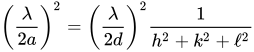
The measurement of the angles can be used to determine crystal structure, see x-ray crystallography for more details.[5][13] As a simple example, Bragg's law, as stated above, can be used to obtain the lattice spacing of a particular cubic system through the following relation:
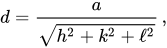
where is the lattice spacing of the cubic crystal, and h, k, and are the Miller indices of the Bragg plane. Combining this relation with Bragg's law gives:

One can derive selection rules for the Miller indices for different cubic Bravais lattices as well as many others, a few of the selection rules are given in the table below.

Selection rules for the Miller indices
Bravais lattices Example compounds Allowed reflections Forbidden reflections
Simple cubic Po Any h, k, None
Body-centered cubic Fe, W, Ta, Cr h + k + = even h + k + = odd
Face-centered cubic (FCC) Cu, Al, Ni, NaCl, LiH, PbS h, k, all odd or all even h, k, mixed odd and even
Diamond FCC Si, Ge All odd, or all even with h + k + = 4n h, k, mixed odd and even, or all even with h + k + ≠ 4n
Hexagonal lattice Ti, Zr, Cd, Be even, h + 2k ≠ 3n h + 2k = 3n for odd

These selection rules can be used for any crystal with the given crystal structure. KCl has a face-centered cubic Bravais lattice. However, the K+ and the Cl ion have the same number of electrons and are quite close in size, so that the diffraction pattern becomes essentially the same as for a simple cubic structure with half the lattice parameter. Selection rules for other structures can be referenced elsewhere, or derived. Lattice spacing for the other crystal systems can be found here.

See also

[edit]

References

[edit]

Further reading

[edit]
[edit]
Revisions and contributorsEdit on WikipediaRead on Wikipedia
from Grokipedia
Bragg's law is a cornerstone equation in that specifies the condition for constructive interference of X-rays diffracted by the atomic planes in a crystalline material, enabling the measurement of interplanar spacings and thus the determination of atomic arrangements. The law is mathematically expressed as nλ=2dsinθn\lambda = 2d \sin\theta, where nn is a positive representing the order of , λ\lambda is the of the incident X-rays, dd is the between adjacent planes, and θ\theta is the angle between the incident ray and the planes. First derived and presented by William Lawrence Bragg in November 1912 during a meeting of the Philosophical Society, the law built upon Max von Laue's earlier discovery of X-ray by and provided a simple geometric interpretation of the phenomenon as from atomic planes. The development of Bragg's law revolutionized structural science, as it allowed for the quantitative analysis of diffraction patterns to infer crystal structures, with William Lawrence Bragg and his father, , applying it to solve the structures of materials like and shortly thereafter. Their pioneering work earned them the 1915 , the only time a father-son pair has shared the award, recognizing their contributions to understanding crystal structures using s. Beyond its historical significance, Bragg's law underpins diffraction (XRD) techniques widely used today for phase identification, lattice parameter measurement, and defect analysis in materials such as metals, ceramics, and pharmaceuticals. In modern applications, the law extends to other forms of diffraction, including neutron and electron diffraction, facilitating research in fields like protein crystallography for , materials engineering for semiconductors, and for mineral characterization. Its simplicity and precision have made it indispensable for non-destructive testing and quality control in industries, while ongoing advancements, such as sources, continue to enhance its resolution and applicability.

Fundamentals

Bragg Condition

The Bragg condition refers to the physical scenario in which incident waves, such as X-rays, reflecting from successive parallel atomic planes within a lattice experience constructive interference, resulting in reinforced diffracted beams of maximum intensity. This setup requires that the path length difference between waves scattered from adjacent planes aligns in a way that their phases match, amplifying the signal while minimizing destructive interference from other paths. Key parameters defining this condition include the interplanar spacing dd, the perpendicular distance between consecutive parallel planes of atoms in the ; the λ\lambda of the incident , which must be comparable to atomic dimensions for to occur; and the angle of incidence θ\theta, the angle between the incident beam and the reflecting plane. The path difference arises from the extra distance traveled by the wave reflecting off a deeper plane compared to the one above it, influencing whether the reflected waves add constructively. Crystals feature atoms arranged in a periodic lattice, forming sets of parallel planes that act as reflecting surfaces. Under the Bragg condition, the reflection follows specular , where the incident and reflected beams make equal angles with the plane normal, akin to mirror reflection but on an atomic scale. This ensures that waves from each plane contribute coherently when the condition is met. The reflection is analogous to principles of reflection in wave optics. The Bragg condition is named after the British physicists and William Lawrence Bragg, father and son, who developed this foundational concept in 1913.

Law Equation and Interpretation

Bragg's law is mathematically expressed as nλ=2dsinθn\lambda = 2d \sin\theta, where [n](/page/Integer)[n](/page/Integer) is a positive representing the order of , λ\lambda is the of the incident , dd is the perpendicular distance between adjacent atomic planes in the crystal lattice, and θ\theta is the Bragg angle, defined as the angle between the incident radiation beam and the atomic planes. This equation quantifies the precise condition under which scattered waves from successive atomic planes interfere constructively, resulting in maxima of intensity in the diffraction pattern. The term 2dsinθ2d \sin\theta arises from the path length difference between waves reflected from adjacent planes, which must equal an multiple of the for phase coherence and reinforcement. For the diffraction (n=1n=1), the equation simplifies to λ=2dsinθ\lambda = 2d \sin\theta, corresponding to the fundamental reflection where the path difference matches exactly one ; higher-order diffractions (n>1n > 1) occur at larger angles θ\theta, producing additional peaks at positions that are harmonics of the angle, thereby revealing information about multiple effective plane spacings within the same lattice set. In , typical wavelengths λ\lambda range from about 0.05 to 0.2 nm (e.g., 0.154 nm for Cu Kα_\alpha radiation), while interplanar spacings dd in common fall between 0.1 and 1 nm, leading to Bragg angles θ\theta often in the range of 5° to 50° for observable peaks.

Historical Context

Discovery and Development

In the early , the nature of X-rays remained a subject of intense debate, with physicists grappling to understand whether they behaved as electromagnetic waves or particles. A pivotal breakthrough occurred in 1912 when and his collaborators at the University of Munich conducted experiments demonstrating that X-rays produced patterns when passed through , providing evidence for both the wave properties of X-rays and the periodic atomic structure of . This discovery inspired the father-son duo of , a professor of physics at the , and his son William Lawrence Bragg, a recent graduate from the , to investigate the underlying principles of the observed diffraction spots. Motivated by Laue's results, the Braggs initiated a collaboration in late 1912, with Lawrence developing a theoretical framework to interpret the patterns as reflections from atomic planes within the crystal lattice. Their partnership, which began during a family holiday and continued through correspondence and joint research, marked a significant advancement in applying X-ray diffraction to probe crystal structures. The conceptual outcome of their work, known as the Bragg condition, was first presented by in a paper titled "The Diffraction of Short Electromagnetic Waves by a ," published in the Proceedings of the Cambridge Philosophical Society in 1913. This formulation provided a simple relation linking wavelengths to crystal spacings and angles, enabling the determination of atomic arrangements in solids. For their pioneering contributions to the analysis of crystal structures using , William Henry Bragg and William Lawrence Bragg were jointly awarded the in 1915, making them the first—and only—parent-child pair to share the honor. Their research also influenced contemporary views on nature, with advocating a corpuscular theory that treated X-rays as neutral particles rather than pure electromagnetic waves, temporarily shifting the away from the wave model before reconciled the duality.

Initial Experimental Validation

The initial experimental validation of Bragg's law was achieved through a series of pioneering measurements conducted by William Lawrence Bragg between 1912 and 1914, utilizing an spectrometer to detect reflections from surfaces. This apparatus, adapted from optical designs, featured an source, a rotatable table, and an filled with gases like to quantify the intensity of reflected beams by measuring induced currents. Bragg targeted simple crystals such as (NaCl) and (ZnS), directing narrow beams onto their cleavage planes and varying the glancing angle θ to observe peaks in reflected intensity, thereby mapping the angular conditions for constructive interference. Key findings from these experiments confirmed the Bragg condition, demonstrating that maximum reflection occurs when the path difference between waves scattered from successive atomic planes satisfies λ = 2d sin θ, where λ is the X-ray wavelength and d is the interplanar spacing. For instance, Bragg measured reflection maxima from NaCl, yielding d ≈ 0.28 nm for its (200) planes, consistent with a cubic lattice. Similar measurements on ZnS revealed a face-centered cubic arrangement with d ≈ 0.31 nm, validating the law across different crystal symmetries and establishing X-rays as electromagnetic waves with wavelengths comparable to atomic dimensions. William Henry Bragg played a crucial role in enabling these validations through his development of X-ray spectroscopy techniques, including ionization chambers to precisely detect and quantify reflected beam intensities. His methods involved direct measurement of ionization currents produced by reflected X-rays, often employing pulsed operation from the X-ray tube to distinguish signal from background and improve sensitivity over photographic detection. These innovations allowed for the first quantitative spectra of crystal reflections, linking intensity variations to atomic scattering and providing empirical support for the law's predictions on diffraction efficiency. These experiments yielded the first structural insights into crystals, with NaCl identified as a rock salt structure featuring alternating layers of Na⁺ and Cl⁻ ions spaced at d/2 ≈ 0.14 nm, explaining its simple reflection pattern. For , Bragg proposed a tetrahedral arrangement of carbon atoms with each surrounded by four others, inferred from the absence of certain expected reflections and consistent with d ≈ 0.206 nm for its (111) planes. ZnS was similarly resolved as a structure, a cubic variant with and atoms in a 1:1 ratio, marking the onset of X-ray-based atomic modeling. Despite these successes, the pre-1920s era posed significant challenges, including limited control over wavelengths due to the continuous spectra from early gas tubes, which required assumptions about dominant λ to interpret data accurately. Detector sensitivity was also constrained, as ionization chambers suffered from low signal-to-noise ratios for weak reflections, and photographic plates—used supplementally—demanded long exposures and offered poor quantitative precision, restricting analyses to high-symmetry crystals.

Theoretical Derivation

Geometric Construction

The geometric construction of Bragg's law begins with a model of a as a stack of infinite parallel atomic planes separated by a uniform interplanar spacing dd. An incident monochromatic wave, such as an beam of λ\lambda, strikes these planes at an θ\theta, defined as the glancing angle between the beam direction and the plane surface (rather than to the plane). The wave reflects from each plane specularly, obeying the law of reflection where the angle of incidence equals the angle of reflection, both measured from . To derive the condition for enhanced reflection, focus on the rays interacting with two adjacent planes: the ray reflected from the lower plane travels an additional distance relative to the ray from the upper plane, which must be analyzed for phase alignment. This extra path length arises from the geometry of the reflections. Imagine the incident ray reaching the first plane at point A and continuing to the second plane at point B; the reflected ray from B returns to meet the extension of the reflected ray from A. By constructing perpendiculars from B to the incident and reflected directions of the ray from A, two congruent right triangles emerge, each with a of dsinθd \sin \theta. The total path difference δ\delta is thus the sum of these : δ=dsinθ+dsinθ=2dsinθ.\delta = d \sin \theta + d \sin \theta = 2d \sin \theta. This calculation assumes the planes are perfectly parallel and the wave fronts are planar, allowing the use of simple trigonometry in the isosceles triangles formed by the ray paths and the plane spacing./01%3A_Fundamental_Crystallography/1.11%3A_Bragg%27s_Law) For the reflected waves from successive planes to interfere constructively and produce a diffraction maximum—the core of the Bragg condition—this path difference must equal an integer multiple of the wavelength, ensuring the waves are in phase. Therefore, 2dsinθ=nλ,2d \sin \theta = n \lambda, where n=1,2,3,n = 1, 2, 3, \dots is the order of reflection. This relation emerges directly from the geometric path analysis and defines the angles at which strong reflections occur. The construction relies on several simplifying assumptions: the reflecting planes are infinite in extent to avoid edge effects, reflection is purely specular with no diffuse scattering, and the crystal is non-absorbing, so wave amplitude remains uniform across planes. These idealizations facilitate the derivation but hold approximately for well-ordered crystals under typical diffraction conditions.

Interference Principle

The wave nature of X-rays, established through their and interference properties, forms the foundation of Bragg's law in . When X-rays interact with a crystal lattice, they are by the electrons surrounding the atoms at lattice points, producing secondary wavelets that propagate in all directions according to Huygens' principle. These scattered waves superpose throughout space, resulting in an interference pattern determined by their relative phases; the overall intensity at any point is the coherent sum of amplitudes from all scattering centers./Instrumentation_and_Analysis/Diffraction_Scattering_Techniques/Bragg's_Law) Constructive interference occurs when the scattered waves from successive lattice planes are in phase, leading to intensity maxima or peaks, while destructive interference arises when they are out of phase, producing minima. This phase alignment is governed by the path length difference between waves reflected from adjacent planes, which must satisfy the condition for reinforcement. Specifically, the phase difference δ\delta between waves from neighboring planes is given by δ=2πλ2dsinθ,\delta = \frac{2\pi}{\lambda} \cdot 2 d \sin \theta, where λ\lambda is the X-ray wavelength, dd is the interplanar spacing, and θ\theta is the incidence angle. Constructive interference, and thus a diffraction peak, happens when δ=2πn\delta = 2\pi n for nn, reducing to the familiar Bragg condition 2dsinθ=nλ2 d \sin \theta = n \lambda. At other angles, the phases misalign, yielding destructive interference and negligible intensity. This wave perspective explains why diffraction peaks appear only at discrete angles, beyond simple geometric reflection./Analytical_Sciences_Digital_Library/Courseware/Introduction_to_X-ray_Diffraction_(XRD)/03_Basic_Theory/02_Diffraction__and_Braggs_Law) In three dimensions, the interference principle extends to the full crystal lattice using the concept of vectors, which represent the scattering conditions in reciprocal space. peaks occur when the scattering vector equals a reciprocal lattice vector Ghkl\mathbf{G}_{hkl}, satisfying the equivalently to Bragg's law in vector form: kk0=Ghkl\mathbf{k} - \mathbf{k_0} = \mathbf{G}_{hkl}, where k0\mathbf{k_0} and k\mathbf{k} are the incident and scattered wave vectors. This is visualized through the Ewald sphere construction, where the sphere's surface (of radius 1/λ1/\lambda) intersects reciprocal lattice points to determine allowed diffraction directions; such intersections enforce the phase-matching for constructive interference across the 3D structure. The basic interference description in Bragg's law assumes ideal conditions, neglecting complexities like multiple scattering—where waves undergo secondary scatters within the , distorting peak positions and intensities—and thermal motion of atoms, which introduces a Debye-Waller factor that exponentially damps amplitudes due to vibrational averaging. These effects become prominent in thick crystals or at high temperatures, requiring more advanced dynamical theories for accurate modeling.

Core Applications

X-ray Crystallography

X-ray crystallography relies on Bragg's law to determine the atomic structure of crystalline materials by analyzing the diffraction patterns produced when monochromatic s interact with the ordered lattice planes. The experimental setup typically involves a monochromatic source, such as one emitting Cu Kα radiation with a of approximately 1.54 , directed at the sample. For single- diffraction, the is mounted on a that allows rotation to orient different lattice planes relative to the incident beam, while a detector—often an area detector like a CCD or image plate—captures the beams at various angles. In , the sample consists of finely ground crystallites in random orientations, eliminating the need for rotation but requiring a focused beam to ensure sufficient intensity. Data collection often employs θ-2θ scans in a Bragg-Brentano geometry, where the sample and detector rotate synchronously to maintain the reflection condition as the angle increases. Diffraction peaks occur when the Bragg condition is satisfied, allowing calculation of interplanar spacings dhkld_{hkl} from the peak positions. The relationship is given by sinθ=nλ2dhkl\sin \theta = \frac{n \lambda}{2 d_{hkl}} where θ\theta is the Bragg angle, nn is the order of diffraction, and λ\lambda is the X-ray wavelength; solving for dhkld_{hkl} enables indexing of peaks to specific (hkl) planes. Lattice parameters are then derived by fitting the observed dhkld_{hkl} values to the crystal system's geometry, such as 1dhkl2=h2+k2+l2a2\frac{1}{d_{hkl}^2} = \frac{h^2 + k^2 + l^2}{a^2} for a cubic lattice with parameter aa. Key techniques in X-ray crystallography include the Laue method, which uses polychromatic X-rays and a stationary crystal to produce simultaneous diffractions from multiple planes, useful for initial assessment. The rotating crystal method involves continuous rotation of a around one axis during exposure to monochromatic X-rays, generating a comprehensive set of reflections for structure solution. , particularly the Debye-Scherrer method, records concentric rings on a or detector from a powdered sample, providing averaged data suitable for polycrystalline materials and phase identification. The primary outcomes of these techniques are the determination of dimensions from indexed dhkld_{hkl} spacings, identification of space groups through systematic absences in reflection intensities, and refinement of atomic positions. maps are constructed via Fourier synthesis, where the structure factors—derived from measured intensities—are used to compute the ρ(x,y,z)=hklFhklexp[2πi(hx+ky+lz)]\rho(x,y,z) = \sum_{hkl} F_{hkl} \exp[-2\pi i (hx + ky + lz)], revealing peaks corresponding to atoms. This process enables precise modeling of molecular structures, including bond lengths and angles. In modern applications, synchrotron radiation sources provide tunable, high-intensity beams with brilliance orders of magnitude greater than laboratory sources, enabling high-resolution studies of complex structures like proteins. These facilities support microcrystallography for small or weakly diffracting samples, achieving resolutions below 1 and facilitating the determination of nearly 250,000 protein structures deposited in the as of November 2025.

Neutron and Electron Diffraction

Neutron diffraction employs thermal s with wavelengths on the order of 0.1 nm, generated from nuclear reactors or sources, to probe crystalline s. These s interact via coherent with atomic nuclei, rather than electron clouds, which provides high sensitivity to light elements like and enables distinction between isotopes due to variations in nuclear lengths. The Bragg condition applies in a geometrically analogous manner to determine interplanar spacings in periodic lattices, but the resulting factors depend on the nuclear potential, leading to patterns that reveal isotopic compositions and positions of light atoms. A key advantage of neutron diffraction lies in its use for magnetic structure analysis, facilitated by the neutron's intrinsic , which produces spin-dependent that highlights antiferromagnetic or ferrimagnetic ordering in materials. This capability is particularly valuable for studying positions in molecular systems, where neutrons scatter strongly from nuclei, allowing precise localization in compounds like metal hydrides or biomolecules that are challenging for other probes. Electron diffraction, in contrast, uses high-energy electrons with de Broglie wavelengths much shorter than 0.1 nm (typically 0.002–0.005 nm at 100–300 keV), accelerated in instruments such as transmission electron microscopes (TEM) or low-energy electron diffraction (LEED) systems. The electrons experience strong Coulombic scattering from atomic potentials, resulting in high scattering cross-sections but shallow penetration depths of tens to hundreds of nanometers, making the technique ideal for investigating surfaces, thin films, and nanostructures. Bragg's law governs the diffraction patterns, with adaptations accounting for relativistic corrections in wavelength calculations that influence the sinθ\sin\theta term, as well as operational modes: transmission through thin samples in TEM for bulk-like crystallography or reflection from surfaces in LEED for adsorbate and reconstruction studies. These probe-specific attributes complement each other in materials analysis; for instance, neutron diffraction excels at revealing hydrogen bonding networks in fibrous biological samples like DNA models, while electron diffraction provides atomic-scale resolution of thin crystalline films in epitaxial growth monitoring.

Extensions and Variations

Beyond Standard Bragg Scattering

While the standard formulation of Bragg's law assumes single scattering events in ideal , real-world often involves multiple scattering processes, particularly in highly perfect . The dynamical of , developed by C.G. Darwin in 1914, accounts for these interactions by treating the crystal as a continuous medium where incident and diffracted waves propagate and interfere within the lattice. In this framework, for perfect , the wave fields satisfy coupled differential equations that describe the excitation of both direct and reflected beams, leading to deviations from the simple kinematic approximation. A key observable in this regime is the Pendellösung effect, where interference between the two wave fields produces intensity oscillations or fringes in the pattern, with the fringe period inversely proportional to crystal thickness. These fringes were first theoretically predicted by Paul Ewald, and experimentally observed independently by Norio Kato in and by Andrew Richard Lang in in 1959. Crystal imperfections, such as and mosaic structures, introduce additional complexities that broaden the peaks beyond the predictions of Bragg's law. In mosaic crystals, the lattice is composed of small, slightly misoriented blocks (mosaicity), which cause angular dispersion and result in wider rocking curves; this broadening is particularly pronounced in regions of high dislocation density, where strain fields distort the local lattice planes. For instance, threading dislocations in epitaxial films can increase the full width at half maximum (FWHM) of Bragg peaks by factors of 10 or more compared to perfect crystals. The distinction between Laue (transmission) and Bragg (reflection) geometries further influences these effects: in thick crystals under Bragg conditions, absorption and multiple amplify broadening from surface mosaicity, whereas Laue transmission through thin crystals minimizes it, allowing clearer resolution of defect-induced tails. Even in perfect lattices, certain reflections predicted by Bragg's law are systematically absent due to the destructive interference arising from crystal symmetry elements. These forbidden reflections, or extinctions, occur when the vanishes for specific , such as in face-centered (F-centered) lattices where hkl reflections are absent unless h, k, and l are all even or all odd, reflecting the translational symmetries of the centering. Such absences provide critical diagnostic tools for determination, as they stem directly from glide planes, axes, or lattice centering that impose phase relationships leading to zero net amplitude. For example, in F-centered cubic structures like , the (100) and (110) reflections are forbidden, sharpening the identification of the from data. Temperature introduces dynamic disorder through atomic vibrations, which attenuates Bragg peak intensities and generates diffuse scattering. The Debye-Waller factor quantifies this attenuation, exponentially reducing the structure factor by e^{-2W}, where W depends on the mean-square displacement of atoms and increases with temperature, thus lowering peak sharpness while enhancing thermal diffuse scattering (TDS) around points. TDS arises from by phonons and can broaden peaks by up to 20-30% in metals at , complicating precise lattice parameter measurements without correction. This effect was first modeled by in 1913 for the temperature dependence of scattering and refined by Ivar Waller in 1923 to include the harmonic approximation for vibrations. Bragg's law extends to non-periodic systems through generalizations that relax the infinite perfect lattice assumption. In quasicrystals, which exhibit aperiodic long-range order, sharp Bragg-like peaks occur at positions indexed by quasi-lattice vectors with irrational ratios, as described by the cut-and-project method; this was evident in the 1982 discovery of icosahedral quasicrystals in Al-Mn alloys, where patterns obey a generalized Bragg condition derived from higher-dimensional . For amorphous materials lacking long-range order, the pair distribution function (PDF), obtained from total data, replaces discrete Bragg peaks with a radial distribution of atomic pairs, allowing via of the reduced ; this approach reveals short-range order up to 10-20 , bridging crystalline and glassy states.

Volume Bragg Gratings

Volume Bragg gratings (VBGs) are holographic optical elements featuring periodic variations in the throughout the volume of a photosensitive , functioning as three-dimensional gratings that obey an adapted form of Bragg's law similar to its original reflection geometry. These gratings are fabricated by exposing photosensitive materials, such as photorefractive crystals or photopolymers, to interference patterns generated by coherent beams, which induce a permanent spatial modulation of the to form volume holograms. This recording process allows for precise control over the grating's orientation and period, enabling tailored diffractive properties in bulk media with thicknesses often exceeding hundreds of micrometers. In VBGs, the Bragg condition governs diffraction, providing sharp angular and wavelength selectivity for visible light in the range of approximately 400-700 nm, where the grating period dd typically spans 0.1-10 μ\mum depending on the desired reflection or transmission mode. For reflection gratings, the condition simplifies to λB=2nΛ\lambda_B = 2 n \Lambda, with Λ\Lambda as the slant-adjusted period and nn the average refractive index, ensuring efficient coupling only near the Bragg angle. This selectivity arises from the volume integration of phase mismatches, leading to high rejection of off-resonance light and enabling narrowband operation with bandwidths as low as 0.1 nm. VBGs find applications as filters for notch or bandpass functionality, beam combiners in high-power to achieve beam combining with kilowatt-level outputs, and components in for dense (DWDM) systems supporting channel spacings of 50 GHz or finer. Their volume effects yield efficiencies greater than 90%, far surpassing the limitations of thinner gratings and minimizing losses in compact laser cavities or multiplexers. A key advantage of VBGs over surface relief gratings is the enhanced thickness, which sharpens angular and spectral selectivity by accumulating phase shifts across the volume, reducing in multi-channel systems and enabling robust performance under high optical powers. This makes them ideal for integration in fiber optic sensors and displays, where surface gratings would suffer from broader responses and lower efficiencies. Mathematical adaptations for VBGs often involve slanted fringe geometries, where the grating vector is tilted relative to the surface normal, introducing off-Bragg parameters to fine-tune the and angle for applications requiring dynamic adjustment. In coupled-wave theory, the off-Bragg ξ\xi quantifies deviations from ideal matching, given by ξ=12(βsinθπd)d\xi = \frac{1}{2} \left( \beta \sin \theta - \frac{\pi}{d} \right) d, allowing prediction of efficiency roll-off and optimization of slanted designs for or wavelength-shifted operation.

Specialized Phenomena

Visible Light Scattering in Colloids

Colloidal crystals are ordered arrays of submicrometer spheres, such as or silica particles with diameters typically ranging from 100 to 500 nm, that self-assemble into photonic lattices through , , or electrostatic interactions. These structures mimic atomic crystals but operate on mesoscopic scales, enabling interactions with visible wavelengths of 400 to 700 nm. In these systems, Bragg scattering produces iridescent colors via constructive interference of visible light waves reflected from the periodic lattice planes, where the scattering angle θ is influenced by the contrast between the particles and the surrounding medium. This phenomenon arises from the periodic modulation of the , leading to selective reflection of specific wavelengths and transmission of others, resulting in vivid, angle-dependent . Experimentally, such is observed as structural colors in natural and synthetic opals, where close-packed silica spheres create photonic lattices that reflect light at peak wavelengths determined by the Bragg condition, adapted for effective neffn_{\text{eff}}: λ=2neffdsinθ\lambda = 2 n_{\text{eff}} d \sin \theta Here, dd is the interplane spacing, and neffn_{\text{eff}} accounts for the average of the . Synthetic colloids, like those formed from spheres, exhibit similar opalescent effects, with colors shifting as the observation angle changes. These materials find applications in photonic bandgap engineering, where the periodic structure creates forbidden frequency ranges for light propagation, enabling low-loss waveguides and mirrors. Additionally, colloidal photonic crystals serve as sensors, detecting strain or chemical changes through shifts in the reflected ; for instance, hydrogel-based assemblies respond to mechanical deformation or solvent exposure by altering lattice spacing. Natural examples include the iridescent wing scales of butterflies like , which employ multilayer photonic structures for Bragg reflection, inspiring artificial opals for optical devices. Unlike scattering in atomic crystals, visible interactions in colloids involve significant multiple scattering events due to the comparable size of particles and wavelengths, which can enhance or complicate the pattern. Polydispersity in particle sizes further broadens the Bragg peaks, reducing the sharpness of reflected colors and stop-band contrast compared to ideal monodisperse systems.

Selection Rules in Practical Use

Selection rules in impose constraints on which Bragg reflections are observable, stemming directly from the symmetries inherent in a crystal's . These symmetries, including lattice centering and translational elements like screw axes and glide planes, can cause the structure factor FhklF_{hkl} to vanish for specific (hkl), leading to systematic absences in the pattern. Such absences occur because the phase contributions from symmetrically equivalent atoms interfere destructively, resulting in zero intensity for those reflections. This phenomenon is a fundamental tool for interpreting data and refining crystal structures. Common examples of these rules arise from Bravais lattice centering types. In primitive (P) lattices, no general restrictions apply to reflections. Body-centered (I) lattices require h + k + l to be even for observable reflections, while face-centered (F) lattices demand that hkl indices are all even or all odd, forbidding mixed-parity indices like (100) in face-centered cubic structures. Base-centered (C) lattices impose conditions such as h + k even. Translational symmetries further refine these: a twofold screw axis (2₁) along c, for instance, absent 00l reflections where l is odd, and a c-glide plane perpendicular to b absent hk0 reflections where h + k is odd. These conditions are tabulated comprehensively for all 230 space groups. In practical applications, these selection rules are essential for determining the and during powder and single-crystal analysis. By identifying patterns of missing reflections, researchers can narrow down possible s from data, facilitating accurate indexing and structure solution. Software packages like GSAS-II incorporate these rules to automate lattice parameter refinement and assignment, often integrating them with peak fitting algorithms for robust analysis. However, limitations exist: atomic disorder or thermal vibrations can produce weak intensities in nominally absent positions, potentially leading to misinterpretation. To mitigate this, selection rules are typically combined with the Ewald , which geometrically predicts allowed points and Bragg peaks consistent with the observed data. In modern contexts, such as protein crystallography, these rules remain vital for resolving ambiguities in low-symmetry space groups, where datasets may be incomplete due to or twinning. Tools within suites like CCP4, including , analyze systematic absences alongside intensity statistics to suggest probable space groups, aiding phase determination and in challenging biological structures. This approach has been instrumental in high-impact studies of macromolecular assemblies.

References

Add your contribution
Related Hubs
User Avatar
No comments yet.