


Community hub
Recent from talks
Contribute something
Nothing was collected or created yet.
British Rail Class 06
View on Wikipedia
| British Rail Class 06 | |||||||||||||||||||||||||||||||
|---|---|---|---|---|---|---|---|---|---|---|---|---|---|---|---|---|---|---|---|---|---|---|---|---|---|---|---|---|---|---|---|
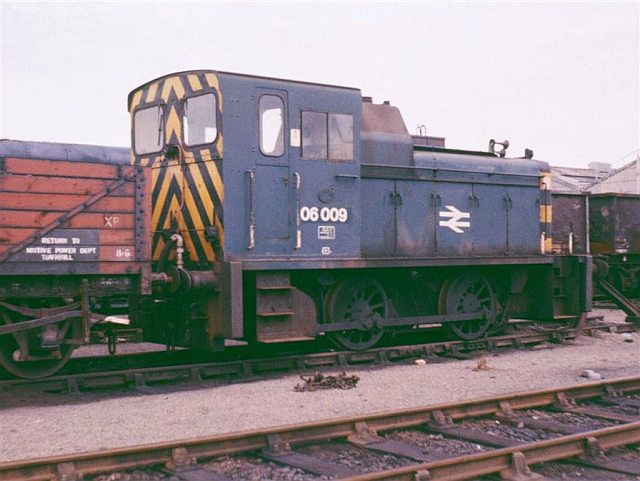
 06009 operating as 'works pilot' at Dunfermline Townhill in July 1975. It was withdrawn the following month. | |||||||||||||||||||||||||||||||
| |||||||||||||||||||||||||||||||
| |||||||||||||||||||||||||||||||
| |||||||||||||||||||||||||||||||
| |||||||||||||||||||||||||||||||
The British Rail Class 06 is a class of 0-4-0 diesel-mechanical shunters built by Andrew Barclay Sons and Company from 1958[1] to 1960 for use on the Scottish Region of British Railways. They were originally numbered D2410–D2444 and survivors after 1973 were given the TOPS numbers 06001–06010.
Technical details
[edit]The engine is a Gardner 8-cylinder 4 stroke "8L3" connected to a Wilson-Drewry CA5 5-speed epicyclic gearbox with a Vulcan-Sinclair type 23 fluid coupling and a Wiseman type 15 RLGB gearbox.
While all technically similar, the locomotives had two different designs for the back of the cab, the first 15 locomotives having three windows, the remaining 20, having two.[2]
Numbering
[edit]They were originally numbered D2410–D2444. The ten still in service in January 1973, nos. D2413/14/20–23/26/37/40/44, were given the TOPS numbers 06001–06010.[2]
| D-number | TOPS Number | Allocation in February 1977 [3][full citation needed] | Image | Status | Notes |
|---|---|---|---|---|---|
| D2410 | Withdrawn | Scrapped | |||
| D2411 | Withdrawn | Scrapped | |||
| D2412 | Withdrawn | Scrapped | |||
| D2413 | 06001 | Withdrawn | Scrapped | ||
| D2414 | 06002 | DT | Scrapped | ||
| D2415 | Withdrawn | Scrapped | |||
| D2416 | Withdrawn | Scrapped | |||
| D2417 | Withdrawn | Scrapped | |||
| D2418 | Withdrawn | Scrapped | |||
| D2419 | Withdrawn | Scrapped | |||
| D2420 | 06003 | ED |  |
Preserved | For a considerable time, at Eastfield depot, carried the number 206003 |
| D2421 | 06004 | DE | Scrapped | ||
| D2422 | 06005 | DE | Scrapped | ||
| D2423 | 06006 | AB | .jpg) |
Scrapped | |
| D2424 | Withdrawn | Scrapped | |||
| D2425 | Withdrawn | Scrapped | |||
| D2426 | 06007 | DT | Scrapped | ||
| D2427 | Withdrawn | Scrapped | |||
| D2428 | Withdrawn | Scrapped | |||
| D2429 | Withdrawn | Scrapped | |||
| D2430 | Withdrawn | Scrapped | |||
| D2431 | Withdrawn | Scrapped | |||
| D2432 | Withdrawn | Unknown | Exported to Italy in 1977, fate unknown. | ||
| D2433 | Withdrawn | Scrapped | |||
| D2434 | Withdrawn | Scrapped | |||
| D2435 | Withdrawn | Scrapped | |||
| D2436 | Withdrawn | Scrapped | |||
| D2437 | 06008 | DT | .jpg) |
Scrapped | |
| D2438 | Withdrawn | Scrapped | |||
| D2439 | Withdrawn | Scrapped | |||
| D2440 | 06009 | Withdrawn | |
Scrapped | |
| D2441 | Withdrawn | Scrapped | |||
| D2442 | Withdrawn | Scrapped | |||
| D2443 | Withdrawn | Scrapped | |||
| D2444 | 06010 | Withdrawn | Scrapped |
Withdrawal
[edit]With a decline in shunting, BR was forced to reduce its shunter fleet in the 1960s and 70s, resulting in mass withdrawals. The first class 06 locomotive to be withdrawn was D2441 in March 1967 and the last was 06002 (formerly D2414) in September 1981.
| Year | Quantity in service at start of year |
Quantity withdrawn |
Locomotive numbers | Notes |
|---|---|---|---|---|
| 1967 | 35 | 1 | D2441 | |
| 1968 | 34 | 9 | D2411–12/15/17–18/25/28/30/32 | D2432 sold into industrial use |
| 1969 | 25 | 5 | 2410/19/27/29/34 | |
| 1970 | 20 | 0 | – | |
| 1971 | 20 | 4 | 2431/35–36/39 | |
| 1972 | 16 | 6 | 2416/24/33/38/42–43 | |
| 1973–4 | 10 | 0 | – | |
| 1975 | 10 | 2 | 06009/010 | |
| 1976 | 8 | 1 | 06001 | |
| 1977 | 7 | 1 | 06007 | |
| 1978 | 6 | 0 | – | |
| 1979 | 6 | 1 | 06004 | |
| 1980 | 5 | 3 | 06005–006/008 | |
| 1981 | 2 | 2 | 06002/003 | 06003 went into departmental use, now preserved. |
Preservation
[edit]_(8061924358).jpg)
A single locomotive survives, number 06003 (formerly D2420). It was the second last locomotive of the class in service when it was withdrawn in February 1981. It was transferred to the departmental fleet following withdrawal and renumbered 97804, and used at the Reading Signal Works where it replaced 97020.[2] After being withdrawn again in 1984, it was sold to Booth's scrapyard in Rotherham (date unknown) before being saved for preservation by the local South Yorkshire Railway based at Meadowhall in Sheffield. Later owned by HNRC and visited several locations before being stored at the Museum of Science and Industry, Liverpool Road, Manchester, and in 2013 was moved into the Heritage Shunters Trust collection at Peak Rail, Rowsley.
One locomotive, D2432, was sold to P. Wood Shipbreakers of Queenborough, Kent in 1969. It was exported to Italy in 1977, but its subsequent fate is unrecorded.[2]
Model Railways
[edit]In 1963 Hornby Railways launched its first version of the BR Class 06 in OO gauge. Since 2011 Hornby have produced a basic representation of the prototype as part of their Railroad range in BR Blue, whilst past examples have carried a variety of liveries.[4]
An etched brass kit of the 06 is in the range of Judith Edge Kits.[5]
References
[edit]- ^ "06 0-4-0". Brdatabase.info. Retrieved 4 August 2022.
- ^ a b c d Strickland 1983, p. 40.
- ^ NREA Locomotive allocation book & February 1977, p. 4.
- ^ "Hornby BR Class 06". Hornby Railways Collector Guide. Retrieved 1 February 2020.
- ^ "Judith Edge Kits". UK Model Shops. Retrieved 8 January 2013.
- Strickland, David C. (1983). Locomotive Directory. Frimley, Surrey: Diesel and Electric Group. p. 40. ISBN 0-906375-10-X.
- Williams, Alan; Percival, David (1977). British Railways Locomotives and Multiple Units including Preserved Locomotives 1977. Shepperton: Ian Allan Ltd. ISBN 0-7110-0751-9.
- British Rail Locomotive Allocation Book (2nd ed.). National Railway Enthusiasts Association. February 1977.
Further reading
[edit]- Vehicle Diagram Book No. 120 for Shunting Diesel Locomotives (PDF). Derby: British Railways Board. April 1974. 06-a – via Barrowmore MRG.
External links
[edit]
British Rail Class 06
View on GrokipediaBackground and Development
Origins and Design
Following the nationalisation of Britain's railways in 1948, the Scottish Region of British Railways identified a pressing need to modernise shunting operations in its often cramped and intricate yards, where pre-existing steam locomotives proved increasingly uneconomical and difficult to maintain amid the push towards dieselisation.[5] These aging steam designs, including compact 0-4-0 tank locomotives inherited from pre-Grouping companies like the Caledonian Railway, were particularly ill-suited to the post-war efficiency demands, prompting British Rail to seek purpose-built diesel replacements tailored to Scotland's unique yard layouts and lighter traffic patterns.[5] The resulting Class 06 emerged as a specialised 0-4-0 diesel shunter refined for enhanced compactness to navigate tight curves and short sidings prevalent in Scottish facilities, ensuring greater reliability for everyday marshalling tasks.[1] Central to its design were two cab variants: the initial batch of 15 locomotives featured a three-window rear cab for standard visibility, while the later 20 units adopted a two-window configuration to optimise space and driver positioning in confined environments.[5][1] The Class 06 used a diesel-mechanical transmission.[6]Construction
The British Rail Class 06 locomotives were built by Andrew Barclay Sons & Co. at their works in Kilmarnock, Scotland, as a dedicated order for the modernization of shunting operations on British Rail's Scottish Region. A total of 35 units were produced to replace steam shunters and enhance efficiency in freight yards across Scotland.[5] Production occurred in two distinct batches over a two-year period. The initial batch comprised 15 locomotives, numbered D2410–D2424, assembled between June 1958 and April 1959; these featured three small windows at the rear of the cab and were primarily allocated to depots in northern Scotland. The subsequent batch of 20 locomotives, numbered D2425–D2444, was constructed from November 1959 to October 1960 and incorporated two larger rear cab windows, with allocation to western Scottish depots.[5]Technical Specifications
Engine and Transmission
The British Rail Class 06 shunter was powered by a Gardner 8L3 inline-eight diesel engine, a naturally aspirated four-stroke unit producing 204 bhp (152 kW) at 1,200 rpm.[7] This engine, with a bore of 139.7 mm and stroke of 196.85 mm, was selected for its robust construction and proven performance in industrial applications, delivering reliable power for light shunting tasks.[7] Power was transmitted mechanically through a Wilson-Drewry CA5 five-speed epicyclic gearbox, combined with a Vulcan-Sinclair Type 23 fluid coupling for smooth engagement, and a Wiseman Type 15 reversing gearbox to the final drive.[3] This arrangement provided the necessary low-speed torque multiplication essential for precise maneuvering in confined yard spaces, with gear ratios optimized to maintain high tractive effort during frequent starts and stops.[3] The locomotive featured a 325 imperial gallon (1,480 L) fuel tank, enabling prolonged operation without frequent refueling in remote or busy depots.[8] Cooling was handled by a dedicated radiator system suited to the engine's output, with provisions for efficient heat dissipation during sustained low-speed running typical of shunting duties.[7] Maintenance of the Gardner 8L3 in shunting environments emphasized its straightforward design, allowing for routine servicing such as oil changes and injector adjustments with minimal downtime, a key factor in its suitability for high-utilization yard work.[9] The engine's durability reduced overhaul intervals compared to less robust alternatives, contributing to cost-effective operations in British Rail's network.[7]Dimensions and Performance
The British Rail Class 06 shunter measured 25 ft 11 in (7.90 m) in length over buffers, 8 ft 5 in (2.57 m) in width, 11 ft 10+3⁄16 in (3.61 m) in height, and had a wheelbase of 7 ft 0 in (2.13 m), making it compact for tight yard maneuvers. These dimensions contributed to its agility in confined spaces, such as Scottish freight yards, where precise positioning was essential for shunting operations.[10] Weighing 37.30 long tons (37.90 t; 41.80 short tons), the locomotive provided sufficient stability without excessive axle loading on lighter branch lines. It featured standard British Rail screw couplings and buffers set at a height of approximately 3 ft 1 in (0.94 m) above rail level, ensuring compatibility with typical wagon stock.[11] In terms of performance, the Class 06 achieved a maximum speed of 22.8 mph (36.7 km/h), adequate for short-haul shunting duties rather than mainline running.[11] Its starting tractive effort was 19,800 lbf, enabling effective handling of light to medium wagon consists in hump yards. The locomotive was equipped with vacuum brakes capable of exerting a force equivalent to 15 long tons, supplemented by hand brakes for stationary control.[1] Sandbox arrangements were positioned near the leading axles, dispensing sand to the rails for improved adhesion, particularly useful on the damp or frosty tracks common in Scottish yards.[10] This feature, combined with the locomotive's overall design, enhanced reliability in adverse weather conditions during routine shunting tasks.[12]Operational History
Introduction and Service
The British Rail Class 06 diesel-mechanical shunters entered service on the Scottish Region between June 1958 and October 1960, with 35 locomotives built by Andrew Barclay & Co. in Kilmarnock specifically for regional needs. The first batch of 15 units was allocated to northern Scottish depots such as Inverness and Kittybrewster starting in 1958–1959, while the second batch of 20 went to western depots including Polmadie, Motherwell, and Ayr from late 1959 onward. By December 1960, allocations included three at Polmadie (66A), reflecting their early integration into key Scottish infrastructure hubs.[13] These locomotives were primarily employed for light shunting operations in goods yards, wagon marshalling, and short-distance trip workings, particularly in Scotland's industrial and coastal areas. They handled routine tasks at depots like Eastfield and Aberdeen Ferryhill, supporting dock duties along the East Coast and branch line activities where maneuverability in confined spaces was essential. Notable transfers within Scotland, such as movements between Kittybrewster, Polmadie, and Eastfield in the 1960s and 1970s, underscored their adaptability to evolving regional freight demands, with around 20 still active as late as 1970.[10] Initially numbered D2410–D2444 under the British Rail diesel scheme, the Class 06 proved suitable for its niche but faced operational limitations in heavier shunting compared to larger classes like the Class 08, restricting them to lighter loads and less demanding environments. Their service emphasized efficiency in Scottish yards, contributing to the region's transition from steam to diesel traction without major disruptions in everyday operations.[10][13]Numbering
The British Rail Class 06 locomotives were originally numbered D2410 to D2444 under the early British Rail diesel shunter numbering scheme, which allocated sequential 'D' prefixes to diesel-mechanical shunters built for the Scottish Region between 1958 and 1960.[13] A total of 35 units were constructed in this range by Andrew Barclay Sons & Co.[13] In the 1970s, as British Rail implemented the Total Operations Processing System (TOPS), the ten surviving Class 06 locomotives were redesignated with new TOPS codes in the 06xxx series to standardize identification across the fleet.[14] This renumbering occurred primarily between 1974 and 1975, with specific mappings as follows:| Original Number | TOPS Number | Renumbering Date |
|---|---|---|
| D2413 | 06001 | April 1974 |
| D2414 | 06002 | April 1975 |
| D2420 | 06003 | April 1974 |
| D2421 | 06004 | December 1974 |
| D2422 | 06005 | April 1975 |
| D2423 | 06006 | April 1975 |
| D2426 | 06007 | December 1974 |
| D2437 | 06008 | April 1975 |
| D2440 | 06009 | December 1974 |
| D2444 | 06010 | April 1975 |