


Community hub
Recent from talks
Contribute something
Nothing was collected or created yet.
Bro Gwened
View on Wikipedia


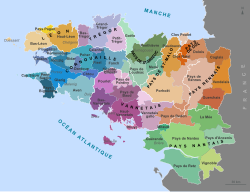
Gwened, Bro-Gwened (Breton: Bro-Wened) or Vannetais (French: Pays Vannetais) is a historic realm and county of Brittany in France. It is considered part of Lower Brittany.[1]
Bro-Gwened was an early medieval principality or kingdom around Vannes in Armorica (Brittany), lasting from around AD 490 to around 635. It was peopled by Christianized Britons fleeing the Saxon invasions of Britain, who displaced or assimilated the remaining pagan Veneti Gauls. Its bishop and (usually) court was at Gwened, the site of the former Roman settlement of Darioritum and the present French city of Vannes.
The territories are included within the modern French department of Morbihan.
Name
[edit]The Breton placename-element plou (Latin: plebs) initially meant a tribe,[2] but came to signify its territory as well. The standard Breton form of the name mutates Gwened, the Breton name for Vannes, while the local dialect leaves it unchanged as "Bro-Gwened". The modern French name derives from adjectival form of Vannes. Both Gwened[4] and Vannes[1] reflect separate developments of the Latin Veneti, the Romans' name for the Gaulish tribe in the area. (It is unrelated to the Welsh realm and county of Gwynedd, which developed from Latin Venedotia.[1])
The historic realm was also known as Bro Erec (Breton: Bro-Ereg, "land of Gwereg") or Bro Waroch (from the gallicisation of the same name) or by numerous variant spellings,[6] although it is unclear whether the namesake Gwereg was Waroch I or II.
History
[edit]The land was allegedly founded by Caradog Strongarm.[7] In the early 6th century, Macliau served as one of the earliest bishops of Vannes prior to usurping his nephew's inheritance in neighboring Cornouaille.[8] He may have also been king of Broerec[9] or simply the refugee guest of Conmor.[8] Major settlements at this time included Gwened (Vannes) and Lokmaria (Locmaria). In the mid-7th century, Bro Gwened was united with Domnonia under its king Saint Judicaël, who was descended from a daughter of Budic II. Domnonia's rulers thenceforth reigned as the high kings of Brittany, with Bro Gwened forming part of their lands.
Dialect
[edit] | You can help expand this section with text translated from the corresponding article in French. (March 2025) Click [show] for important translation instructions.
|

The dialect of Gwened's present inhabitants is known in Breton as Gwenedeg and in French as Vannetais. It is distinct from that of the other regions of Brittany to the point of near unintelligibility.[10] A primary distinction is that the Gwened dialect has paralleled Gaelic in developing earlier θ into h rather than z;[1] ð, meanwhile, has disappeared completely rather than merge with z as in Leon[10] although there are certain parts of Gwened (e.g. the city Baud) where it is still used as an initial mutation of d and t[11] and sometimes in the middle and end of a word as a retainment of Middle Breton ð or θ where the other dialects substituted d or z (e.g. in hiddiù [hiːðiw] ("today") which would be hiziv [hiːziw] or hidiv [hiːdiv] in the other dialects (cf. Welsh heddiw [hɛðɪu̯])). The dialect also has a tendency to close vowels,[10] places stress on the final syllables of words (as in French and Middle Breton), rather than on the penultimate syllable (as in other Breton dialects and Welsh),[1] and (like English) has completely lost its original 2nd person singular pronoun.[10] In 2025, Glottolog reclassified Gwenedeg as its own separate language.[12]
Tartan
[edit]As a historic Breton county, Bro-Wened is registered as an official tartan with the Scottish government.[13]
See also
[edit]- Domnonia (Domnonée)
- Leon (Léon)
- Cornouaille
References
[edit]- ^ a b c d e "AM". "Gwened (Vannes/Vannetais)" in Celtic Culture: A Historical Encyclopedia, Vol. I, p. 860. ABC-CLIO (Sta. Barbara), 2006.
- ^ Baring-Gould, pp. 91–92.
- ^ The Bulletin of the Board of Celtic Studies, Vol. XV–XVII, p. 181. University of Wales Press (Cardiff), 1952.
- ^ Via the Old Breton forms Giünet and Günett to later Guened and finally Gwened.[3]
- ^ "JTK". "Civitas" in Celtic Culture, Vol. I, pp. 450–451.
- ^ Including Bro-Uueroc.[5]
- ^ "European Kingdoms Celts of Armorica". 2014. The History Files. Retrieved 13 June 2014.
- ^ a b Baring-Gould, Sabine. The Lives of the Saints, Vol. XVI, "The Celtic Church and its Saints", p. 103. Longmans, Green, & Co. (New York), 1898.
- ^ Ford, David Nash. "King Tewdwr Mawr" at Early British Kingdoms. 2001. Accessed 1 Dec 2014.
- ^ a b c d Kergoat, Lukian. "Breton Dialects" in Celtic Culture, Vol. I, pp. 250 ff.
- ^ Hemon, Roparz (1975). A Historical Morphology and Syntax of Breton. Dublin: Dublin Institute for Advanced Studies. p. 5.
- ^ https://glottolog.org/resource/languoid/id/vann1244
- ^ The Scottish Register of Tartans. "Tartan Details—Bro-Wened Archived December 8, 2014, at the Wayback Machine". National Records of Scotland (Edinburgh), 2014.


Bro Gwened
View on GrokipediaEtymology and Name
Origins of the Name
The name "Bro Gwened" combines the Breton term bro, meaning "country" or "land," derived from Proto-Celtic mrogis ("borderland" or "region"), with Gwened, the Breton designation for the city of Vannes.[3][4] Gwened traces its roots to the Latin Veneti, the ethnonym for a seafaring Gaulish tribe that dominated the region in antiquity, as documented by Julius Caesar in his accounts of the Gallic Wars. This tribal name, a Latinization of the Gaulish Uenetoi (possibly meaning "kinsmen" or "allies"), evolved linguistically into Breton, reflecting phonetic shifts typical of Brythonic languages where Latin v- often became gw-.[5] The Breton form Gwened emerged prominently during the 5th-century migrations of Britons from insular Britain to Armorica (modern Brittany), where settlers adapted pre-existing Gallo-Roman toponyms to their language amid the socio-political upheavals following the Roman withdrawal. This period saw the establishment of Brittonic-speaking communities that preserved and transformed the name, associating it with the territory around Vannes as Bro Gwened ("land of Gwened").[5][6]Alternative Designations
Throughout its history, Bro Gwened has been referred to by several variant names that reflect its early rulers, geographic focus, and cultural identity in medieval and modern contexts. These designations often appear in contemporary chronicles and later historical analyses, underscoring the region's evolution from a semi-independent Breton principality to a French county. "Bro Waroch" (or "Bro Erec," sometimes rendered as Bro-Ereg or Bro Waroc’h), meaning "land of Waroch," derives from the name of the 6th-century Breton ruler Waroch I or II, who governed the area around Vannes. This name is attested in early medieval sources, including references to Waroc as a successor to other Breton counts in the territory bordering Frankish lands. The designation highlights the personal authority of Waroch figures during the principality's formative period in the late 5th and early 6th centuries. In French nomenclature, the region is known as "Vannetais" or "Pays Vannetais," terms centered on Vannes (the Breton Gwened) as the administrative and cultural hub. This usage persisted from the medieval era into modern times, denoting the historical county and its distinct dialect and traditions within broader Brittany. Additional variants, such as "Broerec" (a form of Bro Erec), emerge in medieval hagiographical and historical texts, emphasizing the region's autonomous Breton character amid interactions with neighboring Frankish and other Armorican entities.Geography
Historical Extent
Bro Gwened, during its existence in the early medieval period from the 5th to the 7th centuries, encompassed a core territory centered on the city of Vannes (Breton: Gwened), extending southward into the Gulf of Morbihan and inland to areas such as Locmaria and surrounding settlements. This region formed the heart of the Vannetais principality, with Vannes serving as the administrative and ecclesiastical capital, overseeing a landscape of coastal settlements and agricultural lands. The territory's physical features included fertile coastal plains along the Atlantic seaboard, which supported early Breton communities, and the intricate estuarine system of the Gulf of Morbihan, a semi-enclosed sea dotted with islands and renowned for its prehistoric megalithic sites like the alignments at Carnac.[1] The approximate boundaries of Bro Gwened delimited it to the north by the forested highlands separating it from the Rennes area, to the south by the Atlantic coast, to the east by Frankish-influenced zones near the lower reaches of the Vilaine River, and to the west by the limits of Cornouaille around the Étel estuary. These borders roughly corresponded to the southern part of the historical diocese of Vannes, aligning closely with much of the present-day Morbihan department, though fluid due to early medieval conflicts and alliances.[1][7][8] River systems, particularly the smaller tributaries like the Marle and Vincin emptying into the Gulf of Morbihan, played a crucial role in shaping settlement and connectivity within Bro Gwened, linking coastal ports to inland areas and enabling the transport of goods across the region's undulating terrain. The area's geography, characterized by a mild maritime climate and accessible waterways, contributed to its resilience as a distinct Breton entity amid broader Armorican integrations.[1]Modern Region
The historical territory of Bro Gwened largely overlaps with the modern French department of Morbihan in the Brittany region, where Vannes serves as the prefecture and administrative center.[9] This alignment reflects the continuity of the region's core around Vannes, now a key urban hub in southern Brittany. Bro Gwened's lands are incorporated into Lower Brittany (Bretagne Sud), the traditionally Breton-speaking southern portion of the region, encompassing coastal and inland areas focused on cultural and linguistic heritage. Major population centers include Vannes, with a population of 54,955 residents as of 2022, supporting a vibrant local economy tied to the area's natural and historical assets.[10] In contemporary times, the region holds significant importance as a tourism destination, particularly through the Gulf of Morbihan, recognized as one of the world's most beautiful bays for its scenic islands, waterways, and biodiversity.[11] The area's megalithic sites along the shores of Morbihan and Carnac were inscribed as a UNESCO World Heritage Site in 2025, highlighting over 550 prehistoric monuments that draw international visitors and underscore the region's ancient legacy.[12] Preservation efforts for Breton heritage are actively supported by regional authorities, including initiatives to protect built and natural patrimony through funding for restoration and cultural programs.[13]History
Formation and Early Period
The establishment of Bro Gwened, an early medieval Breton principality centered on Vannes in southern Armorica, is closely tied to the migrations of Christianized Britons from Britain during the late 5th century. These migrations intensified around AD 490 as Britons fled the advancing Anglo-Saxon invasions in lowland Britain, seeking refuge across the Channel in the Roman province of Armorica, which would later become known as Brittany. Settlers primarily originated from regions such as Dumnonia (modern Devon and Cornwall) and Gwent in Wales, bringing with them Brythonic language, customs, and Christian practices that gradually supplanted or blended with the existing Gallo-Roman and Celtic populations.[14][1] Traditional accounts credit the founding of Bro Gwened to Caradog Freichfras (Caradoc Strongarm), a semi-legendary figure who ruled as king of Gwent in mid-south Wales before leading emigrants to Armorica. Arriving circa AD 490, Caradog is said to have consolidated British settlers in the area around Vannes, establishing it as the political and ecclesiastical center of the new entity, often referred to as Bro Erech or the Vannetais. While Caradog's role draws from hagiographical sources like the Life of St. Padarn and later Welsh pedigrees, archaeological and toponymic evidence supports the broader pattern of British settlement transforming the region into a distinct Celtic polity by the early 6th century. Vannes, with its Roman roots as Darioritum, emerged as a key hub due to its strategic coastal position and fertile lands, facilitating trade and defense.[15][16] In its formative years, Bro Gwened engaged in early interactions that shaped its independence amid regional fragmentation. The principality maintained alliances with neighboring Armorican kingdoms, such as Domnonée to the north, to counter external threats, while settlers integrated peacefully with local Armoricans, estimated to number over 100,000 before the influx. However, conflicts soon arose with the expanding Frankish Merovingians; by the mid-6th century, rulers like Waroch II exploited Frankish civil wars, including raiding territories such as Nantes in 587, prompting retaliatory campaigns under kings like Chilperic I in 578. These encounters, documented by contemporary chronicler Gregory of Tours, underscored Bro Gwened's precarious autonomy, as Breton forces repelled invasions but paid tribute to maintain borders.[14][1]Key Rulers and Events
One of the earliest prominent rulers of Bro Gwened was Waroch I, who is traditionally regarded as the founder of the kingdom in the early 6th century, establishing its independence amid the migrations of Brittonic settlers from insular Britain.[1] His successor, Waroch II, ascended around 577 following internal strife, including the murder of his father Macliau by the usurper Tewdwr, son of Budic II.[1] Waroch II, a second son of Macliau, was permitted to rule after Tewdwr's intervention, marking a period of consolidation but also vulnerability to external threats.[17] Macliau, a 6th-century bishop-king, played a pivotal role in the region's governance and Christianization efforts, serving as both spiritual and temporal leader after escaping imprisonment by his brother Canao I around 570.[18] As bishop of Vannes, he reclaimed his kingdom and promoted ecclesiastical influence, though his reign ended violently in 577.[18] Budic II, king of the Bretons in Cornouaille, was linked to Bro Gwened through a reciprocal alliance with Macliau, supporting expansions and mutual defense against Frankish pressures before his death prior to 577.[1] Key events included recurrent battles against Frankish incursions, notably in 578 when Waroch II clashed with Frankish forces along the Vilaine River, leading to a temporary submission and tribute payment.[17] Further conflicts arose in 587–590, with Waroch II renewing oaths of fealty and compensating the Franks after rebellions, highlighting the kingdom's strategic position and ongoing subjugation efforts.[17] Christianization advanced under Macliau's episcopal rule, integrating monastic foundations and saintly interventions, such as the protection afforded by St. Felix during familial conflicts.[1] A defining event was the mid-7th-century union of Bro Gwened with Domnonia under Saint Judicaël around 635, following the death of Canao II, son of Waroch II; Judicaël, a descendant of Waroch II through his daughter Triphine, assumed high kingship over the Bretons, effectively merging the territories.[1] This internal consolidation, amid persistent Frankish external pressures, precipitated Bro Gwened's decline and absorption into a broader Breton entity by circa 635, diminishing its independent status.[1]Transition to County Status
In the late 8th century, the Frankish king Charlemagne sought to consolidate control over the Breton frontier by reorganizing the region into a series of marches, or border counties, to buffer against independent Breton polities. Around 799, he appointed Frodoald, a noble from an obscure Austrasian family, as the first count of Vannes, thereby formally establishing Bro Gwened as a county within the Breton March. This marked the transition from its earlier status as a semi-autonomous Breton kingdom to a Frankish-administered territory, though local Breton resistance persisted.[15] Under the Carolingian rulers, counts of Vannes navigated tensions between Frankish overlords and Breton autonomy. Nominoë, appointed count of Vannes by Louis the Pious in 824, initially served as a Frankish loyalist but soon rebelled, leveraging his position to challenge Carolingian authority. His forces decisively defeated the Franks at the Battle of Ballon in 845, a victory that weakened Frankish influence and elevated Nominoë to duke of Brittany by 846, expanding his control beyond Vannes. Nominoë's son, Erispoë, succeeded him in 851 and continued resistance, securing recognition from Charles the Bald as duke through military campaigns, but was assassinated in 857 amid internal Breton rivalries.[15] Erispoë's death plunged Bro Gwened into civil strife, exacerbating divisions between the counties of Vannes and Rennes. Pascweten, a prominent Breton aristocrat and count of Vannes from 874 to 877, emerged as a claimant to broader Breton leadership following the assassination of Duke Salomon in 874; however, his rule was short-lived, ending in his death amid ongoing conflicts with rivals like Gurwant of Rennes. These internal divisions provided opportunities for Frankish intervention, though Breton counts maintained de facto independence through alliances and warfare. Alain I, known as the Great and likely a relative of earlier Vannes rulers, consolidated power as count of Vannes from 877 and was recognized as duke of Brittany around 888, repelling Frankish incursions and stabilizing the region until his death in 907.[19][15] The power vacuum after Alain I's death invited external threats, culminating in Viking occupations that further strained the county's Frankish ties. From 914 to 936, Norse raiders under leaders like Ottarr effectively controlled much of Brittany, including Vannes, exploiting the lack of unified Breton resistance and prompting exiles among local nobility. This period of Scandinavian dominance highlighted the fragility of the Breton March, as counts of Vannes balanced Viking pressures with nominal Frankish suzerainty, fostering a legacy of resilient local governance.[15][20]Absorption into Duchy of Brittany
The reclamation of Bro Gwened from Viking control marked a pivotal moment in its transition toward integration into the emerging Duchy of Brittany. In 936, Alain II, known as "the Fox" (Alain al Louarn in Breton), returned from exile in England with military support from the Anglo-Saxon kingdom of Wessex and expelled the Norse invaders who had occupied the region since around 914.[15] As Count of Vannes, Poher, and Nantes, Alain II assumed the title of Duke of Brittany, effectively restoring Breton sovereignty in the south but without fully unifying the territory under a single authority, as the County of Rennes remained semi-independent.[14] His rule until 952 stabilized the area, fostering recovery from Viking depredations and laying the groundwork for centralized ducal governance, though Bro Gwened retained elements of its distinct county identity during this period.[15] Alain II's death in 952 led to the brief rule of his son, Drogo, who served as the last distinct Count of Vannes from 952 to 958 while also holding the ducal title as Prince of Brittany.[15] Drogo's short reign maintained continuity in southern Brittany but occurred amid ongoing fragmentation, with power increasingly contested between the houses of Vannes-Nantes and Rennes.[21] Upon Drogo's death in 958, without a clear successor to preserve Vannes' separate county status, the region fell under the influence of the Counts of Rennes, signaling the effective end of Bro Gwened's autonomy as an independent polity.[15] By the late 10th century, the Duchy of Brittany had coalesced under the Rennes lineage, with Conan I (r. 990–992) emerging as the first duke to exercise unified control over Vannes, Nantes, and Rennes from a Rennes-based administration.[21] This shift completed Bro Gwened's absorption into the duchy by around 958, as local governance was subsumed into the broader Breton feudal structure, increasingly oriented toward French royal influence through alliances and homage.[14] The long-term impact included the permanent loss of political independence for Bro Gwened, transforming it from a semi-autonomous county into an integral southern province of the duchy, though it endured as a distinct cultural and linguistic region within Brittany.[15]Language
Overview of Gwenedeg
Gwenedeg, also known as Vannetais Breton, is one of the four principal dialects of the Breton language, alongside Kerneveg, Leoneg, and Tregerieg.[22] This dialect originated from the Brittonic migrations that brought Celtic speakers from southwestern Britain to Armorica (modern-day Brittany) starting in the 5th century, contributing to the formation of Breton as a distinct Southwestern Brittonic language.[23] As the southeastern variant within Lower Brittany, Gwenedeg developed in the region historically known as Bro Gwened, centered around Vannes, and exhibits influences from contact with Gallo, a Romance language spoken in adjacent areas.[22] Historically, Gwenedeg served as the dominant vernacular in the Vannes area and surrounding rural communities through the medieval and early modern periods, with evidence of its use in religious texts and local literature from the Middle Breton era (12th–17th centuries).[23] Its usage persisted as a community language into the 19th century, reflecting the broader vitality of Breton in Lower Brittany before systematic French assimilation policies accelerated linguistic shift.[22] The 20th century marked a severe decline for Gwenedeg due to French-centric education, urbanization, and national language promotion, leading to the disappearance of monolingual speakers by the 1990s.[22] Today, it is critically endangered, with a small number of speakers, primarily older adults in rural southeastern Brittany.[24] Efforts in language revitalization, including dialect-specific resources, aim to preserve its unique heritage amid the broader challenges facing Breton.[22]Distinct Linguistic Characteristics
Gwenedeg, the Breton dialect spoken in Bro Gwened (Vannes region), exhibits several distinctive phonological features that set it apart from the other major Breton dialects collectively known as KLT (Kerneveg, Leoneg, and Tregerieg). One prominent characteristic is the historical sound shift of Proto-Brythonic *θ to , resulting in forms such as the representation of the digraph zh as rather than the typical in KLT dialects; for instance, the word for "table," taol, is realized as taolh in Gwenedeg. Additionally, Gwenedeg has undergone the complete loss of the voiced dental fricative /ð/, which corresponds to intervocalic -z- in other dialects and has been eliminated in words like kouezhañ ("to fall"), simplifying to forms without the fricative. The dialect also features final syllable stress, contrasting with the penultimate stress pattern in KLT varieties, and a tendency toward vowel closing, where long unnasalized vowels such as [eː] and [oː] close before word-final -r or -l, as seen in dor ("door") pronounced [duːr]. Morphologically, Gwenedeg displays simplifications relative to other Breton dialects, particularly in pronominal systems and verbal paradigms. A notable feature is the absence of a dedicated second-person singular pronoun in eastern Gwenedeg varieties, where the plural form c'hwi serves for both singular and plural addresses, eliminating distinctions in politeness and number that exist elsewhere in Breton; this non-dual system prevails in areas like Pondi and Henbont. Verb conjugations are correspondingly simplified, as the lack of a singular pronoun leads to uniform use of plural endings across addressees, reducing paradigmatic complexity—for example, in constructions like c'hwi n'oc'h ket fur ("you are not wise"), applied identically to singular or plural contexts. Furthermore, Gwenedeg diverges in possessive constructions, such as the mihi est to have pattern, where oblique possessors align with absolute objects and agreeing infinitives, contrasting with the more elaborate clitic systems in KLT dialects. These phonological and morphological traits contribute to Gwenedeg's limited mutual intelligibility with KLT dialects like Kerneveg or Leoneg, often rendering it nearly incomprehensible to speakers of those varieties without prior exposure; for instance, the greeting demat ("good morning") undergoes distinct vowel shifts in Gwenedeg, such as centralization or closing not found in KLT pronunciations, exacerbating comprehension barriers. While central Breton varieties show high intercomprehension among themselves, Gwenedeg's unique features—rooted in its separate literary tradition and historical divergence—require dedicated study for speakers of other dialects to achieve fluency.Culture and Heritage
Traditional Attire and Customs
The traditional attire of Bro Gwened, also known as the Vannetais region, reflects the area's distinct Celtic-influenced heritage, with women's costumes emphasizing elaborate headwear and layered garments in somber yet accented colors. Women's ceremonial dress typically features a black cotton or merino robe consisting of a fitted corsage with wide sleeves and a voluminous skirt measuring approximately 2.40 meters wide, often fringed at the back and adorned with velvet bands or embroidery along the hems and collars.[25] Over this, a tablier apron in satin or silk provides contrast, historically in dark shades like bordeaux, navy, or black, evolving by the early 20th century to include brighter hues such as violet or orange for festive occasions. The coiffe, or jubelein, is a hallmark, made of gauze or embroidered tulle in winged or flat styles that frame the face, with widths varying from ear-lobe length in the 1930s to narrower face-width designs later on; these were paired with a châle shawl of tulle or velvet, often white for brides or colored to match the ensemble.[25] Men's attire in the 19th century, as observed in regional festivals, was simpler and more utilitarian, comprising black trousers, a white shirt, an embroidered waistcoat, and a short black jacket or veste with a straight collar accented by a velvet band. Footwear included sturdy brogues suitable for rural and processional activities, completed with a black felt hat featuring a ribbon. These elements were showcased in communal gatherings, underscoring the practical yet symbolic role of clothing in Vannetais social life.[26][27] Customs in Bro Gwened center on religious and communal rituals that blend Catholic traditions with underlying Celtic elements, prominently featuring pardons—annual pilgrimages and processions honoring local saints, where participants seek indulgences through prayer, confession, and parades clad in their finest attire. In Vannes, these pardons, unique to Brittany since the parish divisions of the Middle Ages, culminate in masses and processions carrying statues and banners, drawing pilgrims from surrounding areas in a display of collective devotion. Traditional dances like an dro, a lively circle or line formation in 4/4 time where dancers link little fingers, originate from the pays vannetais and were performed at such events, emphasizing footwork and communal bonding. Additionally, rituals at megalithic sites in the Gulf of Morbihan, such as dolmens and menhirs tied to prehistoric Celtic roots, involve guided processions and symbolic offerings that evoke ancient spiritual practices, though adapted to modern commemorations.[28][29][30][31] Preservation of these attire and customs occurs through regional festivals, where Vannetais elements are actively showcased to maintain cultural continuity. The Festival Interceltique de Lorient features exhibitions and parades of traditional costumes, including coifs and embroidered vests, performed by over 3,500 artists in authentic dress to celebrate Celtic heritage. In Guémené-sur-Scorff, local gatherings like the Dance Gwenedour in Pays Pourlet revive an dro and processional attire during summer events, integrating historical garments into performances that honor the area's folk traditions.[32][33][34]Regional Tartan
The official tartan associated with Bro Gwened, known as the Bro-Wened tartan, was created in 2005 as part of a series representing the ancient Breton regions.[35] Designed by Kirsty Anderson for the French company Fordiam in Paris, which specializes in Highland dress, it was registered with the Scottish Register of Tartans prior to the registry's formal launch in 2009.[35] This tartan belongs to the "Bro" series, where "Bro" is the Breton term for "area" or "country," honoring the nine historic areas of Brittany, including the Vannetais region centered on Vannes.[35] Its sett pattern incorporates averaged hues from the flags of these Breton areas, prominently featuring black, white, red, and green to evoke regional symbolism and foster a sense of cultural identity.[35] Despite its non-Scottish origins, the Bro-Wened tartan underscores the shared Celtic heritage between Brittany and Scotland, serving as a modern emblem worn in kilts and other Highland attire during Breton cultural events.[35]Modern Cultural Revival
In the late 20th and early 21st centuries, efforts to revive Bro Gwened's cultural heritage have centered on linguistic preservation and community engagement, particularly through media and education. Radio Bro Gwened, established in 1983, has played a pivotal role as the region's bilingual station, broadcasting six hours of Breton content daily from its base in Morbihan, including four hours in the Gwenedeg dialect during prime time to promote local economic, social, and cultural topics.[36] Complementing this, the Diwan network of immersion schools, operational since 1977, offers Breton-medium education in the Vannes area, where Gwenedeg is the primary variant taught, enrolling thousands of students across primary and secondary levels to foster fluency among youth.[37] European Union funding, via the European Regional Development Fund (ERDF), has indirectly supported these initiatives, such as through €12,000 allocated to enhance Breton radio programming and €57,000 for the Stal.bzh app connecting Breton speakers in business and daily life.[38] Cultural events have further sustained interest, with annual festivals like the Fête de la Redadeg in Vannes drawing crowds to celebrate Gwenedeg language and traditions through music and performances organized by groups such as Ti ar Vro - Emglev Bro Gwened.[39] Tourism in the region has amplified these efforts by highlighting prehistoric megaliths, such as those at Carnac, and the coastal heritage of the Gulf of Morbihan, which received UNESCO World Heritage status in July 2025, attracting visitors to sites that embody Bro Gwened's ancient Celtic roots.[12] Local populations engage with neo-Celtic music at these gatherings, featuring traditional instruments like the bombarde in contemporary compositions that blend Gwenedeg lyrics with modern rhythms, as performed by ensembles affiliated with Sonerion Bro Gwened.[40] Despite these advances, the Gwenedeg dialect faces significant challenges from a broader decline in Breton speakers, dropping from over 200,000 in 2018 to 107,000 by 2024, with Gwenedeg remaining the least viable variant due to historical assimilation pressures.[41] This erosion is being countered by digital media platforms, including apps and online content creation that document Gwenedeg stories and vocabulary, as advocated by activists like Talwyn Baudu who emphasize social media's potential for minority language vitality.[42] As of 2025, youth movements have gained momentum, with thousands participating in demonstrations supporting Diwan schools and bilingual education, signaling a generational shift toward active reclamation of the dialect through school enrollments exceeding 20,000 region-wide.[43]References
- https://fr.wiktionary.org/wiki/Bro-Gwened