


Community hub
Recent from talks
Contribute something
Nothing was collected or created yet.
Bretons
View on Wikipedia | This article needs additional citations for verification. (July 2024) |
The Bretons (/ˈbrɛtɒnz, -ənz, -ɒ̃z/;[7] Breton: Bretoned or Vretoned,[8] Breton pronunciation: [breˈtɔ̃nɛt]) are an ethnic group native to Brittany, north-western France. Originally, the demonym designated groups of Brittonic speakers who emigrated from southwestern Great Britain, particularly Cornwall and Devon, mostly during the Anglo-Saxon settlement of Britain. They migrated in waves from the 3rd to 9th century (most heavily from 450 to 600) to the west of Armorica. That western part of Armorica was subsequently named after them, as were the inhabitants.[9]
Key Information


The main traditional language of Brittany is Breton (Brezhoneg), spoken in Lower Brittany (i.e., the western part of the peninsula). Breton is spoken by around 206,000 people as of 2013.[10] The other principal minority language of Brittany is Gallo, a Romance language; Gallo is spoken only in Upper Brittany, where Breton used to be spoken as well but it has seen a decline and has been less dominant in Upper Brittany since around the year 900. Currently, most Bretons' native language is standard French.
Historically, Brittany and its people have been counted as one of the six Celtic nations. The actual number of Bretons in Brittany and France as a whole is difficult to assess as the government of France does not collect statistics on ethnicity. The population of Brittany, based on a January 2007 estimate, was 4,365,500.[11] There is reason to believe that this number includes the department of Loire-Atlantique, which the Vichy government separated from historical Brittany in 1941.[12]
It is said that, in 1914, over one million people spoke Breton west of the boundary between the Breton and Gallo-speaking region—roughly 90% of the population of the western half of Brittany. In 1945, Breton speakers consisted about 75% of the population. In 2018, a study commissioned by the administrative region of Brittany (Loire-Atlantique included) revealed that 5.5% of Bretons considered that they spoke the language (around 213,000 people).[13] In 2024, according to a new study, 2.7% of people surveyed said they spoke Breton very well or fairly well (around 107,000 people). However, the average age of Breton speakers has fallen from 70 in 2018, to 58.5 in 2024.[14]
A strong historical emigration has created a Breton diaspora within the French borders and in the overseas departments and territories of France; it is mainly established in the Paris area, where more than one million people claim Breton heritage. Many Breton families have also migrated to the Americas, predominantly to Canada (mostly Quebec and Atlantic Canada) and the United States. The only places outside Brittany that still retain significant Breton customs are in Île-de-France (mainly Quartier de Montparnasse in Paris), Le Havre and Îles des Saintes, where a group of Breton families settled in the mid-17th century.
History
[edit]
Late Roman era
[edit]In the late fourth century, large numbers of British auxiliary troops in the Roman army may have been stationed in Armorica; Armorica corresponds with the current Brittany and most of Normandy. The ninth-century Historia Brittonum states that the emperor Magnus Maximus, who withdrew Roman forces from Britain, settled his troops in Armorica.
Nennius and Gildas mention a second wave of Britons settling in Armorica in the following century to escape the invading Anglo-Saxons and Scoti. Modern archaeology also supports a two-wave migration.[15]
It is generally accepted that the Brittonic speakers who arrived gave the west of Armorica its current name as well as the Breton language, Brezhoneg, a sister language to Welsh and Cornish.
There are numerous records of Celtic Christian missionaries migrating from Britain during the second wave of Breton colonisation, especially the legendary seven founder-saints of Brittany as well as Gildas.
As in Cornwall, many Breton towns are named after these early saints. The Irish saint Columbanus was also active in Brittany and is commemorated at Saint-Columban in Carnac.
Early Middle Ages
[edit]In the Early Middle Ages, Brittany was divided into three kingdoms—Domnonée, Cornouaille (Kernev), and Bro Waroc'h (Broërec)—which eventually were incorporated into the Duchy of Brittany. The first two kingdoms seem to derive their names from the homelands of the migrating tribes in Britain, Cornwall (Kernow) and Devon (Dumnonia). Bro Waroc'h ("land of Waroch", now Bro Gwened) derives from the name of one of the first known Breton rulers, who dominated the region of Vannes (Gwened). The rulers of Domnonée, such as Conomor, sought to expand their territory, claiming overlordship over all Bretons, though there was constant tension between local lords.[citation needed]
Breton participation in the Norman Conquest of England
[edit]Bretons were the most prominent of the non-Norman forces in the Norman conquest of England. A number of Breton families were of the highest rank in the new society and were tied to the Normans by marriage.[16]
The Scottish Clan Stewart and the royal House of Stuart have Breton origins. Alan Rufus, also known as Alan the Red, was both a cousin and knight in the retinue of William the Conqueror. Following his service at Hastings, he was rewarded with large estates in Yorkshire. At the time of his death, he was by far the richest noble in England. His manorial holding at Richmond ensured a Breton presence in northern England. The Earldom of Richmond later became an appanage of the Dukes of Brittany.
Modern Breton identity
[edit].svg)
Many people throughout France claim Breton ethnicity, including a few French celebrities such as Marion Cotillard,[17] Suliane Brahim,[18] Malik Zidi,[19] Patrick Poivre d'Arvor, Yoann Gourcuff, Nolwenn Leroy and Yann Tiersen.[20]
After 15 years of disputes in the French courts, the European Court of Justice recognized Breton Nationality for the six children of Jean-Jacques and Mireille Manrot-Le Goarnig; they are "European Citizens of Breton Nationality".[21] In 2015, Jonathan Le Bris started a legal battle against the French administration to claim this status.
Diaspora
[edit]The Breton community outside Brittany includes groups of Bretons in France and in others countries. According to data from the administrative region of Brittany, around 400 000 Bretons live in a country other than France,[22] most notably in Canada and the United States.
In France
[edit]The Breton community outside Brittany includes groups of Bretons in the Greater Paris area, Le Havre, and Toulon. In Paris, Bretons used to settle in the neighborhood around the Montparnasse train station, which is also the terminus of the Paris-Brest railway. The Paris Metro construction was co-directed by a Breton, Fulgence Bienvenüe.[23] On 30 June 1933, the "Avenue du Maine" station on the Metro was renamed "Bienvenüe" in his honor. Connected by a corridor to the Montparnasse metro station, located beneath the Montparnasse railway station, Bienvenüe station finally merged with Montparnasse station in 1942 to become Montparnasse - Bienvenüe metro station.
In the United States
[edit]Famous Breton Americans and Americans of Breton descent include John James Audubon, Jack Kerouac, Sylvester Stallone and Joseph-Yves Limantour.
From 1885 to 1970, several thousand Bretons migrated to the United States, many of them leaving the Black Mountains of Morbihan.[24] In June 2020, a replica of the Statue of Liberty was dedicated in Gourin, Morbihan, to celebrate the legacy of these emigrants.
In China
[edit]Bretons have also emigrated to China. A Breton association regularly organises the ‘Fest-noz de Pékin’ (Beijing Fest-Noz)[25].[26]
In Chile
[edit]At the same time as the French emigrated to Chile in the 19th century, many Bretons also emigrated to Chile. Chilean dictator Augusto Pinochet is a notable descendant from a Breton immigrant from Lamballe.
Culture
[edit]Religion
[edit]The Breton people are predominantly members of the Catholic Church, with minorities in the Reformed Church of France and non-religious people. Brittany was one of the most staunchly Catholic regions in all of France. Attendance at Sunday mass dropped during the 1970s and the 1980s; however, other religious practices, such as pilgrimages, have experienced a revival. This includes the Tro Breizh, which takes place in the shrines of the seven founding saints of Breton Christianity. The Christian tradition is widely respected by both believers and nonbelievers, who see it as a symbol of Breton heritage and culture.

Breton religious tradition places great emphasis on the "Seven Founder Saints":
- Paul Aurelian, at Saint-Pol-de-Léon (Breton: Kastell-Paol),
- Tudwal (Sant Tudwal), at Tréguier (Breton: Landreger),
- Brioc, at Saint-Brieuc (Breton: Sant-Brieg, Gallo: Saent-Berioec),
- Malo, at Saint-Malo (Breton: Sant-Maloù, Gallo: Saent-Malô),
- Samson of Dol, at Dol-de-Bretagne (Breton: Dol, Gallo: Dóu),
- Padarn, at Vannes (Breton: Gwened),
- Corentin (Sant Kaourintin), at Quimper (Breton: Kemper).
Pardons
[edit]A pardon is the patron saint's feast day of the parish. It often begins with a procession followed by mass in honour of the saint. Pardons are often accompanied by small village fairs. The three most famous pardons are:
- Sainte-Anne d'Auray/Santez-Anna-Wened
- Tréguier/Landreger, in honour of St Yves
- Locronan/Lokorn, in honour of St Ronan, with a troménie (a procession, 12 km long) and numerous people in traditional costumes
Tro Breizh
[edit]There is an ancient pilgrimage called the Tro Breizh (tour of Brittany) which involves pilgrims walking around Brittany from the grave of one of the Seven Founder Saints to another. Currently, pilgrims complete the circuit over the course of several years. In 2002, the Tro Breizh included a special pilgrimage to Wales, symbolically making the reverse journey of the Welshmen Paul Aurelian, Brioc, and Samson. According to Breton religious tradition, whoever does not make the pilgrimage at least once in his lifetime will be condemned to make it after his death, advancing only by the length of his coffin every seven years.[27]
Folklore and traditional belief
[edit]Some pagan customs from the old pre-Christian tradition remain the folklore of Brittany. The most powerful folk figure is the Ankou or the "Reaper of Death".[citation needed]
Language
[edit]
There are four main Breton dialects: Gwenedeg (Vannes), Kerneveg (Cornouaille), Leoneg (Leon) and Tregerieg (Trégor), which have varying degrees of mutual intelligibility. In 1908, a standard orthography was devised. The fourth dialect, Gwenedeg, was not included in this reform, but was included in the later orthographic reform of 1941.[28]
The Breton language is a very important part of Breton identity. Breton itself is one of the Brittonic languages and is closely related to Cornish and more distantly to Welsh.[29] Breton is thus an Insular Celtic language and is more distantly related to the long-extinct Continental Celtic languages, such as Gaulish, that were formerly spoken on the European mainland, including the areas colonised by the ancestors of the Bretons.
In eastern Brittany, a regional langue d'oïl, Gallo, developed. Gallo shares certain areal features such as points of vocabulary, idiom, and pronunciation with Breton, but is a Romance language. Neither language has official status under French law; however, some still use Breton as an everyday language. As of the 1980s, bilingual roadsides have been placed around the department as a way to regain a sense of cultural heritage.[30]
From 1880 to the mid-20th century, Breton was banned from the French school system and children were punished for speaking it. This was similar to Britain's enforcement of English, not Welsh, being used in Welsh schools during the 18th and early 19th centuries. The situation changed in 1951 with the Deixonne Law. This law allowed Breton language and culture to be taught 1–3 hours a week in the public school system on the provision that a teacher was both able and prepared to do so. In modern times, a number of schools and colleges have emerged with the aim of providing Breton-medium education or bilingual Breton/French education.[28]
Breton-language media
[edit]There are a number of Breton language weekly and monthly magazines.[28] Newspapers, magazines and online journals available in Breton include Al Lanv (based in Quimper),[31] Al Liamm,[32] Louarnig-Rouzig, and Bremañ.
Several radio stations broadcast in the Breton language: Arvorig FM, France Bleu Armorique, France Bleu Breizh-Izel, Radio Bro Gwened, Radio Kerne, and Radio Kreiz Breizh.
Television programmes in Breton are available on Brezhoweb,[33] France 3 Breizh, France 3 Iroise, TV Breizh and TV Rennes.
Music
[edit]
Fest-noz
[edit]A fest-noz is a traditional festival (essentially a dance) in Brittany. Many festoù-noz are held outside Brittany, taking regional Breton culture outside Brittany. Although the traditional dances of the fest-noz are old, some dating back to the Middle Ages, the fest-noz tradition is itself more recent, dating back to the 1950s. Fest-Noz was officially registered on Wednesday, December 5, 2012, by UNESCO on the "Representative List of the Intangible Cultural Heritage of Humanity."
Traditional dance
[edit]There are many traditional Breton dances, the most well-known being gavottes, an dro, the hanter dro, and the plinn. During the fest-noz, most dances are practised in a chain or in a circle with participants locking little (pinky) fingers; however, there are also dances in pairs and choreographed dances with sequences and figures.
Traditional Breton music
[edit]Two main types of Breton music are a choral a cappella tradition called kan ha diskan, and music involving instruments, including purely instrumental music. Traditional instruments include the bombard (similar to an oboe) and two types of bagpipes (veuze and binioù kozh). Other instruments often found are the diatonic accordion, the clarinet, and occasionally violin as well as the hurdy-gurdy. After World War II, the Great Highland bagpipe (and binioù bras) became commonplace in Brittany through the bagadoù (Breton pipe bands) and thus often replaced the binioù-kozh. The basic clarinet (treujenn-gaol) had all but disappeared but has regained popularity over the past few years.
Modern Breton music
[edit]Nowadays groups with many different styles of music may be found, ranging from rock to jazz such as Red Cardell, ethno-rock, Diwall and Skeduz as well as punk. Some modern fest-noz groups also use electronic keyboards and synthesisers, for example Strobinell, Sonerien Du, Les Baragouineurs, and Plantec.
Breton cuisine
[edit]
Breton cuisine contains many elements from the wider French culinary tradition. Local specialities include:
- Crêpe Bretonne
- Chouchenn – a type of Breton mead
- Fars forn (far breton) – a sweet suet pudding with prunes
- Kouign-amann – butter pastry
- Krampouezh (crêpes or galettes) – thin pancakes made either from wheat or buckwheat flour; usually eaten as a main course
- Lambig – apple eau de vie
- Sistr – cider
- Caramel au beurre salé - salted butter caramel
Symbols of Brittany
[edit]
Traditional Breton symbols of Brittany include:

- The national anthem Bro Gozh ma Zadoù, based on the Welsh Hen Wlad Fy Nhadau.
- The traditional motto of the former Dukes of Brittany is Kentoc'h mervel eget bezañ saotret in Breton, or Potius mori quam fœdari in Latin which translates to "death before dishonour".[34]
- The "national day" is observed on 1 August,[35] the Feast of Saint Erwann (Saint Yves). Although, the "Gouel Breizh" (Festival of Brittany), is the biggest Breton national event, taking place every year during the week of the 19th of May: the day Saint Yves died.
- The ermine is an important symbol of Brittany reflected in the ancient blazons of the Duchy of Brittany and also in the chivalric order, L’Ordre de l’Hermine (The Order of the Ermine).
- The triskele is also an important symbol in Breton culture. The triskele is a traditional Celtic symbol that the Bretons use to connect them to their Celtic heritage.
See also
[edit]Gallery
[edit]-
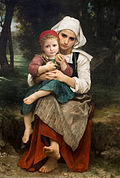 William-Adolphe Bouguereau, Breton Brother and Sister
 -
 Paul Gauguin, Breton Girl
 -

-
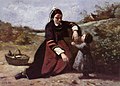 Jean-Baptiste-Camille, Breton woman and her little daughter
 -
 The bagad of Lann-Bihoué of the French Navy
 -
 Breton pipe player
_-_Breton_Brother_and_Sister_(1871).jpg)


Notes
[edit]- ^ Legal population of the administrative region of Brittany in 2017
- ^ Legal population of Loire-Atlantique in 2017
References
[edit]- ^ "Populations légales des régions en 2017". INSEE. Retrieved 13 September 2020.
- ^ "Populations légales des départements en 2017". INSEE. Retrieved 13 September 2020.
- ^ Rolland, Michel. "La Bretagne à Paris". Archived from the original on 2016-11-30. Retrieved 31 December 2016.
- ^ "Ils sont 70 000 ! Notre dossier sur les Bretons du Havre". Archived from the original on 20 December 2016. Retrieved 31 December 2016.
- ^ "Canada Census Profile 2021". Census Profile, 2021 Census. Statistics Canada Statistique Canada. 7 May 2021. Retrieved 3 January 2023.
- ^ Ed. Wade Davis and K. David Harrison (2007). Book of Peoples of the World. National Geographic Society. p. 225. ISBN 978-1-4262-0238-4.
- ^ Wells, John C. (2008). Longman Pronunciation Dictionary (3rd ed.). Longman. ISBN 978-1-4058-8118-0.
- ^ After the definite article, B > V (See Breton mutations)
- ^ Koch, John (2005). Celtic Culture: A Historical Encyclopedia. ABL-CIO. p. 275. ISBN 978-1-85109-440-0. Retrieved September 29, 2012.
- ^ "Breton". Ethnologue. Retrieved 2017-06-09.
- ^ "Breton Language". Retrieved 31 December 2016.
- ^ "France: Bretagne population 2023". Statista. Retrieved 2023-05-03.
- ^ "Enquête socio-linguistique : qui parle les langues de Bretagne aujourd'hui ? · Région Bretagne". Région Bretagne (in French). 2018-10-08. Retrieved 2025-02-14.
- ^ "Communiqué · Transmission et usage du breton et du gallo : résultats de l'étude sociolinguistique 2024 · Région Bretagne". Région Bretagne (in French). Retrieved 2025-02-14.
- ^ Léon Fleuriot, Les origines de la Bretagne: l’émigration, Paris, Payot, 1980.
- ^ Keats-Rohan 1991, The Bretons and Normans of England 1066-1154 Archived 2011-07-24 at the Wayback Machine
- ^ "Marion Cotillard: 'Before my family, everything was dedicated to the character'". The Guardian. August 2, 2014.
- ^ "Suliane Brahim, le Grand Jeu". Libération. February 28, 2018.
- ^ ifrance.com Archived August 27, 2008, at the Wayback Machine
- ^ "Yann Tiersen: ∞ (Infinity) & the Origin of Its Language". Retrieved 31 December 2016.
- ^ "Goarnig Kozh a livré son dernier combat". Retrieved 31 December 2016.
- ^ "Bretonnes et Bretons du monde · Région Bretagne". Région Bretagne (in French). Retrieved 2025-02-13.
- ^ Berton, Claude; Ossadzow, Alexandre; Filloles-Allex, Christiane (1998). Fulgence Bienvenüe et la construction du métropolitain de Paris. Paris: Presses des l'École nationale des ponts et chaussées. ISBN 978-2-85978-296-2.
- ^ Lysiane Bernard, L'émigration « américaine » de la région de Gourin et ses conséquences géographiques. Norois, 1962, pp. 185-195
- ^ "Le fest-noz jusqu'à Pékin". Le Télégramme. 3 January 2019.
- ^ Le Gall, Arnaud (18 May 2015). "1 500 personnes au Fest-noz à Pékin". Ouest France.
- ^ Bretagne: poems (in French), by Amand Guérin, published by P. Masgana, 1842: page 238.
- ^ a b c "Breton language, alphabet and pronunciation". Retrieved 31 December 2016.
- ^ "Breton language". Retrieved 31 December 2016.
- ^ Leizaola, Aitzpea; Egaña, Miren (2007), "Le paysage linguistique", L'Aménagement du territoire en Pays basque, Gasteiz: Zarautz Dakit, pp. 81–102, ISBN 978-84-932368-3-0, retrieved 2023-05-03
- ^ Allanv.microopen.org Archived May 9, 2009, at the Wayback Machine
- ^ "Al Liamm - Degemer". Retrieved 31 December 2016.
- ^ Website of the web streaming channel Brezhoweb: https://www.brezhoweb.bzh/
- ^ Services, ProZ com Translation. "mori quam foedari - Latin to English translation on #KudoZ Term Help Network". www.proz.com. Retrieved 2025-04-30.
- ^ Pierre Le Baud, Cronicques & Ystoires des Bretons.
Bibliography
[edit]- Léon Fleuriot, Les origines de la Bretagne, Bibliothèque historique Payot, 1980, Paris, (ISBN 2-228-12711-6)
- Christian Y. M. Kerboul, Les royaumes brittoniques au Très Haut Moyen Âge, Éditions du Pontig/Coop Breizh, Sautron – Spézet, 1997, (ISBN 2-84346-030-1)
- Morvan Lebesque, Comment peut-on être Breton ? Essai sur la démocratie française, Éditions du Seuil, coll. « Points », Paris, 1983, (ISBN 2-02-006697-1)
- Myles Dillon, Nora Kershaw Chadwick, Christian-J. Guyonvarc'h and Françoise Le Roux, Les Royaumes celtiques, Éditions Armeline, Crozon, 2001, (ISBN 2-910878-13-9).
- Claude Berton, Alexandre Ossadzow et Christiane Filloles, Fulgence Bienvenüe et la construction du métropolitain de Paris, Presses des Ponts, 1998, (ISBN 2859782966).
External links
[edit]Breizh.net – a non-profit association dedicated to the promotion of Brittany and the Breton language on the Internet Breizh.net
- Bretagnenet.com
- Gwalarn.org
- Kervarker.org
- Skolober.com
- Francenet.fr
- Person.wanadoo.fr
- Preder.net
- Dicts.info
- Wordgumbo.com
- Online Breton radio
- Bremañ – Breton language magazine
- Ofis ar Brezhoneg (l'Office de la langue bretonne)
- Website of the French administrative region of Brittany
- [1]


Bretons
View on GrokipediaOrigins and Prehistory
Genetic and Archaeological Evidence
Archaeological evidence demonstrates continuous human occupation in the Armorican peninsula (modern Brittany) from the Neolithic era, with over 3,000 megalithic standing stones at Carnac erected between approximately 4500 and 3300 BCE by pre-Celtic populations engaged in monumental construction and possibly astronomical alignments.[12] Iron Age sites from the Hallstatt (c. 800–450 BCE) and La Tène (c. 450 BCE–1 CE) periods reveal Celtic material culture, including oppida such as the fortified settlement at Paule and metal artifacts like fibulae and swords bearing La Tène motifs, associated with tribes like the Veneti, who controlled maritime trade in the region by the 1st century BCE.[3] Recent excavations, such as those uncovering Stone Age villages and Bronze Age tumuli alongside Iron Age enclosures, indicate a transition to Celtic-speaking societies without evidence of large-scale population replacement prior to Roman contact, though with influences from trans-Alpine Hallstatt elites around 600 BCE.[13] Post-Roman archaeological data supports the 5th–6th century CE migration of Brittonic Celts from southwestern Britain, fleeing Anglo-Saxon expansions, through shifts in rural settlement from Roman villas to clustered hamlets, new funerary practices like cist graves, and the superimposition of Brittonic toponyms (e.g., those ending in -ac or -ou) over Gallo-Roman ones, particularly in western Brittany where continuity with pre-migration Celtic layers is evident.[14] These changes, dated via radiocarbon analysis of sites like Plouguin (Finistère), show admixture rather than conquest, with imported British pottery and querns alongside local Gallo-Roman continuity in eastern areas.[14] Genetic analyses corroborate this archaeological narrative. Autosomal DNA from modern Breton samples reveals fine-scale structure with elevated similarity to ancient and contemporary populations of western Britain (e.g., Cornwall, Wales) and Ireland, attributable to the documented Brittonic migration, as quantified by admixture modeling showing 20–40% British Isles-related ancestry in western Bretons versus lower in eastern counterparts closer to continental French baselines.[15] [16] Y-chromosome haplogroups like R1b-L21, prevalent in Atlantic Celtic zones, further link Bretons to shared paternal lineages in Ireland, Scotland, and Wales, supporting a partial common origin predating the late antique influx but reinforced by it, with minimal Basque-like input distinguishing them from inland French groups.[17] Ancient DNA from Iron Age Armorica, integrated into broader Celtic studies, indicates steppe-related ancestry influx around 2500–2000 BCE aligning with Indo-European expansions, but without a unified "Celtic" genetic signal; instead, regional continuity with Bell Beaker substrates predominates, challenging diffusionist models overly reliant on linguistic spread.[18]Pre-Roman Celtic Foundations
The Armorican peninsula, anciently termed Armorica, was populated by Celtic-speaking groups during the European Iron Age, forming the indigenous ethnic and cultural substrate that underpinned later Breton developments. These Continental Celts, part of the Gaulish linguistic and material continuum, expanded into the region amid broader migrations from Central Europe, with Hallstatt-influenced settlements emerging by the late Bronze Age around 800–500 BC and La Tène cultural markers appearing by the 5th century BC.[19] Archaeological sites, such as the Tronoën sanctuary in Finistère, yield La Tène-style metalwork and votive deposits dated to the 5th–4th centuries BC, indicating organized ritual and trade networks linked to Atlantic-facing Celtic societies.[20] This era saw fortified hill settlements (oppida) and evidence of ironworking, agriculture, and maritime activity, reflecting a warrior-aristocracy structured society typical of pre-Roman Gaul.[21] Greek explorer Pytheas of Massalia, circumnavigating the region circa 325 BC, recorded Celtic populations along the Atlantic coasts, noting their language and customs in what encompassed Armorica.[22] A Gaulish form of Celtic was evidently spoken, as inferred from toponyms and later Roman attestations, distinguishing these groups from pre-Celtic Neolithic inhabitants whose megalithic monuments, like those at Carnac (erected 4500–2500 BC), persisted as landscape features but represented earlier, non-Indo-European layers.[23] Economic life centered on cereal cultivation, animal husbandry, and seafaring trade in tin, amber, and salt, with Armorica's position facilitating exchanges across the Channel and Biscay.[24] By the late 2nd to 1st centuries BC, Armorica hosted at least five principal Celtic tribes, including the seafaring Veneti dominating the southern gulf, the Osismii in the northwest peninsula, the Namnetes along the Loire estuary, and the Coriosolites and Redones in the northeast.[23] These polities maintained semi-autonomous confederacies with chieftains overseeing assemblies, evidenced by coinage imitating Philip II of Macedon's types from circa 100 BC onward, and defended territories via promontory forts like those at Le Camp d'Artus.[23] Polytheistic beliefs, warrior ethos, and oral traditions aligned with pan-Celtic patterns, though regional variations in pottery and weaponry suggest local adaptations rather than uniform imposition.[24] This tribal mosaic provided the demographic and territorial base later integrated during Roman incursions starting in 56 BC, preserving Celtic linguistic remnants amid Gallo-Roman syncretism.[23]Historical Development
Roman Era and Late Antiquity
The Armorican peninsula, inhabited by Celtic tribes such as the Veneti, Osismii, Namnetes, Coriosolites, and Viducasses, resisted Roman expansion until Julius Caesar's campaigns in Gaul.[23] In 56 BC, Caesar defeated a coalition led by the seafaring Veneti in a decisive naval engagement off the Breton coast, employing modified Gallic ships with iron hooks to board and capture enemy vessels, thereby subjugating the region and incorporating it into Roman control as part of conquered Gaul.[25] This victory ended Armorican independence, with surviving tribal leaders executed and their ships confiscated to curb maritime resistance.[23] Under imperial administration from the 1st century AD, Armorica formed part of the province of Gallia Lugdunensis, governed from Lugdunum (modern Lyon), with local civitates organized around tribal centers like Darioritum (Vannes) for the Veneti and Coriosopitum (Corseul) for the Coriosolites.[26] Romanization proceeded unevenly: coastal and riverine areas saw villa estates, roads, and amphorae production for trade, while inland zones retained Celtic rural structures and limited urbanization, evidenced by sparse Roman towns and continued use of indigenous oppid a until the 2nd century AD.[14] Taxation and conscription fueled resentment, but the region contributed grain, metals, and auxiliaries to the empire without major revolts until the 3rd century.[26] In Late Antiquity, amid the Crisis of the Third Century, Armorica experienced Bagaudae uprisings—peasant-led insurgencies of rural laborers, deserters, and smallholders against Roman fiscal exactions and elite landlords—first noted around 280 AD under Emperor Probus, who suppressed them temporarily.[26] These revolts recurred in the early 5th century, with a major Bagaudae rebellion erupting in 407–409 AD amid barbarian invasions and withdrawal of legions from Britain, allowing local warlords like Tibatto to seize control and mint defiant coinage.[26][27] Roman general Flavius Aetius quelled a resurgence in Armorica around 435–437 AD, resettling Alans there as federates to stabilize the area, though central authority eroded.[26] In 451 AD, Armorican forces nominally allied with Aetius against Attila's Huns at the Catalaunian Plains, highlighting semi-autonomous status.[28] By mid-century, weakened imperial oversight fostered de facto independence, setting the stage for subsequent British migrations without full collapse into anarchy.[23]Migration from Britain and Formation of Early Breton Society
The migration of Brittonic-speaking peoples from southwestern Britain to Armorica (modern Brittany) accelerated during the 5th and 6th centuries AD, primarily driven by intensifying pressures from Anglo-Saxon incursions in Britain following the Roman withdrawal around 410 AD.[23] Initial low-level movements had begun by the mid-4th century, involving traders, soldiers, and settlers, but these escalated into substantial population transfers amid the collapse of Roman authority and native British resistance to Germanic expansions.[23] Archaeological evidence, including British-style pottery and settlement patterns in western Armorica, indicates that migrants targeted sparsely populated coastal and riverine areas previously held by Gallo-Roman and indigenous Armorican groups, such as the Osismii tribe.[14] Linguistic continuity provides strong corroboration, as the Breton language—a Brythonic Celtic tongue closely related to Cornish and Welsh—emerged directly from the speech of these migrants, supplanting or coexisting with Latin and Gaulish in the region by the 6th century.[2] Place-name evidence further supports this, with over 400 Breton toponyms deriving from British sources, concentrated in areas like Cornouaille (from Cornwall) and Domnonée (linked to Devon/Dumnonia).[4] Contemporary accounts, such as those from the Byzantine historian Procopius in the mid-6th century, describe large-scale British expatriate communities in Armorica numbering in the tens of thousands, maintaining distinct identities and engaging in cross-Channel ties.[23] Early Breton society formed through the fusion of incoming Britons with local Romano-Celtic populations, resulting in semi-autonomous petty kingdoms by the late 5th century, including those ruled by figures like the legendary Conomor of Domnonée around 550 AD.[4] These entities emphasized tribal loyalties, hillfort reoccupation, and maritime economies, with migrants introducing British drystone building techniques and pagan Celtic practices that persisted alongside emerging Christianity.[14] By the 7th century, this synthesis had solidified a cohesive Breton ethnogenesis, marked by resistance to Frankish overlordship and the establishment of bishoprics like Quimper and Dol that bridged British and continental traditions.[23] The process was not uniform, with eastern Armorica retaining stronger Gallo-Roman influences, while the west became predominantly Brittonic in character.[4]Medieval Duchy of Brittany
The Duchy of Brittany emerged as an independent entity in the 9th century amid resistance to Carolingian overlordship. Nominoë, initially appointed as a Frankish administrator (missus imperatoris) over Brittany around 831 by Louis the Pious, rebelled following the Treaty of Verdun in 843, defeating Frankish forces at Ballon in 845 and securing recognition of autonomy.[29] He assumed the ducal title from 846 until his death on 7 March 851, establishing the foundations of Breton self-rule rooted in the region's Celtic-Brittonic population and prior tribal confederations.[30] His son Erispoë succeeded him, achieving a formal peace with Charles the Bald in 851 that acknowledged Breton independence, though Erispoë's assassination in 857 led to intermittent struggles before stabilization under subsequent rulers like Salomon (857–874) and Alan I (937–952), who repelled Viking incursions and Norman pressures.[31] By the 10th and 11th centuries, the duchy had coalesced into a feudal principality with Nantes as a key power center, under dukes such as Geoffrey I (992–1008) and Alan III (1008–1040), who balanced alliances with the Capetian kings of France and the Anglo-Norman realm to preserve sovereignty.[31] The 12th century saw expansion under Conan III (r. 1112–1148), who integrated Cornouaille and asserted control over ecclesiastical appointments, fostering a distinct Breton aristocracy tied to Celtic traditions and the vernacular Breton language, which served administrative and cultural functions alongside Latin.[32] Conflicts with Anjou and England persisted, exemplified by Henry II's intervention in 1158, yet the duchy retained internal cohesion through hereditary ducal lines like the Cornouaille dynasty until the mid-12th century. The 13th and 14th centuries marked institutional maturation, with Pierre I (r. 1213–1221) adopting the ermine as the ducal emblem, symbolizing purity and regional pride.[32] The War of the Breton Succession (1341–1365), triggered by the death of Joan of Penthièvre's claim against John III's niece, invited French and English involvement; John de Montfort's victory at Auray in 1364, backed by Edward III, installed the Montfort dynasty (1364–1491), which prioritized pragmatic diplomacy over vassalage.[33] Under dukes like John V (r. 1399–1442) and Francis I (r. 1442–1458), Brittany developed sophisticated governance, including the Estates of Brittany convened from 1352 for fiscal consent and a sovereign parlement at Vannes by 1465, enabling resistance to centralizing French monarchs while engaging in Atlantic trade.[33] Independence waned in the late 15th century as Duchess Anne succeeded her father Francis II in 1488 amid French invasion; compelled by the Treaty of Sablé, she married Charles VIII of France in 1491, subordinating Breton affairs to the crown while retaining ducal privileges.[34] Anne's remarriage to Louis XII in 1499 and the subsequent union of her daughter Claude with Francis I culminated in the Edict of Union in 1532, integrating Brittany fiscally and judicially into France, though customary autonomy endured until the Revolution.[34] Throughout the medieval era, the duchy preserved a Celtic-inflected identity, with Breton-speaking nobility and clergy sustaining oral traditions, saints' cults, and resistance to Latinization, distinct from Frankish cultural assimilation.[32]Union with France and Early Modern Period
The union between the Duchy of Brittany and the Kingdom of France was formalized on August 13, 1532, through the Edict of Union signed by the Estates of Brittany in Nantes, establishing a perpetual personal union under King Francis I, who assumed the title of Duke of Brittany while preserving the duchy's customs, laws, and fiscal privileges.[35][36] This arrangement followed the marriages of Duchess Anne of Brittany—successor to her father Francis II in 1488—who wed Charles VIII of France in 1491 after a French invasion aimed at preventing foreign alliances, and later Louis XII in 1499; their daughter Claude's marriage to Francis I in 1514 further tied the territories, though Anne actively negotiated clauses to safeguard Breton autonomy during her queenship.[37] The edict explicitly maintained Brittany's independence in internal governance, exempting it from certain French taxes like the gabelle on salt and allowing the province to function as a pays d'états with its own representative assemblies.[35] In the early modern era, from the 16th to 18th centuries, Brittany retained significant administrative and fiscal distinctiveness under the French crown, governed through the Estates of Brittany, which convened periodically to approve budgets and negotiate the don gratuit—a triennial "free gift" tax levy in lieu of direct royal impositions like the taille, ensuring local control over revenue allocation for provincial needs such as infrastructure and defense.[37] The Parlement de Bretagne in Rennes served as a sovereign court enforcing local customs (coutumes) over Parisian droit commun, while noble and clerical elites benefited from exemptions and representation, fostering a semi-autonomous status that buffered the region from full centralization until the late Ancien Régime.[36] Economic life centered on agriculture, maritime trade, and textile production, with ports like Nantes and Saint-Malo thriving under these privileges, though the Breton language and Celtic cultural practices persisted amid growing French administrative influence.[35] Tensions arose from royal efforts to encroach on these autonomies, culminating in fiscal revolts such as the 1675 Revolt of the Papier Timbré, sparked by Louis XIV's imposition of a stamped paper tax and duties on tin exports, which peasants and artisans—symbolized by their red caps (bonnets rouges)—opposed through riots, arson, and attacks on tax officials from April to September, primarily in western Brittany around Quimper and Morlaix.[38] The uprising, rooted in resistance to perceived violations of the 1532 edict's fiscal guarantees, was brutally suppressed by royal troops under Louis de Crevant, comte d'Harcourt, resulting in executions, village burnings, and over 1,000 arrests, reinforcing central authority while highlighting Breton particularism.[39] Subsequent ministers like Cardinal Richelieu and Jean-Baptiste Colbert pursued integration through intendants and venality of offices, eroding privileges incrementally, yet Brittany's estates continued negotiating don gratuit payments—rising from about 800,000 livres in the mid-17th century to over 2 million by the 1780s—until their abolition by the National Assembly on August 4, 1789, amid the French Revolution.[37][35]Nineteenth and Twentieth Centuries
During the nineteenth century, Brittany remained largely agrarian with limited industrialization confined to shipbuilding and railway development in ports like Nantes, Lorient, and Brest, drawing rural workers to these urban centers.[36] The construction of railways from the mid-century onward began integrating the region more closely with the rest of France, eroding prior isolation.[40] Romantic interest in Celtic heritage spurred a "Bretonist movement" that romanticized local folklore and traditions, influencing literature and arts while attracting tourists and painters who depicted Bretons in exoticized, peasant garb.[41] [42] Concurrently, French centralizing policies, including compulsory primary education in French under the Jules Ferry laws of 1881–1886, hastened the decline of Breton speakers, with monolingualism dropping markedly from the mid-century as urban migration and state assimilation prioritized French.[43] [9] The twentieth century brought severe demographic impacts from the World Wars; in World War I, around one million Bretons were mobilized, suffering casualties at twice the French national rate, which deepened rural depopulation and economic strain.[44] Interwar Breton nationalism, termed the "second Emsav," emerged in the 1920s with groups like Breiz Atao advocating autonomy or independence, drawing on cultural revival but often aligning with anti-French sentiments and, in some cases, authoritarian ideologies.[45] [46] World War II saw opportunistic collaboration by nationalist factions with Nazi occupiers, who promoted Breton autonomy in exchange for support, including propaganda and militia formation; this led to heavy post-liberation purges, executions, and suppression of regionalist movements by the French state.[47] [44] Economically, Brittany lagged in post-war recovery, with emigration of youth to mainland France amid militarization of bases, while Breton language transmission faltered, creating generational gaps and perceptions of the tongue as unsuited for modernity.[5] [48] Despite repression, cultural expressions like traditional music persisted, though overshadowed by accelerating francization.[9]Post-World War II to Present
Brittany emerged from World War II with severe infrastructure damage, as Allied bombings had devastated key port cities including Brest, Lorient, and Saint-Nazaire to neutralize German U-boat bases, leaving much of the region in ruins by 1945.[36] The stigma of collaboration by some Breton nationalists with Vichy France and Nazi Germany during the occupation led to post-liberation repression, weakening overt political separatism and associating it with disloyalty, despite contributions to the French Resistance by other Bretons.[5][49] Economically, Brittany initially missed France's broader post-war growth, remaining agrarian and impoverished, which drove significant emigration of younger Bretons to urban centers like Paris during the 1950s and 1960s.[5] The region's militarization, with expanded naval, air, and army bases, provided some employment but reinforced central French control.[5] By the late 20th century, agricultural modernization transformed Brittany into France's leading producer, accounting for about 15% of national output through intensive farming, seafood processing, and agribusiness, bolstered by European Union subsidies and infrastructure investments.[50][36] This shift, combined with tourism and telecommunications sectors, elevated GDP growth rates above national averages in recent decades, reducing poverty but accelerating urbanization and cultural homogenization.[51] The Breton language, spoken by over one million people around 1950, underwent rapid decline due to French-only education policies and media dominance, falling to approximately 200,000 fluent speakers by the 2000s, with UNESCO classifying it as severely endangered amid an annual loss of about 10,000 speakers.[52][5] Revival efforts gained traction from the 1970s, including immersion schools like Diwan (founded 1977) and the establishment of the Office de la Langue Bretonne in 1999, though transmission remains limited by aging native speakers and low proficiency among youth.[5][53] Culturally, a non-political renaissance began in the late 1940s with festivals celebrating Celtic music, dance, and poetry, such as the 1949 Quimper event, evolving into a broader movement by the 1970s featuring bagads (pipe bands), fest-noz gatherings, and artists like Alan Stivell who popularized kan-ha-diskan and bombarde traditions internationally.[49][54] This paralleled sports revivals like gouren wrestling and religious pilgrimages, fostering a hybrid identity blending Breton heritage with modern French life.[49] Politically, autonomy advocates reemerged with the Union Démocratique Bretonne (UDB, founded 1964) pushing for devolution within France, achieving modest electoral gains like four regional assembly seats in 2004, while radical groups such as the Front de Libération de la Bretagne conducted over 200 attacks from the 1960s to 2000s.[5] France's decentralization laws from 1982 granted Brittany a regional council but excluded Loire-Atlantique (Nantes area), fueling reunification campaigns; independence remains a fringe position with limited support.[5][49] Today, Bretons maintain a distinct regional consciousness through these cultural channels, integrated into the European Union framework, though linguistic erosion and demographic shifts toward French monolingualism pose ongoing challenges to ethnic continuity.[5][51]Geography and Demographics
The Brittany Region
The administrative region of Brittany, or Région Bretagne, occupies a peninsula in northwestern France, extending into the Atlantic Ocean between the English Channel to the north and the Bay of Biscay to the south. It comprises four departments: Finistère in the west, Côtes-d'Armor along the northern coast, Ille-et-Vilaine in the east, and Morbihan in the south, covering a total land area of 27,208 square kilometers. This excludes the department of Loire-Atlantique, which forms the eastern part of historical Brittany but was administratively separated in 1941 and assigned to the Pays de la Loire region. The regional capital is Rennes in Ille-et-Vilaine, while Brest in Finistère serves as a major port city.[55][56] Geographically, Brittany features over 1,700 kilometers of coastline, characterized by dramatic cliffs, sandy beaches, and more than 800 offshore islands, including the Îles du Ponant archipelago. The interior is dominated by the Armorican Massif, a geologically ancient block of granite and schist forming rolling plateaus, gentle hills, and deeply incised valleys, with rivers such as the Vilaine and Rance providing navigable waterways totaling around 400 kilometers. Elevations are modest, peaking at 385 meters at Roc'h Ruz in the Monts d'Arrée within Finistère. The region's oceanic climate is temperate and maritime, with mild winters averaging 9°C, summers reaching about 25°C, frequent precipitation in the form of light drizzle (crachin), and roughly 2,055 hours of annual sunshine, supporting lush vegetation and agriculture focused on cereals, vegetables, and livestock.[56][57] As of the 2022 official estimate, Brittany's population stood at 3,422,845, yielding a density of 125.8 inhabitants per square kilometer—below France's national average—reflecting a mix of urban concentrations and rural dispersion. The population has shown modest growth of 0.55% annually from 2015 to 2022, driven by net migration and natural increase, though aging demographics pose challenges, with life expectancy at 82.5 years in 2023. Breton ethnic and cultural continuity persists, particularly in the western departments where traditional language use correlates with lower population densities and stronger regional identity, though assimilation into French norms has diluted distinctiveness in eastern areas.[55][58]Population Statistics and Urban Centers
The administrative region of Brittany (Bretagne), comprising the departments of Finistère, Côtes-d'Armor, Ille-et-Vilaine, and Morbihan and serving as the primary homeland of the Breton people, recorded a population of 3,422,845 in the 2022 official estimate.[59] This yields a population density of 125.8 inhabitants per square kilometer over 27,208 km², with growth driven by net migration and a birth rate slightly above the national average, projecting 3,475,895 residents by 2025.[59] Ethnic composition data is limited by France's policy against collecting statistics on ethnicity or ancestry, but historical Breton settlement patterns indicate that the majority of residents trace descent to Celtic migrants from Britain, blended with later French inflows; self-identification surveys suggest around 4.3 million individuals of Breton origin in France as of 2007 estimates, including diaspora communities in Paris and abroad.[60] Breton population centers are unevenly distributed, with higher concentrations in rural western areas (Lower Brittany) tied to traditional language use, while eastern zones (Upper Brittany) feature more Gallo-speaking Romance heritage. Urbanization has accelerated since the mid-20th century, with over 70% of the regional population now residing in agglomerations exceeding 10,000 inhabitants, reflecting industrial development in ports and services. The historical core of Brittany, incorporating Loire-Atlantique (around Nantes), adds roughly 1.4 million to the total, reaching 4.8 million in 2021, though this department was detached administratively in 1941 to dilute regional cohesion.[61] Major urban centers dominate economic and administrative functions:| City | Department | Population (2022) | Notes |
|---|---|---|---|
| Rennes | Ille-et-Vilaine | 227,830 | Regional capital; tech and education hub with metropolitan area of ~733,000.[55] |
| Brest | Finistère | 140,993 | Naval base and university city; metropolitan population ~321,000.[55] |
| Quimper | Finistère | 64,530 | Cultural center of Cornouaille; prefecture with historical Breton significance.[55] |
| Lorient | Morbihan | 58,202 | Port city focused on fishing and yachting; site of major WWII submarine base.[55] |
Genetic Composition and Ethnic Continuity
The Bretons display a distinct genetic profile within France, marked by substantial admixture from Insular Celtic populations of the British Isles, attributable to migrations from Britain between the 5th and 6th centuries CE. Autosomal DNA studies reveal that individuals in western Brittany derive approximately 23.5% of their ancestry from Irish-like sources—serving as a proxy for ancient Brittonic Celtic input—and an additional 9% from Cornish-like sources, levels exceeding those in neighboring French regions by at least 10 percentage points.[15] This elevated British Isles component overlays a predominant continental European base, including roughly 46% steppe pastoralist ancestry from Bronze Age Bell Beaker expansions around 2500 BCE and 43.6% early Neolithic farmer ancestry, patterns shared with but intensified relative to central France.[15][62] Fine-scale population structure underscores regional variation within Brittany, with western departments (e.g., Finistère, Côtes-d'Armor) exhibiting stronger genetic affinities to Irish and Welsh populations via elevated identity-by-state sharing and lower F_ST distances (e.g., 0.00057 with Irish samples).[15][63] Eastern Brittany and the downstream Loire basin show diluted signals, with Irish-like ancestry dropping to 14% or less and increased Iberian-related contributions, reflecting greater gene flow from Gallo-Roman substrates.[15] The Loire River functions as a barrier to admixture, delineating 18 major genetic clusters that correlate closely with historical Breton language boundaries and medieval settlement patterns.[62] Linkage disequilibrium patterns indicate historically smaller effective population sizes in isolated western areas, preserving distinct signals of Celtic proximity.[63] Paternal lineages further evidence Celtic ties, with Y-chromosome haplogroup R1b-M269 and its R-L21 subclade—characteristic of Bronze Age steppe expansions and Insular Celtic groups—predominating at frequencies exceeding 50% in Breton samples, higher than in most continental French populations.[64][65] This aligns with autosomal findings of allele sharing with Bell Beaker-associated ancient DNA, suggesting continuity from Indo-European migrations rather than later Germanic influences.[62] Ethnic continuity manifests as a hybrid profile: the migrant Brittonic input, while culturally transformative (e.g., imposing Brittonic language over Gallo-Roman), constitutes a minority genomic fraction amid admixture with indigenous Armorican Celts and Gallo-Romans, yielding a population genetically intermediate between British Isles Celts and northwestern continental Europeans.[15][63] Modern Bretons retain elevated steppe and Insular components absent or subdued elsewhere in France, affirming demographic persistence despite subsequent French centralization and limited external inflows post-medieval period.[15] These patterns challenge narratives of wholesale population replacement, instead supporting causal admixture driven by migration scale insufficient for genetic dominance but potent for cultural assimilation.[62]Language
Breton Language Structure and Dialects
Breton, a Brythonic Celtic language, features a synthetic morphology with fusional elements, including verb-subject-object (VSO) word order in affirmative declarative sentences and periphrastic constructions for tenses using auxiliaries like bezañ ("to be") and ober ("to do").[66] Initial consonant mutations—lenition (softening stops to fricatives or approximants, e.g., /p/ to /b/ or /v/), spirant mutation (voiceless stops to fricatives, e.g., /p/ to /f/), nasal mutation (stops to nasals, e.g., /p/ to /m/), and h-prothesis (vowel-initial words gain /h/)—are triggered by syntactic and morphological contexts, such as articles, prepositions, or negation, functioning as inflectional markers rather than independent phonological processes.[67] [68] The phonology includes seven oral vowels (/i, e, a, o, u, y, ɛ̃/ in some dialects), front rounded vowels like /y/ and /ø/, and nasal vowels, with stress typically penultimate in KLT dialects but variable under French influence.[69] Nouns inflect for gender (masculine/feminine) and number, with mutations indicating definiteness or possession; adjectives agree in gender, number, and mutation, often following the noun.[66] Breton dialects are classified into four primary groups: Kerneveg (Cornouaille), Leoneg (Léon), Tregerieg (Trégor)—collectively KLT—and Gwenedeg (Vannes).[70] The KLT dialects exhibit phonological similarities, such as consistent lenition patterns and shared lexical items derived from Common Brythonic, with minor variations in vowel quality and stress (e.g., penultimate stress in Leoneg versus more variable in Kerneveg).[48] [71] Gwenedeg diverges markedly, featuring distinct phonological traits like reduced mutation systems (e.g., less frequent spirantization), innovative vowel shifts influenced by Gallo-Romance substrates, and lexical borrowings, rendering mutual intelligibility low—Glottolog treats it as a separate language variety from KLT.[70] [72] Standard Breton, formalized in the 1940s–1950s by the Gwalarn movement and Officil eg ar Skridoù Breizh, prioritizes Leoneg morphology and syntax but standardizes vocabulary across dialects, though traditional speakers often retain dialectal mutations and periphrases.[48] Dialectal syntax varies subtly, with Gwenedeg showing more analytic tendencies (e.g., reduced synthetic verb forms) compared to KLT's retention of archaic inflections.[70]Historical Prestige and Decline
The Breton language, a Brittonic Celtic tongue introduced to Armorica by British migrants between the 5th and 6th centuries CE, achieved a degree of cultural prestige during the medieval Duchy of Brittany (circa 939–1532) as the vernacular of the majority population in Lower Brittany.[73] It featured in oral traditions, religious practices, and early written forms, with Old Breton attested in glosses and inscriptions up to the 11th century, followed by Middle Breton in texts such as the 1464 Catholicon, a Breton-Latin dictionary that represented one of the earliest substantial works in the language.[74] However, this prestige was primarily folkloric and communal rather than institutional; administrative and legal documents in the duchy were conducted in Latin or, increasingly after the 12th century, Old French, reflecting the elite's adoption of Romance languages for governance and diplomacy.[73] Breton's lack of standardization and limited scriptural tradition constrained its formal status, positioning it as a substrate language subordinate to those of church and state.[75] The onset of decline accelerated after the 1532 Edict of Union, which integrated Brittany into the French crown and mandated French for legal and administrative purposes, sidelining Breton in official spheres.[5] This centralizing policy intensified under absolutist monarchs like Louis XIV, whose 17th-century edicts further eroded regional linguistic autonomy, though Breton remained dominant in rural daily life. The French Revolution marked a pivotal escalation, with revolutionaries viewing patois like Breton as barriers to national unity; the 1794 report by Abbé Grégoire classified it among France's "degenerate" dialects, advocating eradication to foster a unitary French-speaking republic.[5] Republican education reforms from the 1880s onward enforced French monolingualism in schools via punitive measures—such as the signe d'ignorance (a wooden clog worn by children caught speaking Breton)—effectively stigmatizing the language as backward and unfit for modernity.[76] These state-driven assimilation efforts, compounded by perceptions of Breton as phonetically impoverished and unsuitable for intellectual pursuits, precipitated a shift where bilingualism favored French dominance.[9] By the early 20th century, Breton speakers numbered over 1 million, comprising approximately 90% of the population in western Brittany's Breton-speaking heartland, with monolingualism prevalent in rural areas.[77] Yet, post-World War I urbanization, mandatory military service in French, and the rise of mass media in French accelerated erosion; school bans on Breton persisted until 1951, by which time speaker numbers had begun halving.[76] The interwar and Vichy periods saw fleeting nationalist revivals, but these were undermined by association with collaboration and subsequent Gaullist centralism. By the 1950s, daily speakers still exceeded 1 million, but intergenerational transmission collapsed amid economic migration and cultural Francization, reducing active users to under 200,000 by the 1990s—a decline attributable less to inherent linguistic failings than to deliberate policies prioritizing national cohesion over regional diversity.[7][78] This trajectory reflects France's Jacobin tradition of linguistic homogenization, where empirical data on speaker attrition correlates directly with enforced French primacy in education and public life.[9]Contemporary Revival Efforts and Challenges
Efforts to revive the Breton language have centered on immersion education since the late 1970s, with the Diwan school network—founded in 1977 and meaning "seed" in Breton—providing full immersion programs from primary through secondary levels to produce fluent new speakers.[79][80] Diwan's approach has enrolled thousands of students, emphasizing Breton as a medium of instruction to foster daily use beyond classrooms, though it operates outside the mainstream state system and relies on private funding and parental commitment.[81] Complementary initiatives include bilingual public schools and adult language courses, supported by cultural associations promoting media and literature in Breton. A key policy development occurred in April 2021 when the French National Assembly passed the Molac Law, authorizing regional languages like Breton for primary instruction in state schools, marking a partial shift from France's historical monolingual French mandate.[82][79] However, implementation has been limited by constitutional challenges and administrative hurdles, with the French government maintaining ambivalence toward non-French languages as threats to national unity.[83] Despite these initiatives, Breton faces severe challenges, with speaker numbers halving from 214,000 in 2018 to 107,000 in 2024, primarily due to the deaths of elderly native speakers—65% of whom are aged 60 or older, and 37% over 70.[84] Only 16% of current speakers acquired the language at home, underscoring failed intergenerational transmission amid French's dominance in education, media, and employment.[79] Government actions, such as proposed 2025 cuts to Breton-language radio broadcasts, exacerbate the decline by reducing visibility and access.[85] Standardization efforts for neo-speakers clash with dialectal diversity, while the language's limited utility in modern economic contexts hinders adoption, rendering revival efforts insufficient against entrenched assimilation pressures.[86] UNESCO classifies Breton as "severely endangered," reflecting stalled progress despite educational gains.[84]Culture and Society
Religion and Spirituality
The Bretons, originating from Celtic migrants from Britain in the 5th and 6th centuries CE, initially practiced pagan Celtic religions influenced by druidic traditions common across Gaul and the British Isles, though direct archaeological evidence specific to early Breton druidism remains limited.[87] Christianization occurred primarily through missionaries from Britain and Ireland, establishing Celtic Christianity by the 6th century, which blended monastic traditions with local customs.[19] This process integrated former pagan sites, such as megalithic structures, into Christian veneration, reflecting a gradual syncretism rather than abrupt replacement.[88] By the medieval period, Roman Catholicism became firmly entrenched among the Bretons, reinforced by the veneration of founder saints like Paul Aurelian and regional patrons such as Saint Yves of Tréguier, canonized in 1430 for his advocacy of the poor and legal defense of the oppressed.[89] Distinctive Breton religious expressions emerged in the form of pardons, public pilgrimages and festivals honoring saints, often involving processions, masses, and communal feasts; estimates indicate around 2,000 such events occur annually in Brittany, peaking between Easter and Michaelmas.[90] These gatherings, exemplified by the Great Pardon of Saint Anne d'Auray drawing thousands since its 1624 origins, combine penitential rites with cultural elements like music and dance, preserving communal spirituality amid rural life.[91] Catholicism has historically dominated Breton religious identity, with studies noting its persistence as the primary affiliation despite France's broader secularization; in Brittany, it remains more entrenched than national averages, where self-identified Catholics fell from 92% in 1950 to approximately 46% Christian overall by 2023.[92] [93] Post-World War II dechristianization accelerated, linked to urbanization and education, yet traditional practices like roadside calvaries and saintly intercessions endure in folklore, where pre-Christian motifs—such as the Ankou death figure—overlay Christian eschatology.[49] Modern Breton spirituality often manifests through cultural revivalism, including neopagan interests in Celtic symbols like the triskele, though these represent marginal revivals rather than widespread adherence.[94]Folklore, Myths, and Traditional Beliefs
Breton folklore encompasses a rich oral tradition blending pre-Christian Celtic elements with later Christian influences, featuring supernatural beings, omens of death, and reverence for natural landscapes. Central to these narratives are spirits tied to the land, sea, and cycles of life and death, often collected in the 19th century by folklorists from rural testimonies in Lower Brittany.[95][96] The Ankou stands as a prominent figure personifying death's servant, depicted as a tall, skeletal man in black robes with a wide-brimmed hat, driving a creaking cart to collect souls at night. According to tradition, the Ankou is the last person to die in a parish during the previous year, tasked with harvesting the dead until midnight on December 31, after which a new Ankou assumes the role; hearing its cart's rattle foretells imminent death in the vicinity.[97][98][99] Korrigans represent mischievous fairy-like dwarves or seductive female spirits haunting moors, forests, and water sources, beautiful by moonlight but revealing hag-like forms in daylight. These entities lure travelers with dances or prophecies, sometimes cursing those who resist or stealing children, reflecting beliefs in shape-shifting guardians of sacred sites. Malevolent korrigans, akin to sirens, wash shrouds of the soon-to-die by rivers, echoing death omens similar to the Ankou.[100][101] Traditional beliefs emphasize animism, positing spirits in natural features like megaliths, springs, and dolmens, viewed as portals to an Otherworld inhabited by immortals and ancestors. Superstitions persist around these sites, associating them with druidic rituals, fairy circles, and prohibitions against disturbing stones lest giants or korrigans retaliate; such convictions underscore a worldview where nature demands respect to avert misfortune.[102][103]Music, Dance, and Festivals
Breton music draws from Celtic traditions, featuring acoustic instruments such as the bombarde, a loud double-reed shawm-like aerophone, and the biniou, a small bagpipe with a high-pitched chanter.[104] These instruments, played by sonneurs since at least the 14th century, form the core of traditional ensembles, often paired with diatonic accordions, fiddles, and frame drums for lively rhythms.[105] Vocal forms include gwerz, narrative laments recounting historical events or tragedies, and kan ha diskan, an improvised call-and-response singing style that emphasizes unaccompanied harmony.[104] In the mid-20th century, bagadou emerged as competitive pipe bands, adapting Scottish Highland bagpipes—known locally as biniou bras—alongside bombardes and percussion, with the first notable group, Bagad Lann-Bihoué, formed in 1952 at a French naval base near Lorient.[106] These ensembles, numbering over 100 today, perform at competitions like the Championnat National des Bagadoù, preserving and evolving traditional repertoires through structured marches and dances.[106] Breton dance centers on collective, participatory forms practiced at fest-noz, evening gatherings translating to "night festival," where participants form circles or chains for steps like an-dro and bal-straed, accompanied by live musicians.[107] Recognized by UNESCO in 2012 as Intangible Cultural Heritage, fest-noz fosters community bonds through continuous dancing, often lasting until dawn, with over 1,000 events annually across Brittany.[107] Major festivals amplify these traditions, including the Festival Interceltique de Lorient, established in 1971, which draws over 750,000 attendees yearly for Celtic music, dance, and parades featuring bagadou and international performers.[108] Religious pardons, such as the Pardon of Saint Ronan in Locronan dating to the 15th century, integrate music and dance with pilgrimages, while secular events like Yaouank in Rennes showcase emerging Breton artists alongside traditional fest-noz sessions.[108] These gatherings sustain cultural continuity amid modernization, with participation rates reflecting strong regional identity.[105]Cuisine and Daily Life
Breton cuisine draws heavily from the region's extensive coastline and fertile inland areas, prioritizing fresh seafood, buckwheat-based preparations, and dairy products like the renowned salted butter from areas such as Échiré. Seafood dominates, including oysters harvested in Cancale—where production reached over 40,000 tons annually in recent years—and bouchot mussels cultivated on wooden stakes along the coast. Fish stews like cotriade, combining multiple white fish with vegetables and white wine, exemplify utilitarian use of local catches.[109][110][111] Savory galettes, prepared from buckwheat flour (sarrasin), form a staple, often filled with combinations such as ham, egg, and Emmental cheese in the classic galette complète, reflecting the crop's cultivation since the Middle Ages. Sweet crêpes, made with wheat flour, eggs, milk, and butter, contrast as lighter fare. Agricultural produce like artichokes from the Roscoff area and cauliflower fields near Saint-Pol-de-Léon underpin vegetable-heavy dishes, while pastries such as kouign-amann—layers of dough folded with butter and sugar, originating in Douarnenez in the 19th century—and far breton, a custard pudding with prunes, highlight baking traditions. Beverages center on artisanal cider from over 600 apple varieties, fermented naturally, and chouchen, a honey mead with roots in ancient Celtic practices.[112][113][110] Daily life among Bretons traditionally integrates these culinary elements through communal meals and seasonal rhythms tied to fishing, farming, and markets, where families gather for multi-course dinners emphasizing shared platters. Fishing communities in ports like Concarneau maintain early-morning routines for catches, influencing fresh seafood consumption at midday or evening tables, often accompanied by cider poured from pitchers. Inland, agrarian households prepare stews like kig-ha-farz—boiled meats, vegetables, and buckwheat dumplings—for sustenance during harvest periods. Customs include crepe-making rituals during family events, where the first crêpe flipped with the right hand is placed under a dish for prosperity, and participation in local markets for direct sourcing of ingredients. Religious pardons and festivals punctuate routines with feasting, preserving social bonds amid modernization pressures from tourism and urbanization.[114][115][111]Literature and Intellectual Traditions
Breton literary traditions originated in oral forms, with bards reciting histories, myths, and genealogies in the Brittonic language brought by Celtic migrants from Britain between the 5th and 6th centuries CE, a practice that sustained cultural continuity amid linguistic shifts toward French dominance. Written records in Breton began appearing in the 15th century, mainly as religious texts and complex verse forms like mystery plays and sacred songs, often adapted from Latin or French sources to serve ecclesiastical needs in rural parishes. These early works, such as the Buhez Cathell (Life of St. Catherine), exemplify structured poetic forms that blended local dialects with devotional themes, though surviving manuscripts remain scarce due to historical suppression under French centralization policies.[7] The 19th-century Romantic revival sparked renewed interest in folkloric collections, exemplified by Théodore Hersart de La Villemarqué's Barzaz Breiz (1839), which anthologized purported ancient Breton ballads and songs to assert Celtic heritage amid industrialization and cultural erosion; subsequent scholarly scrutiny in the 1860s revealed interpolations and fabrications by the author, undermining its authenticity while highlighting the era's nationalist impulses to romanticize oral heritage. This period also saw prose and poetry in French by Breton authors like Émile Souvestre, who documented rural life and superstitions in works such as Le Foyer breton (1844), bridging local traditions with broader French literary currents without fully preserving the Breton tongue.[116] In the 20th century, Breton-language literature experienced a modernist surge through the Gwalarn review (1928–1944), founded by Roparz Hemon and others to foster contemporary novels, poetry, and essays in Breton, rejecting archaic styles for accessible prose that addressed social realities like rural poverty and identity loss; Hemon's orthographic reforms and novels, such as Diwallavenn (1930s), standardized the language for literary use, influencing over 100 publications despite wartime censorship. Key figures included Youenn Drezen, whose historical novel Ar Mokedour (1941) explored revolutionary themes, and poets like Jakez Riou, who advanced free verse; later, Anjela Duval's raw, autobiographical poetry from the 1970s onward captured peasant struggles in dialect-heavy works like Gouel ar c'hentañ (1970s), gaining recognition for its unpolished authenticity amid feminist and militant undertones.[41][117] Intellectual traditions among Bretons emphasized linguistic revival as a bulwark against assimilation, evolving from 19th-century folklore documentation to 20th-century advocacy for Breton as a vehicle for modern thought, with movements like Gwalarn prioritizing secular, pan-Celtic influences over clerical dominance; this shift reflected causal pressures from French republican centralism, which marginalized regional tongues, prompting writers to frame literature as resistance—evident in Gwalarn's translations of global authors into Breton to broaden horizons. Post-1945 efforts, including journals like Al Liamm (1950s onward), sustained debates on cultural autonomy, though persistent low readership (fewer than 5,000 copies for major works by 2000) underscored challenges from bilingualism and economic migration. Critics note that while these traditions preserved ethnic markers, they often idealized rural stasis, sidelining urban Breton experiences.[116][118]Identity, Politics, and Nationalism
Evolution of Breton Identity
The Breton identity originated from migrations of Brittonic-speaking Celts from insular Britain to Armorica (modern-day Brittany) between the 4th and 7th centuries AD, driven by pressures from Anglo-Saxon invasions and the collapse of Roman Britain.[4] These settlers, primarily from southwestern Britain including Cornwall and Wales, intermingled with the existing Gallo-Roman and indigenous populations, gradually renaming the region "Little Britain" (Bretagne) to reflect their origins.[23] By the 6th century, distinct Breton principalities emerged, such as those centered in Vannes, Cornouaille, and Domnonée, fostering a shared Celtic linguistic and cultural framework distinct from Frankish Gaul.[119] In the 9th century, Nominoë unified these territories into a nascent duchy around 846 AD, achieving de facto independence from Carolingian overlords through military victories, including the Battle of Ballon in 845.[44] The Duchy of Brittany solidified its autonomy by 938 under Alan II, maintaining sovereignty through alliances, internal consolidation, and resistance to French expansion for centuries.[120] This period reinforced a distinct political identity, with Breton dukes like Conan III emphasizing Celtic heritage and legal traditions separate from feudal France. However, dynastic unions, culminating in the 1532 Edict of Union after Duchess Anne's marriages to French kings, legally integrated Brittany into the French Crown while preserving certain privileges like the Estates of Brittany until the French Revolution.[121] Post-Revolution centralization under the French Republic accelerated linguistic and cultural assimilation, with policies mandating French in education and administration from the 19th century, eroding Breton language use from over 1 million speakers in 1860 to fewer than 200,000 fluent speakers by the late 20th century.[122] The first wave of modern Breton nationalism, known as the "first Emsav," emerged in the mid-19th century amid Romantic interest in regional folklore, led by figures like Hersart de la Villemarqué who collected oral traditions in Barzaz Breiz (1839), though criticized for embellishments.[123] This cultural revival emphasized Celtic roots, music, and literature, countering Jacobin uniformity. The 20th century saw intensified identity struggles, with interwar nationalism splintering into cultural preservationists and radical autonomists, some collaborating with Vichy and Nazis during World War II, discrediting political separatism post-1945.[122] Revival efforts persisted through associations like Diwan (1977) for immersion schooling and festivals promoting Breton music, sustaining identity amid economic integration into France. Today, Breton identity blends regional pride in Celtic heritage with French citizenship, evidenced by support for limited devolution and cultural policies recognizing Breton as a regional language since 1951, though full autonomy remains marginal.[124][51]Nationalist Movements and Ideologies
Breton nationalist movements originated in the late 19th century as part of the first Emsav, emphasizing cultural and linguistic revival through organizations like the Union Régionaliste Bretonne, founded in 1898.[45] Political activism intensified during the interwar period with the formation of the Parti Autonomiste Breton in 1927, advocating for administrative autonomy while drawing on conservative and regionalist ideologies.[46] This evolved into more radical separatist positions by the 1930s, exemplified by the Parti National Breton established in 1931, which promoted full independence and incorporated fascist influences amid economic discontent and anti-centralist sentiment.[45][46] During World War II, a faction of Breton nationalists pursued independence through collaboration with Nazi Germany, forming paramilitary units like the Bezen Perrot militia in late 1943 under Célestin Lainé, comprising approximately 70 members who combated French Resistance forces and guarded interrogation centers.[125] This alignment, rooted in anti-French irredentism and modeled partly on Irish republican tactics, aimed to leverage German occupation for Breton sovereignty but resulted in widespread postwar stigmatization as collaborationist, severely discrediting radical nationalism.[125] Postwar recovery shifted toward leftist autonomism during the third Emsav from the 1960s, with the Union Démocratique Bretonne (UDB) founded in 1964 as a socialist-leaning party seeking devolved powers, linguistic rights, and economic decentralization within France, initially influenced by Marxist thought before moderating.[45] Parallel separatist efforts emerged via the Front de Libération de la Bretagne (FLB) in 1966, employing anti-colonial rhetoric and sporadic bombings to protest perceived cultural oppression, though disavowing lethal violence.[45] Ideologies broadly pivoted from ethnic separatism to civic regionalism, prioritizing Breton language immersion schools and cultural festivals over outright independence, reflecting pragmatic adaptation to French republican structures. Contemporary Breton nationalism remains marginal, with autonomist demands focusing on administrative reunification including Loire-Atlantique and enhanced regional governance, as articulated by groups like Yes Breizh.[126] Support for full independence is limited, polling at 18% in 2013, underscoring that most Bretons prioritize identity preservation within the French framework rather than secession.[127] This evolution highlights causal tensions between historical grievances—such as linguistic suppression post-1532 annexation—and modern integration benefits, tempering ideological extremism with empirical regional gains.Autonomy and Separatism Debates
The debates surrounding Breton autonomy and separatism center on reconciling the region's distinct Celtic heritage, language, and historical identity with France's unitary state structure, which has resisted significant devolution since the 1958 Constitution emphasizing national indivisibility. Proponents argue that greater self-governance would preserve Breton culture amid linguistic decline and economic disparities, while opponents, including French central authorities, view such demands as threats to national unity, citing low public support for radical change.[128][129] Key organizations like the Union Démocratique Bretonne (UDB), founded in 1964, advocate for devolution through federalization of France, emphasizing ecological policies, regional language promotion (Breton and Gallo), and reunification with the Loire-Atlantique department detached in 1941. The UDB, a left-leaning autonomist party, has participated in regional elections and alliances, such as joining Nantes municipal majorities, but holds limited seats, reflecting broader marginalization of regionalist platforms in French politics.[130][131] Opinion polls indicate minimal backing for full independence: a 2013 survey found 18% support among Bretons, with 37% prioritizing regional identity over French nationality, while earlier data from 2000 showed 23%. More recent discussions, including 2023 proposals for enhanced regional powers inspired by Scottish devolution, highlight aspirations for fiscal autonomy and legislative control, yet reunification garners stronger approval at around 44%. These figures underscore that while cultural regionalism enjoys broad sympathy—over 50% in some cultural preservation polls—separatist sentiment remains a minority position, constrained by economic integration with France and lack of mainstream party endorsement.[127][132] Historical separatist actions, such as bombings by the Breton Liberation Front (FLB) in the 1960s–1970s targeting symbols of central authority, have subsided into non-violent advocacy, though debates persist over past collaborations with extremist ideologies during World War II, which tainted early nationalism. Contemporary efforts focus on institutional reforms, like petitions for asymmetric autonomy akin to Corsica's 2018 status, but face resistance from Paris, where regional funding dependencies and EU frameworks limit leverage. Critics within Brittany, including economic analysts, argue that autonomy could exacerbate rural depopulation without addressing root causes like language transmission failures, where Breton speakers dropped to under 110,000 by 2024.[129][133]Controversies and Criticisms
A minority of Breton nationalists collaborated with Nazi occupiers during World War II, forming paramilitary units such as Bezen Perrot, which peaked at approximately 80 members and operated under SS command to combat French Resistance forces.[125] This alliance, predicated on German assurances of Breton self-rule, has drawn sharp condemnation as opportunistic treason, resulting in post-war trials, executions, and a purge that executed or imprisoned dozens of participants while stigmatizing broader nationalist aspirations as potentially collaborationist.[45] Detractors, including French historians, argue that such irredentism exploited anti-centralist grievances but ultimately served foreign aggression, though the phenomenon remained marginal given Brittany's proportionally high Resistance engagement relative to other regions.[134] Postwar separatist violence amplified criticisms of radical Breton movements. The Front de Libération de la Bretagne (FLB), founded in 1966, executed over 200 bombings by the 1970s targeting tax offices, military sites, and infrastructure like the 1974 Roc'h Trédudon transmitter demolition, which killed two workers despite claims of avoiding human targets.[5] French officials and centrist Bretons decried these as indiscriminate terrorism that provoked state repression, including a 1975 military tribunal convicting 72 members and effectively disbanding the group by 1981. Successor factions, notably the Armée Révolutionnaire Bretonne (ARB), sustained attacks into the 2000s—such as the 2000 McDonald's bombing in Pornic and strikes on gendarmes—escalating critiques of ideological extremism that prioritized destruction over democratic advocacy.[135] These episodes have fueled broader rebukes of Breton nationalism as counterproductive and fringe, with opponents citing empirical failures: violent campaigns correlated with declining separatist momentum, as evidenced by polls showing independence support at just 18% in 2013 amid 80% favoring continued French ties in 2012 surveys.[127] [136] Critics, including regional economists, contend that autonomy rhetoric ignores Brittany's economic gains from national integration, such as post-1950s infrastructure booms, while extremism risks alienating the majority invested in bilingual cultural preservation over rupture.[137]Diaspora and Global Presence
Internal Migration within France
During the late 19th and early 20th centuries, economic recession in Brittany, characterized by agricultural stagnation and rural poverty, drove a massive internal migration of Bretons to France's urban and industrial centers, with Paris as the primary destination. This exodus, emblematic of broader rural depopulation in France, saw Bretons—predominantly from the most isolated, Breton-speaking interior departments—arrive in the capital via chain migration relying on family and village networks. By 1883, their numbers in Paris reached about 12,000, escalating to roughly 80,000 around 1900, when they were stigmatized as the "pariahs of Paris" for occupying low-status roles in domestic service (especially women), construction, and manufacturing.[138][139][140] Census data from 1896 recorded 74,462 Bretons in Paris proper and 98,656 across the Seine department, reflecting a peak during the Third Republic (1870–1940) fueled by industrialization and urban demand for labor. Migrants clustered in peripheral arrondissements like the 14th and 20th, forming enclaves that preserved cultural practices amid initial hostility and linguistic barriers.[141][142] While Paris absorbed the majority, smaller flows targeted other regions, including the Loire valley for factory work and Périgord for seasonal agriculture, though these were secondary to the Île-de-France pull.[143] Throughout the 20th century, migration persisted but evolved with socioeconomic mobility; second-generation Bretons shifted to skilled trades and clerical jobs, fostering integration through associations like the Mission Bretonne, established in 1947 to support newcomers. By 2007, approximately one million individuals of Breton origin resided in Île-de-France, forming France's largest internal regional diaspora and contributing disproportionately to sectors like transport and hospitality.[144] Post-1970s trends reversed the outflow, as Brittany's population grew via net positive migration—averaging +20,000 annually in recent decades—driven by tourism, retirement appeal, and regional development, drawing back some descendants while diminishing large-scale departure from the region.[145][146]Emigration to the Americas
Emigration from Brittany to the Americas accelerated in the late 19th and early 20th centuries, primarily due to chronic rural poverty, agricultural stagnation, and limited industrial opportunities in the region.[147] These factors prompted mass departures from departments like Morbihan, where small-scale farming and overpopulation exacerbated economic pressures.[147] The United States emerged as the principal destination, attracting over 115,000 Bretons between 1885 and 1970.[147] Immigrants often took low-skilled jobs in urban areas, particularly New York City, where clusters formed around service industries such as restaurants and hospitality; by the mid-20th century, these communities supported mutual aid societies and cultural events to sustain Breton identity amid assimilation.[148] Estimates place the total Breton influx to the U.S. at around 100,000 from 1880 to 1980, with many originating from the Monts-Noirs area of Morbihan.[149] In Canada, Breton migration included early 17th-century pioneers, such as Jean Rioux, who arrived around 1670, traded land in France for a seigneury in Quebec, and helped establish settlements like Trois-Pistoles. Subsequent waves from the 1870s to the 1980s targeted Quebec and Atlantic provinces, drawn by French-speaking environments and opportunities in fishing, farming, and forestry; coastal Bretons leveraged maritime skills in Newfoundland's cod fisheries, which saw French seasonal presence from the 16th century onward, though permanent settlement remained modest compared to the U.S.[150] These migrants integrated into broader Franco-Canadian populations, contributing to regional dialects and traditions without forming isolated enclaves on the scale of U.S. urban groups. Smaller flows reached South America, with hundreds of Bretons settling in Argentina by the late 19th century, often in rural or trade roles distinct from contemporaneous Welsh colonies.[143] Overall, while total transatlantic Breton emigration numbered in the hundreds of thousands, the majority of the region's 19th-20th century outflows—estimated at over 1.6 million—remained internal to France, limiting the Americas' share to targeted economic escapes rather than wholesale displacement.[151] Descendants in these destinations have variably retained linguistic and cultural ties, though assimilation and intermarriage have diluted distinct Breton markers over generations.Other International Communities
Breton expatriates have formed modest cultural associations in select European countries outside France, fostering ties through language promotion and traditional events. In Belgium, the Institut de la Culture et de la Démocratie des Bretons et des Langues du Bretagne (ICDBL), established in Brussels in 1975, advocates for recognition of the Breton language within European institutions and organizes activities to preserve Breton heritage among residents.[152] Similarly, in the United Kingdom, particularly Scotland, groups like BreizhAlba promote cultural exchanges between Brittany and Scotland, including weekends dedicated to Breton music and dance. In Oceania, small networks exist in New Zealand via the BZH New Zealand association, which supports expatriates in maintaining connections to Breton identity, though specific membership figures remain limited. Australia hosts analogous societies listed among global Celtic networks, reflecting scattered settlement patterns from post-World War II migration waves.[153] Farther afield, isolated pockets appear in Asia, such as the Zhong Breizh Association in Beijing, founded around 2012 by French expatriates from Brittany to share regional customs, cuisine, and festivities like the fest-noz dance gatherings. These groups, often numbering in the dozens rather than thousands, underscore a dispersed rather than concentrated diaspora, with an estimated 300,000 Bretons living abroad as of recent assessments, many integrated into broader French expatriate populations without forming distinct enclaves.[154][155]Symbols and Heritage
National Symbols and Iconography
The primary national symbol of the Bretons is the Gwenn-ha-du flag, meaning "white and black" in Breton, which features nine horizontal stripes alternating black and white, overlaid with eleven black ermine spots on the white stripes.[156] This design was created in 1923 by Breton activist Morvan Marchal, inspired by the stripes of the U.S. flag and the historical ermine emblem, to represent Breton autonomy amid growing regionalist sentiments in the interwar period.[157] The eleven ermine spots symbolize the historic bishoprics of Brittany, while the stripes denote the region's traditional divisions: five black for the Gallo-speaking dioceses (Dol, Nantes, Rennes, Saint-Malo, and Saint-Brieuc) and four white for the Breton-speaking ones (Léon, Trégor, Cornouaille, and Vannes).[156] Though modern in origin, the flag gained official recognition for regional use and is flown widely at cultural events, supplanting the older black-crossed Kroaz Du banner of the medieval Duchy of Brittany.[158] Central to Breton heraldry is the ermine, depicted as black spots on a white field, forming the ducal arms of Brittany since the 13th century. Adopted by Pierre I, Duke of Brittany (r. 1213–1221), also known as Pierre Mauclerc, the ermine symbolized purity and sovereignty, drawing from medieval European fur heraldry reserved for nobility.[157] Duke Jean III formalized it as the official arms in the early 14th century, and it persisted through the union with France, appearing on seals, coins, and modern iconography like shields and crests.[156] The triskelion (or triskele), a motif of three spiraling arms, serves as a prominent icon of Breton Celtic identity, though its use in Brittany is largely a 20th-century revival rather than a continuous medieval tradition. Originating in prehistoric European art and shared across Celtic cultures, it was adopted in Brittany to evoke ancient Armorican roots and pan-Celtic solidarity, appearing on flags, jewelry, and public monuments since the regionalist movements of the 1970s.[159] These symbols collectively reinforce Breton distinctiveness within France, blending medieval heraldry with modern ethnic revivalism, often displayed at festivals like the Fest-noz and in nationalist contexts without implying separatist intent in everyday use.[160]Monuments and Preservation Efforts
Brittany hosts a dense concentration of Neolithic megalithic monuments, including the Alignments of Carnac, comprising over 3,000 standing stones erected between approximately 5000 and 2300 BCE, representing one of Europe's largest such complexes. These structures, along with tumuli and dolmens on the shores of the Morbihan Gulf, were inscribed on the UNESCO World Heritage List in July 2025 as the "Megaliths of Carnac and of the Shores of Morbihan," recognizing their exceptional testimony to early monumental architecture and funerary practices.[161] The Great Cairn of Barnenez, dating to around 4800 BCE and predating the Egyptian pyramids, stands as another key prehistoric monument, featuring two overlapping cairns with 11 chambers accessed via passages.[162] Medieval and early modern Breton heritage includes the enclos paroissiaux, fortified parish enclosures built primarily between the 16th and 18th centuries in Lower Brittany, such as those at Guimiliau and Saint-Thégonnec, which integrate churches, ossuaries, and calvaries showcasing regional granite sculpture and religious iconography tied to Catholic Counter-Reformation efforts.[163] These sites preserve elements of Breton cultural identity, including Celtic-influenced motifs blended with Christian symbolism. Preservation initiatives are led by the French state through the Centre des Monuments Nationaux, which manages Carnac and enforces guided tours from April to September to limit erosion and vandalism, prohibiting climbing on stones for safety and structural integrity.[164] Restoration efforts since the 19th century, including re-erecting toppled megaliths under archaeologist Zacharie Le Rouzic in the early 20th century, have addressed damage from quarrying and agricultural activity, with ongoing campaigns focusing on straightening stelae and stabilizing alignments.[165] The 2025 UNESCO inscription mandates a collaborative management plan involving local authorities to guide conservation, monitor tourism impacts, and integrate archaeological research, amid concerns over fragility from weathering and visitor numbers exceeding 200,000 annually at Carnac.[166][167] National heritage laws provide tax incentives and subsidies for maintaining classified monuments, supporting repairs to parish closes and prehistoric sites vulnerable to coastal erosion.[168]References
- https://en.wikisource.org/wiki/1911_Encyclop%25C3%25A6dia_Britannica/Brittany