


Community hub
Recent from talks
Contribute something
Nothing was collected or created yet.
Celtic toponymy
View on Wikipedia | This article needs additional citations for verification. (June 2008) |

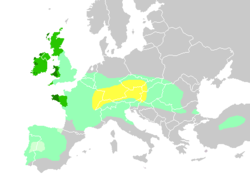
Celtic toponymy is the study of place names wholly or partially of Celtic origin. These names are found throughout continental Europe, Britain, Ireland, Anatolia and, latterly, through various other parts of the globe not originally occupied by Celts.
Celtic languages
[edit]The Proto-Indo-European language developed into various daughter languages, including the Proto-Celtic language.
In Proto-Celtic ("PC"), the Proto-Indo-European ("PIE") sound *p disappeared, perhaps through an intermediate *ɸ. It is a common point between all the Celtic languages. Examples : Latin pater "father", but Gaulish *atir / ater (atrebo, dativ plural), (Old) Irish athair / athir.[1]
After that, languages derived from Proto-Celtic changed PC *kw into either *p or *k (see: P-Celtic and Q-Celtic languages). In P-Celtic languages, PC *kw changed into *p. In Q-Celtic dialects it developed into /k/.
P-Celtic languages include the Continental Gaulish language and the Brittonic branch of Insular Celtic. Common Brittonic is the ancestor of Welsh, Cornish and Breton.
Ancient Q-Celtic languages include the Continental Celtiberian and the Goidelic branch of Insular Celtic. Goidelic is the ancestor of the Gaelic languages Irish, Scottish Gaelic and Manx.
Examples : PIE *kʷetwóres "four" >
- Proto-Italic *kʷettwōr "four" > Latin quattuor
- Proto-Celtic *kʷetwares "four" > Irish ceathair, Scottish Gaelic ceithir "four", but Gaulish petuar[ios] "fourth", Welsh pedwar "four", Old Breton petguar > Breton pevar "four"[1]
Frequent elements in place-names and their cognates in modern Celtic languages
[edit]- Celtic *-āko-, suffix : Gaulish -(i)acon (Latin -(i)acum / (i)acus) < endings -[a]y, -[e]y, -é, -(i)ac in Gaul.[2] Brittonic *-ocon / -*ogon 'place of, property of'; Old Breton -oc > -euc > -ek / -eg (-ec), Welsh -(i)og, etc.
- Celtic *bonus, *bona 'base, foundation' > Old Irish bun 'base, stem, stock', Welsh bon 'base, stem, stock'
- Celtic *briga 'hill, high place'[3] > Welsh bri 'honourable, respected' (not directly related to Welsh bryn 'hill'), Irish brí 'hill; strength, vigour, significance'.
- Celtic *brigant- 'high, lofty, elevated'; used as a feminine divine name, rendered Brigantia in Latin, Old Irish Brigit 'exalted one', name of a goddess.
- Celtic *brīwa, *brīua 'bridge'[3]
- Celtic *dubros 'water' > Old Irish dobur 'water', Welsh Welsh dw[f]r, Cornish dur, Breton dour 'water'
- Celtic *dūnon 'fortress'[3] > Welsh dinas 'city' and din 'fortress', Irish dún 'fortress'
- Celtic *duro- 'door, gate, forum'[3] > Welsh dor, Breton dor 'door'
- Celtic *ialo- 'clearing (wood), assart' > Welsh (tir) ial[3]
- Celtic *kwenno- 'head' > Gallo-Brythonic *penn-, Welsh pen 'head, end, chief, supreme', Breton penn, but Old Irish cenn > Irish ceann 'head'
- Celtic *magos 'field, plain'[3] > Welsh maes 'field', Old Irish mag[3] > Irish magh 'plain'
- Celtic *nemeto- 'wood', 'sacred enclosure', 'sanctuary'[3] > Old Irish nemed 'sanctuary'
- Celtic *rito- 'ford' > Welsh rhyd 'ford'[3]
- Celtic *windo- 'white, fair, blessed' > Welsh gwyn/wyn / gwen/wen 'white, blessed', Old Irish find, Irish fionn 'fair'
European connection
[edit]- Brigantes
- Cambodunum > Champéon (France, Cambdonno / Cambindonno 6-7th century), Champbezon (France, Chambedon 11th century), Kempten (Germany, Camboduno 3rd century)
- Mediolanum > Meulan (France), Milano (Italy)..
- Noviomagus > Nouvion, Nogent, Novion, Nijon, etc. (France), Nijmegen (Netherland); former name of Chichester, Crayford, England
- Ebur(i)acum > Ivry, Évry (France), former name of York, England
- Epiacum > Epfig (Alsace, France, Epiaco 12th century); X (unknown location in Great-Britain)
- Lugdunum > Lyon, Lion, Loudun, Laon, Lauzun (France), Leiden / Leyde (Netherlands)
- Rigomagus > Riom (France), Remagen (Germany)
- Segodunum > Suin, Syon (France); X unclear location near Würzburg (Germany)
- Vuerodunum > several Verdun (France), Verduno (Italy, Piedmont), Verdú (Spain, Catalonia), Birten (Germany, Xanten)
Continental Celtic
[edit]Austria
[edit]- Bregenz, Vorarlberg, Latin Brigantium : from Celtic *brigant- 'high, lofty, elevated' (or divine name, Brigantia)
- Wien, English Vienna, Latin Vindobona : from Celtic *windo- 'white' (Welsh gwyn) + *bona 'base, foundation' (Welsh bôn 'base, bottom, stump', Irish bun 'bottom, base')
Belgium
[edit]- Ardennes, Latin Arduenna Silva : from divine name Arduinna : from Celtic *ardu- 'high' (Irish ard) + Latin silva 'forest'
- Gent, English Ghent, Latin Gandavum : from divine name Gontia
France
[edit]Most of the main cities in France have a Celtic name (the original Gaulish one or the name of the Gaulish tribe).
- Amiens : from Ambiani, a Celtic tribe, replaces Samarobriva 'bridge on the river Somme'
- Angers : from Andecavi, a Celtic tribe, replaces Juliomagus 'market place dedicated to Julius'
- Argentan : from Argentomagus 'silver market', based on arganto- 'silver' cognate to Old Welsh argant > ariant, Old Breton argant > Breton arc'hant 'silver' + magos 'market'
- several places called Argenton
- Argentorate, now Strasbourg
- Arles : from Arelate
- Arras : from Atrebates, a Celtic tribe, replaces Nemetacum, nemeto- 'sacred place' + suffix -acon
- Augustonemetum, now Clermont-Ferrand
- Autun : from Augustodunum, 'town dedicated to Augustus'
- Avignon : from Avenii a Celtic tribe. It was one of the three cities of the Cavari
- Bayeux : from Badiocassi / Bodiocassi, a Celtic tribe, replaces Augustodurum. 'forum dedicated to Augustus'
- Bourges : from Biturigi, a Celtic tribe, replaces Avaricum
- Briançon < Brigantium, from Celtic *brigant- 'high, lofty, elevated' (or divine name, Brigantia)
- several places called Briançon
- Brive < Briva 'bridge'
- several places called Brives
- Caen < Catumagos : from Old Celtic *catu- 'battle' 'fight' 'combat', Old Irish cath 'battle, battalion, troop', Breton -kad /-gad, Welsh cad 'combat, troop'; 'mago- 'field, plain', Old Irish magh. The general meaning seems to be 'battlefield'[4]
- Cahors
- Carentan : from Carentomagus
- several places called Charenton, etc.
- Chambord
- Chartres : from Carnuti, name of a Celtic tribe, replaces Autricum
- Condom : from Condatomagus
- other place : Condom-d'Aubrac
- Divodurum (Latin), now Metz, Lorraine, from Celtic *diwo- 'god, holy, divine' (Scottish Gaelic dia 'god') + **duro- 'fort'
- Douvres (also the French name of Dover) from Celtic dubron, dubra 'water'
- several places called Douvres
- Drevant : from Derventum, Celtic dervo 'oak tree' + suffix -entu
- Évreux : from Eburovici replaces Mediolanum (see below)
- Issoudun
- Jort : from Divoritum 'ford on the river Dives' (Dives from Celtic *dewo 'stream')
- Lillebonne : from Juliobona 'foundation dedicated to Julius'
- Limoges
- Lisieux < (Civitas) Lexoviensis; former Noviomagus[5] 'new market', Old Celtic *noviios 'new', *magos 'field, plain'.
- Lyon, Rhône, Latin Lugdunum : from Celtic *lug- 'Lugus' (divine name) or perhaps 'light' + *dūnon 'fortress'
- several places called Lugdunum : Laon, Lion-en-Beauce, Loudun, Saint-Bertrand-de-Comminges, etc.
- Mediolanum : from Celtic
- Nant
- several places called Nant, Nans
- Nantes
- Nanteuil
- Nanterre (Nemptu doro 5th century) : from nemeto- 'sacred place' + duro- 'gate', 'forum'
- Noyon, Latin Noviomagus Veromanduorum, from Celtic *nowijo- 'new' (Welsh newydd) + *magos 'field, plain'
- several places called Noviomagus : Nouvion, Noyen, Nyons, Nijon, Nojeon, Lisieux, Saint-Paul-Trois-Châteaux, etc.
- Oissel
- Orange : from Arausio, a water god
- Paris : from Parisii (Gaul), name of a Celtic tribe, replaces Lukotekia / Lutetia
- Périgueux / Périgord : from Petrocorii 'the four armies'
- Pierremande < Petromantalum < petro-mantalo- 'four road' = 'crossing'
- Rennes : from Redones, a Celtic tribe, replaces Condate
- several places called Condé, Condat, Candé, etc.
- Riom : from Rigomagus
- Rouen < Rotomagus,[6] sometimes Ratómagos or Ratumacos (on the coins of the Veliocassi tribe). It can be roto-, the word for 'wheel' or 'race', cf. Old Irish roth 'wheel' 'race' or Welsh rhod 'wheel' 'race'. Magos is surer here : 'field', 'plain' or later 'market' cf. Old Irish mag (gen. maige) 'field' 'plain', Old Breton ma 'place'. The whole thing could mean 'hippodrome', 'racecourse' or 'wheel market'.[7]
- Vandœuvre < *vindo-briga 'white fortress'
- several places called Vandœuvres, Vendeuvre, Vendœuvres
- Verdun, Virodunum or Verodunum, from Celtic *uiro-, *uero- 'high' and *dūnon 'hill, fortress'
- several places called Verdun
- Verneuil : from verno- + ialo- 'clearing, plain with alder-trees'
- several places called Verneuil
- Vernon < Vernomagus. There are other Vernons in France, but they come directly from Vernō 'place of the alder-trees'. 'plain of the alder-trees'. uernā 'alder-tree', Old Irish fern, Breton, Welsh gwern, dial. French verne / vergne.
- several places called Vernon
- Veuves : from vidua 'forest' Voves, Vion
- several places called Voves, Vove
- Vion : from Vidumagus 'forest market'
Germany
[edit]From Celtic *alisa, s.f., 'alder'. (Compare the modern German Erlenbach) and Old High German (OHG) aha, s.n., 'flowing water'.
- de Amarahe (?), a lost river name near Fulda c. 800 CE
- Amerbach, a stream near Groß-Umstadt, Babenhausen, Ober-Ramstadt
- Ammer
- Ammerbach
- Ammergraben, a stream near Harpertshausen
- Amorbach, a stream near Mümling and the village named after it.
- Amorsbrunn
- Wald-Amorbach < Perhaps from Celtic *ambara, 'channel, river'. Compare Indo-European *amer-, 'channel, river' > Greek ἀμάρη (amárē), 'channel'. Or, from Celtic *amara, 'spelt, a type of grain'.
- Annelsbach a suburb of Höchst
- Ansbach in Mittelfranken originally Onoltesbah 837 CE : from Celtic *onno-, 'ash tree' plus an OHG bach, 'small river'.
- Boiodurum, now Innstadt, Passau, Niederbayern : first element is Celtic *Boio-, tribal name (Boii), possibly 'cattle-owner' (cf. Irish bó 'cow') or 'warrior'. Second element is Celtic *duro- 'fort'.
- Bonn : from Celtic *bona 'base, foundation' (Welsh bôn 'base, bottom, stump')
- Boppard : from Gaulish Boudobriga, "hill of victory". Containing the elements *boudo- 'victory' (Welsh budd 'gain, benefit') + *briga, 'hill'.
- Düren, Nordrhein-Westfalen, Latin Durum : from Celtic *duro- 'fort'
- Hercynia Silva (Latin), a vast forest including the modern Black Forest : from Celtic *(φ)erkunos 'oak' or divine name Perkwunos + Latin silva 'forest'
- Kempten im Allgäu, Bavaria, Latin Cambodūnum : Celtic cambodūnom, *cambo- 'curved, bent, bowed, crooked', dūnon 'fortress'
- Mainz, Rheinland-Pfalz, Latin Moguntiacum : from Celtic *mogunt-, 'mighty, great, powerful', used as a divine name (see Mogons) + Celtic suffix -(i)acon
- Meggingen : from Celtic *mago- 'plain, field'
- Neumagen-Dhron, Rheinland-Pfalz, Latin Noviomagus Trevirorum
- Noviomagus Nemetum (Latin), now Speyer, Rheinland-Pfalz : from Celtic *nowijo- 'new' (Welsh newydd) + *magos 'field, plain'
- Remagen, Rheinland-Pfalz, Latin Rigomagus or Ricomagus : second element is from Celtic *magos 'field, plain'. The first may be a variant of Celtic *rigi- 'king, chief of *touta'
- Tübingen : maybe hybrid form comprising a Celtic element and a Germanic suffix -ingen.[8] The element tub- in Tübingen could possibly arise from a Celtic dubo-, s.m., 'dark, black; sad; wild'. As found in the Anglo-Irish placenames of Dublin, Devlin, Dowling, Doolin and Ballindoolin. Perhaps the reference is to the darkness of the river waters that flow near the town cf. river Doubs (France) and Dove (GB); if so, then the name can be compared to Tubney, Tubbanford, Tub Hole in England. Compare the late Vulgar Latin tubeta 'morass', from Gaulish. The root is found in Old Irish dub > Irish dubh, Old Welsh dub > Welsh du, Old Cornish duw > Middle Cornish du, Breton du, Gaulish dubo-, dubis, all meaning 'black; dark'
- Worms, Rheinland-Pfalz, Latin Borbetomagus : second element from Celtic *magos, 'plain, field', first perhaps related to Old Irish borb 'fierce, violent, rough, arrogant; foolish'
Hungary
[edit]- Hercynium jugum (Latin) : from Celtic *(φ)erkunos 'oak' or divine name Perkwunos + Latin jugum 'summit'
Italy
[edit]- Brianza, Lombardy, Latin Brigantia : from Celtic *brigant- 'high, lofty, elevated' (or divine name, Brigantia)
- Genova, Liguria, English Genoa, Latin Genua : Perhaps from Celtic *genu- 'mouth [of a river]'. (However, this Ligurian place-name, as well as that of Genava (modern Geneva), probably derive the Proto-Indo-European root *ĝenu- 'knee'.[9])
- Milano, Lombardy, English Milan, Latin Mediolanum : from Celtic medio- 'middle, central' > Old Irish mide 'middle, centre', Old Breton med, met > Breton mez 'middle', etc.[10] and *ɸlan- > *lan-, a Celtic cognate of Latin plānus 'plain', with typical Celtic loss of /p/ or *ɸlānos > Old Irish lán, Welsh llawn, Breton leun 'full'[10]
- Belluno, Veneto, Latin Bellunum : from Celtic **Bhel- 'bright' and *dūnon 'fortress'.
- Bergamo, Lombardy, Latin Bergomum : from Celtic *brigant- 'high, lofty, elevated' (or divine name, Brigantia)
- Brescia, Lombardy, Latin Brixia : from Celtic *briga- 'rocky height or outcrop'.
- Bologna, Emilia Romagna, Latin Bononia : from Celtic **bona 'base, foundation' (Welsh bôn 'base, bottom, stump')
Netherlands
[edit]- Lugdunum Batavorum (Latin), now Katwijk, Zuid-Holland : from Celtic *lug- 'Lugus' (divine name) or perhaps 'light' + *dūnon 'fortress'
- Nijmegen, Gelderland, Latin Ulpia Noviomagus Batavorum : from Celtic *nowijo- 'new' (Welsh newydd) + *magos 'field, plain'
Poland
[edit]Portugal
[edit]- Braga, Braga Municipality, Portugal : from Celtic *bracari- after the Bracari Celts.
- Bragança, Alto Trás-os-Montes, Portugal : from Celtic *brigant- 'divine name, Brigantia'.
- Beira : from Celtic *beira- Cailleach/ Cale's other name Cailleach-Bheura or Beira, the Celtic Goddess of mountains, water and Winter. Three Portuguese provinces: Beira-Baixa, Beira-Alta and Beira-Litoral
- Vale de Cambra, Portugal : from Celtic *cambra- 'chamber, room'.[11]
- Conímbriga, Coimbra, Portugal : from Celtic *briga- 'rocky height or outcrop'.
- Évora, Alentejo, Portugal : from Celtic *ebora- 'plural genitive of the word eburos (trees)'.
- Lacobriga, Algarve, Portugal : from Celtic *Lacobriga- 'Lake of Briga'.[citation needed]
Romania
[edit]- Băișoara and other sites in Transylvania
- Boian in Sibiu, Boianu Mare in Bihor County, villages coming from Boii
- Călan city in Hunedoara.
- Deva, capital of Hunedoara, originally a city of the Dacians
- Galați
- Noviodunum now Isaccea means "new fortress" *nowijo- + *dūn-.
- Timiș River in Banat.
Serbia
[edit]- Singidunum (Latin), now Beograd, English Belgrade : second element from Celtic *dūnon 'fortress'
Slovenia
[edit]- Celje, Latinized Celeia in turn from *keleia, meaning 'shelter' in Celtic
- Neviodunum (Latin), now Drnovo : second element from Celtic *dūnon 'fortress'
Spain
[edit]Asturias and Cantabria
[edit]- Deva, several rivers in northern Spain, and Pontedeva, Galicia, Spain : from Celtic *diwā- 'goddess; holy, divine'
- Mons Vindius (now the Cantabrian Mountains), NW Spain : from Celtic *windo- 'white'.
Castile
[edit]- Segovia, Castile and León, Spain, Greek Segoubía : from *segu-, conjectured to be Celtic for 'victorious', 'strength' or 'dry' (theories).
Galicia
[edit]- Tambre, a river in Galicia (Spain), Latin Tamaris : possibly from Celtic *tames- 'dark' (cf. Celtic *temeslos > Welsh tywyll 'darkness'). Other theories.
- O Grove, Medieval Latin Ogrobre 912:[12] from Celtic *ok-ro- 'acute; promontory'[13] and Celtic *brigs 'hill'.
- Bergantiños, Medieval Latin Bregantinos 830 : from Celtic *brigant- 'high, lofty, elevated', or divine name Brigantia, or from Celtic *brigantīnos 'chief, king'.[14]
- Dumbría, Medieval Latin Donobria 830 : from Celtic *dūnon 'fortress' + Celtic **brīwa 'bridge'.
- Val do Dubra and Dubra River, Galicia : from Celtic *dubr- 'water', *dubrās 'waters' (Welsh dwfr).
- Monforte de Lemos (region), Latin Lemavos, after the local tribe of the Lemavi : from Celtic *lemo- 'elm' + suffix -avo.
- Nendos (region), Medieval Latin Nemitos 830 : from Celtic *nemeton 'sanctuary'.
- Noia, Galicia, Spain, Greek Nouion:[15] from Celtic *nowijo- 'new' (Welsh newydd).
Switzerland
[edit]Switzerland, especially the Swiss Plateau, has many Celtic (Gaulish) toponyms. This old layer of names was overlaid with Latin names in the Gallo-Roman period,[16] and, from the medieval period, with Alemannic German[17] and Romance[18] names.
For some names, there is uncertainty as to whether they are Gaulish or Latin in origin. In some rare cases, such as Frick, Switzerland, there have even been competing suggestions of Gaulish, Latin and Alemannic etymologies.[19]
Examples of toponyms with established Gaulish etymology:
- Solothurn, from Salodurum. The *-durum element means "doors, gates; palisade; town". The etymology of the *salo- element is unclear.
- Thun, Bern: *dunum "fort"
- Windisch, Aargau, Latin Vindonissa: first element from *windo- "white"
- Winterthur, Zürich, Latin Vitudurum or Vitodurum, from *vitu "willow" and *durum
- Yverdon-les-Bains, from Eburodunum, from *eburo- "yew" and *dunum "fort".[20]
- Zürich, Latin Turicum, from a Gaulish personal name Tūros
- Limmat, from Lindomagos "lake-plain", originally the name of the plain formed by the Linth and Lake Zurich.
Insular Celtic
[edit]Brittonic
[edit]England (excluding Cornwall)
[edit]The main survey of Celtic place-names in this region is by Richard Coates and Andrew Breeze.[21] Evidence for a Celtic root to place names in England is widely strengthened by early monastic charters, chronicles and returns: examples relate to Leatherhead and Lichfield. To describe a place as of the Celts, the Old English wealh becoming Wal/Wall/Welsh is often used. This was the main Germanic term for Romano-Celtic peoples, such as the Britons. Such names are a minority, but are widespread across England. For example, a smattering of villages around the heart and east of The Fens hint at this: West Walton, Walsoken, and the Walpoles indicate their continued presence. Nearby Wisbech, King's Lynn and Chatteris have Celtic topographical elements.
- Amwythig (Welsh; Shrewsbury), Shropshire, from Brittonic *ambi-uk-t-iko ("little defense").[22]
- Arden (forest of), Warwickshire - from Celtic *ardu- 'high' (Irish ard)
- From Brythonic *abona 'river' (Welsh afon):
- From Celtic *iska 'water' (Irish uisce):
- First element from Celtic *briga 'hill':
- Brean, Somerset
- Bredon, Worcestershire
- Breedon on the Hill, Leicestershire
- Brewood, Staffordshire
- Brill, Buckinghamshire
- From Celtic *brigant- 'high, lofty, elevated' (or divine name, Brigantia):
- Burslem, Stoke-on-Trent, the -lem element is a Celtic district name from *lemano ("elm").
- Camulodunum (Latin), now Colchester, Essex - from *kamulos 'Camulus' (divine name) + Celtic *dūnon 'fortress'
- Catterick, North Riding of Yorks., *catu ("battle") + *ratis ("rampart") + onjon (suffix).[23]
From *cem (root associated with cefn below) + *-*ed (suffix)[23]
- Chevin, Wharfedale, equivalent to Welsh cefn ("ridge").
- Crayke, North Riding of Yorkshire, equivalent to Welsh craig ("rock").[23]
- From Brythonic *crüg 'hill'[24] (Irish cruach)
- Creech St Michael, Somerset
- Crewkerne, Somerset
- Crich, Derbyshire
- Cricket St Thomas, Somerset
- Crickheath, Shropshire
- Cricklade, Wiltshire
- Crewe, Cheshire - from Old Welsh *criu 'river crossing'
- Cunececestre (Old English), now Chester-le-Street, County Durham, from Latin Concangis, from *cönig, a root of uncertain meaning.[23]
- Devon, Latin Dumnonia - from tribal name Dumnonii or Dumnones, from Celtic *dumno- 'deep', 'world'
- From Celtic *dubr- 'water', *dubrās 'waters' (Welsh dwfr; Breton dour):
- Durham, County Durham, Latin Dunelm - first element is possibly dun, ' hill fort' (Welsh ddin, 'fort').
- First element from Celtic *duro- 'fort'; in Dūrobrīvae, Celtic *brīwa 'bridge':
- Durobrivae (Latin), now Rochester, Kent and Water Newton, Cambridgeshire
- Durovernum Cantiacorum (Latin), now Canterbury, Kent
- From Celtic *iska 'water' (Irish uisce); second element in Isca Dumnoniorum (Exeter) is a tribal name (see Devon):
- Gloucester, Gloucestershire, from Latin Glevum (+ Old English ceaster), from *gleiwom ("bright place").
- Holland, Lincolnshie, possibly from haiw- ("a swamp") (+ OE land).[25]
- From the equivalent of Welsh ynys ("island").
- Ince, Cheshire
- Ince Blundell, Sefton[23]
- Ince-in-Makerfield, Wigan[23]
- Inskip, Lancashire, equivalent to ynys-cyb ("bowl-shaped island").[23]
- Kesteven, Lincolnshire, from cēt- ("a wood") (+ Old Norse stefna ("a meeting place") added later).[26]
- Leatherhead, Surrey - from Brythonic *lēd- [from Celtic *leito-] + *rïd- [from Celtic *(φ)ritu-] = "Grey Ford"[24]
- Lincoln, Lincolnshire, Latin Lindum Colonia - from Celtic *lindo- 'pool' + Latin colonia 'colony'
- From Brittonic *mamm- 'breast'
- Noviomagus (Latin), now Chichester, West Sussex and Crayford, Kent - from Celtic *nowijo- 'new' (Welsh newydd) + *magos 'field, plain'
- Onn, Staffordshire, from *onnā ("ash trees").[29]
- From *panto- and its descendants (Welsh pant, Cumbric pant).
- Pen y Ghent, Yorkshire - equivalent with Welsh pen-y-gant ("summit of the border") or pen-y-gynt ("summit of the heathen").[23]
- Pengethley, Herefordshire - from Brythonic *penn- 'hill, top, head, chief' (Welsh pen) + possibly *kelli 'to stand' (Welsh gelli)
- From Brythonic *penn- 'hill, top, head, chief' (Welsh pen) + *koid- 'wood' (Welsh coed), or *cēd- 'wood':[24]
- First element from Brittonic *penn- 'hill, top, head, chief' (Welsh pen 'head, end, chief, supreme') = Irish ceann 'head', from Proto-Celtic *kwenno-:
- Pencraig, Herefordshire
- Pendlebury, Greater Manchester
- Pendleton, Lancashire
- Pendock, Worcestershire
- Pensnett, West Midlands
- Penn, Buckinghamshire
- Penn, West Midlands
- Lower Penn, Staffordshire
- Penshaw, Sunderland
- Pen Bal Crag, Tynemouth, from pen ("head") + wāl ("wall") (+ English crag).[23]
- Old Sarum, Wiltshire, Latin Sorviodūnum - second element from Celtic *dūnon 'fortress'
- Segedunum (Latin), now Wallsend, Tyne and Wear - from Celtic for 'victorious', 'strength' or 'dry' (theories). Second element is Celtic *dūnon 'fortress'.
- Sinodun Hills, south Oxfordshire - from Celtic *seno- 'old' + *dūnon 'fortress'
- Possibly from Celtic *tames- 'dark' (cf. Celtic *temeslos > Welsh tywyll 'darkness'):
- Trinovantum (Latin), now London - 'Of the Trinovantes', a tribal name, perhaps 'very energetic people' from Celtic *tri- (intensive) + *now- 'energetic', related to *nowijo- 'new' (Welsh newydd)
- Verulamium (Latin), now St Albans, Hertfordshire - from Brittonic *weru- 'broad' + *lam- 'hand' [from Celtic *(φ)lāmā] (Welsh llaw, Irish láimh)
- Wigan, from *wīg ("Roman vicus") + ann (suffix).[23]
- First element from Celtic *windo- 'white' (Welsh gwyn); in Vindolanda, Celtic *landā 'land, place' (Welsh llan). In Vindomora, second element could be 'sea' (Welsh môr, Irish muir):
- Vindobala (Latin), Roman fort in Northumberland
- Vindolanda (Latin), Roman fort in Northumberland
- Vindomora (Latin), Roman fort in County Durham.
- Yeavering, Northumberland, formerly Gefrin, equivalent to Welsh gafrfryn ("goat hill").[30]
- York, Greek Ebōrakon, Latin Eboracum or Eburacum - from Celtic *eburo- 'yew'
Scotland
[edit]The post-6th century AD Brittonic languages of Northern England and Scotland were Cumbric and Pictish. Cumbric place-names are found in Scotland south of the River Forth,[23] while Pictish names are found to the north.[31]
- Aberdeen, Aberdeenshire - from **aber ("river mouth").[32]
- Applecross, Ross-shire - formerly Abercrosan, from aber ("river mouth").[32]
- Arran - possibly equivalent to Middle Welsh aran ("high place").[33]
- Aviemore, Inverness-shire - An Aghaidh Mhòr in Gaelic, possibly involving Brittonic *ag- ("a cleft").[34]
- Ben Lomond, Stirlingshire - Lomond is equivalent to Welsh llumon ("beacon").[23]
- Blantyre, Lanarkshire - equivalent to Welsh blaen ("extremes, source, front") + tir ("land").[23]
- Blebo, Fife - formerly Bladebolg, from Brittonic *blawd ("meal") + *bolg ("sack").[35]
- Burnturk, Fife - formerly Brenturk, equivalent to Welsh bryntwrch ("boar hill").[32]
- Dallas, Moray - equivalent to Welsh dôl ("haugh, meadow") + gwas ("abode").[32]
- Darnaway, Moray - possibly from ancient Brittonic Taranumagos ("thunder-plain").[32]
- Daviot, Inverness-shire - perhaps from Brittonic *dem- meaning "sure, strong".[34]
- Dull, Perthshire - equivalent to Welsh dôl ("haugh, meadow").[32]
- Ecclefechan, Dumfriesshire - equivalent to Welsh eglwysfechan ("small church").[23]
- Edinburgh, Midlothian - from Din Ediyn, from a Brittonic form meaning "fort of Ediyn" (cf. Welsh din).
- Esslemont, Aberdeenshire - equivalent to Welsh iselfynydd ("low hill").[32]
- Glasgo, Aberdeenshire - see Glasgow, Lanarkshire below.[32]
- Glasgow, Lanarkshire - equivalent to Welsh glascau ("blue hollow").[32]
- Hebrides - Ebudes in Ptolemy (c. 140 AD), possibly from ancient Brittonic ep- ("a horse"; cf. Welsh ebol).[36]
- Keith, Banffshire - equivalent to Welsh coed ("wood, forest").[32]
- Lanark, Lanarkshire - equivalent to Welsh llanerch ("a glade").[23]
- Landrick, Perthshire - see Lanark, Lanarkshire.[37]
- Lanrick, Perthshire - see Lanark, Lanarkshire.[37]
- Lauder, Berwickshire - equivalent either to Middle Breton louazr or Welsh llawedrawr.[23]
- Lendrick, Kinross-shire - see Lanark, Lanarkshire.[37]
- Lendrick, Perthshire - see Lanark, Lanarkshire.[37]
- Lomond Hills, Fife - see Ben Lomond, Stirlingshire.[35]
- Mayish, Arran - possibly from Brittonic maɣes ("field"; Welsh maes).[38]
- Meggernie, Perthshire - from an element cognate with Welsh migwernydd ("boggy meadow").[32]
- Methven, Perthshire - equivalent to Welsh meddfaen ("meadstone").[32]
- Midmar, Aberdeenshire - equivalent to Welsh mig(n) ("bog, swamp") + Mar (a district name).[32]
- Migvie, Aberdeenshire - equivalent to Welsh mig(n) ("bog, swamp").[32]
- Mounth, Perthshire, Angus and Aberdeenshire - equivalent to Welsh mynydd ("mountain, moor, hill").[31]
- Ochil Hills, Fife - probably from Common Brittonic *okelon ("a ridge").[31]
- Orchy, Argyll (river) - in Gaelic Urchaidh, from ancient Brittonic are-cētia ("on the wood").[32]
- Panbride, Angus - from pant ("a hollow").[32]
- Panlathy, Angus - from pant ("a hollow").[37]
- Panmure, Angus - equivalent to Welsh pantmawr ("big hollow").[32]
- Pendewen, Angus - first element is possibly equivalent to Welsh pen ("head, top, summit, source").[37]
- Penicuik, Midlothian - equivalent to Welsh pen-y-cog ("summit of the cuckoo").[23]
- Pennan, Aberdeenshire - probably equivalent to Welsh pen ("head, top, summit, source").
- Pennygant Hill, Roxburghshire - see Pen y Ghent, Yorkshire, England.[23]
- Perth, Perthshire - probably equivalent to Welsh perth ("bush").
- Pinderachy, Angus - first element is possibly equivalent to Welsh pen ("head, top, summit, source").[37]
- Pinnel, Fife - possibly equivalent to Welsh pen ("head, top, summit, source").[35]
- Pulrossie, Sutherland - possibly equivalent to Welsh pwllrhos ("promontory pool").[39]
- Rattray, Aberdeenshire - equivalent to Welsh rhawdtref ("ramparts town").[32]
- Urquhart, Ross-shire - formerly Airdchartdan, equivalent to Middle Welsh ar-cardden ("on the enclosure").[32]
- Yell, Shetland - probably from Common Brittonic iâla ("unfruitful land, pasture").[40]
Wales
[edit]The vast majority of placenames in Wales (part of the United Kingdom) are either Welsh or anglicized Welsh.
Cornwall
[edit]The vast majority of placenames in Cornwall are either Cornish or anglicized Cornish. For examples, see List of places in Cornwall.
Brittany
[edit]The vast majority of placenames in the west of Brittany (part of France) are either Breton or derived from Breton. For examples, see Category:Populated places in Brittany.
Goidelic
[edit]England
[edit]Place names in England derived partly or wholly from Goidelic languages include:
- Aireyholme, Yorkshire (Great Ayton), recorded as Erghum (1138), from Old Irish airgh ("summer pastures").[41]
- Ben, Yorkshire (Sedbergh), probably from the Gaelic benn ("a peak").[41]
- Cambois, Northumberland, possibly from Old Irish cambas ("bay, creek")[42]
- Carkin, Yorkshire, possibly from Old Irish carric ("a rock").[43]
- Castle Eden, County Durham, possibly from Old Irish étan ("forehead, hill-brow").[44]
- †Crosskelloc, Lancashire (Ulverston), from Irish cros ("a cross") + Chelloc (personal name).[45]
- Dunmallard, Cumberland, possibly from Middle Irish dùn-mallacht ("fort of curses")[23]
- Durdar, Cumberland (St Cuthbert Without), from Gaelic doiredarach ("oak copse").[41]
- Greysouthen, Cumberland, from Irish craicc-Suthan ("Suthán's rock/cliff").[41]
- Kilmond, Yorkshire (Bowes), possibly from Gaelic ceann-monadh ("head of the hill").[41]
- Knockupworth, Cumberland (Grinsdale), from Irish cnocc ("hillock") (+ the Germanic personal-name Hubert).[41]
- Latrigg, Cumberland, possibly from Old Irish lettir ("a slope").[41]
- Latterbarrow, Lancashire (Hawkshead), possibly from Irish lettir ("a slope").[45]
- Liscard, Cheshire, possibly from Irish Gaelic lios na carraige meaning "fort of the rock".[46]
- Noctorum, Cheshire, from Irish cnocc-tírim ("dry hill").[41]
- Pool Darkin, Westmorland (Beetham), possibly from Gaelic poll ("pool") + the personal name *Dercan.[41]
- Ravenglass, Cumberland, from Irish rann-Glas ("Glas's part/share").[41]
- Torkin, Cumberland (Thursby), from Irish tor-cheann ("peak-head").[41]
Furthermore, some non-Goidelic place-names in mainly Northern and Midland England reference Irish personal names, due to Norse-Gaelic settlement Britain during the 10th century.
- Carperby, Yorkshire containing the Irish Gaelic given-name Cairpe[47]
- Dovenby, from personal name Dufan of Irish origin (OIr 'Dubhán')
- Dunkenhalgh, Lancashire (Hyndburn), from the Gaelic personal name Donnchad (> English Duncan) (+ Old English halh, "haugh").[45]
- Fixby, Yorkshire, from the Gaelic Irish personal name Fiach
- Gatenby, Yorkshire, from the Irish personal name Gaithen (+ Old Norse byr, "farm").[41]
- Glassonby, from the Irish personal name Glassan
- †Iocemhil, Lincolnshire (Killingholme), possibly contains the Irish personal name Eogan.[41]
- Malmesbury, Wiltshire, from the Irish founder of the abbey Máel Dub
- Mellishaw, Lancashire (Lancaster), possibly the Irish personal name Mdeldn (+ Old Norse haugr).[45]
- Melmerby, Yorkshire, from the Old Irish personal name Máel Muire
- Yockenthwaite, Yorkshire, contains the Irish personal name Eogan (+ Old Norse þveit, "clearing").[41]
Place names that directly reference the Irish include Irby, Irby upon Humber, Ireby and Ireleth. Place names with Scot- or similar, such as Scothern in Lincolnshire or Scotton in the North Riding of Yorkshire, may refer to Gaelic speakers from Scotland or Ireland, since Old English Scottas originally had connotations of Irish Gaels.
Ireland
[edit]The vast majority of placenames in Ireland are anglicized Irish language names.
Scotland
[edit]The majority of placenames in the Highlands of Scotland (part of the United Kingdom) are either Scottish Gaelic or anglicized Scottish Gaelic. Gaelic-derived placenames are very common in the rest of mainland Scotland also. Pictish-derived placenames can be found in the northeast, while Brythonic-derived placenames can be found in the south.
Isle of Man
[edit]Many placenames on the Isle of Man (a Crown dependency) are Manx or anglicised Manx, although there are also many Norse-derived place names.
See also
[edit]Notes
[edit]- ^ a b Pierre-Yves Lambert, La Langue gauloise, Editions Errance, 1994, p. 16 - 17
- ^ Pierre-Yves Lambert, La langue gauloise, Editions Errance, 1994, p. 39.
- ^ a b c d e f g h i Lambert, p. 37
- ^ Xavier Delamarre, Dictionnaire de la langue gauloise, 2nd edn. (Paris: Errance, 2003), p. 111.
- ^ See Noviomagus and Lexovii.
- ^ Other examples include Ruan (Rothomago 1233 / Rotomagus 5th century), Rom.
- ^ Delamarre 2003, pp. 261-2.
- ^ Bahlow, Hans. 1955. Namenforschung als Wissenschaft. Deutschlands Ortsnamen als Denkmäler keltischer Vorzeit. Frankfurt am Main.
- ^ see Pokorny, IEW
- ^ a b Xavier Delamarre, Dictionnaire de la langue gauloise, Paris (éditions errance) 2001, p. 221.
- ^ "RIA - Dictionary of Medieval Latin from Celtic Sources". Archived from the original on 2021-04-17. Retrieved 2017-11-29.
- ^ Prósper, Blanca María (2002). Lenguas y Religiones Prerromanas del Occidente de la Península Ibérica. Universidad de Salamanca. p. 375. ISBN 978-84-7800-818-6.
- ^ Matasovic, Ranko (2009). Etymological Dictionary of Proto-Celtic. Brill. p. 28. ISBN 978-90-04-17336-1.
- ^ Matasovic, Ranko (2009). Etymological Dictionary of Proto-Celtic. Brill. pp. 77–78. ISBN 978-90-04-17336-1.
- ^ Ptolemy II 6.21.
- ^ such as Basel, Latin Basilea, from the personal name Basilius, ultimately of Greek origin,
- ^ such as Bern, founded 1191
- ^ such as Neuchâtel, founded 1011
- ^ Frick has been derived from (a) a Celtic word for "confluence", cognate with fork, (b) an Alemannic personal name Fricco and (c) Latin ferra ricia "iron mine, ironworks".
- ^ Bernhard Maier, Kleines Lexikon der Namen und Wörter keltischen Ursprungs, 2010, p. 51. Julius Pokorny, IEW (1959:325), s.v. "ē̆reb(h)-, ō̆rob(h)- 'dark reddish-brown colour'": "alb.-ligur.-kelt.-germ. eburo- 'rowan, mountain ash, yew, evergreen tree with poisonous needles'."
- ^ Coates, Richard; Breeze, Andrew (2000). Celtic Voices, English Places: Studies of the Celtic Impact on Place-Names in Britain. Stamford: Tyas. ISBN 1900289415..
- ^ Schrijver, Peter (27 November 2023). Studies in British Celtic Historical Phonology. Brill. p. 157. ISBN 9789004653733.
- ^ a b c d e f g h i j k l m n o p q r s t u v James, Alan. "The Brittonic Language in the Old North" (PDF). Scottish Place Name Society. Retrieved 28 March 2021.
- ^ a b c Mills, AD. Oxford Dictionary of English Place-Names. Oxford University Press, 1991.
- ^ Hawkins, Jillian Patricia. "The significance of the place-name element *funta in the early middle ages" (PDF). University of Winchester.
- ^ Mills, Anthony David (2003). A Dictionary of British Place-Names. OUP Oxford. ISBN 9780191578472.
- ^ "Key to English place-names - Mamble". University of Nottingham. Retrieved 4 April 2025.
- ^ Mills, David (20 October 2011). A Dictionary of British Place-Names. OUP Oxford. ISBN 9780199609086.
- ^ "Key to English place-names - High Onn". University of Nottingham. Retrieved 4 April 2025.
- ^ "Key to English place-names - Yeavering". University of Nottingham.
- ^ a b c Rhys, Guto. "Approaching the Pictish language: historiography, early evidence and the question of Pritenic" (PDF). University of Glasgow.
- ^ a b c d e f g h i j k l m n o p q r s Watson, W.J.; Taylor, Simon (2011). The Celtic Place-Names of Scotland (reprint ed.). Birlinn LTD. p. 387. ISBN 9781906566357.
- ^ Mackenzie, William Cook (1931). Scottish Place-names. K. Paul, Trench, Trubner & Company. p. 124.
- ^ a b MacBain, Alexander (1922). Place names Highlands & Islands of Scotland. p. 156. Retrieved 20 April 2020.
- ^ a b c Simon, Taylor; Markus, Gilbert (2006). The Place-names of Fife (Illustrated ed.). Shaun Tyas. ISBN 9781900289771.
- ^ Woolf, Alex (2012) Ancient Kindred? Dál Riata and the Cruthin Archived 2016-08-02 at the Wayback Machine. Academia.edu. Retrieved 21 January 2015.
- ^ a b c d e f g Hall, Mark A; Driscoll, Stephen T; Geddess, Jane (11 November 2010). Pictish Progress: New Studies on Northern Britain in the Early Middle Ages. Brill. ISBN 9789004188013. Retrieved 30 June 2019.
- ^ Mac an Tàilleir, Iain. "Gaelic Place Names (K-O)" (PDF). The Scottish Parliament. Archived from the original (PDF) on 2018-11-16. Retrieved 2021-03-31.
- ^ Transactions of the Gaelic Society of Inverness (Volume XX ed.). The Society. 1899. p. 330. Retrieved 14 May 2020.
- ^ Forsyth, Katherine. "Protecting a Pict?: Further thoughts on the inscribed silver chape from St Ninian's Isle, Shetland. Proceedings of the Society of Antiquaries of Scotland (2020)" (PDF). University of Glasgow. Retrieved 6 March 2021.
- ^ a b c d e f g h i j k l m n "Survey of English Place-Names". English Place-Name Society.
- ^ Bethany Fox, 'The P-Celtic Place-Names of North-East England and South-East Scotland', The Heroic Age, 10 (2007), http://www.heroicage.org/issues/10/fox.html (appendix at http://www.heroicage.org/issues/10/fox-appendix.html); "Archived copy" (PDF). Archived from the original (PDF) on 2010-02-15. Retrieved 2009-11-30.
{{cite web}}: CS1 maint: archived copy as title (link) - ^ Ekwall, Eilert (1960). The concise Oxford dictionary of English place-names (4 ed.). Oxford: Oxford University Press. p. 87. OCLC 1228215388.
- ^ Mawer, Allen, The Place-Names of Northumberland and Durham (Cambridge: Cambridge University Press, 1920), p. 71.
- ^ a b c d Ekwall, Eilert (1922). The Place Names of Lancashire. The University Press. ISBN 9789353897918. Retrieved 5 February 2024.
{{cite book}}: ISBN / Date incompatibility (help) - ^ A. D. Mills, A Dictionary of British Place Names (Oxford: Oxford University Press, 2011), s.v.
- ^ Stenton, Frank Merry (1970). Preparatory to Anglo-Saxon England: The Collected Papers of Frank Merry Stenton. Clarendon. p. 312. ISBN 0198223145. Retrieved 5 January 2019.
Celtic toponymy
View on GrokipediaIntroduction and Overview
Definition and Scope
Celtic toponymy is the branch of onomastics that examines the origins, meanings, and cultural significance of place names derived wholly or partially from Celtic languages, encompassing designations for settlements, rivers, mountains, and other geographical features.[4] These names preserve elements of ancient and surviving Celtic linguistic forms, often reflecting interactions between the Celts and their landscapes.[2] The scope of Celtic toponymy extends across prehistoric to modern eras, tracing back to the Proto-Celtic language spoken around 1300–800 BCE and continuing through influences in contemporary Celtic languages, including surviving ones like Irish and Welsh and revived ones like Cornish and Manx.[5] Geographically, it covers continental Europe, including regions once inhabited by Celtic tribes in Gaul (modern France), Iberia, and Central Europe; insular areas like Britain and Ireland; and Brittany in France.[4] Celtic toponyms also appear in Anatolia, particularly in ancient Galatia settled by Celtic migrants around 278 BCE, where Celtic toponyms such as Vindia and Binzea are attested in ancient sources like Ptolemy's Geography.[6] Beyond core Celtic territories, vestiges persist in non-Celtic regions, such as Anglo-Saxon England, through substrate influences on local nomenclature.[2] This field includes diverse categories of names, such as those derived from tribal identities, descriptive terms for natural features, and references to deities. For instance, the city of Paris originates from the Celtic tribe Parisii, who inhabited the Seine valley during the Iron Age.[7] Similarly, numerous rivers named Avon stem from the Proto-Celtic root abonā, meaning "river," illustrating a common descriptive element for waterways.[8]Historical Context
The Celtic expansion across Europe is closely associated with the Hallstatt culture, which flourished from approximately 800 to 450 BCE in Central Europe, and the subsequent La Tène culture, spanning from around 450 BCE to the early 1st century CE.[9] These archaeological horizons represent phases of cultural and technological development among proto-Celtic and Celtic-speaking populations, originating in the Alpine region and Hallstatt heartland before radiating outward through migrations and trade networks. Evidence from linguistic distributions, artifacts, and genetic studies indicates that Celtic influences extended westward to Iberia, where Celtiberian languages emerged by the 6th century BCE, northward to Britain and Ireland during the late Bronze Age to early Iron Age transitions, and eastward to Anatolia via the Galatians' settlement in the 3rd century BCE following their incursions into the Hellenistic world.[10] This widespread dissemination laid the foundation for toponymic patterns reflecting Celtic settlement, resource exploitation, and territorial organization. Key historical events further shaped the preservation and transformation of Celtic place names. The Roman conquest of Gaul, culminating in Julius Caesar's campaigns from 58 to 50 BCE, incorporated vast Celtic territories into the empire, where indigenous toponyms were often Latinized but retained their underlying Celtic roots, as seen in the transmission of pre-conquest names through Roman administrative records and inscriptions.[11] Subsequent Germanic migrations, beginning in the late Roman period and intensifying from the 4th to 6th centuries CE, overlaid Celtic substrates in regions like Gaul and Britain, yet many hydrological and settlement names persisted as linguistic fossils, influencing modern Romance and Germanic languages due to the conservative nature of toponymy in substrate retention.[12] Cultural influences among Celtic societies profoundly impacted toponymic naming conventions, particularly through tribal organization and religious practices. Druids, as high-ranking intermediaries between communities and the divine, played a central role in maintaining oral traditions and legal customs that likely informed place-naming tied to sacred landscapes and tribal identities.[13] Tribal structures centered on oppida—large fortified settlements that served as political, economic, and defensive hubs—frequently incorporated the Proto-Celtic element *dūnon, meaning "fortress" or "enclosed strong place," derived from an Indo-European root denoting durability or enclosure, as evidenced in Gaulish and other Celtic inscriptions.[14] Similarly, religious sites known as *nemeton, referring to sacred groves, were pivotal in Celtic spirituality, functioning as open-air sanctuaries for rituals and assemblies, with the term's etymology linking to Proto-Indo-European concepts of sanctity and holiness, preserved in both continental and insular toponyms.[15] In the modern era, 19th- and 20th-century Celtic revival movements revitalized interest in toponymic studies, prompting efforts to restore and standardize indigenous names in regions like Wales and Ireland. These nationalist and cultural initiatives, fueled by organizations such as the Gaelic League in Ireland from 1893 onward, emphasized the recovery of Gaelic place names to reconnect with pre-colonial heritage, leading to scholarly publications and official policies that influenced contemporary mapping and heritage preservation.[16] In Wales, parallel revivals during the same period, including the establishment of the Welsh Language Society in 1962, supported the reclamation of Brythonic-derived toponyms, enhancing academic analysis of Celtic linguistic substrates.[17][18]Celtic Languages
Continental Celtic Languages
The Continental Celtic languages, spoken across much of prehistoric and early historic Europe, are classified primarily into two branches based on a key phonological innovation: the P-Celtic languages, which underwent the sound shift of Proto-Indo-European (PIE) *kʷ to /p/, and the Q-Celtic languages, which retained the labiovelar as /kʷ/ or /k/. This distinction is evident in lexical comparisons, such as the P-Celtic form *petia for "four" (from PIE *kʷetwores) in languages like Gaulish, contrasting with the Q-Celtic retention of *kʷ in forms like Celtiberian *kʷe. The P-Celtic branch includes Gaulish, Galatian, and Lepontic, while the Q-Celtic branch encompasses Celtiberian, reflecting dialectal divergences within the broader Celtic family that emerged around the 1st millennium BCE.[19] Among the most extensively attested Continental Celtic languages is Gaulish, a P-Celtic tongue spoken across Gaul (modern France, Belgium, and parts of surrounding regions) from approximately the 6th century BCE until its decline. Gaulish is documented through over 800 inscriptions, including the famous Coligny calendar, a bronze tablet from the 2nd century CE that records a lunisolar cycle with month names like *samoni- ("summer") and intercalary markers, providing insight into Gaulish temporal and religious terminology.[20] In the Iberian Peninsula, Celtiberian, a Q-Celtic language, was spoken by Celtic tribes in northeastern Spain from the 3rd century BCE onward, with key evidence from the Botorrita plaques—four bronze tablets from the late 2nd to 1st century BCE containing legal and administrative texts in the Iberian script, such as references to communal decisions (toutam "tribe" or "community").[21] Lepontic, classified as P-Celtic (though its exact affinities are debated), was used in the Alpine regions of northern Italy and southern Switzerland between the 6th and 1st centuries BCE, attested in about 140 short inscriptions using the Lugano alphabet, including funerary texts like the Vergiate stele with phrases such as leponzio ("of the Lepontii people").[22] These languages left a profound mark on European toponymy through direct survivals in Roman Latin records and as substrates influencing later Romance languages. For instance, the name Lugdunum (modern Lyon, France), recorded by Roman sources as a major Gaulish settlement, derives from Gaulish Lugus-dūnon, combining the name of the deity Lugus with dūnon ("fortress" or "hill-fort"), signifying "fort of Lugus."[23] Similarly, the Rhine River's name stems from Gaulish rēnos ("flowing" or "that which flows"), a hydronym reflecting Celtic descriptive nomenclature for waterways and preserved in Latin Rhenus. Such toponyms often incorporated common elements like dūnon for fortified sites or river terms, embedding Celtic linguistic patterns into the landscape even as the spoken languages faded. The Continental Celtic languages largely disappeared by the 5th to 6th centuries CE, driven by Romanization, which promoted Latin as the administrative and cultural lingua franca across Gaul and Hispania.[24] The latest direct attestations of Gaulish, such as curse tablets from the 2nd–4th centuries CE, indicate bilingualism with Latin before full extinction, while Celtiberian and Lepontic ceased earlier under Roman conquest.[24] Their legacy endures primarily in these persistent place names, which outlived the languages themselves and occasionally show parallels to Insular Celtic forms for comparative reconstruction.Insular Celtic Languages
Insular Celtic languages, spoken in the British Isles and Brittany, are classified into two main branches: the Brittonic (or Brythonic) group, which is P-Celtic and includes Welsh, Cornish, and Breton, and the Goidelic (or Gaelic) group, which is Q-Celtic and encompasses Irish, Scottish Gaelic, and Manx.[25][26] This division reflects phonological differences, such as the retention of Proto-Celtic kw as p in Brittonic (e.g., Welsh pen "head") versus k in Goidelic (e.g., Irish ceann).[25] The historical development of these languages diverged significantly after the Roman withdrawal from Britain around the 5th century CE, amid invasions by Anglo-Saxons, Scots, and others, leading to the confinement of Brittonic speech to western regions like Wales and Cornwall, while Goidelic expanded from Ireland to Scotland and the Isle of Man.[26] Early attestations appear in Old Welsh poetry from the 6th century, such as the works of Taliesin, which preserve toponyms like Caer (fort) in references to ancient sites. Similarly, Irish annals from the 7th century onward, including the Annals of Ulster, document early Goidelic place names, such as Dún Dá Lethglas (fort of the two green sides), illustrating continuity in naming conventions for landscape features.[26] Toponymic features of Insular Celtic languages demonstrate remarkable survival despite layers of Anglo-Saxon, Norse, and Norman influences, with Brittonic elements like Welsh aber ("estuary" or "river mouth") appearing in names such as Aberystwyth and even Aberdeen, where it overlays earlier Pictish forms.[3] In Goidelic contexts, Irish dún ("fort") persists in fortified site names like Dundrum and underlies Belfast (Beal Feirste, "ford at the sandbank").[3] The 5th-century migration of Britons to Armorica (modern Brittany) further extended these features, introducing Brittonic toponyms into French usage, such as plou- (parish, e.g., Plouha), lan- (hermitage, e.g., Landévennec), and tre- (homestead, e.g., Tréguier), which mark settlement patterns from the north coast southward.[27] In the modern era, revived Insular Celtic languages continue to shape local toponymy, particularly Cornish, which, following its recognition as a regional language in 2002, has influenced bilingual signage and street naming by Cornwall Council since 2009, reviving forms like Kernow for Cornwall itself.[28] This revival extends to personal and organizational names, reinforcing cultural identity through "Kernowisation" practices that prioritize Cornish over English equivalents.[29]Common Elements in Celtic Place Names
Principal Roots and Meanings
Celtic toponymy draws heavily on Proto-Celtic roots that describe landscape features, reflecting the terrain's influence on naming practices. Among the most prevalent are terms denoting fortified or elevated sites. The root *dūnon signifies a fortified hill or stronghold, derived from Proto-Indo-European *dʰuh₂-no- meaning "enclosed" or "fortified place," and appears in numerous place names such as the Gaulish element in Lugdunum (modern Lyon in France) and British compounds like Segedunum (modern Wallsend in England). Similarly, *briga denotes a hill or elevated fortification, often implying a strategic height, as seen in Brigantium (modern Briançon in France) and numerous Iberian examples like Segobriga. Another key landscape element is *magos, referring to a plain or open field, which underlies names like the Gaulish element magos and compounds such as Vernomagus ('alder plain'), parallel to Irish Fearnmhaigh (modern Fermoy). Water-related roots are equally fundamental in Celtic nomenclature, capturing rivers, depths, and natural sanctuaries. The term *abū (or *abonā) means "river," stemming from Proto-Indo-European *h₂ep- ("water"), and is the basis for widespread hydronyms including the Avon River in Britain. *Dubro-, denoting deep or dark water, derives from Proto-Indo-European *dʰub- ("deep"), and manifests in names like Dubron (modern Dover in England) and the Douro River in Iberia. For sacred natural sites, *nemeton refers to a sacred grove or sanctuary, from Proto-Indo-European *nem- ("to allot" or "holy place"), evident in Nemetocenna (modern Arras in France) and other continental loci associated with ritual spaces. Human and societal elements also feature prominently, often incorporating tribal or authoritative connotations. The root *damo- signifies "people" or "tamed/domesticated," linked to Proto-Indo-European *demh₂- ("to tame"), and appears in compounds like Damnonii (a tribal name in Scotland). *Rixo- means "king" or "ruler," from Proto-Indo-European *h₃rḗǵs, as in Rixovium (modern Roxburgh in Scotland). Tribal or symbolic prefixes such as *eburo-, meaning "yew tree" (from Proto-Indo-European *h₁ebʰros), evoke natural totems and are found in Eboracum (modern York in England). These roots exhibit semantic patterns reconstructed through comparative linguistics, primarily descriptive (topographical, focusing on physical features like hills or rivers) versus possessive (indicating ownership by tribes, deities, or individuals, such as in tribal compounds). Descriptive forms dominate in hydronyms and landscape terms, while possessive structures often integrate personal or group names, as analyzed in Gaulish onomastics.Cognates in Modern Celtic Languages
In the Brittonic branch of modern Celtic languages, ancient Proto-Celtic roots have undergone systematic sound changes that preserve key elements in place names. For instance, the Proto-Celtic penno-, meaning "head" or "end," evolved into Welsh pen, often denoting a hilltop or promontory in toponymy, as seen in the Cumbric-derived name Penrith, where pen combines with rith ("ford") to indicate a "chief ford" or "ford at the head."[30][31] Similarly, Proto-Celtic dūnon, denoting a "fortress" or "stronghold," developed into Welsh din, a common element in fortified site names like Din Lligwy, reflecting continuity in denoting defensive structures.[32] In the Goidelic languages, parallel evolutions link ancient roots to contemporary forms, facilitating the interpretation of historical toponyms. Proto-Celtic briga, signifying a "hill" or "slope," corresponds to Irish brí, which appears in place names such as Brí Chualann (modern Bray), emphasizing elevated terrain.[33] Proto-Celtic magos, meaning "field" or "plain," persists as Scottish Gaelic magh, evident in toponyms like Maghera (machaire, "plain land") and influencing surnames through compounds, underscoring the root's role in denoting open landscapes.[1] These evolutions highlight the P-Celtic/Q-Celtic divide, a key phonological distinction arising from the treatment of Proto-Indo-European *kʷ in Proto-Celtic. In P-Celtic languages (Brittonic), *kʷ shifted to *p, while in Q-Celtic (Goidelic), it remained *kʷ (later *c). The following table illustrates this with examples from the numeral "four" (*kwetwar in Proto-Celtic):| Proto-Celtic | P-Celtic (e.g., Welsh) | Q-Celtic (e.g., Old Irish) | Meaning |
|---|---|---|---|
| *kwetwar | *petwar (pedwar) | *kʷethar (cethair) | four |