


Community hub
Recent from talks
Contribute something
Nothing was collected or created yet.
Burdur
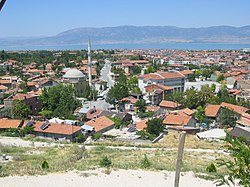
View on WikipediaBurdur is a city in southwestern Turkey. The seat of Burdur Province and of Burdur District,[2] it is located on the shore of Lake Burdur. Its population is 95,436 (2021).[1]
Key Information


History
[edit]

Ancient history
[edit]Whilst there is evidence of habitation in the province dating back to 6500 BC, the earliest sign of habitation in the city itself dates to Early Bronze Age. Artifacts from this period have been found in the site of today's railway station. In antiquity, the area was part of the region of Pisidia. It has been proposed that the city of Burdur has changed location a number of times; the ancient city of Limnombria ("Lake City") was closer to Lake Burdur than the modern city. It is known that in the Byzantine era, the city existed with the name Polydorion (Greek: Πολυδώριον), from which the current name is derived.[3] No remains of Polydorion survive to this day.[4] Burdur may also occupy the site of a town called Praetoria.[5]
Turkish settlement and the Hamidids
[edit]The history of the urban development of Burdur is generally held to begin with the Turkish settlement after the Seljuq victory at the Battle of Manzikert in 1071. In the late 11th century, the Kınalı tribe of the Oghuz Turks captured the Burdur area and settled there. Turks became the majority of the population of the area after 1211, establishing a number of villages in addition to expanding the town.[6] The first Turkish settlement was in an area known as Hamam Bendi that had a lower elevation than today's city but was farther to the lake than the ancient town of Limnombria. These residents used the site of today's Grand Mosque of Burdur as an open marketplace, known as Alanpazarı. Realising the high incidence of malaria in the area they had settled, these residents then moved uphill, away from the lake.[3] These first residents had not submitted to any state, but Kilij Arslan II, the Seljuq Sultan of Rum, captured the area in 1177 and imposed his sovereignty over the local tribes.[7] The town remained under the undisputed sovereignty of the Sultanate of Rum between 1206 and 1260, when it was captured by the Mongol Empire. Developing commerce in the port of Antalya increased the significance of Burdur as a centre of commerce. Tragacanth obtained from the mountains of Psidia, wine from Kütahya, wax, wood and tar from many parts of Anatolia passed through Burdur, in exchange of which Egyptian spices, cotton and sugar was traded.[6]
In 1300, the Hamidids under Dündar Bey captured Burdur. Dündar Bey had the Grand Mosque of Burdur built around a hilly area in 1300, and the town subsequently developed around the mosque. The Hamidids administered Burdur as a district under the town of Eğirdir. The Ilkhanate then captured Burdur in 1324 under the governor of Anatolia, Timurtash. Dündar Bey's son, İshak Çelebi, recaptured Burdur in 1328.[3] Traveller Ibn Battuta visited the town in 1330. In the account of his visit, he described Burdur as a town blessed with natural beauty and a number of orchards and farms, centred around the Burdur Castle near the Grand Mosque. No trace of the castle remains today except for the names of some of the streets, indicating that with the lack of a strategic requirement for a castle, it was gradually destroyed. The account also indicates the presence of a guild of ahis controlling commerce and production. By comparing the description of Burdur with the presentation of other cities such as Eğirdir, Isparta and Denizli, it can be deduced that Burdur was a relatively minor urban centre with limited commerce.[6] It was, nevertheless, still a stop on the trade route between Konya, the cities of the Black Sea and the ports of the Aegean Sea.[8]
Burdur was captured by the Ottoman Empire in 1391, when Bayezid I conquered the Hamidids. It was initially a district centre and a small town under the Sanjak of Hamid. As of 1478, Burdur had four quarters, three being Muslim and one being Christian. The largest of these was the Cami ("Mosque") quarter of the Muslims.[3]
There was a small Greek population living in the city until the Population exchange between Greece and Turkey. An abandoned Greek church in the city has been turned into a museum with a giant dinosaur fossil a few years ago.
Climate
[edit]Burdur has a hot summer mediterranean climate (Köppen climate classification: Csa) or a temperate oceanic climate (Trewartha climate classification: Do). It has chilly, wet and often snowy winters and hot, long and dry summers.
| Climate data for Burdur (1991–2020, extremes 1932–2023) | |||||||||||||
|---|---|---|---|---|---|---|---|---|---|---|---|---|---|
| Month | Jan | Feb | Mar | Apr | May | Jun | Jul | Aug | Sep | Oct | Nov | Dec | Year |
| Record high °C (°F) | 16.8 (62.2) |
23.4 (74.1) |
27.8 (82.0) |
30.7 (87.3) |
35.4 (95.7) |
38.7 (101.7) |
41.0 (105.8) |
41.6 (106.9) |
39.0 (102.2) |
33.6 (92.5) |
26.5 (79.7) |
20.5 (68.9) |
41.6 (106.9) |
| Mean daily maximum °C (°F) | 7.1 (44.8) |
9.4 (48.9) |
13.6 (56.5) |
18.2 (64.8) |
23.7 (74.7) |
29.0 (84.2) |
33.0 (91.4) |
33.1 (91.6) |
28.6 (83.5) |
22.2 (72.0) |
14.8 (58.6) |
8.6 (47.5) |
20.1 (68.2) |
| Daily mean °C (°F) | 2.5 (36.5) |
4.0 (39.2) |
7.4 (45.3) |
11.7 (53.1) |
16.7 (62.1) |
21.5 (70.7) |
25.2 (77.4) |
25.1 (77.2) |
20.5 (68.9) |
14.8 (58.6) |
8.5 (47.3) |
4.1 (39.4) |
13.5 (56.3) |
| Mean daily minimum °C (°F) | −1.0 (30.2) |
−0.2 (31.6) |
2.3 (36.1) |
6.1 (43.0) |
10.4 (50.7) |
14.3 (57.7) |
17.6 (63.7) |
17.6 (63.7) |
13.2 (55.8) |
8.6 (47.5) |
3.5 (38.3) |
0.6 (33.1) |
7.7 (45.9) |
| Record low °C (°F) | −16.7 (1.9) |
−15.0 (5.0) |
−11.6 (11.1) |
−7.0 (19.4) |
−0.4 (31.3) |
3.8 (38.8) |
9.0 (48.2) |
8.8 (47.8) |
3.4 (38.1) |
−2.4 (27.7) |
−12.0 (10.4) |
−15.3 (4.5) |
−16.7 (1.9) |
| Average precipitation mm (inches) | 48.0 (1.89) |
35.1 (1.38) |
46.9 (1.85) |
49.1 (1.93) |
49.3 (1.94) |
29.9 (1.18) |
18.8 (0.74) |
12.8 (0.50) |
17.1 (0.67) |
32.7 (1.29) |
36.8 (1.45) |
55.8 (2.20) |
432.3 (17.02) |
| Average precipitation days | 10.43 | 9.50 | 10.20 | 10.87 | 11.20 | 7.27 | 3.63 | 3.50 | 4.00 | 6.67 | 6.80 | 10.43 | 94.5 |
| Average snowy days | 4.14 | 2.71 | 2.14 | 0.14 | 0 | 0 | 0 | 0 | 0 | 0 | 0.29 | 1.64 | 11.06 |
| Average relative humidity (%) | 72.9 | 67.6 | 61.4 | 58.2 | 56.2 | 49.9 | 42.6 | 43.4 | 48.1 | 57.9 | 65.3 | 74 | 58.1 |
| Mean monthly sunshine hours | 115.0 | 142.9 | 181.2 | 214.4 | 272.2 | 319.3 | 356.6 | 336.3 | 269.9 | 222.0 | 166.7 | 103.2 | 2,699.5 |
| Mean daily sunshine hours | 3.7 | 5.1 | 5.9 | 7.2 | 8.8 | 10.6 | 11.5 | 10.8 | 9.0 | 7.2 | 5.6 | 3.3 | 7.4 |
| Source 1: Turkish State Meteorological Service[9] (extremes[10]) | |||||||||||||
| Source 2: NOAA(humidity, sun 1991-2020),[11] Meteomanz(snow days 2010-2023)[12] | |||||||||||||
Education
[edit]
Mehmet Akif Ersoy University is located in Burdur.
Notable residents
[edit]- Burdurlu Dervish Mehmed Pasha Ottoman Grand Vizier 1818-1820
- Burdurlu Ahmet Şükrü Pasha Ottoman Military Doctor, with major improvements in medical awards[clarification needed]
References
[edit]- ^ a b "Address-based population registration system (ADNKS) results dated 31 December 2021" (XLS) (in Turkish). TÜİK. Retrieved 30 January 2023.
- ^ İl Belediyesi, Turkey Civil Administration Departments Inventory. Retrieved 30 January 2023.
- ^ a b c d "Burdur". İslam Ansiklopedisi. Vol. 6. Türk Diyanet Vakfı. 1992. pp. 426–429.
- ^ "Burdur". Büyük Larousse. Vol. 4. Milliyet. p. 2012.
- ^ Lund University. Digital Atlas of the Roman Empire.
- ^ a b c Çetin, Bayram (2007), Burdur kent coğrafyası (PhD thesis) (in Turkish), Atatürk University, pp. 68–74
- ^ Atasoy, Sertan (2013), Burdur'un ilçelerindeki Türk dönemi eserleri (Master's thesis) (in Turkish), Pamukkale University, pp. 3–6
- ^ Eskikurt, Adnan (2014). "Ortaçağ Anadolu Ticaret Yolları". Muğla Sıtkı Koçman University Journal of the Institute of Social Sciences (33): 15–40.
- ^ "Resmi İstatistikler: İllerimize Ait Mevism Normalleri (1991–2020)" (in Turkish). Turkish State Meteorological Service. Retrieved 27 June 2021.
- ^ "İllerimize Ait Genel İstatistik Verileri: Burdur" (in Turkish). Turkish State Meteorological Service. Retrieved 9 April 2024.
- ^ "WMO Climate Normals for 1991-2020: Burdur" (CSV). ncei.noaa.gov. National Oceanic and Atmospheric Administration. Retrieved 9 April 2024.
- ^ "Burdur - Weather data by months". meteomanz. Retrieved 17 July 2024.
External links
[edit]

| International | |
|---|---|
| National | |
| Geographic | |
| Other | |

Burdur
View on GrokipediaGeography
Location and topography
Burdur is located in southwestern Turkey at coordinates 37°43′10″N 30°17′00″E, with an average elevation of approximately 950 meters above sea level.[9][10] The province lies within the Lakes Region (Göller Yöresi), a distinctive geographical area characterized by numerous inland water bodies and elevated terrains.[11] It is bordered by Afyonkarahisar Province to the north, Isparta Province to the east, Antalya Province to the southeast, Muğla Province to the southwest, and Denizli Province to the west.[12] The topography of Burdur Province is dominated by a high plateau landscape, with elevations ranging from 800 to 1,000 meters, interspersed with valleys and about 60% mountainous terrain.[13] The region is flanked by the Western Taurus Mountains (Batı Toroslar), which form a significant barrier separating the interior plateau from the Mediterranean coastal lowlands.[14] The city of Burdur itself is positioned along the eastern shore of Lake Burdur, a tectonic lake that influences the local urban layout and provides a natural boundary for settlement expansion.[15] Geologically, the Burdur area is shaped by neotectonic processes within the Isparta Angle, a complex structural zone resulting from the convergence of the African and Arabian plates with the Eurasian Plate.[16] Extensional tectonics along the Fethiye-Burdur Fault Zone have led to the formation of half-grabens, which host lacustrine deposits and contribute to the plateau's development.[17] The prevalence of carbonate rocks, primarily limestones from Paleozoic to Cenozoic eras, has fostered extensive karstification in the Western Taurus, producing features such as sinkholes (dolines), poljes (flat-floored depressions resembling plateaus), and underground drainage systems.[18][19] These karst landforms are particularly evident on local highlands like Kestel Mountain, where dissolution processes have sculpted the terrain over millennia.[20]Lakes and environment
Lake Burdur, a tectonic saline lake spanning approximately 250 km² in southwestern Turkey, features brackish, highly alkaline waters with a pH around 9.5 and serves as a vital closed-basin ecosystem.[21][22] Designated as a Ramsar wetland of international importance on July 13, 1994, it encompasses 24,800 hectares and functions as a key habitat within the Burdur and Isparta provinces.[21] Adjacent water bodies include Salda Lake, celebrated for its striking white sand beaches derived from magnesium-rich travertine formations and vivid turquoise hues, which earned inclusion in UNESCO's top 100 geological heritage sites in 2024.[23][24] The region's biodiversity thrives around these lakes, supporting endemic aquatic species such as the critically endangered Burdur killifish (Aphanius sureyanus), unique to the local lakes system.[25] Amphibian populations, including local water frogs like Pelophylax species in the Burdur area, contribute to the wetland's herpetofauna diversity.[26] Local breeds such as the Pirlak sheep, adapted to the lakeside pastures, reflect the area's pastoral heritage.[27] Lake Burdur stands as a critical stopover on bird migration routes, hosting over 190 species, including the globally threatened white-headed duck (Oxyura leucocephala), which finds one of its premier wintering grounds here.[28][29] Surrounding flora features expansive lavender fields, particularly in Yeşilova district, where blooms enhance pollinator habitats and aromatic ecosystems from mid-June onward.[30] Environmental pressures threaten this ecosystem, with Lake Burdur's water levels dropping by about 21 meters over the past half-century, resulting in approximately 50% volume loss since 1975 due to upstream dams, excessive groundwater extraction for agriculture, and drought exacerbated by rising temperatures. As of 2025, the decline continues, with the lake having lost about half its area over the last 50 years, prompting conservation roadmaps such as a March 2025 meeting to address the issue.[31][32][25] Agricultural runoff introduces pollutants, elevating salinity and risking algal blooms that harm endemic biota.[22] Conservation measures encompass its designation as a wildlife reserve in 1994, integrated protected areas under the Ramsar framework, and initiatives by organizations like Doğa Derneği to regulate water use and restore inflows, aiming to mitigate further shrinkage projected at up to 7 meters by mid-century.[21][33][34]Climate
Burdur experiences a hot-summer Mediterranean climate classified as Köppen Csa, marked by prolonged hot and dry summers followed by mild to cool, wet winters. This classification reflects the region's distinct seasonal shifts, with summers dominated by high pressure systems leading to arid conditions and winters influenced by cyclonic activity from the Mediterranean. The climate supports a variety of vegetation adapted to these patterns, though increasing temperatures in recent decades have begun to alter traditional rhythms.[35][36] Average annual temperatures hover between 12°C and 15°C, with monthly means rising from about 2.5°C in January to 25.2°C in July based on long-term observations from 1981 to 2010. Summer daytime highs frequently exceed 30°C, peaking at an all-time record of 41.0°C in both July and August, while winter nights can plummet to -16.7°C, the lowest recorded in January. These extremes underscore the continental influences within the broader Mediterranean framework, occasionally amplified by the province's varied topography that creates localized microclimates.[37] Annual precipitation averages 433 mm, concentrated primarily in the winter half of the year, with December and January typically receiving 80-100 mm each, accounting for over half of the total. Summers remain notably dry, with August seeing less than 10 mm on average, contributing to about 91 rainy days annually. The region benefits from approximately 2,699 hours of sunshine yearly, fostering clear skies for much of the summer but with occasional winter fog and light snow due to elevation and northerly winds moderating Mediterranean moisture.[38][35][39]History
Ancient and classical periods
The region of modern Burdur exhibits evidence of human habitation dating back to the Early Bronze Age, around 3000 BCE, with dense settlement patterns emerging in fertile valleys near water sources, as indicated by archaeological findings from regional sites.[40] These early communities, part of broader Anatolian Chalcolithic and Bronze Age cultures, relied on agriculture and pastoralism, with artifacts such as pottery sherds and tools attesting to organized territorial chiefdoms along the shores of Lake Burdur.[40] During the Iron Age, the area was inhabited by indigenous Anatolian groups, including Pisidians descended from Luwian speakers. In the Hellenistic period, Pisidian tribes established fortified settlements, with key urban centers developing as regional hubs.[41] Sagalassos, one of the primary sites, emerged in the late 5th century BCE during the Achaemenid period, developing into a fortified Pisidian settlement in the Hellenistic era following its conquest by Alexander the Great in 333 BCE; its expansions included a grand theater seating up to 9,000 and a bustling agora for trade and civic life.[42] Nearby Kibyra, relocated to its prominent mountainous site in the 3rd century BCE by Pisidian migrants seeking better fortification, emerged as a Hellenistic-Roman powerhouse, renowned for its stadium—the largest in ancient Asia Minor at 195 meters long, accommodating gladiatorial contests and athletic events for 10,000 spectators.[43] The Roman conquest in 25 BCE integrated Pisidia into the province of Galatia, ushering in a prosperous era for Burdur's ancient cities from the 1st century BCE to the 4th century CE, marked by imperial patronage and monumental construction.[41] Sagalassos, dubbed the "first city of Pisidia" by Emperor Hadrian, saw extensive infrastructure development, including aqueducts channeling water from mountain springs to public fountains like the Antonine Nymphaeum, as well as numerous inscriptions honoring Roman officials and benefactors.[44] Kibyra, rebuilt after a devastating 23 CE earthquake with funds from Emperor Tiberius, flourished as an economic center for leatherworking and horse breeding, its Roman-era bouleuterion and baths reflecting civic grandeur.[43] As Roman rule transitioned to Byzantine administration in the 4th century CE, settlements near Lake Burdur, such as Polydorion (the ancient name for modern Burdur), became important centers for early Christian communities that adapted classical structures for ecclesiastical use amid declining urban vitality.[1] Artifacts from these periods, including colossal marble statue heads of emperors Hadrian and Marcus Aurelius, finely crafted Sagalassos Red Slip Ware pottery, and inscribed stelae, are preserved in the Burdur Archaeological Museum, providing tangible links to the artistic and administrative sophistication of ancient Pisidia.[45]Medieval and Ottoman eras
Following the decisive Seljuk victory at the Battle of Manzikert in 1071, the region encompassing Burdur transitioned from Byzantine control to Seljuk dominance as part of the rapid Turkic expansion across Anatolia. Oghuz Türkmen tribes, integral to the Seljuk forces, began settling in western Anatolia, including areas around Burdur, introducing semi-nomadic pastoral traditions that shaped local land use and social structures for centuries.[46] With the decline of the Sultanate of Rum in the late 13th century, Burdur came under the rule of the Hamidid Beylik around 1300, when Dündar Bey captured the town and integrated it as a district under the administrative center of Eğirdir. The Hamidids, an Oghuz-derived Anatolian principality, fortified key sites in the region and periodically shifted their capital between Eğirdir and Antalya, reflecting strategic adaptations to Mongol Ilkhanate pressures; Burdur was briefly lost to the Ilkhanate in 1313 but recaptured by the Hamidids in 1324. This era marked Burdur's deeper integration into Islamic Turkish governance, with the construction of enduring structures like the Ulu Cami in 1300 by Dündar Bey, exemplifying Seljuk-influenced architecture with its simple stone facade and minaret base.[47] Hamidid-era mansions, featuring timber framing and overhanging upper stories, also emerged, serving as administrative and residential hubs that blended local Byzantine remnants with Turkic designs.[48] The Hamidid Beylik was annexed by the Ottoman Empire in 1391 under Sultan Bayezid I, transforming Burdur into the Sanjak of Hamid and solidifying Ottoman control over southwestern Anatolia.[49] Initially part of the Anatolia Eyalet, the sanjak was reassigned to the Karaman Eyalet by the mid-16th century, where it remained until the 1864 Provincial Redistricting Act reorganized it under the Konya Vilayeti, encompassing sanjaks such as Konya, Isparta, Burdur, Antalya, and Niğde.[50] During the Ottoman centuries (15th–19th), Burdur functioned as a modest administrative and agricultural center, with a diverse population including a notable Greek Orthodox community that maintained churches and contributed to trade until the early 20th century.[50] The Ulu Cami underwent restorations in the Ottoman period, adapting its Seljuk origins to imperial styles while preserving its role as a communal focal point.[47] By the 19th century, amid Tanzimat reforms aimed at centralization, the region saw tensions from fiscal pressures, though Burdur remained relatively stable compared to more volatile eastern provinces.[50]Modern development
During the late Ottoman Tanzimat reforms initiated in 1839, Burdur underwent administrative restructuring as part of broader centralization efforts, including the reorganization of provincial governance and the extension of telegraph networks to enhance imperial communication and control.[51][52] During the Turkish War of Independence (1919–1923), Burdur served as a key logistical base and site of resistance against Allied occupation forces, with local militias supporting Mustafa Kemal Atatürk's national movement. The establishment of the Republic of Turkey in 1923 marked a pivotal shift, with Burdur elevated to provincial status that same year, formalizing its role in the new national framework. This period also saw significant demographic transformations due to the 1923 population exchange between Greece and Turkey, which resulted in the exodus of the local Greek Orthodox community and the influx of Muslim refugees from Greece, reshaping social and economic structures in the region.[53][54] In the post-World War II era, Burdur began transitioning toward industrialization, with state-led initiatives promoting manufacturing and infrastructure to diversify beyond agriculture, though growth remained modest compared to coastal provinces.[55] A defining event was the May 12, 1971, earthquake centered near Yazıköy, measuring 6.2 on the moment magnitude scale, which claimed 57 lives, injured hundreds, and destroyed or severely damaged over 3,800 structures in Burdur and surrounding areas, leading to widespread displacement and accelerated urban rebuilding efforts with improved seismic standards.[56] The 2000s brought economic revitalization, particularly through the marble sector's rapid expansion, driven by increased quarrying and export activities that positioned Burdur as a key producer of high-quality stone, contributing to regional employment and revenue growth.[57] Concurrently, educational infrastructure advanced with the founding of the Burdur Faculty of Education in 1992 under Süleyman Demirel University (later evolving into Mehmet Akif Ersoy University in 2007), fostering higher education access and supporting local human capital development.[58] Urban expansion in recent decades has included the development of new residential and commercial districts, alongside enhanced infrastructure such as roads and public facilities, fueling steady population growth in the city center to approximately 95,907 by 2022.[59]Demographics
Population trends
Burdur city's urban population stood at 96,038 as of 2024, reflecting steady urban expansion within the province. The broader Burdur Province recorded 275,826 residents in 2024, according to official estimates derived from Turkey's address-based population registration system. These figures highlight a modest demographic scale compared to larger Turkish provinces, with the provincial total increasing from 251,550 in 2009 to 275,826 in 2024.[3][60] Historical population trends in Burdur Province demonstrate consistent growth over recent decades, primarily fueled by internal migration rather than high natural increase rates. From 264,779 residents in 2017 to 275,826 in 2024, the province experienced an average annual growth rate of approximately 0.6%, lower than the national average but indicative of sustained demographic stability until a slight decline in 2024. In the city center, growth has been more pronounced, rising from 85,312 in 2017 to 96,038 in 2024 at an annual rate of about 2.0%, driven by inflows seeking urban opportunities. Earlier data from 2009 shows the city at 71,611 and the province at 251,550, underscoring a pattern of acceleration in the 2010s amid broader Turkish urbanization dynamics.[61][62] Urbanization in Burdur has progressed significantly, with about 70.5% of the provincial population residing in urban areas as of 2024. This includes 194,501 people in province and district centers, contrasted with 81,325 in rural localities, highlighting a shift from dispersed rural settlements to concentrated hubs like the city center and districts such as Gölhisar. The median age in the province aligns closely with the national figure of 34.4 years in 2024, featuring a notable youth bulge where individuals under 30 constitute a substantial portion of the population structure, supporting long-term growth potential.[60][60][63] Migration patterns have been central to Burdur's demographic evolution, with net inflows from rural areas within the province and eastern regions of Turkey contributing to population gains. These movements, often motivated by job prospects in agriculture, industry, and services, follow broader national trends where less developed eastern provinces supply labor to western and central areas like Burdur. For instance, internal migration data indicate westward flows dominating, with Burdur benefiting from both intra-provincial rural-to-urban shifts and inter-regional arrivals.[60][64][60]| Year | Province Population | City Population | Annual Growth Rate (Province) |
|---|---|---|---|
| 2009 | 251,550 | 71,611 | - |
| 2017 | 264,779 | 85,312 | - |
| 2022 | 273,799 | 95,907 | - |
| 2023 | 277,452 | 118,000 | - |
| 2024 | 275,826 | 96,038 | 0.6% (2017–2024) |
Ethnic and religious composition
Burdur's population is predominantly ethnic Turkish, reflecting the broader demographic patterns of western Anatolia where Turks form the overwhelming majority. Small minority communities include Kurds and Circassians, with the latter maintaining a presence through historical settlements such as the village of Gencalı in Yeşilova district, home to a Circassian-speaking population of around 275 as of 2008. Kurdish communities are limited, with estimates suggesting a few thousand individuals, primarily in districts like Altınyayla (formerly Dirmil), which has historical ties to Kurdish migration and settlement patterns from eastern regions.[65][66] Religiously, the province is overwhelmingly Sunni Muslim, aligning with national figures where approximately 99% of Turkey's population identifies as Muslim, predominantly Hanafi Sunni. Christian communities, once present as a small Greek Orthodox minority numbering about 500 in 1918, were largely removed following the 1923 population exchange between Greece and Turkey, leaving negligible remnants; surviving Greek churches, such as those in the city center, have been repurposed as museums.[67][68] Historically, Burdur's ethnic diversity was more pronounced in the late Ottoman period, with a 1918 estimate recording 80,000 Muslim Turks alongside 500 Greeks and 60 Armenians in the province. The Yörük, a semi-nomadic subgroup of Turkish origin known for pastoral traditions in the Taurus Mountains, have long been integrated into the local population, contributing to the cultural fabric without forming a distinct ethnic minority.[68][69] Linguistically, Turkish serves as the official and dominant language, spoken by the vast majority. Among minority groups, dialects such as Circassian (Adyghe and related languages) persist in small communities like Gencalı, while Zazaki may be used by some Kurdish residents, though these are not officially recognized or widely documented in the province.[65]Economy
Agriculture and livestock
Burdur's agricultural sector centers on a mix of field crops and specialty plants, with wheat and barley serving as staple grains that form the backbone of local farming. These cereals are cultivated across extensive arable lands, benefiting from the region's fertile soils and suitable growing conditions. In addition, Burdur is renowned for its lavender production, particularly in Kuyucak village, where fields spanning approximately 300 hectares account for about 93% of Turkey's total lavender output.[70] The annual harvest occurs from late June through September, yielding essential oils used in perfumes, cosmetics, and aromatherapy products. Roses, another high-value crop, are prominently grown in the Ağlasun district, contributing to Burdur province's share of Turkey's oil rose production, with the extracted rose oil similarly destined for the perfume industry.[71] Fruit cultivation complements these crops, with cherries thriving in Ağlasun—often called the "Cherry Heaven" due to its ideal highland conditions—and olives grown in warmer, southern parts of the province.[70] These fruits provide both local consumption and export potential, supported by the area's varied topography. Livestock husbandry plays a vital role, focusing on sheep and goats adapted to the local environment, including breeds like the Honamlı goat prevalent in the Teke region. Dairy production, primarily from goats and cows, yields significant milk output—approximately 400,000 tons annually as of 2023—while meat from sheep and goats supports regional markets.[72] Irrigation practices rely heavily on water drawn from Lake Burdur and surrounding aquifers, enabling year-round farming but contributing to the lake's shrinkage, with over 40% water loss observed in recent decades. Organic farming trends are emerging, particularly in response to environmental pressures, with initiatives like organic black seed cultivation in Bucak district and efforts to establish organic villages to conserve water resources.[73] However, challenges such as recurrent droughts exacerbate water scarcity, threatening crop yields and livestock health amid declining lake levels and irregular precipitation patterns. The combined output from crops and livestock underpins a substantial portion of Burdur's economy, with animal husbandry alone accounting for roughly 85% of farm gross income in surveyed enterprises and contributing around 35% to the provincial agricultural GDP through dairy, meat, and related products.[72]Industry and mining
Burdur's mining sector is dominated by marble quarrying, particularly in the Bucak district, where the province hosts approximately 70 quarries and over 100 processing facilities, along with seven erection plants for natural stone products.[11] The extraction and initial processing of high-quality beige marble, known as Burdur Beige, support exports to 27 countries, though around 85% of output remains unprocessed at the local stage.[11] This activity positions Burdur as a key contributor to Turkey's natural stone industry, with the sector experiencing an annual growth rate of 25%.[11] Companies such as ADK Marble operate quarries in the Yeşilova district with an annual production capacity of 30,000 tons, focusing on beige varieties for international markets.[74] In manufacturing, Burdur's industrial base includes agricultural machinery production, which aligns with the province's strong farming heritage by supplying essential equipment like combine harvesters, haymakers, plows, seed drills, trailers, silage machines, baling machines, feed grinders, milk tanks, bakery ovens, and greenhouse pipes.[11] Firms such as Kayhan Ertuğrul Makina, established in 1995, manufacture these items on a 40,000 m² open and 25,000 m² closed facility using advanced technologies including robotic systems and CNC machinery.[75] The organized industrial zone in Burdur further supports this sector alongside other manufacturing activities.[76] Additional manufacturing encompasses textiles, food processing, and related fields. The textile industry features production of off-the-peg clothing and textile machinery, contributing to local economic diversification.[11] Food processing is prominent, with facilities handling meat, dairy products, kadayif (a traditional pastry), pasta, animal feed, flour, halwa, capers, and pickles; daily milk output exceeds 1,000 tons as of recent years, of which 10% undergoes processing.[5] Other sectors include soil-cement-brick production, wood and forest products, furniture, construction materials, spare parts, plastics, and even niche areas like weapons and musical instruments.[11] The development of Burdur's industry and mining accelerated following Turkey's economic liberalization in the 1980s, which encouraged private investment and export-oriented growth in extractive sectors like marble.[77] This shift transformed mining policies to attract foreign capital, boosting production capacities in regions like Burdur.[77] Environmental regulations have since been strengthened, with assessments required for quarry operations to mitigate impacts such as dust pollution and habitat disruption around Lake Burdur, though challenges persist in balancing extraction with ecological protection.[78]Tourism and services
Burdur's tourism sector is anchored by its natural and historical attractions, drawing visitors seeking a blend of archaeological exploration and outdoor recreation. The ancient city of Sagalassos, perched in the Taurus Mountains near Ağlasun, features well-preserved Hellenistic and Roman ruins including a grand theater, agora, and aqueducts, attracting history enthusiasts year-round.[79] Salda Lake, renowned for its turquoise waters and white magnesium-rich beaches often dubbed the "Turkish Maldives," offers swimming, hiking, and camping opportunities, with 323,596 visitors recorded in 2021 alone. To protect the site, annual visitor limits were set at 570,000 starting in 2021.[80] Thermal springs at Çavdır provide therapeutic bathing experiences, contributing to health tourism in the Lakes Region.[81] Overall, Burdur welcomed approximately 500,000 visitors in recent years, including 152,052 staying tourists and additional day-trippers to sites like Sagalassos and İnsuyu Cave.[82][83] Agri-tourism has emerged as a niche draw, particularly through farm tours in rural areas. In Yeşilova district, the Akçaköy Lavender Valley spans over 1,000 decares and blooms vibrantly from late June to early July, hosting hundreds of thousands of visitors for photography, product tastings like lavender ice cream, and educational walks as part of the Lisinia Nature Project.[83] Near Ağlasun, rose farms cultivate Rosa damascena for oil production, with community-based tours highlighting harvest processes and women's cooperatives that empower local farmers while showcasing peri-urban agricultural traditions.[84] These initiatives tap into cultural tourism potential, integrating lavender and rose cultivation with nearby ancient sites to promote sustainable rural experiences.[85] The service sector supports tourism through expanding hospitality and retail options, fostering economic diversification. As of 2021, Burdur had 52 licensed accommodation facilities, including 26 hotels and apart-hotels with 1,277 rooms and 2,409 beds, alongside rural guesthouses catering to eco-tourists.[82] Retail outlets specializing in local lavender products, rose essences, and handicrafts have grown alongside visitor demand, enhancing resident perceptions of tourism's benefits like job creation and improved living standards.[82] Tourism and services collectively bolster the provincial economy by generating employment and stimulating ancillary businesses, though exact GDP shares remain tied to broader regional trends in the Western Mediterranean.[86] Development efforts emphasize sustainability and infrastructure upgrades, with seasonal peaks in summer driving up to 70% of annual visits to lakeside and beach areas. EU-aligned rural tourism policies have funded initiatives across Turkey, including Burdur's promotion of agri-tourism and heritage preservation to address infrastructure gaps and extend the tourism season beyond July-August highs.[87] These projects enhance accessibility to attractions like Salda Lake while mitigating overtourism risks in emerging destinations.[88]Government and infrastructure
Local administration
Burdur is the capital of Burdur Province, established in 1923 during the administrative reorganization following the founding of the Republic of Turkey. The province's governance is headed by a governor appointed by the central government, who represents national authority, coordinates security, and oversees public services across the region. As of 2024, the governor is Tülay Baydar Bilgihan, who has prioritized ecological preservation in alignment with national development goals.[89] At the municipal level, the city of Burdur is administered by the Burdur Municipality under Mayor Ali Orkun Ercengiz of the Republican People's Party (CHP), re-elected in the March 2024 local elections with 46.3% of the vote.[90] The municipal council comprises 37 elected members from multiple parties, tasked with legislating on local matters such as budgeting, urban development, and community services. Key responsibilities include waste management, zoning for residential and commercial areas, and maintenance of public spaces to support daily urban life. Burdur Province is subdivided into 11 districts, each governed by an appointed kaymakam (district governor) who manages local administration under provincial oversight; prominent examples include Bucak, a hub for commerce and light industry, and Gölhisar, centered on rural services. These districts handle devolved functions like civil registry, emergency response, and basic infrastructure, ensuring coordinated delivery of services across diverse terrains from lakeside areas to highlands.[91] Local policies in Burdur emphasize sustainability and tourism promotion, with the provincial and municipal administrations implementing measures to protect natural assets like lakes and forests while fostering eco-friendly visitor experiences. Initiatives include regulations on land use to prevent environmental degradation and promotional campaigns highlighting cultural heritage sites, aiming to balance economic growth with long-term resource conservation.[89]Transportation networks
Burdur's transportation infrastructure primarily relies on a well-developed road network that connects the province to major regional centers. The D650 state highway serves as the main artery, linking Burdur to Antalya approximately 124 kilometers south, with a typical driving time of 1.5 to 2 hours under normal conditions.[92] This route facilitates efficient access to the Mediterranean coast, while the same highway extends northward to Isparta, reachable in about 40 minutes. The provincial road system, managed by the General Directorate of Highways, encompasses around 552 kilometers of paved roads, including 418 kilometers of asphalt concrete and 134 kilometers of surface treatment, supporting local connectivity across the province's rural and urban areas.[93] Rail transport in Burdur is limited to conventional lines, with the province featuring a local station on the existing network operated by Turkish State Railways (TCDD). However, proximity to high-speed rail development is increasing through the ongoing Eskişehir-Afyonkarahisar-Burdur-Antalya line project, a 524-kilometer route designed to integrate Burdur into Turkey's national high-speed network and reduce travel times to major cities like Istanbul and Ankara. Managed by TCDD, this initiative remains under development as of 2025, with the Burdur-Antalya segment partially constructed but not fully operational for high-speed service, aiming to enhance regional mobility.[94][95][96][97] Burdur lacks its own airport, relying on nearby facilities for air travel. The closest option is Isparta Süleyman Demirel Airport, located about 29 kilometers away, offering domestic flights primarily to Istanbul and Ankara. For international connections, Antalya International Airport, approximately 102 kilometers south, serves as the primary gateway, with expanded capacity to handle up to 82 million passengers annually following infrastructure upgrades completed in 2025.[98][99][100] Future regional plans include further enhancements to these airports, such as new terminals and air traffic control improvements at Antalya by 2026, to support growing tourism demands that benefit Burdur's economy. Public transportation in Burdur emphasizes bus services for both intercity and urban mobility. Intercity travel is dominated by private operators like Kamil Koç, Pamukkale, and Metro Turizm, departing from Burdur Bus Terminal to destinations such as Istanbul (10-11 hours), Antalya (2 hours), and Izmir (6-7 hours), providing affordable and frequent options. Within the city and province, dolmuş minibuses operate on fixed routes, offering convenient short-distance service without the need for extensive public rail or tram systems, though coverage is concentrated in the urban center.[101][102]Culture and heritage
Archaeological sites and museums
Burdur Province is renowned for its rich archaeological heritage, particularly the ancient cities of Sagalassos and Kibyra, which showcase remnants of Pisidian and Lycian civilizations spanning from the Hellenistic period through the Roman and Byzantine eras. Sagalassos, located near the town of Ağlasun, features well-preserved Roman structures including baths, temples such as the Temple of Apollo Klarios, and the Antonine Nymphaeum fountain, which has been restored to functionality.[42] This site, inscribed on UNESCO's World Heritage Tentative List in 2009, exemplifies urban planning with its terraced layout adapted to the rugged Taurus Mountains terrain.[42] Kibyra, situated near Gölhisar, is another highlight with its monumental stadium capable of seating approximately 10,000 spectators, one of the largest and best-preserved in Anatolia, alongside a Hellenistic-Roman theater and an odeon featuring a notable Medusa mosaic.[43] Also on UNESCO's Tentative List since 2016, Kibyra reflects the region's role as a center for gladiatorial contests and cultural events.[43] Lesser-known sites like Kremna, near Çamlık village, preserve Pisidian ruins including rock-cut tombs, a necropolis, and remnants of pagan temples from the Roman period, offering insights into cliffside fortifications and early Christian influences.[103] The Burdur Archaeological Museum serves as the primary repository for artifacts from these sites, housing over 71,000 items as of 2025 including marble statues, pottery, mosaics, and inscriptions dating from the Bronze Age to the Byzantine period.[104] Key exhibits include grand sculptures from Sagalassos, such as the Hermes statue, and coins from Kibyra, illustrating economic and artistic exchanges across ancient Anatolia.[92] Complementing this, the Sagalassos Visitor Center near Ağlasun features a permanent exhibition hall displaying excavated materials like ceramics and architectural fragments, providing contextual narratives on the city's daily life and urban development.[105] Systematic excavations at these sites have been ongoing since the 1990s, primarily led by KU Leuven's Sagalassos Archaeological Research Project, which has uncovered significant pottery assemblages, mosaic floors, and urban infrastructure revealing settlement patterns from the 3rd millennium BCE onward. In 2025, excavations at Sagalassos uncovered a sphinx figure, a large odeon, and a Roman association building, while Kibyra's Medusa mosaic was reopened to visitors in April.[106][107][108][109][110] At Kibyra, digs since 2006 by Akdeniz University have revealed gladiatorial artifacts and the stadium's substructures, while Kremna's explorations highlight its role as a Hellenistic colony with Roman overlays.[43] Preservation efforts, supported by international funding including EU grants through cultural heritage programs, have focused on restoration projects such as the stabilization of Sagalassos' theater and the reconstruction of Kibyra's bouleuterion, ensuring these sites remain accessible for scholarly and public study.[111]Festivals and traditions
Burdur's festivals and traditions are deeply rooted in its Yörük heritage and natural bounty, fostering communal bonds and attracting visitors to celebrate local identity. The Aziziye Highland Festival, a longstanding yayla (pastoral) tradition in Aziziye village, features folk dances, live music by local artists, and Yörük customs such as traditional attire displays, typically occurring in July to mark the summer migration season.[47] Traditional practices in Burdur reflect its nomadic Yörük past, with weddings serving as vibrant communal rituals that preserve oral histories and social norms. Yörük weddings often involve elaborate processions, including the "damat donatma" custom where the groom is adorned in finery before the ceremony, accompanied by sipsi music and collective dances like zeybek, reinforcing family ties and hospitality.[112] In Ağlasun district, the rose harvest in late May to June follows time-honored methods, where families rise at dawn to hand-pick petals from terraced fields, a practice tied to the area's Ottoman-era cultivation that sustains local perfumery and evokes ancestral agrarian rhythms.[84] Alevi communities in districts like Senirkent influence certain rituals, incorporating semah dances and communal meals during gatherings that blend spiritual and folk elements, though these remain more private than public spectacles.[113] Cultural events further enrich Burdur's calendar, with the Lavender Harvest and Arts Days in late June transforming fields in Yeşilova into hubs of activity, including guided harvests, scent workshops for soaps and perfumes, and art installations amid the purple blooms, promoting sustainable agriculture.[114] Folk dances and music, such as teke zortlatması and boğaz havası performed on sipsi, are integral to these occasions, often led by women in rural settings to recount Yörük migrations.[115] These festivals and traditions play a vital role in Burdur's community life, enhancing social unity through shared participation across diverse ethnic groups and boosting tourism by highlighting the province's pastoral and floral heritage.[47]Local cuisine and arts
Burdur's local cuisine draws heavily from the region's agricultural and pastoral resources, featuring hearty dishes that blend Mediterranean freshness with Ottoman-influenced techniques. Signature meat preparations include Burdur şiş, a skewered kebab made with tender local lamb seasoned simply with salt and grilled over charcoal, and Dirmil kebap, a variant using marinated meat cooked on skewers. Dairy products play a prominent role, as seen in guymak, a rich cornmeal and cheese dish, while testi kebab involves lamb or beef slow-cooked in a sealed clay pot for tender, flavorful results.[116][117] These elements reflect the province's reliance on livestock rearing, with both Burdur şiş and ceviz ezmesi (walnut paste, a dense sweet made from ground walnuts, sugar, and breadcrumbs) holding geographical indication status for their unique regional preparation.[117] Desserts in Burdur emphasize local produce, such as kabak helvası, a semolina-based halva enriched with pumpkin and often topped with walnuts, and ceviz helvası, featuring caramelized sugar and nuts for a chewy texture. Breads like çanak ekmek, baked in earthenware dishes, complement meals, while bulamaç aşı, a porridge of bulgur and yogurt, serves as a comforting staple. Weekly bazaars in towns like Burdur city center offer these items fresh, fostering a fusion of everyday home cooking and market-driven Ottoman-Mediterranean flavors.[116][117] Culinary tourism has grown, with visitors seeking authentic experiences at family-run eateries that highlight these specialties.[117] In the realm of arts, Burdur's handicrafts preserve ancient Anatolian techniques, particularly in textile production. Dokumacılık, or weaving, is a longstanding tradition where artisans create kilims and alaca dokumalar—vibrant flat-woven rugs and fabrics with geometric patterns using natural root dyes—often for tablecloths, bedspreads, and clothing. Ibecik fabrics, lightweight cotton weaves used historically for bridal attire and headscarves, exemplify this craft's delicacy.[118][117] Pottery, or çömlekçilik, draws inspiration from prehistoric motifs found in the region, producing utilitarian items like pots and decorative vessels from local clay. Wood carving, known as ahşap oymacılığı, involves intricate designs on furniture and utensils, reflecting Ottoman influences in floral and geometric reliefs.[119] Modern efforts sustain these arts through cooperatives and tourism initiatives, such as projects reviving kilim weaving with contemporary small-scale carpets for export, ensuring economic viability while maintaining cultural authenticity. Artisan workshops in rural areas like those near Bucak promote hands-on learning, blending tradition with market demands.[120][117]Education and health
Higher education
Burdur's higher education landscape is dominated by Mehmet Akif Ersoy University, a public institution established in 2006 and named after the esteemed Turkish poet and composer of the national anthem, Mehmet Akif Ersoy.[121] With an enrollment of approximately 28,000-35,000 students as of the 2024-2025 academic year, the university operates across 14 faculties, including those dedicated to engineering and architecture, agriculture, applied sciences, and the newly established Faculty of Medicine in July 2025, fostering education aligned with the province's economic and environmental priorities.[122][121][123] Its programs emphasize practical applications, such as agricultural sciences that support local farming practices and tourism management to bolster the region's heritage-based economy.[121] Key academic offerings include specialized programs in archaeology within the Faculty of Arts and Sciences, which maintain strong ties to excavations at the ancient site of Sagalassos, contributing to the preservation and study of Burdur's rich historical legacy through fieldwork and interdisciplinary research.[124] The Faculty of Veterinary Medicine, established as part of the university's early development, focuses on animal health and livestock production, addressing the province's pastoral economy with initiatives like embryo transfer technologies and breeding programs for local goat breeds.[125] These programs equip graduates to tackle regional challenges, such as sustainable animal husbandry in rural areas.[126] The university's facilities are centered in Burdur's urban core, featuring modern campuses with libraries, research centers, and student accommodations that support both domestic and international scholars.[122] International partnerships, particularly through the EU's Erasmus+ program, facilitate student exchanges and collaborative projects with over 100 institutions across Europe and beyond, enhancing global exposure for participants.[127] Mehmet Akif Ersoy University plays a vital role in regional development by enrolling a significant portion of Burdur's youth and driving research initiatives, including scientific workshops and studies on Lake Burdur's ecological health amid environmental pressures like drying shorelines. These efforts, often involving multidisciplinary teams, inform conservation strategies and underscore the institution's commitment to addressing local environmental issues through evidence-based scholarship.[128]Primary and secondary education
The primary and secondary education system in Burdur province encompasses 85 primary schools (grades 1-4), 76 middle schools (grades 5-8), and 57 high schools (grades 9-12), forming a network that supports foundational learning for students up to age 18.[129] These institutions serve approximately 36,000 enrolled students, with primary enrollment at 13,448, middle school at 12,410, and high school at 10,385 as of the 2024-2025 academic year.[129] The province's literacy rate among those aged 6 and over reached 98% in recent assessments, reflecting strong foundational education outcomes aligned with national improvements.[130] Vocational tracks within high schools emphasize sectors key to Burdur's economy, including agriculture and tourism, with institutions like the Burdur Vocational and Technical High School enrolling 559 students in practical programs such as modern farming techniques and hospitality management.[131] A notable example is the local agriculture high school, where 131 students engage in hands-on training through partnerships with agricultural technology firms, generating practical revenue while building skills in sustainable livestock and crop production.[132] These programs help address regional employment needs, with vocational enrollment contributing to about 30% of high school students overall. Despite these strengths, challenges persist in rural areas, where multigrade classrooms—common in remote villages—pose difficulties for teachers in delivering differentiated instruction and assessment across multiple grade levels simultaneously.[133] Teacher shortages exacerbate access issues, particularly in isolated districts, leading to administrative burdens on existing staff and calls for targeted in-service training.[133] To mitigate these, national initiatives provide free meals and transportation to support attendance, especially for low-income and rural youth, alongside efforts to improve infrastructure in underserved areas.[134] On performance metrics, Burdur students demonstrate above-national-average results in key exams, with top high schools achieving LGS entry scores around 435-440 points—exceeding the national average of approximately 350 points in 2024—and stable placement rates in competitive programs.[135][136] This success is supported by a youth demographic where roughly 25% of the population is under 18, underscoring the importance of accessible schooling for long-term provincial development.[137]Healthcare services
Burdur's healthcare infrastructure centers on public facilities managed under Turkey's Ministry of Health, with the Burdur State Hospital serving as the primary tertiary care provider. This 475-bed facility offers comprehensive services including emergency care, surgery, and internal medicine, handling a significant portion of the province's inpatient needs.[138] The hospital's orthopedics and traumatology clinic is particularly active, reflecting the region's history of seismic activity, such as the 1971 Burdur earthquake, which has informed specialized trauma care protocols.[139] Complementing the state hospital, Mehmet Akif Ersoy University, established in 2006, recently launched its Faculty of Medicine in July 2025, which includes affiliated clinics providing outpatient services and training in various specialties.[123] Primary care is delivered through 36 family health centers across the province, focusing on preventive services, vaccinations, and routine check-ups to support community-level health management.[140] These centers address local environmental health concerns, including monitoring pollution impacts from Lake Burdur, such as heavy metal exposure in surrounding areas, through biomonitoring and public advisories.[141] Public health outcomes in Burdur reflect effective service delivery, with life expectancy at birth reaching 79.1 years in 2020, above the national average.[142] Infant mortality stands at 8.8 per 1,000 live births, indicating improved neonatal care amid regional challenges.[143] Healthcare access is universal through the Social Security Institution (SGK), covering nearly all residents for hospital and primary services, while rural mobile health units extend care to remote villages via periodic visits and screenings.[144][145]Notable people
Historical figures
One of the earliest prominent figures associated with Burdur is Feleküddin Dündar Bey (d. 1326), a ruler of the Hamîdoğulları Beyliği who significantly shaped the region's medieval political landscape. As the son of İlyas Bey and grandson of the beylik's founder Hamîd Bey, Dündar Bey served as emir in Burdur during his youth before succeeding his father and relocating the beylik's capital from Uluborlu to Eğirdir around 1301-1302, renaming it Felekâbâd. He expanded the beylik's territories to include Antalya (captured in 1316), Gölhisar, Korkuteli, and areas reaching Denizli and the Germiyan border, amassing nine cities, fifteen castles, and an army of approximately 30,000 soldiers. In Burdur, he constructed the Ulucami (Great Mosque) in 1300-1301, as evidenced by its inscription, and minted coins in Eğirdir from 1307 onward, initially acknowledging İlhanlı suzerainty before declaring independence as "sultan" in 1321. His rule ended tragically in 1326 when he was betrayed and killed by his nephew Mehmûd Bey in alliance with the karamanid Demirtaş Paşa.[146] Burdurlu Ahmet Şükrü Pasha (d. 1899) was an Ottoman military physician who advanced military medicine, serving as head of the Imperial Medical School and contributing to reforms in healthcare during the late 19th century. Born in Burdur, he implemented major improvements in army hygiene and treatment protocols. In the Ottoman era, Burdurlu Derviş Mehmed Paşa (c. 1765–1837) emerged as a key administrative leader, serving as Grand Vizier from 6 January 1818 to 5 January 1820 under Sultan Mahmud II. Born in Burdur to Rüstem Ağa, a notable from the Nafplion region in Morea, he rose through the ranks, holding positions such as vezir and later contributing to the sultan's early modernization efforts amid the empire's reformist phase. During his tenure, he supported initiatives to strengthen central authority and military restructuring, aligning with Mahmud II's broader agenda to address internal challenges like the Janissary corps' decline. Exiled to Bursa after his dismissal, he was later pardoned and recommended the physician Ali Behçet Efendi to the sultan, facilitating medical advancements in the empire. He died in Yenbu, Hijaz, in 1837.[147] Burdur also produced influential ulema who enriched Ottoman scholarly traditions through its madrasas, which gained regional renown by the 18th century as the "Küçük Medine" (Little Medina) for their rigorous Islamic education. Büyük Şeyh İbrahim Efendi (d. 1725), a pivotal figure, revitalized local ilim (knowledge) by establishing an 11-cell medrese at Şeyh Sinan Camii and authoring works on fiqh and tasawwuf; he traveled extensively to Mecca and joined military campaigns, including one in 1716, before dying near Bucak. His descendants, such as Şeyhzade Ali Efendi (d. 1764), who managed Burdur vakıfs and served as müderris at Çelebi Paşa Medrese in Konya, and Şeyhzade Ömer Efendi (d. c. 1839), author of Envârü'l-Meksûne on hadith, extended this legacy in administration and jurisprudence across Rumeli and Anatolia. Another notable was Küçük Şeyh Mustafa Efendi (d. 1827/1828), a two-time müftü of Burdur who advised Sultan Mahmud II, built a library with over 500 volumes, and composed tefsir and fiqh treatises.[148] These figures left enduring administrative and cultural impacts on Burdur and the broader Ottoman context. Feleküddin Dündar Bey's expansions and constructions laid foundational infrastructure, including mosques and fortifications that integrated the region into Anatolian beylik networks before Ottoman incorporation in 1391. Burdurlu Ahmet Şükrü Pasha's medical reforms enhanced Ottoman military health systems. Derviş Mehmed Paşa's vizierate bolstered central reforms, enhancing Burdur's ties to imperial governance. The ulema's madrasa system fostered a tradition of scholarship that produced administrators and jurists, contributing to Ottoman religious and legal stability while elevating Burdur's status as an educational hub in the Hamid Sancağı.[149]Contemporary personalities
Burdur has produced several notable figures in politics, media, arts, and sports who have gained national and international recognition in recent decades. Ayşen Gürcan, born in Burdur in 1963, is an academic and bureaucrat who served as Turkey's interim Minister of Family and Social Policies in 2015, focusing on social research and policy development during her tenure at the Ministry.[150][151] She holds a doctorate in educational technology and previously led the General Directorate of Family and Social Research, contributing to family policy frameworks in Turkey.[152] Fakir Baykurt (1929–2005), born in Akçaköy, Yeşilova district of Burdur, was a renowned Turkish writer and educator known for his realist novels depicting rural life and social issues, such as Yılanın Öcü (Revenge of the Snake), which critiqued feudalism and poverty in Anatolia. A former teacher and union leader, his works earned him the Orhan Kemal Novel Prize and influenced Turkish literature on agrarian themes. In journalism and politics, Mustafa Balbay, born in Burdur's Yeşilova district in 1960, is a prominent writer and former member of the Turkish Grand National Assembly representing İzmir for the Republican People's Party from 2011 to 2015 and again since 2018.[153] Known for his investigative reporting as a correspondent for the Cumhuriyet newspaper, Balbay authored several books on Turkish politics and faced imprisonment from 2008 to 2014 on charges related to the Ergenekon case before his release and election to parliament.[154] The film industry is represented by Osman Sınav, born in Burdur in 1956 and who passed away on 20 March 2025, an influential director and producer renowned for creating the iconic Turkish TV series Deli Yürek (1998–2007) and Kurtlar Vadisi (Valley of the Wolves, 2003–2005), which shaped modern Turkish television drama with themes of action and social commentary.[155][156] Trained in fine arts and cinema at Istanbul State Fine Arts Academy, Sınav produced over 20 films and series, earning acclaim for his narrative style that blended entertainment with cultural critique.[157] In music, Sümer Ezgü, born in Burdur in 1960, is a celebrated Turkish folk singer, composer, and broadcaster who has preserved and popularized Anatolian folk traditions through albums like Yayla Yollarında and performances on TRT channels.[158] A graduate of Ankara's Gazi University in physical education, Ezgü has released over 15 albums since the 1980s, focusing on regional folk songs from Burdur and surrounding areas, and served as a program editor for Turkish Radio and Television Corporation. Acting contributions include Taner Barlas, born in Burdur in 1947, a veteran performer with roles in Turkish cinema and television, notably appearing in international films like The Accidental Spy (2001) alongside Jackie Chan and domestic series such as Yüksek Sosyete (2016).[159] Trained at Muhsin Ertuğrul's LCC Theater School in the 1960s, Barlas has appeared in over 50 productions, often portraying complex character roles in drama and comedy.[160] Emerging in sports, Hasan Berat Kayalı, born in Burdur's Bucak district in 2005, is a rising footballer who debuted for the Turkey national under-19 team in 2024 and plays as a midfielder for Kayserispor in the Süper Lig, marking Burdur's growing presence in professional athletics.[161]References
- https://wikitravel.org/wiki/en/index.php?title=Burdur&mobileaction=toggle_view_desktop