


Community hub
Recent from talks
Contribute something
Nothing was collected or created yet.
Buton
View on Wikipedia | This article needs additional citations for verification. (August 2009) |

Key Information


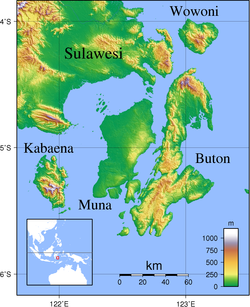
Buton (also Butung, Boeton or Button) is an island in Indonesia located off the southeast peninsula of Sulawesi. It covers roughly 4,727 square kilometers in area, or about the size of Madura; it is the 129th largest island in the world and Indonesia's 19th largest in area.
History
[edit]
In the precolonial era, the island, then usually known as Butung, was within the sphere of influence of Ternate. Especially in the sixteenth century, Buton served as an important secondary regional center within the Ternaten empire, controlling regional trade and collecting tribute to be sent to Ternate.
The Sultanate of Buton ruled over the island from the 14th until the 20th century.[1]
Sultan Murhum, the first Islamic monarch on the island, is remembered in the name of the island's major harbor, Murhum Harbor, in Baubau.
Geography
[edit]Its largest town is Baubau, where the Wolio and Cia-Cia languages are spoken. Major nearby islands include Wawonii (to the north), Muna and Kabaena (to the west) and Siumpu (to the southwest). The Tukangbesi Islands lie just to the east where Tukang Besi is spoken, and is separated by the Gulf of Kolowana Watabo (Teluk Kolowana Watabo).
Batuatas Island is to the south. Also the Bouton Passage (as it was known in the pre-Independence era) was an important inter-island navigational location of the northern Flores Sea.[2]
Ecology
[edit]The island is largely covered by rainforest and is known for its wildlife. It is one of only two habitats of the anoa, a type of buffalo.


People
[edit]
The languages spoken on Buton include Wolio, Cia-Cia, various dialects of Muna, Tukang Besi, Kumbewaha, Lasalimu, Kamaru, Pancana, Busoa, Taloki, Kulisusu and Kioko.[3][4] The Indonesian language, the national language of Indonesia, is also widely used and taught in schools.
In 2009, the Cia-Cia tribe in Baubau city began to use the Korean Hangul alphabet for their language, based on textbooks created by the Hunminjeongeum Society, a linguistic society in Seoul.[5] While ties with the society were temporarily severed in 2011,[6] efforts to preserve Cia-Cia using Hangul were not abandoned. The language continues to be taught using Hangul in schools, and a Cia-Cia dictionary using Hangul was published in 2021.[7]
Economy
[edit]The island has a massive reserve of natural asphalt and several other minerals. Asphalt from Buton can be utilized as bitumen modifiers[8] as well as a substitute for petroleum asphalt. As a result, natural asphalt can be used to reduce dependency on conventional fossil based resources.
Administration
[edit]Buton Island is administratively divided into five second level administrative divisions (Daerah Tingkat II): Baubau City, Buton Regency, (part of) South Buton Regency (which includes several smaller islands to the west and south of Buton), North Buton Regency and (part of) Muna Regency.
| Kabupaten | Area in km2 |
Pop'n Census 2010 [9] |
Pop'n Census 2020 [10] |
comprising |
|---|---|---|---|---|
| North Buton Regency | 1,923.03 | 54,736 | 66,653 | all districts |
| Muna Regency (part) | 400.78 | 19,488 | 22,534 | Pasih Putih, Pasi Kolaga, Wakorumba Selatan, Batukara and Maligano districts |
| Buton Regency | 1,648.04 | 94,388 | 115,207 | all districts |
| Baubau city | 295.07 | 136,991 | 159,248 | all districts |
| South Buton Regency (part) | 460.15 | 41,886 | 51,257 | Sampolawa, Lapandewa and Batauga districts |
| Totals | 4,727.07 | 347,489 | 414,899 |
However, the eponymous archipelago is administered under an additional four regencies: the rest of Muna Regency and South Buton Regency, together with West Muna Regency, Wakatobi Regency, Central Buton Regency (which does not include any portion of Buton Island), and (part of) Bombana Regency.
Notes
[edit]
- ^ Purwanto, Muhammad Roy (October 2017). "SISTEM PEMERINTAHAN ISLAM DAN UNDANG-UNDANG KESULTANAN BUTON DI SULAWESI TENGGARA". Kecamatan Galang Dalam Angka. ISSN 0852-7504.
- ^ Goodall, George (Editor)(1943) Philips' International Atlas London, George Philip and Son map 'East Indies' pp.91-92
- ^ van den Berg, Rene (1991). "Preliminary Notes on the Cia-Cia language (South Buton)". Excursies in Celebes. p. 305. ISBN 90-6718-032-7.
- ^ "Ethnologue". Retrieved 2009-10-11.
- ^ "Cia-Cia adopts Hangul to preserve spoken language". 7 August 2009.
- ^ "Adoption of Hangeul by Indonesian Tribe Hits Snag", The chosunibo
- ^ So-hyun, Kim (2 April 2023). "[Hello Hangeul] Sharing the Korean alphabet with the world". The Korea Herald. Retrieved 5 January 2024.
- ^ "Buton Asphalt Indonesia".
- ^ Biro Pusat Statistik, Jakarta, 2011.
- ^ Badan Pusat Statistik, Jakarta, 2021.
Buton
View on GrokipediaGeography
Location and Physical Features
Buton is an island situated off the southeast peninsula of Sulawesi in Indonesia, forming part of the Southeast Sulawesi province. Its approximate central coordinates are 5°3′S 122°53′E. The island spans a total area of approximately 4,200 km².[7][8] The physical terrain of Buton features rugged landscapes dominated by lowland tropical rainforests and an axial chain of limestone hills in the interior. The highest elevation on the island reaches about 1,190 meters.[7] Key settlements include Baubau, the largest city on the island, located on its southwestern coast.[9] Surrounding Buton are several nearby islands, including Wawonii to the north, Muna and Kabaena to the west, Siumpu to the southwest, and the Tukangbesi Islands to the southeast. Smaller features include Batuatas Island off the southern coast.[10] The Bouton Passage, a significant navigational strait in the northern Flores Sea, separates Buton from the Sulawesi mainland.[11] Geologically, Buton exhibits notable surface features such as natural asphalt deposits, primarily occurring as biodegraded oil accumulations in exposed limestone reservoirs.[12] These deposits, unique to the island in Indonesia, result from the migration and trapping of hydrocarbons in Miocene carbonate formations.[13]Climate and Hydrology
Buton Island experiences a tropical climate characterized by consistently high temperatures and significant humidity throughout the year. Average daily temperatures range from 24°C to 32°C, with means around 25-27°C, influenced by the island's equatorial position. High humidity levels, often exceeding 80%, contribute to a muggy atmosphere that persists across seasons. Rainfall patterns follow a distinct bimodal distribution, with a wet season from November to April bringing heavy precipitation—peaking in January and February—and a drier period from May to October, though occasional showers still occur.[14][15][16] The island's hydrology is shaped by its rugged terrain and seasonal rains, featuring short rivers, freshwater springs, and limited inland lakes that drain toward extensive coastal zones. Notable rivers, such as the Lahumoko in North Buton, originate from upland areas and support local water needs, while waterfalls like Kandawu Ndawuna in Kapontori District highlight the dynamic flow during wet periods. Coastal areas, fringing much of the 4,200 km² island, are influenced by tidal interactions and seasonal surges, providing essential water resources for communities. These features impact agriculture by supplying irrigation during dry months but also pose flooding risks, particularly in low-lying northern and southern regencies, where intense rainfall overwhelms river capacities and leads to inundation of settlements and farmlands.[17][18][19][20] Local weather variability is modulated by monsoon winds and the island's proximity to the Banda Sea, which lies to the south and introduces oceanic influences. The northwest monsoon, active from December to March, drives increased rainfall and stronger southerly flows, while the southeast monsoon from May to October promotes drier conditions with variable winds enhancing coastal upwelling. This maritime positioning amplifies seasonal shifts, occasionally intensifying storms and contributing to the tropical climate's support for dense rainforest cover across the interior.[21][22][14]History
Pre-Colonial and Sultanate Era
The pre-colonial history of Buton traces back to the early 13th century, when four founders known as the Mia Patamiana—Sipanjonga, Simalui, Sitamanajo, and Sijawangkati—from the Malay Peninsula established settlements on the island, forming the initial union of four villages called Empat Limbo.[1] Wa Kaa Kaa was crowned as the first raja in 1332, marking the formal inception of the Buton kingdom, which was already noted in the Majapahit empire's Desawarnana text of 1365 as a regional entity.[1] During this period, Buton experienced influences from the nearby Ternate kingdom, including cultural and political exchanges that shaped its early maritime orientation amid the expanding spice trade networks in eastern Indonesia.[23] The Sultanate of Buton emerged in the 16th century through the Islamization of the kingdom, beginning around 1527 when Sheikh Abdul Wahid, a Sufi missionary from Johor, arrived and employed diplomatic and mystical strategies to convert the ruling elite.[24] The pivotal moment occurred in 1541 (948 AH), when King La Kilaponto, the sixth ruler, converted to Islam and ascended as the first sultan, adopting the title Sultan Murhum Kaimuddin Khalifatul Khamis; this transformation elevated the kingdom to a sultanate and formalized Islamic governance through laws like the Murtabat Tujuh.[24][1] Sultan Murhum established Murhum Harbor in Baubau as a key port, facilitating the sultanate's expansion as a maritime power that controlled vital trade routes in the Buton Strait, a strategic chokepoint for spices from the Maluku Islands and local pearl resources.[25][7] By the 16th century, the sultanate had solidified alliances with Ternate to counter threats from Gowa-Makassar, enhancing its role in regional trade networks that exchanged spices, pearls, and other commodities with Arab, Chinese, and Malay merchants.[23][26] Internal governance was structured hierarchically yet with democratic elements, comprising the sultan at the apex, supported by autonomous regional units called kadie (72 in total), where local leaders (kepala kadie) handled administration through consultative assemblies (mussara); this system emphasized deliberation and limited central interference to maintain stability.[27] The sultanate's height from the 14th to 17th centuries saw cultural flourishing, exemplified by the construction of over 100 limestone forts for defense, including the expansive Wolio Fortress (also known as Buton Palace Fort), completed in stages from the late 16th century under Sultan La Sangaji (Sultan Kaimuddin, r. 1591–1596), which encircled the royal palace and symbolized military prowess against pirates and rival powers.[1][26] The sultanate's decline began in the 17th century amid intensifying external pressures, particularly Dutch interference through the VOC, which sought to monopolize spice trade routes; Buton allied with the VOC in 1667 against Makassar invasions but faced increasing economic encroachment.[1] Despite these challenges, the sultanate persisted as a semi-autonomous entity until the Asyikin–Brugman Treaty of 1906 established Dutch colonial oversight via indirect rule, preserving its structures into the early 20th century.Colonial Period and Modern Developments
The Sultanate of Buton came under formal Dutch colonial administration following the Asyikin–Brugman Treaty signed on April 8, 1906, aboard the Dutch ship de Ruyter, which allowed the Dutch East Indies government to intervene in the sultanate's internal affairs while nominally preserving its self-governing status.[28] This agreement marked the end of Buton's relative autonomy, integrating it into the broader Dutch colonial structure in the Netherlands East Indies, where local rulers were required to adhere to colonial policies on trade, taxation, and administration.[28] Early 20th-century exploitation focused on natural resources, particularly asphalt deposits discovered in the 1920s; on October 21, 1924, the Dutch granted a 30-year mining concession to the Dutch firm A. Volker, which operated until 1926 before transitioning to other entities under colonial oversight.[29] This extraction contributed to economic shifts, with asphalt mining supporting infrastructure projects in the East Indies while benefiting colonial revenues.[30] During World War II, Japanese forces invaded Southeast Sulawesi, including Buton, on January 24, 1942, seizing key areas such as Kendari, Kolaka, Poleang-Rumbia, Buton, Wawonii, and Muna within two days, thereby ending Dutch control in the region.[31] The occupation, lasting until 1945, involved administrative changes like renaming Dutch offices and maintaining swapraja (semi-autonomous) structures in Buton, but it imposed severe restrictions, including forced labor (romusha) and suppression of Christian missions, leading to church closures and population displacements.[31] Following Japan's surrender in August 1945, Buton integrated into the newly proclaimed Republic of Indonesia on August 17, 1945, with formal Dutch recognition of Indonesian sovereignty occurring through the Round Table Conference agreements in 1949 and full transfer in 1950.[32] Post-independence developments saw the sultanate's dissolution in 1960 upon the death of the last sultan, La Ode Muhammad Falihi Laponto, fully incorporating Buton into the Indonesian administrative system.[33] In 1964, Southeast Sulawesi was established as a separate province under Government Regulation in Lieu of Law No. 2/1964, ratified by Law No. 13/1964 on April 27, separating it from South Sulawesi to address regional unrest and promote local governance.[32] Recent infrastructure improvements include enhanced ferry services between Kendari (the provincial capital) and Baubau on Buton, with projects like the Baubau Port Ferry Terminal expansion facilitating shorter travel times and boosting connectivity for passengers and cargo since the early 2010s.[34] Following Indonesia's decentralization reforms after the 1998 fall of Suharto, Buton experienced administrative fragmentation, with the original regency splitting into multiple entities (e.g., North Buton, Central Buton) by 2007 to enhance local autonomy and resource management.[35] These changes have promoted political stability through participatory governance, though challenges persist in balancing customary (adat) institutions with national laws; efforts to revive sultanate cultural roles, such as through festivals and advisory councils, have gained traction since 2020, emphasizing heritage preservation amid stable regional politics.[31]Ecology
Biodiversity and Habitats
Buton Island lies within the Wallacean zoogeographical zone, a transitional region between Asian and Australasian biotas characterized by high levels of endemism and biodiversity hotspots. This classification underscores the island's role as a meeting point of distinct faunal elements, with rainforests dominating the interior landscapes and coastal mangroves fringing the shorelines. These ecosystems support a mosaic of habitats influenced by the region's tropical climate, fostering unique evolutionary divergences.[36] The island's fauna is notably diverse, featuring key species such as the lowland anoa (Bubalus depressicornis), a dwarf buffalo endemic to Sulawesi and Buton as one of only two global habitats for this rare bovid. Endemic birds abound, with over 230 species recorded across the island, including regional specialties like the Sulawesi hornbill (Rhabdotorrhinus exarhatus) and various pittas and fantails adapted to forest understories. Reptiles are equally rich, with endemics such as the recently described blind skink Dibamus oetamai and reed snakes of the genus Calamaria confined to Buton's forests. Surrounding seas, particularly near the Tukangbesi Islands (part of Wakatobi), host vibrant marine life, including diverse coral-associated fish and invertebrates within the Coral Triangle's exceptional reef systems.[37][38][39][40][41] Flora on Buton includes native timber species like ironwood (Eusideroxylon zwageri), which forms part of the mixed dipterocarp-dominated forests covering lowland rainforests up to elevations of about 1,100 meters, transitioning into montane variants on higher slopes. Teak (Tectona grandis), an introduced and cultivated species, is also valuable for timber. Karst limestone formations, prevalent in the lowlands, create unique microhabitats with specialized plant communities, while coastal mangroves provide critical buffering against tides and support halophytic vegetation.[42]Conservation Challenges
Buton faces significant conservation challenges stemming from anthropogenic pressures that threaten its unique ecosystems. Deforestation driven by illegal logging and agricultural expansion has accelerated habitat fragmentation across the island, particularly in forested areas vital for endemic species. Between 2001 and 2019, the Wallacea region, which includes Buton, experienced an annual deforestation rate of 0.39%, lower than neighboring Borneo but still contributing to the loss of primary forest cover essential for biodiversity; specifically on Buton, 38 kha (16%) of tree cover was lost from 2001 to 2023.[36][43] This degradation is exacerbated by mining activities, which have cleared large tracts of land, reducing available habitats and increasing erosion risks.[44] The lowland anoa (Bubalus depressicornis), an endemic dwarf buffalo and IUCN-endangered species, exemplifies the impacts of human expansion on Buton's terrestrial ecosystems. Habitat loss for anoa has intensified due to conversion of rainforests into farmlands and settlements, shrinking natural foraging areas and food supplies; as of 2022, fewer than 300 individuals remain in Buton Regency. Rampant deforestation from mining and agriculture on Buton has directly endangered anoa populations by fragmenting their undisturbed rainforest habitats, with human activities pushing them toward steeper, less accessible terrains. Ongoing land-use changes pose extinction risks without intervention.[45][44] Marine environments around Buton are also vulnerable to pollution from regional trade routes and shipping activities in the Indonesian archipelago. As part of the Coral Triangle, Buton's coastal waters experience plastic debris and other contaminants from maritime traffic, which connect major ocean basins and support extensive trade. Indonesia's national marine plastic debris action plan highlights how shipping routes contribute to pollution accumulation in eastern islands like those near Buton, affecting reef health and fisheries.[46] These pollutants, combined with overfishing, degrade benthic communities and reduce ecosystem resilience in areas such as Kadatua and Liwutonkidi bays.[47] To counter these threats, conservation efforts have established protected areas that safeguard key habitats on Buton. The Lambusango Nature Reserve in central Buton protects high-conservation-value forests, serving as a buffer against logging and supporting endemic wildlife through community-based management.[48] Adjacent to Buton, the Wakatobi National Park influences regional marine conservation by promoting reef monitoring and stakeholder engagement, with management plans extending benefits to Buton's coastal zones through shared ecological corridors.[49] Anoa-specific initiatives include ex-situ breeding programs, bolstered by 2022 developments in Buton that established dedicated grounds to propagate captive populations and reduce poaching pressures.[44] The SAFE Action Indonesia program, launched in 2025 for 2025-2028, further advances anoa conservation through collaborative strategies involving habitat restoration and anti-hunting measures.[50] Post-2020 biodiversity surveys have intensified monitoring on Buton to assess threats and guide interventions. Operation Wallacea-led expeditions since 2020 have documented forest integrity and species distributions in central Buton, revealing persistent logging impacts while informing reserve expansions.[48] These surveys, combined with national Aichi Biodiversity Targets reporting, underscore the need for enhanced data collection to track anoa and reef recovery.[51] Recent developments from 2021 to 2025 have emphasized sustainable alternatives to mitigate environmental pressures. Eco-tourism and geotourism initiatives on Buton promote low-impact visitation to geological and historical sites, fostering economic incentives for habitat preservation while reducing reliance on extractive industries.[52] For instance, guided tours in Baubau highlight volcanic formations and karst landscapes, integrating conservation education to support local communities. Potential UNESCO recognition for Buton's historical-ecological sites, such as the expansive Wolio Fortress complex, could elevate global protection efforts by linking cultural heritage with biodiversity safeguards.[53] Climate change poses escalating risks to Buton's coral reefs, with rising sea temperatures projected to cause frequent bleaching events and further degradation by 2030 without adaptive measures like reef restoration.[54] Overarching policy frameworks under Indonesian law provide the legal backbone for Buton's environmental management. Law No. 32 of 2009 on Environmental Protection and Management mandates pollution prevention, habitat conservation, and integrated planning, applying to regency-level actions in Buton Utara and Baubau.[55] At the regency scale, local regulations enforce spatial planning to balance development with protected areas, though enforcement challenges persist amid resource extraction pressures.[56] These policies align with national targets for reducing deforestation and marine debris by 2025, emphasizing community involvement in regency environmental offices.[57]People and Culture
Demographics and Ethnicity
The population of Buton, encompassing its administrative divisions including the regencies of Buton, North Buton, Central Buton, South Buton, and the city of Baubau, totaled 551,142 according to the 2020 Indonesian Population Census conducted by Statistics Indonesia (BPS).[58] The population was estimated at 574,350 in 2023.[6] This figure reflects a population density of approximately 116.7 inhabitants per square kilometer across the island's approximately 4,725 square kilometers.[58] The urban-rural split is pronounced, with Baubau serving as the primary urban hub and home to 159,248 residents, while rural areas dominate the regencies, supporting a largely agrarian and fishing-based lifestyle.[59] The ethnic composition of Buton is dominated by the Butonese people, who form the majority and are primarily from the Wolio subgroup, known for their historical ties to the Buton Sultanate.[60] Minority groups include the Cia-Cia, an indigenous subgroup with distinct customs, as well as the Muna people from neighboring islands, and migrants from other parts of Sulawesi and Java who have settled for trade and labor opportunities.[60] These diverse groups contribute to a multicultural fabric, with Butonese traditions influencing social norms across the island. Population trends indicate steady growth, rising from 452,417 in the 2010 census to 551,142 in 2020, at an average annual rate of approximately 2.0%, driven by natural increase and inbound migration for employment in mining, agriculture, and fisheries.[58] Out-migration to urban centers like Kendari and Makassar for better economic prospects has tempered this expansion in rural areas. Buton's social structure retains elements of its historical hierarchy from the sultanate era, traditionally divided into four classes: nobles (gau), freemen (sawah), commoners (tuka), and former slaves (anakoda), though modern influences have blurred these lines.[61] Family systems are predominantly bilateral, with inheritance and descent traced through both parental lines, emphasizing extended kin networks for support in traditional communities.[61] Gender roles in these settings often follow complementary patterns, where men historically handle public and economic activities like trading and leadership, while women manage domestic spheres including child-rearing and crafts such as weaving, though ethnographic studies in communities like Wasilomata highlight evolving access to public power and shared decision-making in response to contemporary changes.[62]Languages and Traditions
The primary language of Buton is Wolio, an Austronesian language belonging to the Celebic subgroup, spoken predominantly in and around the city of Baubau where it serves as the official regional language and a historical trade lingua franca.[63] Wolio has been documented in written form using a modified Arabic script since the 16th century, reflecting its role in administrative and cultural documentation during the sultanate period.[64] Another significant language is Cia-Cia, also Austronesian and closely related to Wolio, spoken by communities in southern Buton, particularly around Baubau; it gained international attention in 2009 when the local government adopted the Korean Hangul script for its orthography due to phonetic similarities with Korean and the limitations of Latin script for its sounds.[65] In 2021, the first comprehensive Hangul-based dictionary for Cia-Cia was published, aiding preservation efforts amid declining speaker numbers estimated in the thousands.[66] Buton features several dialects within the Muna-Buton language group, including Kumbewaha and Lasalimu, which are mutually intelligible with Wolio and Cia-Cia to varying degrees but show distinct phonological and lexical variations across eastern and western areas of the island.[67] Indonesian (Bahasa Indonesia), a standardized form of Malay, functions as the national lingua franca and is the medium of instruction in schools, promoting widespread literacy—reaching 98.86% among adults in Southeast Sulawesi province as of 2024—while facilitating communication among diverse ethnic groups and access to higher education.[68] This emphasis on Indonesian in formal education has supported bilingualism but also contributed to the endangerment of local languages like Cia-Cia, as younger generations prioritize the national language for economic opportunities. Buton's cultural traditions are deeply shaped by Islam, practiced by the vast majority of residents in the Shafi'i school, with influences from the historical sultanate that established mosques as central community hubs.[69] Key religious sites include the Masjid Raya Wolio in Baubau, a 16th-century structure within the Buton Palace complex serving as the island's primary place of worship, and the tombs of sultans like Murhum, which blend Islamic architecture with local stone carvings symbolizing spiritual authority.[70] Festivals such as the annual Budaya Tua Buton (Ancient Buton Culture Festival) celebrate Islamic heritage alongside pre-Islamic customs, featuring rituals like Posuo—a seclusion rite for young women preparing for marriage—and traditional dances that honor community bonds.[71] Syncretic elements persist in Buton's traditions, where Islamic practices incorporate remnants of pre-Islamic animism, such as reverence for ancestral spirits and natural forces in agricultural rites, though modernist Islamic movements have increasingly discouraged overt animistic rituals in favor of orthodox observance. Traditional architecture reflects this cultural synthesis through elevated stilt houses known as Rumah Malige, constructed from timber and raised on posts to protect against flooding and pests while aligning with Islamic purity concepts by separating living spaces from the ground; these structures often feature tiered roofs and intricate carvings evoking both spiritual protection and environmental harmony.[72] Crafts like weaving are integral to Buton's traditions, with women producing sorume textiles—ikat-style fabrics dyed using natural plants such as Morinda citrifolia for red hues and mangrove bark for blacks—in villages like Wabula, where these cloths are used in ceremonies and as symbols of social status.[73] These practices not only preserve technical knowledge passed through generations but also embody syncretic motifs blending Islamic geometric patterns with animistic representations of fertility and protection.Economy
Natural Resources and Mining
Buton Island possesses substantial natural asphalt deposits, known as Buton rock asphalt (BRA) or Asbuton, embedded within Miocene limestone formations, making it a key extractive resource in Indonesia. These deposits, containing 15-35% bitumen by weight, represent the country's only commercially mined natural asphalt, with total resources estimated at 792.5 million tons and proven reserves of 182.65 million tons.[74] The asphalt's high asphaltene and resin content provides natural stability, positioning it as a sustainable modifier for petroleum-based binders in global road construction applications.[75] Mining of Buton asphalt began in the 1920s during the Dutch colonial era, with initial exploration and small-scale extraction from surface outcrops in the Sampolakosa and Tondo formations.[30] Production expanded post-independence but declined in the 1970s due to competition from cheaper refinery asphalt; as of 2021, output stood at approximately 43,000 tons annually from 16 processing facilities, though capacity reached 2 million tons per year with low utilization of 2.1%.[74] As of 2025, there are 34 processing facilities with a total capacity of 1.5 million tons per year and utilization below 5%. The Indonesian government has implemented an import substitution policy starting in 2024, targeting the substitution of 300,000 tons of asphalt imports using Asbuton to meet part of the 933,000 tons pure asphalt demand, potentially boosting production and economic contributions.[76][77] Extraction involves open-pit quarrying of asphaltic limestone, followed by mechanical crushing and thermal or solvent separation to isolate bitumen, yielding recoveries up to 98% via multi-stage solvent processes.[78] Beyond asphalt, Buton features valuable timber resources, including teak (Tectona grandis) and ironwood (Eusideroxylon zwageri), harvested from selectively logged forests under Indonesia's sustainable forestry guidelines. Potential minerals include nickel laterites in southeastern deposits and exploratory prospects for gold and hydrocarbons, though large-scale operations remain limited.[79] Extraction for timber employs selective felling and steam-assisted logging to minimize damage, while mineral activities require environmental impact assessments (EIA) under Law No. 32/2009 on Environmental Protection, mandating reclamation and waste management to curb erosion and sedimentation.[80] Economically, Buton asphalt contributes modestly to Indonesia's GDP through local revenues of around IDR 17 billion annually as of 2021 and supports import substitution, potentially saving US$65.66 million in foreign exchange by 2023 while generating export income of up to US$656.59 million by 2031, primarily to markets like China for raw and processed grades.[74] Post-2020 innovations, such as blending BRA with styrene-butadiene rubber (SBR) and reclaimed asphalt pavement (RAP), enhance rutting resistance and reduce volatile organic compound emissions by up to 50%, promoting lower fossil fuel dependency in durable road pavements.[75] Timber and mineral extraction add to regional GDP via employment and exports, though asphalt dominates with projected total revenues of US$2.49 billion by 2045.[74]Agriculture, Trade, and Tourism
Agriculture in Buton primarily relies on smallholder farming systems, where farmers cultivate a variety of crops on family-owned plots to support both subsistence needs and local markets. Key crops include coconuts, which dominate the landscape and contribute significantly to household incomes, with average yields reaching IDR 6,092,500 per hectare in areas like Kambowa District, North Buton Regency. Sago palms are also vital, processed into starch that serves as a staple food and export commodity, though production faces challenges from land conversion to other uses in Southeast Sulawesi. Sugarcane and tobacco provide additional cash income for farmers, integrated into mixed cropping systems alongside food crops like rice and cassava, reflecting the region's emphasis on diversified, low-input agriculture. Fishing complements these activities, with coastal communities engaging in capture fisheries for dried fish and occasional pearl harvesting, supporting agribusiness development in regencies like Buton Tengah through improved processing and market access.[81][82][83] Trade in Buton has evolved from historical maritime networks to contemporary inter-island commerce, with roots in the 17th- and 18th-century spice routes that positioned the island as a key hub in Southeast Sulawesi's sea trade, facilitating exchanges of cloves, nutmeg, and other goods across the archipelago. Modern trade centers on copra exports derived from coconut plantations, shipped through ports like Baubau's Murhum Harbor, which serves as a collection point for commodities from surrounding islands before transshipment to larger centers such as Makassar. Inter-island commerce includes dried fish, sago flour, and tobacco, sustaining local economies and linking Buton to broader Indonesian markets via ferry and cargo services.[84][85][86][87] Tourism in Buton is emerging as a growth sector, driven by cultural heritage sites such as the expansive Wolio Fortress—built in the 16th century and spanning 23.375 hectares—and relics of the Buton Sultanate, including palaces and mosques that highlight the island's 15th-century Islamic legacy. Geotourism attractions feature unique asphalt landscapes from natural deposits, alongside karst formations like limestone caves (e.g., Lakasa and Lanto) and blue holes, offering opportunities for exploration tied to the island's geological history. Eco-tourism benefits from proximity to Wakatobi National Park, attracting researchers and divers through programs like Operation Wallacea, which draw hundreds of visitors annually for marine biodiversity studies. From 2021 to 2025, sustainable strategies have focused on site revitalization, community-based heritage management, and geopark development, with the Wolio Fortress proposed for UNESCO recognition to boost visitor numbers amid Indonesia's national tourism recovery, which saw over 11 million international arrivals by late 2025.[53][2][2][2][88]Administration
Governance Structure
Buton Regency, as part of Southeast Sulawesi Province, operates within Indonesia's unitary state framework, where local governance has been shaped by post-1998 decentralization reforms enacted through Law No. 22/1999 on Regional Government and subsequent legislation. These reforms devolved significant authority from the central government in Jakarta to provincial and regency levels, enabling Buton to manage local affairs such as public services, infrastructure, and environmental protection while adhering to national policies.[89] The regency's integration into the province, established in 1999, allows for coordinated development under provincial oversight, with the central government retaining control over macroeconomic planning, defense, and foreign affairs.[90] At the regency level, governance is headed by an elected regent (Bupati), who serves as the executive leader responsible for implementing regional policies, managing budgets, and overseeing administrative units. The regent is supported by a secretariat and various regional apparatus organizations (OPD), including departments for planning, finance, and public works. In urban areas like Baubau City on Buton Island, a mayor (Wali Kota) fulfills a similar executive role, focusing on municipal services. Both positions are elected directly by the public every five years, promoting democratic accountability in line with decentralization principles.[91][92] The legislative branch is represented by the District Parliament (Dewan Perwakilan Rakyat Daerah or DPRD), an elected body that approves budgets, enacts local regulations, and oversees executive performance. Comprising members from various political parties, the DPRD ensures representation of Buton's diverse communities and collaborates with the regent on development priorities. Key institutions include the Environment Agency (Dinas Lingkungan Hidup or DLH), which handles environmental management, pollution control, and conservation efforts, often aligning with national environmental laws. Relations with the central government involve regular reporting, funding allocations through transfer mechanisms like the General Allocation Fund (DAU), and joint programs for infrastructure and social welfare.[93][94] Elements of the historical Buton Sultanate continue to influence modern customs and governance, particularly in leadership values such as mutual obedience (pomae-maeka), social justice (poma-masiaka), and empowerment (poangka-angkataka), which are reflected in contemporary policy visions emphasizing community harmony and inclusive development. Current elected bodies incorporate these traditions in ceremonial practices and ethical guidelines for officials. Policy focuses, as outlined in the 2020-2025 Medium-Term Regional Development Plan (RPJMD), prioritize infrastructure improvements like road networks and ports to boost connectivity and economic growth, while the 2025-2029 plan extends these efforts toward sustainable and competitive regional advancement.[95][96][97]Administrative Divisions
Buton Island is administratively organized into five primary divisions within Southeast Sulawesi Province: Baubau City and the regencies of Buton, North Buton, Central Buton, and South Buton. These units encompass the majority of the island's territory, with additional portions falling under Muna Regency in the northwest. The divisions reflect the island's political subdivision established through successive splits, including the creation of Central and South Buton regencies in 2014 from the original Buton Regency. No significant boundary changes have occurred since the 2020 census.[98][99] The following table summarizes key data for these divisions as of 2023, including area (land only), population, and density. Populations are based on official estimates by Statistics Indonesia (BPS) as of mid-2023. Areas are derived from administrative boundaries as recorded in 2020 (unchanged). Densities are calculated as population per square kilometer.[6][98]| Division | Capital | Area (km²) | Population (2023) | Density (inhabitants/km²) |
|---|---|---|---|---|
| Baubau City | Baubau | 221 | 166,150 | 751 |
| Buton Regency | Pasarwajo | 1,669 | 120,210 | 72 |
| North Buton Regency | Buranga | 1,920 | 68,950 | 36 |
| Central Buton Regency | Labungkari | 837 | 119,460 | 143 |
| South Buton Regency | Batu Putih | 510 | 99,580 | 195 |
References
- https://www.cruiserswiki.org/wiki/Southeast_Sulawesi