


Community hub
Recent from talks
Contribute something
Nothing was collected or created yet.
Byrdstown, Tennessee
View on Wikipedia
Byrdstown is a town in Pickett County, Tennessee, United States. The population was 798 at the 2020 census.[6] It is the county seat of Pickett County.[7]
Key Information


History
[edit]Byrdstown was established in 1879 as a county seat for the newly formed Pickett County. The town, where several families already lived, was named for Colonel Robert K. Byrd, a state senator whose district included the new county. Byrdstown was officially incorporated in 1917.
Former Secretary of State Cordell Hull (1871–1955)— who played a pivotal role in the creation of the United Nations— was born just west of Byrdstown. The Pickett County Courthouse, built in 1935, and the Cordell Hull Birthplace are both listed on the National Register of Historic Places. Other historical sites include the Amonett House at the junction of TN-325 and TN-111.[8][9]
Geography
[edit]Byrdstown is located at 36°34′21″N 85°8′14″W / 36.57250°N 85.13722°W (36.572585, -85.137088).[10] The town is situated in a hilly area on the Highland Rim, a few miles south of the Kentucky state line. Byrdstown lies south of the Wolf River, north of the Obey River, and east of Dale Hollow Lake, where the two rivers converge.

Tennessee State Route 325 traverses Byrdstown from west to east, mostly following West Main Street and East Main Street. This highway connects Byrdstown with the Dale Hollow Lake and Cordell Hull Birthplace State Park areas to the west, and the rural parts of central Pickett County to the east. Tennessee State Route 111, which intersects SR 325 in western Byrdstown, connects the town with Livingston to the southwest, and Static at the state line to the north. At Static, the highway terminates at an intersection with U.S. Route 127, with the latter continuing northward to Albany, Kentucky.
According to the United States Census Bureau, the town has a total area of 1.5 square miles (3.9 km2), all of it land.
Climate
[edit]| Climate data for Byrdstown, Tennessee, 1991–2020 normals, extremes 1998–present | |||||||||||||
|---|---|---|---|---|---|---|---|---|---|---|---|---|---|
| Month | Jan | Feb | Mar | Apr | May | Jun | Jul | Aug | Sep | Oct | Nov | Dec | Year |
| Record high °F (°C) | 77 (25) |
79 (26) |
87 (31) |
90 (32) |
91 (33) |
100 (38) |
101 (38) |
100 (38) |
96 (36) |
96 (36) |
84 (29) |
81 (27) |
101 (38) |
| Mean maximum °F (°C) | 66.7 (19.3) |
71.6 (22.0) |
79.3 (26.3) |
85.3 (29.6) |
86.7 (30.4) |
90.3 (32.4) |
91.0 (32.8) |
90.7 (32.6) |
89.9 (32.2) |
85.6 (29.8) |
76.3 (24.6) |
70.3 (21.3) |
93.2 (34.0) |
| Mean daily maximum °F (°C) | 45.7 (7.6) |
50.2 (10.1) |
59.1 (15.1) |
69.6 (20.9) |
75.6 (24.2) |
82.1 (27.8) |
84.5 (29.2) |
84.4 (29.1) |
79.7 (26.5) |
70.3 (21.3) |
59.1 (15.1) |
49.2 (9.6) |
67.5 (19.7) |
| Daily mean °F (°C) | 36.2 (2.3) |
39.7 (4.3) |
47.7 (8.7) |
56.9 (13.8) |
65.0 (18.3) |
72.4 (22.4) |
75.6 (24.2) |
74.4 (23.6) |
68.5 (20.3) |
57.9 (14.4) |
47.3 (8.5) |
39.8 (4.3) |
56.8 (13.8) |
| Mean daily minimum °F (°C) | 26.7 (−2.9) |
29.2 (−1.6) |
36.2 (2.3) |
44.2 (6.8) |
54.3 (12.4) |
62.6 (17.0) |
66.6 (19.2) |
64.4 (18.0) |
57.3 (14.1) |
45.4 (7.4) |
35.5 (1.9) |
30.3 (−0.9) |
46.1 (7.8) |
| Mean minimum °F (°C) | 7.1 (−13.8) |
12.1 (−11.1) |
20.0 (−6.7) |
28.4 (−2.0) |
38.3 (3.5) |
51.7 (10.9) |
56.3 (13.5) |
55.4 (13.0) |
45.5 (7.5) |
30.7 (−0.7) |
20.5 (−6.4) |
16.2 (−8.8) |
5.5 (−14.7) |
| Record low °F (°C) | −9 (−23) |
−6 (−21) |
8 (−13) |
19 (−7) |
32 (0) |
43 (6) |
51 (11) |
49 (9) |
35 (2) |
24 (−4) |
13 (−11) |
−3 (−19) |
−9 (−23) |
| Average precipitation inches (mm) | 4.52 (115) |
4.96 (126) |
5.01 (127) |
5.19 (132) |
4.90 (124) |
4.74 (120) |
5.28 (134) |
4.09 (104) |
3.62 (92) |
3.27 (83) |
3.68 (93) |
5.32 (135) |
54.58 (1,385) |
| Average precipitation days (≥ 0.01 in) | 13.7 | 13.1 | 13.6 | 12.3 | 12.2 | 11.4 | 11.8 | 10.3 | 8.1 | 9.8 | 10.3 | 13.5 | 140.1 |
| Source 1: NOAA[11] | |||||||||||||
| Source 2: National Weather Service (mean maxima/minima 2006–2020)[12] | |||||||||||||
Demographics
[edit]| Census | Pop. | Note | %± |
|---|---|---|---|
| 1920 | 125 | — | |
| 1930 | 135 | 8.0% | |
| 1940 | 215 | 59.3% | |
| 1950 | 379 | 76.3% | |
| 1960 | 613 | 61.7% | |
| 1970 | 582 | −5.1% | |
| 1980 | 884 | 51.9% | |
| 1990 | 998 | 12.9% | |
| 2000 | 903 | −9.5% | |
| 2010 | 803 | −11.1% | |
| 2020 | 798 | −0.6% | |
| Sources:[13][14][4] | |||
2020 census
[edit]| Race | Number | Percentage |
|---|---|---|
| White (non-Hispanic) | 730 | 91.48% |
| Black or African American (non-Hispanic) | 1 | 0.13% |
| Asian | 2 | 0.25% |
| Other/Mixed | 28 | 3.51% |
| Hispanic or Latino | 37 | 4.64% |
As of the 2020 United States census, there were 798 people, 409 households, and 246 families residing in the town.
2000 census
[edit]As of the census[5] of 2000, there were 903 people, 395 households, and 233 families residing in the town. The population density was 587.5 inhabitants per square mile (226.8/km2). There were 460 housing units at an average density of 299.3 per square mile (115.6/km2). The racial makeup of the town was 98.12% White, 0.22% African American, 0.44% Native American, and 1.22% from two or more races. Hispanic or Latino of any race were 0.55% of the population.

There were 395 households, out of which 24.1% had children under the age of 18 living with them, 39.7% were married couples living together, 14.9% had a female householder with no husband present, and 41.0% were non-families. 37.7% of all households were made up of individuals, and 18.7% had someone living alone who was 65 years of age or older. The average household size was 2.11 and the average family size was 2.80.
In the town, the population was spread out, with 19.8% under the age of 18, 9.7% from 18 to 24, 22.4% from 25 to 44, 23.9% from 45 to 64, and 24.1% who were 65 years of age or older. The median age was 43 years. For every 100 females, there were 81.0 males. For every 100 females age 18 and over, there were 75.7 males.
The median income for a household in the town was $19,375, and the median income for a family was $25,938. Males had a median income of $23,281 versus $16,389 for females. The per capita income for the town was $14,462. About 19.2% of families and 28.1% of the population were below the poverty line, including 40.4% of those under age 18 and 32.5% of those age 65 or over.
Notable residents
[edit]- Cordell Hull (1871–1955), U.S. Secretary of State and Nobel Peace Prize winner
- Sierra Hull (b. 1991), musician
References
[edit]- ^ Tennessee Blue Book, 2005-2006, pp. 618-625.
- ^ "ArcGIS REST Services Directory". United States Census Bureau. Retrieved October 15, 2022.
- ^ a b U.S. Geological Survey Geographic Names Information System: Byrdstown, Tennessee
- ^ a b "Census Population API". United States Census Bureau. Retrieved October 15, 2022.
- ^ a b "U.S. Census website". United States Census Bureau. Retrieved January 31, 2008.
- ^ Tennessee Department of Economic and Community Development, Certified Population of Tennessee Incorporated Municipalities and Counties Archived June 30, 2014, at the Wayback Machine, State of Tennessee official website, July 14, 2011. Retrieved: December 6, 2013.
- ^ "Find a County". National Association of Counties. Archived from the original on May 31, 2011. Retrieved June 7, 2011.
- ^ "History of Pickett County, Tennessee Archived 2008-05-09 at the Wayback Machine." Overton County/Pickett County E-911. Retrieved: December 19, 2007.
- ^ The Federal Writers' Project, The WPA Guide to Tennessee (Knoxville, Tenn.: University of Tennessee Press, 1986), 507.
- ^ "US Gazetteer files: 2010, 2000, and 1990". United States Census Bureau. February 12, 2011. Retrieved April 23, 2011.
- ^ "U.S. Climate Normals Quick Access – Station: Byrdstown, TN". National Oceanic and Atmospheric Administration. Retrieved February 27, 2023.
- ^ "NOAA Online Weather Data – NWS Nashville". National Weather Service. Retrieved February 27, 2023.
- ^ "Census of Population and Housing: Decennial Censuses". United States Census Bureau. Retrieved March 4, 2012.
- ^ "Incorporated Places and Minor Civil Divisions Datasets: Subcounty Resident Population Estimates: April 1, 2010 to July 1, 2012". Population Estimates. U.S. Census Bureau. Archived from the original on June 11, 2013. Retrieved December 11, 2013.
- ^ "Explore Census Data". data.census.gov. Retrieved December 26, 2021.
External links
[edit]
- Official site
- Municipal Technical Advisory Service entry for Byrdstown — information on local government, elections, and link to charter
Municipalities and communities of Pickett County, Tennessee, United States | ||
|---|---|---|
| Town | 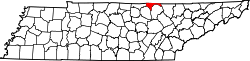 | |
| Unincorporated communities | ||
| Ghost town | ||
| Footnotes | ‡This populated place also has portions in an adjacent county or counties | |
| International | |
|---|---|
| National | |

Byrdstown, Tennessee
View on GrokipediaHistory
Founding and early settlement
Pickett County, encompassing the area of Byrdstown, was established on February 27, 1879, through an act of the Tennessee General Assembly that carved its territory from adjacent sections of Overton and Fentress counties, making it one of the state's final Reconstruction-era counties.[9][10] The creation of the county was advocated by state legislators Lemuel "Lem" Wright and Howell L. Pickett, reflecting local demands for administrative autonomy in a remote, hilly region suited to small-scale agriculture and timber extraction.[10] Byrdstown emerged simultaneously as the designated county seat, with the site selected for its central location along the Obey River and existing rudimentary infrastructure; several pioneer families had already settled there amid the broader early 19th-century influx of European descendants—primarily from Virginia, North Carolina, and eastern Tennessee—following the removal of Cherokee and other Native American groups via treaties and forced relocations in the 1810s.[10][11] Initially proposed for naming as Wrightsville to honor Lem Wright, the town was instead christened Byrdstown in recognition of Colonel Richard Byrd, a Kingston resident and staunch Unionist who had opposed Tennessee's secession during the Civil War, enlisting in federal forces after 1861 and later serving in the state senate.[10] Early inhabitants focused on subsistence farming of corn, oats, and livestock, supplemented by logging and river-based rafting of timber to downstream markets, activities that predated the town's formal designation but intensified with improved county governance.[10] Records indicate families such as the Garretts had migrated to the vicinity by the 1810s, establishing log cabins and basic mills amid forested terrain that supported self-reliant homesteads.[12] Formal municipal incorporation of Byrdstown occurred later, in 1917, but the 1879 founding marked the transition from scattered settlements to an organized civic hub.[10]20th-century growth and Dale Hollow Lake
Byrdstown experienced modest growth in the early 20th century, primarily driven by the timber industry, which dominated Pickett County's economy following the town's incorporation in 1917.[10][13] The population remained small, increasing from 125 in 1920 to 215 in 1940, reflecting limited infrastructure and reliance on agriculture and logging in the isolated Appalachian region. The construction of Dale Hollow Dam marked a pivotal shift, beginning on March 2, 1942, as a wartime priority under the U.S. Army Corps of Engineers to expedite flood control along the Obey River.[14] The dam's flood control components were completed in 1943, impounding water to form Dale Hollow Lake, a reservoir spanning 27,700 acres across Tennessee and Kentucky. Hydropower facilities followed postwar, with generating units operational in 1948, 1949, and 1953, providing electricity and further economic stimulus. The lake's development catalyzed Byrdstown's expansion by attracting federal investment, temporary construction employment, and long-term recreational tourism. Population surged to 379 by 1950 and 613 by 1960, a more than doubling from prewar levels, as the reservoir enabled boating, fishing—particularly for smallmouth bass—and camping, drawing visitors to the area. This influx supported local businesses, marinas, and lodging, transitioning the economy from timber-dependent extraction to service-oriented activities centered on the lake's clear waters and scenic shores.[15][16] By mid-century, Dale Hollow Lake had established Byrdstown as a gateway for regional tourism, mitigating earlier stagnation while preserving the town's rural character.[17]Recent developments
In 2024, Fitzgerald Trailers commenced operations at a new facility in Byrdstown, utilizing steel and aluminum fabrication and robotic welding to produce up to 2,000 dry van commercial truck trailers annually.[18] This project, supported by New Markets Tax Credits from Three Roots Capital, aims to revive local manufacturing jobs previously lost in the region and includes coordinated workforce training programs.[18] [19] The U.S. Army Corps of Engineers Nashville District announced plans in 2024 for the potential expansion of Sunset Marina into the adjacent Plankyard Access Area at Dale Hollow Lake, with public meetings held on November 18, 2024, at the Byrdstown Agricultural Learning Center to discuss environmental assessments and infrastructure improvements such as additional boat slips and access ramps.[20] [21] These developments seek to enhance recreational boating capacity while addressing Corps-managed shoreline regulations, potentially boosting tourism-related economic activity in the area.[22]Geography
Location and physical features
Byrdstown lies in northern Tennessee within Pickett County, serving as the county seat, at geographic coordinates 36°34′28″N 85°07′44″W.[23] Positioned approximately 5 miles south of the Tennessee-Kentucky border, the town occupies a site at the northern edge of the state, adjacent to the western portion of Dale Hollow Lake.[24] Pickett County spans about 162 square miles, with Byrdstown covering roughly 1.5 square miles of land area.[25] The town's elevation reaches 1,027 feet (313 meters) above sea level, amid a landscape of rolling hills and valleys formed by the dissection of sedimentary rock layers.[24] This terrain reflects the transitional physiography between the Eastern Highland Rim to the west and the Cumberland Plateau to the east, featuring steep escarpments, narrow ridges, and incised stream valleys that contribute to significant local elevation variations exceeding 900 feet within 2 miles of the center.[26] The underlying geology consists primarily of Pennsylvanian-age sandstones and shales, which cap higher plateaus and influence the rugged, forested character of the surrounding uplands.[27] In the broader Pickett County context, physical features include natural arches, rock shelters, and outcrops exposed by erosion along the plateau's western margin, with forests dominated by oak and hickory species adapted to the thin soils and karst-influenced hydrology.[28] These elements define a rural, elevated setting prone to seasonal flooding in low-lying areas near tributaries of the Obey and Cumberland Rivers.[25]Climate
Byrdstown has a humid subtropical climate (Köppen Cfa), marked by hot, humid summers, cool winters, and precipitation distributed throughout the year without a pronounced dry season.[29] The annual temperature typically varies from a low of 29°F to a high of 86°F, with extremes rarely falling below 13°F or exceeding 93°F.[26] Average annual precipitation measures about 55 inches, occurring on roughly 135 days, while snowfall totals around 7 inches, concentrated from December to March.[30][31] Summers, spanning June through August, are long, warm, and muggy, with average highs reaching 86°F in July and lows around 67°F; humidity peaks during this period, contributing to discomfort.[26] Winters are short and very cold relative to summers, with January highs averaging 46°F and lows 30°F, and a higher likelihood of frozen precipitation.[26] Spring and fall serve as transitional seasons, with March to May bringing rising temperatures and increasing rainfall probability, peaking at 44% in late June.[26] December is the wettest month at 4.3 inches, while October is driest at 2.9 inches.[26] The following table summarizes average monthly high and low temperatures:| Month | Average High (°F) | Average Low (°F) |
|---|---|---|
| January | 46 | 30 |
| February | 50 | 32 |
| March | 60 | 40 |
| April | 69 | 48 |
| May | 76 | 56 |
| June | 84 | 63 |
| July | 86 | 67 |
| August | 85 | 66 |
| September | 80 | 58 |
| October | 69 | 48 |
| November | 58 | 39 |
| December | 49 | 33 |
Dale Hollow Lake
Dale Hollow Lake is a reservoir straddling the Tennessee-Kentucky border, with its southeastern extent serving as a key geographical feature near Byrdstown in Pickett County, Tennessee. Formed by the impoundment of the Obey River via the Cordell Hull Dam, constructed by the U.S. Army Corps of Engineers and completed in 1943, the lake primarily supports flood control and hydroelectric power generation.[32] [33] The dam, located near Celina in Clay County, Tennessee, creates a body of water that extends into Pickett County, providing Byrdstown with proximate access to over 27,700 surface acres at normal pool elevation and approximately 620 miles of forested shoreline.[34] [35] The lake's physical characteristics include a maximum depth of around 130 feet and clear waters over a bottom composed of broken rock, boulders, and gravel, contributing to its ecological profile that supports diverse aquatic habitats.[36] [35] Positioned east of Byrdstown, the reservoir influences local hydrology by integrating the Obey and Wolf Rivers, which converge near the town before flowing into the lake, shaping the surrounding terrain of rolling hills and forested uplands typical of the Cumberland Plateau region.[8] Renowned for its smallmouth bass fishery, Dale Hollow holds the world record for the species, an 11-pound, 15-ounce specimen caught on July 9, 1955, by angler D. L. Hayes, underscoring the lake's status as a premier fishing destination that enhances its geographical significance to nearby communities like Byrdstown.[37] [38] The undeveloped shoreline preserves natural aesthetics, while marinas and public access points in Pickett County facilitate recreational use without substantial alteration to the basin's original contours.[34]Government
Municipal structure
Byrdstown operates under a mayor-aldermanic form of government as established by its municipal charter. The legislative authority resides in the town board, composed of the mayor, recorder, and three aldermen. This structure vests executive powers in the mayor while the board handles legislative functions, including ordinance adoption and officer appointments.[39] The mayor serves as chief executive officer, enforcing town ordinances, overseeing daily operations, and recommending policy measures to the board. The mayor presides over meetings but holds a voting role limited to breaking ties. Aldermen and the recorder must be qualified town voters with at least one year of residency and are elected to staggered four-year terms in nonpartisan elections held on the first Thursday in August every four years, aligning with Tennessee gubernatorial election cycles. Terms commence on September 1 following election.[39][40] Board proceedings require a quorum of three voting members, with actions, including ordinance passage, needing three affirmative votes. The board sets annual salaries—$34,800 for the mayor, $4,800 for the recorder, and $2,400 per alderman—which remain fixed during terms—and both the mayor and recorder post $100,000 surety bonds. The board may dismiss appointed officers by majority vote. As of 2024, the mayor is Sam Gibson, with aldermen Barbara Mitchell, Jeff D. Rich, and John Keisling (appointed), and recorder Johnny Sells.[39][41][40]County seat functions
As the county seat of Pickett County, Byrdstown serves as the central hub for county judicial, executive, and administrative operations. The Pickett County Courthouse, situated at 1 Courthouse Square, accommodates the Circuit, Criminal, and Chancery Courts, which handle civil, criminal, and equity cases for the jurisdiction.[42] Completed in 1935 and constructed from Crab Orchard stone, the courthouse has functioned as the focal point for county governance and legal proceedings since its establishment.[13] Key administrative departments are also headquartered in Byrdstown, including the County Clerk's office in Suite 201 of the courthouse, which maintains public records such as deeds, marriage licenses, and business registrations, and processes vehicle titles and registrations.[43] [44] The Sheriff's Office, located in Suite 300, enforces county laws, operates the jail, and provides public safety services across Pickett County's 158 square miles.[45] The Property Assessor's office, similarly based at the courthouse, appraises real and personal property for taxation purposes.[46] Executive functions are coordinated through the County Mayor's office, addressed to PO Box 280 in Byrdstown, which oversees county budgeting, road maintenance, and intergovernmental relations as the chief elected executive.[47] The County Election Commission, operating from 105 South Main Street, administers voter registration, conducts elections, and certifies results for county-wide races.[48] Additional services, such as the county health department at 1013 Woodlawn Drive, support public welfare from within town limits.[49] This concentration of facilities in Byrdstown, a town of approximately 800 residents, facilitates efficient access for Pickett County's sparse population of around 5,000.[50]Economy
Key economic sectors
The primary economic sectors in Byrdstown revolve around retail trade, manufacturing, and service-oriented industries, reflecting the town's small population and rural setting. In 2023, retail trade was the largest employer among residents, supporting 73 jobs, followed by other services (except public administration) with 49 jobs and manufacturing with 46 jobs, out of a total employed population of 372.[51] These sectors align with broader Pickett County trends, where services comprised 45.2% of employment for those aged 16 and older in 2018, manufacturing 13.0%, and retail trade 5.4%.[52] Manufacturing includes specialized assembly operations, notably Fitzgerald Glider Kits, which produces semi-truck glider kits in a 110,000-square-foot facility employing around 150 workers as of 2019.[52][53] Smaller manufacturing firms in the county produce items such as marine products, bottled water, and reconditioned diesel engines, contributing to a total of six industrial units with 60 employees county-wide in 2019.[52] Retail and services encompass local stores, repair shops, and healthcare facilities, including nursing homes like Pickett Care and Rehabilitation Center, which serve both residents and visitors.[51] The town's median household income stood at $32,250 in 2023, with employment levels showing slight decline from the prior year.[51] Pickett County's unemployment rate averaged 4.0% in 2017, indicative of stable but limited job growth in these sectors.[52] Agriculture and mining remain minor, accounting for 4.8% of county employment in 2018.[52]Tourism and recreation
Tourism in Byrdstown centers on Dale Hollow Lake, a 28,000-acre reservoir straddling the Tennessee-Kentucky border, renowned for smallmouth bass fishing and drawing over 3 million visitors annually for boating and water recreation.[54] The lake supports numerous marinas, such as those in nearby Alpine, offering boat rentals, fuel, and docking facilities that facilitate houseboat vacations and guided fishing trips.[55] Swimming, kayaking, and paddleboarding are common activities, with public access points like the Obey River Recreation Area providing campgrounds and launch ramps.[56] Pickett CCC Memorial State Park, located adjacent to Byrdstown, spans 12,000 acres and features 35 miles of hiking trails, including moderate paths to Hazard Cave and easier routes to Natural Bridge and waterfalls, attracting hikers and nature enthusiasts year-round.[57] The park also offers swimming beaches, fishing piers, and a nine-hole golf course, with additional pursuits like rock climbing, horseback riding, and stargazing under its certified dark sky designation.[58] Horseback riding trails utilize forest roads, while off-highway vehicle use is permitted on designated unimproved paths in Pickett State Forest.[28] Local recreation facilities include the Byrdstown Activities Park, equipped with a walking trail, pavilion, picnic tables, and restrooms for community events and casual outings.[59] Seasonal events, such as the Byrdstown Autumn Festival, feature crafts, food vendors, and family activities amid fall foliage, complementing the outdoor focus.[60] These attractions contribute to the local economy through visitor spending on lodging, dining, and equipment rentals, with the area's moderate climate supporting extended seasons for tourism.[61]Demographics
Population trends
The population of Byrdstown experienced significant growth during the mid-20th century, increasing from 125 residents in 1920 to a peak of 998 in 1990, before stabilizing and slightly declining to 798 by the 2020 decennial census.[62][63][64] This trajectory reflects broader patterns in rural Tennessee counties, where early industrialization and infrastructure improvements drove influxes, followed by out-migration due to limited economic opportunities beyond agriculture and lake-related tourism.[65]| Year | Population | % Change |
|---|---|---|
| 1920 | 125 | — |
| 1930 | 135 | +8.0% |
| 1940 | 215 | +59.3% |
| 1950 | 379 | +76.3% |
| 1960 | 613 | +61.7% |
| 1970 | 582 | -5.1% |
| 1980 | 884 | +51.9% |
| 1990 | 998 | +12.9% |
| 2000 | 903 | -9.5% |
| 2010 | 803 | -11.1% |
| 2020 | 798 | -0.6% |
Socioeconomic characteristics
The median household income in Byrdstown stood at $32,250 in 2023, markedly lower than the Tennessee statewide median of $65,200 reported for the prior year and reflective of broader rural economic constraints including limited local industry and reliance on seasonal employment.[51][71] Per capita income was approximately $19,012, underscoring household-level financial pressures amid high commuting times averaging 45.6 minutes to work sites often outside the immediate area.[72][67] Poverty affects 27% of Byrdstown residents for whom status is determined, equating to 347 individuals out of a relevant population base of about 1,280, exceeding the Pickett County rate of 25.8% and far above national norms; this disparity correlates with factors such as aging infrastructure and outmigration of younger workers.[73][74] Unemployment hovered around 5.4% locally, with county-level data showing 4.5% in 2025, while labor force participation remains subdued at 42.7% in Pickett County—well below the U.S. average of 61.5%—indicating structural barriers like skill mismatches and geographic isolation from urban job markets.[67][75][76] Educational attainment among adults aged 25 and older is modest, with 19% lacking a high school diploma or equivalent, 42% holding only a high school diploma, 18% having some college experience, and roughly 10% possessing a bachelor's degree or higher; these figures trail Tennessee averages, where 30.4% have attained some postsecondary credential beyond high school, contributing to cycles of lower-wage employment in service and manual sectors.[73][73] County-wide, bachelor's degree attainment reaches 17.2%, aligning with Appalachian rural patterns where access to higher education is hindered by distance and economic priorities favoring immediate workforce entry.[77]Ethnic composition
According to the 2018-2022 American Community Survey estimates, Byrdstown's population is 98% White alone (non-Hispanic), with Black or African American alone (non-Hispanic) comprising 1%, and all other racial categories, including Asian, Native American, Native Hawaiian or Pacific Islander, and multiracial, each under 1%.[73] Hispanic or Latino residents of any race account for approximately 0.3% to 2.4% across sources, reflecting minimal ethnic diversity.[78][79]| Racial/Ethnic Group | Percentage (ACS 2018-2022) |
|---|---|
| White (non-Hispanic) | 98% |
| Black (non-Hispanic) | 1% |
| Hispanic or Latino (any race) | ~1% |
| Other groups (combined) | <1% |