Hubbry Logo
McDonnell CF-101 VoodooMcDonnell CF-101 VoodooMain
Open search
McDonnell CF-101 Voodoo
Community hub
McDonnell CF-101 Voodoo
logo
8 pages, 0 posts
0 subscribers
Be the first to start a discussion here.
McDonnell CF-101 Voodoo
from Wikipedia

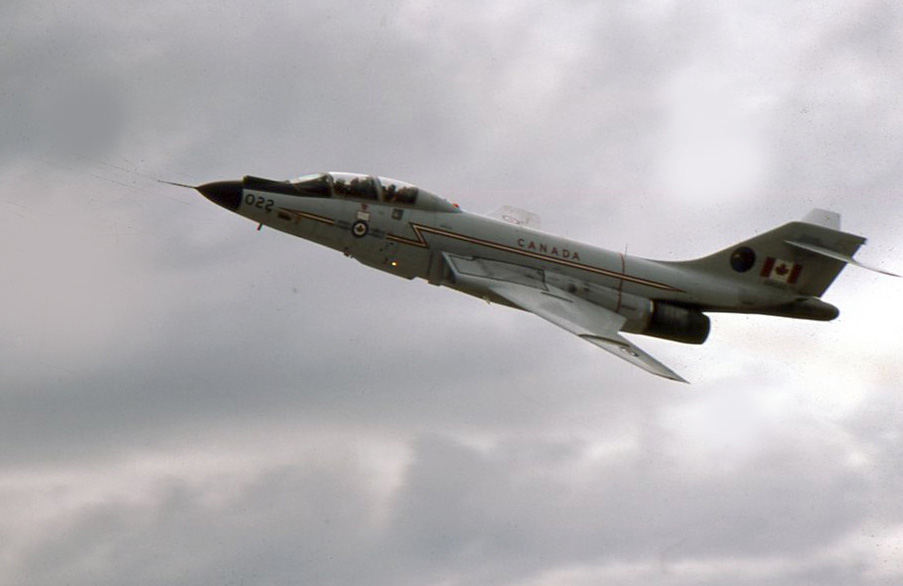
The McDonnell CF-101 Voodoo was an all-weather interceptor aircraft operated by the Royal Canadian Air Force and the Canadian Forces between 1961 and 1984. They were manufactured by the McDonnell Aircraft Corporation of St. Louis, Missouri for the United States Air Force (as F-101s), and later sold to Canada. CF-101s replaced the obsolete Avro CF-100 Canuck in the RCAF's all-weather fighter squadrons. The Voodoo's primary armament was nuclear AIR-2A Genie unguided air-to-air rockets, and there was significant political controversy in Canada about their adoption. Although they never fired a weapon in wartime, the CF-101 served as Canada's primary means of air defence from Quick Reaction Alert facilities at Canadian airbases. The CF-101s were retired in the 1980s and replaced with McDonnell Douglas CF-18 Hornet fighters. Many examples are preserved in museums and parks in Canada and the United States.

Key Information

Acquisition

[edit]

Origins

[edit]

After the cancellation of the CF-105 Arrow program in February 1959, George Pearkes, the Canadian Minister of National Defence, officially maintained that the existing Avro CF-100 interceptors and the Bomarc missiles that had been ordered in September 1958 would be adequate for Canada's air defence needs. Unofficially, it was recognized that there was still a bomber threat, and talks had been underway prior to the Avro Arrow's termination on the RCAF acquisition of an "off-the-shelf" interceptor from the United States.

The USAF indicated its readiness to supply 56 F-101B interceptors and 10 F-101F trainers (by employing Convair F-102 Delta Daggers in less demanding NORAD sectors) for Canada. The deal was delayed by over a year by negotiations over offsets and acquisition costs, as well as debate within the Diefenbaker government about Canada adopting nuclear weapons systems, which had been agreed to in principle in 1958. The financial arrangements were settled by Canada taking on the staffing and funding of 11 Pinetree Line radar stations within Canada that had formerly been operated and funded by the USAF. An agreement signed in June 1961 covered the transfer of the aircraft, meant to equip five front-line squadrons (replacing nine CF-100 squadrons) and an Operational Training Unit (OTU).

Nuclear weapons controversy

[edit]
CF-101B firing AIR-2 Genie in 1982

The issue of nuclear weapons in Canada had not been resolved in June 1961, thus the CF-101s were armed only with their secondary AIM-4D Falcon missiles. In April 1963, the issue led to the collapse of the Diefenbaker government. The succeeding Pearson government signed an agreement with the United States concerning nuclear arms for Canada on 16 August 1963. The agreement did not actually state that Canada was acquiring nuclear weapons; the Canadian government usually refused to confirm or deny that there were any nuclear arms in Canada. The agreement specifically stated that the AIR-2A Genie rockets were the property of the United States and would only be released to Canada for actual use with the joint agreement of Canada and the United States through NORAD. The stringent training requirements meant that it took until June 1965 for the Genies to become operational in Canada. The Genies were kept in the custody of the USAF, with detachments of the 425th Munitions Support Squadron located at each of the Canadian bases.

Operational history

[edit]
CF-101B Voodoo 17395 at the Bagotville Air Pageant, summer 1962. Notice the old-style Canadian flag.

On 24 July 1961, the first two Voodoos were transferred to Canada in a ceremony at RCAF Uplands in Ottawa, marking the beginning of Operation Queen's Row. 425 Squadron officially began operations at RCAF Namao, Alberta, on 15 October 1961, initially acting as the conversion training squadron for 410, 416, 409, and 414 Squadrons. No. 425 then became an operational unit itself, turning the conversion role over to No. 3 All Weather OTU at RCAF Bagotville, Quebec. By the end of 1962, the squadrons were operating out of RCAF Comox, British Columbia, (409 Squadron), RCAF North Bay, Ontario, (414 Squadron), RCAF Uplands, Ottawa, Ontario, (410 Squadron), RCAF Bagotville, Quebec, (425 Squadron), and RCAF Chatham, New Brunswick, (416 Squadron). Defence cuts in 1964 eliminated Nos. 410 and 414 Squadrons (although a reformed 414 Squadron would operate the Voodoo years later).

CF-101 Voodoo 101060 from 409 "Nighthawk" Squadron, CFB Comox on the ramp at CFB Moose Jaw in 1982

Each Voodoo base was laid out to allow aircraft to be kept at immediate readiness at all times. A Quick Reaction Alert (QRA) facility was positioned at the end of the main runway to allow alert aircraft to launch as quickly as possible. Two aircraft and their crews were always on "five minute" alert — they were to be in the air, en route to intercept unknown aircraft, within five minutes of receiving the order. In one instance, 416 Squadron got two alert aircraft in the air only 57 seconds after receiving the alert. Voodoos were regularly dispatched to intercept unidentified NORAD radar contacts, usually off course airliners, although 416 and 425 occasionally intercepted Soviet Tu-95 Bear bombers flying along the Atlantic coast to Cuba. Fortunately, no situation arose in which a CF-101 pilot fired his weapons in anger.

Between 1970 and 1972, Canada traded the 56 survivors of the original CF-101 fleet back to the USAF for 66 replacements under Operation Peace Wings. These replacement aircraft were actually manufactured earlier than the original fleet, but the "new" airframes had a lower number of hours and had received updates that the original Canadian Voodoos had not (such as an IR tracking system). Bristol Aerospace of Winnipeg, Manitoba performed modifications on the incoming fleet such as transferring some specifically Canadian equipment, including engines, from the old aircraft to the new. Most of the old Canadian Voodoos were scrapped in the US, but 22 were converted to RF-101B photo-reconnaissance versions and flew with the Nevada Air National Guard until 1975.

CF-101B (101057) from 409 Squadron in an airshow flypast on 13 June 1982 at CFB Edmonton

During its service, the CF-101 was a popular performer at airshows and other events in Canada and the United States. In 1967, a CF-101 flew (in company with a CF-104 and The Red Knight T-33) in the Golden Centennaires display team to mark the nation's Centennial. In 1984, each squadron painted a special "show" aircraft to commemorate the type's impending retirement.

Obsolescence and retirement

[edit]

Through the 1970s, the increasing obsolescence of the CF-101 and the CF-104 led to the New Fighter Aircraft program. Launched in 1977, the program sought a replacement for the CF-5, CF-104 Starfighter, and CF-101 Voodoo. The Grumman F-14 Tomcat, F-15 Eagle, F-16 Falcon, McDonnell Douglas F/A-18 Hornet, Panavia Tornado, Dassault Mirage F1, and the Mirage 2000 were evaluated as potential replacements. Cost considerations reduced the choice to the F-16 and F-18; the F-18 was ultimately selected in April 1980. The Voodoo OTU converted to CF-18 Hornets in June 1982; 409 and 425 Squadrons also stood down in June 1984. In 1985, 416 Squadron moved from CFB Chatham, New Brunswick to CFB Cold Lake, Alberta and converted from the Voodoo to the Hornet.[1] With the stand down, the last nuclear weapons in Canada were returned to the US.

A CF-101 (background) on display at Hamilton International Airport. A CF-104 is in the foreground.

Two Voodoos remained in service after the stand-down: the unique EF-101B "Electric Voodoo" electronic jamming aircraft and a single CF-101F trainer with 414 Squadron at North Bay, Ontario. The EF-101B was a conversion of a regular F-101B, incorporating the electronic jamming suite from an EB-57E Canberra. Only one aircraft was converted before the program was cancelled and this sole example was leased to Canada.[citation needed] The EF-101B was returned to the United States on 7 April 1987, while CF-101F 101006 made the world's last Voodoo flight on 9 April 1987, as it made a delivery flight from CFB North Bay to CFB Greenwood via CFB Bagotville and CFB Chatham for eventual display at CFB Cornwallis, Nova Scotia, where it decorated the parade square at the Recruit School.[citation needed] After CFB Cornwallis closed in 1995, 006 was moved to the Cornwallis Military Museum; in October 2013, due to corrosion and security concerns, 006 was donated to the Jet Aircraft Museum in London, Ontario, where it is presently undergoing refurbishment.[2]

Voodoo 101006 is currently on static display at the Jet Air Museum in London, Ontario, alongside its afterburners and missile cases.

Variants

[edit]
The EF-101B "Electric Voodoo" on its final deployment, 1987
  • CF-101B : Two-seat all-weather interceptor fighter aircraft.
  • CF-101F : Two-seat, dual control training aircraft.
  • EF-101B : Electronic jamming aircraft.

Operators

[edit]
Canada /  Canada

Aircraft on display

[edit]
Royal Canadian Air Force McDonnell CF-101 Voodoo at the Canada Aviation and Space Museum.
CF-101B at the Western Canada Aviation Museum, Winnipeg, Manitoba, c. 2005.
CF-101 displayed at CFB Borden.
CF-101F S/N 101022 at McChord Air Force Base

Over 30 Canadian and ex-Canadian CF-101s are preserved in museums and as memorials in Canada and the United States.[4]

Specifications (F-101B)

[edit]

Data from The Great Book of Fighters[5]

General characteristics

  • Crew: Two
  • Length: 67 ft 5 in (20.55 m)
  • Wingspan: 39 ft 8 in (12.09 m)
  • Height: 18 ft 0 in (5.49 m)
  • Wing area: 368 sq ft (34.20 m2)
  • Airfoil: NACA 65A007 mod root, 65A006 mod tip
  • Empty weight: 28,495 lb (12,925 kg)
  • Gross weight: 45,665 lb (20,715 kg)
  • Max takeoff weight: 52,400 lb (23,770 kg)
  • Powerplant: 2 × Pratt & Whitney J57-P-55 afterburning turbojets, 11,990 lbf (53.3 kN) thrust each dry, 16,900 lbf (75 kN) with afterburner

Performance

  • Maximum speed: 1,134 mph (1,825 km/h, 985 kn) at 35,000 ft (10,500 m)
  • Maximum speed: Mach 1.72
  • Range: 1,520 mi (2,450 km, 1,320 nmi)
  • Service ceiling: 54,800 ft (17,800 m) [6]
  • Rate of climb: 36,500 ft/min (185 m/s) [7]
  • Wing loading: 124 lb/sq ft (607 kg/m2)
  • Thrust/weight: 0.74

Armament

  • Rockets: two AIR-2A Genie unguided nuclear rockets with 1.5 Kt warhead
  • Missiles: Two AIM-4D Falcon heat-seeking air-to-air missiles

Avionics

  • Hughes MG-13 fire control system

See also

[edit]

Related development

Aircraft of comparable role, configuration, and era

Related lists

References

[edit]
[edit]
Revisions and contributorsEdit on WikipediaRead on Wikipedia
from Grokipedia
The McDonnell CF-101 Voodoo was a two-seat supersonic all-weather interceptor aircraft operated exclusively by the Royal Canadian Air Force (RCAF) and later the Canadian Forces from 1961 to 1984. Derived from the McDonnell F-101B Voodoo originally developed for the United States Air Force as a long-range bomber interceptor, the CF-101 featured advanced radar fire-control systems and was powered by two Pratt & Whitney J57-P-55 turbojet engines each producing 7,575 kg of thrust with afterburner. Canada acquired 66 ex-USAF CF-101B aircraft—56 interceptors and 10 trainers—following the 1959 cancellation of the Avro Arrow program, selecting the Voodoo to replace the obsolescent CF-100 Canuck in fulfilling North American Aerospace Defense Command (NORAD) commitments. Equipped with semi-active radar-homing and infrared-guided missiles alongside the nuclear-armed rocket, the CF-101 provided with a credible supersonic defense capability against potential Soviet bomber incursions during the , achieving a maximum speed of 1,825 km/h and a service ceiling of 16,700 m. The entered RCAF service in five squadrons, including Nos. 409 and 416, based across for continuous air sovereignty patrols, with the fleet later refreshed in the by exchanging for lower-hour USAF examples upgraded with improved systems. Notable for its extended operational lifespan exceeding two decades—outlasting U.S. service—the CF-101 underscored reliable performance in harsh northern environments but was ultimately phased out in 1984, supplanted by the multirole amid evolving threats favoring versatile fighters over dedicated interceptors.

Development and Design

Origins in the F-101 Program

The McDonnell F-101 program originated from a (USAF) requirement issued in the early 1950s for a long-range penetration fighter to escort strategic bombers deep into enemy territory, building on the earlier that had demonstrated supersonic capabilities in afterburner-equipped tests. In November 1951, the USAF formalized this need under Weapon System MX-1534, prompting to propose an enlarged derivative of the XF-88 with twin turbojet engines for enhanced range and speed. The resulting F-101A design emphasized structural efficiency, incorporating a with low-mounted engines partially embedded into the sides to reduce through smoother airflow integration, a first-principles approach to minimizing resistance at and supersonic regimes. The F-101A prototype achieved its on September 29, 1954, at , powered by J57-P-11 s augmented with s that injected fuel into the exhaust stream to generate additional , enabling sustained Mach 1+ speeds essential for evading interceptors. This configuration allowed the aircraft to set multiple speed records shortly after, validating the drag-reduction benefits of the semi-submerged nacelles, which positioned the intakes low on the to leverage and effects for better high-speed stability. Initial flight tests revealed challenges with reliability and airframe flutter, leading to refinements in design and area-ruled shaping to mitigate . By 1957, the program shifted toward an all-weather interceptor variant amid evolving USAF priorities for continental defense against Soviet bombers, resulting in the two-seat F-101B . The F-101B , designated NF-101B, first flew on March 27, 1957, featuring an enlarged forward fuselage to accommodate the Hughes MG-13 system, which provided semi-automatic target tracking integrated with data links for ground-directed intercepts. Production of the F-101B commenced for USAF Air Defense Command, with the first operational units entering service in January 1959, establishing the baseline design later exported and redesignated as the CF-101 for allied use.

Adaptations for All-Weather Interception

The McDonnell CF-101 Voodoo, designated for the Royal Canadian Air Force, underwent significant modifications from the original F-101A to serve as a dedicated all-weather interceptor, primarily through the incorporation of a tandem two-seat configuration. This adaptation extended the forward to position a weapons systems aft of the pilot, allowing dedicated operation of the interception during extended patrols in variable weather. The core enhancement for all-weather operations was the nose-mounted Hughes MG-13 system, derived from earlier interceptor designs and optimized for guiding semi-active radar-homing missiles while providing in low-visibility conditions prevalent in northern latitudes. This enabled detection and lock-on against bomber-sized at tracking ranges of up to 30 nautical miles in baseline configurations, with later upgrades under programs like Bold Journey improving frequency agility and countering electronic countermeasures for sustained low-level intercept efficacy. The system's integration necessitated a redesigned and supporting , including data links to ground-based SAGE direction centers for coordinated intercepts over vast . Structural changes emphasized reliability in harsh Canadian environments, including reinforced with wider tires and bulged doors to manage the increased gross weight of approximately 45,665 pounds from added , crew, and fuel provisions for long-range northern sorties. These modifications, combined with the aircraft's inherent supersonic , facilitated operations in sub-zero temperatures and icing conditions without compromising structural integrity, though empirical testing revealed minor drag penalties from the enlarged section. Propulsion adaptations balanced these weight gains via twin J57-P-55 afterburning turbojets, each rated at 16,900 lbf of thrust, which maintained a near 0.74 and preserved Mach 1.72 dash speeds despite the 20% mass increase over single-seat predecessors. This empirical trade-off ensured the CF-101 could loiter at high altitudes for sweeps while accelerating to intercept intruders, prioritizing over agility in the defensive role.

Propulsion and Structural Features

The McDonnell CF-101 Voodoo employed two Pratt & Whitney J57-P-55 afterburning turbojet engines, each producing 16,900 pounds (75 kN) of thrust with afterburner. These engines, derived from the J57 series used in earlier USAF aircraft, featured axial-flow compressors and afterburners that enabled sustained supersonic speeds up to Mach 1.72 at 35,000 feet, critical for rapid interception during Cold War air defense missions. Water-methanol injection augmented engine performance by cooling the compressor stages, permitting higher mass flow and thrust output for short bursts or climbs without exceeding turbine limits, thereby enhancing acceleration and dash capabilities. Internal fuel capacity totaled approximately 2,000 US gallons (7,600 liters), supporting a combat radius of around 540 nautical miles and a ferry range exceeding 2,000 miles with external drop tanks, which minimized refueling needs for northern patrols. This configuration prioritized endurance over agility, as the engines' high fuel consumption at supersonic speeds—driven by afterburner heat addition—necessitated efficient internal storage to balance and range demands. Structurally, the CF-101 utilized a aluminum , with stressed-skin panels riveted over stringers and bulkheads to distribute loads during high-g maneuvers up to 6.5 g. The fuselage incorporated transonic area ruling, narrowing the cross-section amidships to maintain constant effective diameter and reduce by up to 25% near Mach 1, a principle derived from Richard Whitcomb's NACA research and validated in McDonnell's tests. This design directly improved climb rates to 49,200 feet per minute and service ceilings above 50,000 feet by minimizing compressibility effects. The wing featured a 56-foot 5-inch (17.2 m) span with 32.5-degree sweep and low for stability, enhancing lift distribution at high altitudes where thin air demanded larger surfaces to counter induced drag without excessive structural . reinforcements in high-heat areas, such as engine nacelles, addressed thermal stresses from operation, while the overall empty of 28,500 pounds (12,900 kg) reflected trade-offs favoring speed over payload flexibility. These elements collectively enabled the CF-101's role as a high-altitude interceptor, where efficiency and aerodynamic coherence determined intercept success against bomber threats.

Procurement

Selection by the Royal Canadian Air Force

Following the cancellation of the Avro CF-105 Arrow interceptor program on February 20, 1959, the Royal Canadian Air Force (RCAF) required an urgent replacement for its aging subsonic Avro CF-100 Canuck fleet to fulfill commitments against potential Soviet bomber incursions. The CF-100, with a maximum speed of approximately 675 mph, struggled to match the operational demands of intercepting faster strategic threats like the , which cruised at over 500 mph and could approach North American airspace at high altitudes. In contrast, the McDonnell F-101B Voodoo provided supersonic performance exceeding Mach 1, coupled with the AN/APQ-46 radar for all-weather detection and tracking beyond 100 miles, enabling rapid response to high-speed, long-range bombers. By early 1960, the RCAF selected the CF-101 as the optimal off-the-shelf solution over other alternatives, prioritizing immediate operational readiness and integration with U.S. Air Force systems under rather than pursuing further domestic development akin to the Arrow's ambitious but cost-prohibitive Mach 2 design. The agreed to transfer 56 refurbished F-101B interceptors and 10 F-101F dual-control trainers from Air Defense Command stocks, reallocating Convair F-102 Delta Daggers to secondary roles to facilitate the exchange. This procurement, conducted under mutual defense aid protocols, ensured the RCAF could equip its Air Defence Command squadrons with aircraft capable of supersonic dash speeds and nuclear-armed intercepts, addressing the velocity and sensor gaps exposed by the CF-100's limitations against evolving Soviet aviation tactics.

Delivery and Initial Integration Challenges

The initial deliveries of the CF-101 Voodoo to the Royal Canadian Air Force commenced under Operation Queen's Row, with the first two aircraft transferred in a ceremony at RCAF Station Uplands in on July 24, 1961. Subsequent aircraft arrived via ferrying operations between 1961 and 1963, totaling 66 interceptors drawn from existing production surplus to equip five squadrons. This approach minimized new manufacturing expenses, resulting in limited cost overruns for the program. Pilot and ground crew training emphasized rapid familiarization with the aircraft's advanced all-weather systems. No. 425 Squadron at RCAF Station Namao, , served as the initial conversion and operational training unit starting in November 1961, where crews underwent five weeks of intensive instruction before achieving operational status on January 20, 1962. Over 100 RCAF personnel transitioned to the Voodoo platform, focusing on its , and features, with early emphasis on adapting Canadian operators to the type's high-speed handling characteristics. Early integration encountered technical hurdles, particularly with the engines' afterburners, which exhibited reliability issues that compromised mission readiness and increased maintenance demands. These flameout-prone components were mitigated through targeted modifications, including improved fuel controls and ignition systems, restoring acceptable dispatch rates by mid-1962. Concurrently, linking the CF-101's onboard datalink to the (SAGE) network posed coordination challenges in northern Canadian sectors, requiring software alignments and upgrades to ensure seamless command vectoring; however, these were resolved without major delays to squadron activations. Overall, the rollout prioritized interoperability, with initial squadrons achieving alert status by late 1962 despite these teething problems.

Armament and Strategic Debates

Conventional and Nuclear Weapon Systems

The McDonnell CF-101 Voodoo was equipped with a rotary armament launcher in its lower fuselage that accommodated a mix of and conventional air-to-air weapons for intercepting Soviet bombers. The primary conventional armament consisted of two AIM-4D Falcon infrared-guided missiles, which relied on the aircraft's Hughes MG-13 for and lock-on before launch. These missiles featured a motor and a passive seeker head, enabling heat-seeking homing against enemy engines after separation from the launcher. For nuclear strikes, the CF-101 carried two AIR-2A unguided rockets, each armed with a W25 thermonuclear yielding 1.5 kilotons. The measured 9 feet 8 inches in length, with a 17.5-inch and 3-foot-4-inch wingspan, weighed 822 pounds loaded, and achieved speeds up to Mach 3.3 over a range of approximately 6 miles via its solid-propellant motor and for airburst detonation. Launched in the direction of the target following illumination, the unguided design prioritized simplicity and reliability in high-altitude intercepts against formations. Weapon employment integrated with the CF-101's suite, where the SAGE provided ground-directed steering commands to position the interceptor for optimal firing geometry, after which the MG-13 handled autonomous target tracking and release. This semi-automated process allowed for rapid response in all-weather conditions, with the rotary launcher facilitating sequential exposure and firing of up to four weapons without exposing the full load to aerodynamic drag. Canadian CF-101s maintained operational readiness with these s from until retirement in 1984, though no live nuclear munitions were expended in service.

Political Controversy Over Nuclear Deterrence

The administration of Prime Minister (1957–1963) resisted equipping Canadian forces with nuclear weapons, including warheads for the rockets intended for the CF-101 Voodoo interceptors, despite agreements under that obligated to maintain credible air defense capabilities against potential Soviet bomber attacks. This delay stemmed from Diefenbaker's evolving opposition to nuclear armament, which left the newly delivered CF-101s—acquired in 1961 as a low-cost replacement for the Avro CF-100 Canuck—incapable of fulfilling their primary interception role until warheads arrived. The policy contributed to a broader crisis, including unwarheaded Bomarc missiles, exacerbating tensions with the over shared continental defense. Following the 1963 election, Lester B. Pearson's Liberal government reversed course, accepting U.S. nuclear warheads for Canadian delivery systems, including up to 108 rockets with 1.5-kiloton W25 warheads stored under dual-key U.S.-Canadian custody arrangements to meet commitments. Proponents of arming the CF-101 argued that empirical evidence of Soviet bomber incursions—such as repeated TU-95 Bear probes into North American airspace during the 1960s, prompting thousands of intercepts from 1961 onward—demanded unguided, nuclear-tipped rockets like the to ensure rapid, overwhelming response against massed formations penetrating defenses. These advocates emphasized causal deterrence logic: Soviet , evidenced by overflights and alerts, required capabilities that conventional arms could not match, stabilizing by denying easy bomber breakthroughs. Opposition, including domestic protests and pacifist groups, centered on moral objections to hosting nuclear weapons and fears of escalation drawing into superpower conflict, often framing the as an immoral "doomsday" device despite its defensive intent. Critics of this stance contended that such anti-nuclear moralism overlooked the stabilizing effects of credible second-strike postures under MAD doctrine, potentially inviting Soviet adventurism by signaling Canadian vulnerability. Ultimately, the warheads remained in storage without combat use; returned them to the in 1984 alongside Voodoo retirement, marking the end of its nuclear air defense role.

Operational History

Introduction to Service (1961–1965)

The McDonnell CF-101 Voodoo entered (RCAF) service in 1961 as the primary all-weather interceptor for North American air defense, replacing the Avro CF-100 Canuck under the framework. Initial deliveries commenced with the transfer of the first two aircraft on July 24, 1961, during a ceremony at RCAF Station Uplands in , initiating Operation Queen's Row to ferry the fleet from the . No. 425 "Alouette" Squadron at RCAF Station Namao, , began Voodoo operations on October 15, 1961, serving initially as the conversion training unit for pilots transitioning from the CF-100. No. 410 "Cougar" Squadron achieved the first operational status on December 20, 1961, resuming quick-reaction alert commitments the following day with aircraft armed for interception duties. Early operations encountered teething issues, including handling challenges in adverse weather inherent to the aircraft's all-weather design and the RCAF's transition to supersonic interceptors. A notable incident occurred on , 1962, when a No. 416 Squadron CF-101B (serial 17452) at RCAF Station Bagotville, , collided with a during a takeoff attempt in poor visibility, resulting in two fatalities on the and injuries, including to the Voodoo crew; the fighter was holding short of the for an air intercept mission. Such events highlighted initial integration difficulties with ground control and systems, though they were not systemic structural failures but rather procedural and environmental factors during ramp-up. By 1963, as additional squadrons like No. 409 at RCAF Station , became operational, maintenance protocols improved, enabling higher sortie rates despite these early setbacks. Integration with the U.S. Air Defense Command (ADC) progressed through shared protocols, with CF-101s participating in joint exercises and alert rotations to counter Soviet bomber threats. By 1963, RCAF Voodoos achieved full nuclear-armed alert status, typically with pairs of aircraft loaded with AIR-2A unguided rockets for rapid scrambles directed by the SAGE system at North Bay. This capability ensured seamless interoperability, as the Voodoos operated under unified command structures, filling gaps in continental defense left by the CF-100's obsolescence. Initial availability stabilized as spares and technician training from U.S. sources addressed engine and quirks, allowing squadrons to maintain dispersed alert postures across western and .

Peak Cold War Deployments (1965–1970s)

During the mid-to-late period from 1965 through the 1970s, No. 425 Squadron at , , and No. 416 Squadron at CFB Chatham, , operated the CF-101 Voodoo as primary all-weather interceptors within the framework, maintaining quick-reaction alert postures to defend against Soviet long-range bomber threats such as the . These squadrons contributed to continental air sovereignty by integrating with U.S. forces in routine and response operations, with Voodoos frequently generating sorties in response to radar tracks originating from northern radar chains like the DEW Line extensions. CF-101 crews conducted numerous live intercepts of unidentified aircraft, predominantly civilian airliners deviating from flight paths into monitored airspace, validating the aircraft's radar and interception capabilities in real-world scenarios. On several occasions, 416 and 425 Squadron Voodoos were vectored to intercept Soviet Tu-95 Bears approaching the North American air defense identification zone, compelling the intruders to divert and thereby demonstrating effective deterrence without escalation. Such engagements, coupled with participation in NORAD command post exercises simulating massed bomber penetrations, highlighted the Voodoo's sustained utility in maintaining aerial readiness amid evolving Soviet probing tactics throughout the decade. Operational effectiveness was tempered by persistent maintenance burdens, notably unreliability in the J57-P-55 engines' afterburners, which frequently grounded aircraft and necessitated intensive efforts to achieve acceptable rates. Despite these drawbacks, which reduced overall availability, the CF-101's deployment justified its costs through proven intercept proficiency and contribution to NORAD's layered defense, as Soviet bomber fleets remained a credible vector for strategic attack until the rise of ICBM primacy.

Upgrades and Extended Service (1970s–1984)

In the early 1970s, the Royal Canadian Air Force, facing fatigue in its CF-101 fleet after a decade of intensive operations, initiated a mid-life extension through an exchange program with the . Under Operation Peace Wings, launched in 1971, traded 46 worn-out CF-101B interceptors for 56 refurbished F-101B models drawn from USAF stocks; these aircraft, from earlier production lots, had undergone upgrades including sensors and enhanced fire control systems as part of the USAF's Project Update. The refurbished Voodoos incorporated structural reinforcements and improvements to maintain supersonic performance and radar compatibility, enabling continued all-weather interception roles without major domestic overhauls. This exchange, completed by 1972, effectively reset the fleet's operational lifespan, with the incoming aircraft featuring updated capabilities for missiles alongside retained rocket compatibility. During the 1970s period, CF-101 squadrons adapted to evolving threats, including the proliferation of Soviet intercontinental ballistic missiles that diminished the emphasis on bomber intercepts, yet maintained postures at bases like Comox, Chatham, and Bagotville to enforce North American airspace sovereignty. Electronic countermeasures enhancements, such as podded ECM systems tested on select airframes, were evaluated to counter improving Soviet electronic warfare, though fleet-wide adoption remained limited due to the aircraft's age and impending obsolescence. The Voodoos logged thousands of alert hours and intercepts of Soviet reconnaissance flights, demonstrating sustained viability despite reduced nuclear alert commitments following Canada's 1972 policy shift away from live warheads. The upgraded fleet supported operations until the mid-1980s, with No. 409 Squadron at CFB Comox conducting the final CF-101 sorties; the squadron decommissioned its Voodoos in June 1984, marking the end of front-line interceptor service for the type in . This closure aligned with NORAD's transition to more versatile platforms amid fiscal constraints and the CF-18 Hornet's rollout, though the Voodoos' extended tenure underscored their reliability in subsonic threat environments post-détente.

Retirement and Replacement

The retirement of the CF-101 Voodoo fleet from Canadian Forces service began in 1981 as squadrons transitioned to newer platforms, with most aircraft phased out by the end of 1984. This drawdown was driven by the Voodoo's technological obsolescence, particularly its optimization for high-altitude intercepts of Soviet strategic bombers, a role diminished by the proliferation of submarine-launched and air-launched that emphasized low-level penetration tactics beyond the CF-101's effective and maneuverability. The evolving threat assessment prioritized versatile fighters capable of addressing both residual bomber threats and emerging cruise missile vectors, rendering further Voodoo upgrades uneconomical given rising maintenance costs for airframes averaging over 20 years in service. The New Fighter Aircraft program, launched in the 1970s to address the CF-101's limitations alongside those of the CF-104, culminated in the 1980 selection of the McDonnell Douglas CF-18 Hornet as replacement. Deliveries of the CF-18 commenced in 1982, achieving initial operational capability shortly thereafter and enabling progressive squadron conversions that yielded cost savings by obviating a full-scale renewal of the Voodoo fleet, which numbered 66 aircraft following the 1970–1972 Operation Peace Wings exchange. The Hornet's multi-role design—integrating advanced avionics for air-to-air, air-to-ground, and maritime operations—better aligned with post-Cold War deterrence needs, including integration with AWACS and ground-based early-warning systems for cruise missile defense. Post-retirement, the CF-101 fleet underwent storage, with airframes subsequently scrapped or transferred; the final Voodoo flight occurred in 1987, likely involving stored or test assets. No major accidents or operational disruptions marred the withdrawal, reflecting the deliberate pacing of the transition amid declining interceptor demands.

Variants

CF-101B

The CF-101B represented the baseline interceptor variant of the acquired by the Royal Canadian Air Force, comprising 56 aircraft transferred from inventory following the 1959 cancellation of the Avro CF-105 Arrow program. These two-seat, all-weather fighters were delivered starting in November 1961, equipping squadrons for continental air defense duties against potential Soviet bomber threats. The initial batch entered operational service with No. 410 Squadron at Uplands, , on November 13, 1961. Equipped with the Hughes MG-13 , the CF-101B featured a distinctive chin-mounted for long-range detection and target tracking in adverse weather conditions. Armament consisted of semi-recessed under-fuselage bays capable of carrying four infrared or semi-active radar-guided missiles, supplemented by a single unguided nuclear rocket on a centerline pylon for high-altitude interception. Powered by two J57-P-55 afterburning turbojets each producing 10,700 lbf dry and 15,600 lbf with , the aircraft achieved supersonic speeds exceeding Mach 1.7 at altitude. These original CF-101Bs served as Canada's primary interceptors through the early period until 1970–1971, when 46 surviving airframes were traded back to the USAF under Operation Peace Wings in exchange for refurbished and modernized replacements to extend . Unlike later upgrades, the baseline CF-101B lacked enhanced or structural modifications, relying on its inherent speed, capabilities, and nuclear-tipped weaponry for deterrence roles within the North American Aerospace Defense Command framework.

CF-101F

The CF-101F was the Canadian designation for the F-101F, a two-seat dual-control trainer variant of the , which retained full combat capability for all-weather duties. Ten CF-101F aircraft were initially acquired by the Royal Canadian Air Force under Operation Queens Row between July 1961 and May 1962, consisting of surplus examples. These trainers supported operational squadrons by providing conversion and proficiency training for pilots transitioning to the CF-101B interceptor. In 1970–1971, as part of Operation Peace Wings, the Canadian Forces exchanged older CF-101B and CF-101F airframes for 56 refurbished F-101B interceptors and ten upgraded F-101F trainers from the USAF inventory. These replacement CF-101Fs incorporated enhancements from the USAF's Project Bold Journey, including an (IRST) sensor installed in the nose—replacing the refueling probe—and an improved for better and missile guidance. Powered by uprated J57-P-55 turbojets, the upgraded models offered enhanced thrust for superior acceleration and overall performance compared to earlier variants. The CF-101Fs served primarily with squadrons such as Nos. 409, 410, 416, and 425, contributing to air defense training and readiness exercises through the 1970s. Their service life extended into the early 1980s, with the overall CF-101 fleet, including trainers, remaining operational until retirement in 1984, when they were supplanted by the . Unlike the single-seat CF-101B, the CF-101F's dual facilitated instructor-pilot operations, enabling more effective crew training while maintaining armament compatibility with and missiles.

Operators

Royal Canadian Air Force Squadrons

The Royal Canadian Air Force assigned the McDonnell CF-101 Voodoo to five all-weather fighter squadrons as part of its air defense commitments under NORAD, replacing the Avro CF-100 Canuck. These squadrons—No. 409, No. 410, No. 414, No. 416, and No. 425—were equipped progressively starting in late 1961, reaching full operational capability by the end of 1962 with a total of 66 aircraft distributed among them. Initial deliveries supported conversion training, with No. 425 "Alouette" Squadron beginning Voodoo operations at RCAF Station Namao, , on 15 October 1961, after crews completed five weeks of training there from 13 . No. 410 "Cougar" Squadron at RCAF Station Uplands, , received the first batch of 45 CF-101Bs and CF-101Fs for operational service on 13 1961. No. 416 Squadron reactivated at RCAF Station Bagotville, , on 1 January 1962, transitioning to the Voodoo. Subsequent assignments placed No. 409 "Nighthawk" Squadron at RCAF Station , converting in February 1962 to cover the Pacific coast. No. 414 "Black Knight" Squadron at RCAF Station North Bay, Ontario, was the last to equip with the Voodoo, focusing on central Canada defense. No. 425 Squadron relocated to Bagotville, and No. 416 later moved to RCAF Station , for Atlantic coverage. These bases formed a networked defense chain, with squadrons maintaining continuous armed alerts and conducting periodic detachments, including rotations to from western units like No. 409 for extended patrols.

Preservation and Museum Displays

Following the retirement of the CF-101 Voodoo from Canadian Forces service in 1984, numerous airframes were preserved for display in museums and as static gate guardians across . Approximately 25 to 30 examples remain viewable today, including both complete aircraft and select components, reflecting ongoing efforts to maintain these Cold War-era interceptors. In September 2023, the Air Force Museum Society of Alberta added a CF-101 to its collection in Namao, enhancing public access to preserved examples from the type's operational history. Other notable displays include serial number 101025 at the in and examples at the Canadian Warplane Heritage Museum in . Gate guardians are positioned at sites such as Miramichi in , serving as memorials to the Voodoo's role in air defense. Preservation maintenance continues to ensure longevity, exemplified by the application of Ceramic Pro protective coatings to a CF-101B at the in 2022, aimed at preventing corrosion and reducing future upkeep costs. The retirement in 1984, marked by the final alert on June 30 and subsequent last flights, prompted initial preservation initiatives, with later commemorative events underscoring the aircraft's historical significance.

Specifications

General Characteristics

The McDonnell CF-101 Voodoo was a twin-engine, two-crew (pilot and /radar operator) supersonic all-weather interceptor derived from the F-101B, featuring a of 67 ft 5 in (20.55 m), of 39 ft 8 in (12.09 m), height of 18 ft (5.49 m), and wing area of 368 sq ft (34.2 m²). Its empty weight measured approximately 28,500 lb (12,925 kg), with gross weight at 45,665 lb (20,713 kg) and reaching 52,400 lb (23,768 kg). Power was supplied by two afterburning turbojets, each delivering 10,200 lbf (45 kN) of dry thrust or up to 16,900 lbf (75 kN) with . Internal fuel capacity totaled 2,053 US gal (7,771 L), supporting operational ranges with a combat radius exceeding 500 mi (800 km) under typical intercept profiles.

Performance and Armament

The CF-101 Voodoo interceptor achieved a service ceiling of 54,800 feet (16,700 meters), enabling rapid ascent to high-altitude interception profiles during air defense missions. Its initial measured 49,200 feet per minute (249 meters per second), a performance metric derived from U.S. Air Force evaluations of the closely related F-101B and adapted for operations, which prioritized quick scrambles against potential bomber threats. In terms of armament, the CF-101B carried two unguided nuclear rockets, each with a 1.5 kiloton W25 warhead, designed for area-effect detonation against enemy formations at standoff ranges. Complementing these were two infrared-homing air-to-air missiles, mounted on a rotary launcher door within the to maintain aerodynamic profile. This configuration, optimized for all-weather intercepts under protocols, dispensed with cannon armament in favor of missile-centric loadouts, reflecting post-1950s shifts toward beyond-visual-range engagements. Earlier proposals for up to six AIM-4 Falcons were curtailed to two Genies plus two Falcons due to weapons bay constraints and operational doctrine emphasizing nuclear-tipped rocketry.

Legacy

Role in NORAD and Deterrence

The McDonnell CF-101 Voodoo formed a cornerstone of operations from 1961 to 1984, serving as Canada's primary all-weather interceptor in the binational defense framework established to counter Soviet aerial threats. Operated by five squadrons initially, and later by the Canadian Forces following unification in 1968, the aircraft replaced the slower Avro CF-100 Canuck and integrated into NORAD's layered defense system, which combined radar surveillance, ground-based missiles, and manned interceptors to protect continental airspace. This deployment underscored Canada's commitment to joint U.S.-Canadian defense under the 1958 NORAD agreement, with CF-101 units positioned at forward bases to cover vast and northern approaches vulnerable to long-range bomber incursions. CF-101 squadrons maintained Quick Reaction Alert (QRA) status, ensuring armed aircraft could launch within minutes of detection to intercept unidentified or hostile intruders, thereby providing immediate aerospace control and warning to NORAD commanders. The Voodoo's Mach 1.8 speed and Hughes AN/APG-37 radar enabled effective engagement of high-altitude, fast-moving targets like Soviet Tupolev Tu-95 Bear bombers, as evidenced by documented intercepts of Tu-95s approaching North American buffer zones during the 1960s and 1970s. These operations complemented U.S. Strategic Air Command (SAC) offensive capabilities by denying adversaries a viable bomber pathway over the pole, forcing reliance on less reliable submarine-launched or ICBM alternatives. The CF-101's sustained presence deterred Soviet bomber strategies through credible denial, as its rapid response potential raised the operational costs and uncertainties of massed raids on North American targets, aligning with NORAD's broader mission to prevent surprise attacks amid escalating tensions. Over 24 years, the fleet logged thousands of flight hours in training and alert postures without live combat firings, yet its reliability in exercises and actual intercepts reinforced the alliance's defensive posture, contributing to strategic stability until replacement by the CF-18 Hornet in 1984.

Technological Achievements and Limitations

The McDonnell CF-101 Voodoo represented a significant advancement in all-weather interception technology through its integration with the (SAGE) system, enabling ground controllers to vector the aircraft toward targets via a datalink that provided real-time steering commands and target data directly to the and fire-control systems. This capability allowed for efficient, coordinated responses to potential bomber incursions, with the two-seat configuration facilitating division of duties between pilot and weapons systems officer for complex intercepts at supersonic speeds up to Mach 1.85. The aircraft's armament, including the unguided nuclear rocket (capable of a 1.5-kiloton yield) and semi-active radar-homing missiles, supported rapid engagement of high-altitude threats, contributing to peak squadron readiness rates where, by December 1960, nine of 17 U.S. F-101B squadrons achieved C-1 status (full combat readiness) and seven reached C-2. Canadian CF-101 operations similarly benefited from these features, maintaining high alert postures within commitments through the 1960s and 1970s. Despite these strengths, the CF-101 faced notable limitations in engine reliability, particularly with the Pratt & Whitney J57-P-55 turbojets, where afterburner malfunctions reduced operational availability and necessitated extensive maintenance, prompting the Royal Canadian Air Force to implement upgrades under the Voodoo Improvement Program (VIP) in the mid-1960s to extend afterburner length and improve stability. The AIM-4 Falcon missiles suffered from design flaws, including the absence of proximity fuzes, which required direct hits for lethality and resulted in only five confirmed kills across U.S. service despite thousands fired, limiting effectiveness against maneuvering targets. Additionally, the aircraft's emphasis on high-altitude, high-speed intercepts made it vulnerable to evolving threats like Soviet surface-to-air missiles (e.g., SA-2 Guideline systems deployed from 1960 onward), which could engage at altitudes and ranges where the Voodoo operated, while its large size and radar cross-section offered limited survivability against integrated air defenses. These factors contributed to its phased retirement as multi-role fighters with better low-level performance and beyond-visual-range missiles superseded dedicated interceptors by the late 1970s.

Post-Retirement Assessments

In retrospective analyses, the CF-101 Voodoo has been evaluated as a reliable supersonic interceptor that bridged gaps in Canadian air defense capabilities following the 1959 cancellation of the Avro Arrow program, serving effectively as a manned complement to emerging ground-based missile systems like the BOMARC until the introduction of the CF-18 Hornet in the mid-1980s. Its ability to achieve speeds exceeding Mach 1.2 and carry nuclear-tipped rockets enabled rapid response to potential bomber threats, contributing to NORAD's layered deterrence strategy against Soviet incursions. Critiques of the CF-101's retirement in 1984 have focused on Canada's broader policy of nuclear denuclearization under Prime Minister , which removed the Genie's unguided nuclear warheads from service; some defense analysts contend this aversion to nuclear-armed platforms eroded deterrence credibility and strained interoperability with U.S. forces in , prioritizing political symbolism over operational realism in alliance commitments. Maintenance challenges, including J57 engine reliability issues that limited availability rates to around 60-70% in later years, were also highlighted as factors hastening against evolving threats, though the aircraft's structural allowed extended service beyond initial projections. Recent preservation efforts underscore the CF-101's enduring . In September 2023, a former RCAF CF-101 was acquired by the Air Force Museum Society of Alberta, recognizing its role as a NATO-era mainstay in continental defense from the 1960s to 1980s. By 2025, ongoing restorations, including static displays and discussions of airworthy returns, continue to affirm its value as a symbol of vigilance, with surviving airframes maintained at sites like the .

References

Add your contribution
Related Hubs
User Avatar
No comments yet.