Hubbry Logo
Cat's Eye NebulaCat's Eye NebulaMain
Open search
Cat's Eye Nebula
Community hub
Cat's Eye Nebula
logo
8 pages, 0 posts
0 subscribers
Be the first to start a discussion here.
Cat's Eye Nebula
Cat's Eye Nebula
from Wikipedia
Cat's Eye Nebula
Emission nebula
Planetary nebula
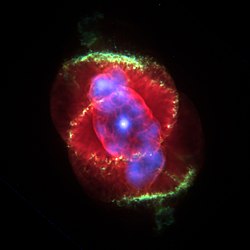
An object resembling a red eye, with a blue pupil, red-blue iris and a green brow. Another green "brow" is placed under the eye, symmetrically versus the pupil.
Composite image using optical images from the HST and X-ray data from the Chandra X-ray Observatory.
Observation data: J2000 epoch
Right ascension17h 58m 33.423s[1]
Declination+66° 37′ 59.52″[1]
Distance3.3±0.9 kly (1.0±0.3 kpc)[2] ly
Apparent magnitude (V)9.8B[1]
Apparent dimensions (V)Core: 20″[2]
ConstellationDraco
Physical characteristics
RadiusCore: 0.2 ly[note 1] ly
Absolute magnitude (V)−0.2+0.8
−0.6
B[note 2]
Notable featurescomplex structure
DesignationsNGC 6543,[1] Snail Nebula,[1] Sunflower Nebula,[1] (includes IC 4677),[1] Caldwell 6
See also: Lists of nebulae

The Cat's Eye Nebula (also known as NGC 6543 and Caldwell 6) is a planetary nebula in the northern constellation of Draco, discovered by William Herschel on February 15, 1786. It was the first planetary nebula whose spectrum was investigated by the English amateur astronomer William Huggins, demonstrating that planetary nebulae were gaseous and not stellar in nature. Structurally, the object has had high-resolution images by the Hubble Space Telescope revealing knots, jets, bubbles and complex arcs, being illuminated by the central hot planetary nebula nucleus (PNN).[3] It is a well-studied object that has been observed from radio to X-ray wavelengths. At the centre of the Cat's Eye Nebula is a dying Wolf–Rayet star, the sort of which can be seen in the Webb Telescope's image of WR 124. The Cat's Eye Nebula's central star shines at magnitude +11.4. Hubble Space Telescope images show a sort of dart board pattern of concentric rings emanating outwards from the centre.

General information

[edit]

NGC 6543 is a high northern declination deep-sky object. It has the combined magnitude of 8.1, with high surface brightness. Its small bright inner nebula subtends an average of 16.1 arcsec, with the outer prominent condensations about 25 arcsec.[4] Deep images reveal an extended halo about 300 arcsec or 5 arcminutes across,[5] that was once ejected by the central progenitor star during its red giant phase.

NGC 6543 is 4.4 minutes of arc from the current position of the north ecliptic pole, less than 110 of the 45 arcminutes between Polaris and the current location of the Earth's northern axis of rotation. It is a convenient and accurate marker for the axis of rotation of the Earth's ecliptic, around which the celestial North Pole rotates. It is also a good marker for the nearby "invariable" axis of the Solar System, which is the center of the circles which every planet's north pole, and the north pole of every planet's orbit, make in the sky. Since motion in the sky of the ecliptic pole is very slow compared to the motion of the Earth's north pole, its position as an ecliptic pole station marker is essentially permanent on the timescale of human history, as opposed to the pole star, which changes every few thousand years.

Observations show the bright nebulosity has temperatures between 7000 and 9000 K, whose densities average of about 5000 particles per cubic centimetre.[6] Its outer halo has the higher temperature around 15,000 K, but is of much lower density.[7] Velocity of the fast stellar wind is about 1900 km/s, where spectroscopic analysis shows the current rate of mass loss averages 3.2×10⁻⁷ solar masses per year, equivalent to twenty trillion tons per second (20 Eg/s).[6]

An optical image of the nebula's surrounding halo

Surface temperature for the central PNN is about 80,000 K, being 10,000 times as luminous as the sun. Stellar classification is O7 + [WR]-type star.[6] Calculations suggest the PNN is over one solar mass, from a theoretical initial 5 solar masses.[8] The central Wolf–Rayet star has a radius of 0.65 R (452,000 km).[9] The Cat's Eye Nebula, given in some sources, lies about three thousand light-years from Earth.[10]

Observations

[edit]

The Cat's Eye was the first planetary nebula to be observed with a spectroscope by William Huggins on August 29, 1864.[11][12] Huggins' observations revealed that the nebula's spectrum was non-continuous and made of a few bright emission lines, first indication that planetary nebulae consist of tenuous ionised gas. Spectroscopic observations at these wavelengths are used in abundance determinations,[13] while images at these wavelengths have been used to reveal the intricate structure of the nebula.[14]

Infrared observations

[edit]

Observations of NGC 6543 at far-infrared wavelengths (about 60 μm) reveal the presence of stellar dust at low temperatures. The dust is believed to have formed during the last phases of the progenitor star's life. It absorbs light from the central star and re-radiates it at infrared wavelengths. The spectrum of the infrared dust emission implies that the dust temperature is about 85 K, while the mass of the dust is estimated at 6.4×10⁻⁴ solar masses.[15]

Infrared emission also reveals the presence of un-ionised material such as molecular hydrogen (H2) and argon. In many planetary nebulae, molecular emission is greatest at larger distances from the star, where more material is un-ionised, but molecular hydrogen emission in NGC 6543 seems to be bright at the inner edge of its outer halo. This may be due to shock waves exciting the H2 as ejecta moving at different speeds collide. The overall appearance of the Cat's Eye Nebula in infrared (wavelengths 2–8 μm) is similar in visible light.[16]

Optical and ultraviolet observations

[edit]

The Hubble Space Telescope image produced here is in false colour, designed to highlight regions of high and low ionisation. Three images were taken, in filters isolating the light emitted by singly ionised hydrogen at 656.3 nm, singly ionised nitrogen at 658.4 nm and doubly ionised oxygen at 500.7 nm. The images were combined as red, green and blue channels respectively, although their true colours are red, red and green. The image reveals two "caps" of less ionised material at the edge of the nebula.[17]

X-ray observations

[edit]
X-ray image of Nebula.

In 2001, observations at X-ray wavelengths by the Chandra X-ray Observatory revealed the presence of extremely hot gas within NGC 6543 with the temperature of 1.7×10⁶ K.[18] It is thought that the very hot gas results from the violent interaction of a fast stellar wind with material previously ejected. This interaction has hollowed out the inner bubble of the nebula.[14] Chandra observations have also revealed a point source at the position of the central star. The spectrum of this source extends to the hard part of the X-ray spectrum, to 0.5–1.0 keV. A star with the photospheric temperature of about 100,000 K would not be expected to emit strongly in hard X-rays, and so their presence is something of a mystery. It may suggest the presence of a high temperature accretion disk within a binary star system.[19] The hard X-ray data remain intriguing more than ten years later: the Cat's Eye was included in a 2012 Chandra survey of 21 central stars of planetary nebulae (CSPNe) in the solar neighborhood, which found: "All but one of the X-ray point sources detected at CSPNe display X-ray spectra that are harder than expected from hot (~100,000 K) central star photospheres, possibly indicating a high frequency of binary companions to CSPNe. Other potential explanations include self-shocking winds or PN mass fallback."[20]

Distance

[edit]

Planetary nebulae distances like NGC 6543 are generally very inaccurate and not well known.[21] Some recent Hubble Space Telescope observations of NGC 6543 taken several years apart determine its distance from the angular expansion rate of 3.457 milliarcseconds per year. Assuming a line of sight expansion velocity of 16.4 km·s−1, this implies that NGC 6543's distance is 1001±269 parsecs (3×10¹⁹ k or 3300 light-years) away from Earth.[22] Several other distance references, like what is quoted in SIMBAD in 2014 based on Stanghellini, L., et al. (2008) suggest the distance is 1623 parsecs (5300 light-years).[23]

Age

[edit]

The angular expansion of the nebula can also be used to estimate its age. If it has been expanding at a constant rate of 10 milliarcseconds a year, then it would take 1000±260 years to reach a diameter of 20 arcseconds. This may be an upper limit to the age, because ejected material will be slowed when it encounters material ejected from the star at earlier stages of its evolution, and the interstellar medium.[22]

Composition

[edit]
Blue-green diffuse disk with complex circular structure in its center. The disk is crossed by s-shaped brown curve.
Image of NGC 6543 processed to reveal the concentric rings surrounding the inner core. Also visible are the linear structures, possibly caused by precessing jets from a binary central star system.

Like most astronomical objects, NGC 6543 consists mostly of hydrogen and helium, with heavier elements present in small quantities. The exact composition may be determined by spectroscopic studies. Abundances are generally expressed relative to hydrogen, the most abundant element.[7]

Different studies generally find varying values for elemental abundances. This is often because spectrographs attached to telescopes do not collect all the light from objects being observed, instead gathering light from a slit or small aperture. Therefore, different observations may sample different parts of the nebula.

However, results for NGC 6543 broadly agree that, relative to hydrogen, the helium abundance is about 0.12, carbon and nitrogen abundances are both about 3×10⁻⁴, and the oxygen abundance is about 7×10⁻⁴.[13] These are fairly typical abundances for planetary nebulae, with the carbon, nitrogen and oxygen abundances all larger than the values found for the sun, due to the effects of nucleosynthesis enriching the star's atmosphere in heavy elements before it is ejected as a planetary nebula.[24]

Deep spectroscopic analysis of NGC 6543 may indicate that the nebula contains a small amount of material which is highly enriched in heavy elements; this is discussed below.[13]

Kinematics and morphology

[edit]

The Cat's Eye Nebula is structurally a very complex nebula, and the mechanism or mechanisms that have given rise to its complicated morphology are not well understood.[14] The central bright part of the nebula consists of the inner elongated bubble (inner ellipse) filled with hot gas. It, in turn, is nested into a pair of larger spherical bubbles conjoined together along their waist. The waist is observed as the second larger ellipse lying perpendicular to the bubble with hot gas.[25]

The structure of the bright portion of the nebula is primarily caused by the interaction of a fast stellar wind being emitted by the central PNN with the visible material ejected during the formation of the nebula. This interaction causes the emission of X-rays discussed above. The stellar wind, blowing with the velocity as high as 1900 km/s, has 'hollowed out' the inner bubble of the nebula, and appears to have burst the bubble at both ends.[14]

It is also suspected that the central WR:+O7 spectral class PNN star, HD 164963 / BD +66 1066 / PPM 20679[1] of the nebula may be generated by a binary star.[1] The existence of an accretion disk caused by mass transfer between the two components of the system may give rise to astronomical jets, which would interact with previously ejected material. Over time, the direction of the jets would vary due to precession.[26][27]

Outside the bright inner portion of the nebula, there are a series of concentric rings, thought to have been ejected before the formation of the planetary nebula, while the star was on the asymptotic giant branch of the Hertzsprung–Russell diagram. These rings are very evenly spaced, suggesting that the mechanism responsible for their formation ejected them at very regular intervals and at very similar speeds.[5] The total mass of the rings is about 0.1 solar masses.[28] The pulsations that formed the rings probably started 15,000 years ago and ceased about 1000 years ago, when the formation of the bright central part began (see above).[29]

Further, a large faint halo extends to large distances from the star. The halo again predates the formation of the main nebula. The mass of the halo is estimated as 0.26–0.92 solar masses.[28]

See also

[edit]

Notes

[edit]

References

[edit]

Cited sources

[edit]
[edit]
Revisions and contributorsEdit on WikipediaRead on Wikipedia
from Grokipedia
The Cat's Eye Nebula (NGC 6543) is a in the northern constellation of Draco, situated approximately 3,000 light-years from . Discovered by astronomer on February 15, 1786, it serves as a visual record of the final evolutionary stages of a Sun-like star that has shed its outer layers, leaving behind a hot core. The nebula's intricate structure includes multiple concentric shells of ionized gas and dust, high-velocity jets, curved arcs, and dense knots shaped by shock waves, making it one of the most morphologically complex examples of its kind. Hubble Space Telescope observations since 1994 have unveiled over 11 nearly concentric rings and bubbles expanding outward from the central core, with the inner bright region exhibiting a kinematic age of about 1,040 years based on expansion measurements. The nebula expands at an average rate of 16.4 km/s, while its outer halo, composed of material ejected during the progenitor star's phase, reaches temperatures around 15,000 K. The central is a with a surface temperature of approximately 80,000 K and a mass of about 1 , driving the ionization and illumination of the surrounding gas through intense ultraviolet radiation. This nebula's unusual asymmetry and layered morphology challenge traditional models of planetary nebula formation, suggesting multiple ejection episodes from the central star over the past 15,000 years, and it remains a prime target for spectroscopic studies of stellar winds and nebular dynamics.

Discovery and Historical Context

Discovery and Early Observations

The classification of originated with William Herschel's work in 1785, when he grouped certain bright, disk-shaped nebulous objects into Class IV of his catalog, noting their resemblance to due to their appearance in telescopes. This framework provided the foundational understanding for identifying such objects as distinct from star clusters or galaxies. The Cat's Eye Nebula was discovered by on February 15, 1786, during his systematic sweeps of the northern sky, and he cataloged it as H IV-37 within his class; it received the designation NGC 6543 in John Herschel's later . Herschel's initial observation revealed a bright, in the constellation Draco, which he interpreted as evidence of stellar formation, though later studies clarified its nature as ejected material from a dying star. John Herschel included the nebula in his General Catalogue, contributing to early characterizations of its structure. Significant progress came in 1864 when William Huggins conducted the first spectroscopic study of the Cat's Eye Nebula on , identifying bright emission lines from and unidentified green lines (later attributed to ionized oxygen), confirming its gaseous composition and distinguishing it from stellar objects. Mid-20th-century spectroscopic efforts further solidified its classification as a , with detailed analyses in the examining the central star's Wolf-Rayet-like spectrum and the nebula's emission lines, revealing carbon-rich compositions and reinforcing models of post-asymptotic giant branch evolution. These observations, conducted at facilities like , built on earlier work by resolving ambiguities in line identifications and dynamics up to that era.

Nomenclature and Significance

The Cat's Eye Nebula is formally designated NGC 6543 in the , compiled by J. L. E. Dreyer and published in 1888, which lists it as a in the constellation Draco. It also appears as Caldwell 6 in Patrick Caldwell-Moore's 1995 catalogue of deep-sky objects visible to amateur astronomers. Additional designations include PK 96+29.1 from the 1967 Perek-Kohoutek catalogue of galactic planetary nebulae. Although discovered after the compilation of Charles Messier's famous catalogue in 1781, NGC 6543 has been suggested in historical discussions as a candidate for inclusion due to its brightness and visual appeal, akin to other prominent nebulae like the . The popular nickname "Cat's Eye Nebula" originates from the nebula's distinctive visual appearance in telescopic observations and photographs, where the bright central region and surrounding shells evoke the elongated pupil and chatoyant glow of a cat's eye gemstone. This descriptive name gained traction in 20th-century astronomical literature, with early printed uses appearing in popular magazines by the 1970s, though informal references likely predate this in observational notes. NGC 6543 holds pivotal significance in planetary nebula research as a prototype for investigating late-stage stellar evolution in Sun-like stars. Its complex morphology and kinematics provide key insights into the mass-loss processes and shaping mechanisms during the asymptotic giant branch phase, as highlighted in seminal 20th-century reviews of nebular dynamics. Discovered in 1786 by William Herschel, it played a central role in early spectroscopic debates on nebula origins; in 1864, William Huggins' analysis of its emission-line spectrum confirmed the gaseous composition of planetary nebulae, overturning the prevailing view of them as stellar clusters. Further advancing nebular , observations of the Cat's Eye Nebula in the contributed to resolving the mystery of "nebulium" lines—unidentified emissions puzzling astronomers since the . In 1928, Ira S. Bowen's seminal paper identified these as forbidden transitions of doubly ionized oxygen and in low-density interstellar gas, enabling accurate modeling of nebular excitation and abundance. This breakthrough, applied to NGC 6543's among others, transformed understanding of ionized nebulae and remains foundational in . The nebula's intricate structure and historical legacy have cemented its cultural and educational impact, featuring prominently in astronomy textbooks since the 1960s as an illustrative example of planetary nebula evolution and multi-shell ejection events. Its iconic images, particularly from the Hubble Space Telescope, continue to symbolize the beauty and complexity of dying stars in public outreach and scientific discourse.

Physical Properties

Distance and Extent

The Cat's Eye Nebula is located in the constellation Draco, with equatorial coordinates of 17h 58m 33s and +66° 37' 59". Distance estimates to the Cat's Eye Nebula have undergone revisions since the , when values around 1,000 parsecs were common based on early spectroscopic and statistical methods. Refined measurements utilized expansion from proper motions to improve accuracy. The current best estimate, incorporating 2021 Early Data Release 3 data and spectroscopic analyses, places the nebula at approximately 950–1,100 parsecs (3,100–3,600 light-years) from . The inner core of the nebula exhibits an angular size of 20 arcseconds, which translates to a physical diameter of about 0.1 parsecs (0.3 light-years) given the adopted distance. The faint outer halo extends to an angular size of about 5.8 arcminutes, corresponding to a physical diameter of over 3 light-years. These distances have been derived primarily through trigonometric parallax observations from the Gaia mission and expansion proper motion techniques, the latter incorporating the nebula's radial expansion velocity of 20 km/s.

Age and Expansion Rate

The dynamical age of the Cat's Eye Nebula (NGC 6543) is estimated to be between 900 and 1,400 years for its prominent inner shells, based on measurements of shell expansion rates derived from multi-epoch (HST) imaging. These estimates come from analyses of nebular features observed over baselines spanning the to the , where angular expansions are combined with spectroscopic velocities to compute kinematic ages. For instance, early HST data from 1994 to 1999 yielded an age of approximately 890 ± 290 years for the inner shell at a distance of about 1 kpc. More recent analyses, incorporating HST observations up to 2014, refine the rim age to 1,340 ± 70 years and the main shell to 1,580 ± 110 years, though the core remains consistently young within the 900–1,400 year range across studies. The expansion velocity profile of the nebula shows a gradient, with inner shells expanding at 10–20 km/s and outer regions reaching up to 40 km/s along polar directions, as mapped through long-slit spectroscopy and proper motions. HST proper motion data from the 1990s confirmed an average expansion velocity of 20 ± 7 km/s for the inner shell, while spectroscopic studies reveal equatorial velocities increasing from ~16 km/s in the inner regions to ~28 km/s in the outer shell, with polar jets approaching 40 km/s. These velocities, scaled by the nebula's distance of approximately 1 kpc, support the young dynamical age and highlight the structured ejection history. The formation of the Cat's Eye Nebula traces back to the progenitor star's (AGB) phase, which lasted around 100,000 years and involved earlier mass ejections that formed the outer halo, dated to 50,000–90,000 years old based on expansion of filamentary structures at low velocities (~6–10 km/s). The more recent superwind phase during late AGB, ending roughly 10,000–15,000 years ago, initiated the rapid post-AGB mass loss that sculpted the inner structures. Age determinations carry uncertainties due to asymmetric ejections and non-uniform expansion, which can lead to discrepancies of up to 20–30% in kinematic models; these are mitigated through 2010s-era radiation-hydrodynamic simulations that correct for deceleration and morphological complexities. Compared to other planetary nebulae, such as the (NGC 7293) with an age of around 10,600 years, the Cat's Eye is relatively young, preserving finer details of its early evolutionary dynamics.

Multi-Wavelength Observations

Optical and Ultraviolet Imaging

Optical imaging of the Cat's Eye Nebula (NGC 6543) has been pivotal in unveiling its intricate morphology, with the (HST) providing unprecedented since the 1990s. The first HST observations in 1994, using the Wide Field Planetary Camera 2 (WFPC2), revealed a complex structure within the central 30 arcseconds, including concentric gas shells surrounding the bright inner core and numerous shock-induced knots of gas, interpreted as condensations shaped by interactions with the . Subsequent HST imaging in 2000 further refined this view, highlighting up to eleven or more concentric rings of dust and gas, each representing episodic mass ejections from the central star over approximately 1,000 years. These space-based images surpass ground-based optical observations, which are limited by atmospheric seeing to about 1 arcsecond resolution, while HST's WFPC2 achieved approximately 0.05 arcsecond , allowing resolution of fine-scale features like jets and . Key to the nebula's vivid appearance in optical images are prominent emission lines from ionized gases. The [O III] line at 5007 Å dominates, producing green hues indicative of doubly ionized oxygen in the highly ionized zones, while Hα at 6563 Å contributes red emission from ionized hydrogen, and He II at 4686 Å traces helium in regions of even higher ionization near the central star. These lines, observed in narrow-band HST filters, highlight the nebula's layered structure, with [O III] emission outlining the inner shells and knots, and Hα revealing cooler, outer filaments. The high ionization levels suggest intense radiation from the hot central , driving throughout the nebula. Ultraviolet spectroscopy has complemented optical imaging by probing the central star's properties. Observations with the International Ultraviolet Explorer (IUE) in the late 1970s and 1980s detected strong P Cygni profiles in resonance lines like C IV and N V, evidencing a fast with terminal velocities of approximately 1900 km/s and mass-loss rates around 3 × 10^{-7} M_⊙ yr^{-1}, which sculpts the nebula's inner dynamics. These UV data reveal the wind's role in energizing the surrounding gas, with absorption features indicating variability in the outflow. More recent HST data from the Wide Field Camera 3 (WFC3) in the 2010s, building on earlier WFPC2 results, have emphasized dust scattering effects and filamentary structures in the outer halo. UVIS channel imaging at 0.04 arcsecond resolution captures scattered light from dust grains, illuminating faint, thread-like filaments extending beyond the bright core, likely remnants of earlier ejection episodes. These observations underscore the nebula's extended envelope, where dust scattering contributes to the observed continuum alongside emission lines. Infrared counterparts to these optical filaments, such as in the 8–13 μm range, trace cooler dust components but are detailed elsewhere.

Infrared and Radio Studies

Infrared observations of the Cat's Eye Nebula have provided insights into its cooler dust components and molecular content, complementing optical views by penetrating the ionized gas layers. The Spitzer Space Telescope's Infrared Array Camera (IRAC) and Multiband Imaging Photometer for Spitzer (MIPS), operating in the 2000s, captured images at 8–24 μm that reveal emission from polycyclic aromatic hydrocarbons (PAHs) in the nebula's extended halo, alongside prominent dust lanes tracing the outer envelope structure. These features indicate the presence of carbonaceous dust grains excited by ultraviolet radiation from the central star, with PAH bands peaking near 8 μm and broader dust continuum at longer wavelengths. More recent James Webb Space Telescope (JWST) observations from 2022 onward, utilizing the Mid-Infrared Instrument (MIRI), have enhanced resolution of these dust distributions, resolving intricate rings and lanes at mid-infrared wavelengths that align loosely with optical shell features. Mid-infrared spectroscopy from Spitzer's Infrared Spectrograph (IRS) further identifies silicate dust signatures, including an amorphous silicate feature at 10 μm and emission from crystalline grains at longer wavelengths (e.g., 23–33 μm), suggesting a mixed dust chemistry with both oxygen- and carbon-rich components in the outer regions. These silicates, comprising about 10% of the cool dust mass, likely originated during the asymptotic giant branch phase and have been partially processed by shocks and radiation. Radio studies probe the ionized plasma and molecular remnants beyond the optical shell. (VLA) continuum observations at 1.4 GHz detect thermal free-free emission from the nebula's ionized gas, yielding an integrated flux density of approximately 1.3 Jy and enabling estimates of the electron density at ne104n_e \approx 10^4 cm3^{-3}. This emission traces the overall ionized and , with the optically thin confirming a filling factor consistent with clumpy morphology. Molecular line observations have detected the CO J=1–0 transition at 115 GHz, with a line intensity indicating a remnant circumstellar envelope from the progenitor's asymptotic giant branch phase, extending beyond the ionized nebula. Recent Atacama Large Millimeter/submillimeter Array (ALMA) interferometry in the 2010s–2020s has resolved kinematic asymmetries in CO outflows, revealing bipolar structures with velocity gradients up to 20 km s1^{-1} and pointing to episodic mass ejections that shaped the nebula's point-symmetric morphology. These high-resolution maps highlight cooler, molecular gas components decoupled from the inner ionized regions, providing evidence for multiple outflow episodes during the post-asymptotic giant branch evolution.

X-ray and High-Energy Emissions

observations since the early 2000s have revealed diffuse soft X-ray emission (0.3–2.0 keV) from the Cat's Eye Nebula (NGC 6543), originating from shocked gas at temperatures around 1.7 × 10^6 K. This emission is confined to the central elliptical shell and aligned extensions, indicating heating by interactions between the fast and the surrounding nebula. The total luminosity of this diffuse component is approximately 10^{32} erg s^{-1}, assuming a distance of 1 kpc, highlighting the energetic role of shocks in the nebula's inner dynamics. A point-like X-ray source is also detected at the position of the central star, attributed to collisions within its fast wind, with a of approximately 10^{30} erg s^{-1} in the 0.3–2.0 keV band. Spectral analysis of this source, fitted with thermal plasma models, reveals temperatures in the range of 0.5–1.5 keV, consistent with shock-heated plasma. Key spectral features include lines from He-like O VII (∼0.57 keV), H-like O VIII (∼0.65 keV), He-like Ne IX (∼0.92 keV), and Fe L-shell blends (∼1.10 keV), indicating a composition enriched in and matching the stellar wind abundances rather than the nebular material. The evolution of the emission is linked to the nebula's expansion shocks, where hydrodynamic models simulate the interaction of the with expanding shells, producing the observed hot plasma distribution and temperature profile. These 2010s-era simulations demonstrate how shocks at shell interfaces elevate temperatures by several thousand , driving the diffuse morphology and tying it to the overall kinematic expansion.

Structure and Dynamics

Morphological Components

The (NGC 6543) displays a highly intricate multi-shell structure, characterized by multiple concentric gas shells that form a layered, onion-skin configuration around the central star. The innermost region features a bright elliptical core, approximately 0.3 pc across, composed of two intersecting prolate ellipsoids that create the distinctive "cat's eye" appearance through their orthogonal orientations. Surrounding this core are intermediate partial rings, interpreted as remnants of episodic ejections, which contribute to the nebula's point-symmetric morphology. The outer halo extends to a diameter of about 1.9 pc and encompasses more than ten faint concentric shells, visible in high-resolution as delicate and filaments indicative of successive mass-loss events from the progenitor star. Along the polar axes, prominent ansae knots appear as low-ionization condensations, particularly bright in [N II] emission, extending roughly 0.1 pc in length and representing dense blobs of gas shaped by shock interactions. Imaging data reveal bipolar lobes protruding from the poles, connected by an inferred equatorial that constricts at the waist, giving the nebula a barrel-like form with non-spherical asymmetries. These asymmetries, including the point-symmetric rings and jets, are hypothesized to arise from non-uniform ejections influenced by a binary companion to the central , though this remains unconfirmed. Three-dimensional reconstructions derived from observations spanning the 1990s to the 2020s, using morpho-kinematic modeling, confirm a toroidal for the intermediate structures, with partial tori tilted relative to the symmetry axis and bipolar outer shells. A 2022 study using modeling further confirmed the rings as remnants of a precessing jet with calculated tilt and opening .

Kinematic Features

Spectroscopic mapping of the Cat's Eye Nebula (NGC 6543) using long-slit echelle has revealed a Hubble-type field, where expansion velocities increase linearly outward from the central star, ranging from approximately 10 km/s near the core to about 20 km/s in the outer regions of the main shell, with higher velocities in jets and knots. This kinematic structure indicates a homologous expansion pattern consistent with a spherical outflow shaped by subsequent ejections, as observed along multiple position angles crossing the nebula's bipolar lobes and equatorial regions. Proper motion studies based on multi-epoch (HST) imaging have measured transverse expansion velocities averaging around 3.5 mas/yr across symmetric features in the inner shell and ansae, confirming a three-dimensional expansion that aligns with the data to yield a consistent dynamical picture. These measurements, insensitive to bulk nebular motions, highlight the prolate geometry and point-symmetric elements, supporting models of episodic mass loss from the central engine. Hydrodynamic simulations from the , incorporating interacting stellar , demonstrate how fast post-asymptotic giant branch collide with slower earlier to sculpt the nebula's prolate morphology and internal cavities. These models reproduce the observed gradients and shell interactions, emphasizing the role of wind momentum in driving the asymmetric expansion without requiring . Turbulent velocities within the prominent knots, such as the large western knot in the halo, reach about 20 km/s, as traced by high-resolution of [O III] emission, signaling hydrodynamic instabilities like Rayleigh-Taylor disruptions at the interfaces between fast and slow flows. This disrupts coherent expansion in localized regions, contributing to the knotty substructures observed in imaging. Evidence for binary-induced precession emerges from kinematic twists in the position-velocity diagrams of the inner rings and jets, modeled in studies as remnants of a precessing collimated outflow with a half-opening angle of ~10 degrees and period of several centuries. These twists manifest as S-shaped deviations from pure Hubble flow, attributable to orbital motion in a close perturbing the ejection axis.

Composition and Central Engine

Chemical Makeup

The of the Cat's Eye Nebula (NGC 6543) reflects the nucleosynthetic of its (AGB) progenitor star, with elemental abundances derived from optical and ultraviolet emission lines indicating a mix of primordial and processed material. The helium-to-hydrogen abundance ratio is He/H = 0.118, consistent with modest enrichment from the star's evolution. Oxygen abundance is solar-like at O/H = 5.5 × 10^{-4}, while and neon show enhancements at N/H = 2.3 × 10^{-4} and Ne/H = 1.9 × 10^{-4}, respectively, attributed to dredge-up episodes that brought these elements from the stellar interior to the surface during the AGB phase. Ionization states vary radially across the , revealing a stratified structure shaped by the central star's radiation field. Inner regions near the core exhibit high , dominated by such as O^{6+} (O VI), produced through collisions at the interface between the hot bubble (T ≈ 10^6 ) and the cooler nebular shell. In contrast, outer regions, including caps, ansae, and jets, display low- conditions with prominent N^+ and S^+ lines, as traced by [N II] and [S II] emission, where the ionization potential is lower and recombination dominates. Dust grains constitute a significant component of the nebula's , comprising and materials as identified from spectra. These grains account for approximately 20–30% of the mass, with silicates (both amorphous and crystalline forms) being prominent in the oxygen-rich environment, contributing to the observed far- emission. The presence of such influences the overall and indicates formation during the progenitor's AGB mass-loss phase. Isotopic ratios provide evidence of mixing processes in the progenitor. The ^{12}C/^{13}C ratio is low at ≈4, far below the solar value of ≈90, signaling extensive extra-mixing on the AGB that converted ^{12}C to ^{13}C via the CN cycle. This ratio is derived from ultraviolet lines, highlighting the nebula's role as a probe of stellar nucleosynthesis. Certain metals exhibit depletions relative to gas-phase expectations, due to incorporation into dust grains. Iron, for instance, shows significant depletion with log(Fe/O) ranging from -3.1 to -2.5, implying over 90% of iron is locked in dust, as quantified by comparing UV and optical forbidden line ratios such as [Fe II]/[O II] and [Fe III]/[O III]. Similar depletions affect other refractories like silicon and magnesium, consistent with silicate grain formation.

Properties of the Central Star

The central star of the Cat's Eye Nebula is a hot, evolved remnant classified as spectral type Of-WR(H), characterized by a hydrogen-rich atmosphere with prominent absorption, strong lines, and emission features from elements like C IV and N V typical of post-asymptotic giant branch (post-AGB) stars with a dense . Analysis of and optical spectra yields an of approximately 80,000 K and surface gravity log g ≈ 5.7–6.0, reflecting its high state and compact structure as a pre-white dwarf. Stellar atmosphere modeling from Balmer line fitting estimates the luminosity at approximately 10³ L⊙ and the mass at about 0.6 M⊙, consistent with evolutionary tracks for low- to intermediate-mass progenitors transitioning to white dwarfs. The star exhibits a fast stellar wind with a terminal velocity of around 1,500 km/s and a mass-loss rate of roughly 10⁻⁷ M⊙ yr⁻¹, as derived from International Ultraviolet Explorer (IUE) observations and supplemented by Pan-STARRS photometry for distance and extinction corrections. This ongoing mass ejection shapes the nebula's inner dynamics, contributing to its complex morphology while the star's composition underscores late-stage nucleosynthesis in the progenitor. Recent astrometric data constrain the presence of a binary companion to an upper mass limit of less than 0.01 M⊙, suggesting the nebula's structures arise primarily from the single-star evolution rather than binary interactions, though this limit impacts interpretations of potential precessional jets.

References

Add your contribution
Related Hubs
User Avatar
No comments yet.