

Calling of Matthew
View on Wikipedia

The Calling of Matthew, also known as the Calling of Levi, is an episode in the life of Jesus which appears in all three synoptic gospels, Matthew 9:9–13, Mark 2:13–17 and Luke 5:27–28, and relates the initial encounter between Jesus and Matthew, the tax collector who became a disciple.[1]
Biblical narratives
[edit]According to the Gospel of Matthew: "As Jesus went on from there, he saw a man named Matthew sitting at the tax collector's booth. "Follow me", he told him, and Matthew got up and followed him."[2]
A tax collector could be either an independent contractor with the Roman government, who paid a fee to Rome to obtain the right to extract taxes from the people in a certain area, with an added fee for the collector and his employees; or he might have also been a toll collector for Herod Antipas,[3] Capernaum was an area with a high traffic of people and merchants.[4] In any case, Levi-Matthew would have been a very unpopular individual.
The Biblical Greek: τὸ τελώνιον (to telōnion) is often translated as "the tax collector's booth" (e.g. NIV) or "tax office" (e.g. RSV). The King James Version says Matthew was "sitting at the receipt of custom". Wycliffe's translation was "sitting in a tollbooth", and the Expanded Bible suggests that the telōnion was "probably a tariff booth for taxing goods in transit".[5]
In all three synoptic gospels, this episode takes place shortly after the miracle of healing the paralytic at Capernaum and is followed by Jesus' image of the danger of putting new wine into old wineskins. In the Gospels of Mark and Luke, the person called is called Levi, who was the son of Alpheus according to Mark (Luke does not mention Alpheus).[6]
Also in all three synoptic accounts Jesus is then invited to a banquet, with a crowd of tax collectors and others. The Pharisees then complain:
29 Then Levi held a great banquet for Jesus at his house, and a large crowd of tax collectors and others were eating with them. 30 But the Pharisees and the teachers of the law who belonged to their sect complained to his disciples, "Why do you eat and drink with tax collectors and sinners?" 31 Jesus answered them, "It is not the healthy who need a doctor, but the sick. 32 I have not come to call the righteous, but sinners to repentance."[7]
Commentary
[edit]Roger Baxter reflects on Matthew's call in his Meditations, writing that:
Great was the force of this call, which was able to withdraw a man from his riches: and yet the same call, perhaps, would not be forcible enough to withdraw you from smaller impediments. Who can despair of salvation, when he sees public sinners taken out of a custom house, assumed not only to the friendship of God, but raised to the highest dignity of the apostleship." Truly, " His tender mercies are over all His works." (Ps. 144:9.)[8]
Cornelius a Lapide in his commentary writes:
Thus then as a magnet draws iron unto it, so did Christ draw Matthew, and by His drawing, gave him his virtues, and chiefly his exceeding love of God, zeal for souls, ardour in preaching. Listen to the account of S. Matthew’s conversion, which he himself gave to St. Bridget of Sweden, when praying at his tomb at Malphi: “It was my desire at the time I was a publican to defraud no man, and I wished to find out a way by which I might abandon that employment, and cleave to God alone with my whole heart. When therefore He who loved me, even Jesus Christ was preaching, His call was a flame of fire in my heart; and so sweet were His words unto my taste, that I thought no more of riches than of straws: yea, it was delightful to me to weep for joy, that my God had deigned to call one of such small account, and so great a sinner as I to His grace. And as I clave unto my Lord, His burning words became fixed in my heart, and day and night I fed upon them by meditation, as upon sweetest food.”[9][10]
In art
[edit]The calling of Matthew has been the subject of works of art by several painters, including:
- The Calling of St Matthew by Caravaggio (1599–1600) at Contarelli Chapel in the church of San Luigi dei Francesi in Rome
- Hendrick ter Brugghen (1621)
- Juan de Pareja (1661).
-
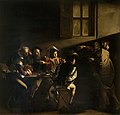 The Calling of Saint Matthew, by Caravaggio
 -
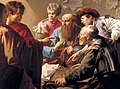 The Calling of St. Matthew, by Hendrick ter Brugghen
 -
 The Calling of St Matthew, by the Master of the Abbey of Dilighem
 -
 The Calling of St. Matthew, by Orcagna
 -
 The Calling of St. Matthew, by Naldini
.jpg)


,_1367-68,_05.jpg)

See also
[edit]- Commissioning the twelve Apostles
- First disciples of Jesus
- Gospel harmony: Matthew 9, Mark 2, Luke 5
- Great Commission
- Life of Jesus in the New Testament
- Jesus eats with sinners and tax-collectors

References
[edit]- ^ France, R.T. (2007), The Gospel of Matthew, p. 349, ISBN 978-0-8028-2501-8.
- ^ Matthew 9:9: KJV
- ^ Brown, Raymond E. (1990), The New Jerome Biblical Commentary, et al., Prentice Hall, ISBN 0-13-614934-0.
- ^ Kilgallen, John J. (1989), A Brief Commentary on the Gospel of Mark, Paulist Press, ISBN 0-8091-3059-9.
- ^ Matthew 9:9: Expanded Bible
- ^ Strauss, David Friedrich (1860), The Life of Jesus, Calvin Blanchard, p. 340.
- ^ Luke 5:29–32
- ^ Baxter, Roger (1823). . Meditations For Every Day In The Year. New York: Benziger Brothers.
- ^ ""The New (& the Old) Evangelization: From tax collector to apostle"". Catholic News Agency. Archived from the original on June 17, 2022. Retrieved 2022-04-18.
- ^ Lapide, Cornelius (1908). The Great Commentary of Cornelius À Lapide: S. Matthew's gospel, chaps. 1-9. J. Grant.
External links
[edit]- St Matthew the Apostle from The Golden Legend
- Apostle and Evangelist Matthew Orthodox icon and synaxarion
Calling of Matthew
View on GrokipediaBiblical Accounts
Gospel of Matthew
In the Gospel of Matthew, the calling of Matthew occurs as Jesus is walking along and notices a man named Matthew seated at the tax collector's booth; he simply commands, "Follow me," and Matthew immediately rises and obeys, leaving his position behind.[2] This abrupt summons underscores the transformative power of Jesus' invitation, requiring instant response without elaboration or negotiation.[3] The narrative continues with a banquet scene in Matthew's house, where Jesus reclines at table with many tax collectors and sinners alongside his disciples (Matthew 9:10).[4] The observing Pharisees object to the disciples, questioning why their teacher associates with such individuals, whom they regard as morally compromised (Matthew 9:11).[5] Jesus overhears and responds directly: "Those who are well have no need of a physician, but those who are sick," likening his presence to healing and then directing the Pharisees to reflect on Hosea 6:6—"I desire mercy, not sacrifice"—before declaring, "For I have come to call not the righteous but sinners" (Matthew 9:12-13).[6] This exchange frames the meal as an act of compassionate outreach rather than endorsement of wrongdoing. Matthew's account particularly stresses Jesus' deliberate association with sinners as a fulfillment of Old Testament prophecy, evident in the strategic quotation from Hosea 6:6, which elevates covenantal mercy (eleos in Greek) over ritual sacrifice (thusia), positioning Jesus as the embodiment of God's restorative intent toward the outcast.[7] Through this redactional choice, the evangelist portrays the calling and banquet not merely as biographical events but as demonstrations of messianic authority that align with divine priorities of faithfulness and inclusion over legalistic purity.[3] Verse 9 introduces the key Greek term telōnēs (τελώνης), denoting Matthew as a "tax collector" or public revenue gatherer, a role derived from telos (toll or duty) and implying a contracted agent for imperial collection, often tainted by accusations of overcharging and collaboration with Roman oppressors.[8] In verses 10-11, telōnēs recurs alongside "sinners" (hamartōloi), reinforcing the duo's shared status as social pariahs excluded from pious Jewish fellowship due to ritual impurity and ethical stigma.[8] This terminology amplifies the scandal of Jesus' call, highlighting Matthew's low standing and the radical grace extended to those deemed irredeemable. This episode parallels similar callings in Mark 2:13-17 and Luke 5:27-32, where the figure is named Levi, indicating narrative variations of one tradition.[3]Gospel of Mark
In the Gospel of Mark, the calling of Levi occurs during Jesus' ministry in Galilee. Jesus goes out beside the Sea of Galilee, where a large crowd gathers around him, and he begins teaching them (Mark 2:13). As he walks along the seashore, he sees Levi son of Alphaeus sitting at the tax collector's booth and says to him, "Follow me," prompting Levi to immediately rise and follow (Mark 2:14). This seaside setting emphasizes the public nature of the encounter, with the tax booth likely positioned to collect tolls on goods transported by water or road near Capernaum.[9] Following the call, Jesus reclines at a meal in Levi's house, joined by many tax collectors and sinners who are eating with him and his disciples, as numerous people had begun to follow Jesus (Mark 2:15). When the teachers of the law, who were Pharisees, observe this and question the disciples about why Jesus associates with such individuals, Jesus responds, "It is not the healthy who need a doctor, but the sick. I have not come to call the righteous, but sinners" (Mark 2:16-17). This exchange highlights the controversy surrounding Jesus' choice of companions, underscoring the immediate aftermath of Levi's summons.[10] Mark's account uniquely precedes the calling with Jesus teaching a large crowd by the sea, a detail absent from the synoptic parallels in Matthew 9:9-13 and Luke 5:27-32, which portray the event more directly without the preceding public instruction.[11] Regarding Levi's identity, scholars widely regard him as the apostle otherwise known as Matthew, with "Levi" possibly representing his original Hebrew name—evoking the tribal heritage of Levi—prior to his apostolic designation as Matthew, son of Alphaeus, which aligns him with the list of the Twelve in Mark 3:18. This naming suggests an evolution in his identity from a marginalized tax collector to a key disciple, potentially linking him familially to James son of Alphaeus among the apostles.[12][1]Gospel of Luke
In the Gospel of Luke, the calling of Levi is recounted in chapter 5, verses 27-32. After this, Jesus went out and saw a tax collector by the name of Levi sitting at his tax booth. “Follow me,” Jesus said to him, and Levi got up, left everything and followed him.[13] The term "tax booth" translates the Greek telōnion, referring to a customs post where tolls were collected on goods passing through, highlighting Levi's involvement in the Roman taxation system that imposed economic burdens on the local population.[14] This detail underscores Levi's status as a societal outcast, yet Jesus' direct call demonstrates his outreach to the marginalized.[15] Levi responds by hosting a great banquet for Jesus at his house, attended by a large crowd of tax collectors and others.[16] This event emphasizes communal celebration and inclusion, as the guest list extends beyond Jesus and his disciples to encompass those deemed unclean or sinful by Jewish purity standards, such as tax collectors who were viewed as collaborators with Roman authorities.[17] Luke's portrayal of the banquet as a "great" (megas) affair amplifies its joyful tone, contrasting with more subdued depictions in parallel accounts and aligning with the evangelist's recurring theme of table fellowship as a sign of God's kingdom welcoming outsiders.[15] The Pharisees and teachers of the law, observing the scene, complain to the disciples: “Why do you eat and drink with tax collectors and sinners?” Jesus replies, “It is not the healthy who need a doctor, but the sick. I have not come to call the righteous, but sinners to repentance.”[18] This response articulates Jesus' mission of moral and spiritual transformation, explicitly adding the call "to repentance" as a Lukan redactional emphasis not found in the shorter version in Mark 2:13-17, where Levi is similarly named but the banquet is described more simply as a dinner.[15]Textual Comparisons
The synoptic Gospels—Matthew, Mark, and Luke—present parallel accounts of Jesus calling a tax collector to discipleship, with the narratives sharing core elements such as the location at a tax booth and the subsequent banquet involving criticism from religious leaders. These parallels highlight both harmonies in the event's structure and notable differences in details, particularly regarding the disciple's name and the banquet's specifics.[19][20] The following table summarizes key elements across the accounts:| Element | Gospel of Matthew (9:9–13) | Gospel of Mark (2:13–17) | Gospel of Luke (5:27–32) |
|---|---|---|---|
| Name of Tax Collector | Matthew | Levi, son of Alphaeus | Levi |
| Setting | Tax booth (implied Capernaum) | Tax booth by the sea (Capernaum) | Tax booth (implied Capernaum) |
| Immediate Response | He rose and followed him | He rose and followed him | He left everything, got up, and followed him |
| Banquet Details | At home (implied Matthew's), with many tax collectors and sinners | At Levi's house, with many tax collectors and sinners reclining | At Levi's house, great banquet, many tax collectors and others |
| Critics | Pharisees | Scribes of the Pharisees | Pharisees and their scribes |
| Jesus' Response | "Those who are well have no need of a physician, but those who are sick... Go and learn what this means: 'I desire mercy, and not sacrifice.' For I came not to call the righteous, but sinners." | "Those who are well have no need of a physician, but those who are sick. I came not to call the righteous, but sinners." | "Those who are well have no need of a physician, but those who are sick. I have not come to call the righteous but sinners to repentance." |