Hubbry Logo
Partition function (statistical mechanics)Partition function (statistical mechanics)Main
Open search
Partition function (statistical mechanics)
Community hub
Partition function (statistical mechanics)
logo
8 pages, 0 posts
0 subscribers
Be the first to start a discussion here.
Partition function (statistical mechanics)
from Wikipedia

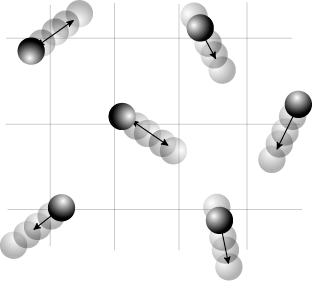
The thermal motions of the atoms or molecules in a gas are allowed to move freely, and the interactions between the two (the gas and the atoms/molecules) can be neglected.

In physics, a partition function describes the statistical properties of a system in thermodynamic equilibrium.[citation needed] Partition functions are functions of the thermodynamic state variables, such as the temperature and volume. Most of the aggregate thermodynamic variables of the system, such as the total energy, free energy, entropy, and pressure, can be expressed in terms of the partition function or its derivatives. The partition function is dimensionless.

Each partition function is constructed to represent a particular statistical ensemble (which, in turn, corresponds to a particular free energy). The most common statistical ensembles have named partition functions. The canonical partition function applies to a canonical ensemble, in which the system is allowed to exchange heat with the environment at fixed temperature, volume, and number of particles. The grand canonical partition function applies to a grand canonical ensemble, in which the system can exchange both heat and particles with the environment, at fixed temperature, volume, and chemical potential. Other types of partition functions can be defined for different circumstances; see partition function (mathematics) for generalizations. The partition function has many physical meanings, as discussed in Meaning and significance.

Canonical partition function

[edit]

Definition

[edit]

Initially, let us assume that a thermodynamically large system is in thermal contact with the environment, with a temperature T, and both the volume of the system and the number of constituent particles are fixed. A collection of this kind of system comprises an ensemble called a canonical ensemble. The appropriate mathematical expression for the canonical partition function depends on the degrees of freedom of the system, whether the context is classical mechanics or quantum mechanics, and whether the spectrum of states is discrete or continuous.[citation needed]

Classical discrete system

[edit]

For a canonical ensemble that is classical and discrete, the canonical partition function is defined as where
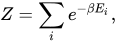
  • is the index for the microstates of the system;
  • is Euler's number;
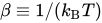
  • is the thermodynamic beta, defined as where is the Boltzmann constant;
  • is the total energy of the system in the respective microstate.

The exponential factor is otherwise known as the Boltzmann factor.

Derivation of canonical partition function (classical, discrete)

There are multiple approaches to deriving the partition function. The following derivation follows the more powerful and general information-theoretic Jaynesian maximum entropy approach.

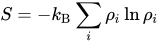
According to the second law of thermodynamics, a system assumes a configuration of maximum entropy at thermodynamic equilibrium. We seek a probability distribution of states that maximizes the discrete Gibbs entropy subject to two physical constraints:

  1. The probabilities of all states add to unity (second axiom of probability):
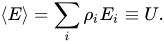
  2. In the canonical ensemble, the system is in thermal equilibrium, so the average energy does not change over time; in other words, the average energy is constant (conservation of energy):

Applying variational calculus with constraints (analogous in some sense to the method of Lagrange multipliers), we write the Lagrangian (or Lagrange function) as


Varying and extremizing with respect to leads to

Since this equation should hold for any variation , it implies that

Isolating for yields

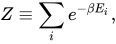
To obtain , one substitutes the probability into the first constraint: where is a number defined as the canonical ensemble partition function:

Isolating for yields .

Rewriting in terms of gives

Rewriting in terms of gives

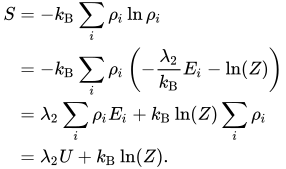
To obtain , we differentiate with respect to the average energy and apply the first law of thermodynamics, :

(Note that and vary with as well; however, using the chain rule and one can show that the additional contributions to this derivative cancel each other.)

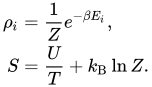
Thus the canonical partition function becomes where is defined as the thermodynamic beta. Finally, the probability distribution and entropy are respectively
Classical continuous system

[edit]

In classical mechanics, the position and momentum variables of a particle can vary continuously, so the set of microstates is actually uncountable. In classical statistical mechanics, it is rather inaccurate to express the partition function as a sum of discrete terms. In this case we must describe the partition function using an integral rather than a sum. For a canonical ensemble that is classical and continuous, the canonical partition function is defined as where

To make it into a dimensionless quantity, we must divide it by h, which is some quantity with units of action (usually taken to be the Planck constant).

For generalized cases, the partition function of particles in -dimensions is given by

Classical continuous system (multiple identical particles)

[edit]

For a gas of identical classical non-interacting particles in three dimensions, the partition function is where

  • is the Planck constant;
  • is the thermodynamic beta, defined as ;
  • is the index for the particles of the system;
  • is the Hamiltonian of a respective particle;
  • is the canonical position of the respective particle;
  • is the canonical momentum of the respective particle;
  • is shorthand notation to indicate that and are vectors in three-dimensional space.
  • is the classical continuous partition function of a single particle as given in the previous section.

The reason for the factorial factor N! is discussed below. The extra constant factor introduced in the denominator was introduced because, unlike the discrete form, the continuous form shown above is not dimensionless. As stated in the previous section, to make it into a dimensionless quantity, we must divide it by h3N (where h is usually taken to be the Planck constant).

Quantum mechanical discrete system

[edit]

For a canonical ensemble that is quantum mechanical and discrete, the canonical partition function is defined as the trace of the Boltzmann factor: where:
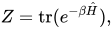
  • is the trace of a matrix;
  • is the thermodynamic beta, defined as ;
  • is the Hamiltonian operator.

The dimension of is the number of energy eigenstates of the system.

Quantum mechanical continuous system

[edit]

For a canonical ensemble that is quantum mechanical and continuous, the canonical partition function is defined as where:

In systems with multiple quantum states s sharing the same energy Es, it is said that the energy levels of the system are degenerate. In the case of degenerate energy levels, we can write the partition function in terms of the contribution from energy levels (indexed by j) as follows: where gj is the degeneracy factor, or number of quantum states s that have the same energy level defined by Ej = Es.

The above treatment applies to quantum statistical mechanics, where a physical system inside a finite-sized box will typically have a discrete set of energy eigenstates, which we can use as the states s above. In quantum mechanics, the partition function can be more formally written as a trace over the state space (which is independent of the choice of basis): where Ĥ is the quantum Hamiltonian operator. The exponential of an operator can be defined using the exponential power series.

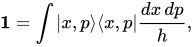
The classical form of Z is recovered when the trace is expressed in terms of coherent states[1] and when quantum-mechanical uncertainties in the position and momentum of a particle are regarded as negligible. Formally, using bra–ket notation, one inserts under the trace for each degree of freedom the identity: where |x, p is a normalised Gaussian wavepacket centered at position x and momentum p. Thus A coherent state is an approximate eigenstate of both operators and , hence also of the Hamiltonian Ĥ, with errors of the size of the uncertainties. If Δx and Δp can be regarded as zero, the action of Ĥ reduces to multiplication by the classical Hamiltonian, and Z reduces to the classical configuration integral.

Connection to probability theory

[edit]

For simplicity, we will use the discrete form of the partition function in this section. Our results will apply equally well to the continuous form.

Consider a system S embedded into a heat bath B. Let the total energy of both systems be E. Let pi denote the probability that the system S is in a particular microstate, i, with energy Ei. According to the fundamental postulate of statistical mechanics (which states that all attainable microstates of a system are equally probable), the probability pi will be proportional to the number of microstates of the total closed system (S, B) in which S is in microstate i with energy Ei. Equivalently, pi will be proportional to the number of microstates of the heat bath B with energy EEi. We then normalize this by dividing by the total number of microstates in which the constraints we have imposed on the entire system; both S and the heat bath; hold. In this case the only constraint is that the total energy of both systems is E, so:
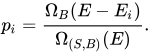
Assuming that the heat bath's internal energy is much larger than the energy of S (EEi), we can Taylor-expand to first order in Ei and use the thermodynamic relation , where here , are the entropy and temperature of the bath respectively:


Thus

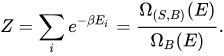
Since the total probability to find the system in some microstate (the sum of all pi) must be equal to 1, we know that the constant of proportionality must be the normalization constant, and so, we can define the partition function to be this constant:
Calculating the thermodynamic total energy

[edit]

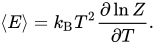
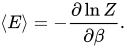
In order to demonstrate the usefulness of the partition function, let us calculate the thermodynamic value of the total energy. This is simply the expected value, or ensemble average for the energy, which is the sum of the microstate energies weighted by their probabilities: or, equivalently,

Incidentally, one should note that if the microstate energies depend on a parameter λ in the manner then the expected value of A is


This provides us with a method for calculating the expected values of many microscopic quantities. We add the quantity artificially to the microstate energies (or, in the language of quantum mechanics, to the Hamiltonian), calculate the new partition function and expected value, and then set λ to zero in the final expression. This is analogous to the source field method used in the path integral formulation of quantum field theory.[citation needed]

Relation to thermodynamic variables

[edit]

In this section, we will state the relationships between the partition function and the various thermodynamic parameters of the system. These results can be derived using the method of the previous section and the various thermodynamic relations.

As we have already seen, the thermodynamic energy is
The variance in the energy (or "energy fluctuation") is

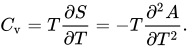
The heat capacity is

In general, consider the extensive variable X and intensive variable Y where X and Y form a pair of conjugate variables. In ensembles where Y is fixed (and X is allowed to fluctuate), then the average value of X will be:
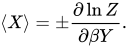
The sign will depend on the specific definitions of the variables X and Y. An example would be X = volume and Y = pressure. Additionally, the variance in X will be

In the special case of entropy, entropy is given by where A is the Helmholtz free energy defined as A = UTS, where U = ⟨E is the total energy and S is the entropy, so that

Furthermore, the heat capacity can be expressed as
Partition functions of subsystems

[edit]

Suppose a system is subdivided into N sub-systems with negligible interaction energy, that is, we can assume the particles are essentially non-interacting. If the partition functions of the sub-systems are ζ1, ζ2, ..., ζN, then the partition function of the entire system is the product of the individual partition functions:

If the sub-systems have the same physical properties, then their partition functions are equal, ζ1 = ζ2 = ... = ζ, in which case

However, there is a well-known exception to this rule. If the sub-systems are actually identical particles, in the quantum mechanical sense that they are impossible to distinguish even in principle, the total partition function must be divided by a N! (N factorial):

This is to ensure that we do not "over-count" the number of microstates. While this may seem like a strange requirement, it is actually necessary to preserve the existence of a thermodynamic limit for such systems. This is known as the Gibbs paradox.

Meaning and significance

[edit]

It may not be obvious why the partition function, as we have defined it above, is an important quantity. First, consider what goes into it. The partition function is a function of the temperature T and the microstate energies E1, E2, E3, etc. The microstate energies are determined by other thermodynamic variables, such as the number of particles and the volume, as well as microscopic quantities like the mass of the constituent particles. This dependence on microscopic variables is the central point of statistical mechanics. With a model of the microscopic constituents of a system, one can calculate the microstate energies, and thus the partition function, which will then allow us to calculate all the other thermodynamic properties of the system.

The partition function can be related to thermodynamic properties because it has a very important statistical meaning. The probability Ps that the system occupies microstate s is
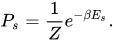
Thus, as shown above, the partition function plays the role of a normalizing constant (note that it does not depend on s), ensuring that the probabilities sum up to one:

This is the reason for calling Z the "partition function": it encodes how the probabilities are partitioned among the different microstates, based on their individual energies. Other partition functions for different ensembles divide up the probabilities based on other macrostate variables. As an example: the partition function for the isothermal-isobaric ensemble, the generalized Boltzmann distribution, divides up probabilities based on particle number, pressure, and temperature. The energy is replaced by the characteristic potential of that ensemble, the Gibbs Free Energy. The letter Z stands for the German word Zustandssumme, "sum over states". The usefulness of the partition function stems from the fact that the macroscopic thermodynamic quantities of a system can be related to its microscopic details through the derivatives of its partition function. Finding the partition function is also equivalent to performing a Laplace transform of the density of states function from the energy domain to the β domain, and the inverse Laplace transform of the partition function reclaims the state density function of energies.

Grand canonical partition function

[edit]

We can define a grand canonical partition function for a grand canonical ensemble, which describes the statistics of a constant-volume system that can exchange both heat and particles with a reservoir. The reservoir has a constant temperature T, and a chemical potential μ.

The grand canonical partition function, denoted by , is the following sum over microstates Here, each microstate is labelled by , and has total particle number and total energy . This partition function is closely related to the grand potential, , by the relation This can be contrasted to the canonical partition function above, which is related instead to the Helmholtz free energy.


It is important to note that the number of microstates in the grand canonical ensemble may be much larger than in the canonical ensemble, since here we consider not only variations in energy but also in particle number. Again, the utility of the grand canonical partition function is that it is related to the probability that the system is in state :
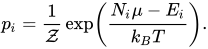
An important application of the grand canonical ensemble is in deriving exactly the statistics of a non-interacting many-body quantum gas (Fermi–Dirac statistics for fermions, Bose–Einstein statistics for bosons), however it is much more generally applicable than that. The grand canonical ensemble may also be used to describe classical systems, or even interacting quantum gases.

The grand partition function is sometimes written (equivalently) in terms of alternate variables as[2] where is known as the absolute activity (or fugacity) and is the canonical partition function.

See also

[edit]

References

[edit]
Revisions and contributorsEdit on WikipediaRead on Wikipedia
from Grokipedia
In , the partition function is a central mathematical construct that encodes the statistical properties of a in , serving as a normalization factor from which all thermodynamic quantities—such as , , and free energy—can be derived. It quantifies the number of thermally accessible microstates, weighted by their Boltzmann factors, thereby bridging microscopic behavior to macroscopic observables like and . Developed in the late 19th and early 20th centuries, it formalizes the ideas of and , enabling predictions of system behavior under fixed conditions like and . The most common form is the canonical partition function ZZ, applicable to systems in the where the number of particles NN, volume VV, and TT are held constant, allowing only energy exchange with a heat bath. Mathematically, for a discrete set of states, it is expressed as Z=ieβEiZ = \sum_i e^{-\beta E_i}, where β=1/(kBT)\beta = 1/(k_B T), kBk_B is Boltzmann's constant, and EiE_i are the eigenvalues of the microstates; for continuous systems, the sum becomes an integral over . This function determines the probability of each state via the pi=eβEi/Zp_i = e^{-\beta E_i}/Z, ensuring the probabilities sum to unity. Key thermodynamic relations stem directly from ZZ: the Helmholtz free energy is F=kBTlnZF = -k_B T \ln Z, internal energy U=lnZ/βU = -\partial \ln Z / \partial \beta, entropy S=(UF)/TS = (U - F)/T, and pressure P=kBT(lnZ/V)T,NP = k_B T (\partial \ln Z / \partial V)_{T,N}. For indistinguishable particles, such as in ideal gases, the partition function is adjusted by dividing by N!N! to account for overcounting, yielding Z=(qN)/N!Z = (q^N)/N! where qq is the single-particle partition function. These derivations highlight the partition function's role in reproducing classical thermodynamics from statistical principles. Beyond the canonical ensemble, variants like the grand canonical partition function Z=NeβμNZ(N,V,T)\mathcal{Z} = \sum_N e^{\beta \mu N} Z(N,V,T) (with chemical potential μ\mu) apply to open systems exchanging particles and energy, facilitating studies of phase transitions and fluctuations. In quantum statistics, for fermions or bosons, the partition function incorporates antisymmetric or symmetric wavefunctions, underpinning phenomena like Bose-Einstein condensation. Overall, the partition function remains indispensable for theoretical predictions in fields from to biochemistry, providing a unified framework for equilibrium properties.

Fundamentals

General Definition

In statistical mechanics, the partition function, denoted as ZZ, is the normalizing constant for the , which gives the probability of the system occupying a particular microscopic state in . For systems with discrete energy levels EiE_i, it is defined as Z=iexp(βEi),Z = \sum_i \exp(-\beta E_i), where β=1/(kBT)\beta = 1/(k_B T), kBk_B is Boltzmann's constant, and TT is the absolute temperature. This summation runs over all accessible states ii, with each term representing the Boltzmann factor exp(βEi)\exp(-\beta E_i), which weights states by their relative likelihood based on energy and temperature. The partition function thus quantifies the total "statistical weight" of the system, enabling the derivation of probabilities Pi=exp(βEi)/ZP_i = \exp(-\beta E_i)/Z. For classical systems with continuous phase space, the partition function takes the form of an integral: Z=1N!hfexp(βH(q,p))dqdp,Z = \frac{1}{N! h^f} \int \exp\left(-\beta H(\mathbf{q}, \mathbf{p})\right) d\mathbf{q}\, d\mathbf{p}, where H(q,p)H(\mathbf{q}, \mathbf{p}) is the Hamiltonian of the system, NN is the number of indistinguishable particles, ff is the number of degrees of freedom, hh is Planck's constant, and the integral extends over all coordinates q\mathbf{q} and momenta p\mathbf{p}. The factorial N!N! corrects for particle indistinguishability, while the factor hfh^f ensures dimensional consistency and arises from the semiclassical quantization of phase space. This formulation applies particularly in the classical limit, where quantum effects are negligible. The partition function is primarily defined within statistical ensembles, such as the canonical ensemble (fixed NN, volume VV, and TT) or the grand canonical ensemble (fixed μ\mu, VV, and TT), providing a framework for averaging over microstates consistent with macroscopic constraints. The partition function plays a pivotal role in by encoding all thermodynamic properties of the system; notably, the is given by F=kBTlnZF = -k_B T \ln Z, from which , , and other potentials follow via Legendre transforms. It allows computation of thermal averages, such as the mean energy E=lnZβ=1ZiEiexp(βEi)\langle E \rangle = -\frac{\partial \ln Z}{\partial \beta} = \frac{1}{Z} \sum_i E_i \exp(-\beta E_i) (or the analogous for continuous cases), linking microscopic energies to macroscopic observables like specific . This central object facilitates predictions of equilibrium behavior across diverse systems, from ideal gases to complex materials, without direct enumeration of all states.

Historical Context

The concept of the partition function emerged from early efforts in kinetic theory and to connect microscopic particle behaviors to macroscopic thermodynamic properties. James Clerk Maxwell's work in the 1860s on the velocity distribution of gas molecules laid a foundational precursor, providing probabilistic descriptions of molecular speeds that anticipated combinatorial approaches to equilibrium states. advanced this in 1868 by deriving a distribution function involving exponential factors of the form exp(αE)\exp(-\alpha E) through combinatorial counting of molecular energy states in ideal gases, formalizing the probability of energy configurations in dilute systems. Boltzmann expanded these ideas between 1868 and 1877, applying combinatorial methods to gases and establishing the relation between and the logarithm of accessible states, which implicitly relied on summing over energy partitions. The formalization of the partition function as a central tool occurred in the early . , in his 1902 treatise Elementary Principles in Statistical Mechanics, introduced the concept of statistical ensembles and explicitly defined the canonical partition function as the sum over all microstates weighted by their Boltzmann factors, bridging integrals to thermodynamic potentials. This framework clarified the averaging over ensembles for systems in with a . In 1914, addressed ambiguities in classical statistics by emphasizing the indistinguishability of particles, refining Boltzmann's combinatorial methods to avoid overcounting in and resolving issues like the . Concurrently, Max Planck's 1900 quantum hypothesis for incorporated discrete energy elements, leading him to employ a partition-like sum over quantized states to derive the correct spectral distribution, influencing the transition to quantum formulations. The 1920s marked a pivotal shift to quantum statistics, driven by the development of . Charles Galton Darwin and Ralph H. Fowler coined the term "partition function" in 1925 while applying statistical methods to quantum assemblies of imperfect gases, using it to denote the sum over energy partitions in their Darwin-Fowler integral approach. In 1926, and independently developed Fermi-Dirac statistics for with spin, incorporating antisymmetric wave functions and partition sums that accounted for Pauli exclusion, essential for gases. This complemented and Einstein's earlier Bose-Einstein statistics for integer-spin particles. 's 1925 and Erwin Schrödinger's 1926 wave mechanics provided the quantum framework, enabling partition functions to incorporate operator-based sums over eigenstates and facilitating applications to quantum ideal gases in the 1930s. Post-World War II advances in computation revolutionized the evaluation of partition functions, previously limited by analytical intractability. The advent of electronic computers in the late 1940s enabled numerical methods, such as the 1949 Florence conference discussions on that spurred algorithmic developments. Pioneering simulations by and others in the 1950s allowed direct sampling of Boltzmann-weighted configurations to approximate partition functions for complex systems like Ising models, marking a computational era that extended beyond classical and early quantum limits.

Canonical Partition Function

Classical Formulation

In classical statistical mechanics, systems with discrete configurations, such as lattice models, employ a partition function defined as a sum over all accessible states of the Boltzmann factor. For instance, in the , which describes magnetic spins on a lattice, the partition function is given by Z={σ}exp(βE({σ})),Z = \sum_{\{\sigma\}} \exp\left(-\beta E(\{\sigma\})\right), where {σ}\{\sigma\} denotes all possible spin configurations, E({σ})E(\{\sigma\}) is the energy of a given configuration (typically involving nearest-neighbor interactions), β=1/(kBT)\beta = 1/(k_B T), kBk_B is Boltzmann's constant, and TT is the temperature. This formulation, rooted in Gibbs' ensemble theory, allows computation of thermodynamic averages as weighted sums over these discrete states. For continuous classical systems, the partition function shifts to an integral over phase space to account for the continuum of positions and momenta. For a single particle with ff degrees of freedom, the single-particle partition function is Z1=1hfdfqdfpexp(βH(q,p)),Z_1 = \frac{1}{h^f} \int d^f q \, d^f p \, \exp\left(-\beta H(\mathbf{q}, \mathbf{p})\right), where H(q,p)H(\mathbf{q}, \mathbf{p}) is the classical Hamiltonian, typically comprising kinetic energy K(p)=pi2/(2m)K(\mathbf{p}) = \sum p_i^2 / (2m) and potential energy V(q)V(\mathbf{q}), hh is Planck's constant (introduced to render the phase space integral dimensionless), and the integral extends over the accessible configuration space. This expression originates from Gibbs' development of statistical ensembles and ensures consistency with the classical limit of quantum mechanics. For three-dimensional motion (f=3f=3), hh is replaced by h3h^3. When extending to a system of NN identical indistinguishable particles, the total partition function must correct for overcounting permutations in , resolving the that would otherwise predict an unphysical increase upon mixing identical gases. The corrected form is Z=Z1N/N!Z = Z_1^N / N! for non-interacting particles in the classical , where the factorial term arises from dividing by the number of indistinguishable permutations. In semi-classical approximations, quantum corrections (such as those from Bose-Einstein or Fermi-Dirac statistics) may modify this for dense systems, but the 1/N!1/N! factor remains essential for classical validity. Gibbs introduced this indistinguishability correction in his foundational work to align statistical predictions with thermodynamic observations. A prototypical example is the monatomic , where interactions are absent (V=0V=0) and the separates into position and momentum integrals. The single-particle partition function simplifies to Z1=V(2πmkBT/h2)3/2Z_1 = V (2\pi m k_B T / h^2)^{3/2}, with VV , leading to the NN-particle partition function Z=VNN!(2πmkBTh2)3N/2.Z = \frac{V^N}{N!} \left( \frac{2\pi m k_B T}{h^2} \right)^{3N/2}. This expression, derived independently by Sackur and , yields the Sackur-Tetrode equation for the absolute upon thermodynamic analysis, providing a quantum-corrected classical benchmark for gas properties. The classical formulation assumes the , which equates the time average of an observable along a single trajectory to the ensemble average over , thereby justifying equilibrium properties as phase space integrals rather than dynamical simulations. Boltzmann originally proposed this hypothesis to bridge and , with Gibbs later incorporating it into ensemble theory for isolated systems in thermal contact.

Quantum Formulation

In quantum statistical mechanics, for a system described by a Hamiltonian operator H^\hat{H} with a discrete spectrum of energy eigenvalues {En}\{E_n\}, the canonical partition function is given by the sum Z=neβEn,Z = \sum_n e^{-\beta E_n}, where β=1/(kBT)\beta = 1/(k_B T) is the inverse , kBk_B is Boltzmann's constant, and TT is the . This expression arises from summing the Boltzmann factors over all accessible quantum states, weighted by their energies. A more general and basis-independent formulation expresses the partition function as the trace over the Hilbert space: Z=Tr[eβH^].Z = \mathrm{Tr} \left[ e^{-\beta \hat{H}} \right]. In the energy eigenbasis, this trace reduces to the discrete sum above, but the trace form holds for any complete orthonormal basis and is essential for operator-level manipulations in quantum thermodynamics. For quantum systems with a continuous energy spectrum, such as free particles or certain many-body excitations, the partition function involves an integral weighted by the density of states ρ(E)\rho(E), which counts the number of states per unit energy interval: Z=0eβEρ(E)dE.Z = \int_0^\infty e^{-\beta E} \rho(E) \, dE. This form accounts for the degeneracy and distribution of states in the continuum, often derived from the spectral properties of the Hamiltonian. An alternative representation of the partition function employs the Feynman path integral, expressing ZZ as a functional integral over all possible paths in imaginary time, bridging quantum mechanics and statistical ensembles. When dealing with identical particles, the quantum partition function must respect the symmetry requirements of the wavefunction: antisymmetric for fermions (obeying Fermi-Dirac statistics) and symmetric for bosons (obeying Bose-Einstein statistics). The trace is thus taken over the appropriately symmetrized subspace of the , restricting accessible states and leading to distinct statistical behaviors, such as Pauli exclusion for fermions. In the presence of a chemical potential μ\mu, the form previews the grand canonical trace Tr[eβ(H^μN^)]\mathrm{Tr} \left[ e^{-\beta (\hat{H} - \mu \hat{N})} \right], where N^\hat{N} is the particle number operator, though full details belong to grand canonical treatments./06%3A_Quantal_Ideal_Gases/6.04%3A_Statistical_Mechanics_of_Independent_Identical_Particles) A canonical example is the one-dimensional , with Hamiltonian H^=ω(a^a^+1/2)\hat{H} = \hbar \omega (\hat{a}^\dagger \hat{a} + 1/2), yielding equally spaced energy levels En=ω(n+1/2)E_n = \hbar \omega (n + 1/2) for n=0,1,2,n = 0, 1, 2, \dots. The partition function evaluates to a closed form: Z=n=0eβω(n+1/2)=eβω/21eβω=12sinh(βω/2).Z = \sum_{n=0}^\infty e^{-\beta \hbar \omega (n + 1/2)} = \frac{e^{-\beta \hbar \omega / 2}}{1 - e^{-\beta \hbar \omega}} = \frac{1}{2 \sinh(\beta \hbar \omega / 2)}. This sum highlights the role of quantum discreteness in thermal properties, such as the oscillator's approaching classical equipartition only at high .

Thermodynamic Relations

The partition function ZZ serves as the foundation for deriving key thermodynamic quantities in the , where the system is in contact with a heat bath at fixed TT, VV, and particle number NN. The probabilities of the system occupying microstates with energies EiE_i are given by pi=eβEi/Zp_i = e^{-\beta E_i}/Z, where β=1/(kT)\beta = 1/(kT) and kk is Boltzmann's constant; this ensures normalization ipi=1\sum_i p_i = 1, linking statistical weights directly to . The Helmholtz free energy FF, a fundamental thermodynamic potential for systems at constant TT, VV, and NN, is obtained from the partition function as F=kTlnZF = -kT \ln Z. This relation establishes FF as the Legendre transform of the energy with respect to entropy, and at equilibrium, FF achieves a minimum value, reflecting the stability of the thermodynamic state. The internal energy UU, representing the average total energy, follows from differentiating the logarithm of the partition function: U=(lnZ)/β=E=ipiEiU = -\partial (\ln Z)/\partial \beta = \langle E \rangle = \sum_i p_i E_i. The variance in energy, σE2=E2E2\sigma_E^2 = \langle E^2 \rangle - \langle E \rangle^2, quantifies fluctuations and is given by σE2=2(lnZ)/β2\sigma_E^2 = \partial^2 (\ln Z)/\partial \beta^2. Entropy SS, measuring the disorder or multiplicity of accessible states, is derived from the thermodynamic relation S=(UF)/TS = (U - F)/T. Substituting the expressions for UU and FF yields S=kβ2(TlnZ)/β+klnZS = k \beta^2 \partial (T \ln Z)/\partial \beta + k \ln Z, or equivalently S=k(lnZ+βU)S = k (\ln Z + \beta U). For an ideal monatomic gas, this general form specializes to the Sackur-Tetrode equation, S=Nk[ln(VN(4πmU3Nh2)3/2)+52]S = Nk \left[ \ln \left( \frac{V}{N} \left( \frac{4\pi m U}{3Nh^2} \right)^{3/2} \right) + \frac{5}{2} \right], which accounts for quantum indistinguishability and provides an explicit connection between microscopic phase space and macroscopic entropy. The heat capacity at constant volume, CV=(U/T)VC_V = (\partial U / \partial T)_V, measures the system's response to changes and is expressed as CV=kβ2σE2C_V = k \beta^2 \sigma_E^2, highlighting the role of fluctuations in thermal response. For systems where volume enters the partition function, the pressure PP is given by P=kT(lnZ)/VP = kT \partial (\ln Z)/\partial V, consistent with the thermodynamic identity P=(F/V)T,NP = -(\partial F / \partial V)_{T,N}. These relations demonstrate how ZZ encapsulates all thermodynamic information for the .

Subsystem Properties

In the canonical ensemble, for a composite system composed of two non-interacting subsystems AA and BB, the total Hamiltonian is H=HA+HBH = H_A + H_B. The partition function then factors as Ztotal=ZAZB,Z_\text{total} = Z_A Z_B, where ZA=iexp(βEiA)Z_A = \sum_i \exp(-\beta E_i^A) and ZB=jexp(βEjB)Z_B = \sum_j \exp(-\beta E_j^B) are the partition functions of the individual subsystems, with β=1/(kT)\beta = 1/(kT). This factorization occurs because the trace (or integral in the classical case) over the joint state space separates into the product of individual traces. Consequently, the logarithm of the partition function is additive: lnZtotal=lnZA+lnZB.\ln Z_\text{total} = \ln Z_A + \ln Z_B. This additivity of lnZ\ln Z implies corresponding additivity in thermodynamic quantities derived from the partition function. The F=kTlnZF = -kT \ln Z satisfies Ftotal=FA+FBF_\text{total} = F_A + F_B, reflecting the extensive nature of free energy for independent systems. Similarly, the U=lnZ/βU = -\partial \ln Z / \partial \beta adds as Utotal=UA+UBU_\text{total} = U_A + U_B. These properties hold because the subsystems do not exchange energy or , preserving the separation of their contributions to the total . A representative example is a system of NN independent spin-1/21/2 paramagnetic particles in an external magnetic field BB. For a single spin, the energies are ±μB\pm \mu B, yielding the partition function Z1=2cosh(βμB)Z_1 = 2 \cosh(\beta \mu B). Since the spins are non-interacting, the total partition function is the product Z=[2cosh(βμB)]NZ = [2 \cosh(\beta \mu B)]^N. This leads to an average magnetization per spin of μtanh(βμB)\mu \tanh(\beta \mu B), illustrating the additive structure in a simple magnetic system. When subsystems interact, the partition function no longer factors simply. The total energy includes an interaction term, so Ztotal=i,jexp[β(EiA+EjB+Eint(i,j))],Z_\text{total} = \sum_{i,j} \exp[-\beta (E_i^A + E_j^B + E_\text{int}(i,j))], where EintE_\text{int} depends on the states of both subsystems. Exact computation is challenging for strong interactions, but approximations like provide tractable solutions by replacing interactions with an average effect. In the seminal Weiss mean-field approach to , interactions among spins are modeled as an effective molecular field proportional to the average mm, yielding a self-consistent m=tanh[β(μB+λm)]m = \tanh[\beta (\mu B + \lambda m)], where λ\lambda is the mean-field coupling. The partition function is then approximated as a product of single-spin functions in this effective field. For open subsystems that can exchange particles with a , the is insufficient, and the grand ensemble is employed, with the grand partition function Ξ=NZ(N)eβμN\Xi = \sum_N Z(N) e^{\beta \mu N} incorporating variable particle number via the μ\mu.

Grand Canonical Partition Function

Definition and Formulation

The grand canonical partition function, denoted Ξ\Xi, describes the statistical properties of a system in with a heat at TT and a particle at μ\mu, permitting the exchange of both and particles with the surroundings. This is particularly suited to open systems where the number of particles NN is not fixed. The function is formulated as Ξ(β,V,μ)=N=0eβμNZ(N,V,T),\Xi(\beta, V, \mu) = \sum_{N=0}^{\infty} e^{\beta \mu N} Z(N, V, T), where β=1/(kBT)\beta = 1/(k_B T), kBk_B is Boltzmann's constant, VV is the volume, and Z(N,V,T)Z(N, V, T) is the canonical partition function for a system of exactly NN particles. The canonical partition function thus serves as the fundamental building block in this summation over all possible particle numbers. In the quantum mechanical framework, the grand partition function takes the operator form Ξ=Tr[eβ(H^μN^)],\Xi = \mathrm{Tr} \left[ e^{-\beta (\hat{H} - \mu \hat{N})} \right], where H^\hat{H} is the Hamiltonian operator, N^\hat{N} is the particle number operator, and the trace is performed over the entire Fock space, encompassing all possible particle numbers and states. This expression naturally incorporates the summation over both quantum states and particle sectors. For classical ideal gases in the grand canonical ensemble, the partition function simplifies in the limit of low density, yielding Ξ=exp(zZ1),\Xi = \exp\left( z Z_1 \right), where z=eβμz = e^{\beta \mu} is the fugacity and Z1Z_1 is the single-particle partition function. This exponential form arises from treating particles as indistinguishable and integrating over phase space configurations. In quantum statistics for non-interacting ideal gases, the grand partition function factorizes over single-particle momentum states. For bosons, it is Ξ=k11zeβϵk,\Xi = \prod_k \frac{1}{1 - z e^{-\beta \epsilon_k}}, while for fermions, it is Ξ=k11+zeβϵk,\Xi = \prod_k \frac{1}{1 + z e^{-\beta \epsilon_k}}, where ϵk\epsilon_k are the single-particle energy levels and the product runs over all modes kk; the upper sign applies to fermions and the lower to bosons. The average number of particles in the system is obtained from the grand potential as N=zlnΞz=1βlnΞμ.\langle N \rangle = z \frac{\partial \ln \Xi}{\partial z} = \frac{1}{\beta} \frac{\partial \ln \Xi}{\partial \mu}. This relation provides a direct link between the chemical potential and the expected particle count.

Fluctuations and Applications

In the grand canonical ensemble, the particle number NN is not fixed but fluctuates around its mean value N\langle N \rangle, with the variance given by σN2=N2N2=kT(Nμ)T,V=z(Nz)T,V,\sigma_N^2 = \langle N^2 \rangle - \langle N \rangle^2 = kT \left( \frac{\partial \langle N \rangle}{\partial \mu} \right)_{T,V} = z \left( \frac{\partial \langle N \rangle}{\partial z} \right)_{T,V}, where kk is Boltzmann's constant, TT is temperature, μ\mu is the chemical potential, z=eβμz = e^{\beta \mu} is the fugacity with β=1/kT\beta = 1/kT, and the derivatives are at fixed TT and volume VV. This expression arises from the probability distribution of NN, which is proportional to zNZ(N,V,T)/Ξz^N Z(N, V, T)/\Xi, where ZZ is the canonical partition function and Ξ\Xi is the grand partition function. The relative fluctuation σN/N\sigma_N / \langle N \rangle scales as 1/N1/\sqrt{\langle N \rangle}
Add your contribution
Related Hubs
User Avatar
No comments yet.