



Community hub
Recent from talks
Contribute something
Nothing was collected or created yet.
Statistical mechanics
View on Wikipedia
| Statistical mechanics |
|---|
 |
In physics, statistical mechanics is a mathematical framework that applies statistical methods and probability theory to large assemblies of microscopic entities. Sometimes called statistical physics or statistical thermodynamics, its applications include many problems in a wide variety of fields such as biology,[1] neuroscience,[2] computer science,[3][4] information theory[5] and sociology.[6] Its main purpose is to clarify the properties of matter in aggregate, in terms of physical laws governing atomic motion.[7][8]
Statistical mechanics arose out of the development of classical thermodynamics, a field for which it was successful in explaining macroscopic physical properties—such as temperature, pressure, and heat capacity—in terms of microscopic parameters that fluctuate about average values and are characterized by probability distributions.[9]: 1–4
While classical thermodynamics is primarily concerned with thermodynamic equilibrium, statistical mechanics has been applied in non-equilibrium statistical mechanics to the issues of microscopically modeling the speed of irreversible processes that are driven by imbalances.[9]: 3 Examples of such processes include chemical reactions and flows of particles and heat. The fluctuation–dissipation theorem is the basic knowledge obtained from applying non-equilibrium statistical mechanics to study the simplest non-equilibrium situation of a steady state current flow in a system of many particles.[9]: 572–573
History
[edit]In 1738, Swiss physicist and mathematician Daniel Bernoulli published Hydrodynamica which laid the basis for the kinetic theory of gases. In this work, Bernoulli posited the argument, still used to this day, that gases consist of great numbers of molecules moving in all directions, that their impact on a surface causes the gas pressure that we feel, and that what we experience as heat is simply the kinetic energy of their motion.[10]
The founding of the field of statistical mechanics is generally credited to three physicists:
- Ludwig Boltzmann, who developed the fundamental interpretation of entropy in terms of a collection of microstates
- James Clerk Maxwell, who developed models of probability distribution of such states
- Josiah Willard Gibbs, who coined the name of the field in 1884
In 1859, after reading a paper on the diffusion of molecules by Rudolf Clausius, the Scottish physicist Maxwell formulated the Maxwell distribution of molecular velocities, which gave the proportion of molecules having a certain velocity in a specific range.[11] This was the first-ever statistical law in physics.[12] Maxwell also gave the first mechanical argument that molecular collisions entail an equalization of temperatures and hence a tendency towards equilibrium.[13] Five years later, in 1864, Boltzmann, a young student in Vienna, came across Maxwell's paper and spent much of his life developing the subject further.
Statistical mechanics was initiated in the 1870s with the work of Boltzmann, much of which was collectively published in his 1896 Lectures on Gas Theory.[14] Boltzmann's original papers on the statistical interpretation of thermodynamics, the H-theorem, transport theory, thermal equilibrium, the equation of state of gases, and similar subjects, occupy about 2,000 pages in the proceedings of the Vienna Academy and other societies. Boltzmann introduced the concept of an equilibrium statistical ensemble and also investigated for the first time non-equilibrium statistical mechanics, with his H-theorem.

The term "statistical mechanics" was coined by the American mathematical physicist Gibbs in 1884.[15] According to Gibbs, the term "statistical", in the context of mechanics, i.e. statistical mechanics, was first used by Maxwell in 1871:
"In dealing with masses of matter, while we do not perceive the individual molecules, we are compelled to adopt what I have described as the statistical method of calculation, and to abandon the strict dynamical method, in which we follow every motion by the calculus."
— J. Clerk Maxwell[16]
"Probabilistic mechanics" might today seem a more appropriate term, but "statistical mechanics" is firmly entrenched.[17] Shortly before his death, Gibbs published in 1902 Elementary Principles in Statistical Mechanics, a book which formalized statistical mechanics as a fully general approach to address all mechanical systems—macroscopic or microscopic, gaseous or non-gaseous.[18] Gibbs' methods were initially derived in the framework classical mechanics, however they were of such generality that they were found to adapt easily to the later quantum mechanics, and still form the foundation of statistical mechanics to this day.[19]
Principles: mechanics and ensembles
[edit]In physics, two types of mechanics are usually examined: classical mechanics and quantum mechanics. For both types of mechanics, the standard mathematical approach is to consider two concepts:
- The complete state of the mechanical system at a given time, mathematically encoded as a phase point (classical mechanics) or a pure quantum state vector (quantum mechanics).
- An equation of motion which carries the state forward in time: Hamilton's equations (classical mechanics) or the Schrödinger equation (quantum mechanics)
Using these two concepts, the state at any other time, past or future, can in principle be calculated. There is however a disconnect between these laws and everyday life experiences, as we do not find it necessary (nor even theoretically possible) to know exactly at a microscopic level the simultaneous positions and velocities of each molecule while carrying out processes at the human scale (for example, when performing a chemical reaction). Statistical mechanics fills this disconnection between the laws of mechanics and the practical experience of incomplete knowledge, by adding some uncertainty about which state the system is in.
Whereas ordinary mechanics only considers the behaviour of a single state, statistical mechanics introduces the statistical ensemble, which is a large collection of virtual, independent copies of the system in various states. The statistical ensemble is a probability distribution over all possible states of the system. In classical statistical mechanics, the ensemble is a probability distribution over phase points (as opposed to a single phase point in ordinary mechanics), usually represented as a distribution in a phase space with canonical coordinate axes. In quantum statistical mechanics, the ensemble is a probability distribution over pure states and can be compactly summarized as a density matrix.
As is usual for probabilities, the ensemble can be interpreted in different ways:[18]
- an ensemble can be taken to represent the various possible states that a single system could be in (epistemic probability, a form of knowledge), or
- the members of the ensemble can be understood as the states of the systems in experiments repeated on independent systems which have been prepared in a similar but imperfectly controlled manner (empirical probability), in the limit of an infinite number of trials.
These two meanings are equivalent for many purposes, and will be used interchangeably in this article.
However the probability is interpreted, each state in the ensemble evolves over time according to the equation of motion. Thus, the ensemble itself (the probability distribution over states) also evolves, as the virtual systems in the ensemble continually leave one state and enter another. The ensemble evolution is given by the Liouville equation (classical mechanics) or the von Neumann equation (quantum mechanics). These equations are simply derived by the application of the mechanical equation of motion separately to each virtual system contained in the ensemble, with the probability of the virtual system being conserved over time as it evolves from state to state.
One special class of ensemble is those ensembles that do not evolve over time. These ensembles are known as equilibrium ensembles and their condition is known as statistical equilibrium. Statistical equilibrium occurs if, for each state in the ensemble, the ensemble also contains all of its future and past states with probabilities equal to the probability of being in that state. (By contrast, mechanical equilibrium is a state with a balance of forces that has ceased to evolve.) The study of equilibrium ensembles of isolated systems is the focus of statistical thermodynamics. Non-equilibrium statistical mechanics addresses the more general case of ensembles that change over time, and/or ensembles of non-isolated systems.
Statistical thermodynamics
[edit]The primary goal of statistical thermodynamics (also known as equilibrium statistical mechanics) is to derive the classical thermodynamics of materials in terms of the properties of their constituent particles and the interactions between them. In other words, statistical thermodynamics provides a connection between the macroscopic properties of materials in thermodynamic equilibrium, and the microscopic behaviours and motions occurring inside the material.
Whereas statistical mechanics proper involves dynamics, here the attention is focused on statistical equilibrium (steady state). Statistical equilibrium does not mean that the particles have stopped moving (mechanical equilibrium), rather, only that the ensemble is not evolving.
Fundamental postulate
[edit]A sufficient (but not necessary) condition for statistical equilibrium with an isolated system is that the probability distribution is a function only of conserved properties (total energy, total particle numbers, etc.).[18] There are many different equilibrium ensembles that can be considered, and only some of them correspond to thermodynamics.[18] Additional postulates are necessary to motivate why the ensemble for a given system should have one form or another.
A common approach found in many textbooks is to take the equal a priori probability postulate.[19] This postulate states that
- For an isolated system with an exactly known energy and exactly known composition, the system can be found with equal probability in any microstate consistent with that knowledge.
The equal a priori probability postulate therefore provides a motivation for the microcanonical ensemble described below. There are various arguments in favour of the equal a priori probability postulate:
- Ergodic hypothesis: An ergodic system is one that evolves over time to explore "all accessible" states: all those with the same energy and composition. In an ergodic system, the microcanonical ensemble is the only possible equilibrium ensemble with fixed energy. This approach has limited applicability, since most systems are not ergodic.
- Principle of indifference: In the absence of any further information, we can only assign equal probabilities to each compatible situation.
- Maximum information entropy: A more elaborate version of the principle of indifference states that the correct ensemble is the ensemble that is compatible with the known information and that has the largest Gibbs entropy (information entropy).[20]
Other fundamental postulates for statistical mechanics have also been proposed.[10][21][22] For example, recent studies show that the theory of statistical mechanics can be built without the equal a priori probability postulate.[21][22] One such formalism is based on the fundamental thermodynamic relation together with the following set of postulates:[21]
- The probability density function is proportional to some function of the ensemble parameters and random variables.
- Thermodynamic state functions are described by ensemble averages of random variables.
- The entropy as defined by Gibbs entropy formula matches with the entropy as defined in classical thermodynamics.
where the third postulate can be replaced by the following:[22]
- At infinite temperature, all the microstates have the same probability.
Three thermodynamic ensembles
[edit]There are three equilibrium ensembles with a simple form that can be defined for any isolated system bounded inside a finite volume.[18] These are the most often discussed ensembles in statistical thermodynamics. In the macroscopic limit (defined below) they all correspond to classical thermodynamics.
- Microcanonical ensemble
- describes a system with a precisely given energy and fixed composition (precise number of particles). The microcanonical ensemble contains with equal probability each possible state that is consistent with that energy and composition.
- Canonical ensemble
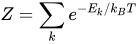
- describes a system of fixed composition that is in thermal equilibrium with a heat bath of a precise temperature. The canonical ensemble contains states of varying energy but identical composition; the different states in the ensemble are accorded different probabilities depending on their total energy.
- Grand canonical ensemble
- describes a system with non-fixed composition (uncertain particle numbers) that is in thermal and chemical equilibrium with a thermodynamic reservoir. The reservoir has a precise temperature, and precise chemical potentials for various types of particle. The grand canonical ensemble contains states of varying energy and varying numbers of particles; the different states in the ensemble are accorded different probabilities depending on their total energy and total particle numbers.
For systems containing many particles (the thermodynamic limit), all three of the ensembles listed above tend to give identical behaviour. It is then simply a matter of mathematical convenience which ensemble is used.[9]: 227 The Gibbs theorem about equivalence of ensembles[23] was developed into the theory of concentration of measure phenomenon,[24] which has applications in many areas of science, from functional analysis to methods of artificial intelligence and big data technology.[25]
Important cases where the thermodynamic ensembles do not give identical results include:
- Microscopic systems.
- Large systems at a phase transition.
- Large systems with long-range interactions.
In these cases the correct thermodynamic ensemble must be chosen as there are observable differences between these ensembles not just in the size of fluctuations, but also in average quantities such as the distribution of particles. The correct ensemble is that which corresponds to the way the system has been prepared and characterized—in other words, the ensemble that reflects the knowledge about that system.[19]
| Microcanonical | Canonical | Grand canonical | |
|---|---|---|---|
| Fixed variables | |||
| Microscopic features | Number of microstates | Canonical partition function | Grand partition function |
| Macroscopic function | Boltzmann entropy | Helmholtz free energy | Grand potential |






Calculation methods
[edit]Once the characteristic state function for an ensemble has been calculated for a given system, that system is 'solved' (macroscopic observables can be extracted from the characteristic state function). Calculating the characteristic state function of a thermodynamic ensemble is not necessarily a simple task, however, since it involves considering every possible state of the system. While some hypothetical systems have been exactly solved, the most general (and realistic) case is too complex for an exact solution. Various approaches exist to approximate the true ensemble and allow calculation of average quantities.
Exact
[edit]There are some cases which allow exact solutions.
- For very small microscopic systems, the ensembles can be directly computed by simply enumerating over all possible states of the system (using exact diagonalization in quantum mechanics, or integral over all phase space in classical mechanics).
- Some large systems consist of many separable microscopic systems, and each of the subsystems can be analysed independently. Notably, idealized gases of non-interacting particles have this property, allowing exact derivations of Maxwell–Boltzmann statistics, Fermi–Dirac statistics, and Bose–Einstein statistics.[19]
- A few large systems with interaction have been solved. By the use of subtle mathematical techniques, exact solutions have been found for a few toy models.[26] Some examples include the Bethe ansatz, square-lattice Ising model in zero field, hard hexagon model.
Monte Carlo
[edit]Although some problems in statistical physics can be solved analytically using approximations and expansions, most current research utilizes the large processing power of modern computers to simulate or approximate solutions. A common approach to statistical problems is to use a Monte Carlo simulation to yield insight into the properties of a complex system. Monte Carlo methods are important in computational physics, physical chemistry, and related fields, and have diverse applications including medical physics, where they are used to model radiation transport for radiation dosimetry calculations.[27][28][29]
The Monte Carlo method examines just a few of the possible states of the system, with the states chosen randomly (with a fair weight). As long as these states form a representative sample of the whole set of states of the system, the approximate characteristic function is obtained. As more and more random samples are included, the errors are reduced to an arbitrarily low level.
- The Metropolis–Hastings algorithm is a classic Monte Carlo method which was initially used to sample the canonical ensemble.
- Path integral Monte Carlo, also used to sample the canonical ensemble.
Other
[edit]- For rarefied non-ideal gases, approaches such as the cluster expansion use perturbation theory to include the effect of weak interactions, leading to a virial expansion.[30]
- For dense fluids, another approximate approach is based on reduced distribution functions, in particular the radial distribution function.[30]
- Molecular dynamics computer simulations can be used to calculate microcanonical ensemble averages, in ergodic systems. With the inclusion of a connection to a stochastic heat bath, they can also model canonical and grand canonical conditions.
- Mixed methods involving non-equilibrium statistical mechanical results (see below) may be useful.
Non-equilibrium statistical mechanics
[edit]Many physical phenomena involve quasi-thermodynamic processes out of equilibrium, for example:
- heat transport by the internal motions in a material, driven by a temperature imbalance,
- electric currents carried by the motion of charges in a conductor, driven by a voltage imbalance,
- spontaneous chemical reactions driven by a decrease in free energy,
- friction, dissipation, quantum decoherence,
- systems being pumped by external forces (optical pumping, etc.),
- and irreversible processes in general.
All of these processes occur over time with characteristic rates. These rates are important in engineering. The field of non-equilibrium statistical mechanics is concerned with understanding these non-equilibrium processes at the microscopic level. (Statistical thermodynamics can only be used to calculate the final result, after the external imbalances have been removed and the ensemble has settled back down to equilibrium.)
In principle, non-equilibrium statistical mechanics could be mathematically exact: ensembles for an isolated system evolve over time according to deterministic equations such as Liouville's equation or its quantum equivalent, the von Neumann equation. These equations are the result of applying the mechanical equations of motion independently to each state in the ensemble. These ensemble evolution equations inherit much of the complexity of the underlying mechanical motion, and so exact solutions are very difficult to obtain. Moreover, the ensemble evolution equations are fully reversible and do not destroy information (the ensemble's Gibbs entropy is preserved). In order to make headway in modelling irreversible processes, it is necessary to consider additional factors besides probability and reversible mechanics.
Non-equilibrium mechanics is therefore an active area of theoretical research as the range of validity of these additional assumptions continues to be explored. A few approaches are described in the following subsections.
Stochastic methods
[edit]One approach to non-equilibrium statistical mechanics is to incorporate stochastic (random) behaviour into the system. Stochastic behaviour destroys information contained in the ensemble. While this is technically inaccurate (aside from hypothetical situations involving black holes, a system cannot in itself cause loss of information), the randomness is added to reflect that information of interest becomes converted over time into subtle correlations within the system, or to correlations between the system and environment. These correlations appear as chaotic or pseudorandom influences on the variables of interest. By replacing these correlations with randomness proper, the calculations can be made much easier.
- Boltzmann transport equation: An early form of stochastic mechanics appeared even before the term "statistical mechanics" had been coined, in studies of kinetic theory. James Clerk Maxwell had demonstrated that molecular collisions would lead to apparently chaotic motion inside a gas. Ludwig Boltzmann subsequently showed that, by taking this molecular chaos for granted as a complete randomization, the motions of particles in a gas would follow a simple Boltzmann transport equation that would rapidly restore a gas to an equilibrium state (see H-theorem).
The Boltzmann transport equation and related approaches are important tools in non-equilibrium statistical mechanics due to their extreme simplicity. These approximations work well in systems where the "interesting" information is immediately (after just one collision) scrambled up into subtle correlations, which essentially restricts them to rarefied gases. The Boltzmann transport equation has been found to be very useful in simulations of electron transport in lightly doped semiconductors (in transistors), where the electrons are indeed analogous to a rarefied gas.
A quantum technique related in theme is the random phase approximation. - BBGKY hierarchy: In liquids and dense gases, it is not valid to immediately discard the correlations between particles after one collision. The BBGKY hierarchy (Bogoliubov–Born–Green–Kirkwood–Yvon hierarchy) gives a method for deriving Boltzmann-type equations but also extending them beyond the dilute gas case, to include correlations after a few collisions.
- Keldysh formalism (a.k.a. NEGF—non-equilibrium Green functions): A quantum approach to including stochastic dynamics is found in the Keldysh formalism. This approach is often used in electronic quantum transport calculations.
- Stochastic Liouville equation.
Near-equilibrium methods
[edit]Another important class of non-equilibrium statistical mechanical models deals with systems that are only very slightly perturbed from equilibrium. With very small perturbations, the response can be analysed in linear response theory. A remarkable result, as formalized by the fluctuation–dissipation theorem, is that the response of a system when near equilibrium is precisely related to the fluctuations that occur when the system is in total equilibrium. Essentially, a system that is slightly away from equilibrium—whether put there by external forces or by fluctuations—relaxes towards equilibrium in the same way, since the system cannot tell the difference or "know" how it came to be away from equilibrium.[30]: 664
This provides an indirect avenue for obtaining numbers such as ohmic conductivity and thermal conductivity by extracting results from equilibrium statistical mechanics. Since equilibrium statistical mechanics is mathematically well defined and (in some cases) more amenable for calculations, the fluctuation–dissipation connection can be a convenient shortcut for calculations in near-equilibrium statistical mechanics.
A few of the theoretical tools used to make this connection include:
- Fluctuation–dissipation theorem
- Onsager reciprocal relations
- Green–Kubo relations
- Landauer–Büttiker formalism
- Mori–Zwanzig formalism
- GENERIC formalism
Hybrid methods
[edit]An advanced approach uses a combination of stochastic methods and linear response theory. As an example, one approach to compute quantum coherence effects (weak localization, conductance fluctuations) in the conductance of an electronic system is the use of the Green–Kubo relations, with the inclusion of stochastic dephasing by interactions between various electrons by use of the Keldysh method.[31][32]
Applications
[edit]The ensemble formalism can be used to analyze general mechanical systems with uncertainty in knowledge about the state of a system. Ensembles are also used in:
- propagation of uncertainty over time,[18]
- regression analysis of gravitational orbits,
- ensemble forecasting of weather,
- dynamics of neural networks,
- bounded-rational potential games in game theory and non-equilibrium economics.
Statistical physics explains and quantitatively describes superconductivity, superfluidity, turbulence, collective phenomena in solids and plasma, and the structural features of liquid. It underlies the modern astrophysics and virial theorem. In solid state physics, statistical physics aids the study of liquid crystals, phase transitions, and critical phenomena. Many experimental studies of matter are entirely based on the statistical description of a system. These include the scattering of cold neutrons, X-ray, visible light, and more. Statistical physics also plays a role in materials science, nuclear physics, astrophysics, chemistry, biology and medicine (e.g. study of the spread of infectious diseases).[citation needed]
Analytical and computational techniques derived from statistical physics of disordered systems, can be extended to large-scale problems, including machine learning, e.g., to analyze the weight space of deep neural networks.[33] Statistical physics is thus finding applications in the area of medical diagnostics.[34]
Quantum statistical mechanics
[edit]Quantum statistical mechanics is statistical mechanics applied to quantum mechanical systems. In quantum mechanics, a statistical ensemble (probability distribution over possible quantum states) is described by a density operator S, which is a non-negative, self-adjoint, trace-class operator of trace 1 on the Hilbert space H describing the quantum system. This can be shown under various mathematical formalisms for quantum mechanics. One such formalism is provided by quantum logic.[citation needed]
Index of statistical mechanics topics
[edit]Physics
[edit]- Probability amplitude
- Statistical physics
- Boltzmann factor
- Feynman–Kac formula
- Fluctuation theorem
- Information entropy
- Vacuum expectation value
- Cosmic variance
- Negative probability
- Gibbs state
- Master equation
- Partition function (mathematics)
- Quantum probability
Percolation theory
[edit]See also
[edit]References
[edit]- ^ Teschendorff, Andrew E.; Feinberg, Andrew P. (July 2021). "Statistical mechanics meets single-cell biology". Nature Reviews Genetics. 22 (7): 459–476. doi:10.1038/s41576-021-00341-z. PMC 10152720. PMID 33875884.
- ^ Advani, Madhu; Lahiri, Subhaneil; Ganguli, Surya (March 12, 2013). "Statistical mechanics of complex neural systems and high dimensional data". Journal of Statistical Mechanics: Theory and Experiment. 2013 (3) P03014. arXiv:1301.7115. Bibcode:2013JSMTE..03..014A. doi:10.1088/1742-5468/2013/03/P03014.
- ^ Huang, Haiping (2021). Statistical Mechanics of Neural Networks. doi:10.1007/978-981-16-7570-6. ISBN 978-981-16-7569-0.
- ^ Berger, Adam L.; Pietra, Vincent J. Della; Pietra, Stephen A. Della (March 1996). "A maximum entropy approach to natural language processing" (PDF). Computational Linguistics. 22 (1): 39–71. INIST 3283782.
- ^ Jaynes, E. T. (May 15, 1957). "Information Theory and Statistical Mechanics". Physical Review. 106 (4): 620–630. Bibcode:1957PhRv..106..620J. doi:10.1103/PhysRev.106.620.
- ^ Durlauf, Steven N. (September 14, 1999). "How can statistical mechanics contribute to social science?". Proceedings of the National Academy of Sciences. 96 (19): 10582–10584. Bibcode:1999PNAS...9610582D. doi:10.1073/pnas.96.19.10582. PMC 33748. PMID 10485867.
- ^ Huang, Kerson (September 21, 2009). Introduction to Statistical Physics (2nd ed.). CRC Press. p. 15. ISBN 978-1-4200-7902-9.
- ^ Germano, R. (2022). Física Estatística do Equilíbrio: um curso introdutório (in Portuguese). Rio de Janeiro: Ciência Moderna. p. 156. ISBN 978-65-5842-144-3.
- ^ a b c d Reif, Frederick (1965). Fundamentals of Statistical and Thermal Physics. McGraw–Hill. p. 651. ISBN 978-0-07-051800-1.
- ^ a b Uffink, Jos (March 2006). Compendium of the foundations of classical statistical physics (Preprint).
- ^ See:
- Maxwell, J.C. (1860) "Illustrations of the dynamical theory of gases. Part I. On the motions and collisions of perfectly elastic spheres," Philosophical Magazine, 4th series, 19 : 19–32.
- Maxwell, J.C. (1860) "Illustrations of the dynamical theory of gases. Part II. On the process of diffusion of two or more kinds of moving particles among one another," Philosophical Magazine, 4th series, 20 : 21–37.
- ^ Mahon, Basil (2003). The Man Who Changed Everything – the Life of James Clerk Maxwell. Hoboken, NJ: Wiley. ISBN 978-0-470-86171-4. OCLC 52358254.
- ^ Gyenis, Balazs (2017). "Maxwell and the normal distribution: A colored story of probability, independence, and tendency towards equilibrium". Studies in History and Philosophy of Modern Physics. 57: 53–65. arXiv:1702.01411. Bibcode:2017SHPMP..57...53G. doi:10.1016/j.shpsb.2017.01.001. S2CID 38272381.
- ^ Ebeling, Werner; Sokolov, Igor M. (2005). Statistical Thermodynamics and Stochastic Theory of Nonequilibrium Systems. Series on Advances in Statistical Mechanics. Vol. 8. Bibcode:2005stst.book.....E. doi:10.1142/2012. ISBN 978-981-02-1382-4.
- ^ Gibbs, J. W. (1885). On the Fundamental Formula of Statistical Mechanics, with Applications to Astronomy and Thermodynamics. OCLC 702360353.
- ^ James Clerk Maxwell ,Theory of Heat (London, England: Longmans, Green, and Co., 1871), p. 309
- ^ Mayants, Lazar (1984). The enigma of probability and physics. Springer. p. 174. ISBN 978-90-277-1674-3.
- ^ a b c d e f g Gibbs, Josiah Willard (1902). Elementary Principles in Statistical Mechanics. New York: Charles Scribner's Sons.
- ^ a b c d Tolman, Richard Chace (1979). The Principles of Statistical Mechanics. Courier Corporation. ISBN 978-0-486-63896-6.[page needed]
- ^ Jaynes, E. (1957). "Information Theory and Statistical Mechanics". Physical Review. 106 (4): 620–630. Bibcode:1957PhRv..106..620J. doi:10.1103/PhysRev.106.620.
- ^ a b c Gao, Xiang; Gallicchio, Emilio; Roitberg, Adrian E. (July 21, 2019). "The generalized Boltzmann distribution is the only distribution in which the Gibbs-Shannon entropy equals the thermodynamic entropy". The Journal of Chemical Physics. 151 (3): 034113. arXiv:1903.02121. Bibcode:2019JChPh.151c4113G. doi:10.1063/1.5111333. PMID 31325924.
- ^ a b c Gao, Xiang (March 2022). "The Mathematics of the Ensemble Theory". Results in Physics. 34 105230. arXiv:2006.00485. Bibcode:2022ResPh..3405230G. doi:10.1016/j.rinp.2022.105230. S2CID 221978379.
- ^ Touchette, Hugo (2015). "Equivalence and Nonequivalence of Ensembles: Thermodynamic, Macrostate, and Measure Levels". Journal of Statistical Physics. 159 (5): 987–1016. arXiv:1403.6608. Bibcode:2015JSP...159..987T. doi:10.1007/s10955-015-1212-2. S2CID 118534661.
- ^ The Concentration of Measure Phenomenon (PDF). Mathematical Surveys and Monographs. Vol. 89. 2005. doi:10.1090/surv/089. ISBN 978-0-8218-3792-4.[page needed]
- ^ Gorban, A. N.; Tyukin, I. Y. (April 28, 2018). "Blessing of dimensionality: mathematical foundations of the statistical physics of data". Philosophical Transactions of the Royal Society A: Mathematical, Physical and Engineering Sciences. 376 (2118) 20170237. arXiv:1801.03421. Bibcode:2018RSPTA.37670237G. doi:10.1098/rsta.2017.0237. PMC 5869543. PMID 29555807.
- ^ Baxter, Rodney J. (1982). Exactly solved models in statistical mechanics. Academic Press Inc. ISBN 978-0-12-083180-7.[page needed]
- ^ Jia, Xun; Ziegenhein, Peter; Jiang, Steve B (2014). "GPU-based high-performance computing for radiation therapy". Physics in Medicine and Biology. 59 (4): R151 – R182. Bibcode:2014PMB....59R.151J. doi:10.1088/0031-9155/59/4/R151. PMC 4003902. PMID 24486639.
- ^ Hill, R; Healy, B; Holloway, L; Kuncic, Z; Thwaites, D; Baldock, C (March 2014). "Advances in kilovoltage x-ray beam dosimetry". Physics in Medicine and Biology. 59 (6): R183 – R231. Bibcode:2014PMB....59R.183H. doi:10.1088/0031-9155/59/6/R183. PMID 24584183. S2CID 18082594.
- ^ Rogers, D W O (2006). "Fifty years of Monte Carlo simulations for medical physics". Physics in Medicine and Biology. 51 (13): R287 – R301. Bibcode:2006PMB....51R.287R. doi:10.1088/0031-9155/51/13/R17. PMID 16790908. S2CID 12066026.
- ^ a b c Balescu, Radu (1975). Equilibrium and Non-Equilibrium Statistical Mechanics. Wiley. ISBN 978-0-471-04600-4.[page needed]
- ^ Altshuler, B L; Aronov, A G; Khmelnitsky, D E (December 30, 1982). "Effects of electron-electron collisions with small energy transfers on quantum localisation". Journal of Physics C: Solid State Physics. 15 (36): 7367–7386. Bibcode:1982JPhC...15.7367A. doi:10.1088/0022-3719/15/36/018.
- ^ Aleiner, I. L.; Blanter, Ya. M. (February 28, 2002). "Inelastic scattering time for conductance fluctuations". Physical Review B. 65 (11) 115317. arXiv:cond-mat/0105436. Bibcode:2002PhRvB..65k5317A. doi:10.1103/PhysRevB.65.115317.
- ^ Ramezanpour, Abolfazl; Beam, Andrew L.; Chen, Jonathan H.; Mashaghi, Alireza (November 19, 2020). "Statistical Physics for Medical Diagnostics: Learning, Inference, and Optimization Algorithms". Diagnostics. 10 (11): 972. doi:10.3390/diagnostics10110972. PMC 7699346. PMID 33228143.
- ^ Mashaghi, Alireza; Ramezanpour, Abolfazl (March 16, 2018). "Statistical physics of medical diagnostics: Study of a probabilistic model". Physical Review E. 97 (3) 032118. arXiv:1803.10019. Bibcode:2018PhRvE..97c2118M. doi:10.1103/PhysRevE.97.032118. PMID 29776109.
Further reading
[edit]- Reif, F. (2009). Fundamentals of Statistical and Thermal Physics. Waveland Press. ISBN 978-1-4786-1005-2.
- Müller-Kirsten, Harald J W. (2013). Basics of Statistical Physics (PDF). doi:10.1142/8709. ISBN 978-981-4449-53-3.
- Kadanoff, Leo P. "Statistical Physics and other resources". Archived from the original on August 12, 2021. Retrieved June 18, 2023.
- Kadanoff, Leo P. (2000). Statistical Physics: Statics, Dynamics and Renormalization. World Scientific. ISBN 978-981-02-3764-6.
- Flamm, Dieter (1998). "History and outlook of statistical physics". arXiv:physics/9803005.
External links
[edit]
- Philosophy of Statistical Mechanics article by Lawrence Sklar for the Stanford Encyclopedia of Philosophy.
- Sklogwiki - Thermodynamics, statistical mechanics, and the computer simulation of materials. SklogWiki is particularly orientated towards liquids and soft condensed matter.
- Thermodynamics and Statistical Mechanics by Richard Fitzpatrick
- Cohen, Doron (2011). "Lecture Notes in Statistical Mechanics and Mesoscopics". arXiv:1107.0568 [quant-ph].
- Videos of lecture series in statistical mechanics on YouTube taught by Leonard Susskind.
- Vu-Quoc, L., Configuration integral (statistical mechanics), 2008. this wiki site is down; see this article in the web archive on 2012 April 28.
| Theory |  | |
|---|---|---|
| Statistical thermodynamics | ||
| Models | ||
| Mathematical approaches | ||
| Critical phenomena | ||
| Entropy | ||
| Applications | ||
| International | |
|---|---|
| National | |
| Other | |

Statistical mechanics
View on GrokipediaHistorical Development
Early Concepts and Precursors
The development of classical thermodynamics in the early 19th century provided essential precursors to statistical mechanics by establishing key principles of heat, work, and energy transformation. In 1824, Sadi Carnot published Réflexions sur la puissance motrice du feu, analyzing the efficiency of heat engines through the idealized Carnot cycle, which operates reversibly between a hot and cold reservoir and demonstrated that the motive power of heat depends on temperature differences rather than the working substance. This work implicitly highlighted the directional nature of heat flow, setting the stage for later statistical interpretations of irreversibility.[11] Rudolf Clausius built upon Carnot's ideas in the 1850s, formulating the second law of thermodynamics in 1850 as the principle that it is impossible for heat to pass spontaneously from a colder to a hotter body without external work, thereby introducing the concept of unavailable energy. Clausius formalized entropy in 1865 as a state function quantifying the degradation of energy, defined mathematically as where represents the infinitesimal reversible heat transfer and is the absolute temperature in Kelvin; this integral measures the total entropy change for a reversible process, with entropy increasing in irreversible ones.[12] The atomic hypothesis and kinetic theory of gases emerged in the mid-19th century, bridging macroscopic thermodynamics to microscopic molecular behavior. James Clerk Maxwell, in his 1860 paper "Illustrations of the Dynamical Theory of Gases," revived the atomic view by modeling gases as collections of colliding point particles, deriving the velocity distribution function that gives the probability of molecules having speeds between and as proportional to , where is molecular mass, is Boltzmann's constant, and is temperature; this distribution explained pressure, diffusion, and viscosity without assuming equilibrium a priori.[13] Ludwig Boltzmann extended kinetic theory in the 1870s by linking thermodynamic entropy directly to molecular disorder, interpreting entropy as a logarithmic measure of the multiplicity of microscopic configurations consistent with a macroscopic state, such that higher entropy corresponds to greater probable disorder among atoms. A key milestone was Boltzmann's 1872 H-theorem, which mathematically showed that the function (where is the velocity distribution) decreases monotonically due to molecular collisions, mirroring the second law's entropy increase and providing a statistical explanation for irreversibility in isolated systems.[14] Early applications of probability theory to physics also laid groundwork for statistical approaches. Pierre-Simon Laplace, in works like Théorie Analytique des Probabilités (1812), applied probabilistic methods to deterministic mechanical systems in celestial mechanics, using averages over possible initial conditions and errors to predict outcomes under uncertainty, which prefigured the ensemble averaging over microstates central to later statistical mechanics.[15]Key Figures and Formulations
Ludwig Boltzmann played a pivotal role in formalizing statistical mechanics through his probabilistic interpretation of thermodynamic entropy. In 1877, he introduced the famous relation connecting entropy to the number of microstates accessible to a system in thermal equilibrium, given by where is Boltzmann's constant. This combinatorial approach provided a microscopic foundation for the second law of thermodynamics, linking macroscopic irreversibility to the overwhelming probability of equilibrium states. However, Boltzmann faced significant challenges, including the reversibility paradox raised by Josef Loschmidt in 1876, which questioned how time-reversible molecular dynamics could yield irreversible macroscopic behavior; Boltzmann addressed this by emphasizing statistical likelihood over strict determinism in his 1877 response. Boltzmann's ideas encountered controversy during his lifetime, particularly from positivists like Ernst Mach and Wilhelm Ostwald who rejected the atomic hypothesis underlying his work, contributing to his deepening depression. Tragically, amid these professional struggles and personal health issues, Boltzmann died by suicide in 1906 while on vacation near Trieste, Italy. Despite the opposition, his contributions laid essential groundwork for later developments, including a brief reference to the ergodic hypothesis as a foundational assumption bridging classical mechanics to statistical ensembles. Josiah Willard Gibbs advanced statistical mechanics by developing the concept of ensembles, which describe systems through averages over possible states in phase space. In his seminal 1902 book Elementary Principles in Statistical Mechanics, Gibbs formalized the use of phase space averaging to derive thermodynamic properties from mechanical laws, introducing the canonical ensemble and clarifying the foundations of equilibrium statistics. This work emphasized rational foundations for thermodynamics without relying solely on kinetic theory, providing a more general framework applicable to diverse systems. Although Gibbs' contributions were highly regarded in European circles during his lifetime, they received limited attention in the United States and experienced a significant revival in the 1930s, coinciding with advances in quantum statistical mechanics that built upon his ensemble methods. Albert Einstein contributed to the validation of statistical mechanics by applying it to observable phenomena, particularly in his 1905 paper on Brownian motion. There, Einstein derived the mean squared displacement of particles suspended in a fluid, demonstrating that random fluctuations arise from molecular collisions and providing quantitative predictions that confirmed the existence of atoms through experimental verification by Jean Perrin in 1908. This work not only supported Boltzmann's atomic theory but also bridged statistical fluctuations to macroscopic transport properties, strengthening the empirical basis of the field. Max Planck initiated the transition toward quantum statistical mechanics with his 1900 hypothesis on blackbody radiation. In a presentation to the German Physical Society on December 14, 1900, Planck proposed that energy is exchanged in discrete quanta , where is Planck's constant and is frequency, to resolve the ultraviolet catastrophe in classical Rayleigh-Jeans theory; this led to the spectral energy distribution formula that matched experimental data. Although Planck initially viewed quantization as a mathematical artifice rather than a fundamental physical reality, his work marked the birth of quantum theory and paved the way for quantum statistics, with full implications realized in subsequent decades.Fundamental Principles
Microstates, Macrostates, and Ensembles
In statistical mechanics, a microstate refers to a specific configuration of a physical system, providing a complete description of the positions and momenta of all its constituent particles at a given instant./Thermodynamics/Energies_and_Potentials/Entropy/Microstates) This microscopic detail captures the exact dynamical state, which is inaccessible in practice due to the immense number of particles involved, typically on the order of Avogadro's number for macroscopic systems.[16] In contrast, a macrostate is defined by a set of measurable thermodynamic variables, such as volume , internal energy , and particle number , which characterize the system's overall behavior without resolving individual particle motions.[16] Multiple microstates can correspond to the same macrostate, and the number of such microstates, often denoted , quantifies the system's degeneracy and underpins concepts like entropy./Thermodynamics/Energies_and_Potentials/Entropy/Microstates) The space encompassing all possible microstates is known as phase space, represented by the -dimensional manifold , where and are the position and momentum vectors of the -th particle.[17] In classical Hamiltonian dynamics, the evolution of microstates in phase space obeys Liouville's theorem, which asserts that the phase-space volume occupied by an ensemble of systems remains constant over time due to the incompressible nature of the flow./01%3A_Classical_mechanics/1.06%3A_Phase_space_distribution_functions_and_Liouville%27s_theorem) Formally, for a probability density in phase space, Liouville's equation is where is the Hamiltonian and denotes the Poisson bracket, implying that is conserved along trajectories./01%3A_Classical_mechanics/1.06%3A_Phase_space_distribution_functions_and_Liouville%27s_theorem) This conservation ensures that the statistical description of the system is time-invariant for isolated systems, providing a foundation for averaging over microstates. To bridge the microscopic and macroscopic descriptions, statistical mechanics employs the concept of an ensemble, introduced by J. Willard Gibbs as a hypothetical collection of identical systems, each in a different microstate but sharing the same macrostate constraints.[18] The fundamental postulate of statistical mechanics states that, in the absence of additional information, all accessible microstates within the ensemble are equally probable a priori.[18] This postulate, central to Gibbs' formulation in Elementary Principles in Statistical Mechanics (1902), allows macroscopic observables to be computed as averages over the ensemble, such as the expectation value of energy .[18] Ensembles thus serve as probabilistic tools for predicting thermodynamic properties from underlying mechanics. A key assumption linking time-dependent dynamics to ensemble statistics is the ergodic hypothesis, first articulated by Ludwig Boltzmann in the 1870s. It posits that, for an isolated system in equilibrium, the time average of any observable—computed by following a single trajectory over infinite time—equals the ensemble average over all accessible microstates. This equivalence justifies using static ensemble averages to describe real systems, assuming ergodicity holds, and underpins the applicability of statistical methods to isolated systems like the microcanonical ensemble.Ergodic Hypothesis and Equilibrium
The ergodic hypothesis is a foundational assumption in statistical mechanics that bridges dynamical evolution and statistical ensembles, asserting that for sufficiently large systems governed by chaotic dynamics, the time average of an observable equals its phase space average over the invariant measure. Formally, for a dynamical system with phase space point evolving under Hamiltonian flow, the hypothesis states that , where is an observable and is the equilibrium probability density. This equivalence enables the replacement of intractable time integrals with computationally tractable ensemble averages, justifying the use of statistical predictions for macroscopic properties. The hypothesis was rigorously proven by Birkhoff in 1931 for measure-preserving transformations on probability spaces, particularly applicable to chaotic systems where mixing ensures rapid exploration of phase space.[19] The approach to equilibrium in isolated systems relies on this hypothesis, with relaxation occurring through coarse-graining of phase space, where fine details are averaged to yield macroscopic observables that evolve irreversibly toward the most probable state. This resolves Loschmidt's paradox—the apparent conflict between time-reversible microscopic dynamics and irreversible macroscopic behavior—by recognizing that while exact reversals are theoretically possible, they require precise alignment of all microstates, which is practically impossible due to the exponential growth of phase space volume and the statistical improbability of such alignments. Coarse-graining introduces effective irreversibility, as the reversed trajectory would need to pass through an extraordinarily low-entropy configuration, making the forward relaxation the overwhelmingly likely path on observable timescales.[1] The second law of thermodynamics emerges statistically as the tendency for entropy to increase toward its maximum, corresponding to the macrostate with the largest number of accessible microstates, with deviations (fluctuations) being rare and scaling as order for a system of particles. These fluctuations arise from the finite sampling of the vast phase space, but their relative amplitude vanishes in the thermodynamic limit , rendering the entropy increase effectively deterministic for macroscopic systems. This probabilistic interpretation aligns the second law with dynamical reversibility, as temporary decreases in entropy are possible but exponentially suppressed.[20] Mathematical justification for equilibrium's stability comes from the Poincaré recurrence theorem, which guarantees that trajectories in a finite-volume phase space return arbitrarily close to their initial conditions after a finite time, but this recurrence time is astronomically large—vastly exceeding the age of the universe for systems with Avogadro-scale particle numbers—ensuring that equilibrium persists on all practical timescales without recurrence. For a gas with particles, the recurrence time exceeds years, far beyond cosmological scales, thus supporting the unidirectional approach to equilibrium without contradicting microreversibility.[21]Equilibrium Statistical Mechanics
Microcanonical Ensemble
The microcanonical ensemble represents the statistical description of an isolated physical system characterized by a fixed number of particles , fixed volume , and fixed total energy . In this framework, the system is assumed to be in equilibrium, and the probability distribution is uniform across all accessible microstates that correspond to the specified macrostate, specifically those lying within a thin energy shell of width around the energy . This ensemble forms the foundational postulate of equilibrium statistical mechanics for closed systems without exchange of energy or matter with the surroundings. The multiplicity , or the number of accessible microstates, quantifies the degeneracy of the macrostate and is given by the volume of the phase space hypersurface at energy , appropriately normalized for classical systems. For indistinguishable classical particles, , where is the Hamiltonian, is Planck's constant, and is the Heaviside step function restricting the integral to the energy shell; this division by accounts for particle indistinguishability to avoid overcounting. The thermodynamic entropy emerges directly from this multiplicity via Boltzmann's formula , where is Boltzmann's constant, linking microscopic counting to the macroscopic irreversible increase of entropy in isolated systems.[22] From the entropy expression, fundamental thermodynamic quantities can be derived by considering its functional dependence on the extensive variables. The temperature is obtained from the partial derivative , reflecting how the multiplicity changes with energy at fixed volume and particle number, thus defining the inverse temperature as the rate of entropy growth with added energy. Similarly, the pressure follows from , indicating the entropic response to volume changes while holding energy and particle number constant. These relations establish the microcanonical ensemble as a direct bridge to classical thermodynamics without invoking auxiliary reservoirs.[23] A key application arises in the ideal monatomic gas, where the phase space integral can be evaluated explicitly to yield the Sackur-Tetrode equation for the entropy: with the particle mass; this formula, derived by integrating over momentum and position coordinates in the non-interacting limit, provides an absolute scale for entropy and resolves Gibbs' paradox regarding mixing identical gases through the factor. The derivation involves approximating the energy shell volume for large and using Stirling's approximation for factorials, confirming the extensive nature of entropy in the thermodynamic limit.[24]Canonical and Grand Canonical Ensembles
The canonical ensemble provides a statistical description of a system consisting of a fixed number of particles , in a fixed volume , and in thermal equilibrium with a large heat reservoir at temperature . This ensemble was introduced by J. Willard Gibbs in his foundational work on statistical mechanics. In this framework, the system can exchange energy with the reservoir but not particles or volume, leading to fluctuations in the system's energy around its average value. The probability of finding the system in a microstate with energy is given by the Boltzmann distribution: where , is Boltzmann's constant, and is the canonical partition function. The partition function normalizes the probabilities and is defined as the sum over all accessible microstates: This sum can be over discrete states or an integral for continuous phase space in classical systems. The partition function encodes all thermodynamic information for the canonical ensemble, allowing computation of ensemble averages for observables. The Helmholtz free energy , a key thermodynamic potential for systems at constant , , and , is directly related to the partition function by From this, the average internal energy can be derived as Other averages, such as pressure or entropy, follow from appropriate derivatives of or . In the thermodynamic limit of large , the canonical ensemble becomes equivalent to the microcanonical ensemble for fixed average energy. A characteristic feature of the canonical ensemble is the fluctuation in energy, which quantifies the uncertainty in due to thermal exchange with the reservoir. The variance of the energy is where is the heat capacity at constant volume. This relation connects microscopic fluctuations to a macroscopic thermodynamic quantity, showing that energy fluctuations scale with the system's heat capacity and vanish relative to in the thermodynamic limit. The grand canonical ensemble extends the canonical description to open systems that can exchange both energy and particles with reservoirs, characterized by fixed chemical potential , volume , and temperature . Like the canonical case, this ensemble originates from Gibbs' formulation. The probability of a state with energy and particle number is proportional to , and the grand partition function is where the outer sum runs over possible particle numbers. The grand potential serves as the analogous thermodynamic potential, from which averages like are obtained. In the grand canonical ensemble, particle number fluctuations arise due to exchange with a particle reservoir, with the variance given by This fluctuation measures the compressibility of the system in particle space and, like energy fluctuations, becomes negligible relative to in the thermodynamic limit. Energy fluctuations in this ensemble follow a similar form to the canonical case but include contributions from particle exchange.Thermodynamic Connections
Statistical mechanics establishes a profound connection to classical thermodynamics by expressing thermodynamic potentials as ensemble averages or functions derived from partition functions, thereby linking microscopic probabilities to macroscopic observables. The internal energy is identified with the expectation value of the total energy in the relevant ensemble, such as the microcanonical or canonical, providing a direct bridge from statistical weights to the first law of thermodynamics.[25] This average energy encapsulates the thermal motion of particles and serves as the foundation for deriving heat capacities and response functions. In the canonical ensemble, the Helmholtz free energy emerges as , where is the partition function and is Boltzmann's constant, allowing the entropy and pressure to be computed systematically.[26] Extending to open systems, the grand canonical ensemble yields the grand potential , where is the grand partition function; this potential equals and facilitates the Gibbs free energy , with the chemical potential and the average particle number, underscoring the consistency between statistical and thermodynamic descriptions of phase equilibria.[26] These potentials, first systematically formulated by Gibbs, enable the recovery of thermodynamic relations without invoking ad hoc postulates. Maxwell relations, which equate mixed second partial derivatives of the potentials, follow naturally from their construction in statistical mechanics, ensuring the equality of cross-derivatives due to the exactness of thermodynamic differentials. For instance, from the Helmholtz free energy, , and statistical expressions like allow explicit computation.[27] In the grand canonical framework, the isothermal compressibility relates to fluctuations via derivatives such as , linking macroscopic response to microscopic variability and validating thermodynamic stability criteria. The specific heat at constant volume is directly obtained from the temperature derivative of the ensemble-averaged energy, , revealing how thermal excitations contribute to energy storage; for example, in ideal gases, this yields the classical equipartition value of .[27] Furthermore, connects to energy fluctuations as , quantifying the role of statistical dispersion in thermodynamic responses. The principle of equal a priori probabilities, positing that all accessible microstates in an isolated system are equally likely, underpins the microcanonical entropy , where counts the microstates for a given macrostate. Extending this to low temperatures, as thermal energy diminishes, the system confines to the degenerate ground state, implying approaches a finite value (often 1 for non-degenerate cases), such that as , thereby deriving the unattainability of absolute zero and the third law of thermodynamics from statistical foundations.[27] This statistical justification aligns with Nernst's heat theorem, confirming that entropy differences vanish at absolute zero for reversible processes.Computational Methods
Exact Solutions
Exact solutions in statistical mechanics refer to analytical methods that yield closed-form expressions for key quantities, such as the partition function, in simplified model systems under equilibrium conditions. These solutions are rare and typically limited to low-dimensional or non-interacting systems, providing benchmarks for understanding phase transitions, thermodynamic properties, and the validity of approximations. They often employ techniques like transfer matrices or integral evaluations to compute the partition function exactly, revealing fundamental behaviors such as the absence of phase transitions in one dimension or precise critical points in two dimensions.[28] One of the earliest exact solutions is for the one-dimensional Ising model, which describes spins on a chain with nearest-neighbor interactions. Ernst Ising solved this model in 1925 by computing the partition function through a recursive relation, showing that the magnetization vanishes for all finite temperatures, implying no phase transition in one dimension. The partition function for a chain of spins with periodic boundary conditions is , where and is the coupling constant, confirming the system's exact solvability via simple matrix diagonalization or transfer matrix precursors.[29] In contrast, the two-dimensional Ising model on a square lattice admits a phase transition, solved exactly by Lars Onsager in 1944 using the transfer matrix method. This approach constructs the partition function by considering the eigenvalues of a transfer matrix that encodes spin configurations row by row, yielding for an lattice, where is the largest eigenvalue. The exact critical temperature is given by , marking the onset of spontaneous magnetization below . This solution not only confirmed the existence of a finite-temperature phase transition but also provided the exact free energy and correlation functions, influencing subsequent studies of critical phenomena.[28] For non-interacting systems, the partition function of a classical harmonic oscillator is obtained via Gaussian integrals, serving as a cornerstone for ideal gases and phonons. The single-oscillator partition function is , where the factor of ensures dimensional consistency in phase space. For independent oscillators, , leading to the equipartition theorem result of average energy per oscillator, exactly recoverable in the classical limit. The virial expansion provides an exact series solution for the equation of state of classical dilute gases, expressing the compressibility factor as , where the virial coefficients are determined from cluster integrals over Mayer f-functions representing pairwise interactions. Joseph E. Mayer derived this expansion in 1937 by linking it to the cluster expansion of the partition function, allowing exact computation of low-order coefficients for potentials like hard spheres, where for diameter . This method is exact to all orders in the low-density limit, bridging microscopic interactions to macroscopic thermodynamics. The Gibbs-Bogoliubov inequality offers an exact variational bound on the free energy, stating that for any trial Hamiltonian with known partition function , the true Helmholtz free energy satisfies , where denotes the average in the trial ensemble. This becomes exact when the trial distribution matches the true one, providing rigorous upper bounds in limits like mean-field approximations for interacting systems. Originally formulated by J. Willard Gibbs for classical cases and extended by N. N. Bogoliubov to quantum mechanics, it underpins variational methods while achieving equality in solvable limits such as non-interacting particles.Monte Carlo and Molecular Dynamics Simulations
Monte Carlo methods provide a powerful class of stochastic simulation techniques for approximating equilibrium properties in statistical mechanics, particularly when analytical solutions are intractable. These methods generate a sequence of configurations according to the canonical ensemble probabilities, enabling the estimation of thermodynamic averages through importance sampling. By constructing Markov chains that satisfy detailed balance, the simulations sample from the Boltzmann distribution, allowing computation of quantities such as energy, pressure, and correlation functions for complex systems like fluids and polymers. The Metropolis Monte Carlo algorithm, introduced in 1953, forms the foundation of these approaches. It operates by proposing random moves from a current configuration, such as displacing a particle, and accepting the new state with probability , where is the inverse temperature, is Boltzmann's constant, is temperature, and is the energy difference between the proposed and current states. Rejections leave the configuration unchanged, ensuring the chain explores the phase space ergodically over long runs. Observables are then approximated as the time average over accepted samples, converging to the ensemble average for sufficiently long simulations. This method was first applied to compute the equation of state for a system of hard spheres, demonstrating its utility for interacting particle systems. Molecular dynamics simulations complement Monte Carlo by generating dynamical trajectories rather than static configurations. These deterministic methods integrate Newton's equations of motion derived from Hamilton's equations for a classical many-body system, evolving positions and momenta under interparticle potentials like the Lennard-Jones potential. To maintain constant temperature and sample the canonical ensemble ergodically, thermostats such as the Nosé-Hoover method introduce fictitious variables that couple the system to a heat bath, enforcing the desired distribution without stochastic forces. The Nosé formulation extends the phase space with an additional degree of freedom to control temperature, while Hoover's canonical dynamics ensures reversibility and ergodicity. Pioneered in the late 1950s for hard-sphere fluids, molecular dynamics has since been used to study transport properties and structural correlations in liquids. Error analysis in these simulations is crucial due to correlations in generated samples, which reduce effective independence. The integrated autocorrelation time quantifies the number of steps needed for decorrelation, with statistical errors scaling as , where is the total number of samples; longer indicates slower convergence, particularly for large system sizes near critical points. For Monte Carlo, blocking or windowing techniques estimate from the decay of the autocorrelation function, ensuring reliable uncertainty quantification. In molecular dynamics, trajectory lengths must exceed to capture equilibrium fluctuations accurately. These analyses reveal that for Ising models or Lennard-Jones liquids, can grow as or worse, necessitating optimized algorithms for efficiency. Applications of these methods abound in studying liquid structure, exemplified by computing the radial distribution function , which describes pairwise particle correlations. In Monte Carlo simulations of rigid spheres, peaks at contact distances, matching experimental scattering data and revealing packing effects; molecular dynamics extends this to time-dependent correlations, yielding diffusion coefficients from velocity autocorrelations. For instance, early simulations of Lennard-Jones fluids reproduced experimental densities and pressures, validating the techniques for real materials like argon. These tools have impacted fields from colloid science to biomolecular folding. Hybrid Monte Carlo addresses limitations of pure methods by combining deterministic dynamics with stochastic acceptance. It proposes moves via leapfrog integration of Hamilton's equations over multiple timesteps, then accepts or rejects based on the Metropolis criterion using the Hamiltonian difference, minimizing rejection rates and autocorrelation times. Developed in 1987 for lattice field theories, this approach enhances sampling efficiency for continuous systems, such as proteins or gauge theories, where step-size errors are controlled without discretization bias.[30]Non-Equilibrium Statistical Mechanics
Kinetic Theory and Boltzmann Equation
Kinetic theory provides a microscopic description of gases by treating them as collections of particles whose collective behavior leads to macroscopic thermodynamic properties. For dilute gases far from equilibrium, the Boltzmann transport equation governs the evolution of the single-particle distribution function , which represents the number density of particles at position with velocity at time . This equation balances the streaming of particles due to free motion and external forces against changes from collisions.[31] The Boltzmann equation is given by where is the external force per unit mass, and the collision term on the right-hand side accounts for binary collisions. The collision integral is expressed as with and denoting the pre-collision distributions, and the post-collision distributions, the relative speed, the differential cross-section, and the integral over the relative velocity and solid angle . This form assumes pairwise interactions and neglects three-body collisions. For collisionless systems, such as in plasmas, the collision term is neglected, leading to the Vlasov equation. In 1938, Anatoly Vlasov developed the Vlasov equation, a collisionless kinetic equation describing the evolution of the distribution function in plasmas, extending the principles of statistical mechanics to non-equilibrium systems without binary collisions.[32] The equation was derived by Ludwig Boltzmann in his 1872 memoir, marking a foundational step in non-equilibrium statistical mechanics.[31] The derivation relies on key assumptions valid for dilute gases: the system has low density so that the mean free path is much larger than the interparticle spacing, ensuring collisions are predominantly binary; and the molecular chaos hypothesis (Stosszahlansatz), which posits that particle velocities are uncorrelated immediately before a collision, allowing factorization of the joint distribution into products of single-particle functions. These assumptions hold for Knudsen numbers , where is a characteristic length scale, but break down in dense or highly correlated systems. The collision integral thus enforces detailed balance in equilibrium, recovering the Maxwell-Boltzmann distribution from the canonical ensemble.[31] A crucial consequence is the H-theorem, which demonstrates the monotonic approach to equilibrium. Define the H-functional as integrated over velocity space (up to constants). Boltzmann showed that with equality only at equilibrium, where the collision integral vanishes. This inequality arises from the positivity of the collision term under the molecular chaos assumption, akin to the second law of thermodynamics, and drives the system toward the Maxwell-Boltzmann distribution. The theorem, also from Boltzmann's 1872 work, resolves the apparent irreversibility in reversible microscopic dynamics through statistical averaging.[31] To compute transport properties like viscosity and diffusion near equilibrium, the Chapman-Enskog expansion solves the Boltzmann equation perturbatively. Assume , where is the local Maxwell-Boltzmann equilibrium distribution, and scales with gradients (e.g., ). The first-order correction yields the Navier-Stokes transport coefficients. For viscosity, , where is density, the mean free path, and the thermal speed; similarly, the self-diffusion coefficient . These expressions, derived systematically by Chapman (1916–1917) and Enskog (1917), and refined in Chapman and Cowling's 1939 monograph, match experimental values for dilute monatomic gases to within a few percent.Linear Response and Fluctuation-Dissipation
Linear response theory provides a framework for describing how a physical system near thermal equilibrium responds to small external perturbations, assuming the response is proportional to the perturbation strength. This approximation is valid when the system remains close to equilibrium, allowing the use of equilibrium statistical mechanics to compute transport coefficients and susceptibilities. The theory bridges microscopic dynamics to macroscopic irreversible phenomena, such as electrical conductivity or thermal expansion, by expressing the response in terms of time-correlation functions of equilibrium fluctuations.[33] The Kubo formula, derived from the quantum Liouville equation or its classical analog, relates the linear response function between observables and to the equilibrium commutator or correlation. In the quantum case, for a perturbation , the change in expectation value , where for , with denoting the canonical ensemble average.[33] The classical limit replaces the commutator with the Poisson bracket or, equivalently, , where . This formulation applies to diverse systems, including dielectrics and conductors, enabling computation of response from equilibrium dynamics without solving full time-dependent equations.[33] The fluctuation-dissipation theorem (FDT) establishes a profound connection between the dissipative response of a system and its equilibrium fluctuations, asserting that dissipation arises from the same microscopic processes causing fluctuations. In the canonical ensemble, the theorem relates the spectral density of fluctuations to the imaginary part of the frequency-dependent response function: for classical systems at high temperatures, or the quantum generalization .[34] This relation, first proven in general form for quantum systems, implies that quantities like electrical conductivity or magnetic susceptibility can be obtained from the power spectrum of equilibrium noise, such as Johnson-Nyquist noise in resistors.[34] The FDT holds under time-translation invariance and detailed balance, providing a cornerstone for understanding near-equilibrium transport.[35] Onsager reciprocal relations emerge as a symmetry principle within linear response, stating that the transport coefficients linking fluxes to forces satisfy (or for certain pseudoscalar forces), derived from the microscopic reversibility of the dynamics. These relations apply to coupled processes like thermoelectric effects, where the Seebeck coefficient equals the Peltier coefficient (up to sign), and follow from the symmetry of the Kubo response matrix under time reversal.[36] Onsager's derivation uses the principle of least dissipation for steady states near equilibrium, ensuring consistency with the second law of thermodynamics.[37] Violations occur only in systems with broken time-reversal symmetry, such as those with magnetic fields, where modified relations hold.[37] A illustrative application is Brownian motion, where the FDT links the diffusion coefficient of a particle to its velocity autocorrelation function . For a particle of mass in a fluid at temperature , the Langevin equation yields , with friction , and the FDT ensures , whose integral gives the mean-squared displacement .[35] This example demonstrates how equilibrium velocity fluctuations dictate long-time diffusive transport, validating Einstein's relation where is the drag coefficient.[35]Stochastic and Master Equation Approaches
Stochastic approaches in statistical mechanics provide a framework for describing the time evolution of systems influenced by random fluctuations or discrete state transitions, particularly in non-equilibrium settings where deterministic descriptions fail. These methods model the probability distribution over system states using Markovian assumptions, capturing irreversible processes like diffusion and reactions through probabilistic rules. Central to this are the master equation for discrete-state systems and the Fokker-Planck equation for continuous variables, both derived from underlying stochastic dynamics.[38] The master equation governs the time-dependent probabilities of a system occupying discrete states , assuming Markovian transitions between states. It takes the form where represents the transition rate from state to . This equation, applicable to classical systems with countable states, ensures probability conservation and describes relaxation toward steady states. The formulation arises from the Chapman-Kolmogorov equation for Markov processes in statistical mechanics.[38] In equilibrium, the master equation satisfies detailed balance, where forward and reverse transition rates obey , with and the energy of state . This condition ensures that the equilibrium distribution is stationary, linking stochastic dynamics to thermodynamic equilibrium without net flux between states. Detailed balance holds for systems coupled to a heat bath, preventing cycles with net probability flow.[38] For systems with continuous variables, such as positions or velocities under thermal noise, the Fokker-Planck equation describes the evolution of the probability density . In one dimension, it reads where is the drift coefficient and the diffusion constant. This equation derives from the overdamped Langevin dynamics with Gaussian white noise , where relates to friction and to temperature via the fluctuation-dissipation relation. The Fokker-Planck form emerges in the continuum limit of small jumps, bridging microscopic noise to macroscopic diffusion.[39] Applications of these approaches abound in chemical kinetics, where the master equation models unimolecular reactions by treating energy levels as discrete states. In transition state theory, stochastic versions incorporate master equations to compute rate constants for barrier-crossing, accounting for energy redistribution via collisions; for instance, in RRKM theory, the eigenvalue spectrum of the master equation yields microcanonical rate constants , essential for predicting reaction yields under non-equilibrium conditions. In population dynamics, master equations describe stochastic birth-death processes, such as in ecological models, where transition rates reflect proliferation and extinction probabilities, revealing noise-induced transitions absent in mean-field approximations. The relaxation dynamics in these equations are characterized by the eigenvalue spectrum of the transition operator. For the master equation, the eigenvalues (with for the steady state) determine the decay rates of modes, such that probabilities relax as , where are eigenvectors. The spectral gap sets the longest relaxation time , quantifying how quickly the system approaches equilibrium; in finite-state systems, exact spectra can be computed for linear one-step processes, aiding analysis of metastable states.[40]Quantum Statistical Mechanics
Quantum Ensembles and Density Matrices
In quantum statistical mechanics, the formalism of ensembles is extended from classical mechanics to account for the intrinsic uncertainties and superpositions inherent in quantum systems. Rather than describing states via probability distributions over phase space points, quantum ensembles are represented using operators in Hilbert space, enabling the computation of expectation values for observables through traces. This operator approach, pioneered by John von Neumann, provides a unified framework for both pure and mixed states, bridging the gap between individual quantum evolutions and statistical descriptions.[41] The density operator, denoted , encapsulates the statistical state of a quantum system as , where are probabilities satisfying and are normalized pure states. It is Hermitian, positive semi-definite, and normalized such that . For a pure state, , which satisfies , whereas mixed states have , quantifying the degree of mixture.[41][41] In the quantum microcanonical ensemble, corresponding to a system with fixed energy in a subspace of dimension , the density operator is , where are energy eigenstates; this uniform projection ensures equal weighting over the degenerate manifold. For the canonical ensemble at inverse temperature , the density operator takes the Gibbs form , with partition function and Hamiltonian ; expectation values of observables are then . These expressions parallel classical counterparts but incorporate quantum commutation relations.[42][42] The von Neumann entropy, , serves as the quantum analog of classical entropy, measuring the uncertainty or mixedness of the state; for pure states, , and it is additive for independent systems. In the semiclassical limit, where diagonalizes in a complete set of commuting observables, reduces to the Shannon entropy , establishing thermodynamic consistency. Von Neumann demonstrated the equivalence between this entropy and thermodynamic entropy for quantum systems in thermal equilibrium.[41][41][43] The time evolution of the density operator for closed systems follows the von Neumann equation, , derived directly from the Schrödinger equation and preserving the trace and positivity of . For open quantum systems interacting with an environment, the equation generalizes to include dissipators, as in the Lindblad master equation , where are Lindblad operators modeling decoherence and relaxation while ensuring complete positivity.[41]Quantum Statistics for Indistinguishable Particles
In quantum statistical mechanics, the treatment of indistinguishable particles requires accounting for their quantum nature, leading to distinct statistical distributions that differ from classical Maxwell-Boltzmann statistics. For bosons, which follow Bose-Einstein statistics, the average occupation number of a quantum state with energy ε is given by the Bose-Einstein distribution:where β = 1/(kT), k is Boltzmann's constant, T is temperature, and μ is the chemical potential. This distribution was derived by Satyendra Nath Bose for photons in 1924 and extended by Albert Einstein to massive particles in 1925. For fermions, which obey the Pauli exclusion principle, the average occupation number is described by the Fermi-Dirac distribution:
originally formulated independently by Enrico Fermi and Paul Dirac in 1926. These distributions arise from symmetrizing or antisymmetrizing the many-particle wave function for identical particles, ensuring proper exchange symmetry. A key phenomenon in Bose-Einstein statistics is Bose-Einstein condensation (BEC), where below a critical temperature T_c, a macroscopic number of bosons occupy the ground state as μ approaches zero from below. The fraction of particles in excited states is 1 - (T/T_c)^{3/2} for an ideal non-relativistic Bose gas in three dimensions, with the condensed fraction given by 1 - (T/T_c)^{3/2}. This condensation occurs when the thermal de Broglie wavelength becomes comparable to the interparticle spacing, marking a phase transition to a coherent quantum state. In contrast, Fermi-Dirac statistics leads to degeneracy pressure, preventing collapse; at absolute zero (T=0), all states up to the Fermi energy ε_F are occupied, with
where ℏ is the reduced Planck's constant, m is the particle mass, and n is the number density. For ideal quantum gases, the equation of state reflects these statistics: the pressure P for a non-relativistic gas is P = (2/3)(U/V), where U is the internal energy and V is the volume, analogous to the classical ideal gas but with quantum-corrected U from integrating the distributions over the density of states. Specific heat capacities exhibit notable behavior at low temperatures; for bosons, C_V approaches zero as T → 0 due to condensation, while for fermions, C_V is linear in T (C_V ≈ (π²/3) k² T g(ε_F)/ε_F, where g(ε_F) is the density of states at ε_F), reflecting the excitation of particles near the Fermi surface. These properties underpin the stability of white dwarfs via electron degeneracy and enable ultracold atomic gases in laboratories. Experimental realization of BEC was achieved in 1995 using dilute vapors of alkali atoms like rubidium-87, cooled to nanokelvin temperatures via laser and evaporative cooling, confirming the predicted macroscopic occupation of the ground state. This milestone, shared by teams led by Eric Cornell and Carl Wieman at JILA, and Wolfgang Ketterle at MIT, earned the 2001 Nobel Prize in Physics and opened avenues for studying superfluidity and quantum coherence in controlled settings.