


Community hub
Recent from talks
Contribute something
Nothing was collected or created yet.
Maxwell relations
View on Wikipedia | This article relies largely or entirely on a single source. (March 2023) |
| Thermodynamics |
|---|
 |







Maxwell's relations are a set of equations in thermodynamics which are derivable from the symmetry of second derivatives and from the definitions of the thermodynamic potentials. These relations are named for the nineteenth-century physicist James Clerk Maxwell.
Equations
[edit]The structure of Maxwell relations is a statement of equality among the second derivatives for continuous functions. It follows directly from the fact that the order of differentiation of an analytic function of two variables is irrelevant (Schwarz theorem). In the case of Maxwell relations the function considered is a thermodynamic potential and and are two different natural variables for that potential, we have


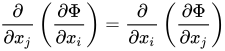
where the partial derivatives are taken with all other natural variables held constant. For every thermodynamic potential there are possible Maxwell relations where is the number of natural variables for that potential.


The four most common Maxwell relations
[edit]The four most common Maxwell relations are the equalities of the second derivatives of each of the four thermodynamic potentials, with respect to their thermal natural variable (temperature , or entropy ) and their mechanical natural variable (pressure , or volume ):
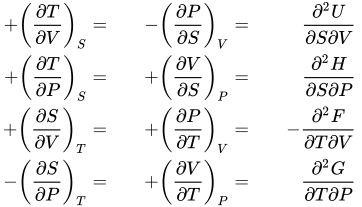
where the potentials as functions of their natural thermal and mechanical variables are the internal energy , enthalpy , Helmholtz free energy , and Gibbs free energy . The thermodynamic square can be used as a mnemonic to recall and derive these relations. The usefulness of these relations lies in their quantifying entropy changes, which are not directly measurable, in terms of measurable quantities like temperature, volume, and pressure.


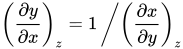
Each equation can be re-expressed using the relationship which are sometimes also known as Maxwell relations.
Derivations
[edit]Short derivation
[edit]Source:[1]
Suppose we are given four real variables , restricted to move on a 2-dimensional surface in . Then, if we know two of them, we can determine the other two uniquely (generically).


In particular, we may take any two variables as the independent variables, and let the other two be the dependent variables, then we can take all these partial derivatives.
Proposition:
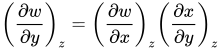
Proof: This is just the chain rule.
Proposition:
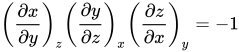
Proof. We can ignore . Then locally the surface is just . Then , etc. Now multiply them.


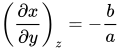
Proof of Maxwell's relations:
There are four real variables , restricted on the 2-dimensional surface of possible thermodynamic states. This allows us to use the previous two propositions.

It suffices to prove the first of the four relations, as the other three can be obtained by transforming the first relation using the previous two propositions. Pick as the independent variables, and as the dependent variable. We have .



Now, since the surface is , that is,which yields the result.

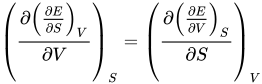
Another derivation
[edit]Source:[2]
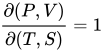
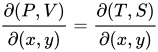
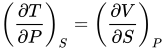
Since , around any cycle, we haveTake the cycle infinitesimal, we find that . That is, the map is area-preserving. By the chain rule for Jacobians, for any coordinate transform , we haveNow setting to various values gives us the four Maxwell relations. For example, setting gives us




Extended derivations
[edit]Maxwell relations are based on simple partial differentiation rules, in particular the total differential of a function and the symmetry of evaluating second order partial derivatives.
Derivation of the Maxwell relation can be deduced from the differential forms of the thermodynamic potentials:
The differential form of internal energy U is
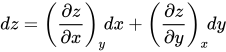
This equation resembles total differentials of the form
It can be shown, for any equation of the form,
that
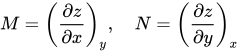
Consider, the equation . We can now immediately see that
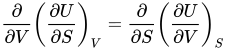
Since we also know that for functions with continuous second derivatives, the mixed partial derivatives are identical (Symmetry of second derivatives), that is, that
we therefore can see that
and therefore that




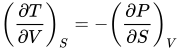
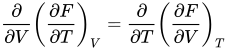
Derivation of Maxwell Relation from Helmholtz Free energy
The differential form of Helmholtz free energy is From symmetry of second derivatives and therefore that The other two Maxwell relations can be derived from differential form of enthalpy and the differential form of Gibbs free energy in a similar way. So all Maxwell Relationships above follow from one of the Gibbs equations.




Combined form first and second law of thermodynamics,
| Eq.1 |

U, S, and V are state functions. Let,


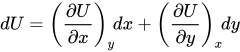
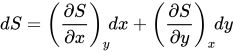
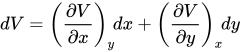
Substitute them in Eq.1 and one gets, And also written as, comparing the coefficient of dx and dy, one gets Differentiating above equations by y, x respectively




| Eq.2 |

and
| Eq.3 |

U, S, and V are exact differentials, therefore, Subtract Eq.2 and Eq.3 and one gets Note: The above is called the general expression for Maxwell's thermodynamical relation.
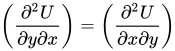
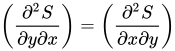


- Maxwell's first relation
- Allow x = S and y = V and one gets
- Maxwell's second relation
- Allow x = S and y = P and one gets
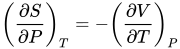
- Maxwell's third relation
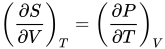
- Allow x = T and y = V and one gets
- Maxwell's fourth relation
- Allow x = T and y = P and one gets
Derivation based on Jacobians
[edit]If we view the first law of thermodynamics, as a statement about differential forms, and take the exterior derivative of this equation, we get since . This leads to the fundamental identity



The physical meaning of this identity can be seen by noting that the two sides are the equivalent ways of writing the work done in an infinitesimal Carnot cycle. An equivalent way of writing the identity is
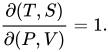
The Maxwell relations now follow directly. For example, The critical step is the penultimate one. The other Maxwell relations follow in similar fashion. For example,


General Maxwell relationships
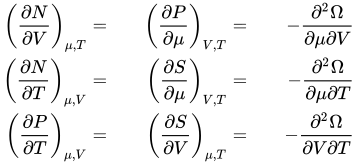
[edit]The above are not the only Maxwell relationships. When other work terms involving other natural variables besides the volume work are considered or when the number of particles is included as a natural variable, other Maxwell relations become apparent. For example, if we have a single-component gas, then the number of particles N is also a natural variable of the above four thermodynamic potentials. The Maxwell relationship for the enthalpy with respect to pressure and particle number would then be:

where μ is the chemical potential. In addition, there are other thermodynamic potentials besides the four that are commonly used, and each of these potentials will yield a set of Maxwell relations. For example, the grand potential yields:[3]

See also
[edit]References
[edit]- ^ Pippard, A. B. (1957-01-01). Elements of Classical Thermodynamics:For Advanced Students of Physics (1st ed.). Cambridge: Cambridge University Press. ISBN 978-0-521-09101-5.
{{cite book}}: ISBN / Date incompatibility (help) - ^ Ritchie, David J. (2002-02-01). "Answer to Question #78. A question about the Maxwell relations in thermodynamics". American Journal of Physics. 70 (2): 104–104. doi:10.1119/1.1410956. ISSN 0002-9505.
- ^ "Thermodynamic Potentials" (PDF). University of Oulu. Archived (PDF) from the original on 19 December 2022.
| Theory |  | |
|---|---|---|
| Statistical thermodynamics | ||
| Models | ||
| Mathematical approaches | ||
| Critical phenomena | ||
| Entropy | ||
| Applications | ||
Maxwell relations
View on GrokipediaIntroduction
Definition and principles
Maxwell relations are a set of thermodynamic equations that arise from the equality of mixed second partial derivatives of thermodynamic potentials, which are state functions in thermodynamics. These relations stem from the fundamental mathematical property in multivariable calculus that, for a potential depending on natural variables and , the mixed derivatives satisfy , assuming the second derivatives are continuous.[4][5] This principle, applied to thermodynamics, ensures the total differentials of potentials like internal energy or Gibbs free energy are exact, linking conjugate pairs of variables such as entropy and temperature, or volume and pressure.[6] In essence, Maxwell relations connect key thermodynamic variables—including pressure (), temperature (), volume (), entropy (), and chemical potential ()—by equating cross-derivatives of these potentials. For instance, the general form for a potential yields , where the partials correspond to measurable responses like thermal expansion or compressibility.[7][4] This interconnection arises because thermodynamic potentials are constructed via Legendre transforms from the fundamental relation, such as , allowing relations to bridge intensive and extensive properties across different ensembles.[5] These relations play a crucial role in thermodynamics by guaranteeing the internal consistency of experimental data on state variables, as any inconsistency would violate the equality of mixed derivatives.[6] Moreover, they enable the prediction of hard-to-measure properties—such as changes in entropy with pressure—from more accessible quantities like isothermal volume expansion, without requiring direct calorimetric or volumetric experiments.[7] This predictive power stems from the symmetry inherent in exact differentials, reducing the number of independent second derivatives needed to describe a system and facilitating broader applications in equilibrium thermodynamics.[5]Historical development
The development of classical thermodynamics in the mid-19th century provided the essential context for the emergence of Maxwell relations, following Sadi Carnot's pioneering 1824 study of heat engines, which established the efficiency limits of reversible cycles, and Rudolf Clausius's subsequent 1850s formulations of the first and second laws, including the introduction of entropy as a measure of unavailable energy.[8] These advances shifted the understanding of heat from a fluid-like substance to a form of energy, enabling deeper exploration of state functions and their interdependencies.[4] James Clerk Maxwell introduced the relations in 1871 within his influential textbook Theory of Heat, where he derived them as consequences of the symmetry in the second partial derivatives of thermodynamic potentials, such as internal energy expressed in terms of entropy and volume.[4] Maxwell applied these relations to connect thermal phenomena with mechanical properties, including elasticity in solids and fluids, demonstrating how changes in temperature and pressure relate to entropy variations; his work built on Hermann von Helmholtz's 1847 principle of energy conservation, which highlighted potential functions in thermodynamic processes.[4] Shortly thereafter, Josiah Willard Gibbs advanced the framework in his 1876–1878 memoir On the Equilibrium of Heterogeneous Substances, formalizing the use of thermodynamic potentials like the Gibbs free energy to study phase equilibria and heterogeneous systems, where the relations served as foundational equalities among cross-derivatives to ensure consistency in equilibrium conditions.[9] Gibbs's rigorous integration of these tools with vector analysis and graphical methods elevated their role in predicting chemical and physical behaviors, bridging Maxwell's derivations with practical applications in complex systems.[10] By the early 20th century, Maxwell relations had solidified as standard analytical instruments, prominently featured in Max Planck's 1897 Treatise on Thermodynamics, which presented them as direct outcomes of the exact differential nature of state functions and used them to derive properties like specific heats and compressibilities. Planck's authoritative text, emphasizing empirical foundations over speculative models, disseminated the relations widely in academic curricula, ensuring their enduring status as cornerstones of thermodynamic theory.Thermodynamic Prerequisites
Exact differentials in thermodynamics
In thermodynamics, an exact differential refers to the total differential of a state function, which depends solely on the current state of the system and is independent of the path taken to reach that state. For a state function , its differential takes the form , where and . This form is exact if the integral of between any two states yields the same result regardless of the path, ensuring is well-defined as a function of state variables.[11] The condition for exactness is the equality of mixed second partial derivatives: . This cross-derivative test, derived from the symmetry of second derivatives in multivariable calculus (Clairaut's theorem), confirms whether the differential corresponds to a state function. In thermodynamics, this property is crucial because it allows state functions to be integrated path-independently, facilitating the definition of equilibrium properties without regard to process history.[11][12] Thermodynamic state functions, such as internal energy , exhibit exact differentials, as their changes depend only on initial and final states. For instance, the fundamental relation for internal energy is , where is temperature, is entropy, is pressure, and is volume; here, (with respect to ) and (with respect to ), and the exactness condition holds because . In contrast, heat and work are path-dependent quantities with inexact differentials; for reversible processes, , but itself is not the differential of a state function, as its value varies with the process path.[11][12]Thermodynamic potentials
In thermodynamics, the primary thermodynamic potentials are state functions that describe the energy of a system in terms of its natural variables, facilitating the analysis of equilibrium properties and processes. These potentials are constructed via Legendre transforms of the internal energy, allowing the substitution of intensive variables (such as temperature and pressure) for extensive ones (such as entropy and volume) to suit different experimental conditions. The four fundamental potentials—internal energy, enthalpy, Helmholtz free energy, and Gibbs free energy—share the property of being exact differentials, which underpins their utility in deriving relations among thermodynamic variables.[13][14] The internal energy is the foundational thermodynamic potential, representing the total internal energy of a system as a function of its entropy and volume , which are its natural variables. Its differential form is given by where is the temperature and is the pressure, serving as the conjugate intensive variables to and , respectively. No Legendre transform is applied to itself, as it is the starting point for generating the other potentials.[13][14] Enthalpy , defined as , is obtained from the internal energy via a Legendre transform with respect to volume, replacing with its conjugate as a natural variable, alongside . The resulting differential form is making particularly useful for processes at constant pressure, where it relates directly to heat transfer.[13][15] The Helmholtz free energy , expressed as , arises from a Legendre transform of with respect to entropy, substituting for while retaining as a natural variable. Its differential form is which highlights the maximum non-expansion work available at constant temperature and volume.[13][14] The Gibbs free energy , given by or equivalently , is derived by applying an additional Legendre transform to the Helmholtz free energy (replacing with ) or directly from enthalpy (replacing with ), yielding natural variables and . The differential form is rendering essential for constant-temperature and constant-pressure conditions, such as in chemical reactions.[13][15] As exact differentials of state functions, these thermodynamic potentials enable the equality of mixed second partial derivatives, providing the mathematical foundation for Maxwell relations that connect seemingly independent thermodynamic coefficients.[13][14]Standard Maxwell Relations
The four principal relations
The four principal Maxwell relations arise from the equality of mixed second partial derivatives of the fundamental thermodynamic potentials, providing connections between thermodynamic state variables such as temperature , pressure , volume , and entropy . These relations are derived from the internal energy , enthalpy , Helmholtz free energy , and Gibbs free energy . The subscript notation in partial derivatives, such as , indicates the variable held constant during differentiation. From the internal energy, the relation is This equates the rate of change of temperature with volume at constant entropy to the negative rate of change of pressure with entropy at constant volume, relevant for adiabatic processes where entropy is conserved.[16] From the enthalpy, the relation is This connects the temperature variation with pressure at constant entropy to the volume variation with entropy at constant pressure, useful in isentropic expansions or compressions.[16] From the Helmholtz free energy, the relation is This links the entropy change with volume at constant temperature to the pressure change with temperature at constant volume, facilitating analysis of isothermal volume adjustments.[16] From the Gibbs free energy, the relation is This relates the entropy variation with pressure at constant temperature to the negative volume variation with temperature at constant pressure, directly tying to the thermal expansion coefficient , which measures material expansion under heating, and indirectly to isothermal compressibility through subsequent thermodynamic identities.[16][17]Explicit forms and variables
The principal Maxwell relations can be adapted into alternative forms that incorporate experimentally measurable coefficients, facilitating practical computations in thermodynamics. For instance, the relation is often rewritten using the coefficient of thermal expansion and the isothermal compressibility , yielding .[18] This form links entropy changes to volume variations at constant temperature directly through quantities obtainable from equations of state or calorimetry.[19] Similarly, the relation rearranges to , but more usefully expresses entropy-pressure dependence via , emphasizing thermal expansion's role in isothermal processes.[18] Thermodynamic variables in Maxwell relations distinguish between extensive quantities (e.g., entropy and volume , scaling with system size) and intensive ones (e.g., temperature and pressure , independent of size). For extensive variables, the relations apply directly to total system properties, but practical applications often employ intensive or molar forms to normalize for system scale. Molar quantities, such as molar entropy (where is the total number of moles) and molar volume , yield analogous relations like , preserving the structure while using per-mole metrics suitable for mixtures or specific substances.[6] These adaptations ensure consistency across system sizes, as thermodynamic potentials are homogeneous functions of degree one in extensive variables.[18] Common rearrangements of the relations highlight dependencies useful for predicting property changes. For example, from , one obtains the volume-temperature response at constant pressure in terms of entropy-pressure derivatives, aiding analysis of thermal effects on fluids.[19] Another frequent form derives from combining relations with heat capacities; the difference emerges indirectly through Maxwell-linked derivatives, though this specific identity stems from broader thermodynamic identities.[18] The four principal Maxwell relations, in their canonical forms with variable dependencies, are compared below for clarity:| Thermodynamic Potential | Relation | Fixed Variables | Dependent Variables |
|---|---|---|---|
| Helmholtz free energy | |||
| Gibbs free energy | |||
| Enthalpy | |||
| Internal energy |