Hubbry Logo
Cascade VolcanoesCascade VolcanoesMain
Open search
Cascade Volcanoes
Community hub
Cascade Volcanoes
logo
8 pages, 0 posts
0 subscribers
Be the first to start a discussion here.
Cascade Volcanoes
Cascade Volcanoes
from Wikipedia

The Cascade Volcanoes (also known as the Cascade Volcanic Arc or the Cascade Arc) are a number of volcanoes in a continental volcanic arc in western North America, extending from southwestern British Columbia through Washington and Oregon to Northern California, a distance of well over 700 miles (1,100 km). The arc formed due to subduction along the Cascadia subduction zone. Although taking its name from the Cascade Range, this term is a geologic grouping rather than a geographic one, and the Cascade Volcanoes extend north into the Coast Mountains, past the Fraser River which is the northward limit of the Cascade Range proper.

Key Information

Some of the major cities along the length of the arc include Portland, Seattle, and Vancouver, and the population in the region exceeds 10 million. All could be potentially affected by volcanic activity and great subduction-zone earthquakes along the arc. Because the population of the Pacific Northwest is rapidly increasing, the Cascade volcanoes are some of the most dangerous, due to their eruptive history and potential for future eruptions, and because they are underlain by weak, hydrothermally altered volcanic rocks that are susceptible to failure. Consequently, Mount Rainier is one of the Decade Volcanoes identified by the International Association of Volcanology and Chemistry of the Earth's Interior (IAVCEI) as being worthy of particular study, due to the danger it poses to Seattle and Tacoma. Many large, long-runout landslides originating on Cascade Volcanoes have engulfed valleys tens of kilometers from their sources, and some of the areas affected now support large populations.

The Cascade Volcanoes are part of the Pacific Ring of Fire, the ring of volcanoes and associated mountains around the Pacific Ocean. The Cascade Volcanoes have erupted several times in recorded history. Two most recent were Lassen Peak in 1914 to 1921 and a major eruption of Mount St. Helens in 1980. It is also the site of Canada's most recent major eruption, in 410 BCE at the Mount Meager massif.[1]

Geology

[edit]

The Cascade Arc includes nearly 20 major volcanoes, among a total of over 4,000 separate volcanic vents including numerous stratovolcanoes, shield volcanoes, lava domes, and cinder cones, along with a few isolated examples of rarer volcanic forms such as tuyas. Volcanism in the arc began about 37 million years ago; however, most of the present-day Cascade Volcanoes are less than 2,000,000 years old, and the highest peaks are less than 100,000 years old. Twelve volcanoes in the arc are over 10,000 feet (3,000 m) in elevation, and the two highest, Mount Rainier and Mount Shasta, exceed 14,000 feet (4,300 m). By volume, the two largest Cascade Volcanoes are the broad shields of Medicine Lake Volcano and Newberry Volcano, which are about 145 and 108 cu mi (600 and 450 km3) respectively. Glacier Peak is the only Cascade Volcano that is made exclusively of dacite. The history of the Cascade Volcanoes can be separated into three major chapters which are discussed below.

Lassen Peak and Devastated Area from Cinder Cone

West Cascades period

[edit]

The time between 37 million and 17 million years ago is known as the West Cascades period, this era is characterized as being when the volcanoes in this region were exceptionally active.[2] During this time the arc was situated a little farther west than it is today. One volcano that was active during this time was the Mount Aix Volcanic Complex, which erupted more than 100 km3 (24 cu mi) of tephra and pyroclastic debris over the span of just three eruptions.[3] Lavas representing the earliest stage in the development of the Cascade Volcanic Arc mostly crop out south of the North Cascades proper, where uplift of the Cascade Range has been less, and a thicker blanket of Cascade Arc volcanic rocks has been preserved. In the North Cascades, geologists have not yet identified with any certainty any volcanic rocks as old as 35 million years, but remnants of the ancient arc's internal plumbing system persist in the form of plutons, which are the crystallized magma chambers that once fed the early Cascade volcanoes. The greatest mass of exposed Cascade Arc plumbing is the Chilliwack batholith, which makes up much of the northern part of North Cascades National Park and adjacent parts of British Columbia beyond. Individual plutons range in age from about 35 million years old to 2.5 million years old. The older rocks invaded by all this magma were affected by the heat. Around the plutons of the batholith, the older rocks recrystallized. This contact metamorphism produced a fine mesh of interlocking crystals in the old rocks, generally strengthening them and making them more resistant to erosion. Where the recrystallization was intense, the rocks took on a new appearance dark, dense and hard. Many rugged peaks in the North Cascades owe their prominence to this baking. The rocks holding up many such North Cascade giants, as Mount Shuksan, Mount Redoubt, Mount Challenger, and Mount Hozomeen, are all partly recrystallized by plutons of the nearby and underlying Chilliwack batholith.

Widespread dormancy period

[edit]

The West Cascades period came to an end 17 million years ago when the Columbia River flood basalts began erupting in eastern Washington and Oregon.[2] For a reason unknown to scientists the initiation of the flood basalts seemingly caused a significant dip in volcanic activity in the cascade chain lasting for over 8 million years.[2] During this time the volcanoes were stripped down to their cores by weathering and erosion because they were not active enough to rebuild. This low point lasted from 17 to 9 million years ago and came to end when the Columbia flood basalts waned.

High Cascades period

[edit]

As production of the Columbia River flood basalts slowed 9 million years ago the Cascade volcanoes became active again.[2] The volcanic arc also drifted farther east to its present location. When the Columbia basalts stopped entirely 6 million years ago the Cascades of central Oregon spectacularly flared up. This flare up lasted between 6.25 and 5.45 million years ago and is known as the Deschutes Formation.[4] During this 800,000 year span approximately 400 to 675 km3 (96 to 162 cu mi) of pyroclastic material was expelled in 78 distinct eruptions.[4] It has been hypothesized that a heightened flux of basalt, possibly induced by tectonic slab-rollback, was focused beneath the volcanic arc and into the shallow crust by minor amounts of crustal extension. This extension allowed for the high flux of basalt to be stored at shallow levels beneath a new arc locus within fertile crust, resulting in the silica-rich volcanism we see in the Deschutes Formation.[4] After this pulse of activity the cascades retreated to the levels of activity we are more familiar with today.

For the remaining 5 or so million years the ancestors of many of the modern day Cascade volcanoes were built. Around half a million years ago a generation of older volcanoes died and many of the stratovolcanoes that we see today began their growth such as Glacier Peak and Mt. Shasta (600,000 years ago),[5] Mt. Rainier and Mt. Hood (500,000 years ago),[5] Mt. Adams (450,000 years ago),[5] and Mt. Mazama (420,000 years ago).[5]

Modern arc

[edit]

The volcanoes of the Cascade Arc share some general characteristics, but each has its own unique geological traits and history. Lassen Peak in California, which last erupted in 1917, is the southernmost historically active volcano in the arc, while the Mount Meager massif in British Columbia, which erupted about 2,350 years ago, is generally considered the northernmost member of the arc. A few isolated volcanic centers northwest of the Mount Meager massif such as the Silverthrone Caldera, which is a circular 20 km (12 mi) wide, deeply dissected caldera complex, may also be the product of Cascadia subduction because the igneous rocks andesite, basaltic andesite, dacite and rhyolite can also be found at these volcanoes as they are elsewhere along the subduction zone.[6][7] At issue are the current estimates of plate configuration and rate of subduction, but based on the chemistry of these volcanoes, they are also subduction related and therefore part of the Cascade Volcanic Arc.[8][9] The Cascade Volcanic Arc appears to be segmented; the central portion of the arc is the most active and the northern end least active.

The Garibaldi Volcanic Belt is the northern extension of the Cascade Arc. Volcanoes within the volcanic belt are mostly stratovolcanoes along with the rest of the arc, but also include calderas, cinder cones, and small isolated lava masses. The eruption styles within the belt range from effusive to explosive, with compositions from basalt to rhyolite. Due to repeated continental and alpine glaciations, many of the volcanic deposits in the belt reflect complex interactions between magma composition, topography, and changing ice configurations. Four volcanoes within the belt appear related to seismic activity since 1975, including: Mount Meager massif, Mount Garibaldi and Mount Cayley.

The Pemberton Volcanic Belt is an eroded volcanic belt north of the Garibaldi Volcanic Belt, which appears to have formed during the Miocene before fracturing of the northern end of the Juan de Fuca Plate. The Silverthrone Caldera is the only volcano within the belt that appears related to seismic activity since 1975.

Mount Garibaldi as seen from the south

The Mount Meager massif is the most unstable volcanic massif in Canada. It has dumped clay and rock several meters deep into the Pemberton Valley at least three times during the past 7,300 years. Recent drilling into the Pemberton Valley bed encountered remnants of a debris flow that had traveled 50 km (31 mi) from the volcano shortly before it last erupted 2,350 years ago. About 1,000,000,000 m3 (0.24 cu mi) of rock and sand extended over the width of the valley. Two previous debris flows, about 4,450 and 7,300 years ago, sent debris at least 32 km (20 mi) from the volcano. Recently, the volcano has created smaller landslides about every ten years, including one in 1975 that killed four geologists near Meager Creek. The possibility of the Mount Meager massif covering stable sections of the Pemberton Valley in a debris flow is estimated at one in 2,400 years. There is no sign of volcanic activity with these events. However, scientists warn the volcano could release another massive debris flow over populated areas any time without warning.

Mount Cayley as seen from its southeast slopes

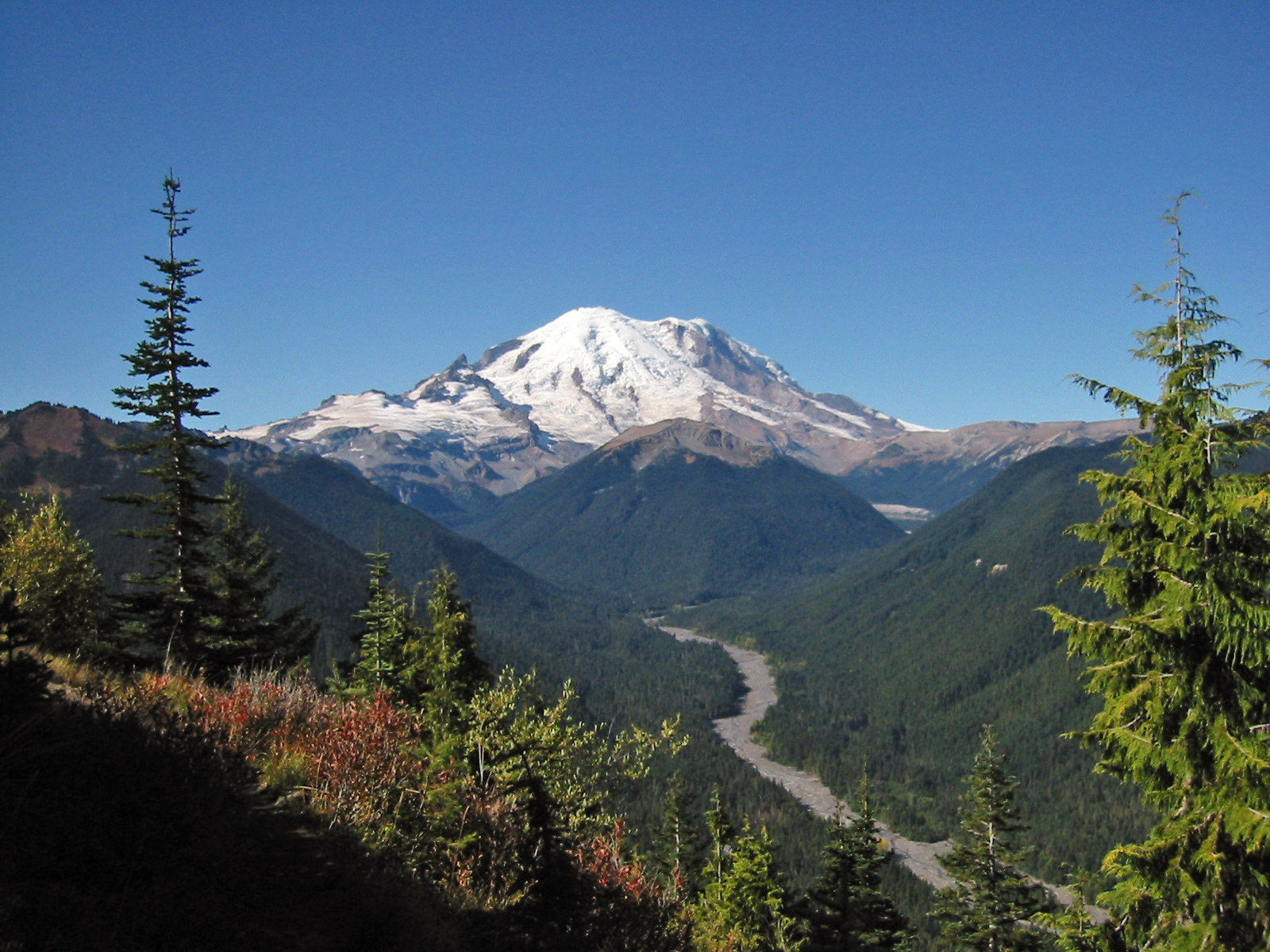
In the past, Mount Rainier has had large debris avalanches, and has also produced enormous lahars due to the large amount of glacial ice present. Its lahars have reached all the way to Puget Sound. Around 5,000 years ago, a large chunk of the volcano slid away and that debris avalanche helped to produce the massive Osceola Mudflow, which went all the way to the site of present-day Tacoma and south Seattle. This massive avalanche of rock and ice took out the top 1,600 feet (490 m) of Rainier, bringing its height down to around 14,100 feet (4,300 m). About 530 to 550 years ago, the Electron Mudflow occurred, although this was not as large-scale as the Osceola Mudflow.

While the Cascade volcanic arc (a geological term) includes volcanoes such as the Mount Meager massif and Mount Garibaldi, which lie north of the Fraser River, the Cascade Range (a geographic term) is considered to have its northern boundary at the Fraser.

Largest eruptions

[edit]
Overview of Dusty Creek drainage, to the left pyroclastic deposits from Gamma Ridge can be seen.
Ignimbrite deposited by the Lake Tapps eruption that formed the Kulshan caldera.

The table below lists some of the greatest eruptions to have occurred in the Cascade chain.

Volcano Eruption Name Age VEI Volume of Magma (km3) Volume of Tephra (km3) Reference
Lassen Volcanic Center Rockland Tephra 610,000 7 130 326.7 [10][11]
Mount Baker Volcanic Field Lake Tapps Tephra 1,149,000 7 124 N/A [12]
Crater Lake Mazama Ash 5783 BC 7 61 176 [13]
Gamma Ridge Gamma Ridge Caldera Formation 1,242,000 6–7 40 N/A [14]
Medicine Lake Antelope Well Tuff 171,000 6 20 N/A [14]
Newberry Olema Ash 80,000 6 14–22 N/A [14]
Tepee Draw Tuff 230,000 6 10 25 [14][11]
Mount St. Helens Layer Yn 1860 BC 6 4 15.3 [11]

Human history

[edit]
Major Cascade volcano eruptions in the last 4000 years

Native Americans have inhabited the area for thousands of years and developed their own myths and legends concerning the Cascade volcanoes. According to some of these tales, Mounts Baker, Jefferson, Shasta and Garibaldi were used as refuge from a great flood. Other stories, such as the Bridge of the Gods tale, had various High Cascades such as Hood and Adams, act as god-like chiefs who made war by throwing fire and stone at each other. St. Helens with its pre-1980 graceful appearance, was regaled as a beautiful maiden for whom Hood and Adams feuded. Among the many stories concerning Mount Baker, one tells that the volcano was formerly married to Mount Rainier and lived in that vicinity. Then, because of a marital dispute, she picked herself up and marched north to her present position. Native tribes also developed their own names for the High Cascades and many of the smaller peaks, the most well known to non-natives being Tahoma, the Lushootseed name for Mount Rainier. Mount Cayley and The Black Tusk are known to the Squamish people who live nearby as "the Landing Place of the Thunderbird".

Hot springs in the Canadian side of the arc, were originally used and revered by First Nations people. The springs located on Meager Creek are called Teiq[15] in the language of the Lillooet people and were the farthest up the Lillooet River. The spirit-beings/wizards known as "the Transformers" reached them during their journey into the Lillooet Country, and were a "training" place for young First Nations men to acquire power and knowledge. In this area, also, was found the blackstone chief's head pipe that is famous of Lillooet artifacts; found buried in volcanic ash, one supposes from the 2350 BP eruption of the Mount Meager massif.

Legends associated with the great volcanoes are many, as well as with other peaks and geographical features of the arc, including its many hot springs and waterfalls and rock towers and other formations. Stories of Tahoma – today Mount Rainier and the namesake of Tacoma, Washington – allude to great, hidden grottos with sleeping giants, apparitions and other marvels in the volcanoes of Washington, and Mount Shasta in California has long been well known for its associations with everything from Lemurians to aliens to elves and, as everywhere in the arc, Sasquatch or Bigfoot.

Cascadia earthquake sources

In the spring of 1792 British navigator George Vancouver entered Puget Sound and started to give English names to the high mountains he saw. Mount Baker was named for Vancouver's third lieutenant, the graceful Mount St. Helens for a famous diplomat, Mount Hood was named in honor of Samuel Hood, 1st Viscount Hood (an admiral of the Royal Navy) and the tallest Cascade, Mount Rainier, is the namesake of Admiral Peter Rainier. Vancouver's expedition did not, however, name the arc these peaks belonged to. As marine trade in the Strait of Georgia and Puget Sound proceeded in the 1790s and beyond, the summits of Rainier and Baker became familiar to captains and crews (mostly British and American).

With the exception of the 1915 eruption of remote Lassen Peak in Northern California, the arc was quiet for more than a century. Then, on May 18, 1980, the dramatic eruption of little-known Mount St. Helens shattered the quiet and brought the world's attention to the arc. Geologists were also concerned that the St. Helens eruption was a sign that long-dormant Cascade volcanoes might become active once more, as in the period from 1800 to 1857 when a total of eight erupted. None have erupted since St. Helens, but precautions are being taken nevertheless, such as the Mount Rainier Volcano Lahar Warning System in Pierce County, Washington.[16]

Cascadia subduction zone

[edit]
Area of the Cascadia subduction zone, including Cascade volcanoes (red triangles)

The Cascade Volcanoes were formed by the subduction of the Juan de Fuca, Explorer and the Gorda Plate (remnants of the much larger Farallon Plate) under the North American Plate along the Cascadia subduction zone. This is a 680-mile (1,090 km) long fault, running 50 miles (80 km) off the coast of the Pacific Northwest from northern California to Vancouver Island, British Columbia. The plates move at a relative rate of over 0.4 inches (10 mm) per year at a somewhat oblique angle to the subduction zone.

Because of the very large fault area, the Cascadia subduction zone can produce very large earthquakes, magnitude 9.0 or greater, if rupture occurred over its whole area. When the "locked" zone stores up energy for an earthquake, the "transition" zone, although somewhat plastic, can rupture. Thermal and deformation studies indicate that the locked zone is fully locked for 60 km (37 mi) downdip from the deformation front. Farther downdip, there is a transition from fully locked to aseismic sliding.

Unlike most subduction zones worldwide, there is no oceanic trench present along the continental margin in Cascadia.[17] Instead, terranes and the accretionary wedge have been uplifted to form a series of coast ranges and exotic mountains. A high rate of sedimentation from the outflow of the three major rivers (Fraser River, Columbia River, and Klamath River) which cross the Cascade Range contributes to further obscuring the presence of a trench. However, in common with most other subduction zones, the outer margin is slowly being compressed, similar to a giant spring. When the stored energy is suddenly released by slippage across the fault at irregular intervals, the Cascadia subduction zone can create very large earthquakes such as the Mw  8.7–9.2 Cascadia earthquake of 1700.

Famous eruptions

[edit]
3,000-foot (910 m) steam plume from Mount St. Helens on May 19, 1982

1980 eruption of Mount St. Helens

[edit]

The 1980 eruption of Mount St. Helens was one of the most closely studied volcanic eruptions in the arc and one of the best studied ever. It was a plinian style eruption with a VEI 5 and was the most significant to occur in the lower 48 U.S. states in recorded history. An earthquake at 8:32 a.m. on May 18, 1980, caused the entire weakened north face to slide away. An ash column rose 15 miles into the atmosphere and deposited ash in 11 U.S. states. The eruption killed 57 people and thousands of animals and caused more than a billion U.S. dollars in damage. Over 1.3 km3 of tephra was ejected during this eruption.

1914–1917 eruptions of Lassen Peak

[edit]

On May 22, 1915, an explosive eruption at Lassen Peak devastated nearby areas and rained volcanic ash as far away as 200 miles (320 km) to the east.[18] A huge column of volcanic ash and gas rose more than 30,000 feet (9,100 m) into the air and was visible from as far away as Eureka, California, 150 miles (240 km) to the west. A pyroclastic flow swept down the side of the volcano, devastating a 3-square-mile (7.8 km2) area. This explosion was the most powerful in a 1914–1917 series of eruptions at Lassen Peak.[18]

2350 BP (400 BC) eruption of the Mount Meager massif

[edit]

The Mount Meager massif produced the most recent major eruption in Canada, sending ash as far away as Alberta.[19] The eruption sent an ash column approximately 20 km (12 mi) high into the stratosphere.[19] This activity produced a diverse sequence of volcanic deposits, well exposed in the bluffs along the Lillooet River, which is defined as the Pebble Creek Formation.[20] The eruption was episodic, occurring from a vent on the north-east side of Plinth Peak.[15] An unusual, thick apron of welded vitrophyric breccia may represent the explosive collapse of an early lava dome, depositing ash several meters (a dozen or so feet) in thickness near the vent area.[20] The volume of magma erupted in this event is equal to 2 km3.[14]

7700 BP (5783 BC) eruption of Mount Mazama

[edit]
The caldera of Mount Mazama, filled by Crater Lake

The 7,700 BP eruption of Mount Mazama was a large catastrophic eruption in the U.S. state of Oregon. It began with a large eruption column with pumice and ash that erupted from a single vent. The eruption was so great that most of Mount Mazama collapsed to form a caldera and subsequent smaller eruptions occurred as water began to fill in the caldera to form Crater Lake. Volcanic ash from the eruption was carried across most of the Pacific Northwest as well as parts of western Canada.

13100 BP (11,150 BC) eruptions of Glacier Peak

[edit]

About 13,000 years ago, Glacier Peak generated an unusually strong sequence of eruptions, with one of them being a staggering 5 times larger than the 1980 eruption of Mount St. Helens. These eruptions were some of the largest to occur in Washington state in the last 15,000 years, depositing volcanic ash as far away as Wyoming.[21]

Eruption Sequence ~13,000 Years Ago
Unit Name DRE Volume Bulk Deposit Volume Plume Height
Layer B 2.1 km3 (0.50 cu mi) 6.5 km3 (1.6 cu mi) 31 km (19 mi)
Layer M 0.4 km3 (0.096 cu mi) 1.1 km3 (0.26 cu mi) N/A
Layer G 1.9 km3 (0.46 cu mi) 6.0 km3 (1.4 cu mi) 32 km (20 mi)

Other eruptions

[edit]

Silverthrone Caldera

[edit]

Most of the Silverthrone Caldera's eruptions in the Pacific Range occurred during the Last Glacial Period and was episodically active during both Pemberton and Garibaldi Volcanic Belt stages of volcanism. The caldera is one of the largest of the few calderas in western Canada, measuring about 30 kilometres (19 mi) long (north-south) and 20 kilometres (12 mi) wide (east-west).[22] The last eruption from Mount Silverthrone ran up against ice in Chernaud Creek. The lava was dammed by the ice and made a cliff with a waterfall up against it. The most recent activity was 1000 years ago.

Mount Garibaldi

[edit]

Mount Garibaldi in the Pacific Range was last active about 10,700 to 9,300 years ago from a cinder cone called Opal Cone. It produced a 15 km (9.3 mi) long broad dacite lava flow with prominent wrinkled ridges. The lava flow is unusually long for a silicic lava flow.

Mount Baker

[edit]
Panorama from the northwest of Mount Baker and the Black Buttes

During the mid-19th century, Mount Baker erupted for the first time in several thousand years. Fumarole activity remains in Sherman Crater, just south of the volcano's summit, became more intense in 1975 and is still energetic. However, an eruption is not expected in the near future.[21]

Glacier Peak

[edit]

Glacier Peak last erupted about 200–300 years ago and has erupted about six times in the past 4,000 years.[21]

Mount Rainier

[edit]

Mount Rainier last erupted between 1824 and 1854, but many eyewitnesses reported eruptive activity in 1858, 1870, 1879, 1882, and in 1894 as well. Mount Rainier has created at least four eruptions and many lahars in the past 4,000 years.[21]

Mount Adams

[edit]

Mount Adams was last active about 1,000 years ago and has created few eruptions during the past several thousand years, resulting in several major lava flows, the most notable being the A. G. Aiken Lava Bed, the Muddy Fork Lava Flows, and the Takh Takh Lava Flow. One of the most recent flows issued from South Butte created the 4.5-mile (7.2 km) long by 0.5-mile (0.80 km) wide A.G. Aiken Lava Bed. Thermal anomalies (hot spots) and gas emissions (including hydrogen sulfide) have occurred especially on the summit plateau since the Great Slide of 1921.[21]

Mount Hood

[edit]

Mount Hood was last active about 200 years ago, creating pyroclastic flows, lahars, and a well-known lava dome close to its peak called Crater Rock. Between 1856 and 1865, a sequence of steam explosions took place at Mount Hood.[21]

Newberry Volcano

[edit]

A great deal of volcanic activity has occurred at Newberry Volcano, which was last active about 1,300 years ago. It has one of the largest collections of cinder cones, lava domes, lava flows and fissures in the world.[21]

Medicine Lake Volcano

[edit]

Medicine Lake Volcano has erupted about eight times in the past 4,000 years and was last active about 1,000 years ago when rhyolite and dacite erupted at Glass Mountain and associated vents near the caldera's eastern rim.[21]

Mount Shasta

[edit]

Mount Shasta last erupted around 1250[23] and has been the most active volcano in California for about 4,000 years.[21] Previous claims of a 1786 eruption have been discredited.[24]

Eruptions in the Cascade Range

[edit]

Eleven of the thirteen volcanoes in the Cascade Range have erupted at least once in the past 4,000 years, and seven have done so in just the past 200 years.[21] The Cascade volcanoes have had more than 100 eruptions over the past few thousand years, many of them explosive eruptions.[21] However, certain Cascade volcanoes can be dormant for hundreds or thousands of years between eruptions, and therefore the great risk caused by volcanic activity in the regions is not always readily apparent.

When Cascade volcanoes do erupt, pyroclastic flows, lava flows, and landslides can devastate areas more than 10 miles (16 km) away; and huge mudflows of volcanic ash and debris, called lahars, can inundate valleys more than 50 miles (80 km) downstream. Falling ash from explosive eruptions can disrupt human activities hundreds of miles downwind, and drifting clouds of fine ash can cause severe damage to jet aircraft even thousands of miles away.

All of the known historical eruptions have occurred in Washington, Oregon and in Northern California. The three most recent were Lassen Peak from 1914 to 1921, a major eruption of Mount St. Helens in 1980, and a minor eruption of Mount St. Helens from 2004 to 2008.[25] In contrast, volcanoes in southern British Columbia, central and southern Oregon are currently dormant. The regions lacking new eruptions keep in touch to positions of fracture zones that offset the Gorda Ridge, Explorer Ridge and the Juan de Fuca Ridge. The volcanoes with historical eruptions include: Mount Rainier, Glacier Peak, Mount Baker, Mount Hood, Lassen Peak, and Mount Shasta.

Renewed volcanic activity in the Cascade Arc, such as the 1980 eruption of Mount St. Helens, has offered a great deal of evidence about the structure of the Cascade Arc. One effect of the 1980 eruption was a greater knowledge of the influence of landslides and volcanic development in the evolution of volcanic terrain. A vast piece on the north side of Mount St. Helens dropped and formed a jumbled landslide environment several kilometers away from the volcano. Pyroclastic flows and lahars moved across the countryside. Parallel episodes have also happened at Mount Shasta and other Cascade volcanoes in prehistoric times.

List of volcanoes

[edit]

Washington has a majority of the very highest volcanoes, with 4 of the top 6 overall, although Oregon does hold a majority of the next highest peaks. Even though Mount Rainier is the tallest, Medicine Lake Volcano in California is the largest by volume, followed by Oregon's Newberry Volcano. This is a list of the dozen highest Cascade volcanoes, along with the highest in British Columbia (Silverthrone Caldera) and the most recently erupted (Mount St. Helens):

Name Elevation State/Province Location Last eruption
feet   meters   Coordinates
Mount Rainier 14,411 4,392 Washington 46°51′10″N 121°45′37″W / 46.8528857°N 121.7603744°W / 46.8528857; -121.7603744 November to December 1894
Mount Shasta 14,162 4,317 California 41°24′33″N 122°11′42″W / 41.409196033°N 122.194888358°W / 41.409196033; -122.194888358 About 1250 AD
Mount Adams 12,280 3,740 Washington 46°12′09″N 121°29′27″W / 46.202411792°N 121.490894694°W / 46.202411792; -121.490894694 About 950 AD
Mount Hood 11,239 3,426 Oregon 45°22′25″N 121°41′45″W / 45.373514489°N 121.695918558°W / 45.373514489; -121.695918558 1865 to 1866
Mount Baker 10,781 3,286 Washington 48°46′38″N 121°48′48″W / 48.7773426°N 121.8132008°W / 48.7773426; -121.8132008 September to November 1880
Glacier Peak 10,541 3,213 Washington 48°06′45″N 121°06′50″W / 48.112513950°N 121.113804642°W / 48.112513950; -121.113804642 1700 ± 100 years
Mount Jefferson 10,497 3,199 Oregon 44°40′27″N 121°47′58″W / 44.674300600°N 121.799573611°W / 44.674300600; -121.799573611 About 950 AD[citation needed]
Lassen Peak 10,457 3,187 California 40°29′17″N 121°30′18″W / 40.4881731°N 121.5050078°W / 40.4881731; -121.5050078 1914 to 1917
South Sister (Three Sisters) 10,358 3,157 Oregon 44°06′12″N 121°46′09″W / 44.1034490°N 121.7692058°W / 44.1034490; -121.7692058 50 BC
North Sister (Three Sisters) 10,085 3,074 Oregon 44°09′58″N 121°46′21″W / 44.1662273°N 121.7725431°W / 44.1662273; -121.7725431 (North Sister) 100,000 yrs ago
Middle Sister (Three Sisters) 10,047 3,062 Oregon 44°08′53″N 121°47′02″W / 44.1481718°N 121.7839312°W / 44.1481718; -121.7839312 (Middle Sister) 14,000 yrs ago
Mount McLoughlin 9,495 2,894 Oregon 42°26′40″N 122°18′56″W / 42.44444°N 122.31556°W / 42.44444; -122.31556 About 30,000 years ago
Silverthrone Caldera 9,396 2,864 British Columbia 51°26′00″N 126°18′00″W / 51.43333°N 126.30000°W / 51.43333; -126.30000 About 100,000 years ago
Mount St. Helens 8,363 2,549 Washington 46°11′28″N 122°11′40″W / 46.1912000°N 122.1944000°W / 46.1912000; -122.1944000 2004 to 2008

See also

[edit]

Notes

[edit]

References

[edit]
[edit]
Revisions and contributorsEdit on WikipediaRead on Wikipedia
from Grokipedia
The Cascade Volcanoes, also known as the Cascade Volcanic Arc, constitute a prominent chain of stratovolcanoes and related volcanic features stretching approximately 1,300 km (800 mi) from southern British Columbia in Canada to northern California in the United States, forming the backbone of the Cascade Range along the Pacific Northwest coast. This arc arises from the ongoing subduction of the young, hot Juan de Fuca oceanic plate beneath the North American continental plate, a process that releases water into the mantle, triggering partial melting and magma ascent to produce andesitic to dacitic eruptions typical of continental margin volcanism. Encompassing over 2,900 volcanic vents—including about 20 major stratovolcanoes such as Mount Rainier (the highest at 4,392 m or 14,411 ft), Mount St. Helens, Mount Hood, and Lassen Peak—the system has been active for roughly 37 million years, with the modern arc initiating around 7–5 million years ago following tectonic adjustments after the accretion of the Siletzia terrane. Geologically, the Cascade Volcanoes represent a young continental arc within the Pacific Ring of Fire, characterized by a diverse array of eruptive styles ranging from explosive Plinian eruptions to effusive lava flows, building steep-sided cones often capped by glaciers and snowfields that amplify hazards like lahars (volcanic mudflows). The arc's volcanism has produced a ~37-million-year record of activity, with Quaternary eruptions (past 2.6 million years) dominated by intermediate-composition magmas, though significant mafic (basaltic) volcanism occurs in flank zones and back-arc regions like the High Cascades. Notable historical activity includes seven eruptions since the late 18th century, most famously the 1980 cataclysmic explosion of Mount St. Helens, which devastated over 500 km² and highlighted the arc's potential for widespread impacts on ecosystems, agriculture, aviation, and infrastructure supporting millions of residents. Monitoring and research by the U.S. Geological Survey's Cascades Volcano Observatory underscore the arc's ongoing threat level, with nine volcanoes classified as high or very high risk due to their proximity to urban centers like Seattle, Portland, and Vancouver, and the capacity for ash plumes to disrupt air travel across North America. Beyond the towering peaks, the broader volcanic field includes diffuse features such as cinder cones, lava domes, and shield volcanoes, contributing to fertile soils that sustain the region's forests and agriculture while posing long-term risks from seismic activity and potential flank collapses. The Cascade Volcanoes not only define the dramatic skyline of the Pacific Northwest but also serve as a critical natural laboratory for studying subduction zone dynamics, eruption forecasting, and volcanic hazard mitigation in a tectonically active setting.

Geological Setting

Tectonic Framework

The Cascade Volcanic Arc is formed by the Cascadia Subduction Zone, where the oceanic Juan de Fuca Plate converges with and subducts beneath the continental North American Plate at a rate of approximately 4 cm per year. This oblique convergence occurs along a transform boundary to the north and south, with the subduction zone extending roughly 1,000 km from northern California to southern British Columbia. The descending slab dips eastward at angles of 10–30 degrees, reaching depths of 100–150 km beneath the volcanic arc, where it influences the overlying mantle. Subduction of the hydrated oceanic crust and overlying sediments releases volatiles, primarily water, into the mantle wedge above the slab through devolatilization reactions at depths of 80–150 km. These volatiles lower the solidus temperature of the peridotitic mantle, inducing partial melting in the wedge and generating hydrous basaltic to andesitic magmas that rise to form the arc volcanoes. The flux of slab-derived components, including water and other volatiles, controls the volume and composition of the melts, with higher volatile contents promoting more silicic magmas in certain segments of the arc. The resulting volcanic arc aligns linearly parallel to the subduction trench, spanning about 1,000 km with major stratovolcanoes typically spaced 50–100 km apart along its length. This spacing reflects the geometry of mantle flow and melt segregation in the wedge, modulated by the slab's position and local tectonic variations. The arc's position, approximately 100–150 km landward of the trench, corresponds to the depth at which optimal volatile release and melting occur, sustaining long-term volcanism.

Subduction Zone Dynamics

The Cascadia Subduction Zone, where the Juan de Fuca Plate subducts beneath the North American Plate, is characterized by periodic megathrust earthquakes capable of reaching moment magnitude (M) 9.0, with a recurrence interval of approximately 300–600 years based on paleoseismic records. The most recent such event occurred on January 26, 1700, as evidenced by coastal subsidence, ghost forests from tree-ring dating showing sudden death in late 1699–1700, and submarine turbidite deposits indicating synchronous slope failures along the margin. This earthquake generated a trans-Pacific tsunami that reached heights of 1–5 meters along Japanese coasts, documented in historical records as an "orphan" tsunami without a local seismic source. These great earthquakes result from the sudden release of accumulated strain on the locked megathrust interface, which extends downdip to about 30–40 km depth, and can potentially trigger volcanic activity by altering stress fields or facilitating fluid migration in the overlying crust. The subducting slab in Cascadia exhibits a Benioff zone that dips eastward at 30–45 degrees, transitioning from a shallower angle offshore to steeper inclinations beneath the continental margin, with lateral variations in slab geometry influencing interplate coupling. These geometric irregularities, including slab tears and segmentation, lead to heterogeneous locking along the megathrust, resulting in segmented patterns of seismicity and volcanism; for instance, stronger coupling in the north correlates with higher seismic activity, while weaker coupling in the south allows for more distributed deformation. As of 2025, continuous GPS monitoring reveals ongoing interseismic strain buildup across the zone, with near-full locking (coupling ratios >0.8) on the shallow megathrust in central Cascadia, indicating that elastic strain is accumulating at rates consistent with subduction velocities of 3–4 cm/year, heightening the risk of future ruptures. Subduction dynamics directly influence Cascade volcanism through hydrous processes in the mantle wedge. Dehydration of the young, warm Juan de Fuca slab at depths of 80–120 km releases aqueous fluids that flux-melt the overlying peridotite, lowering its solidus and generating basaltic magmas that rise to form the arc. Episodic slab rollback, driven by the slab's buoyancy and mantle flow, has contributed to the eastward migration of the volcanic arc over the past 40 million years, shifting activity from the Eocene Clarno Formation to the modern High Cascades. Megathrust seismicity may further modulate this by inducing dynamic triggering of eruptions, as stress perturbations from large earthquakes can destabilize magma chambers, though the primary driver remains the steady flux of slab-derived volatiles.

Geological Evolution

West Cascades Phase

The West Cascades Phase represents the initial stage of Cascade arc volcanism, spanning approximately 46 to 5 million years ago (Ma), coinciding with the reinitiation of subduction following the accretion of the Siletzia oceanic terrane and the fragmentation of the Farallon plate. This period began in the middle Eocene (around 46 Ma) to Oligocene as the southern segment of the intact Farallon slab migrated northward, reestablishing a subduction zone after a hiatus caused by earlier ridge-trench interactions. The volcanic activity was driven by the subduction of the remnant Farallon plate beneath North America, producing a broad magmatic arc that laid the foundation for the modern Cascade Range. Post-accretion magmatism may have been influenced by the Yellowstone hotspot, contributing to episodes like the Tillamook volcanism around 42–35 Ma. Volcanic products during this phase primarily consisted of andesite and basalt lava flows, interspersed with pyroclastic deposits, which constructed a wide arc spanning up to 160 km across, extending from northern California to southern British Columbia. Notable examples include the integration of Siletzia terrane materials, where accreted basaltic sequences influenced early arc compositions, leading to hybrid calc-alkaline assemblages. These deposits formed thick sequences of basaltic andesite flows and lesser dacitic tuffs, reflecting hydrous melting in the mantle wedge above the subducting slab. The arc's extensional setting during the Oligocene contributed to widespread effusive eruptions, building a discontinuous chain of shields and stratovolcanoes across the forearc region. Subsequent uplift and intense erosion profoundly shaped the landscape, resulting in a deeply dissected terrain characterized by steep ridges, incised valleys, and rugged topography across the western flank of the range. Paleomagnetic studies indicate that the arc's paleoposition was approximately 75–110 km west of the current High Cascades alignment, with clockwise rotations of up to 30-50 degrees relocating volcanic centers eastward over time. This westward offset is evidenced by discordant paleopoles in Oligocene-Miocene lavas, corrected for tectonic rotations that accommodated oblique convergence. The phase waned toward its end due to decreasing eruption rates, which dropped by a factor of about six from 35 Ma onward, attributed to changes in subduction dynamics including shallower slab angles and reduced convergence rates from clockwise rotation of the North American plate margin. These shifts led to a prolonged dormancy, marking the transition to the subsequent High Cascades Phase as magmatism migrated eastward.

Dormancy and Transition

The Miocene-Pliocene interval, spanning approximately 17 to 5 million years ago (Ma), represented a period of dormancy in the Cascade volcanic arc following the more active West Cascades phase, characterized primarily by tectonic quiescence, extensive erosion of pre-existing volcanic edifices, and infilling of sedimentary basins rather than significant eruptive activity. Volcanism declined sharply after 17 Ma, with only sparse eruptions recorded between 17 and 5 Ma, as indicated by thin interbeds of volcaniclastics within regional sedimentary sequences like the Ellensburg and Ohanapecosh Formations. This reduced output contrasted with earlier arc building, allowing surface processes to dominate and reshape the landscape through folding, uplift, and denudation. Several tectonic factors likely contributed to this diminished melt production and volcanic output. Hypotheses include episodes of flat-slab subduction or mantle delamination, which could have altered the thermal structure of the mantle wedge and limited fluid flux from the subducting plate, as inferred from low eruption rates and sedimentary records documenting prolonged tectonic stability. Additionally, slowing convergence rates between the North American and Farallon plates, combined with increasingly oblique subduction, reduced overall arc productivity during this time. These processes are evidenced by the scarcity of magmatic products and the prevalence of non-volcanic sedimentation, such as diatomite deposits and volcaniclastic debris in basin fills. Key geomorphic and structural developments during dormancy included the incision of ancestral river systems into the erosional remnants of the West Cascades, forming valleys for rivers like the Tieton, Naches, Columbia, and White, with the latter entrenching up to 400 m into Miocene andesites. Xenolith analyses and seismic profiling reveal crustal thickening to 40–50 km, likely resulting from cumulative shortening and magmatic underplating, which stabilized the thickened lithosphere and further suppressed volcanism. This dormancy ended around 5 Ma with a transition to renewed arc activity, triggered by a kinematic shift to steeper subduction of the nascent Juan de Fuca plate and the onset of Basin and Range extension, initiating the High Cascades phase through the formation of early basaltic shield volcanoes.

High Cascades Phase

The High Cascades Phase marks a significant resurgence of volcanism in the Cascade arc, beginning in the Pliocene around 5 million years ago and continuing to the present day. This period follows a phase of relative dormancy and is distinguished by the eastward shift of the volcanic axis by approximately 20-30 km, reflecting changes in subduction dynamics such as slab rollback or plate rotation. The migration positioned the active volcanism along the modern crest of the Cascade Range, where it has constructed the prominent topographic backbone of the range in Oregon, Washington, and northern California. This renewed activity rebuilt the arc after earlier erosion and tectonic adjustments, establishing the framework for the contemporary volcanic landscape. Volcanic products of the High Cascades Phase primarily consist of stratovolcanoes, calderas, and lava domes, forming a diverse array of edifices that dominate the region's geology. Magma compositions during this time trended toward more evolved dacitic types compared to earlier phases, largely due to processes of crustal assimilation where ascending magmas incorporated continental crust material, leading to silica enrichment. Key geochronological studies using potassium-argon (K-Ar) and argon-argon (⁴⁰Ar/³⁹Ar) dating methods have documented episodic peaks of activity, with intense eruptive episodes clustered around 3-1 Ma and in the Quaternary, interspersed by quieter intervals. These dating techniques, applied to volcanic rocks across the central and northern segments, reveal that activity was not continuous but occurred in pulses tied to fluctuations in magma supply and tectonic stress. Today, the High Cascades maintain low-level ongoing activity, characterized by background seismicity, gas emissions, and minor deformation at several centers, indicating persistent magma movement beneath the surface. More than a dozen major volcanoes in the range are considered potentially active, capable of future eruptions based on their Holocene records and monitoring data. This subdued but persistent unrest underscores the arc's vitality, with the U.S. Geological Survey maintaining vigilant observation through the Cascades Volcano Observatory to track any escalations.

Volcanic Features

Volcano Types and Morphology

The Cascade Volcanoes exhibit a variety of landforms shaped by diverse eruptive styles and post-eruptive processes, including stratovolcanoes, shield volcanoes, and smaller features such as lava domes, cinder cones, and fissure vents. These structures reflect the subduction-related volcanism along the arc, with morphology influenced by the interplay of viscous magmas and explosive events. Stratovolcanoes, also known as composite volcanoes, dominate the Cascade arc and are characterized by steep-sided, conical profiles built from alternating layers of lava flows, pyroclastic deposits, and tephra. These volcanoes form through repeated eruptions that accumulate hundreds of overlapping flows and explosive debris, resulting in heights typically ranging from 2,500 to 3,500 meters above sea level. There are about 20 major stratovolcanoes in the range, including prominent examples like Mount Rainier, which rises to 4,392 meters and exemplifies the classic symmetric cone shape modified by glacial erosion. Shield volcanoes in the Cascades, such as Newberry Volcano, feature broad, gently sloping profiles formed primarily by low-viscosity basaltic lava flows that spread widely from central vents. Newberry, the largest volcano in the range, covers an area comparable to Rhode Island and includes a summit caldera resulting from structural collapse following major eruptions. Similarly, the caldera at Crater Lake formed from the cataclysmic collapse of Mount Mazama, a former stratovolcano, during a massive explosive eruption about 7,700 years ago, creating a deep basin now filled by rainwater and snowmelt. Other volcanic forms in the Cascades include lava domes, cinder cones, and fissure vents, which represent more localized or monogenetic activity. Lava domes, like Lassen Peak, form from the extrusion of viscous dacitic or rhyolitic lava that piles up around the vent, creating steep, mound-like structures up to 3,187 meters high. Cinder cones, built from ejected pyroclastic fragments during Strombolian eruptions, are abundant across the range, numbering in the thousands alongside small shields and domes. Fissure vents contribute to extensive basaltic fields, such as those in the Oregon High Cascades, where linear cracks allow effusive eruptions that produce widespread lava plateaus. Glacial modification has profoundly influenced the morphology of Cascade volcanoes, particularly the higher stratovolcanoes, where repeated Pleistocene and Holocene glaciations have carved cirques, U-shaped valleys, and eroded summits into rugged, horn-like peaks. Lahars, or volcanic mudflows, have further shaped the landscape by incising deep valleys and depositing thick sediment layers around these volcanoes, often triggered by eruptions interacting with snow and ice covers. Magma compositions, ranging from basalt to rhyolite, play a key role in determining these forms, with more silicic magmas favoring explosive stratovolcanoes and domes.

Magma Composition and Processes

The magmas of the Cascade volcanic arc exhibit a wide compositional range, spanning from primitive basalts with low silica content (typically <53 wt% SiO₂) derived from partial melting of the mantle wedge to more evolved andesites, dacites, and rhyolites (up to >65 wt% SiO₂) formed through extensive modification. These basaltic end-members originate from hydrous flux melting of the peridotitic mantle induced by fluids or melts released from the subducting Juan de Fuca and Gorda plates, a process tied to dehydration reactions at depths of 80–120 km. As magmas ascend, they undergo fractional crystallization, where minerals such as olivine, pyroxene, and plagioclase sequester compatible elements, enriching the residual melt in silica and incompatible elements, alongside crustal assimilation that incorporates siliceous continental material, further driving evolution toward calc-alkaline compositions. Geochemical and isotopic signatures underscore the subduction-related origins of these magmas, with elevated Ba/La ratios (often >50) reflecting fluid-mobile element enrichment from slab-derived components, a hallmark of arc settings. Variations in Sr/Nd isotopic ratios (e.g., ⁸⁷Sr/⁸⁶Sr from 0.7028 to 0.7034 and ¹⁴³Nd/¹⁴⁴Nd around 0.5130) across arc segments indicate heterogeneous mantle sources influenced by prior subduction events and varying degrees of crustal contamination, with higher ⁸⁷Sr/⁸⁶Sr in the south signaling greater assimilation of ancient terranes like the Siletzia block. North-south trends show a progression toward more rhyolitic magmas in the southern Cascades (e.g., at Lassen Peak and Medicine Lake), where increased basalt flux into thicker crust promotes extensive differentiation and partial melting of assimilated material, contrasting with basalt-dominated northern volcanism. Monitoring of volcanic gases provides critical indicators of magma dynamics in the Cascades, with emissions of SO₂ and CO₂ signaling ascent and degassing as magmas approach the surface. Elevated SO₂ fluxes, for instance, correlate with increased magma supply rates, as sulfur exsolves at shallower depths (∼1–5 km), while CO₂/H₂O ratios can reveal deeper reservoir pressures; routine airborne and ground-based measurements at sites like Mount St. Helens and Mount Rainier detect these changes to assess unrest. Such geochemical surveillance integrates with petrologic models to forecast potential eruptive activity.

Major Eruptive Events

Prehistoric Eruptions

The prehistoric eruptive history of the Cascade Volcanoes is reconstructed primarily through geological records such as tephra layers, lahar deposits, and caldera structures, revealing a series of large-scale explosive events that shaped the regional landscape prior to European contact. These eruptions, dated using tephrochronology and radiocarbon methods, produced widespread ashfall, pyroclastic flows, and debris avalanches that extended far beyond the volcanic centers, influencing ecosystems and sediment records across western North America. One of the most significant prehistoric eruptions in the Cascade arc occurred at Mount Mazama approximately 7,700 years before present (BP), culminating in a climactic explosive event with a Volcanic Explosivity Index (VEI) of 7. This eruption ejected about 50 km³ of rhyodacitic magma as pumice and ash, forming an 8-km-wide caldera that now holds Crater Lake. Pyroclastic flows traveled up to 70 km from the vent, devastating the surrounding terrain, while the ash plume dispersed tephra across much of North America, with layers identifiable in sediments from the Pacific Northwest to the Great Lakes region through mineralogical correlations. Farther north, Glacier Peak produced a series of explosive eruptions around 13,100 BP, including at least nine tephra-producing events over a few hundred years, with the largest reaching VEI 5–6 and ejecting over 5 km³ of material—more than five times the volume of the 1980 Mount St. Helens eruption. These events generated widespread ashfall documented via tephrochronology in eastern Washington and western Montana, where stratigraphic correlations reveal multiple layers used for dating regional paleoenvironments. Accompanying lahars buried forests and inundated valleys along the White Chuck, Suiattle, and Sauk Rivers, with deposits extending tens of kilometers downstream and preserving evidence of postglacial landscape alteration. In the northern segment of the arc, Mount Meager experienced a major eruption around 2,350 BP, rated at VEI 5, involving dome collapse, pyroclastic flows, and effusive activity that produced pumice fallout known as the Bridge River tephra. This event triggered large-volume lahars and debris flows that traveled over 100 km down the Bridge and Lillooet Rivers, depositing thick sequences of volcanic material in Pemberton Valley and posing significant hazards in steep, ice-influenced terrain. Older events include the formation of Silverthrone Caldera, with major explosive activity during the Pleistocene epoch, approximately 100,000 to 900,000 years ago, during an early phase of Cascade arc volcanism, potentially involving super-eruption-scale outputs that contributed to regional ignimbrite sheets, though specific volumes remain uncertain due to erosion. Tephrochronological studies across the Cascades link these prehistoric ashes to synchronous events, enabling correlations that highlight the arc's episodic explosivity and its role in Quaternary paleoclimate records.

Historic Eruptions

The Cascade Volcanoes have experienced several documented eruptions and periods of unrest since the late 1700s, primarily involving steam explosions, ash emissions, and explosive events that affected local communities and prompted early scientific observations. These activities, recorded through explorer journals, settler accounts, and later instrumental monitoring, highlight the range's ongoing volcanic hazard potential, with eruptions occurring at an average rate of about two per century over the past 4,000 years, though historic events are fewer and better chronicled. One of the most significant historic eruptions was the 1980 event at Mount St. Helens in Washington, which began with a major landslide and lateral blast on May 18, registering a Volcanic Explosivity Index (VEI) of 5 and ejecting approximately 0.25 cubic kilometers of dense-rock equivalent material. The blast devastated 600 square kilometers of forest, caused 57 fatalities, and generated widespread lahars that buried communities and infrastructure along rivers like the Toutle and Cowlitz. Following the initial explosion, a lava dome began forming in the crater in June 1980, growing episodically until 1986, while monitoring efforts focused on lahar risks through stream gauges and seismic networks established by the U.S. Geological Survey (USGS). The eruption's ash plume reached over 80,000 feet, disrupting air travel and agriculture across the Pacific Northwest. Further south, Lassen Peak in California, the southernmost Cascade volcano, underwent the longest recent eruptive sequence from 1914 to 1917, with over 180 steam explosions culminating in a major explosive event on May 22, 1915, rated VEI 3 to 4. This eruption produced a plume exceeding 30,000 feet, depositing ash up to 12 inches thick in nearby areas and finer layers as far as 300 miles away, which damaged crops, contaminated water supplies, and impacted regional agriculture in the Sacramento Valley. The activity included pyroclastic flows, glowing avalanches, and the formation of temporary geysers from heated groundwater, marking the only eruption in the contiguous U.S. during the 20th century prior to Mount St. Helens. In the northern Cascades, Mount Baker exhibited heightened unrest in 1975 without progressing to an eruption, characterized by a tenfold increase in thermal emissions from Sherman Crater, vigorous steaming, and the ejection of rock fragments up to 1 meter in size from fumaroles. This activity, which persisted into 1976, prompted the first geophysical monitoring campaigns on a Cascade volcano, including gravity surveys and gas sampling that detected magmatic volatiles like sulfur dioxide, raising concerns about potential magma intrusion. Although no significant seismic swarm was recorded during this episode—contrasting with later monitoring—the event led to lake closures and heightened public alerts. Minor volcanic activity has also been noted at other sites, such as Mount Hood in Oregon, where fumarolic emissions and possible small explosions occurred around 1907, though details remain limited due to sparse observations. By 2025, post-1980 recovery at Mount St. Helens has advanced significantly, with forests regenerating to cover over 90% of the blast zone through natural succession and restoration efforts, while ongoing USGS monitoring tracks subtle seismicity and gas emissions indicative of a stable but active magmatic system. In September 2025, strong easterly winds lofted old ash from the 1980 eruption, forming a plume visible from afar but confirmed as non-volcanic through monitoring. The 1912 Novarupta eruption in nearby Alaska, while not in the Cascades, influenced regional climate studies relevant to Cascade volcanoes by causing a temporary global cooling of about 0.2–0.4°C through stratospheric aerosols, underscoring the broader atmospheric impacts of large eruptions in the Pacific margin.

Key Cascade Volcanoes

Northern Segment

The Northern Segment of the Cascade Volcanoes extends from Mount Garibaldi in British Columbia northward to Mount Baker in Washington, forming the Garibaldi Volcanic Belt, where volcanic activity is shaped by the oblique subduction of the Juan de Fuca Plate beneath the North American Plate, resulting in a transtensional tectonic regime that influences magma ascent and edifice morphology. This segment features predominantly andesitic to dacitic stratovolcanoes and dome complexes, with Holocene activity focused on effusive eruptions and localized explosive events, though overall eruptive frequency is lower than in the central Cascades due to the more complex crustal structure of the Canadian Cordillera. Glaciers mantle a substantial portion of these volcanoes, covering approximately 80% of their high-elevation surfaces and exacerbating hazards like lahars during eruptions. Mount Garibaldi, a Pleistocene-Holocene dome complex rising to 2,678 m, exemplifies effusive volcanism in the northern segment, with its preserved volume of 16-20 km³ consisting of andesite to rhyolite (56-77% SiO₂). Holocene activity includes the ~10 ka eruption of the 4.5 km³ Ring Creek basalt-andesite lava flow from Opal Cone, alongside rhyolitic (72-77% SiO₂) dome extrusion at Lava Peak, indicating potential for future dome-building events with minimal explosive risk but possible pyroclastic flows. The volcano's ice-clad flanks, subject to significant glacial erosion, heighten the threat of debris flows in the Squamish Valley. Further north, Mount Cayley forms a dissected, multivent volcanic complex of middle Pleistocene age (>2 Ma), dominated by dacitic (57-69% SiO₂) flows and domes totaling ~15-20 km³, situated atop the Coast Plutonic Complex. Although no confirmed Holocene eruptions are documented, late Pleistocene activity may include the <15 ka Shovelnose dacitic dome pair and associated 0.5 km³ flows, alongside rhyodacitic (69% SiO₂) pyroclastic deposits, suggesting a history of silicic magmatism with low current threat levels despite the potential for large-volume events from its caldera-like structure. Glaciovolcanic features indicate interaction with ice sheets, contributing to its eroded morphology. Silverthrone Caldera, a 20-km-wide, deeply eroded Pleistocene complex in remote British Columbia, represents an ancient rhyolitic center with dacitic and andesitic lava domes, flows, and breccias, last active around 350 ka. Its history includes explosive caldera-forming eruptions producing voluminous silicic ignimbrites, but the absence of Holocene activity places it at low threat, primarily from distant ash fall or renewed lahars in uninhabited terrain, though large-volume potential persists due to its size. Mount Baker, the segment's northernmost prominent stratovolcano at 3,286 m, is an active andesite-dacite edifice (~160 km³ total volume) constructed mainly between 40-12 ka, with ongoing hydrothermal activity signaling magma at depth. A key Holocene event was the ~6.7 ka (6,750-6,710 cal yr B.P.) magmatic eruption at Sherman Crater, producing 0.08 km³ of andesitic tephra (layer BA) and triggering clay-rich lahars up to 240×10⁶ m³ along the Baker and Nooksack Rivers. Other postglacial activity includes the ~9.8 ka basaltic-andesite Sulphur Creek flows (1 km³) and ~14 ka Glacier Creek andesite lava (0.1 km³). Persistent fumaroles at Sherman Crater and Dorr Fumarole Field emit CO₂ and H₂S, with temperatures among the highest in the Cascades, reflecting sustained heat flux. The 1975-1976 seismic crisis involved elevated seismicity, a tenfold heat increase, new fumaroles, and ~500 m³ of nonjuvenile tephra, linked to a stalled magmatic intrusion but culminating without eruption; activity later migrated westward. Its extensive icecap and radial glaciers amplify lahar risks to downstream communities.

Central Segment

The central segment of the Cascade Volcanic Arc, spanning from Glacier Peak in northern Washington to Mount Hood in northern Oregon, encompasses some of the most prominent and hazardous stratovolcanoes in the range, characterized by their tall edifices, extensive glaciation, and proximity to densely populated areas. These volcanoes pose significant risks due to their potential for explosive eruptions, sector collapses, and glacier-triggered lahars that could impact urban centers like Seattle and Portland. Glacier Peak, the northernmost in this segment, stands at 3,213 meters and is notable for its remote location in the North Cascades, yet its eruptive history underscores far-reaching ashfall hazards. Approximately 13,000 years ago, following the retreat of Pleistocene glaciers, the volcano produced a series of at least six explosive eruptions that ejected voluminous tephra layers, with ash deposits reaching the Puget Sound lowlands and affecting early postglacial environments over hundreds of kilometers eastward. These events highlight Glacier Peak's capacity for Plinian-style eruptions, and future activity could similarly disperse ash toward population centers, disrupting air travel, agriculture, and water supplies in the Puget Sound region despite the volcano's isolation. Mount Rainier, at 4,392 meters the highest peak in the Cascade Range, exemplifies the segment's glaciated stratovolcanoes and ranks as the most heavily glaciated volcano in the contiguous United States, with over 25 major glaciers holding more ice than all other Cascade volcanoes combined. This extensive ice cover amplifies lahar risks, as demonstrated by the Osceola Mudflow around 5,600 years ago, when a sector collapse of the summit edifice—likely triggered by phreatomagmatic activity—generated a 3.8 cubic kilometer debris flow rich in hydrothermally altered clay that surged 120 kilometers down the White River valley to the Puget Sound area, burying more than 200 square kilometers under up to 30 meters of deposits. The event reshaped regional drainages and left a legacy of heightened awareness for Rainier's instability, with its steep, ice-laden slopes continuing to threaten downstream communities through potential future collapses or eruption-induced melting. Further south, Mount St. Helens, rising to 2,549 meters, remains the most active volcano in the central segment, with its 1980 eruption serving as a benchmark for Cascade hazards; on May 18, a magnitude-5 earthquake triggered a massive landslide that removed 0.67 cubic kilometers of the north flank, followed by a lateral blast that devastated 600 square kilometers of forest, ejected 1.1 cubic kilometers of tephra (equivalent to a VEI of 5), and generated lahars that filled river valleys up to 200 meters deep. Subsequent dome-building episodes from 1980–1986 and 2004–2008 added new material to the crater, but as of November 2025, the volcano exhibits only background seismicity with small earthquakes (magnitudes below 1.0) and no signs of renewed extrusion or unrest beyond normal levels. Mount Adams (3,757 meters) and Mount Hood (3,429 meters) complete the segment's major peaks, both showing Holocene activity dominated by andesitic lava flows and dome growth rather than large explosions. Mount Adams' last eruptions occurred between 3,500 and 4,000 years ago, producing minor tephra and flows, while its summit ice cap heightens lahar potential, with modeled inundation zones extending tens of kilometers down the White Salmon and Klickitat River valleys. Similarly, Mount Hood has experienced intermittent Holocene eruptions since about 1,500 years ago, including dome collapses that spawned lahars along the Sandy and Hood River drainages, exacerbated by its substantial glacier cover; these events underscore the volcano's vulnerability to rapid snow-and-ice melting during even modest activity. Collectively, the central segment's volcanoes expose over 100,000 people and critical infrastructure to high-risk hazards, with future eruptions likely reaching VEI 4–5 based on historical patterns, potentially causing widespread ashfall, pyroclastic flows, and lahars that could inundate valleys within hours and affect aviation across the Pacific Northwest. This elevated threat stems from the segment's alignment with major population corridors, necessitating robust monitoring by the USGS Cascades Volcano Observatory to mitigate impacts on urban and economic hubs.

Southern Segment

The southern segment of the Cascade Volcanic Arc extends from Mount Jefferson in central Oregon southward through northern California to Lassen Peak, encompassing a more diffuse array of volcanic features compared to the centralized stratovolcanoes farther north. This region marks a transitional zone influenced by the onset of Basin and Range extension, where the continental crust thins to approximately 35-40 km, facilitating greater eruption of basaltic magmas with less fractional crystallization than in thicker-crust settings to the north. Volcanism here includes shield volcanoes, calderas, and volcanic fields dominated by basalt (comprising over 70% of erupted volumes in some areas), alongside subordinate andesitic and rhyolitic activity, reflecting back-arc extension and slab window influences near the Mendocino Triple Junction. Mount Jefferson, a stratovolcano rising to 3,199 m, anchors the northern end of this segment and has produced andesitic to dacitic eruptions over the past 500,000 years, with its most recent activity around 15,000 years ago involving lava domes and pyroclastic flows. Farther south, Newberry Volcano represents a massive shield structure covering approximately 1,300 km² at its core edifice, formed by repeated basaltic to rhyolitic eruptions over 600,000 years, culminating in a 6 x 8 km caldera. Its Holocene activity includes obsidian flows from about 1,300 years ago, such as the Big Obsidian Flow, which extruded 0.13 km³ of rhyolitic lava, and ongoing geothermal manifestations like hot springs and fumaroles driven by a shallow magma reservoir. Mount Shasta, a prominent stratovolcano at 4,322 m in northern California, exemplifies the segment's composite edifices built from multiple overlapping cones, including the main Shasta cone, the parasitic Shastina (erupted ~9,000 years before present), and older Hotlum and Black Butte cones. A significant eruption around 9,000 BP at Shastina produced pyroclastic flows and lahars that extended tens of kilometers, while the volcano's overall Holocene record includes episodic andesitic to basaltic events averaging once every 600-800 years over the last 10,000 years. To the east, Medicine Lake Volcano forms a broad, 55 km northeast of Mount Shasta, characterized by caldera collapse around 420,000 years ago and subsequent plug-dome and cinder cone development in a highly extensional setting. Composed largely of basalt with rhyolitic caps, it features over 200 vents and Holocene obsidian flows like Glass Mountain (~1,000 years ago), alongside active fumaroles and seismic swarms indicating persistent magmatic unrest. Southward, the Lassen Volcanic Center includes Lassen Peak, a plug dome within a broader caldera system formed 300,000-600,000 years ago, with dominantly andesitic to dacitic volcanism punctuated by basaltic flank eruptions. Its most recent activity, from 1914 to 1917, involved phreatic explosions, lava extrusion, and a major Plinian eruption on May 22, 1915, that propelled ash 10 km high and generated pyroclastic flows reaching 6 km, marking the only confirmed Cascade eruption of the 20th century.

Human Dimensions

Indigenous and Early Settlement History

Indigenous peoples of the Pacific Northwest, including tribes such as the Coast Salish, Yakama, and Klamath, have long regarded the Cascade volcanoes as sacred and spiritually significant entities, often embodying deities or powerful forces in their cosmologies. For instance, Mount Adams holds deep spiritual importance for the Yakama Nation, serving as a site of cultural and religious practices that connect the people to their ancestral landscapes. Similarly, the Yakama name for Mount St. Helens, Si Yett, translates to "woman" and features in legends as a beautiful maiden placed on earth by the Great Spirit, reflecting the volcano's role in tribal narratives of creation and natural power. Oral histories among these tribes preserve accounts of major volcanic events, providing some of the earliest human records of Cascade eruptions. The Klamath people's traditions vividly describe the cataclysmic eruption of Mount Mazama approximately 7,700 years ago, recounting "red-hot rocks as large as the hills" hurtling through the sky, oceans of flame consuming forests, and the mountain's collapse into what became Crater Lake. These stories, passed down through generations, align closely with geological evidence and indicate that Klamath and Umpqua ancestors witnessed the event, underscoring the volcanoes' integration into tribal memory as transformative spiritual occurrences. Pre-colonial settlement patterns in the Cascades were shaped by the volcanic landscape, with indigenous communities strategically locating villages and resource-gathering sites to navigate hazards like unstable terrain while exploiting volcanic resources. Archaeological evidence reveals seasonal use of subalpine areas around Mount Rainier for hunting and gathering by ancestors of modern tribes, suggesting adaptive mobility that avoided persistently dangerous lowlands prone to debris flows. A key resource was obsidian from Newberry Volcano, quarried by local groups including the Klamath and Warm Springs tribes for crafting sharp tools, arrowheads, and trade goods, which were distributed across hundreds of miles via established networks. European contact with the Cascade volcanoes began in the late 18th century, marked by British explorer George Vancouver's 1792 expedition, during which he sighted and named several peaks, including Mount Baker on April 30, Mount Rainier on May 8, Mount St. Helens on October 20, and Mount Hood on October 30. These sightings from Puget Sound and the Columbia River initiated European documentation of the range's volcanic features. In the 19th century, early mining efforts near Mount Baker, such as prospecting in the Nooksack River valley, coincided with observed volcanic activity, including mid-century explosive events from Sherman Crater that produced steam plumes and minor tephra falls visible from distant settlements like Bellingham; however, the sparse population at the time limited direct disruptions to operations. Among 19th-century European settlers, myths and legends about the Cascades often echoed indigenous fears, portraying the volcanoes as ominous "fire-mountains" capable of sudden fury, which influenced cautious approaches to homesteading in the region. For example, settlers in the 1850s initially overlooked Glacier Peak's volcanic nature until informed by Native Americans, leading to tales of hidden dangers in the wilderness. Archaeological records from sites like those near Crater Lake show human artifacts beneath Mazama ash layers, indicating pre-eruption occupation, followed by evidence of repopulation in the millennia after, as tribes reestablished seasonal camps and resource use in recovering landscapes.

Modern Monitoring and Risk Assessment

The U.S. Geological Survey's Cascades Volcano Observatory (CVO), established in 1980 following the eruption of Mount St. Helens, operates real-time monitoring networks across the Cascade Range to detect precursors of volcanic unrest. These networks include seismometers for earthquake detection, GPS receivers for ground deformation measurement, and gas sensors to monitor emissions such as sulfur dioxide and carbon dioxide, enabling early warnings of potential activity at volcanoes like Mount Rainier and Mount St. Helens. Over the decades, the CVO has expanded these systems, adding stations at key sites such as Mount Hood in 2020 to enhance coverage of seismic, geodetic, and gas data. Recent innovations include the use of uncrewed aircraft systems (UAS) for targeted gas sampling, as demonstrated in 2018 flights over Mount St. Helens that measured emissions without risking personnel in hazardous areas. Hazard mapping efforts by the CVO focus on modeling potential inundation zones for lahars, which pose the greatest threat to downstream communities due to the volcanoes' glacial cover. For Mount Rainier, advanced simulations using the Laharz_py GIS tool delineate areas at risk from debris flows originating as landslides on the volcano's steep flanks, identifying valleys like the Puyallup and Nisqually as high-hazard zones that could affect urban areas up to 100 km away. Similarly, lahar models for Mount St. Helens incorporate glacier melt and dome instability to forecast flows along the North Fork Toutle River, building on post-1980 eruption data to refine evacuation planning. Probabilistic forecasts integrate the Volcanic Explosivity Index (VEI) to estimate eruption likelihood and impacts, such as a 0.008 annual probability of a VEI 4–5 event producing widespread tephra fallout across the Pacific Northwest. Risk assessments highlight the vulnerability of over 100,000 people living in lahar-prone valleys near major Cascade volcanoes, with broader exposure affecting hundreds of thousands in the Pacific Northwest through ashfall and disruption. Economic threats include aviation hazards from ash plumes, which can abrade aircraft engines and close airspace, as seen in the 1980 Mount St. Helens eruption that grounded flights regionally. Timber industries face risks from tephra burial and lahar damage to forests, contributing to billions in potential losses as documented in post-1980 economic analyses. The CVO collaborates internationally with agencies like the Geological Survey of Canada to monitor the continuous Cascade arc, including cross-border volcanoes in the Garibaldi Volcanic Belt. Responses to recent seismic swarms, such as the largest-ever recorded event at Mount Rainier from July to August 2025 and those at Mount Shasta in 2022, involve intensified network analysis to rule out magmatic triggers and inform public alerts.

References

Add your contribution
Related Hubs
User Avatar
No comments yet.