Hubbry Logo
CelastralesCelastralesMain
Open search
Celastrales
Community hub
Celastrales
logo
8 pages, 0 posts
0 subscribers
Be the first to start a discussion here.
Celastrales
Celastrales
from Wikipedia

Celastrales
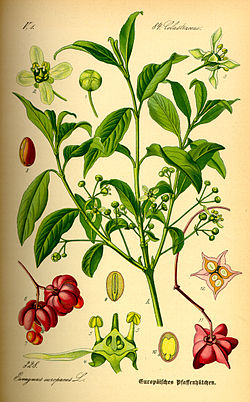
Euonymus europaea, family Celastraceae
Scientific classification Edit this classification
Kingdom: Plantae
Clade: Tracheophytes
Clade: Angiosperms
Clade: Eudicots
Clade: Rosids
Clade: Fabids
Order: Celastrales
Link[1]
Families

Celastraceae
Lepidobotryaceae

The Celastrales are an order of flowering plants found throughout the tropics and subtropics, with only a few species extending far into the temperate regions. The 1200[2] to 1350[3] species are in about 100 genera. All but seven of these genera are in the large family Celastraceae. Until recently, the composition of the order and its division into families varied greatly from one author to another.

Description

[edit]

The Celastrales are a diverse order that has no conspicuous distinguishing characteristic, so is consequently hard to recognize.[4] The flowers are usually small with a conspicuous nectary disk. The stipules are small or rarely absent. The micropyle has two openings and is therefore called a bistomal micropyle. Flowers with well-developed male and female parts are often functionally unisexual. The seed often has an aril. In bud, the sepals have a quincuncial arrangement. This means that two sepals are inside, two are outside, and the remaining sepal is half inside and half outside.

Relationships

[edit]

Perhaps the most conspicuous and unusual trait of the Celastrales is the nectary disk, a feature that it shares with another rosid order, Sapindales. Since the orders are not closely related, the disk must have been an independent development in each of these lines.

The Celastrales are a member of the Celastrales, Oxalidales (including Huaceae), and Malpighiales (COM) clade[5] of Fabidae, with Fabidae being one of the two groups of Eurosids.[6]

Circumscription

[edit]

The name Celastrales was first used by Thomas Baskerville in 1839.[7] In the time since Baskerville first defined the order, until the 21st century, great differences of opinion occurred about what should be included in the order and in its largest family, the Celastraceae. The family Celastraceae was the only group consistently placed in the order by all authors who accepted it. Because of the ambiguity and complexity of its definition, the Celastraceae became a dumping ground for genera of dubious affinity. Several genera were assigned to this family with considerable doubt about whether they really belonged there. Also, some genera that properly belong in the Celastraceae were placed elsewhere.

By the end of the 20th century, Goupia and Forsellesia had been excluded from the Celastraceae and also from the Celastrales. Goupia is now in the Malpighiales.[8] Forsellesia is now in the Crossosomatales.[9] It continues to be the subject of a dispute about whether its proper name is Forsellesia or Glossopetalon.[10]

After being placed elsewhere, Canotia, Brexia, and Plagiopteron were found to belong in the Celastraceae. The family Hippocrateaceae was found to be deeply nested within the Celastraceae and is no longer recognized as a separate family.

In 2000, Vincent Savolainen et alii found that three families - Lepidobotryaceae, Parnassiaceae, and Celastraceae - were closely related.[11] They stated that these three families should constitute the order Celastrales, and this idea was accepted by the Angiosperm Phylogeny Group, which later subsumed the Parnassiaceae into the Celastraceae. Savolainen and co-authors also excluded Lophopyxis from the Celastrales. Lophopyxis now constitutes a monogeneric family in the Malpighiales.[8]

In 2001, in a molecular phylogenetic study of DNA sequences, Mark Simmons and others confirmed all of these results except for the placement of Lophopyxis and the Lepidobotryaceae, which they did not sample.[12]

In 2006, Li-Bing Zhang and Mark Simmons produced a phylogeny of the Celastrales based on nuclear ribosomal, and chloroplast DNA.[13] Their results showed that Bhesa and Perrottetia were misplaced in the Celastraceae. Bhesa is now in the Centroplacaceae, a family in the Malpighiales.[8] and Perrottetia is in the Huerteales.[14] Zhang and Simmons found Pottingeria and Mortonia to be closely related to the families Parnassiaceae and Celastraceae, as they were then defined, but not in either of them. These two genera are therefore in the Celastrales. They found that Siphonodon and Empleuridium are proper members of the Celastraceae, removing considerable doubt about their placement there. They also showed that the small family Stackhousiaceae, consisting of three genera, is embedded in the Celastraceae. Except for taxa that were not sampled, these results were confirmed by the second phylogeny of the Celastrales, which was produced by Mark Simmons and several co-authors in 2008.[15]

Nicobariodendron sleumeri, the only member of its genus, continues to be an enigma. It is a small tree from the Andaman and Nicobar Islands of India. Little is known of it and it has never been sampled for DNA. It is generally thought to belong in the Celastrales,[3] but this is not a certainty. It is one of the five taxa placed incertae sedis in the angiosperms in the APG III system of classification.[1]

Families

[edit]

The Celastrales have been divided into families in various ways. In their APG II classification in 2003, the Angiosperm Phylogeny Group recognized three families in the Celastrales – Lepidobotryaceae, Parnassiaceae, and Celastraceae. When they revised their classification in 2009, they recognized only two families because Pottingeria and the two genera of Parnassiaceae were transferred to the Celastraceae. Nicobariodendron became one of the five taxa placed incertae sedis in the angiosperms.

In the 2006 phylogeny, Nicobariodendron was not sampled, but those species that were sampled fell into two strongly supported clades. One was a small clade consisting only of the family Lepidobotryaceae. Its sister was a very large clade containing the rest of the order. The large clade consisted of five strongly supported groups. These are the family Parnassiaceae, the genus Pottingeria, the genus Mortonia (in the Celastraceae), and a pair of genera from the Celastraceae (Quetzalia and Zinowiewia), and the rest of the Celastraceae. No relationships were resolved among these groups.

In 2008, Simmons and others produced a phylogeny of the Celastrales that achieved better resolution than the 2006 study by sampling more species and more DNA. They found the same pentatomy of five strongly supported groups that the previous study had found, but only weak to moderate support for any relationships between the five groups.[15] In the APG III system, the family Celastraceae was expanded to consist of these five groups. No one has yet published an intrafamilial classification for the expanded Celastraceae.[1]

Phylogeny

[edit]

The following phylogenetic tree was made by combining parts of three different trees.[12][13][15] Bootstrap support is 100% except where shown. Branches with less than 50% bootstrap support are collapsed. The clade numbers are from Simmons et al. (2008).[15]

Celastrales

References

[edit]
[edit]
Revisions and contributorsEdit on WikipediaRead on Wikipedia
from Grokipedia
Celastrales is an order of flowering plants in the clade of , recognized under the as consisting of two families—Celastraceae (the staff-vine or bittersweet family) and Lepidobotryaceae—encompassing approximately 100 genera and 1,350 species worldwide. These plants are predominantly shrubs, small trees, and woody vines (lianas), with simple, alternate or opposite leaves often bearing small caducous stipules, and exhibit a but achieve greatest diversity in tropical and subtropical regions, with limited extension into temperate areas. The order's floral characteristics include small, usually bisexual and actinomorphic flowers arranged in cymose inflorescences, featuring a quincuncial calyx of 4–5 sepals, a corolla of 4–5 petals (rarely absent), 4–5 stamens alternating with the petals, and a superior to half-inferior with 2–5 locules, often surrounded by an annular nectary disk. Fruits are typically capsules, berries, drupes, or samaras containing 1–2 seeds per locule, with arillate seeds in many taxa. Vessel elements in the wood have simple perforation plates, a trait shared with other . Celastraceae, the dominant family with over 1,300 across about 100 genera, includes ecologically significant groups such as lianas that play key roles in canopies, while Lepidobotryaceae is a small family limited to two genera and 2–3 of trees endemic to African rainforests. Notable genera in Celastraceae include (spindle trees, ~170 , valued for ornamental berries and wood), (bittersweets, ~30 , known for habits and invasive potential in some regions), and Maytenus (over 200 , with medicinal uses in traditional systems). Recent phylogenetic studies, integrating genomic, morphological, and sequence data, have refined the order's classification into 13 subfamilies within Celastraceae, highlighting evolutionary patterns like multiple origins of habits and biogeographic dispersals from centers like . Phylogenetically, Celastrales belongs to the COM clade (Celastrales-Oxalidales-Malpighiales) within fabids, with divergence estimates placing its origin around 75–100 million years ago during the . Some incongruences between and nuclear data suggest potential deeper ties to malvids, but current consensus supports its rosid I placement. The order's diversity reflects adaptations to varied habitats, from rainforests to dry woodlands, with many species contributing to biodiversity hotspots and human uses in , timber, and .

Overview

Description

Celastrales is an order of placed within the of angiosperms, encompassing two families, approximately 100 genera, and an estimated 1,200–1,350 species. The group exhibits considerable morphological diversity but is characterized by a predominance of woody habits, including trees, shrubs, and lianas, with a few herbaceous representatives. These are primarily distributed across tropical and subtropical regions worldwide, though some extend into temperate zones, reflecting adaptations to warm, humid environments. Vegetatively, Celastrales species typically feature simple leaves arranged oppositely or suboppositely along the stems, with pinnate or palmate venation and margins that are entire, serrate, or dentate; stipules are usually small, caducous, or absent. Many taxa display translucent dots or lines on the leaf lamina, resulting from internal secretory structures such as glands or canals that produce resins or other compounds. These secretory features contribute to the plants' chemical defenses and ecological interactions. Reproductively, the order is defined by small, inconspicuous flowers that are bisexual or unisexual, actinomorphic or slightly zygomorphic, with (3–)4–5(–7) sepals and petals in a quincuncial aestivation; a conspicuous nectar disk is often present, upon which 3–5(–10) stamens are inserted. The superior ovary is typically 1–5-locular, bearing 1–many anatropous ovules per locule, and develops into diverse fruits such as loculicidal capsules, drupes, berries, or schizocarps; seeds are commonly arillate, winged, or equipped with a fleshy appendage for dispersal. Distinctive traits of Celastrales include the bistomal micropyle of the ovules, a rare configuration with two openings formed by the integuments, and the production of secondary metabolites such as monoamine alkaloids (e.g., and ) and triterpenoids, which are widespread particularly in the core family Celastraceae. These chemical compounds often serve ecological roles in deterrence and attraction.

Distribution and Habitat

The order Celastrales exhibits a predominantly tropical and subtropical distribution worldwide, encompassing approximately 1,300 species across its families, with the vast majority occurring in these warm climates. Highest species diversity is concentrated in the Neotropics, particularly Amazonia, where numerous genera such as Cheiloclinium and Tontelea thrive, alongside significant richness in tropical and , home to endemic lineages like Mysteria and Brexia. Southeast and also harbor substantial diversity, including climbing species in the genus , while extensions into temperate zones are limited to a few genera, such as , which reaches and . Species of Celastrales occupy diverse habitats, ranging from humid rainforests and montane cloud forests to seasonally dry forests, savannas, and shrublands, often in well-drained soils. Many taxa, especially in the family Celastraceae, grow as lianas climbing into the forest canopy or as shrubs, facilitating access to light in dense vegetation; for instance, genera like and Hippocratea are common in tropical vine thickets and lowland forests of and the Neotropics. In more open environments, such as African savannas or Australian sclerophyll woodlands, they appear as small trees or erect shrubs adapted to periodic disturbance. Adaptations to environmental variability are evident in leaf morphology and growth strategies, with some Celastraceae developing sclerophyllous leaves that enhance in arid or seasonal habitats, such as Mediterranean-like shrublands or dry tropical forests. These thick, leathery leaves reduce and withstand water stress, as seen in Australian endemics like Denhamia in semi-arid woodlands. is pronounced in hotspots, with over 50% of Malagasy Celastraceae unique to the island's rainforests and spiny thickets, and similarly high levels in Amazonian understories, reflecting long-term isolation and speciation.

Classification History

Early Classifications

The concept of Celastrales as a distinct taxonomic order emerged in the mid-19th century within natural classification systems that emphasized correlated morphological characters across plant groups. In the influential system of and , outlined in their multi-volume Genera Plantarum (1862–1883), Celastrales was recognized as an order under the subclass Thalamiflorae, with the core tribe Celastrineae incorporating the family Celastraceae along with related families such as Stackhousiaceae and Hippocrateaceae, based on shared features like simple leaves, regular flowers, and a perigynous disk. This arrangement highlighted the unity of these groups through their woody habits and structures, though was sometimes allied nearby due to similar . By the late 19th century, Adolf Engler and Karl Anton Eugen Prantl refined this framework in Die Natürlichen Pflanzenfamilien (1887–1915), positioning the families Celastraceae and Hippocrateaceae within the order Sapindales in the subclass Archichlamydeae, adjacent to Rhamnales, with emphasis on floral similarities such as the antepetalous stamen insertion and the presence of a nectariferous disk in both orders. Engler and Prantl treated Celastraceae and Hippocrateaceae as distinct but closely related families within Sapindales, with Hippocrateaceae distinguished by fewer stamens than sepals and their insertion within the disk, while excluding Stackhousiaceae to Sapindales; this separation underscored debates on whether such stamen-disk relations warranted familial rank. Their phylogenetic approach aimed to reflect evolutionary progression from apetalous to more advanced forms, with Sapindales viewed as intermediate between simpler polypetalous orders. Into the 20th century, Armen Takhtajan expanded the circumscription of Celastrales in his system, as detailed in Sistema i filogeniia tsvetkovykh rastenii, incorporating a broader array of families alongside Celastraceae and Hippocrateaceae, such as Stackhousiaceae, justified by embryological and palynological of shared primitive traits like tenuinucellate ovules and tricolpate . Takhtajan's synthetic approach integrated records and , placing Celastrales within the subclass Rosidae and emphasizing its role as a transitional order between more basal dicots and advanced rosid groups. Throughout the 19th and early 20th centuries, significant debates centered on family boundaries within Celastrales, particularly the status of Hippocrateaceae, which some botanists like Nicolaas Hallé (1962) maintained as separate due to its lianescent habits, opposite leaves, and reduced androecium, while others, following Bentham and Hooker, subsumed it under Celastraceae for consistency in gynoecial structure and seed coat anatomy. These discussions often hinged on wood anatomy and types, with Engler and Prantl's partial separation influencing subsequent systems until mid-century revisions favored broader alliances based on comparative morphology.

Modern Systems

In Arthur Cronquist's 1981 classification system, the order Celastrales was retained within the subclass Rosidae, encompassing a diverse array of families such as Celastraceae, Hippocrateaceae, Icacinaceae, Stackhousiaceae, and Aquifoliaceae, though subsequent molecular analyses revealed this circumscription to be polyphyletic due to convergent morphological traits like perigynous flowers and imbricate petals. During the 1980s, Rolf Dahlgren's revised system positioned Celastrales within the superorder Violanae (part of the subclass Magnoliidae), including core families like Celastraceae (encompassing Hippocrateaceae) and others such as Stackhousiaceae and Lepidobotryaceae, emphasizing chemical and anatomical characters such as compounds and vessel elements. The (APG) classifications marked a shift toward , with APG I in 1998 establishing Celastrales as a monophyletic order within the eurosids I clade (now fabids), initially comprising Celastraceae s.l. (including Hippocrateaceae), Lepidobotryaceae, and Parnassiaceae based on analyses of genes like rbcL and 18S rDNA. APG II in 2003 maintained this structure with minor options for family delimitation but confirmed the order's placement in fabids through expanded multi-gene datasets. APG III in 2009 further refined Celastrales by reducing it to two families—Celastraceae (expanded to subsume Parnassiaceae and Stackhousiaceae) and Lepidobotryaceae—after rbcL, atpB, and morphological data demonstrated Parnassiaceae's nested position within Celastraceae, excluding polyphyletic elements like Goupia (now in ). APG IV in 2016 endorsed this two-family circumscription with no major alterations, incorporating additional nuclear and plastid markers to solidify internal relationships while noting ongoing uncertainties in the Celastrales-Oxalidales- clade.

Current Circumscription

Families

The order Celastrales is circumscribed in the to include two families: Celastraceae and Lepidobotryaceae. Celastraceae represents the dominant family within the order, comprising approximately 100 genera and 1,300 species of predominantly woody , ranging from shrubs and trees to lianas. This family incorporates the former Hippocrateaceae, expanding its scope to include taxa previously segregated. typically exhibit simple leaves arranged oppositely or suboppositely, small bisexual or unisexual flowers featuring a prominent intrastaminal disk, and fruits most commonly as loculicidal capsules enclosing arillate seeds. Representative genera include , encompassing spindle trees valued for their ornamental berries and bark, and Catha, which includes C. edulis (), a shrub harvested for its psychoactive leaves. Lepidobotryaceae is a minor family with just two genera—Lepidobotrys and Ruptiliocarpon—and 2–3 species, restricted to tropical regions of (L. staudtii) and Central/ (R. caracolito). These are dioecious trees characterized by alternate, simple leaves with articulated petioles, unisexual flowers in axillary inflorescences featuring five imbricate petals and sepals, and septicidally dehiscent capsules containing arillate seeds. Key distinctions between the families include (lianescent forms common in Celastraceae versus strictly arboreal in Lepidobotryaceae), leaf phyllotaxy (frequently in Celastraceae versus alternate in Lepidobotryaceae), and floral features such as the presence of a nectar disk in Celastraceae and imbricate (rather than valvate or quincuncial) petals in Lepidobotryaceae.

Subfamilies in Celastraceae

The classification of Celastraceae recognizes 13 subfamilies, established through an integrated of genomic , morphological traits, and Sanger-sequence characters, providing a more natural circumscription than previous systems. This framework, proposed by Simmons et al. (2023), incorporates five newly defined subfamilies—Crossopetaloideae, Maytenoideae, Microtropioideae, Monimopetaloideae, and Salaciopsioideae—reflecting phylogenetic relationships resolved across approximately 1,200 species in the family. These subfamilies collectively encompass around 100 genera, with distributions spanning tropical and temperate regions worldwide, emphasizing the family's diversity in woody shrubs, trees, and lianas. Among the core subfamilies, Celastroideae represents the largest group, containing approximately 30 genera such as and characterized by imbricate aestivation and variable fruit types, including capsules and berries, often with 5-petaled flowers typical of the family's central . Hippocrateoideae, comprising lianas and scandent shrubs in tropical regions, features genera like Hippocratea with pinnate venation and winged or capsular fruits adapted for dispersal in forest understories. The newly erected Maytenoideae focuses on shrubs, including Maytenus, distinguished by valvate aestivation and simple leaves with distinct venation patterns, highlighting biogeographic patterns in Gondwanan lineages. Recent recircumscriptions have prompted revisions in several genera to align with this phylogeny, notably Cassine, Gymnosporia, Elachyptera, Salacia, and Semialarium, which span multiple subfamilies and require further taxonomic adjustments based on shared morphological markers like fruit dehiscence and seed arils. New subfamilies such as Crossopetaloideae and Microtropioideae address previously polyphyletic groups, with Crossopetaloideae including small trees featuring unique crossed petal arrangements and Microtropioideae encompassing herbaceous or shrubby taxa with specialized leaf venation for arid adaptations. These changes underscore the role of integrative evidence in refining subfamily boundaries, where morphological traits like petal aestivation (e.g., valvate vs. imbricate) and fruit morphology (e.g., samaras vs. follicles) serve as key diagnostic features alongside genomic support.

Phylogeny

Position Within Angiosperms

Celastrales belongs to the rosid clade within the , specifically positioned in the fabids (previously known as eurosids I), according to the IV (APG IV) classification. This placement reflects robust molecular evidence integrating nuclear, mitochondrial, and data, though some incongruence exists between plastid-based phylogenies (favoring fabids) and nuclear/mitochondrial datasets (suggesting affinity to malvids). Within the fabids, Celastrales forms part of the COM clade alongside Oxalidales and , with Celastrales often resolved as sister to or the pair sister to Oxalidales. Phylogenetic support for this positioning derives from analyses of markers, including the trnL-F spacer, atpB, matK, and rbcL, which consistently recover Celastrales within the COM clade with high bootstrap support (e.g., 100% in parsimony and likelihood analyses). These markers highlight close relationships between Celastrales and , distinguishing them from Oxalidales while affirming the overall of the COM group within fabids. Fossil-calibrated molecular phylogenies estimate the crown age of Celastrales at approximately 88 Ma (; 95% HPD: 81–95 Ma), with the stem near 100 Ma. Key synapomorphies uniting Celastrales and supporting its COM affiliation include an intrastaminal disk, typically cupular or annular and positioned around the ovary base to attract pollinators. Shared features, such as tricolpate grains with perforate tecta and variable supratectal elements (e.g., echinae or verrucae), further characterize the order and distinguish it within the clade, though diversity in aperture number and tectum sculpture occurs across families.

Internal Relationships

The internal phylogeny of Celastrales reveals two primary clades, with Lepidobotryaceae positioned as the basal to an expanded Celastraceae that incorporates several formerly recognized families such as Hippocrateaceae, Stackhousiaceae, and Parnassiaceae. This structure is supported by analyses integrating morphological characters and DNA sequences, confirming the of Celastrales while excluding unrelated lineages. A 2023 phylogenomic study utilizing 353 nuclear loci resolved Celastraceae into 13 subfamilies with strong support (posterior probabilities >0.95), including Cassinoideae, Celastroideae, Cinnamometoideae, Crossopetaloideae, Hippocrateoideae, Lophopetaloidae, Maytenoideae, Microtropioideae, Monimopetaloidae, Parnassioideae, Salacioideae, Salaciopsioideae, and Tripterygioideae; these reflect evolutionary divergences driven by geographic isolation and ecological adaptations, such as the Platispermum group (with flattened seeds and tropical distributions) and Loeseneriella group (scandent shrubs in African and Asian forests). Earlier studies identified five major subclades encompassing these, though some relationships remain unresolved due to polytomies in genera like Maytenus and Gymnosporia, where rapid radiations limit resolution. Updates from broader sampling confirm this framework, with ongoing recircumscription needed for polyphyletic groups. Molecular evidence from markers such as matK and nuclear ITS sequences has been instrumental in delineating these relationships, demonstrating the of former families like Aquifoliaceae, which were once included in Celastrales but are now excluded as a distinct order based on their distant placement within . Despite these advances, polytomies persist in certain subclades, highlighting areas for future genomic investigation.

Morphology and Reproduction

Vegetative Characteristics

Plants in the order Celastrales exhibit diverse vegetative habits, predominantly as woody shrubs, trees, or lianas, with stems that are typically terete and branched. In the dominant Celastraceae, many species display lianescent growth forms adapted to climbing, where stems can reach considerable lengths and diameters through specialized vascular development. Anomalous is prevalent in the vines of Celastraceae, characterized by successive cambia producing interxylary and included islands, which facilitate rapid girth expansion and mechanical support in climbing habits. Leaves in Celastrales are generally simple, with minute, caducous stipules (rarely absent). They are arranged oppositely or suboppositely (decussate) in most Celastraceae, often with two-ranked orientation along the stem. Secretory canals, lined by epithelial cells, traverse and mesophyll, appearing as glandular dots or streaks visible under ; these structures contain resins, alkaloids, or other secondary metabolites that contribute to . Root systems in Celastrales vary by habit: trees typically develop deep systems for anchorage in stable soils, while shrubs and lianas often form more fibrous, shallow networks suited to resource exploitation in or environments. Mycorrhizal associations, particularly arbuscular mycorrhizae, are common across the order, enhancing nutrient uptake in nutrient-poor tropical soils where many occur. Vegetative variations include alternate leaf arrangement in the family Lepidobotryaceae, where leaves are spirally placed but distichously oriented in two ranks along the branch. Heterophylly is observed in some Celastraceae lianas, such as species, with juvenile leaves differing in size, shape, or margin from mature ones, reflecting ontogenetic adaptations to shaded or exposed conditions.

Reproductive Features

Flowers in Celastrales are typically small and hypogynous, featuring a superior with 2-5 locules and a conspicuous nectar disk positioned below or around the stamens, which serves to attract pollinators. Petals exhibit imbricate or valvate , often enveloping the bud in early development, and are generally four- or five-merous, contributing to the order's subtle floral display. In some species, such as those in dioecious genera like , flowers are unisexual, with stamens and carpels in separate individuals, promoting . Pollination in Celastrales is primarily mediated by insects, including bees (Hymenoptera) and flies, facilitated by the nectar disk and floral scents, though wind pollination occurs in certain taxa. Fungus gnats serve as pollinators in some Euonymus species, reflecting specialized insect interactions within the order. Protandry and herkogamy, involving sequential stamen movement and spatial separation of sexual organs, further enhance cross-pollination efficiency in bisexual flowers. Fruits in Celastrales vary from dehiscent capsules that split septicidally or loculicidally to indehiscent berry-like drupes or schizocarps, often with distinct endocarp layers aiding in seed protection and release. are typically medium to large, featuring an that attracts avian or myrmecochorous dispersers such as birds or , with some taxa exhibiting wings for additional wind dispersal. The , often colorful and fleshy, envelops the seed coat, promoting endozoochory in genera like Maytenus and . Embryological features in Celastrales include bitegmic, anatropous or apotropous ovules that are weakly crassinucellate or incompletely tenuinucellate, with a bistomal micropyle formed by both integuments, distinguishing the order from related rosid clades. The nucellus is small with early tissue disintegration, and development is nuclear, leading to copious or absent in mature seeds accompanied by a straight and large cotyledons. These traits, observed across families like Celastraceae and Lepidobotryaceae, support the of Celastrales.

Ecology and Significance

Ecological Roles

Many species in the Celastrales order, particularly lianas within the Celastraceae family, serve as keystone elements in ecosystems by providing structural and connectivity across canopy layers, which supports arboreal and enhances overall complexity. These climbing vines, such as those in genera like and Hippocratea, create bridges between trees, facilitating animal movement and contributing to the three-dimensional architecture that sustains in these environments. Additionally, Celastrales species play a vital role in networks, where fleshy arils surrounding seeds attract avian and mammalian frugivores, promoting long-distance dissemination and regeneration. Chemical defenses are prominent in Celastrales, with alkaloids produced by various Celastraceae species acting as potent deterrents against herbivory by disrupting insect feeding and digestion. For instance, alkaloids in seeds exhibit strong properties, reducing damage from generalist herbivores and thereby enhancing plant survival in herbivore-rich habitats. Some Celastrales taxa also function as in disturbed areas, rapidly colonizing gaps created by or natural events due to their tolerance for high and instability, which aids in early succession and habitat recovery. Celastrales exhibit high levels of in global biodiversity hotspots, such as and parts of , where they contribute significantly to regional plant diversity and ecosystem uniqueness. However, poses a major threat through habitat loss and fragmentation, with some species classified as vulnerable or endangered on the as of 2024. However, only a limited number of species have been formally assessed, with many remaining , underscoring the need for further . Symbiotic interactions further bolster their ecological integration; for example, associations with via extrafloral nectaries provide indirect defense against herbivores, while arbuscular mycorrhizal fungi enhance nutrient uptake, particularly , in nutrient-poor tropical soils.

Economic and Medicinal Importance

Plants in the order Celastrales have several economic applications, primarily through species in the family Celastraceae. The genus Euonymus is widely cultivated as ornamental shrubs and small trees for landscaping due to their attractive foliage, vibrant fall colors, and compact growth habits, contributing to the horticultural trade in temperate regions. Catha edulis, known as khat, serves as a significant cash crop in East Africa, particularly in Ethiopia and Kenya, where its cultivation provides substantial income for farmers, accounting for up to 70% of household earnings in some areas through domestic and export markets. Certain tree species, such as Maytenus emarginata and Maytenus obtusifolia, yield durable timber used for construction, furniture, and fuelwood in regions like India and tropical Africa. Medicinally, Celastrales species are valued for their bioactive compounds, especially alkaloids. Extracts from species, such as and Celastrus paniculatus, contain sesquiterpene alkaloids with demonstrated anti-cancer properties, including inhibition of tumor in liver, gastric, and breast cancers through mechanisms like induction. In traditional medicine, Salacia species like Salacia reticulata and Salacia chinensis are used for anti-inflammatory treatments, addressing conditions such as , , and skin disorders, supported by their bioactive constituents that modulate inflammatory pathways. Additional uses include fibers from lianas; for instance, stems of Hippocratea volubilis provide resistant binding materials in Neotropical regions. However, some species pose challenges as invasives; Celastrus orbiculatus has become a problematic in , outcompeting native vegetation and disrupting ecosystems after its introduction from . Conservation concerns arise from of medicinal , leading to population declines. Maytenus senegalensis in eastern Africa faces threats from unsustainable harvesting for traditional remedies, while Celastrus paniculatus in is endangered due to excessive collection for its therapeutic seeds, highlighting the need for to prevent further rarity.

References

Add your contribution
Related Hubs
User Avatar
No comments yet.