


Community hub
Recent from talks
Contribute something
Nothing was collected or created yet.
Teeth-cleaning twig
View on Wikipedia

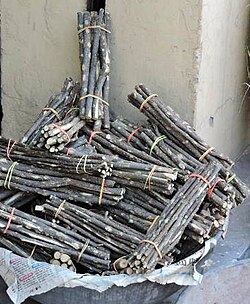
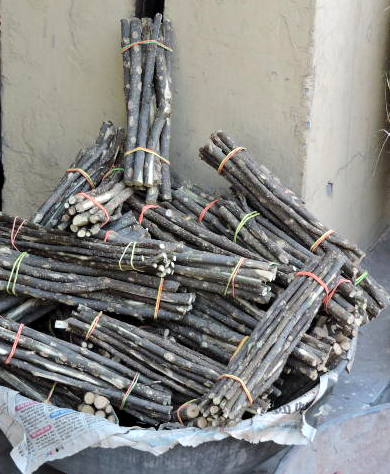
A teeth-cleaning twig (in Hindi: datwoon[1]) is an oral hygiene tool made from a twig from a tree. It can help to prevent tooth decay and gum disease.

Denominations
[edit]Tooth sticks often take the same name as the trees or plants from which they come.
History
[edit]The oral hygiene practice using herbal sticks exists in many parts of the world since ancient time: ancient India, ancient Greece (mentioned by Alciphron), ancient Rome, ancient Israel (mentioned in Talmud), Eastern Asia (mentioned in the Gospel of Buddhism)[2], etc.
Chew sticks are twigs or roots of certain plants that are chewed until one end is frayed. This end can be used to brush against the teeth,[3] while the other end can be used as a toothpick.[4] The earliest chew sticks have been dated to Babylonia in 3500 BCE[4] and an Egyptian tomb from 3000 BCE;[3] they are mentioned in Chinese records dating from 1600 BCE[4] In the Ayurvedas around 4th century BCE and in Tipitaka, in the Buddhist Canon around the 5th century BCE in India.[5][6]
The Indian way of using tooth wood for brushing is presented by the Chinese monk Yijing (635–713 CE) when he describes the rules for monks in his book:[7]
Every day in the morning, a monk must chew a piece of tooth wood to brush his teeth and scrape his tongue, and this must be done in the proper way. Only after one has washed one's hands and mouth may one make salutations. Otherwise both the saluter and the saluted are at fault. In Sanskrit, the tooth wood is known as the dantakastha—danta meaning tooth, and kastha, a piece of wood. It is twelve finger-widths in length. The shortest is not less than eight finger-widths long, resembling the little finger in size. Chew one end of the wood well for a long while and then brush the teeth with it.
A wide variety of plants can be used as dantakastha.[8]
In Africa, many kinds of sticks exist and many plants and trees are used to produce them by various peoples, ethnicities and tribes.[9] African chew sticks are often made from the tree Salvadora persica, also known as the "toothbrush tree".
In Islam, this tree is traditionally used to create a chew stick called miswak, as frequently advocated for in the hadith (written traditions relating to the life of Muhammad).[10]
In South India, neem is used as a teeth cleaning twig. Neem, in full bloom, can aid in healing by keeping the area clean and disinfected. There is an old Tamil proverb praising the twig, comparing it with the moral works of Naladiyar and the Kural, which says that both of the works are very good in expressing human thoughts just as the twigs of the banyan and the neem trees are good in maintaining the teeth.
- ஆலும் வேலும் பல்லுக்குறுதி; நாலும் இரண்டும் சொல்லுக்குறுதி.
- (Aalum vaelum pallukkuruthi; naalum irandum sollukkuruthi)
- Literal translation: "Banyan and neem maintain oral health; Four and Two maintain moral health."
- (Here "Four" and "Two" refer to the quatrains and couplets of the Naladiyar and the Kural text, respectively.)
Traditional Sikhs still use datun today as it is written in their scriptures:
ਦਾਤਨ ਕਰੇ ਨਿਤ ਨੀਤ ਨਾ ਦੁਖ ਪਾਵੈ ਲਾਲ ਜੀ ॥ (੨੩)
Dear/beloved, natural twig, brush everyday, and pains you shall never get. (23)
Twigs used
[edit]_flowers_at_Hodal_W_IMG_1163.jpg)
_in_Hyderabad_W_IMG_6976.jpg)
Teeth-cleaning twigs can be obtained from a variety of tree species. Although many trees are used in the production of teeth-cleaning twigs, some trees are better suited to clean and protect the teeth, due to the chemical composition of the plant parts. The tree species are:[12][13][14][15][16][17]
- Salvadora persica
- Sassafras
- Gumtree[18]
- Lime tree (Citrusaurantafolia)[19]
- Garcinia mannii in West Africa[20]
- Orange tree (Citrus × sinensis)[19]
- African laburnum (Cassia sieberiana)[19]
- Tea tree
- Neem in the Indian subcontinent
- Vachellia nilotica, also called babool or kikar in the Indian subcontinent
- Dalbergia sissoo, also called sheesham in the Indian subcontinent
- Liquorice
- Gouania lupuloides
- Cinnamon
- Dogwood
- Olive
- Walnut
- Acacia catechu
- Acacia nilotica
- and other trees with bitter roots.
Europe and North America
Australia
India
- Apamarga
- Arjun
- Bael
- Bargad
- Ber
- Dhak
- Gular
- Jamun
- Kamer
- Karanj
- Madar ak
- Mango
- Mulhatti
- Neem
- Peepal
- Safed babul or Acacia
- Tejovati
- Vijayasar
Carrying
[edit]Many companies produce special cases for carrying, storing and protecting chew sticks, known popularly as "miswak holders".
Attributes
[edit]When compared to toothbrushes, teeth-cleaning twigs have several differentiations such as:
- More ecological in its life-cycle.
- Dependence from external supplier, if lack of access to the respective trees.
- Some twigs need moistening with water if they become dry, to ensure the end is soft. The end may be cut afresh to ensure hygiene, and should not be stored near a sink. The twig is replaced every few weeks to maintain proper hygiene.
- Lower cost (0–16% of the cost of a toothbrush).
- Not standardized hardness. Careful selection of the right hardness is required before use.
- Use without toothpaste. Thus indefinite fluoride consumption.
- Cleaning teeth all day long, instead of twice a day for a few minutes.[18]
See also
[edit]- Ayurveda
- Babool (brand) of tooth paste in India, made from babool tree
- Miswak
References
[edit]- ^ Winer, Lise (2009). Dictionary of the English/Creole of Trinidad & Tobago. McGill-Queen's. p. 285. ISBN 978-0-7735-7607-0.
[Bhojpuri] datwan, dantwan, [Hindi] datwoon 'toothbrush; twig for cleansing the teeth'
- ^ "A Review on the Pharmagnostic Evaluation of Meswak, Salvadora Persica | Bioscience Biotechnology Research Communications".
- ^ a b Panati, Charles (2013). Extraordinary Origins of Everyday Things. HarperCollins. pp. 208–209. ISBN 978-0-06-227708-4.
- ^ a b c Yu, Hai-Yang; Qian, Lin-Mao; Zheng, Jing (2013). Dental Biotribology. Springer. pp. 18–19. ISBN 978-1-4614-4550-0.
- ^ Dantakaṭṭha sutta (AN 5.208) Mahāsaṅgīti Tipiṭaka Buddhavasse 2500
- ^ Singh, Abhinav; Purohit, Bharathi (2011). "Tooth brushing, oil pulling and tissue regeneration: A review of holistic approaches to oral health". Journal of Ayurveda and Integrative Medicine. 2 (2): 64–68. doi:10.4103/0975-9476.82525. PMC 3131773. PMID 21760690.
- ^ Li, R., 2000. Buddhist Monastic Traditions of Southern Asia: A Record of the Inner Law Sent Home from the South Seas (p. 198). Numata Center for Buddhist Translation and Research.
- ^ Panuganti, Siva (2018). "Dantakasthas (Chewing Sticks) in Ayurveda: A Review". Advances in Complementary & Alternative Medicine. 2 (3). doi:10.31031/ACAM.2018.02.000536.
- ^ Roland Portères Journal d'agriculture traditionnelle et de botanique appliquée Année 1974 21-4-6 pp. 111-150, https://www.persee.fr/doc/jatba_0021-7662_1974_num_21_4_3157
- ^ "Search Results - miswak (page 1) - Sunnah.com - Sayings and Teachings of Prophet Muhammad (صلى الله عليه و سلم)". sunnah.com.
- ^ "Tankahnama". SearchGurbani.com. Gateway to Sikhism. Retrieved 30 September 2016.
- ^ "Neem tree as teeth cleaning twig". Batplants.co.uk. Archived from the original on 2011-01-13. Retrieved 2011-01-17.
- ^ "Natural twigs used as teeth cleaning twigs". Naturaltoothbrush.com. Archived from the original on 2011-02-07. Retrieved 2011-01-17.
- ^ "Neem tree as teeth cleaning twig 2". Neem-products.com. Retrieved 2011-01-17.
- ^ "Natural toothbrush twigs". Naturallygreen.co.uk. 2007-09-15. Archived from the original on 2011-10-08. Retrieved 2011-01-17.
- ^ "Natural toothbrush overview". Nzherald.co.nz. 2007-06-19. Retrieved 2011-01-17.
- ^ "Xuanzang (玄奘) <603 - 664>: Buddhist records of the Western world (大唐西域記), book VIII/IX". www.payer.de.
- ^ a b Fletcher, Pascal (19 June 2007). "African twig brushes offer all-day dental care". The New Zealand Herald. NZME. Retrieved 17 January 2011.
- ^ a b c Ra'ed I. Al Sadhan, Khalid Almas (1999). "Miswak (chewing Stick): A Cultural And Scientific Heritage". Saudi Dental Journal. 11 (2): 80–88.
- ^ Cheek (2004)
Teeth-cleaning twig
View on GrokipediaTerminology
Definition
A teeth-cleaning twig, also known as a chewing stick, is a natural oral hygiene tool derived from the twig, root, or stem of specific trees or shrubs, such as Salvadora persica, which is prepared by chewing or fraying one end to create soft, bristle-like fibers for brushing the teeth and gums. This traditional implement has been employed for millennia to maintain oral cleanliness through manual abrasion, predating the development of synthetic toothbrushes by thousands of years.[4][5] The primary function of a teeth-cleaning twig is to mechanically remove plaque and food debris from tooth surfaces, while also massaging the gums to promote circulation and freshening breath via the natural fibers and released plant juices, all without the need for additional toothpaste or powered devices. The frayed end acts as rudimentary bristles, allowing effective cleaning of interdental spaces and along the gumline through gentle rubbing motions.[5][6] Distinguished from modern toothbrushes by its fully biodegradable composition and inherent portability, the teeth-cleaning twig offers an eco-friendly, sustainable alternative for oral care, particularly in resource-limited settings where access to commercial products may be restricted.[4]Names and Denominations
The term "miswak" originates from Arabic, derived from the root "s-w-k" (sawak), which signifies rubbing or cleaning, reflecting its primary function as a tool for oral hygiene.[7] This etymology underscores the stick's role in equalizing and purifying the teeth and gums through friction. In broader linguistic contexts, "miswak" has been borrowed and adapted from pre-Islamic Persian "sevâk," referring to a cleaning twig from the arak tree, highlighting early cross-cultural exchanges in the region.[8] In Hindi and Sanskrit traditions, the equivalent term is "datun," stemming from Sanskrit roots related to "danta" (tooth) and "kastha" (wood), denoting a wooden twig used for dental care, often from neem or similar trees.[9] Regional variations further illustrate cultural adaptations: in Persian contexts, it is known as "arak," naming both the Salvadora persica tree and its derived twig, emphasizing the plant's integral role. In Malay and Indonesian languages, "siwak" serves as a phonetic variant of "miswak," commonly used in Muslim communities for the same purpose.[10] Additionally, "kayu sugi" in Malaysian (Malay) contexts refers to the miswak stick from Salvadora persica employed for teeth cleaning.[11][12] English synonyms for these twigs include "chewing stick," "natural toothbrush," and "herbal toothpick," which capture their functional essence without regional specificity.[13] These terms often emphasize the eco-friendly and rudimentary nature of the tool. The linguistic evolution of such denominations frequently mirrors religious and cultural significance; for instance, "miswak" is deeply embedded in Islamic tradition, where its use is recommended in hadiths for spiritual purity alongside physical cleanliness, elevating the term beyond mere utility to a symbol of piety.[14] This association has perpetuated the word's prominence in Muslim-majority regions, influencing its spread and standardization in global discourse on natural oral hygiene.History
Ancient Origins
The earliest evidence of teeth-cleaning twigs dates back approximately 5,500 years to ancient Mesopotamia around 3500 BCE, where natural twigs were used to maintain oral hygiene through mechanical abrasion.[15] In ancient Egypt, tombs dating to around 3000 BCE have yielded artifacts of frayed twigs, confirming their role in early oral care routines.[15] In Mesopotamia, particularly among the Babylonians, cuneiform records from circa 3500 BCE describe the use of chewing sticks as a standard method for oral cleanliness, emphasizing their frayed ends for effective scrubbing. Ancient Egyptian texts and artifacts further document these twigs as integral to daily hygiene, often combined with abrasive pastes to polish teeth and prevent decay. These practices highlight a widespread recognition in early urban civilizations of the need for regular dental maintenance using locally available natural materials.[10][16] Early Asian traditions are evidenced in Chinese historical texts from around 1600 BCE, which detail the use of aromatic twigs chewed to clean teeth and freshen breath, reflecting a cultural emphasis on holistic health. In sub-Saharan Africa, indigenous tribes employed local shrubs as teeth-cleaning tools, with archaeological and ethnographic evidence pointing to continuous use from ancient times for both hygiene and ritual purposes. These regional practices underscore the global antiquity of twig-based oral care, adapted to diverse environments and resources. In ancient Greece, similar twig-based methods were used alongside other rudimentary oral hygiene practices.[17][5][18] The religious dimensions of teeth-cleaning twigs emerged prominently in early Islam in the 7th century CE, where Hadith collections, such as those in Sahih Muslim, strongly recommend the miswak twig for oral hygiene before prayers, attributing spiritual and physical benefits to its use. These foundations elevated the twig from a utilitarian tool to a symbol of piety and health in religious contexts.[19]Global Spread and Adoption
The dissemination of teeth-cleaning twigs, particularly the miswak derived from Salvadora persica, accelerated during the Islamic Golden Age (8th–13th centuries) as Arab traders and conquerors expanded Islamic cultural practices across continents. Following the initial Arab conquests in North Africa during the 7th–8th centuries under the Umayyad Caliphate, the habit of using miswak for oral hygiene became embedded in local customs, spreading through trade networks that connected the Mediterranean to sub-Saharan regions. Arab merchants, establishing settlements in Gujarat and southern India by the 8th century, introduced miswak alongside other Islamic traditions, integrating it into daily routines among Muslim communities. Similarly, in Southeast Asia, peaceful trade along maritime silk routes from the 9th century onward facilitated its adoption in Indonesia, Malaysia, and the Philippines, where it aligned with emerging Islamic influences among coastal populations.[20][21][22] The Ottoman Empire (14th–early 20th centuries) played a pivotal role in standardizing miswak use across its vast territories, enforcing Islamic hygiene norms that emphasized its application before prayers and in public life. As the empire controlled key trade hubs in the Middle East, North Africa, and the Balkans, miswak production and distribution were regulated through guilds and religious edicts, ensuring consistent quality and availability in urban centers like Istanbul and Cairo. This institutionalization reinforced its status as a sunnah (recommended practice) in Ottoman-influenced regions, bridging pre-modern traditions with broader cultural dissemination. Colonial eras further propelled the global adoption of teeth-cleaning twigs through migration and cultural exchange. In the Americas, European settlers during the 18th–19th centuries adopted twig-based methods from Native American practices, employing dogwood (Cornus florida) twigs—chewed to form a frayed brush—for oral cleaning in frontier settlements where commercial toothbrushes were scarce.[23][24] Into the 19th and 20th centuries, teeth-cleaning twigs endured in rural Middle East, African, and South Asian communities despite the widespread introduction of mass-produced Western toothbrushes in the late 1800s, prized for their low cost and natural availability. The World Health Organization endorsed chewing sticks like miswak in 1987 as effective, economical tools for oral health in developing countries, spurring targeted promotions in resource-limited areas. This support fueled post-colonial revivals in African nations such as Sudan, Kenya, and Nigeria, where national health campaigns integrated traditional miswak use with modern dentistry to enhance accessibility post-independence.[25][26][27]Botanical Sources
Salvadora persica
Salvadora persica, a member of the Salvadoraceae family, is a small evergreen shrub or tree characterized by a crooked trunk and scabrous, cracked bark. It typically reaches heights of 3 to 6 meters, with soft whitish-yellow wood and smooth green leaves that are sometimes consumed as salad. Native to arid and semi-arid regions spanning the Middle East, North Africa, East Africa, and South Asia, the plant is particularly abundant in areas like the Arabian Peninsula, Pakistan, and India.[28][29][30] The species thrives in challenging environments, including saline, alkaline, and loamy soils, often forming up to 10% of vegetation in desert habitats. It demonstrates high salt tolerance, enabling growth in coastal and inland saline areas up to 1,800 meters in altitude. Propagation occurs primarily through seeds or cuttings, supporting its cultivation in key regions such as Saudi Arabia, Pakistan, and Sudan, where it aids in soil reclamation and ecosystem stabilization.[31] Twigs for teeth-cleaning, known as miswak, are harvested from the plant's roots or branches and cut to lengths of approximately 15-20 cm. These twigs feature natural resins and fibrous structures that facilitate fraying at one end for effective use. As the primary botanical source for miswak, Salvadora persica supports traditional oral hygiene practices across its native range.[32][10][5] Commercial farming of Salvadora persica is established in countries including Iran and Yemen, where it contributes to local economies through the harvest of twigs and seeds for various applications. Mature trees can yield significant biomass, with 10-year-old plants producing around 10 kg of seeds annually and 20-year-old ones up to 35 kg, underscoring its potential for sustainable production in marginal lands.[33][29]Other Plants Used
In various regions worldwide, alternative plants to Salvadora persica serve as sources for teeth-cleaning twigs, selected primarily based on local availability and traditional practices in non-arid climates.[32] In South Asia, particularly India, neem (Azadirachta indica) twigs are widely used for their reputed antibacterial qualities in rural oral hygiene routines.[34] Mango (Mangifera indica) twigs are also commonly chewed in rural and semi-urban areas as a natural teeth-cleaning tool.[35] Cashew tree twigs find similar application in some rural South Asian communities where fruit trees are abundant substitutes.[36] Across East Africa, Rhus vulgaris and Lantana trifolia are prevalent choices for chewing sticks among local populations, reflecting adaptations to regional flora.[37] In Mediterranean North Africa, olive (Olea europaea) and walnut (Juglans regia) twigs provide viable alternatives, valued for their suitability in producing frayed bristles for cleaning.[25] In North America, dogwood (Cornus florida) twigs were employed by Appalachian pioneers and early settlers as pounded or chewed brushes for daily oral care.[38] Native American groups, including the Ojibwa, utilized birch (Betula spp.) twigs for their aromatic properties in teeth cleaning.[39] Willow (Salix spp.) twigs similarly served indigenous communities for gum maintenance through chewing.[40] Elsewhere, coconut palm (Cocos nucifera) roots and young twigs are used in Pacific Island traditions as accessible oral hygiene aids in tropical environments.[41] Sassafras (Sassafras albidum) roots and twigs were chewed in early U.S. settlements for their cleansing effects, often due to widespread availability in forested areas.[42] These substitutions highlight how cultural preferences favor locally abundant species over the dominant Salvadora persica in arid regions.[43]Preparation and Use
Preparation Methods
Teeth-cleaning twigs, commonly known as miswak when derived from Salvadora persica, are prepared by selecting fresh, straight branches or roots from healthy plants to ensure efficacy and safety. Guidelines recommend choosing twigs approximately 15-20 cm in length and 1-1.5 cm in diameter for optimal handling and durability, avoiding any diseased or damaged sections that could introduce contaminants.[44][45] The twig is then cut cleanly from the plant, preferably using a sharp tool like a knife for a precise end, to minimize fiber damage and facilitate subsequent fraying.[5] After harvesting, the twig undergoes a basic cleaning process to remove surface debris. It is rinsed thoroughly under running water to eliminate dirt, sand, or residues, ensuring hygiene before use.[44] For twigs that have dried during transport or storage, an optional soaking in fresh water for up to 24 hours softens the fibers and revives the natural properties, though prolonged immersion should be avoided to prevent loss of active compounds.[44] In some traditional practices, sun-drying the cleaned twig briefly aids preservation without affecting usability, but fresh preparation is preferred for maximum benefits.[25] The fraying technique transforms the cut end into a functional brush head. The bark is first peeled or trimmed away from one end, exposing the inner wood, which is then gently chewed or lightly beaten to separate the fibers into a soft, bristle-like structure about 1 cm long.[5][45] This process creates a natural brush capable of cleaning teeth and gums; the frayed end should be replaced by trimming it off every 1-2 days or when it becomes compacted, allowing the twig to last several weeks with repeated renewal.[44] Variations in preparation exist based on plant parts and cultural practices. Roots are often favored for their spongy texture, which frays more easily upon chewing, while branches or stems from Salvadora persica provide firmer fibers suitable for prolonged use.[44] In certain traditions, a knife is employed for precise tapering of the end instead of chewing, particularly for individuals preferring a non-oral initial preparation method.[5]Usage Techniques
To use a teeth-cleaning twig, such as the miswak derived from Salvadora persica, the frayed end is held with a three- or five-finger grip, similar to a pen, and positioned perpendicular to the teeth for cleaning.[46] Practitioners apply gentle up-and-down or rolling motions along the buccal, lingual, and occlusal surfaces of the teeth, directing the strokes away from the gingival margins to avoid irritation while focusing on all tooth surfaces, gums, and occasionally the tongue for comprehensive oral cleansing.[46][47] This brushing routine typically lasts 2-5 minutes to ensure effective plaque removal.[48] Recommendations for frequency vary by cultural and practical context, with habitual use suggested 3-5 times daily, particularly after meals to maintain oral hygiene; in Islamic traditions, it is often employed five times a day as part of ablutions before prayers.[49][50] Following the brushing session, users commonly rinse their mouth with water or infusions made from miswak extracts or other herbal solutions to clear debris and enhance cleansing.[51] An additional practice involves combining the twig's use with gentle finger massage on the gums to promote circulation and further stimulate oral tissues.[52] Adaptations for specific users include providing supervision and instruction for children, who may learn the technique from parents using shorter, softer-frayed twigs to ease handling.[47] For the elderly or those with dexterity challenges, modern variants such as miswak-integrated toothbrushes with ergonomic holders facilitate easier grip and motion without altering the core fraying process.[53]Carrying and Maintenance
Teeth-cleaning twigs, particularly miswak derived from Salvadora persica, are inherently portable due to their slender, pencil-like dimensions—typically 15–20 cm in length and 1-1.5 cm in diameter—making them suitable for travelers and daily carry in pockets, purses, or protective cases.[25] This compactness facilitates easy access without the bulk of conventional toothbrushes, supporting on-the-go oral hygiene in various settings.[54] Proper storage is essential to preserve the twig's efficacy and prevent degradation; regularly used miswak should be kept in a plastic travel case to shield it from dust and contaminants, while bulk purchases are best wrapped in aluminum foil and stored in the freezer to extend freshness.[25] Maintaining a dry, cool environment during storage helps sustain the natural fibers and antimicrobial properties, with users often rotating multiple twigs to ensure ongoing hygiene.[55] Maintenance routines involve periodic trimming of frayed ends—cutting about 0.5 inches and peeling the bark to reveal fresh bristles—whenever the flavor intensity wanes or the tip becomes worn, typically allowing a single twig to remain usable for several weeks with proper care.[25] Twigs are biodegradable and should be discarded once they no longer produce effective bristles or show signs of ineffectiveness, promoting sustainable use. In traditional Middle Eastern practices, wooden holders crafted from local materials serve as cultural accessories for secure carrying and protection during market travel or daily routines.[56]Properties and Benefits
Mechanical Properties
The teeth-cleaning twig, commonly derived from Salvadora persica (miswak), exhibits a distinctive fiber structure that facilitates effective mechanical cleaning. When the end of the twig is chewed or frayed, it forms a brush-like array of natural bristles composed primarily of plant cellulose, creating a spongy texture embedded with irregular-shaped crystals.[57] This structure allows the fibers to splay outward along the twig's long axis, providing flexibility that enables better access to tooth crevices, interdental spaces, and gingival margins compared to the rigid nylon filaments in synthetic toothbrushes.[58] The abrasiveness of the twig arises from its fibrous end and embedded crystalline elements, which exert a mild polishing action on tooth surfaces to remove stains and plaque without causing significant enamel erosion. Scanning electron microscopy studies have demonstrated that miswak filaments produce less surface alteration on enamel than certain commercial toothbrush types, such as those with finer bristles, indicating a gentler mechanical interaction.[59] Additionally, the frayed fibers enable a massaging effect on the gums during use, promoting circulation and potentially reducing soft tissue inflammation through physical stimulation rather than chemical means.[60] In terms of durability, the twig maintains its structural integrity over extended periods, with a single stick typically usable for several weeks before requiring full replacement. The brush end can be recut or re-chewed every few days to expose fresh fibers, preserving the cleaning efficacy without loss of shape or flexibility during routine application.[60] This resilience stems from the natural lignocellulosic composition, allowing the twig to withstand repeated mechanical stress while remaining biodegradable upon disposal.[58] Comparative studies highlight the twig's mechanical performance relative to manual toothbrushes, showing equivalent or superior plaque removal in controlled trials. Another investigation reported up to 75% plaque reduction after eight days of miswak use, underscoring its ability to match synthetic brushes in mechanical debridement when applied correctly.[58]Chemical Composition
The teeth-cleaning twig derived from Salvadora persica, commonly known as miswak, is rich in bioactive compounds that contribute to its oral hygiene properties. Primary constituents include the alkaloid salvadorine, which exhibits antimicrobial activity, along with tannins, resins, saponins, and sulfur compounds. Volatile oils are prominent, with benzyl isothiocyanate being a key component comprising approximately 52.5% of the essential oil extracted from the roots and twigs, responsible for much of the antibacterial effects against oral pathogens.[61] Additionally, the plant contains fluoride, chloride, trimethylamine, vitamin C, and a high silica content in the roots and stems, which supports polishing action.[61][62] In other plants used for teeth-cleaning twigs, such as neem (Azadirachta indica), the chemical profile differs but shares some overlapping elements. Neem twigs feature azadirachtin, a limonoid compound known for its antifungal and antibacterial actions, particularly against oral fungi like Candida species.[63] Across various teeth-cleaning twigs, including those from Salvadora persica and neem, there is a general presence of fluorine for potential anticariogenic effects and saponins that enhance foaming and cleansing during use.[61][64] These compounds are primarily extracted through natural mechanical action during chewing, where mastication frays the twig and releases active ingredients into saliva, with benzyl isothiocyanate levels detectable in oral fluids post-use. Silica concentrations in S. persica twigs, while varying, are sufficient for abrasive polishing without excessive wear. The stability of these bioactive elements in the dried twig form allows for gradual release over multiple sessions, preserving potency for several days of use before significant degradation occurs.[65][5]Health Effects and Scientific Evidence
The use of teeth-cleaning twigs, particularly from Salvadora persica (miswak), has been associated with significant reductions in dental plaque, with clinical studies reporting plaque score decreases of up to 75% after regular use over short periods such as 8 days.[47] This efficacy is comparable to conventional toothbrushing, as demonstrated in multiple randomized controlled trials where miswak alone or as an adjunct reduced plaque indices to similar levels as toothbrushes with fluoride toothpaste.[66] For gingivitis prevention, miswak's antibacterial properties contribute to lowered gingival inflammation scores, with meta-analyses confirming no significant difference in gingivitis reduction between miswak users and those using standard toothbrushes.[67] The World Health Organization recognizes miswak as an effective and affordable oral hygiene tool, particularly in resource-limited settings, due to these plaque and gingivitis control benefits.[10] Key clinical evidence includes a 1995 study by Al-Lafi and Ababneh, which found that miswak extracts exhibited strong antimicrobial activity against oral bacteria, including Streptococcus mutans, a primary cariogenic bacterium.[68] In the 2010s, systematic reviews and meta-analyses, such as those analyzing randomized trials from 2012 onward, validated miswak's role in promoting remineralization similar to fluoride-based interventions, with lower caries prevalence observed among habitual users and enhanced survival rates for dental restorations.[66] These findings attribute anticaries effects to miswak's natural compounds, including silica for abrasion and antimicrobial agents that disrupt biofilm formation. Broader health effects encompass natural teeth whitening, where miswak-based pastes at concentrations of 0.4% to 0.5% shifted tooth shade by two levels in clinical assessments, compared to one level with lower concentrations.[66] Breath freshening is supported by reductions in odor-causing bacteria through plaque control and aromatic oils, though direct chlorophyll-mediated effects remain inferred from composition rather than isolated trials.[5] Anticaries potential is further bolstered by miswak's fluoride content, which, while lower in natural form than commercial toothpaste, contributes to enamel strengthening when combined with other minerals like calcium and phosphate released during use.[58] Despite these benefits, miswak is not a complete substitute for interdental cleaning methods like flossing, as studies indicate limited access to proximal surfaces and potential for uneven cleaning in posterior areas.[69] Evidence gaps persist for long-term use, particularly beyond 3-6 months, and for twigs from non-Salvadora persica plants, where fewer rigorous trials exist and efficacy varies due to differing chemical profiles.[66] Overall, while short-term outcomes are well-supported, more longitudinal research is needed to confirm sustained impacts on oral microbiota and periodontal health.Cultural and Modern Aspects
Traditional Significance
In Islamic tradition, the use of the miswak (a teeth-cleaning twig from the Salvadora persica tree) is regarded as a Sunnah practice, strongly recommended by the Prophet Muhammad as part of ritual purification before prayers, with hadiths emphasizing its role in maintaining oral cleanliness up to five times daily.[70][50] This religious endorsement has embedded the twig deeply in Muslim daily life, symbolizing both physical hygiene and spiritual devotion across historical societies.[5] Among Hindu communities, particularly in India, neem twigs (Azadirachta indica) serve as teeth-cleaning tools in rituals aimed at achieving purity, as their use is believed to disintegrate Raja-Tama predominant waves—impure energies—on the teeth while facilitating the generation of sattvik (pure) gases in the mouth.[71] In certain African tribal contexts, such as among the Fante people of Ghana, elaborately carved chewing sticks function as ceremonial objects during girls' initiation rites, marking the transition to adulthood and serving as symbols of maturity and cultural identity.[72] Folklore in ancient Arabian society associated the miswak with aesthetic ideals, where its application to whiten and shine teeth was prized as a marker of beauty and social attractiveness, often celebrated in poetry and customs.[5] These traditions underscore the twig's broader role in reinforcing communal values of cleanliness, piety, and rite-of-passage milestones, distinct from its practical applications.Contemporary Applications
In contemporary oral care, teeth-cleaning twigs, commonly known as miswak derived from Salvadora persica, are widely available in supermarkets across Muslim-majority countries such as Saudi Arabia, Pakistan, and Indonesia, where they serve as an accessible alternative to synthetic toothbrushes. Exports to diaspora communities in Europe, North America, and Australia have expanded their reach, driven by cultural preservation and growing interest in natural products. The global miswak market, valued at approximately $312 million as of 2024, is projected to grow at a compound annual growth rate (CAGR) of 7.1% through 2033, fueled by post-2020 trends toward eco-friendly and sustainable oral hygiene options.[73] Hybrid products integrating miswak have emerged to blend traditional elements with modern preferences, including flavored miswak sticks in varieties like peppermint, strawberry, and vanilla for enhanced user appeal. Miswak-infused toothpastes, such as those containing extracts from the plant alongside ingredients like moringa and cinnamon, are commercially available and marketed for their natural antibacterial properties. These innovations facilitate broader adoption by combining the twig's mechanical cleaning action with convenient formats suitable for daily routines. Public health initiatives have promoted miswak as a cost-effective tool, particularly in low-income regions. The World Health Organization (WHO) endorses its use for oral hygiene in developing countries, recognizing its role in preventing plaque and gingivitis where access to conventional products is limited. Recent studies in the 2020s highlight miswak's sustainability advantages over plastic toothbrushes, noting its biodegradability and minimal environmental footprint, which supports its integration into global efforts to reduce single-use plastics in oral care.[74][75][76] Challenges in miswak's contemporary applications include potential supply chain disruptions from environmental pressures, such as overharvesting in arid regions like India, where the species faces endangerment risks. Ongoing research focuses on developing standardized miswak extracts for use as additives in global toothpaste formulations, aiming to ensure consistent efficacy and scalability while preserving the plant's natural benefits.[77][5][78]References
- https://en.wiktionary.org/wiki/miswak