Hubbry Logo
Chile rellenoChile rellenoMain
Open search
Chile relleno
Community hub
Chile relleno
logo
8 pages, 0 posts
0 subscribers
Be the first to start a discussion here.
Chile relleno
Chile relleno
from Wikipedia

Chile relleno
Chiles rellenos
TypeStuffed vegetable
CourseFirst or main
Place of originMexico
Serving temperatureHot
Main ingredientsPoblano pepper, egg, cheese
VariationsNew Mexico chile, pasilla, meat
  •   Media: Chile relleno

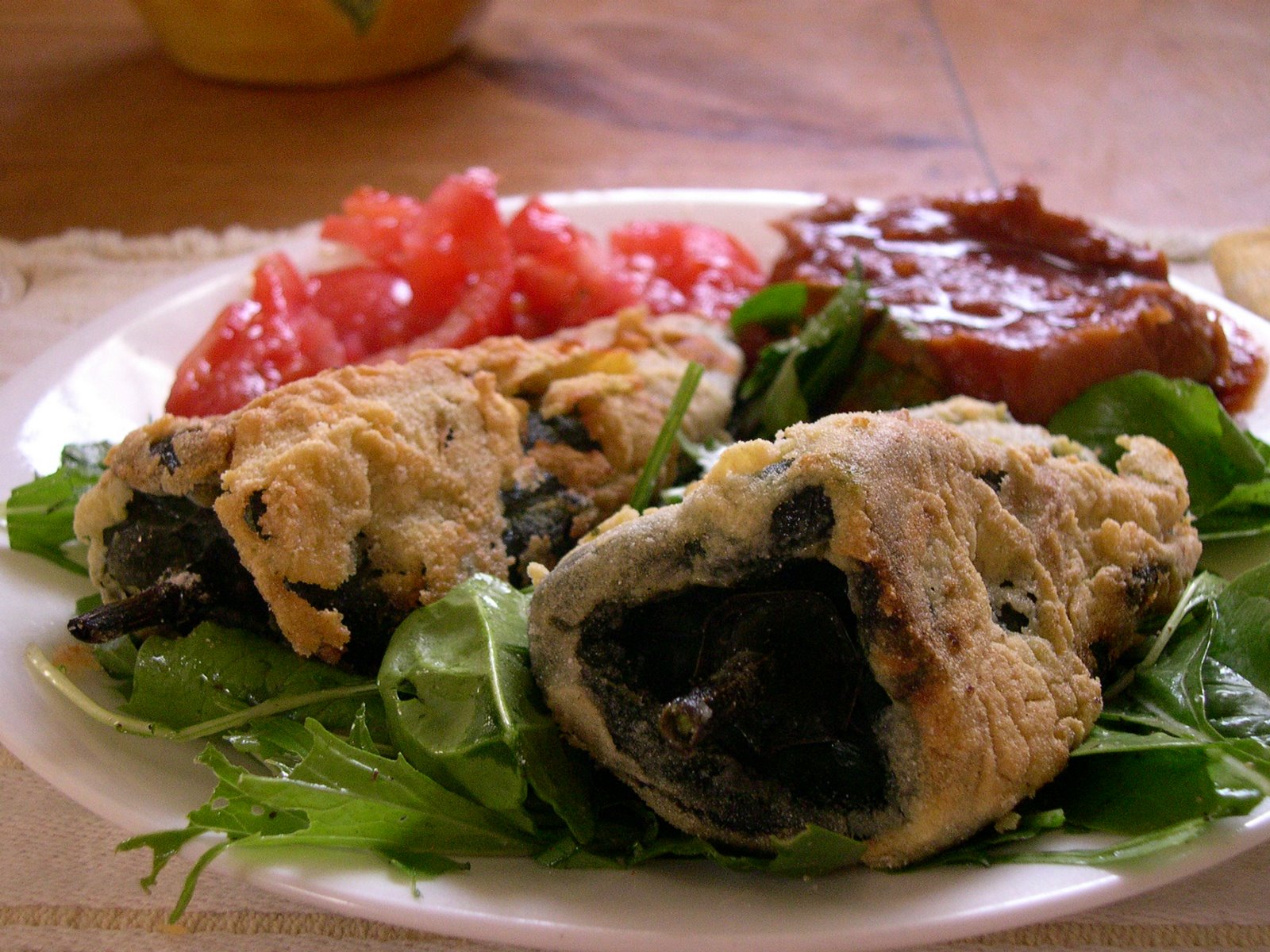
The chile relleno (Spanish pronunciation: [ˈtʃile reˈʝeno], literally "stuffed chile")[1] is a dish in Mexican cuisine that originated in the city of Puebla. In 1858, it was described as a "green chile pepper stuffed with minced meat and coated with eggs".[1]

The most common pepper used is Puebla's poblano pepper, though New Mexico chile, pasilla, or even jalapeño peppers are popular as well. It is typically stuffed with melted cheese, such as queso Chihuahua or queso Oaxaca or with picadillo meat made of diced pork, raisins and nuts, seasoned with canella; covered in an egg white batter, simply corn masa flour and fried, or without any batter at all.[2][3] Although it is often served in a tomato sauce, the sauces can vary.

Regional variation

[edit]

Mexico

[edit]

Some regional versions in Mexico use rehydrated dry chiles such as anchos or pasillas.[2]

United States

[edit]

In the United States, chiles rellenos are usually filled with asadero or Monterey Jack cheese, but can also be found with cheddar or other cheeses, as well as ground or minced meat.[4]

Variations, which can be seen based on regional tastes or experimentation, include:

A recipe from 1914 (as "chili reinas") is published in a period guidebook to San Francisco restaurants.[8]

In addition, the jalapeño popper can be described as a version of the chile relleno using jalapeños.[9]

Guatemala

[edit]

In Guatemala, the pimiento pepper is stuffed with shredded pork and vegetables. Like the Mexican version, it is covered with egg batter and fried. It is served with tomato sauce or inside a bread bun.

[edit]

See also

[edit]

References

[edit]
Revisions and contributorsEdit on WikipediaRead on Wikipedia
from Grokipedia
Chile relleno is a classic dish in , featuring a large, mild that is charred over a flame to blister its skin, peeled, stuffed typically with or cheese, dipped in a light egg batter, and deep-fried until golden and crisp, then often simmered in a simple tomato-based sauce for serving. The name "chile relleno" translates to "stuffed chili" in Spanish, highlighting its core preparation of filling the pepper with a melty, savory interior that contrasts the smoky exterior. Originating from the city of Puebla in central , the dish was first described in 1858 as a green chile pepper stuffed with minced meat and covered with eggs. This underscores the dish's ties to 's colonial era, blending indigenous chili peppers—domesticated in over 6,000 years ago—with Spanish influences like frying techniques and cheese introduced during the . While the exact origins are debated, chiles rellenos reflect the fusion of pre-Hispanic staples such as poblanos (a variety of native to ) with European battering methods, evolving into a symbol of regional pride in and beyond. Variations of chile relleno abound across and in Mexican-American communities, where fillings might include (a spiced mixture with potatoes, raisins, and nuts), shredded chicken, or even in coastal areas, though the cheese-stuffed version remains the most iconic. The poblanos are selected for their thick walls that hold the filling well and their mild heat, which allows the batter—a frothy mixture of whipped egg whites and yolks—to puff up dramatically during frying without overpowering the palate. Accompaniments often include , , or fresh salsa, and in adaptations, the dish appears in burritos or casseroles for easier preparation. Despite its labor-intensive process, chile relleno endures as a festive staple at celebrations, embodying the rich, layered history of Mexican culinary traditions.

History

Origins in Mexico

The origins of the chile relleno trace back to the pre-colonial era in central , where Aztec peoples cultivated chile peppers and incorporated them into their cuisine alongside practices of stuffing foods with meats, fish, or fruits. Archaeological evidence shows that chili peppers (Capsicum spp.) were domesticated in around 6,000 years ago, with —the species including the poblano pepper—widely grown in regions like northeast and extending to central areas such as by the time of Aztec dominance. These indigenous groups used chiles in sauces, stews, and as flavorings, often combining them with stuffed preparations like tamales filled with meats or fruits, laying the groundwork for later fusion dishes. The dish's emergence as a distinct preparation occurred in 16th-century during the Spanish colonization of , blending Aztec chile cultivation with European techniques introduced by Spanish settlers. peppers, native to the region and prized for their mild heat and sturdy structure suitable for filling, became central to early versions of the relleno. Spanish culinary influences, particularly the method of battering and frying with eggs (a technique from Iberian cuisine), were adapted to stuff and cook the local chiles, creating a hybrid that reflected colonial culinary exchange, including the incorporation of cheese into fillings. This fusion is documented in historical accounts of 's convents and kitchens, where nuns and cooks experimented with available ingredients to produce the battered and fried stuffed pepper. The earliest known written reference to the chile relleno appears in the works of Mexican writer and historian José Joaquín Fernández de Lizardi in the early 19th century, describing it as a green chile pepper stuffed with minced meat and picadillo, then battered and fried. In his 1820s play Todos contra el payo, y el payo contra todos, Lizardi mentions "cincuenta chiles rellenos" in a scene listing festive foods, indicating the dish's established presence in Mexican culinary culture by that time. This description aligns with the colonial-era preparation using poblano chiles filled with picadillo—a mixture of minced meat, fruits, and spices—highlighting its roots in Puebla's traditions.

Historical Development and Legends

A popular legend attributes the creation of the chile relleno to nuns in a convent who prepared stuffed peppers for , the general who became Mexico's first emperor, as he marched to in to declare independence from . This story, often linked to the Santa Mónica Convent and the Augustinian order, ties the dish to Mexico's independence era and Saint Augustine's feast day on August 28, blending religious and national themes. Note that a similar legend involving flag colors (green chile, white filling, red sauce) is commonly associated with the related dish , created around the same time for Iturbide, leading to occasional confusion between the two. During the colonial period, cheese fillings were incorporated alongside meat-based ones, reflecting Spanish influences and accommodating Lenten observances that prohibited meat, with cheese providing a suitable alternative. By the , the dish had evolved into various forms, with both meat (like ) and cheese versions common in . Mexican cookbooks from the late 19th and early 20th centuries further documented traditional recipes, contributing to its spread as a national culinary symbol.

Description

Key Ingredients

The primary ingredient in the classic Mexican chile relleno is the chile (), a mild chili pepper originating from the state of , , where it has been cultivated for centuries. This pepper is prized for its thick, leathery skin, which allows it to withstand roasting over an open flame or under a broiler, facilitating the removal of its blistered exterior while preserving its shape for stuffing. With a heat level ranging from 1,000 to 1,500 Scoville heat units, the poblano provides subtle warmth without overwhelming spiciness, making it ideal for balancing the dish's richer elements. For fillings, the most traditional option is queso fresco or , both of which offer a mild, creamy flavor and excellent melting properties that create a gooey, stretchy interior when fried. Queso fresco, a fresh cow's milk cheese, crumbles easily but softens without becoming oily, while , similar to in texture, pulls into strings for added appeal. An alternative filling is , a savory mixture of seasoned with onions, , tomatoes, , carrots, potatoes, and green peas, reflecting influences from colonial-era . The batter consists of egg whites whipped to stiff peaks and gently folded with yolks, yielding a light, airy coating that puffs up during frying to encase the stuffed pepper crisply. A light dusting of on the stuffed and peeled poblanos before dipping helps the batter adhere evenly, ensuring a golden exterior without sogginess. Chile relleno is typically served with salsa roja, a tomato-based simmered with onions, , and chiles for tangy acidity, or made from tomatillos, cilantro, and serrano peppers for a brighter, herbaceous contrast that complements the fried pepper's richness.

Traditional Preparation

The traditional preparation of chile relleno, particularly in its Puebla-style form, begins with selecting fresh poblano chiles, which are then roasted to enhance their flavor and facilitate peeling. The chiles are charred over an open flame or under a broiler until their skins blister and blacken evenly on all sides, a process that typically takes about 5-7 minutes and imparts a smoky depth without cooking the flesh through. After roasting, the hot chiles are immediately placed in a plastic bag or covered bowl to steam for 10-15 minutes, allowing the blistered skin to loosen; this step is crucial to prevent bitterness from the charred bits adhering to the flesh. The skins are then gently peeled off under running water or by hand, taking care not to tear the chile, as any remaining skin can impart an acrid taste. Once peeled, a lengthwise slit is made in each , about 2-3 inches long, starting from the stem end, to create an opening for while preserving the chile's shape. The seeds and veins are carefully removed through this slit using a spoon or knife, as they contain that could overpower the filling's flavors. The —traditionally queso fresco or a mixture of ground meat, carrots, potatoes, peas, and spices—is inserted gently, filling the chile without overpacking to avoid breakage during subsequent steps; for cheese, wedges are shaped to fit snugly, while is spooned in loosely to allow even cooking. The slit is sometimes secured with toothpicks, though in authentic preparations, it is left open to permit infusion later. The battered coating, a hallmark of the dish, is prepared by separating eggs, beating the whites to stiff peaks for lightness and structure, then folding in the yolks and a small amount of to create a fluffy, tempura-like batter that adheres well without sogginess. The stuffed chiles are dredged lightly in before being dipped into this egg batter, ensuring an even coating. They are then fried in hot or heated to approximately 350°F (175°C), submerging each one for 2-3 minutes per side until golden and crisp; the high heat seals the batter quickly, preventing oil absorption and maintaining the chile's tenderness inside. This method, rooted in colonial influences, yields a contrast of crunchy exterior and molten filling. Finally, the fried chiles rellenos are drained on absorbent paper towels or a wire rack to remove excess oil, and they are served immediately while hot to preserve the batter's crispness, often atop a tomato-based salsa ranchera for added moisture and tang. Delaying service can lead to sogginess, so timing is essential in traditional settings.

Regional Variations

Mexican Styles

In , particularly in regions like Chihuahua and , chile relleno often features a hearty beef filling that incorporates diced potatoes and carrots for added texture and substance, reflecting the area's ranching traditions and use of staple vegetables in everyday cooking. This version tends to be spicier than central Mexican counterparts, with additions like chopped jalapeños or other fresh chiles integrated into the picadillo to enhance heat levels suited to local palates. The stuffed poblanos or anaheim chiles are typically battered and fried, then served with a simple tomato-based salsa, emphasizing robust, savory flavors over sweetness. Moving to central Mexico outside of Puebla, variations incorporate fruits such as apples or pears into the filling to introduce a subtle that balances the savory and spices, a technique seen in festive preparations like those inspired by traditions. This fruit-infused , often made with ground or alongside raisins and nuts, highlights the region's agricultural abundance and colonial influences on flavor profiles. Vegetarian adaptations also emerge here, substituting the meat with seasoned beans or cheese for lighter, plant-based options that maintain the dish's structural integrity while aligning with dietary preferences or meat shortages. In southern Mexico, exemplified by Oaxaca, chile relleno showcases local ingredients like quesillo—a stringy, fresh cheese akin to mozzarella—for the filling, which melts richly inside the battered pepper and provides a creamy contrast to the dish's crisp exterior. Rather than the standard tomato salsa, these rellenos are frequently served bathed in mole sauce, such as the complex red mole coloradito, which adds layers of chocolate, chiles, and spices for a distinctive regional depth. This pairing underscores Oaxaca's renowned mole heritage and elevates the relleno into a more elaborate plate, often using local chiles like chile de agua to complement the sauce's intensity. Across , modern preparations of chile relleno have shifted from traditional deep-frying in —which imparts a distinctive flavor and higher —to , a change driven by considerations, availability, and cost in contemporary home and restaurant kitchens. This adaptation preserves the dish's fried texture while reducing saturated fat content. Portion sizes typically accommodate family meals, with two to three rellenos per person served alongside , beans, or tortillas to create a balanced, communal entree.

Adaptations in the United States

The chile relleno was introduced to the through Mexican-American communities in the early , with one of the earliest documented references appearing as "chili reinas" in a 1914 guidebook to restaurants. This adaptation reflected the influx of Mexican immigrants to Southwestern states, where the dish evolved to incorporate local ingredients and simplified preparation methods suited to American kitchens. In , the chile relleno prominently features Hatch green chiles, a variety cultivated in the Hatch Valley and prized for their robust flavor. These chiles are typically roasted during the annual Hatch Chile Festival, held over weekend, where large-scale roasting operations prepare them for stuffing and cooking. The rellenos are often stuffed with cheese and served with green chile sauce, sometimes baked instead of fried to align with regional preferences for lighter preparations. Versions in and frequently simplify the traditional form into casseroles or wrapped preparations, using canned chiles and for convenience. In , particularly El Paso-style casseroles layer roasted chiles, cheese, and a light egg batter with salsa, often incorporating for added heartiness and baked as a family-style dish. California adaptations may wrap the stuffed chiles in flour tortillas, creating a portable format that blends with local influences. Commercial adaptations have made the dish more accessible, with frozen and pre-made versions available in U.S. supermarkets since the late , including cheese-stuffed options from brands like Goya and Amy's. Fusion variations, such as the relleno burrito—where a battered chile relleno is enclosed in a with —have emerged in Mexican-American eateries, combining the stuffed pepper with traditions popular in the Southwest.

Variations in Central America

In , the chile relleno has evolved through cultural exchanges with , particularly in where it holds status as a despite its origins in , . Guatemalan versions typically feature poblano peppers or jalapeños stuffed with a savory mixture of ground or with diced such as potatoes, carrots, and green beans. The stuffed peppers are then coated in an batter, fried until golden, and served topped with a recado —a tomato-based enriched with onions, , and spices that provides a tangy contrast to the rich filling. This adaptation reflects local preferences for heartier, meat-centric fillings integrated with staple ingredients, distinguishing it from lighter styles. Often prepared as a festive , especially during celebrations, Guatemalan chiles rellenos are accompanied by sides such as fried plantains, , or fresh tortillas to create a balanced emphasizing communal dining. In neighboring countries like and , the dish incorporates regional produce for unique twists, though it remains less formalized than in . Salvadoran preparations may include loroco flowers with ground meat or cheese, while maintaining the classic battering and frying technique before serving in a light . Honduran variants may incorporate local produce, often served with sides like plantains for a sweet contrast. These influences highlight the broader diffusion of the chile relleno across via historical migrations and trade routes since the .

Cultural Significance

Role in Mexican Cuisine

The chile relleno occupies a central role in traditional , embodying the fusion of indigenous ingredients like chiles with Spanish techniques such as battering and frying, and serving as a staple in festive and familial gatherings across . The dish is often featured during celebrations, which commemorate the 1862 against French forces; it is prepared and shared at communal events to honor this historic victory, highlighting Mexico's culinary pride. A notable variant, —a stuffed topped with creamy walnut sauce and pomegranate seeds in the green, white, and red colors of the Mexican flag—is especially tied to Poblan traditions reenacting national triumphs, though more commonly linked to Independence Day festivities that echo the Battle of Puebla's patriotic spirit. The dish also appears in Day of the Dead observances (Día de los Muertos), where it is served alongside other foods to symbolize abundance and nourishment for returning souls, reflecting Mexico's syncretic blend of indigenous and Catholic beliefs in honoring the deceased. Recognized as an iconic element of Mexico's gastronomic heritage, the chile relleno influences both vendors and everyday home cooking, with its versatility allowing for regional adaptations while maintaining core traditions. In alone, annual consumption underscores its enduring popularity; for instance, over 4 million units of , a celebrated form of the dish, are sold during the peak July-to-September season, generating significant economic impact and affirming its status as a cultural mainstay.

Modern Interpretations and Popularity

In recent years, health-conscious adaptations of chile relleno have gained traction, particularly since the amid rising interest in plant-based diets and reduced-oil cooking methods. Vegetarian and vegan versions often substitute traditional cheese or meat fillings with alternatives like , cashew-based cheese, or black beans, while or air-frying the battered peppers to minimize frying oil and calorie content. For instance, recipes featuring crumbled mixed with and provide a protein-rich, dairy-free that maintains the dish's melty texture when baked. These modifications align with broader wellness trends, allowing the dish to appeal to diverse dietary needs without compromising its spicy, comforting essence. Contemporary fusions have extended chile relleno beyond its roots, incorporating global ingredients and techniques in innovative ways. In some modern interpretations, poblanos are stuffed with tangy and paired with balsamic reductions or pine nuts for a lighter, herbaceous profile that echoes European cheese traditions. Asian-inspired variations employ tempura-style battering for a crispier exterior, blending the stuffed pepper concept with Japanese frying methods to create lighter, fusion dishes served in select restaurants. These adaptations highlight the dish's versatility, transforming it into a canvas for cross-cultural experimentation while preserving the core roasted poblano flavor. The dish's popularity has surged in the , amplified by visuals of its golden, stuffed presentation and features on culinary television programs. Shows like Mexico: One Plate at a Time have dedicated episodes to perfecting chiles rellenos, showcasing techniques from kitchens and inspiring home cooks worldwide. This visibility coincides with UNESCO's 2010 recognition of traditional as an Intangible Cultural Heritage of Humanity, which encompasses staples like chiles rellenos as symbols of ancestral knowledge and community rituals. Commercially, chile relleno has seen steady growth in the United States since the , appearing on menus at chains like Chevy's Fresh Mex, where it features as a combo option with peppers stuffed with jack cheese and ranchero sauce. The rise of frozen, ready-to-heat versions—often using individually quick-frozen (IQF) poblanos exported from —has made the dish more accessible for home preparation and foodservice, supporting its integration into everyday American dining.

References

Add your contribution
Related Hubs
User Avatar
No comments yet.